


Appeals court throws out case blaming Twitter for ISIS attacks
A woman suing Twitter for allowing ISIS activity on its website has had her case thrown out by a federal appeals court in San Francisco. The court ruled that Twitter Inc is not liable to families of two US government contractors killed in an Islamic State attack in Jordan for its failure to block ISIS from using its messaging services.
The case began in January 2015 after the woman’s husband, Lloyd Carl Field Jr, was killed during an incident that took place the previous November. Court documents on the woman’s side claimed that “Twitter has knowingly permitted the terrorist group ISIS to use its social network as a tool for spreading extremist propaganda, raising funds and attracting new recruits. This material support has been instrumental to the rise of ISIS and has enabled it to carry out numerous terrorist attacks.”
The appeals court, however, ruled 3-0 that the families failed to demonstrate a direct link between Twitter’s services and the death of the contractors. Circuit Judge Milan Smith said: “Communication services and equipment are highly interconnected in modern economic and social life, such that the provision of these services and equipment to terrorists could be expected to cause ripples of harm to flow far beyond the defendant’s misconduct. Nothing in [the law] indicates that Congress intended to provide a remedy to every person reached by these ripples.”
The verdict upholds a previous ruling from August 2016, but the families’ lawyer Joshua Arisohn said his clients were now weighing up their legal options. “Requiring a more direct connection between the provision of material support to terrorists and the attacks that they carry out contravenes the central purpose of the Anti-Terrorism Act: holding enablers of terrorists accountable,” he said. Other companies have also been hit with legal action related to extremist activities on their websites. While none has been successfully sued, these proceedings do call into consideration their dubious position in anti-terrorism matters, and put question marks over how long they’ll be able to rely on court precedents like this one.
Source: Reuters
Engadget giveaway: Win an HD Pan & Tilt camera courtesy of VTech!
Once you leave the house, there’s no looking back, at least not unless you’ve outfitted your crib with a remote monitoring system. VTech offers a an easy-to-use solution with its HD Pan & Tilt camera, which provides live streaming video and two-way talk via the MyVTech Cams app. This Wi-Fi device offers in-app gesture controls to pan and zoom, giving you a clear view of your at-home surroundings, even in the dark. Along with the peace of mind that video provides, you can also have a two-way chat with any person or pet in the room (comprehension is up to you). You can also get motion alerts while you’re away, for in-home security. This week, VTech has provided us with one of its VC931 HD Pan & Tilt cameras for one lucky reader. All you need to do is head to the Rafflecopter widget below for up to three chances at winning some extra peace of mind with this VTech monitoring camera.
a Rafflecopter giveaway
- Entries are handled through the Rafflecopter widget above. Comments are no longer accepted as valid methods of entry. You may enter without any obligation to social media accounts, though we may offer them as opportunities for extra entries. Your email address is required so we can get in touch with you if you win, but it will not be given to third parties.
- Contest is open to all residents of the 50 states, the District of Columbia and Canada (excluding Quebec), 18 or older! Sorry, we don’t make this rule (we hate excluding anyone), so direct your anger at our lawyers and contest laws if you have to be mad.
- Winners will be chosen randomly. One (1) winner will receive one (1) VTech HD Pan & Tilt Camera (VC931, approximate value $119.95).
- If you are chosen, you will be notified by email. Winners must respond within three days of being contacted. If you do not respond within that period, another winner will be chosen. Make sure that the account you use to enter the contest includes your real name and a contact email. We do not track any of this information for marketing or third-party purposes.
- This unit is purely for promotional giveaway. Engadget and AOL are not held liable to honor warranties, exchanges or customer service.
- The full list of rules, in all of its legalese glory, can be found here.
- Entries can be submitted until February 2nd at 11:59PM ET. Good luck!
Owl is a smarter spin on a dashboard camera
Owl hopes to do for the dashboard camera market what the iPod did for portable audio players. That might seem like a tall order for a fledgling startup, but the ambition makes sense for a company led by Andy Hodge, who served as the iPod product lead at Apple for a decade. After a stint at Dropcam, he realized that there’s another area where a smart security camera could be useful: Inside your car. Given the ever-present threat of accidents, break-ins and mysterious parking lot dings, a cloud-connected dashcam seems like something every driver would want today.
The Owl Car Cam is an unassuming device. It has a small frame and a 2.5-inch touchscreen — enough so that you can see video playback from the driver’s seat, but not so large that it would distract you on the road. There’s a 4 megapixel camera facing the road, while another is pointed at you inside the car. Together, they capture most of your in-car experience — they can even see what’s happening off to the sides, like a cop talking to you when they pull you over. The front camera records at 1440p, which gives you room to zoom in for a sharp 1080p image, while the rear one shoots at 720p. Notably, the Owl also features a bevy of sensors for detecting break-ins and accidents when you’re away from your car. It’ll turn on an LED flood light to scare off potential intruders, and you can also remotely shout them using Owl’s app.
Just like the iPod, Hodge is aiming to make the Owl easier to use than any other dashcam. With its built-in LTE connectivity, the camera can back up key moments to its cloud service for 24 hours. And you can always keep tabs on your vehicle and your clips right from your phone. Taking a cue from voice assistants, you can also command the camera to record specific moments while you’re driving by saying “Okay, Presto.” You can also title the clips with your voice, which should make it easy to find specific videos in the future. Hodge thinks of it as more than just a car security camera — it’s also a way to quickly capture and share all of the weird and wonderful moments that occur while you’re driving.
The company claims you’ll be able to set up the Owl in around five minutes. It connects to the OBD port under your dashboard, which is standard in cars built after 1996 (and it can also be found in plenty of earlier vehicles, too). The camera also comes with a tool for hiding its cable underneath your windshield. The setup looked neat and unobtrusive in a modern Land Rover, where I saw the Owl in action.
It’s easy to see the parallels between where dashboard cameras are today, and where MP3 players were before the iPod. There are plenty of options on the market, but there’s still no “killer product.” Some longtime dashcam manufacturers, like Blackvue, have also implemented cloud connectivity. The goal for Owl is to become something that drivers will deem as essential as the iPod. While I don’t own a car today (as a stereotypical New Yorker), the Owl is the first dashboard camera I’ve seen that makes me wish I was still a regular driver.
The Owl Car Camera is available today for $349 with one year of LTE service. Come 2019, it’ll sell for $299 with LTE service priced at $10 a month. That’ll include 60 minutes of live viewing, as up to 60 video tags.
YouTube TV App for Apple TV ‘Coming Very Soon’ as Roku Support Launches Ahead of Super Bowl LII
YouTube TV is YouTube’s bundled streaming television service, available for customers on the web, iOS, Android, Xbox One, Android TV, and other platforms. An app for Apple TV was initially planned for late 2017, but was delayed to Q1 2018, and now a YouTube representative speaking to CNET has teased the Apple TV app’s imminent launch by stating it will be “coming very soon.”
Apart from Apple TV, today YouTube TV has expanded to Roku devices in time for Super Bowl LII. Taking into account the YouTube representative’s comments, it appears that the company is working to launch the Apple TV app in time for some of the big live TV events this winter. So if it doesn’t launch for Super Bowl LII this Sunday, February 4, there’s still time for a debut during the Winter Olympic games (February 9-25) and ahead of the 90th Academy Awards (March 4).
Like other versions of the app, YouTube TV on Apple TV will offer subscribers of the $35/month service the ability to stream cable television shows on ABC, CBS, Fox, NBC, CW, Disney, ESPN, FX, USA, and dozens of other major channels. YouTube TV is a competitor to similar services like Sling TV, Hulu with Live TV, DirecTV Now, and Playstation Vue, all of which can be viewed on the fourth and fifth generation Apple TV models. In addition to streaming live TV, YouTube TV includes content from the $9.99/month YouTube Red service.
The company previously detailed the Apple TV app last October, showing that the app will have Home, Live, and Library tabs for viewing content similar to other iterations of YouTube TV. There will also be a dark background on Apple TV, a live grid-based guide to check out what’s currently on TV, and a feature that keeps video running in the background while you navigate the app.
Related Roundup: Apple TVTag: YouTube TVBuyer’s Guide: Apple TV (Buy Now)
Discuss this article in our forums
Discord Desktop Apps Gain Deep Spotify Integration, Including Real-Time ‘Listen Along’ Feature
Gaming-focused chat platform Discord today announced a new integration with Spotify that will allow users to connect their Spotify accounts to Discord in order to showcase what they’re listening to. Spotify Premium subscribers will be able to “Listen Along” to songs and full playlists together with fellow Premium members directly within their Discord server, which syncs up tracks so that each user is hearing everything at the same time.
Non-Premium members will have the ability to display a currently listening to track in their Discord profile, so when friends click on the profile they can discover new music with a “Play on Spotify” button. Discord confirmed to MacRumors that the Spotify update will be available for both the Mac and PC apps, as well as in web browsers, and all of the Spotify integrations will go live on Discord today.
On iOS, Discord users will be able to see what their friends are listening to, but shared listening will only be available on the desktop apps.
“This is the next natural step to highlight the importance of music as an integral part of the gaming experience,” said Mikael Ericsson, Product Director, Platform & Partner Experience at Spotify. “Starting today, we’re really excited to offer Spotify Premium and Discord users the ability to listen together as a group or highlight what they’re jamming out to while enjoying their favorite games.”
Today’s updates are set to become more enhanced additions to existing features already available in Discord. For example, the chat app previously included syncing with Spotify to show when members of a server were using the music streaming service, but today’s announcement is a far deeper integration between the two companies with specific track listings that show song, album, and time in the song.
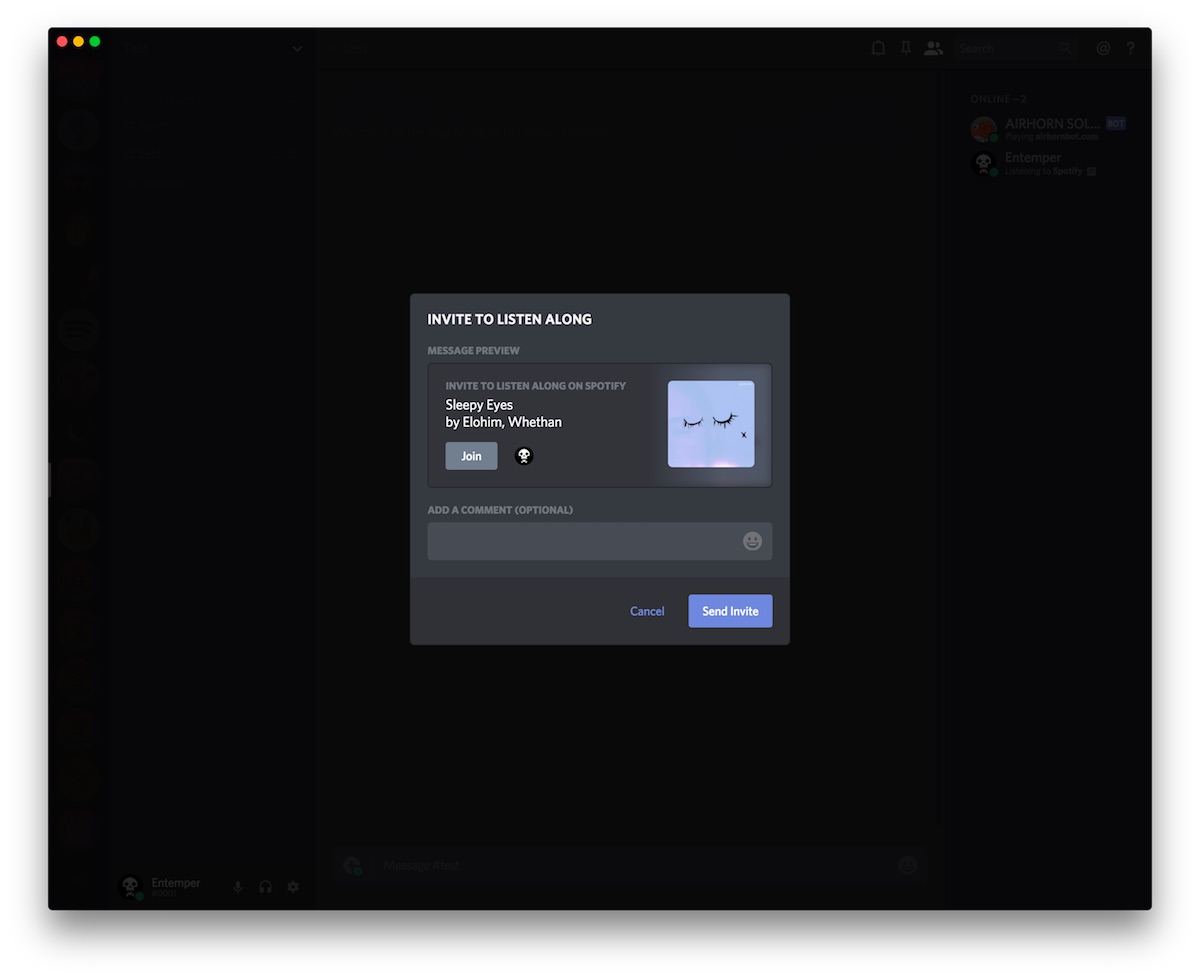
There have also been bots in Discord that perform a somewhat similar function to Listen Along, allowing server mods to create channels where users can add songs to a playlist — with audio usually sourced from YouTube music videos — and let multiple people join in the channel to listen in real time and edit what’s coming up next.
For those who haven’t downloaded it yet, Discord is a free app for Mac, PC, iOS, and Android that lets its users join servers that are typically aimed at discussing a specific game and organizing events around the game. The Mac app is available to download on the company’s website and the iOS app is free on the App Store [Direct Link].
Tags: Spotify, Discord
Discuss this article in our forums
Third-person MOBA ‘Gigantic’ to close on July 31st
Gigantic’s long and troubled development cycle is finally over. The colorful, hero-based MOBA will be shut down on July 31st, developer Motiga announced in a blog post yesterday. Ultimately, the game “did not resonate” with as many players as the studio had hoped, limiting the viability of future updates and support. As a result, the January Update — which contains new hero T-Mat, various skins and computer-controlled bloomer creatures — will be “the final content update.” Microtransactions have been switched off, making all heroes free to unlock, and store items will be heavily discounted for anyone who has leftover cash to spend.
Gigantic was unveiled in 2014 as an alternative to League of Legends, Dota 2 and Smite. Heroes of the Storm wasn’t around back then and the glut of hero-based arena shooters, including Overwatch, Lawbreakers and Battleborn, didn’t exist either. Gigantic, then, was still an intriguing proposition. Two teams of five fight across a large map on behalf of a large guardian who occasionally jumps into the fray. Killing opposition heroes, summoning helpful creatures and capturing control points earn “power” for your guardian that eventually triggers a devastating attack. Inflict three wounds on the enemy guardian and your team is pronounced the victor.
Gigantic’s window of opportunity soon closed, however. In December 2015, Motiga confirmed it had laid off 16 members of staff and delayed the game into 2016. Almost a year later, an open beta was released for Xbox One and Windows 10. By this point, of course, Overwatch was out and many other third-person MOBAs, such as Paragon and Paladins, were available or in active development. Gigantic finally arrived on July 20th, 2017 for Windows 10, Steam and Xbox One. It had favourable reviews — the game has a 76 rating on Metacritic — but failed to find a massive audience.
Gigantic follows Paragon into the MOBA graveyard. Both had some fresh ideas — I personally liked Gigantic’s cheery art style — but couldn’t reach the scale required for a competitive, free-to-play brawler to thrive. “Over the last several months, the teams at Motiga and Perfect World looked into viable options to sustain Gigantic,” a blog post reads. “However, the current state of the game has restricted options for further progress and relevant content updates, and delivering basic features while also fixing long-standing issues was more complicated than expected.” The market, it would seem, just isn’t big enough to sustain more than three major MOBAs.
Source: Gigantic (Blog Post)
YouTube’s live TV starts streaming on Roku devices
Google is living up to its promise of making native YouTube TV apps available for the media hub of your choice. You can now add a YouTube TV channel on “select” Roku devices, giving you the service’s usual range of live broadcasts, a cloud DVR and the other perks of the cord cutter service. There isn’t any mention of Roku-specific features, but the allure is really the freedom to watch in your living room using a device explicitly meant for a laid-back viewing experience.
There’s no mention of how close the Apple TV app might be. However, Google had promised both that and the Roku app in early 2018. The chances are that you won’t have to wait long to watch however you like. That’s crucial for a live TV offering that’s growing quickly, but still has a small-enough base that added support could be a big deal.
Source: Roku
Flash storage spec doubles speeds on future smartphones
Smartphones already have storage speeds that rival PCs and they’re going to take another big leap soon. Standards group JEDEC has unveiled UFS 3.0, a new flash storage standard for mobile devices, Chromebooks, VR headsets and automotive devices that doubles the bandwidth of UFS 2.1 to a stellar 2.9 GB/s. That’s only a theoretical maximum that real-world devices won’t likely reach, however, and requires that the host device has the hardware to support it.
UFS 3.0 also lowers flash power consumption and increases reliability in a wide ranger of temperature conditions, a bonus for vehicle applications. It does all this thanks to lower voltage requirements that support the latest types of NAND, a refresh function that increases reliability, and double the speeds per lane (from 5.8 to 11.6 Gbps with a maximum of two lanes).
Such speeds might seem crazily unnecessarily, but they would let you do things like capture 4K at 60 fps or even 8K without stressing your phone. And as Samsung, for one, has promised new 512GB storage modules for its next-gen phones, you’re going to want to transfer all that data as fast as possible.
Just because there’s a new standard doesn’t mean your next phone will have it, for course — UFS 3.0 might take a while for companies to implement. Samsung devices might be among the first to see chips and controllers using it, as Samsung is far and away the biggest NAND manufacturer in the world.
Source: JEDEC
India Announces Latest Tax Increase on Imported Smartphones, Including iPhone
India is preparing to raise its customs duty on imported mobile phones — including Apple’s iPhone models besides the iPhone SE — from a previous standard of 15 percent to 20 percent (via Bloomberg). The latest tax hike for imported iPhones comes under two months after the last one, which saw the taxes on imported mobile phones increase from 10 percent to 15 percent.
Like the previous increase, the new raise on taxes for imported smartphones is a move by the Indian government to promote India’s domestic manufacturing and get more companies to build products within the country. While Apple has set up an iPhone SE assembly in India, and is looking into doing the same for the iPhone 6s, this further increase is yet another setback for Apple’s expansion in India.
India is raising custom duties on imported mobile phones to 20 percent from 15 percent, a bid to promote domestic manufacturing that may hurt Apple Inc.’s ability to compete in the world’s fastest-growing smartphone market.
The iPhone maker has been seeking to expand its presence in India and has negotiated with the government for lower tariffs on certain components. But the latest duties — part of a budget unveiled Thursday — show the country moving in the opposite direction.
The raise is part of Prime Minister Narendra Modi’s long-running Make in India program, aimed at getting foreign companies to build more manufacturing and assembly operations in India. At the time of the 15 percent tax on imported smartphones, the price of iPhone models rose by about 3.5 percent across the board (excluding the Bangalore-built iPhone SE). The most expensive model, a 256GB iPhone X, cost 105,720 rupees ($1,646), up from 102,000 rupees ($1,593).
As most of Apple’s hardware becomes more expensive in India, users of the company’s software in the country spoke about the poor performance of services like Apple Maps and Siri. One user in Bangalore, Mihir Sharma, told CNBC that “Apple Maps is a joke in India,” and many users reported that Siri “often struggles” to make sense and correctly respond to Indian accents. Analyst Faisal Kawoosa said, “There is no denial that the Apple ecosystem isn’t aligned much to the usage and value of Indian users,” and until Apple can expand its footprint in India most customers believe it will stay that way.
Tag: India
Discuss this article in our forums
eBay Details Plans to Replace PayPal as Main Payments Processor With New Partner Adyen
eBay this week announced major changes coming for both buyers and sellers on its online marketplace, with a plan to phase out its 15-year-long partnership with PayPal and eventually integrate Amsterdam-based payments company Adyen as its “primary partner for payments processing globally” (via Recode). This will eventually affect all eBay customers on every version of the site, including desktop and its iOS and Android apps.
The process will happen over a long period of time, beginning with payments intermediation on its marketplace — essentially helping sellers and buyers transition to Adyen — in the second half of 2018. This will be a “small scale” initial expansion, and grow further throughout 2019. eBay currently has an operating agreement to keep PayPal as its primary payments processor through mid-2020, so the plan is to have “transitioned a majority” of its marketplace customers to Adyen by 2021.
After that time, PayPal will be relegated to a secondary checkout option for customers until July 2023. Following that transition it’s unclear whether eBay and PayPal’s partnership will end completely, or if the payments company will simply continue as a secondary option in checkout.
For Adyen, eBay noted that there will be “additional payments-related data” required to transition to the new platform, with these steps “required” to continue selling on eBay. Still, the company ensured that most of the ways that buyers and sellers pay for and receive money on the site will “be very similar” to how it worked with PayPal.
The way that sellers engage with eBay in an intermediated landscape will, for the most part, be very similar as they do today. For example, sellers will not need to change their accounts with eBay. Sellers will continue to log into eBay and manage their listings as they do today. As eBay begins to intermediate payments, sellers can expect to see new, streamlined dashboards and reports inclusive of payments – all within eBay.
eBay said customers will benefit from this shift in multiple ways, including lower costs of payments processing for sellers, as well as a simplified pricing structure and “more predictable access” to funds. Buyers will have more payment options, which eBay hopes will increase checkouts on the site. Additionally, because Adyen focuses solely on providing back-end payments services and will not link out to a secondary website, eBay said it will now “manage the entire checkout experience” so the payment process can be more streamlined.
PayPal became eBay’s main payments provider in 2003, following eBay’s acquisition of PayPal a year prior at $1.5 billion. In 2015, the companies split to become separate public companies, but agreed upon a deal that keeps PayPal as its primary payments provider for five years, through 2020. For PayPal, the company has been expanding its own reach in online payments over the past year, allowing friends to pay one another in Facebook Messenger and introducing Venmo as an online payment option at more than two million retailer websites last October.
Ahead of the launch of Apple Pay Cash — which works like Venmo in letting users pay one another through an app — PayPal CEO Dan Schulman said he didn’t think Apple’s peer-to-peer payments platform would hurt Venmo because of Venmo’s availability across ecosystems. “We’re technology agnostic,” Shulman said at the time, emphasizing that this provides the PayPal-owned company a “powerful advantage” over rival P2P platforms.
Tags: eBay, PayPal, Adyen
Discuss this article in our forums
 AIVAnet