


NVIDIA Shield TV 6.3 update adds Nest Cam streaming, new apps, and more
The best Android TV box keeps getting better.
The NVIDIA Shield Android TV is still the best gadget around for experiencing everything that Android TV has to offer, and its latest 6.3 software update adds a few extra goodies to it that make the user experience even better.

For starters, NVIDIA has added support for watching live streams of any Nest Cams that you own. To do this, just hold down the microphone button on your remote to prompt Google Assistant and say something along the lines of “Show me my front door camera on Shield.” In addition to Nest products, this also works with the Logitech Circle.
You can also now use Google Assistant on the Shield TV to broadcast messages to any Google Home speakers you have in your home, there’s a security patch for the recent Spectre vulnerability, and there are improvements for the responsiveness of the 2017 remote.
As if that wasn’t enough, NVIDIA also says that the 6.3 update adds commercial-free recording with Plex DVR, support for picture-in-picture and 360-degree videos with VLC, new Cartoon Network, VH1, SiriusXM apps, and more.
The 6.3 upgrade should already be available to download, but if you haven’t received it yet, keep an eye out for an OTA update over the next couple days.
NVIDIA Shield Android TV
- Read our Shield Android TV review
- The latest Shield Android TV news
- Shield vs. Shield Pro: Which should I buy?
- Join the forum discussion
- Complete Shield Android TV specs
Amazon
The Shield TV hasn’t gotten Oreo yet because no one cares about Android TV
Oreo should arrive at some point this year, but this still isn’t a good sign.
As I’ve said before, the NVIDIA Shield TV is the best way to experience Android TV. It’s fast performance, unique design, and excellent software make it a great buy, and while NVIDIA’s typically been fast with software updates, Oreo has been noticeably absent from the streaming box. However, it looks like we finally have a reason for its delay.

Our friends at 9to5Google recently did some digging, and during CES earlier this month, NVIDIA’s Director of Shield Management, Chris Daniel, said in an interview that Oreo hasn’t come to the Shield TV yet due to developers not supporting the new software.
The Oreo update brings a major facelift to Android TV, and one of the highlights is channel recommendations. Installed channels are now displayed in a vertical list, and next to these are recommendations for new shows to watch based on your viewing habits and what the apps think you’d like to watch. It’s a great idea, but developers need to update their apps to support the new layout, and this hasn’t been happening.
Daniel is on record saying “if you release a whole new interface, and the apps aren’t supporting it, then we don’t feel like it’s a good launch for us, so we’re working hard on that.” Daniel also said that NVIDIA is “making a lot of change with Google” in an effort to get Oreo rolled out as soon as possible.

Android TV’s Oreo update and the troublesome channel recommendations.
Oreo is said to finally be coming to the Shield TV at some point in 2018, but there’s no exact time frame in place at the moment.
Although it’s encouraging to hear that Oreo is on its way, Daniel’s comments about lacking developer support for Oreo on Android TV is anything but. It’s no secret that most companies spend more time fleshing out apps for Roku, Fire TV, and Apple TV before bothering with Android TV, but if this is now resulting in delayed software updates, that’s a problem Google needs to address ASAP.
NVIDIA Shield TV 6.3 update adds Nest Cam streaming, new apps, and more
NVIDIA Shield Android TV
- Read our Shield Android TV review
- The latest Shield Android TV news
- Shield vs. Shield Pro: Which should I buy?
- Join the forum discussion
- Complete Shield Android TV specs
Amazon
Researchers treat ear defect by growing implants from cells
While scientists have been working on growing organs and body parts like ears for some time, researchers in China have taken it one important step further. They’ve grown new ears for five children with microtia — an ear defect that results in small, underdeveloped ears and often affects hearing — grafted them onto the children and continued to observe the development for over two years. The work is important because it’s the first study of its kind and shows that these sorts of methods stand to be a viable option going forward.
First, the scientists built scaffolds based on the children’s healthy ears using CT scanning and 3D printing. Those scaffolds were then seeded with cells from the children’s underdeveloped, microtia ears and cultured for three months. The team then implanted the ears in the five patients, who have been continuously monitored ever since. Now, the researchers have over two years of follow-up data and the results are promising. None of the children rejected the new ears, four of the five ears developed cartilage after the implantation and though two showed slight distortion after the surgery, three were healthily shaped.

There are some things to note. First, this concept isn’t new. “For many years, we have tried to harvest cells from people and expand those cells on polymer to grow kind of a new structure,” Tessa Hadlock, chief of facial plastic and reconstructive surgery at Massachusetts Eye and Ear, told CNN, “and we’ve done it in animals for a long time.” Hadlock, who wasn’t involved with the work, said that what is new here is the extensive follow up and the multiple patients. But there are still a few unknowns. The scaffold used in the study is made of a material meant to degrade over time. So far, it appears to be degrading as expected and the grown ears are still holding their shape. But longer term effects of the material still need to be studied. Additionally, such a treatment will likely be expensive and because it’s complicated, hard to scale up.
However, this is still a big step. The researchers plan to follow the five cases for a couple of more years and their study lays out a few directions this type of work could go in the future. “This work clearly shows tissue engineering approaches for reconstruction of the ear and other cartilaginous tissues will become a clinical reality very soon,” Cornell University biomedical engineering Professor Lawrence Bonassar told CNN. “The aesthetics of the tissue produced are on par with what can be expected of the best clinical procedures at the present time.”
You can check out the study, published this month in EBioMedicine, here. But fair warning, some of the images and videos may be a little graphic for some.
Image: Guangdong et al. EBioMedicine
Via: The Verge
Source: EBioMedicine
Amazon patent details hand-tracking wristbands for warehouse workers
Companies are all about making sure you’re working, and they’re using increasingly high-tech solutions to do so. One firm in London uses AI to analyze your daily behavior, while the FreshTeam messaging app can track employee locations. Now, Amazon was just awarded a patent for a wristband that tracks warehouse workers’ hand movements.
The patents, originally filed in 2016, may likely never see the light of day. As Gizomodo points out, the wristband system has three parts, with an ultrasonic unit for the wrist, various ultrasonic devices placed around the work area and a module to manage all that data. The patent also points to a haptic feedback module, which could buzz employees for various reasons, including notifying them of breaks or to help them find items in the warehouse, Apple Watch navigation-style.
While legal, of course, a system like this should likely raise privacy concerns, though as Geekwire notes, the patent itself positions such a wristband as a labor-saving device, helping employees perform their tasks more efficiently and connecting to the inventory system.
Via: Gizmodo
Source: US Patent Office
Democrats demand more from Facebook and Twitter on #ReleaseTheMemo
Last week, Representative Adam Schiff and Senator Dianne Feinstein asked Facebook and Twitter to investigate whether Russia-linked accounts were involved in spreading the #ReleaseTheMemo campaign. The hashtag refers to a memo written by Republican Representative Devin Nunes that claims the FBI has abused its power. Democrats, however, have maintained that the memo is misleading and largely meant to undermine Special Counsel Robert Mueller’s investigation into inappropriate interactions between Russian officials and the Trump administration. Both Facebook and Twitter responded to that letter, but neither Congressperson is satisfied with their answers and they’ve sent another letter reiterating their requests.
Facebook’s response to the first letter, just two paragraphs long, basically says it’s continuously monitoring its platform for any foreign interference and it will update Congress if anything seems noteable. “We are committed to protecting our platform from bad actors who try to undermine our democracy,” Facebook Associate General Counsel Molly Cutler wrote in the company’s response. Twitter’s response was a bit longer and said that a preliminary analysis didn’t turn up much. “Our initial inquiry, based on available data, has not identified any significant activity connected to Russia with respect to Tweets posting original content to this hashtag,” says the reply. Twitter also pointed out that verified US accounts had a hand in spreading the hashtag.
But Schiff and Feinstein found those responses to be inadequate. “Although we are encouraged by your companies’ continued willingness to work with Congress to raise awareness about potential abuse of your platforms by agents of foreign influence, your replies have raised more questions they have answered,” they wrote. The two basically say that neither company did a bang up job looking into any Russian meddling and listed a series of questions they would like answered. “By failing to address whether Russian-tied online accounts on Twitter or Facebook were — or still are — amplifying the #ReleaseTheMemo campaign and related messaging, we are no closer to understanding Russia’s continuing interference in our democratic affairs,” said Schiff and Feinstein.
#ReleaseTheMemo: Do you know someone who has access to the FISA abuse memo? Send them here: https://t.co/cLRcuIiQXz
WikiLeaks will match reward funds up to $1m sent to this unique Bitcoin address: 3Q2KXS8WYT6dvr91bM2RjvBHqMyx9CbPMN
or marked ‘memo2018’: https://t.co/lmsmphuH2N pic.twitter.com/j1YEkXqi2S
— WikiLeaks (@wikileaks) January 19, 2018
They reiterated their requests for information regarding which Russian-linked accounts were involved in spreading the hashtag, how often they posted and how many legitimate accounts were exposed to their posts. The letter also demands information on whether either company looked at accounts other than those known to be affiliated with the Russian Internet Research Agency, how they used geographic data in their analyses, whether they only focused on those distributing original content or if they also included accounts that were sharing or retweeting others and whether they looked into accounts interacting with WikiLeaks’ post offering $1 million for the memo. Additionally, Schiff and Feinstein pointed to a CNN article that reported hundreds of new Twitter accounts were opened last week and tweeted the hashtag nearly 5,000 times as well as the New York Times article detailing how easy it is to raise an online profile by purchasing followers.
The new letter requests additional responses by February 7th.
Via: Recode
Source: House Intelligence Committee (1), (2), (3)
Can Amazon Go help the unbanked go digital?
If Amazon’s newly opened Go supermarket is any indicator, shopping with physical currency won’t be an option for much longer. Instead of human cashiers (or even self-checkout stands), the store relies on a range of technology to know who’s shopping and what they’re buying. Amazon then automatically deducts the cost of your items from your bank account. From a turnstile entrance that identifies shoppers by scanning their smartphones to tracking cameras that know what is pulled from each shelf, Amazon Go bills itself as the shopping experience of the future.
But where do the working poor fit into such a future? Or otherwise underserved and rural communities that may not have access to internet connections, smartphones or even checking accounts? You know, all the things that Amazon’s new store demands of shoppers just to get in the door.
As our economy embraces digital transactions while shunning cash, it’s the poor that will be most harmed. “There are many people who are unbanked and cannot receive lines of credit for a whole range of reasons,” Rainey Reitman, activism director at the Electronic Frontiers Foundation, told Fast Company, “and a ban on cash would particularly impact the unbanked community.”

This community is not a small one. According to a 2014 Gallup poll, 29 percent of Americans don’t have a credit card. What’s more, according to the 2013 U.S. Survey of Consumer Finance, 7.5 percent of American households don’t have bank accounts at all — that’s nearly 24 million people. Worldwide, 38 percent of the global population does not have access to a conventional bank account, roughly 2 billion adults. That figure has been shrinking steadily since 2011, per the World Bank, yet more than half of adults in the poorest 40 percent of households in developing countries lack access to a bank account as of 2014. For them, cash is the only way they can participate in the economy.
However, dealing in cash is costly to banks. Storing, processing and transferring stacks of cash is far more expensive for financial institutions than simply wiring digital funds, and those costs are often passed along to the customer.
Prepaid cards are one alternative to dealing in cash and a popular one for the unbanked community. In 2013, the FDIC found that among people without bank accounts, 22 percent had used a general purpose reloadable (GPR) prepaid card within the previous 12 months, compared to just five percent of people with accounts. These cards can be loaded either through direct deposit or cash and utilized like bank-issued debit cards for both online and offline purchases. And because consumers can’t spend more money than the card is loaded with, it can serve as a helpful means of budgeting and controlling one’s spending without the danger of overdraft fees.
However, GPR cards are not without their drawbacks. They are often saddled with numerous and steep fees for everything from using them to withdraw cash from ATMs to making online purchases — even putting money on the card can come with a fee. What’s more, these fees vary widely between providers, yet according to a 2015 Pew Charitable Trust study, only around a third of consumers actually compare the fees and features of various cards before purchasing them.
Mobile money accounts are another emerging alternative to traditional bank accounts. Mobile money is essentially an electronic wallet that allows users to send and receive funds using their phone. The technology has taken hold in both Sub-Saharan Africa and China, where Alibaba reported in 2014 that more than half of its transactions were made on mobile devices using its Alipay digital wallet. The number of adults in that region with any type of financial account rose from 24 to 34 percent between 2011 and 2014, a 10 percent increase in a region where two-thirds of adults still have no form of financial account at all.
But even as prepaid cards and mobile money accounts move into the mainstream of financial services, they are not a permanent solution to the problems facing the unbanked community. Eventually, government action may prove necessary.
“Clearly you’re going to need a way to get everybody into the system if you’re going to get rid of cash,” Susan Athey, the Economics of Technology Professor at Stanford Graduate School of Business, told Engadget in October. “One of the things the government will have to do is ensure banking access to everyone.”

Just as the FDIC offers insurance on both conventional bank accounts and prepaid cards, the government would not be remiss to require financial institutions to offer low-cost services like zero-interest checking accounts to their customers. Doing so would provide a direct means of entry into the world of digital finances for poorer people.
Doing so would also offer a slew of benefits to both consumers and their financial institutions. Previously unbanked customers would not only be able to more fully participate in the economy but also would then have access to safer and speedier financial transactions with less threat of corruption or theft. Meanwhile banks would be able to more accurately track a new set of customers’ financial histories, thereby enabling them to create and market a new ecosystem of products such as microloans to these customers, according to the Gates Foundation Financial Services for the Poor program.
Amazon has already taken a number of steps to be as inclusive as it can when it comes to extracting money from its customers. This is the company that pioneered the Dash button (of which there are more than 250 varieties, both physical and digital), after all. For example, Amazon rolled out a new feature dubbed Amazon Pay Places last July, which enables users to pay for items at real-world stores, like TGI Fridays, and pay for them through their existing Amazon account with the mobile app.
What’s more, the company already has a mechanism for paying for its wares with cash: It’s this wild new thing the kids are calling gift cards, which can be purchased for physical currency at a variety of locations including Western Union, MoneyGram and Coinstar.
Additionally, the company has a separate program called Amazon Cash that enables users to pay their account balances at any of 16 different chains — like 7-Eleven and GameStop — by having the cashier swipe a bar code generated by their mobile app and handing over the appropriate amount of money. However, neither of these methods are quite as seamless or as streamlined as what Go shoppers with bank accounts experience, with each demanding a separate trip to a third-party vendor to make the currency exchange. And for the foreseeable future, that will simply be the cost of doing business for those living outside the formal banking system.
Images: REUTERS/Lindsey Wasson (Turnstyle closeup) REUTERS/Jeffrey Dastin (Customers entering store)
YouTube TV snags rights to local Los Angeles FC soccer broadcasts
You can certainly watch sports on cord-cutting TV services, but major sports exclusives? Not until now. YouTube TV has reached a deal that makes it the official live TV and video partner for Major League Soccer’s brand new team, the Los Angeles Football Club. The streaming service will be the only place for Angelenos to watch all locally televised English-language LAFC games, and it’ll also carry all nationally broadcast games on ESPN, Fox and FS1. The deal will be impossible to ignore regardless of how you watch — players will have YouTube TV’s logo “prominently” plastered on their jerseys.
You won’t have to pay more than YouTube TV’s $35 base monthly rate to watch.
This certainly isn’t the biggest team deal in TV land, and it remains to be seen how many people will tune in. MLS doesn’t attract nearly as many viewers as other sports leagues in the US, even on conventional TV — how many people are going to add or switch to YouTube TV just to catch local games? Still, it’s a groundbreaking moment. To date, American teams and leagues have made a beeline toward traditional TV when they want local exclusives. While YouTube TV is far from a household name in the US, it’s now big enough that a team is willing to take a chance on the service.
Via: Variety
Source: MLS
NVIDIA proves the cloud can replace a high-end gaming rig
A year ago, NVIDIA’s GeForce Now game-streaming service let me play The Witcher 3, a notoriously demanding PC-only title, on a MacBook Air. This year, NVIDIA finally unveiled the Windows version of the service, and it was even more impressive. I was able to play Rainbow Six: Siege and PlayerUnknown’s Battlegrounds on underpowered PCs that sell for $200 to $300. If NVIDIA’s Mac demo was a revelation, playing high-end PC games on discount hardware felt like a miracle. Now, after testing the GeForce Now beta release on PCs for a week, I’m even more intrigued by the possibilities of game streaming.
To put it simply, the service lets you remotely tap into the power of an expensive gaming rig from any computer. It runs on remote servers powered by NVIDIA’s GTX 1080Ti GPUs. While the company isn’t divulging further specifications, you can bet they’re also stuffed with more than enough RAM and CPU horsepower. (NVIDIA claimed they were the equivalent of a $1,500 gaming PC a year ago.) When you launch GeForce Now, you’re actually watching a video streaming to your PC. But since there’s very little latency between what you’re seeing and your keyboard and mouse inputs, it feels as if the games are running right on your computer.
You don’t need a very powerful PC to run the GeForce Now client. At the minimum, NVIDIA recommends using a 3.1GHz Core i3 processor and 4GB RAM, along with either Intel HD 2000, GeForce 600 series or Radeon HD 3000 graphics. Those are all specs you’ll find in PCs four to six years old. But of course, solid internet access is a must. You’ll need speeds of at least 25Mbps, but NVIDIA advises a 50Mbps connection for the best experience. You’ll also have to make sure your computer has a reliable link to your router — which means you’ll either need to use an Ethernet cable or a 5GHz Wi-Fi network.
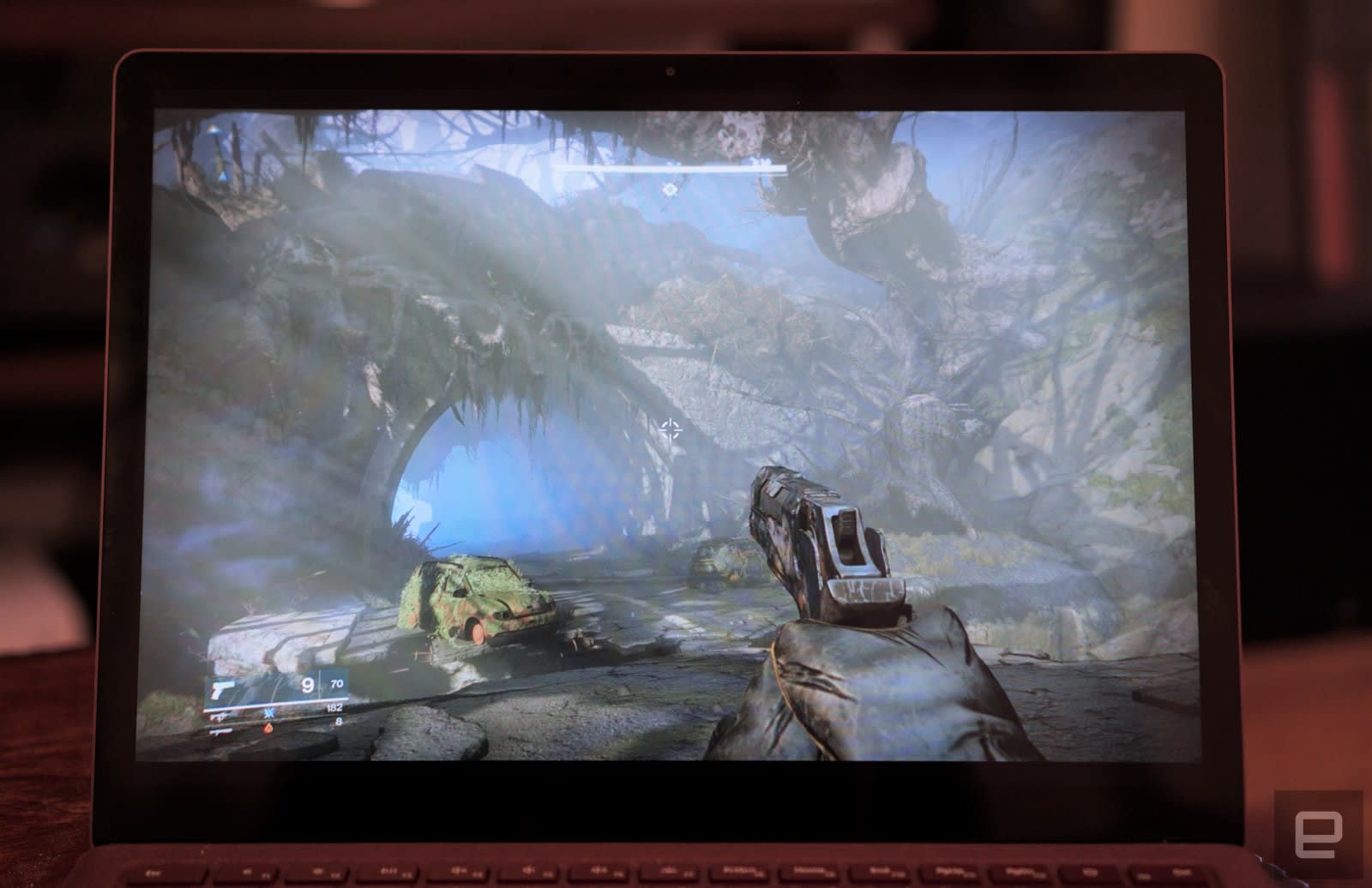
At the moment, GeForce Now on Macs and PCs only lets you play games you already own on Steam, Blizzard’s Battle.net or Ubisoft’s Uplay. Anything you don’t own can be purchased through the streaming platform. That’s a major difference from GeForce Now on NVIDIA’s Shield tablet and set-top box, which includes a handful of titles as part of its $7.99 monthly fee as well as games for purchase. Both versions of the service support popular titles like Overwatch, Call of Duty WWII and The Witcher 3, but you’ll probably have to wait a bit for them to work with lesser-known games. NVIDIA isn’t specifying what it takes to make a game compatible with the service, but I’d wager it has to test them out to make sure nothing breaks in the streaming process.
Setting up GeForce Now is as easy as downloading and installing the client and choosing a title to play. Then you just need to provide your login information for whichever service hosts the game. If you’re launching a Steam title, you’ll end up seeing the service’s familiar Windows interface, where you can either buy the game or download it to your library. One big downside with GeForce Now is that you’ll have to install games every time you want to play them, since you’re thrown onto a different server whenever you log in. It’s not a huge problem, though, since the remote machines are plugged into a fat network pipe and offer unlimited storage. PUBG, which weighs in at 12GB, installed in around four minutes while The Witcher 3 (31.7GB) took more than 10 minutes.
Devindra Hardawar/AOL
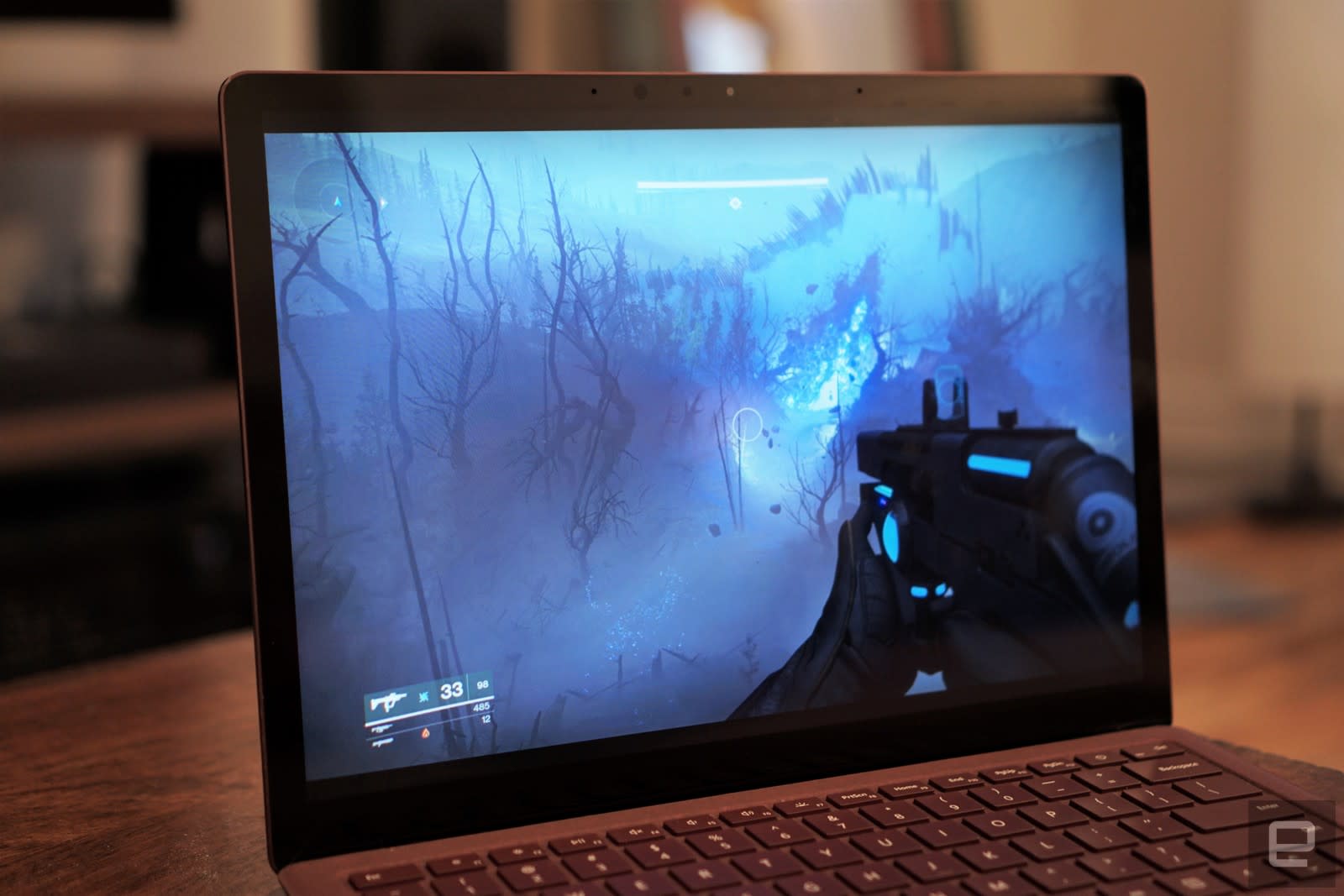
On the Surface Laptop — a great ultrabook marred only by its weak integrated graphics — running over our office’s WiFi, PUBG felt almost as smooth as it does on my dedicated gaming rig. It ran at a steady 60 frames per second, even though I cranked the graphics settings to Ultra and the resolution to 2,560 x 1,400. After a few minutes of running around the game’s apocalyptic European town and taking out other players, I almost forgot I was playing something that was running on a server hundreds of miles away.
The game’s excellent audio design also survived: I had no trouble pinpointing people sneaking around a house while wearing headphones, and the bomb strikes in “Red Zones” still rattled my skull. Mostly, though, I was surprised that I didn’t feel any lag while I was using the Surface Laptop’s keyboard and a Logitech wireless G903 gaming mouse. Moving the camera around and aiming my weapons felt incredibly responsive, and I was surprised that I was able to outgun some players in some heated shootouts.

That lack of latency was even more impressive with Overwatch, an even faster-paced game. Characters like Tracer and Genji, both of whom would be tough to play with any noticeable lag, felt as nimble as they do on my desktop. I didn’t even have trouble landing shots with snipers like Hanzo and Ana. I was simply able to enjoy playing the game as I normally do. And even more so than with PUBG, I was impressed by how well GeForce Now handled Overwatch’s vibrant and colorful graphics. Gorgeous maps like Ilios and Dorado appeared as detailed as ever, and the same goes for the game’s imaginative character models and costumes.
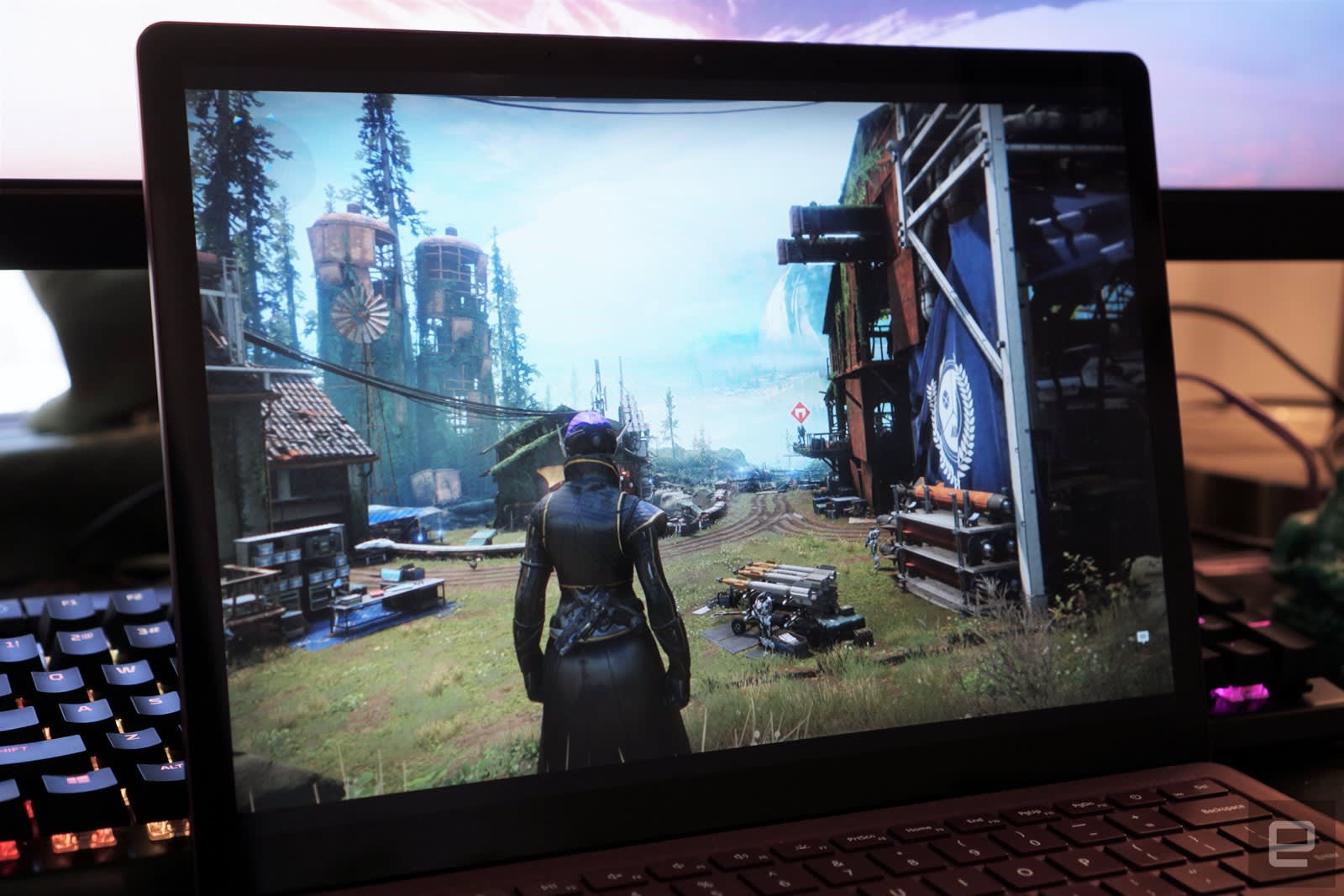
GeForce Now easily handled graphically intensive titles like Destiny 2 and The Witcher 3, which felt even more impressive to play on the Surface Laptop. Both games managed to run at 60 FPS at a 2,560 x 1,400 resolution (the service supports up to 2,560 x 1,600), with all of their graphics settings turned all the way up. Even though Destiny 2 isn’t exactly a fast-paced shooter, it still benefited from the service’s low latency, which helped me mow down waves of enemies without much trouble. And with the Witcher 3, I was impressed that its graphically rich world didn’t lose any fidelity while being streamed. Perhaps because these games are particularly demanding, I occasionally experienced connection hiccups while playing them. They only lasted a few seconds, but if I were fighting against tough bosses, they could have easily led to my doom.
Those disruptions also made it clear that your experience with GeForce Now will depend largely on your internet connection. I had a mostly trouble-free experience in our office and at home, where I have 100 Mbps cable service. But if you don’t have a steady 25 Mbps connection, Ethernet access or strong wireless reception, you’ll likely see more gameplay-disrupting issues. I wasn’t able to run any games at Starbucks locations around NYC, and based on my terrible experiences with hotel WiFi, I’d wager you’d have trouble using GeForce Now while traveling too. (The service is only supported in the US and Europe at the moment.)
Devindra Hardawar/AOL
The big problem with GeForce Now? We don’t know what the service will look like once it leaves beta. You can request access now, and if you’re lucky enough to get in, you can test the service for free. NVIDIA isn’t giving us a time frame for an official release or how much it’ll eventually cost. Based on what we typically see with streaming services, I’d also expect GeForce Now’s smooth performance to take a hit once it’s open to the hordes of frag-happy gamers.
For now, though, it’s a glimpse at the true future of gaming — a world where we don’t have to worry if our video cards are fast enough or if we have enough hard drive space for a massive open-world game. Well, as long as you have an internet connection fast enough to handle all of that gaming goodness.
GoPro’s Plus service will replace your busted camera
GoPro has amped up its Plus subscription in a big way. The offering, which was mostly a back-up service for your photos and videos, now comes with device replacement for the same price. GoPro says if you break your camera, it’ll replace it for you with no questions asked — so long as you only go in twice per 12 months of subscription. If you break your GoPro a third time within a year, you’re on your own… and you probably need to think of a way to keep your camera safer when you go on your wild adventures.
While device replacement is definitely Plus’ biggest new feature, GoPro has also tossed in a couple more perks. In the past, auto-backup for photos and videos to the Plus cloud service was only possible from a GoPro camera or a computer, but soon you’ll be able to upload your stuff directly from a mobile device. If you have an iPhone, you’ll be able to take advantage of the feature as soon as February 20th, but you’ll have to wait till spring if you’re an Android user. You now also get unlimited photo storage and 35 hours of video storage (around 250GB) with a subscription, whereas you were previously limited to 250GB of cloud backup overall.
GoPro is likely hoping that these features can make the service look more enticing, so it can boost that revenue stream. Although the company finally became profitable again last quarter, its struggles aren’t over: it recently had to cut 300 jobs after it quit making drones and exited the market entirely. Whatever GoPro’s reason is, the addition of device replacement could make Plus look a lot more appealing, especially to veritable daredevils. Even better? The service still costs $5 a month, and you’re covered by device replacement even if you’re just trying it out for free for 30 days.
Twitter now says 1.4 million users interacted with Russian spam accounts
Midway through January, Twitter posted a public statement on their blog confirming that over 677,000 users had followed, liked or retweeted messages from Russian-backed spam accounts. The social network reached out to inform everyone who had. But today, Twitter updated their count to 1.4 million users who had interacted with these accounts leading up to the 2016 election.
In a company blog post, Twitter said the increased number included interactions they hadn’t previously considered: That 1.4 million encompasses users who retweeted, quoted, replied to, mentioned, or liked those accounts or content produced by them during the 2016 election. (It also includes those who opted out of email notifications and weren’t included in Twitter’s initial wave of outreach emails.) The social network pointed out that this tally still doesn’t include every user ever who was exposed to messages from the Russian-backed accounts — for example, those who saw their tweets but didn’t otherwise interact.
But it’s worth pointing out that Twitter didn’t expand its pool of spam producers — it’s still only considering content from the 3,814 accounts linked to the Russia-backed Internet Research Agency (IRA) that it had previously suspended. The social network will reach out to those in the revised 1.4 million total who it hadn’t already emailed.
But as Ars Technica reporter Cyrus Farivar noted in a tweet, the social network duly informed him that he’d interacted with a Russian-backed account…but didn’t identify which one, nor any details about the interaction. Which calls into question how useful these outreach efforts really are for informing users so they can avoid such accounts in the future.
.@twitter just told me that I followed/replied/mentioned/retweeted a Russian bot account. But which one was it?
It’s not saying.
What exactly am I supposed to do with this email? pic.twitter.com/C2saIFZXqU
— Cyrus Farivar (@cfarivar) January 31, 2018
Source: Twitter blog
 AIVAnet