


Facebook may be losing the fight against fake news
Facebook has made quite a few headlines when it comes to fake news. In September, it was revealed that Russian groups may have spent $100,000 or more disseminating fake news posts on the social media platform during the 2016 election season. The company has issued a new set of media guidelines that it hopes will improve the News Feed’s algorithms and filter out fake news. However, now Facebook’s fact checkers are speaking out, and their perspective is a grim one. According to The Guardian, Facebook’s latest war on fake news has failed and the entire thing has become nothing more than a PR campaign.
Late last year, when it became clear that Facebook’s fake news problem had influenced the election, CEO Mark Zuckerberg outlined steps the organization would take to combat the epidemic. One of these initiatives was to partner with Poynter’s International Fact-Checking Network (IFCN) to check whether stories flagged as fake news were real or not.
Now, the fact checkers, who spoke with The Guardian anonymously, have raised concerns about Facebook’s refusal to release statistics on their work, even internally. The social network introduced a “disputed” warning banner for potential fake news, but one fact checker found that it was rare to actually see the tag applied. “Fact checkers said they had queries about how often the tags were placed on articles, what effect they had on the content and what sites were most often targeted — but said that Facebook had not provided information,” reports The Guardian.
This isn’t the first time we’ve heard about these issues when it comes to Facebook’s fact-checking efforts (or perhaps the lack thereof). Back in September, a report from Politico suggested that the data Facebook had gathered from this fake news “crackdown” could be valuable, but the organization hadn’t shared it. Now, it’s becoming increasingly clear that the reason for its refusal to disclose any data about its fight on fake news might be because Facebook is losing badly.
Source: The Guardian
Why your favorite indie game may not get a boxed edition
The Entertainment Software Rating Board is not a government entity. In fact, it was created in the 1990s specifically to keep Congress out of the video game industry, at a time when lawmakers were loudly condemning the infusion of digital violence in popular culture. The ESRB was modeled after the film industry’s MPAA, doling out ratings for video games in North America. Back in the Clinton era, there were no federal laws requiring publishers to display ratings on their games, and there still aren’t today.
The ESRB oversees the entirety of the video game ratings system, from AAA to independent developers and specialty shops like iam8bit, Special Reserve and Limited Run Games (which release physical editions of digital indie titles). This year, the ESRB announced a change to its rating policy that rocked the very foundation of Limited Run Games’ business model.
Before September, it was possible to launch a boxed version of an existing, digital-only game without paying for an additional ESRB rating. This policy allowed Limited Run to be a lean operation, avoiding ESRB fees and still releasing physical versions of weird digital games (all of which are already rated by the ESRB).
In September, the board announced a new tier for rating digital-to-physical games, allowing any title with a development budget of $1 million or less to be rated as a boxed product for $3,000, rather than the standard submission price of more than $10,000. With this change, all three console manufacturers made it a requirement for every game to pay this fee and carry an ESRB rating — even physical launches of digital titles.

“Obtaining ESRB assigned age and content ratings has always been voluntary,” an ESRB spokesperson tells Engadget. “That said, many US retailers, including most major chains, have policies to only stock or sell games that carry an ESRB rating, and console manufacturers have typically required games that are published on their systems to be rated by ESRB.”
In this case, “voluntary” is a complicated term. Developers aren’t legally required to slap an ESRB rating on their games, but without one, they’re shut out of the mainstream marketplace.
“There’s no nice way to put it; they basically have a monopoly,” Douglas Bogart, co-founder of Limited Run Games, says about the ESRB. “There’s no one above them. You have to follow their rules. Your business basically lives or dies by their whim, which is really scary, in my opinion.”
Limited Run Games specializes in producing physical copies of otherwise digital-only, independent console games, in small batches. These are collectors’ items for fans of cult hits, strange projects and underappreciated gems. The whole endeavor is meant to preserve the indie industry for posterity. With hundreds of new games coming out nearly every day, it’s easy to lose a tiny, digital-only title into the ether — unless its box is sitting on your shelf, snuggled between Halo and Zelda.
The new mandate is a hurdle for Limited Run, which attempts to cover production fees for all of the indie games they box up, taking a portion of the profits afterward. Since Limited Run sells the physical editions through their own storefront, they’ve historically not needed to secure additional ESRB ratings or pay any fees. Now, Limited Run and the developers they work with are required to pay at least $3,000 to the ESRB if they want to get physical.

“We can’t just sign any game we want any more solely based on whether we liked it or not,” Bogart says. “It needs to have a broader appeal so it can sell more units. Basically, this killed off small-run indie games. Video games have a high cost as it is and then adding that ESRB fee on top of it, pretty much makes it unfeasible.”
Some indie developers hit it big with a sub-$1 million game, and for them, the new tier is a great discount. However, for many small developers, $3,000 is an insurmountable barrier.
“That’s a whole month’s salary for some developers, or funding for their next game,” Bogart says. “Some of these people are literally living meal-to-meal.”
Limited Run co-founder Josh Fairhurst adds, “The physical release that we’re putting out could be the difference between them living another day as game developers or closing up shop and going back to something else. I think that what we’re doing in terms of making them money is really important.”
And then there’s the necessary Long Form rating process itself, which can add months to a boxed edition’s release schedule.
“It takes considerably longer now to get a game through the entire process to market, and it also hurts the developer on how much money they’re getting,” Bogart says. “It’s delayed a lot of our stuff, which, as a business, hurts.”
For AAA and mid-size publishers, the new, discounted rate for digital-to-physical games is a net positive — if they publish a game that cost less than $1 million to make, they get to save a few thousand dollars in rating fees. Small indies, however, are now on the hook for at least $3,000 if they want to release a physical product through a service like Limited Run, iam8bit or Special Reserve Games.

It’s not surprising the new rules favor large publishers over small ones, considering the ESRB’s reliance on the multi-billion-dollar AAA gaming market.
The Entertainment Software Association founded the ESRB in 1994, as Congress was holding hearings about violent and sexual content in games like Mortal Kombat and Night Trap, threatening to impose regulations on the entire industry. The ESA is the trade association behind the Electronic Entertainment Expo, or E3, and its due-paying members include the most prominent names in games: Activision Blizzard, Electronic Arts, Microsoft, Nintendo, Sony Interactive Entertainment, Tencent and 31 other companies. Aside from a few well-established mid-tier publishers like Focus Home Interactive and Gearbox, the independent industry is not represented in ESA membership.
The ESA oversees the ESRB. All three major console manufacturers are on the board, and all three agreed to mandate the new digital-to-physical rating tier this September.
“They just made it harder for us smaller publishers,” Bogart says. “In some cases, you’re going to see the small publishers probably shrink and go back to digital-only, which is what we were trying to prevent.”
The ESRB has streamlined the rating process for indie developers over the years — in 2011, it rolled out a free, automatic rating system for digital games; it’s still free today. Plus, the ESRB and ESA have invested heavily in the International Age Rating Coalition, which offers free ratings from authorities across the globe. And for midsize or super-successful small studios, the new fee is a real value, implemented “to accommodate publishers of digital games with a small development budget who didn’t initially anticipate releasing their game in a physical form at retail,” as the ESRB puts it. Still, the mandate puts specialty publishers, who tend to work with smaller indie games, in a difficult situation.

Limited Run hasn’t had to cancel any projects because of the new rules — but Special Reserve Games has. Ruiner, a highly acclaimed cyberpunk game from independent Polish studio Reikon Games, was on track to get a physical edition this year, courtesy of Special Reserve. However, on Halloween, the company canceled the boxed version, citing the ESRB’s new mandate:
“In late August, the ESRB announced a new mandate for all physical releases across all consoles would soon be required, and shortly after we announced our intention to produce Ruiner, we received word that this mandate would be applied to it and future new game releases. The process of obtaining this rating comes with a fee that puts the production costs for new releases like Ruiner out of the acceptable range for us to produce physical discs for PS4. This decision was agonizing, and we have tried multiple ways to reach a compromise, but sadly, we have had to change our plans to produce our intended collector edition PS4 discs for Ruiner.”
Not every small-batch publisher has a problem with the ESRB’s new rules. Iam8bit, for example, tells Kotaku it supports the board’s decision, noting that ratings help parents decide which games are suitable for their kids, whether they’re shopping online or in the real world. This is the ESRB’s founding principle, after all — keeping ultra violent, sexual or otherwise “inappropriate” games out of young people’s hands.
Fairhurst just doesn’t see how this mission applies to his business at Limited Run.
“The thing that I think is crazy about this is the ESRB was created to give parents the knowledge that they need to make good purchasing decisions for their children, but there’s not parents wandering onto our site and, in the 10-minute window that we have a game available for sale, picking up the game for their kid’s birthday,” he says. “They’re not uninformed. They’re a very specific type of customer that knows what they’re buying.”
If the ESRB is going to impose a fee on digital-to-physical games, Bogart would like to see it based on the number of discs a publisher will actually produce. Limited Run generally only presses 2,000 or 3,000 copies of a single game, while AAA publishers will press — and sell — hundreds of thousands. For a major publisher, $3,000 or even $14,000 represents just a sliver of a game’s development costs. For Limited Run, the fee raises its costs 20 percent to 100 percent, Bogart says.
“Having to pay for a rating hurts us significantly more than the bigger publishers,” he says. “This might have been seen as a win for a lot of the bigger publishers, but for us that do smaller runs, they’re not taking into consideration how many copies we’re printing. And the fee itself is what hurts us.”
Technically, there are no laws forcing publishers, developers or small-batch distributors to have their games rated. Technically, ESRB ratings are part of a voluntary system. But, practically, the ESRB has the power to dramatically disrupt gaming’s small-batch industry.
“If the ESRB doesn’t let us get through the process of getting a game rated or it’s too expensive, that’s a release we have to cancel,” Bogart says. “That’s potential money we lost for the company and for the developer. If that keeps happening or we keep getting fees from the ESRB for whatever the violations are, they can take us out pretty quickly.”
Qualcomm rejects Broadcom’s buyout bid
Last week, wireless chip manufacturer Broadcom made a $130 billion bid to buy out rival Qualcomm. The unsolicited proposal was expected to be rejected by Qualcomm, and as of this morning, it has been. The company’s board of directors unanimously voted against Broadcom’s bid saying that it undervalued Qualcomm.
“It is the board’s unanimous belief that Broadcom’s proposal significantly undervalues Qualcomm relative to the company’s leadership position in mobile technology and our future growth prospects,” Paul Jacobs, Qualcomm’s chairman of the board, said in a statement. Qualcomm CEO Steve Mollenkopf added that the company’s technology — its 5G tech in particular — puts it in a position to generate additional value for stockholders beyond what Broadcom’s bid suggests, and Qualcomm’s director, Tom Horton said, “We are highly confident that the strategy Steve and his team are executing on provides far superior value to Qualcomm shareholders than the proposed offer.”
This is unlikely to be the end of the attempted takeover, however. Sources told Reuters that prior to Qualcomm’s official rejection, Broadcom was already considering a larger bid. It was also exploring the possibility of putting the decision in the shareholders’ hands by nominating individuals to Qualcomm’s board who would engage with negotiation talks. If shareholders are more open to the buyout than the current board is, they would then have the option of voting in new members who are more supportive of the deal.
Source: Qualcomm
Lyft’s international expansion begins this year in Toronto
Lyft started the year hoping to expand into 100 new cities. As of February, the ride-hailing company smashed through that goal and later added an additional 32 states to its coverage area. Today, Lyft announced it’d move into one more place before year’s end: Toronto. This marks the first time the company has expanded beyond our domestic borders. Exact timing for when the service goes live isn’t known at this point, according to the CBC.
Earlier this year, Uber opened an Advanced Technologies Group office in the city with a focus on self-driving vehicles. And Toronto overall is making a case for itself as a city of the future. Last month, Alphabet announced that it’d be making a $50 million investment in the city along the waterfront. That’ll create the Quayside neighborhood, where infrastructure is being built with autonomous vehicles in mind.
Does that mean Lyft and Uber will come to blows? Likely not. Uber can’t exactly afford another PR nightmare at the moment.
Via: CBC
Source: Lyft
Future HomePod Models Could Include Face ID Technology
A new rumor out of Apple’s supply chain over the weekend suggests future iterations of the HomePod could come with 3D-sensing cameras supporting Face ID, similar to the front-facing technology on the iPhone X. Specifically, Inventec Appliances president David Ho mentioned recently that the company sees a trend towards both facial and image recognition technology being incorporated into smart speakers, without specifying which speakers in particular (via Nikkei).
Ho made the comment following Inventec’s latest earnings conference, and analysts listening predict that he was likely referring to “the next generation of Apple’s HomePod.” Inventec Appliances is currently the sole supplier of both Apple’s AirPods and HomePod, but also makes Xiaomi smartphones, Fitbit devices, and Sonos speakers, among others. Given the company’s ties to Apple, analyst Jeff Pu predicts Ho’s comments could suggest a Face ID-enabled HomePod in 2019.
“We see trends that engineers are designing smart speakers that will not only come with voice recognition but also incorporate features such as facial and image recognition,” President David Ho told reporters after the company’s earnings conference.
Jeff Pu, an analyst at Yuanta Investment Consulting, said Apple could roll out HomePods with 3D-sensing cameras in 2019.
Ho said that facial recognition features “are set to make people’s lives more convenient and to make the product easier to use.” He further clarified his comments, however, citing hesitancy about whether smart speakers “with more AI features” would become popular.
HomePod is set to release in December, although Apple has yet to confirm a specific release date for the new device. The upcoming smart speaker was first revealed during WWDC in June, where Apple explained it would be a music-focused speaker with high quality sound, deep Siri integration, and spatial recognition for providing the best sound in any space. Even before it was officially announced, rumors of the device’s production were connected to Inventec Appliances.
Over a year before its unveiling at WWDC 2017, Apple’s “Siri Speaker” was rumored to include facial recognition of some kind as another leg up on competing Echo products from Amazon. At the time, sources with knowledge of Apple’s project said the device would be “self aware” and able to bring up different user profiles as people walk into a room, “such as the music and lighting they like.” The HomePod launching next month will lack any such features and instead be controlled mainly through voice-enabled user prompts with Siri.
Related Roundup: HomePodTags: nikkei.com, Face ID
Discuss this article in our forums
Amazon Working on Free Ad-Supported Version of Prime Video as Content War With Apple Intensifies
Amazon is developing a free, ad-supported version of its Prime Video streaming video service, according to Ad Age.
The free tier will complement Amazon’s ad-free, on-demand Prime Video service that is included with an annual $99 subscription to Amazon Prime, which provides free shipping, deals, and other perks to its online shoppers.
Amazon is reportedly in talks with TV networks, movie studios, and other media companies about programming for the service.
For the ad-supported service, Amazon wants to dive into back catalogs of TV and movie studios, looking to beef up its children’s programming, for example, one TV industry insider says. It is also going after lifestyle, travel, cooking and other shows that are a good fit for an e-commerce platform.
Amazon, which is reportedly already estimated to have spent almost $5 billion on content by the end of the year, is said to be doubling down on its content efforts as Apple and several other tech companies push into original programming.
Last week, for example, Apple reportedly outbid Netflix for a new TV show that will star Reese Witherspoon and Jennifer Aniston. The series is said to revolve around the lives of morning talk show hosts, based on journalist Brian Stelter’s book Top of the Morning: Inside the Cutthroat World of Morning TV.
Apple’s push into original content is being led in part by former Sony executives Zack Van Amburg and Jamie Erlicht, who joined the iPhone maker back in June. Van Amburg and Erlicht are known for their work on many popular TV shows, including Breaking Bad, The Crown, and Better Call Saul.
Of note, Amazon Prime Video is still not available for the Apple TV. Apple said the app will be released by the end of 2017.
Tags: Amazon, Amazon Prime Video
Discuss this article in our forums
Apple Watch Nike+ Series 3 Available With New Midnight Fog Band Starting Tomorrow
Nike today announced the Apple Watch Nike+ Series 3 will be available with a new “Midnight Fog” colored Sport Loop starting November 14.
Nike says the Space Gray aluminum casing coupled with the darkly shaded Sport Loop combine to give this particular model a so-called “stealthy color scheme” of “deep grays with iridescent accents.”
The new Midnight Fog edition will be offered in a Cellular + GPS configuration for the usual $399 on Nike.com and at Nike retail stores in the United States. It’s unclear if the model will be sold by Apple as well.
The new Apple Watch Nike+ Series 3 variation will be accompanied by Nike’s new Air VaporMax in a matching Midnight Fog color. The $190 shoes will be available November 27 in North America and November 24 elsewhere.
Apple Watch Nike+ comes with all the features of Apple Watch Series 3, including cellular, which lets you take calls, send messages, and stream Apple Music without needing to pair the watch to your iPhone.
Apple Watch Nike+ models have exclusive Nike watch faces designed specifically for Apple Watch, with digital and analog styles. You can launch the Nike+ Run Club app directly from the face by tapping the complication.
Related Roundups: Apple Watch, watchOS 4Tag: Nike+Buyer’s Guide: Apple Watch (Buy Now)
Discuss this article in our forums
ESPN looks to reinvent itself with a SportsCenter for Snapchat
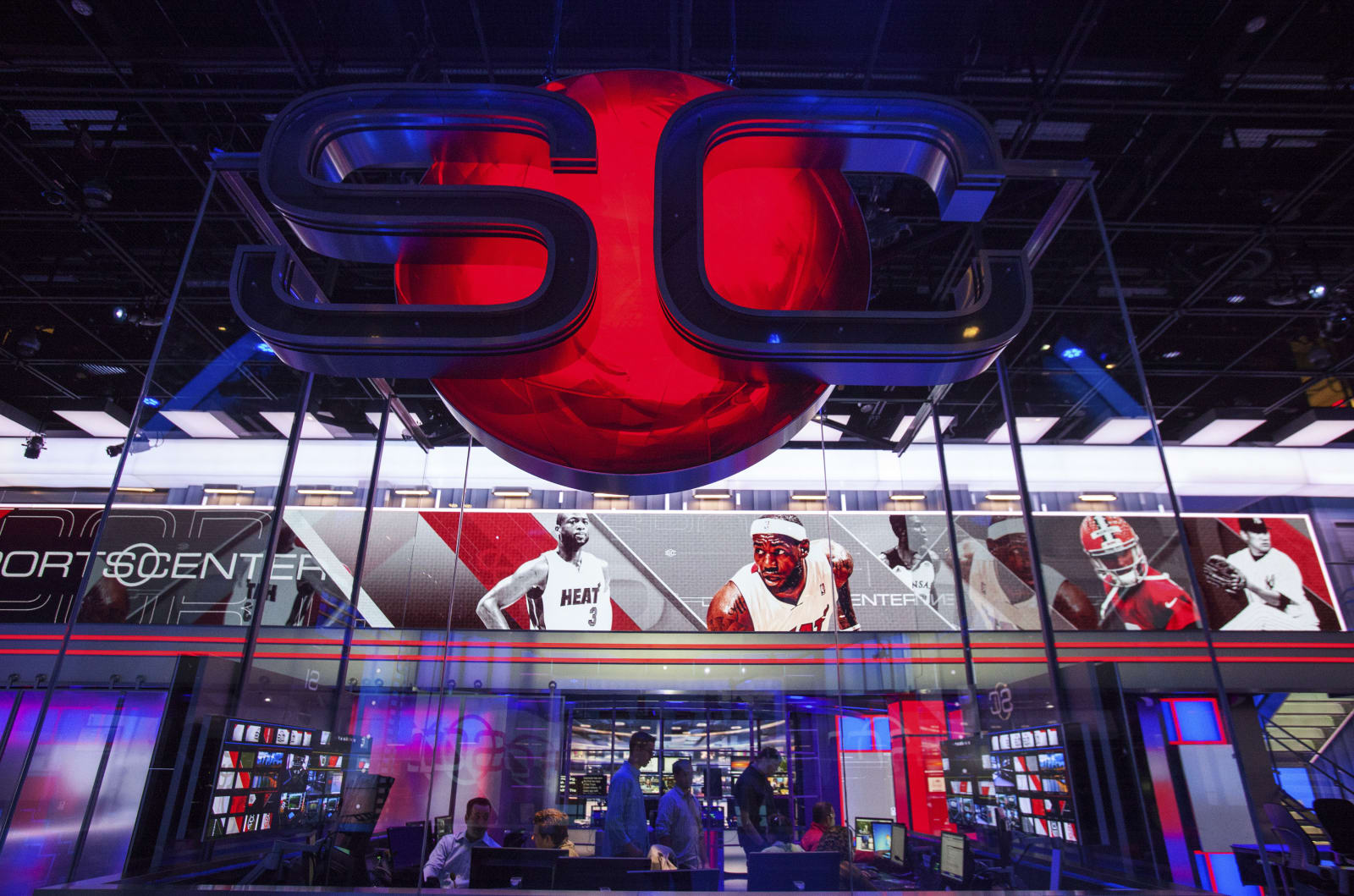
More than three years ago, ESPN opened a 194,000-square-foot, state-of-the-art production facility known as Digital Center 2. That space was built to house five studios, including the home of its flagship show SportsCenter, which has been airing on TV since 1979. The goal from the beginning was to make the show futureproof, by laying the foundation for its studio to support incoming technologies like 4K and 8K content. It was also set up to handle the rise of social media, what with a wall made of 56 screens giving the anchors’ the ability to interact with Twitter or Facebook posts from athletes in a real-time 3D environment.
The Digital Center 2 brought SportsCenter into the 21st century.
But a lot has changed since 2014. The way people, particularly millennials and younger generations, watch video has shifted dramatically. These days, it’s all about the smartphone, not an immovable TV set. That’s why traditional television networks such as CNN and NBC are creating original programming for Facebook and Snapchat, two platforms that unexpectedly became major players for hosting TV content. And now we can add ESPN to the list of channels looking to adapt to these new mediums.
The company is debuting SportsCenter for Snapchat, a twice-daily show that was made specifically to be viewed through smartphone screens. While it has the same sports news DNA as its namesake, SportsCenter on Snapchat consists of three- to five-minute episodes that are shot in portrait mode, which is obviously the most noticeable change. ESPN will be focusing on a “fast-paced mix of the latest, most engaging stories in sports,” so there’s no need for an hour-long version here.

The pilot episodes honestly don’t even feel like watching SportsCenter; it’s a completely new show. There are interactive cards for news segments that will be a big part of this SportsCenter, each letting you go more into detail about a particular story. That’ll be complemented by colorful imagery, large text overlays and meme-inspired visuals — all the things that Snapchat is known for.
To bring it all together, ESPN is relying on different personalities to host the show, including Katie Nolan and comedian Cy Amund, as well as SportsCenter TV anchor Elle Duncan. The company says it was key to find people “with diverse backgrounds and points of view,” who aren’t wearing a suit or another type of business attire when they’re delivering the news. At launch, there will be a total of six hosts, though ESPN says more will be added to the roster in the future.
SportsCenter on Snapchat will have a 5AM ET morning edition and 5PM ET evening edition. The morning show will be a recap of what happened the night before, while the afternoon episodes are going to be about trending topics that have come up during the day.
Glenn Jacobs, ESPN’s senior coordinating producer of SportsCenter and News, told Engadget there’s also a plan in place for breaking news coverage after the 5PM show. Although most of the content will be recorded early in the day, Jacobs said his team can redo the beginning of a show to include new information and upload an edited version. In theory, that will ensure that Snapchat users don’t miss out on any breaking news stories, like if LeBron James got traded to the Lakers for Lonzo Ball. Or some insane highlight of the day.
Jacobs said the most important aspect of SportsCenter on Snapchat was to make it unique, while staying true to the show’s roots. “This is going to be a sports fan [the host] sharing something cool with another sports fan,” he said. “It’s about how do we share the most interesting things in the world of sports, not just the news?” He said the Snapchat version of the show also needed to “get rid of stereotypes” and not feel like the TV SportsCenter because “if it’s not authentic, people aren’t going to buy it.”

Of course, SportsCenter on Snapchat is just the latest example of ESPN trying to adapt and connect with fresh audiences. According to research firm Nielsen, the network’s viewership has been on a steady decline for the last six years, as TV-viewing habits have shifted more toward online streaming. Cord cutters have even driven Disney, ESPN’s parent company, to finally launch a standalone streaming version of the channel in 2018.
Snapchat’s Head of Original Content, Sean Mills, said the idea to make this version of SportsCenter was a mutual one with ESPN. After all, the network has been working closely with Snap since the launch of Discover in 2015, so for Mills the evolution of the relationship felt natural. ESPN told Engadget that the deal is exclusive, meaning you won’t see this version of SportsCenter on Facebook, Instagram or Twitter anytime soon. That may be a bit short sighted on ESPN’s part, given Snapchat’s struggles, which have led the company to plan a huge redesign in hopes of attracting more users.
It’s obvious that ESPN needs Snapchat now more than ever, especially if it wants to find a way to win millennials over. A SportsCenter for Snapchat may not be the answer to all its troubles, but it shows that the network is eagerly looking for ways to stay relevant.
Spotify sells cosmetics now
In 2016, Spotify contrived to lose around $568 million, which is a lot of dough for a streaming service fighting against far-richer rivals. Consequently, the company is hoping to earn a fast buck or twelve by getting into the cosmetics retail game. Spotify is extending its merchandising operation not just to include t-shirts from your favorite artists, but the makeup that they’re using to look on-point this season.
The first entry in this new business is a tie-up with beauty brand Pat McGrath Labs, which is selling a collection exclusively through the music service. McGrath is the makeup provider of choice for singer-songwriter Maggie Lindemann, and the pairing will offer lipsticks and lip pencils, as well as eye pallets and pencils. All users need to do is head over to Lindemann’s artist page, and scroll down to her Merchbar to find what’s on offer.
This form of cross-brand cross-pollination is an ever-increasing aspect of how businesses and individuals make money online. The FTC-troubling Kardashians often hawk products on their Instagram pages and YouTubers earn commission on products that they endorse. All of this creates a feedback loop whereby social media stars burnish their own brands as they become pitch-people for the gear they’re hawking. This deal, as well, helps promote Lindemann’s next single, Obsessed, which drops November 17th.
It makes sense, too, since there are plenty of cosmetics companies, all looking for ways of carving a niche for their fans. Why buy the generic store brand if you can grab the eye palette or lip pencil of your social media / musical icons? Although it’ll be very interesting to see how many other artists — beyond Rihanna — jump on this new business line — we’re looking forward to seeing what Tom Waits offers up.
Source: Merchbar
Philips-branded TVs to come with built-in Roku streaming
With low-cost interlopers in the US TV market like TCL and Vizio, it’s easy to forget about Philips, which is manufactured for the US market by Japan’s Funai. That company has licensed Roku TV streaming tech and will incorporate them in Philips-branded models later this year, it announced. If you had understandably forgotten, Philips sells a variety of sets, including models with 4K UltraHD, Dolby Vision and Chromecast support. Until now, though, its smart TVs have used its aging, in-house NetTV platform, so Roku will be a big step up.
Confusingly, Philips sets are made in Europe, China and elsewhere by a Chinese firm called TP Vision. Suffice to say, the Dutch company doesn’t manufacture any TVs or other consumer tech itself, having elected to focus on Hue bulbs and medical imaging equipment.
Philips sets are known for the Ambilight effect, which floods the wall behind your TV with colored light that matches the TV’s visuals. The sets aren’t mentioned in the same breath as models from Samsung, LG and Sony in terms of quality, but are considered a decent value offering. Funai also manufactures millions of TVs for Magnavox, Emerson, Sanyo and other second-tier brands.
Roku has generally been praised for responsiveness and ease-of-use on sets from TCL and other manufacturers, with nice touches like live program preview on hover. Funai didn’t say which Philips models will support Roku, but it would make sense to have it on 4K sets with Dolby Vision to compete with the likes of TCL. By the way, if you’re in the market for a Roku streaming stick, its Streaming Stick+ is $20 off for Black Friday.
 AIVAnet