


NHS trials smart plaster that can detect blood poisoning
The UK’s National Health Service (NHS) is backing a slew of apps and wireless sensors that could help save lives and diagnose patients remotely. RespiraSense, for instance, is a small device that sticks to the side of the user’s rib cage. A plaster-shaped sensor measures breathing through the chest and abdomen, before processing and transmitting that information through a small plastic capsule. It can help detect a number of life-threatening conditions including sepsis, a blood infection that causes the body to attack its own organs. Doctors can access the data on a tablet and receive alerts when a patient’s breathing hits a dangerous threshold.
The NHS is also championing HaMpton, an app for pregnant women who might be at risk of pre-eclampsia. The condition, characterised by high blood pressure and protein in the urine, usually occurs 20 weeks into a pregnancy. HaMPton allows users to carry out their own blood pressure readings and urine tests at home; the results, along with a short survey, are then recorded in the app and processed by a hospital computer. The alternative — twice-weekly tests at a Maternity Assessment Unit — can be stressful for patients and increases the burden on stretched NHS hospitals.
Other highlights include Waitless, an app that tells patients with minor injuries the fastest way to be treated, and Dip.io, a home urine test that allows patients to check for chronic kidney diseases, urinary tract infections (UTIs) and pre-eclampsia. They all fall under the NHS Innovation Accelerator, a programme designed to increase innovation and use of technology in the healthcare sector. Selected projects have access to experts and mentors inside the NHS, workshops and webinars, and, crucially, bursaries to aid their development. They’re all in a trial phase, but it’s hoped the best will become standard NHS procedure some day.
Source: NHS England
Grindr adds more transgender-inclusive features
Grindr is rolling out new features to be more inclusive of transgender members. User profiles now include a new “identity” feature that includes options for listing gender and preferred pronouns. Members can pick from a list of common gender identities such as “trans man”, “woman”, “cis man”, “non-binary, “non-conforming” and “queer”, or specify their own identity if it doesn’t appear on the list. Pronouns such as “he/him/his”, “she/her/hers” and “they/them/theirs” can also be chosen, or specific pronouns written if not listed. Writing throughout the website has also been updated to include gender neutral terms.

The changes coincide with Transgender Awareness Week, and are the result of a survey of 5,500 existing trans users, as well as a consultation with the National Center for Transgender Equality. “One thing we heard over and over again from trans people using Grindr was that they felt unwelcome and that their non-trans peers only wanted to ask them about what it means to be trans or approached without knowing how to speak respectfully about trans issues,” said Jack Harrison-Quintana, Director of Grindr for Equality. “That’s why we created written resources linked from the gender identity fields in the profile to answer cis users’ questions and decrease that burden on trans people.” The update also includes a comprehensive FAQ on transgender issues to help non-trans members interact courteously.
Considering Tinder — a dating site generally considered more binary-focused — implemented transgender options last year, many will question why Grindr, a dedicated queer space, has taken so long to introduce these features. However, the company has been addressing trans issues for some time, having included a trans option in its “Tribes” feature back in October 2013. Plus, as Grindr notes, the company wanted to make sure it got the update right for its trans members. “As the largest global queer social network, Grindr has always had trans men, trans women, and non-binary users on the app,” said Peter Sloterdyk, VP of Marketing. “We are proud to release these updates to our core functionality to firmly establish that we are committed to making Grindr a welcome and safe space for trans people.”
BMW kills the ‘hybrid tax’ with the 530e
The rule is that if you want the hybrid version of a car, you have to shell out more cash. Maybe tax credits would cover the difference, but usually not. Then, you have to figure out if the money you save on gas — after a few years of diligent driving — would bridge the gap. But, if you’re in the market for a luxury sedan, BMW no longer asks you to make the decision based on your bank account.
The BMW 530e hybrid luxury sedan is the same price as its all-gas counterpart, the 530i. Both start at $52,400. That’s a big deal. This is the turning point in the evolution of electric cars where customers are no longer forced to debate the merits of being green (well, greener) against saving cash. But it’s not just the price that’s the same, on the surface you’d be hard-pressed to find the differences between the two cars.
Both cars push out 248 horsepower, although the 530e distributes it over the gas engine and the electric motor (137 and 111 respectively). They both look the same inside and out, save for an eDrive badge and charging port. Both are rear-wheel drive. Both can be outfitted to be all-wheel drive. The options list is nearly identical and when you’re sitting in the car, both feel like a BMW — with all the luxury and technology that entails.
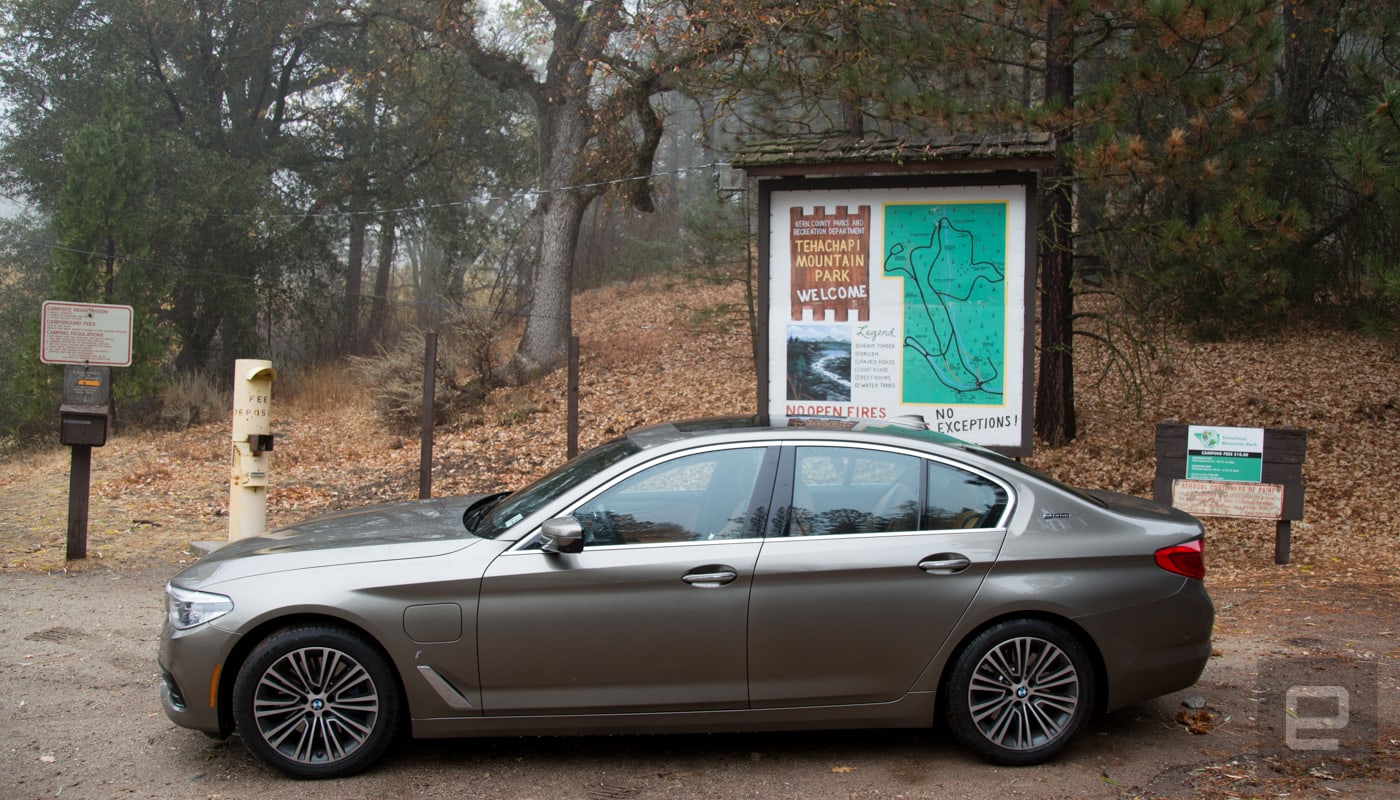
For anyone looking at both these models the question now is: Who do you want to be behind the wheel? If the answer is “someone that saves some cash while doing a small part to reduce pollution spewed by your vehicle,” the 530e is the simple choice. That said, even though the cars are similar, there are some important differences.
The extra torque (310 foot-pounds versus 258) gives the — albeit heavier — hybrid version a bit more umph. Plus, the instant acceleration of the electric motor pushes the car forward at stops while the gas engine restarts. If you’ve ever turned off your car’s “auto-off at stops” function, you’ll be pleasantly surprised at how nice it is having that EV system available off the line with the starter kicks in.
On the efficiency — and ultimately, cash-saving front — the 530e’s EPA-rated high-end of 72 miles per gallon equivalent dusts the 530i’s 27 miles per gallon. My tests in San Francisco and surrounding Bay Area yielded mid to high 50s while driving in economy mode. During extended highway driving that dropped to the mid 30s and low 40s. But there was an unexpected issue during the road trip.

The 530e’s tank is only 12.1 gallons (you have to put that 9.2 kWh battery somewhere). Meanwhile, the 530i comes equipped with an 18-gallon tank. That’s a range difference of 116 miles, which means extra stops to fill up. If you’re constantly taking long road trips, that might become a problem.
For running errands and city commutes, the 530e’s pure electric mode reminds you why you wanted a plug-in hybrid in the first place. With a range of about 19 miles on a full charge, I was able to drive to and from work (11 miles, round trip) plus various pit stops with no problem. With the hilly terrain of San Francisco, I was able to eek out about 16 miles total. In less challenging areas, that rose to 18 miles. Once I even managed 24 miles, but that required a ton of effort to reduce power consumption — something I’d never actually do in real life. Still, with an overnight charge of the car, I could reduce my trips to the gas station substantially.
Of course, I would be driving by gas stations in the luxury of a 5 Series BMW, which tells the world, “sure I want to save the planet a bit, but I also like feeling pampered.” The 530e doesn’t skimp on any of the luxury you expect from the German automaker. The interior is well designed and the Fineline Ridge wood trim makes it feel more like a log cabin than a gaudy condo. It has seating for five, but if the front passengers are tall, those in the back will notice the lack of legroom. The trunk has more than enough room for an eight-bag grocery run, a pair of golf clubs, or a small bookshelf from Ikea.

On the tech front, BMW’s iDrive infotainment system is still one of the best in the automotive world. Even though the 10.2-inch display is a touchscreen, the round controller and seven keys situated behind the shifter were my go-to means of control. BMW offers CarPlay support, but it’s a $300 option, which seems ridiculous considering how many cars have it as standard. Even without it, I had no problem navigating with the vehicle’s mapping system or listening to music from my iPhone.
Behind the wheel, the car delivers on BMW’s reputation of sporty luxury vehicles. The 530e is 500 pounds heavier than the 530i, but that battery lowers the center of gravity, making the car sure-footed on mountain road switchbacks with power to spare to accelerate on the straights. The 5 Series has grown in stature over the past few generations and you do notice it, but it never felt like the heft of the vehicle was getting in the way of performance.
On the highway, the semi-autonomous lane-keep assist and adaptive cruise control were solid performers. The system’s not as nice as Tesla’s Autopilot or Cadillac’s Super Cruise, but in stop-and-go gridlock or during long jaunts on boring freeways, the Driving Assistance package is worth the $1,700 it’ll set you back when you purchase the car.
When you factor in the $4,668 tax credit available to 530e buyers, the Driving Assistance package is actually not that bad of an investment. In fact, the 530e (with that tax credit) is actually cheaper than its gas counterpart. Of course, those credits could go away pending tax bills working their way through the government, but for now, it’s a nice thank you for reducing the amount of gas you use every year.

Sadly, the coolest feature of the 530e isn’t even available yet: the wireless charging pad. Drivers just pull their vehicle up over the device and it refills the battery without plugging in — it uses inductive charging via magnetic coils to generate energy. The pad will be available in Europe in 2018 and in the United States once it passes regulatory tests.
Even without the wireless charging pad, the BMW 530e is an outstanding luxury hybrid. As a BMW it delivers all the performance and luxury expected from the brand. As a hybrid, it seamless switches between gas and electric without the driver knowing, all while offering up a nearly 20-mile range pure electric mode. The fact that it’s the same price as its gas-only counterpart is more than icing on the cake — it’s the first step in reducing the gap between these two types of cars. While not all of us (myself included) can afford a 5 Series BMW, it’s good to know that true choice, without the financial concerns between hybrid and gas cars, is coming to more affordable vehicles. If they’re all as great as the 530e, the decision is going to be simple.
Intel’s latest Core processors have serious security flaws
Intel has confirmed previous reports that its recent PC, internet of things and server chips are vulnerable to remote hacking. The problem is with the onboard “Management Engine,” which has multiple holes that could let remote attackers run malicious software, get privileged access and take over computers. The vulnerability affects sixth, seventh and eighth generation Core chips (Skylake, Kaby Lake and Kaby Lake R), along with Pentium, Celeron, Atom and multiple Xeon chips.
In the worst case scenario, the vulnerabilities can allow hackers to “load and execute arbitrary code outside the visibility of the user and operating system,” Intel wrote in the security bulletin. Other flaws affect the Management Engine and Intel’s Server Platform Services, potentially giving hackers privilege escalation rights.
Intel has published a detection tool for Linux and Windows to help administrators and users detect if their systems are vulnerable. It has also posted a fix for its PC customers, but so far, but only Dell, Lenovo and Intel itself (for its NUC and Compute Sticks) have listed affected systems. No firmware updates appear to be available yet.
Thoughts on the latest Intel ME vulnerabilities: based on public information, we have no real idea how serious this is yet. It could be fairly harmless, it could be a giant deal.
— Matthew Garrett (@mjg59) November 20, 2017
If you own a recent PC with a Core or Pentium Intel chip, it’s safe to assume that you’re probably affected — both Lenovo and Dell’s lists are very large. On the plus side, researchers say that so far, there’s no way to exploit the flaws unless you already have access to a network. That could change, however: “We have no real idea how serious this is yet,” said Google security researcher Matthew Garrett. “It could be fairly harmless, it could be a giant deal.”
Via: Ars Technica
Source: Intel
iPhone SE 2 Again Rumored to Launch in First Half of 2018
Apple will release a second-generation iPhone SE in the first half of 2018, according to China’s Economic Daily News.
The report claims the tentatively named iPhone SE 2 will be assembled exclusively by Taiwanese manufacturer Wistron at its factory in Bengaluru, India, where some assembly of the current iPhone SE occurs.
The rumored release date window lines up with an earlier report from Focus Taiwan claiming a new iPhone SE will ship in the first quarter of 2018, which encompasses January through March of next year.
Apple introduced the current iPhone SE at a media event on March 21, 2016, and the device launched later that month. Given the rumored launch dates, the iPhone SE 2 could certainly be unveiled in March too.
Indian website Tekz24 previously reported that the next-generation iPhone SE will be powered by Apple’s A10 Fusion chip, with 2GB of RAM, 32GB and 128GB storage capacities, a 12-megapixel rear camera, a five-megapixel front camera, and a slightly larger 1,700 mAh battery.
Tekz24 isn’t a website we’re familiar with, and it doesn’t have an established track record of reporting on Apple rumors, so don’t place too much faith in those tech specs until if and when they are confirmed by other sources.
The current iPhone SE looks much like the iPhone 5s, including its smaller four-inch display preferred by a subset of customers. The device is powered by Apple’s A9 chip, like the iPhone 6s and iPhone 6s Plus, and it has 2GB of RAM, a 12-megapixel rear camera, a 3.5mm headphone jack, and Touch ID.
Apple hasn’t entirely refreshed the iPhone SE since it launched, but it did double the available storage capacities to 64GB and 128GB in March. It also dropped the device’s starting price to $349 a few months ago.
Related Roundup: iPhone SETag: udn.comBuyer’s Guide: iPhone SE (Caution)
Discuss this article in our forums
MIUI 9 will be the last update for these six Xiaomi phones
Software support is ending for six Xiaomi phones.
Back during the launch of MIUI 9, Xiaomi announced that its custom ROM would be making its way to over 30 devices in the company’s portfolio, going back all the way to the 2012 Mi 2. And while Xiaomi has done a great job of making sure that older devices receive updates, the manufacturer has announced that six devices will not be getting any further updates beyond MIUI 9.

These are the devices that will not be receiving updates following the rollout of MIUI 9:
- Mi 2/2S
- Mi 4i
- Redmi Note 4G
- Redmi 2
- Redmi 2 Prime
- Mi Note
Xiaomi has suspended rolling out beta builds to the aforementioned devices, and has mentioned that the stable OTA build — set to arrive sometime in January 2018 — will be the last update for these handsets:
MIUI ROM has been updated regularly ever since its first version was released. And MIUI Team has been committed to providing the best experience to users of all devices. Therefore, MIUI performance is constantly improved to deliver a better and better system experience to all users.
However, to ensure the best performance of MIUI, we have to make a tough decision of suspending the update of 6 devices after a long-time discussion and evaluation about the release time of devices, active users, hardware performance, etc.
Xiaomi also mentioned that it will provide instructions for users that are using beta versions of the ROM to make the switch to the stable channel. It’s easy to see why Xiaomi is depreciating support for these devices — the latest phone in the list is the Mi Note, which made its debut back in January 2015.
UC Browser returns to the Play Store with an updated app
UC Browser’s removal was because of a setting that wasn’t in line with Google Play policies.
After getting delisted last week, Alibaba-owned UC Browser is once again back on the Play Store. UC Web has clarified that the reason for the removal was “because of a certain setting of UC Browser that was not in line with Google’s policy,” and that the updated listing fully conforms to the Play Store’s guidelines.

In a statement to Gadgets 360, Alibaba Mobile Business Group’s Head of International Business Department Young Li talked about the passion of UC Browser fans, who managed to get the lightweight alternative to the browser to the top of the Play Store’s free charts:
During the brief absence of UC Browser on Play Store, we continued to meticulously check our technical settings while also witnessing an uninterrupted passion of our users for the product, who looked upon the alternative version, UC Browser Mini, and made it to the top of [the] Free Apps category on the Play Store.
UC Web also cleared up the confusion surrounding a statement made by an alleged employee, who said that the browser was banned because the company was resorting to “misleading and unhealthy methods of promotion to increase installs” on the Play Store:
We would like to state that we have no records of anyone named ‘Mike Ross’ claiming to be working for UC Browser, as mentioned in some reports. The person claiming to be working for UC Browser is in no way associated with the firm nor represents the views of the company.
The allegations of misleading and malicious promotions by the said person are completely false and baseless.
Google also chimed in on the ban, stating that its policy is to remove apps that violate Play Store guidelines:
Our policies are designed to provide a safe and positive experience for users. That’s why we remove apps from Google Play that violate those policies.
UC Browser doesn’t have a huge userbase in Western countries, but it is the most-used mobile browser in India, with a market share of 45%.
Google Play Store discounting apps, games, and more through November 27
In honor of Black Friday and Cyber Monday, the Google Play Store is running deals on apps, games, movies, and plenty more.
As you’d expect for this time of year, there’s no shortage of deals to be found for the likes of smartphones, TVs, tablets, smartwatches, etc. The savings here are great, but these days, hardware is only as good as the software that’s on it. Google recently announced a heap of discounts that are now available on the Play Store, and there’s something here for just about everyone.

For apps and games, Google is slashing the prices on hundreds of applications throughout the entire Play Store – including a 50-percent discount on Colorfy’s monthly subscription. You’ll also be able to find savings up to 80-percent for the likes of Call of Duty: Black Ops Zombies, LEGO Ninjago: Shadow of Ronin, LEGO Jurassic World, and many others. Plus, if you’re a Gardenscapes or Homescapes player, you’ll have access to discounts on in-game items, power-ups, and even unlimited lives. These savings begin now, and they’ll last through November 27.
Movie rental and comic book savings will only be available on November 25.
Music is an essential whether you’re trying to relax or party with friends, and to help give your jams a nice boost, you’ll be able to get four months of Google Play Music for free. Just like the apps and games, this deal is available now through November 27.
If you’d rather sit back and watch something, Google is offering 50-percent off any one movie and 25-percent off a television series that you buy. Along with this, you can also rent any single movie of your choosing for 99 cents. The deal for buying a movie or TV series goes into effect November 23, and the rental promotion will be available on November 25 only.
Lastly, if reading is more your thing, you’ll be able to get a $5 credit towards any book you purchase that costs $5 or more. Many of the hottest titles will be discounted from their regular price, and comics revolving around some of your favorite superheroes will be available for just $5 or less. Savings on comics will only be available on November 25, but the book deals will be available from November 23 through the 27th.
If you want to browse through everything that’s on sale, check out Google’s Holiday Hub.
Nest thermostats, cameras, and more are now down to Black Friday prices
This is the best deal you’ll find on Nest products right now!
Is this deal for me?
If you’re tired of the crazy weather patterns and walking into a house that is the wrong temperature, you need to get a smart thermostat now. The ability to control the temperature in your home from anywhere using your smartphone is amazing, and right now Nest’s Smart Thermostats are on sale at both Amazon and B&H. The indoor and outdoor cameras are also discounted, so be sure to check them all out.

- Nest Smart Learning Thermostat – $199 (Normally $249.99) | Also at B&H
- Nest E Smart Thermostat – $149 (Normally $169)
- Nest Cam Indoor – $139 (Normally $199) | Also at B&H
- Nest Cam Outdoor – $149 (Normally $199) | Also at B&H
- Nest Cam Outdoor (2-pack) – $298 (Normally $348) | Also at B&H
- Nest Cam IQ – $249 (Normally $299)
- Nest Protect – $99.99 (Normally $119.99) | Also at B&H
While $200 may seem like a big investment to replace something in your house that still works, you’ll also want to think about the long-term savings potential here. With Nest’s learning feature you may be able to reduce the costs associated with heating and cooling your house by up to 30%, which means it could eventually pay for itself over time. You may even be eligible for rebates with this purchase.
These devices are compatible with Google Home and Amazon’s Alexa allowing for voice control.
TL;DR
- What makes this deal worth considering? – This sale drops a bunch of Nest products down to their lowest prices, and they don’t go on sale all that often. Whether you want a camera or thermostat, this deal has you covered.
- Things to know before you buy! – Nest products are compatible with Google Home and Amazon’s Alexa so you can even control it with your voice.
Pixel 2 vs. iPhone X: Which does the best portrait selfie?
How much stronger does Portrait Mode make your selfie game, and which phone does it better?

Portrait Selfies are my favorite thing happening in smartphones right now. I can feel your eyes rolling as you read this, but hear me out for a moment. On a technical level, we’re seeing a massive push to improve the quality of the front-facing camera while applying depth maps and color correction so a photo can be instantly transformed into something new. It’s fascinating and fun, and in the early days of this feature existing on smartphones there are two massively different ways of creating this effect being used.
Apple’s True Depth camera features multiple sensors to create a depth map in real time on the iPhone X. Google’s solution relies entirely on machine learning and an impressive single camera to accomplish the same effect on the Pixel 2. Here’s a look at how these two methods compare!


Left: Google Pixel 2 Right: Apple iPhone X
The first thing you need to understand when comparing these cameras is where Apple and Google are placing priority when it comes to the photos being produced. We know on a technical level these two phones have the best photo capabilities in the world right now, with the only read difference for most people being what parts of the photo and what features are taking priority.
In these shots, two things become quickly apparent. The background in the iPhone X shot is blown out in an attempt to make sure my face is well lit and properly colored. The background in the Pixel 2 shot is better balanced with the rest of the photo thanks to Google’s HDR+, but as a result, my face is noticeably darker and takes on a slightly reddish tint you don’t see in the other shot.
There are also substantial differences in that blurring effect used to create Portrait Selfies. Google’s software applies a more aggressive blur, and it makes imperfections in the depth map stand out quite a bit. It almost looks like a cut-out sticker of me has been applied to this photo. Apple’s blue is a little more natural looking right until you get to my hair and parts of me start to look a little out of focus. Neither shot really “nails” the picture due to their respective faults, but the flaws are subtle enough that you have a pair of fun photos.
Here’s another example, only this time it’s an outdoor shot zoomed in 100%.


This pair of shots offers a lot of the same conclusions. Apple better lights my face, in particular, my eyes, while Google better lights the background and makes the whole photo feel richer. Apple’s blurring extends too deep into my hair and makes part of me look out of focus, while Google’s blur is so severe it actually edited out some of my hair that was sticking out of place. Without the Portrait Mode it’s clear the iPhone X took the better photo, but with that photo mode enabled it’s easier to appreciate the effect of Google’s software.
Apple and Google seem to be approaching this photo technique from opposing directions, and it seems likely what we’ll see in the not-too-distant future is some kind of meeting in the middle.
There are some natural limitations to both of these photo modes, especially in these early days. The iPhone X will flash warnings in Portrait Mode if the background is too bright or if objects in the background are too far away to grab a proper depth map. Google’s algorithm has a nasty habit of editing out corners of prescription glasses or objects in the foreground that aren’t attached to a person. There’s a bit of trial and error in getting both to work correctly, which in theory gets less frequent over time as Apple and Google continue to improve this tech.
The biggest thing Apple has over Google in this Portrait Mode right now has to be Portrait Lighting. Being able to see the possible edits to the photo in real time as you go to take the picture is a big deal, and the ability to continue editing Portrait Lighting after the photo has been taken is incredible. It’s a very hit-or-miss feature right now, especially when you start looking at Stage Lighting, but nothing but the iPhone has this right now.
When editing the photos, Google has something Apple currently doesn’t and probably should. When you take a Portrait Mode photo with a Pixel 2, you get a pair of photos. One photo is edited with the blurred areas, and the other is just a plain selfie with the front camera. This gives you the ability to edit both photos and see which you prefer. Apple keeps everything as a single photo, which in my opinion is a little less convenient to see edits between the two modes. On the other hand, it’s one fewer photo in your Camera Roll, so this is probably just personal preference.

There’s a lot to be said about the “right” way to take a photo, and even more to be said about the virtues of color accuracy and feature effectiveness. Apple and Google seem to be approaching this photo technique from opposing directions, and it seems likely what we’ll see in the not-too-distant future is some kind of meeting in the middle. Right now, it’s not immediately clear that Apple’s hardware-based approach is measurably better than Google’s software-based approach to Portrait Selfies. All of the things that make the iPhone X camera take a great selfie already exist on the iPhone 8 and 8 Plus. At the same time, it’s not clear how much better Google can make its photo editing software with a single camera and a lighting preference for the whole photo instead of the face.
One thing is absolutely clear — we’re nowhere near the end of Apple and Google giving us more and better selfie features.
Google Pixel 2 and Pixel 2 XL
- Pixel 2 FAQ: Everything you need to know!
- Google Pixel 2 and 2 XL review: The new standard
- Google Pixel 2 specs
- Google Pixel 2 vs. Pixel 2 XL: What’s the difference?
- Join our Pixel 2 forums
Google Store
Project Fi
Verizon
Best Buy
 AIVAnet