


Say ‘nǐ hǎo’ to Duolingo’s new Mandarin language course for iOS and Android
Over 1 billion people worldwide speak Chinese as their native or second language, and that number is growing rapidly. Also growing is selection of language courses available on Duolingo.
On Wednesday, November 16, the language learning platform added Mandarin Chinese as its 27th course offering, which is available now on the Duolingo app for iOS and Android. In addition to its recently added Japanese course, Duolingo claims that Chinese has been one of its most requested languages.
While there are a number of different Chinese dialects, Duolingo’s course will only focus on Modern Standard Mandarin, the official language of the People’s Republic of China (China) and the Republic of China (Taiwan). It’s also one of the official languages of Singapore and Myanmar.
Since Chinese is an extremely difficult language to master, Duolingo’s course does not aim to make its students fluent. Like its other courses, the Mandarin course teaches basic phrases and slang terms used by Mandarin speakers. The course specifically focuses on learning words and words and phrases for food, culture and travel, festivals, and internet slang, as well as business and financial transactions. All in all, the course covers all of the vocabulary and grammar points to successfully complete levels 1 through 3 of the official Chinese proficiency test.
In addition to speaking the language, Duolingo’s course will focus on Chinese characters as well. The Chinese writing system is the world’s oldest, and is vastly different than the English alphabet. Initially users will learn about 1,000 of the most commonly used simplified Chinese characters, though Duolingo does plan to add traditional Chinese characters to the lessons in the future. Hanyu Pinyin, the standard romanization system, is also covered in the course.
Like its other courses, Duolingo relied on extensive research to create its newest offering. Duolingo developed the course curriculum using the Common European Framework of Reference for Languages as a point of reference. CEFR provides a step-by-step framework for language learning and makes sure that learners are proficient in certain basic areas before beginning more complex materials.
Duolingo offers free language courses online as well as through apps for iOS and Android.
Editors’ Recommendations
- Bezel-less Mi Mix 2 and Android One Mi A1 lead Xiaomi’s European charge
- ‘Stranger Things’ season 3 is coming! Here’s everything we know so far
- Learn to do pretty much anything with flash-card-based learning app TinyCards
- ‘Stranger Things’ season 2 has arrived! Here’s everything we know
- New Fluent Forever language-learning app breaks Kickstarter records
Google Maps navigates its way to a cleaner, more useful design
You may not have thought Google Maps was looking a bit stale or a little faded, but the relevant folks holed up inside the company’s Mountain View campus in Silicon Valley clearly thought it was time to haul the mapping tool into the workshop for a makeover.
The bright new look, unveiled on Wednesday, is supposed to reflect “your world, right now,” according to Liz Hunt, product Manager of Google Maps.
In other words, it now highlights particular information that’s relevant to what you’re doing with Maps at any given time. So gas stations will show up more prominently in Navigation, and train stations in Transit, that kind of thing.
An easy-on-the-eye color scheme has also been introduced, and you’ll notice a bunch of new icons so you can quickly make sense of different places in the vicinity. You’ll have to get familiar with them first, though, so check out the slideshow below to see what to expect.
“Places like a cafe, church, museum or hospital will have a designated color and icon, so that it’s easy to find that type of destination on the map,” Hunt wrote in a post explaining the changes. “For example, if you’re in a new neighborhood and searching for a coffee shop, you could open the map to find the nearest orange icon (which is the color for food/drink spots).”
The changes are being rolled out to all the relevant Google products over the coming weeks, including not only Maps but also Google Assistant, Search, Earth, and Android Auto.
“Over time, the new style will also appear in the apps, websites and experiences offered by companies that use Google Maps APIs as well,” Hunt said.
Launched in 2005, Google Maps has received multiple makeovers over the years, with new features being added all the time.
Most recently, it announced “wait times” for Maps (and Search) that’ll show you the estimated wait time at your favorite restaurant so you can decide if it’s worth lining up, or whether you should choose somewhere else for dinner.
But the tool hasn’t always had an easy ride, or to put it more accurately, hasn’t always given users an easy ride. Its Navigation feature, for example, has occasionally been known to give erroneous directions, sometimes sending drivers miles off course, though thankfully such occurrences are rare.
Editors’ Recommendations
- Organize your thoughts with this list of the best mind-mapping software
- Android 8.0 Oreo review
- The 10 best calendar apps for Android and iOS help you organize a chaotic day
- Here’s how Apple’s new Files app works in iOS 11
- Garmin’s Edge 1030 cycling computer review
Best Phone Under ₹10,000 in India
- Best overall
- Best small phone
- Best selfie phone
Best overall
Xiaomi Redmi Note 4

See at Flipkart
The Redmi Note 4 is the phone to beat in the budget segment. It features a 5.5-inch Full HD display with 2.5D curved glass, a premium design with an all-metal chassis and contoured edges, and class-leading battery life.
And with Xiaomi issuing a permanent price cut, the Redmi Note 4 is much more pocket-friendly. The variant with 3GB of RAM and 32GB storage is now selling for ₹9,999, making it the best deal in the budget segment. If you need more memory and storage, Xiaomi is offering the model with 4GB of RAM and 64GB storage for ₹11,999.
The phone is now receiving the stable build of MIUI 9, which is based on Android 7.0 Nougat. If you’re new to the MIUI ecosystem, there’s plenty to look forward to: the custom ROM comes with a slew of useful features, and you can alter the look of the interface through a varied selection of themes from the store.
The camera has received a sizeable upgrade as well, and it now takes great images in daylight conditions. Overall, you’re getting a phone that offers an incredible amount of features for not a whole lot of money.
Bottom line: A premium aluminum design, great battery life, decent camera, and attractive pricing make the Redmi Note 4 the standout device in this category. For its price, there really isn’t another device that gives you more.
One more thing: The Redmi Note 4 is available online and from thousands of retail stores across the country.
Why the Redmi Note 4 is the best
Xiaomi has figured out the formula to succeed in India’s competitive budget segment: offer devices packed to the gills with features, and price them lower than the rest of the market. It’s no wonder, then, that the Chinese manufacturer currently fields three of the best-selling phones in India in the Redmi Note 4, Redmi 4, and the Redmi 4A.
The Redmi Note 4 is at the pinnacle of budget phones. You get a 5.5-inch Full HD IPS LCD display, Snapdragon 625 with eight Cortex A53 cores, a 13MP rear camera with PDAF and dual-tone LED flash, 5MP front camera, and a massive 4100mAh battery. The design is much more premium than its predecessor, and the camera is of a higher quality. You even get an IR blaster that lets you control appliances in your house.
The Redmi Note 4 has a premium design and outstanding battery life.
The phone has recently picked up the MIUI 9 update, which introduces a bevy of new features. You get a brand-new image editor that lets you remove elements from the background, a notification pane with bundled notifications, system-wide optimizations to make the UI feel smoother, native split screen mode, a new video player, and so much more.
Another area where the Redmi Note 4 excels at is battery life. With a 4100mAh battery under the hood, you routinely get screen-on-time of over eight hours on a full charge. While there’s no fast charging available, you’re guaranteed to get two days’ worth of usage from a single charge.
There’s no dearth of features on the Redmi Note 4, and all things considered, you’re getting a lot for your money.
Best small phone
Xiaomi Redmi 4

See at Amazon
If you’re looking for a device with a 5.0-inch form factor, then the Redmi 4 is right up your alley. The device is a bargain for ₹8,999, offering a 720p display with a built-in blue light filter, Snapdragon 435, 3GB of RAM, 32GB of internal storage, and a massive 4100mAh battery.
The compact size and the huge battery make the Redmi 4 a great option if you’re in the market for a device that can last two days between charges.
The Redmi 4 also has a 13MP camera with an f/2.0 lens and PDAF, and you get the usual bells and whistles in the Mi Camera app: Panorama, burst mode, HDR, real-time filters with previews, and face recognition. You can also use Xiaomi’s Beautify effects in conjunction with the 5MP front shooter.
Bottom line: The Redmi 4 gets the basics right at an unbeatable price tag.
One more thing: The phone is available in gold and black color options, and should pick up the update to MIUI 9 shortly.
Best selfie phone
Xiaomi Redmi Y1

See at Amazon
The Redmi Y1 shares a lot of similarities with the Redmi 4, including its ₹8,999 price tag. The phone also comes with the Snapdragon 435, and has 3GB of RAM and 32GB of internal memory.
Where the Y1 differs is the front camera, which is a 16MP offering with a dedicated selfie flash. The flash kicks in automatically in low-light conditions, and Xiaomi’s Bestufy 3.0 feature automatically “enhances your natural beauty” to get that perfect selfie.
The Y1 isn’t just about the front camera; the phone also features a 5.5-inch 720p display, a design aesthetic that’s similar to that of the Redmi Note 4, and a 3080mAh battery that gives you all-day battery life. The MIUI 9 stable build is also making its way to the device.
Bottom line: The Redmi Y1 is your best option if you’re looking for a device with a great selfie camera.
One more thing: The Y1 comes with a dedicated microSD card slot along with a dual-SIM card tray, so you don’t have to choose between using a secondary SIM card or an SD card.
Conclusion
Right now, it feels like Xiaomi is the only manufacturer that’s serious about the budget segment. Lenovo has released several devices in this category this year, including the likes of the K8, K8 Plus, and the K8 Note. Although the company made the switch to stock Android, the devices won’t be receiving the Oreo update until June 2018 at the earliest.
Then there’s Motorola, which rolled out the Moto E and Moto C in this segment. The Moto E4 Plus is particularly interesting thanks to its 5000mAh battery, but the phone isn’t confirmed to receive the Oreo update. For a device that’s just three months old, that’s inexcusable.
Simply put, if you’re looking for a phone that offers the most value for your money, then the Redmi Note 4 should be at the top of that list. The recent price cut makes it a much more enticing option, with the 3GB variant now available for just ₹9,999. For that price, you get a great design, incredible hardware, amazing battery life, and a camera that holds its own in this category.
Best overall
Xiaomi Redmi Note 4
See at Flipkart
The Redmi Note 4 is the phone to beat in the budget segment. It features a 5.5-inch Full HD display with 2.5D curved glass, a premium design with an all-metal chassis and contoured edges, and class-leading battery life.
And with Xiaomi issuing a permanent price cut, the Redmi Note 4 is much more pocket-friendly. The variant with 3GB of RAM and 32GB storage is now selling for ₹9,999, making it the best deal in the budget segment. If you need more memory and storage, Xiaomi is offering the model with 4GB of RAM and 64GB storage for ₹11,999.
The phone is now receiving the stable build of MIUI 9, which is based on Android 7.0 Nougat. If you’re new to the MIUI ecosystem, there’s plenty to look forward to: the custom ROM comes with a slew of useful features, and you can alter the look of the interface through a varied selection of themes from the store.
The camera has received a sizeable upgrade as well, and it now takes great images in daylight conditions. Overall, you’re getting a phone that offers an incredible amount of features for not a whole lot of money.
Bottom line: A premium aluminum design, great battery life, decent camera, and attractive pricing make the Redmi Note 4 the standout device in this category. For its price, there really isn’t another device that gives you more.
One more thing: The Redmi Note 4 is available online and from thousands of retail stores across the country.
Update, November 2017: The Redmi Note 4 continues to be our top budget pick in India.
‘Battlefront II’ under investigation in Belgium over loot crates
EA isn’t only getting a lot of flak over Battlefront II’s loot crates, it’s also under investigation from Belgium’s gambling authority. According to VTM Nieuws, the country’s gaming commission is in the midst of taking a closer look at both Battlefront II and Overwatch, since add-on boxes that have to be purchased before you can see what’s inside might constitute gambling. As Commission chairman Peter Naessens points out, random loot boxes are a game of chance.
Authorities are especially concerned over the fact that the games are marketed towards children. Naessens says kids could feel forced to spend a lot of money under social pressure. EA made earning heroes easier after facing backlash, but players might still end up spending serious money on the game — according to a computation by Star Wars Gaming, it will take at least 4,528 hours of gameplay or $2,100 to unlock all its base content.
We reached out to Blizzard to find out the developer’s stance on the investigation. In a statement provided to GameSpot, EA made its position clear and insisted that Battlefront II’s loot crate mechanics aren’t gambling:
“Creating a fair and fun game experience is of critical importance to EA. The crate mechanics of Star Wars Battlefront II are not gambling. A player’s ability to succeed in the game is not dependent on purchasing crates. Players can also earn crates through playing the game and not spending any money at all. Once obtained, players are always guaranteed to receive content that can be used in game.”
If Belgium’s gaming authorities decide that loot boxes constitute gambling, EA and Overwatch will have to secure a special permit if they want to continue making those games accessible in the country.
Via: Kotaku
Source: VTM Nieuws
Teenage Engineering’s ‘H’ and ‘R’ aren’t your typical smart speakers
Most people still don’t know who or what Teenage Engineering is. But, those that do probably think of them as a music company — the iconic OP-1 synthesizer, OD-11 speaker and line of tiny Pocket Operator synths have earned Teenage Engineering that reputation. But more than that, the company is made of of people who love getting weird with hardware design; pushing the boundaries of what can be created is in Teenage Engineering’s DNA.
The two new products Teenage Engineering just unveiled at the Baidu World conference in Beijing, China most definitely fit with that ethos. Simply referred to by the single letters “H” and “R,” the easiest way to identify devices is to call them smart speakers. But they don’t in any way resemble what Amazon and Google have trained us to think of when we think of speakers that you talk to.
Of the two products, the R is easily more striking. The prototype brings to mind Apple’s iMac G4 with its pivoting arm and screen floating on top of a white dome. In this case, though, the entire construction is much smaller — there’s a speaker base, a six-axis gimbal “arm” and a touch-sensitive, LED screen, all packed into a tiny frame. But unlike the iMac G4, the R can move all on its own. It’s not ready for production yet, but the R uses a combo of motors and software to make the R’s display look at you when you speak to it. Or, it’ll just dance along to music you play.
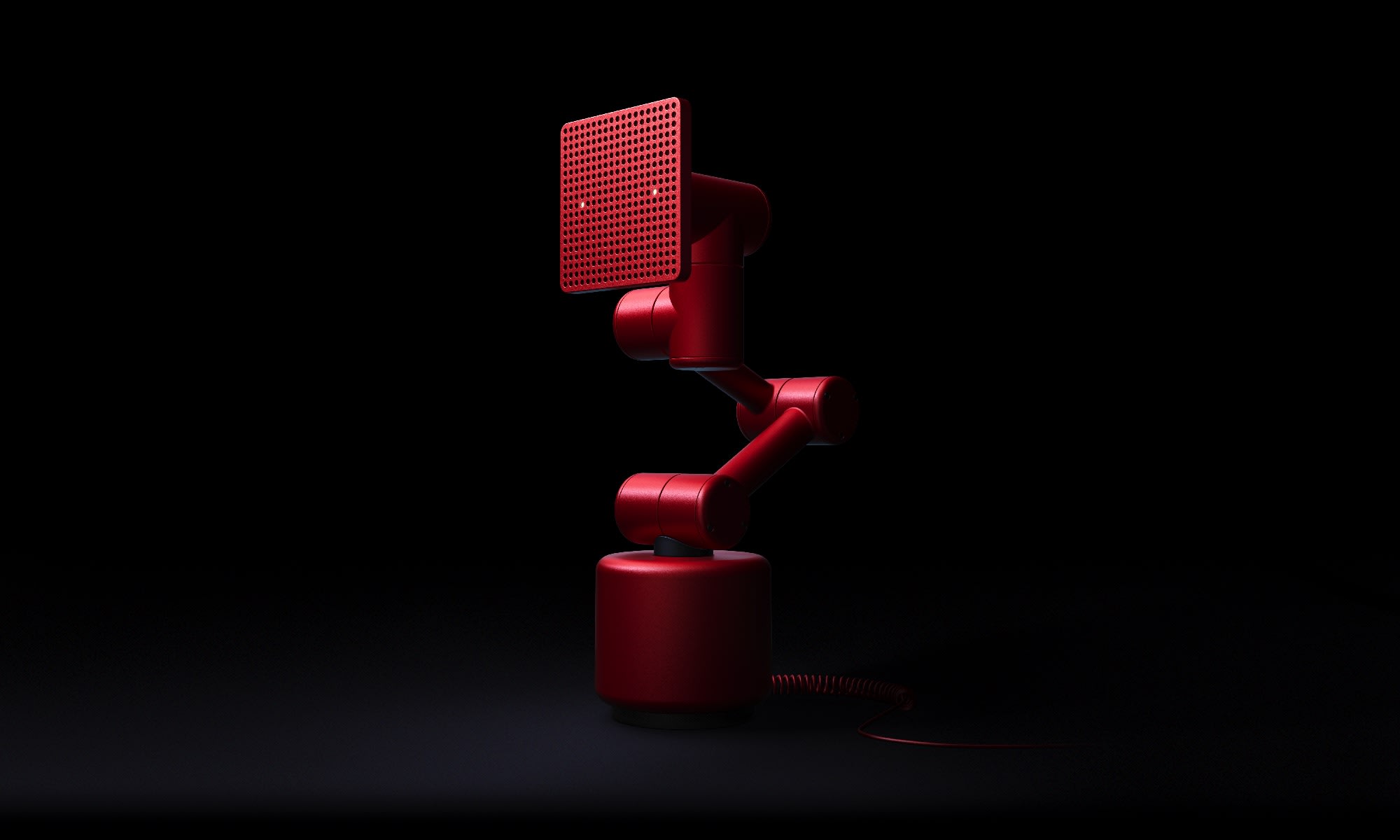
Teenage Engineering
The H is a bit less ambitious, but no less distinctive. It essentially looks like a stack of colorful drink coasters, and you can even remove the top layer. Just as on the R, that top piece is a touch-sensitive LED array with built-in microphones; it also functions as a remote when you remove it from the rest of the H. Below the screen, the the H houses a speaker, more microphones and a rechargeable battery so it can be moved around the home. When it’s connected, you can tilt the screen up so it faces forward when not being used as a remote.
As with everything Teenage Engineering builds, having personality is just as important as having a functional product. “In my head, [the R] is a mix between a plant and a pet,” CEO and founder Jesper Kouthoofd told Engadget. “When I was doing the first sketches for the H, I was thinking of fruit. That’s why it’s so colorful. With the R, I thought of flowers.”
That personality extends to the display itself. Kouthoofd said that its primary purpose is more for emotional connection and feedback rather than displaying information. It’ll light up and respond to your voice or music that it plays; it can also show small bits of info like the time. But like the Google Home or Amazon Echo, voice feedback is the primary interaction.
While the H responds to users with visuals and sound, the R will add in motion; as such, Teenage Engineering is thinking of the R as its first foray into robotics. “Other robotics companies focus so much on having the unit move around, they don’t really care about the interaction between the man and the machine,” Kouthoofd said. “Teenage Engineering believes it has to give something back to the user, at an emotional level.” Kouthoofd said. An example of that is how the R will respond to music. Teenage Engineering wrote custom software so that it’ll analyze what’s being played, divide up the beat and dance along, in time. It’ll even recognize when there’s a breakdown in a song and change things up. “
Unsurprisingly, building the arm and its motors was the most challenging part of the process, particularly given that the team went from 3D-printed models to a working prototype in about six months. But despite the high level of engineering here, Kouthoofd is hoping to make the R fairly affordable — relatively speaking. “Hopefully the end product will not be a $2,000 robot,” he said, “it’ll hopefully be around $500 or $600.” That’s a lot more expensive than an Amazon Echo, but Teenage Engineering isn’t afraid of charging premium prices. The OP-1 synthesizer still sells for $899, while the OD-11 speaker costs $999.
How exactly these products will work remains a bit of a mystery, largely due to the fact that both products are initially only launching in China. Most of the software and AI will be provided by Baidu and digital assistant company Raven Tech, which Baidu purchased earlier this year. Kouthoofd says it’ll essentially do all the smart speaker things that devices from Google and Amazon are doing — it’ll answer questions, play music, let you order food, control smart home devices and generally connect to Baidu’s knowledge graph and servers to pull down info.
Kouthoofd admits that he’s not 100 percent sure how the H will work in use, because his team has been so focused on the hardware side of things. But Raven had already built something similar for China; this new model will likely work the same way, just with Teenage Engineering’s distinctive design language.

Teenage Engineering
Teenage Engineering expects to bring these new products out of China, but it’s not going to be easy. Baidu operates only in China, and its services won’t work with other languages right now — a pretty big requirement for a voice-activated speaker. Kouthoofd casually mentioned the potential of working with Amazon or Google to get their robust voice services on Teenage Engineering products in the future, but it’s not the main focus at the moment.
Besides, Kouthoofd is currently a lot more enamored with the technology coming out of China than what’s going on in Silicon Valley. “Everything comes from Silicon Valley… they dictate what’s cool in the tech world,” he said. “I’ve been thinking for two years that it’s a little bit boring, it’s just one voice.” But the Teenage Engineering crew looks at China as an opportunity to bring their unique perspective to a massive marketplace. “We bet on China instead of Silicon Valley because that’s where we can make a change,” he said. “We can’t really do that in Silicon Valley, it has a really strong voice, but we can be part of China’s voice.”
The first step in building that voice starts today: The simpler H model is available for pre-order now, with delivery expected in late December. But the R model is still in the prototype phase. Between that and the new market Teenage Engineering is trying to enter, it’s hard to say how successful the company will be at jumping into China.
But Kouthoofd looks at this as just the beginning of Teenage Engineering’s move to robotics. “We thought about what we can deliver on today, not in a year,” he said. “So we built a robot in the home with a face: that’s the H, with its display and voice. The R is like giving it a body… maybe for the next phase we’ll do the legs.”
Duolingo adds Mandarin course to its language library
Online language learning company Duolingo has finally added a Mandarin course to its offerings. With more than one billion speakers, Mandarin is the most popular language on the planet, but it’s also on one of the hardest to learn, which is why the course will prove a little beefier than its European language counterparts. English speakers will learn the language’s characters as well as the four tones of Mandarin, with lessons structured by themes such as greetings, food, health and sports.
The course will be particularly helpful for people doing business in China, with a business and finance section putting emphasis on phrases such as “Have you read the contract?” and “We would like to invest in your company”. Although for all of Duolingo’s successes, it probably isn’t advisable to conduct million-dollar deals with only a language app to help with the fine print. It’s available now on iOS and Android.
Sky watchers, get your popcorn ready: A guide to the Leonid meteor shower
Right on the heels of the first total solar eclipse to hit the United States in nearly 40 years, we’re approaching yet another celestial treat. The annual Leonid meteor shower will peak late in the evening on Friday, November 17 and into the early morning hours of Saturday, November 18 and if the conditions are just right in your neck of the woods, you won’t want to miss it.
While some companies are already working on creating massive artificial meteor showers, using microsatellite and a series of ornate “pellets” the naturally occurring events are certainly more impressive to behold. That said, here’s everything you need to know about the (shooting) star-studded event.
Meteors, meteorites, and meteoroids — oh, my!
First and foremost, let’s get the semantics out of the way. Per the good folks over at NASA: A meteor is a piece of stony or metallic material that fully burns up in our atmosphere. A meteoroid is an object comprised of this same material that is currently traveling in space. Lastly, a meteorite is a meteor which actually survives reentry and eventually impacts our planet.
What is a meteor shower?
Meteors are specifically the cosmic leftovers of passing comets and chunks of asteroids. As a comet approaches the sun, ice along the surface melts releasing dust and other sediments along the comet’s path. The majority of this debris is rather small (relatively speaking) about the size of a grain of sand, however, some may be as large as a boulder. (It is important to note that the risk of any of these objects surviving re-entry is infinitesimal.) A meteor shower occurs as our planet travels through one of these debris fields. The light we see from the ground is the result of these objects entering our atmosphere. We pass through a comet’s orbit and into such a debris field multiple times a year.
Modra Observatory of the 1998 Leonid meteor shower.
What causes the Leonids specifically?
This time around, the earth is passing through the orbit of comet 55P/Tempel-Tuttle — a relatively small comet roughly 2.2 miles across. This comet orbits our sun once every 33 years in an elliptic pattern. The Leonids are particularly fast-moving and whirl overhead at roughly 44 miles per second. During the infamous 1966 Leonid meteor storm, thousands of meteors burned through the atmosphere over the course of just 15 minutes.
The Leonids meteor shower can be quite finicky with meteor rates ranging as low as roughly 15 meteors per hour. However, sometimes the Leonids produce a meteor storm specifically defined as an event with a minimum of 1,000 meteors per hour. As many as 100,000 meteors per hour were observed in the 1833 Leonid storm.
Unfortunately, we’ve had a Leonid meteor storm drought with the last Leonid specific storm occurring in 2002. Based on current estimates, we won’t hit another dense pocket of material until 2099. We could experience a few unexpected flare-ups in activity before then as our planet passes through “uncharted” portions of this trail. The comet itself is set to make a triumphant return to our neck of the cosmic woods in 2031 and 2064.
Where, when, and how to see the Leonids?
While the Leonids meteor shower began on November 5 and will continue until November 30, the peak is set for this weekend. This apex will occur late on November 17 and into the predawn hours on November 18.
The Leonids are named after the constellation in which the system appears to radiate from, Leo — this point is called the radiant. However, NASA recommends viewing the Leonids outside of this portion of the sky. By looking directly at the radiant, the streaking meteors will appear to be short due to an effect called foreshortening. Observations outside of the radiant point will appear longer and “more spectacular,” according to the space agency.
Fortunately, the Leonids can be seen with the naked eye, so you don’t need binoculars or a telescope to behold the event. However, getting away from the bright lights of the city will certainly make it easier to see fainter glints streaking across the sky. We may not be in for a meteor storm this year but patient sky watchers should expect to see up to 25 meteors per hour during the peak. NASA has created a Flux Estimator — aka the Fluximator — allowing individuals to more clearly anticipate the overhead concentrations for a specific date and time.
Editors’ Recommendations
- Weird junk-seeking spacecrafts could soon ‘bag up’ our space debris
- NASA is sending its strange ‘Martian igloo’ into orbit for a trial run
- Prepare for liftoff! 17 upcoming space missions worth getting excited about
- The 10 best exoplanets we’ve discovered so far, ranked
- RIP, Cassini: 25 spellbinding Saturn images from NASA’s self-sacrificing probe
AT&T tells customers to restart their phones to make calls
Now that Google Docs is back up and running, it’s apparently AT&T’s turn to take a stumble. Customers have reported trouble making calls for the last couple of hours, however, the company said the problem can be resolved by restarting your phone (it may take multiple restarts). There’s no word yet on the root cause of the problem, if we get more information then we will update this post.
AT&T:
We are aware of an issue affecting some users’ ability to make certain wireless calls. These users should restart their devices, which should resolve the issue.
If you’ve experienced an issue when making wireless calls, please restart your device, this might be required multiple times- that should resolve the issue.
— AT&T (@ATT) November 16, 2017
Source: AT&T (Twitter)
Goofy-looking RipRow balance board will whip you into mountain biking shape
What do you get when you mash up a pedal-free exercise bike, a rowing machine, and a balance board? Quite possibly something like the RipRow, the mountain biking training tool you never knew you wanted, but now may find yourself desperately keen to get hold of.
Now that we’re firmly out of summer and veering rapidly in the direction of winter, the thought of using your cold and wet weekends to go mountain biking suddenly becomes a lot whole lot less appealing for most of us. It’s also important to hold onto your core strength, coordination, balance, and sense of confidence on a bike during the off-season months. This is where the rugged-sounding RipRow comes into play. While stationary gym bikes have been around for a long time, a machine that’s built specifically with mountain biking in mind has been in much shorter supply. Until now, at least.
The RipRow is the creation of mountain biking coach, enthusiast, and author Lee McCormack, who has spent the past four years working on it. Its smart design can be both pushed and pulled for carrying out strength exercises, while the unstable base is perfect for improving your strength and balance. To use it, “riders” straddle the aluminum frame like they’re riding a mountain bike and then utilize the handlebars to move the frame around, battling against 12 levels of adjustable resistance.
While we’ve not had the opportunity to put it through its paces, RipRow’s creator claims that, by making these movements, it is more than capable of replicating the varied movements required for cycling a bike over rough terrain, as well as up and downhill. You won’t get to see any gorgeous scenery while you’re using it (well, unless you put it on top of a mountain, we guess!), but you’ll certainly get a good workout in the process.
The RipRow’s first production units are currently being manufactured in Boulder, Colorado, with an estimated completion date of December — making them the perfect Christmas gift for the mountain biker in your life. Although with pricing set at $1,199, you’d better make sure that the mountain biker in your life is worth it.
Editors’ Recommendations
- These 6 choice iPhone bike mounts hold your phone so you don’t have to
- A thousand yellow ‘ofo’ bikes are yours to use in Seattle
- Whether you prefer clipless or flat, these are the best mountain bike pedals you can buy
- The best electric bikes you can buy
- The best mountain bikes you can buy
Streamer shootout: Roku Express vs. Chromecast vs. Fire TV Stick vs. Roku Stick
Streaming sticks and compact dongles used to exist solely as low-budget alternatives to bigger, better, and more powerful set-top boxes. Nowadays, though, these tiny little tech marvels can often perform the same tasks as their larger brethren, but at more manageable prices (and sizes).
Google, Roku, and Amazon are the biggest players in this market, with each touting signature streamers at reasonable rates and packed full of the features you want and expect. But which one is best? Chromecast’s aging, but still solid, hockey-puck device is worth consideration. Amazon’s Fire TV Stick (2016) isn’t too shabby either, and both Roku options — the Streaming Stick and the Express — have undergone recent makeovers, boosting power and adding neat features to boot.
We decided to pit Chromecast vs. Roku vs. Fire TV Stick in the categories that matter most, from ease of use to price and features. Take a look to see which streamer should win your heart (and your wallet).
Film buff? Once you’ve officially opted for a streaming device, take a look at our guides to the best Netflix movies, the best movies on Hulu, and the best movies on Amazon Prime.
Google Chromecast
Roku Streaming Stick
Roku Express
Amazon Fire TV Stick
Price
$35
$50
$30
$40
Dedicated remote
No
Yes
Yes
Yes
Controller app
Android, iOS, MacOS, Windows, Chrome OS
Android, iOS, Windows Phone, BB10
Android, iOS, Windows Phone, BB10
Android, iOS
Voice search
Yes, via app
Yes
Yes, via app
Yes, via app or remote upgrade
Cross-platform search
Limited
Yes
Yes
Limited
DT Review
Yes
Roku Streaming Stick+
Yes
Yes
Available here
Various retailers
Amazon, Roku
Amazon, Roku
Amazon
Ease of use
Even though it lets you access the same content, the Chromecast functions nothing like the other two devices. It doesn’t have a menu-based user interface, it comes with no remote control, it doesn’t store anything … in fact, in a world of smart devices, the Chromecast is perhaps the dumbest of them all.
But when it comes to simplicity and ease of use, that’s a very good thing. The Chromecast leaves all the smarts to your smartphone, tablet, or computer, simply acting as a conduit through which your TV can access content. Find what you want to watch or listen to on your personal device, “cast” it at the Chromecast with the tap of a button and, voilà, it’s on your TV. That includes any content you can put on a Chrome window, meaning anything on the web. It’s not that the other options here are complex — in fact, they’re all quite manageable — but the Chromecast takes the top spot here.
Winner: Chromecast
Processing power
Well, technology moves fast, so the winner in this category is generally the most recently released product. As of our most recent update, that would be the Roku Express and Streaming Stick, of which the Streaming Stick is superior. Moving on!
Winner: Roku Streaming Stick
Games
Sure, the Roku devices will let you play Angry Birds and a handful of other cute games, but the Fire TV Stick has access to a huge library of more advanced titles (like Shovel Knight and Minecraft) in the Google Play Store. Plus, the Fire TV Stick can be used with the same console-style gaming controller available with the Fire TV (sold separately). These games are highly appealing to casual gamers, and represent more than just a novelty. Chromecast’s games are fine, but you won’t find much to please the console crowd. Most are multiplayer party titles such as Risk, Scrabble, and Monopoly. Yes, Angry Birds is on Chromecast, too (yay).
Winner: Amazon Fire TV Stick
App library
When it comes to the sheer number of available apps (not counting games) the Roku Express, with access to more than 1,000 apps (or channels, as Roku calls them) wins by a landslide. You can also use the official Roku app to select content on your smartphone. Chromecast apps (“Cast Enabled” apps) also number in the thousands now, but support for the casting platform between PC, Android, and iOS devices varies, which can be frustrating.
The good news is that, unlike Roku and Amazon Fire TV, any Android or iOS app can be Cast enabled if the developer chooses, making for a wide selection. But Chromecast still can’t natively play Amazon Prime Instant Video. All of which is to say, Roku is still king of app mountain.
Winner: Roku Express & Roku Streaming Stick (tie)
User interface
We’ve owned one Roku device or another for the last four years, and more recently added a Fire TV set-top box and Fire TV Stick. Having grown accustomed to the Fire TV interface, this has become a tough call to make. The Roku interface is extremely user friendly — some might even call it “bubbly” — whereas the Amazon Fire TV interface has a little more techno-flash, yet is still very able to take care of business. We enjoy using both for different reasons, and neither is significantly better than the other by any objective measurement, so we’re calling this one a draw. While Chromecast does have a lot of functionality via the Home app, it doesn’t really have a traditional UI, per se.
Winner: Roku Express, Roku Streaming Stick, & Amazon Fire TV Stick (tie)
Editors’ Recommendations
- Dongle Duel to the Death! Amazon Fire TV vs. Roku Streaming Stick+
- Roku Streaming Stick+ review
- Amazon Fire TV vs. Roku Streaming Stick+
- Who makes the best 4K streamer? Apple, Roku, Amazon, and more square off
- TWB Podcast: iPhone X release is here; Roku Stick; Robotic Dog; AI Scary Stories
 AIVAnet