


LastPass won’t be affected by restrictions on Accessibility Services
LastPass and other big applications will be able to keep using Accessibility Services like normal.
At the beginning of this week, it was discovered that Google was informing app developers about new restrictions being implemented on the use of Accessibility Services. We have a full breakdown that explains exactly what’s going on and why these changes are being made, but essentially what it boils down to is Google trying to prevent malicious applications from tapping into this deeper part of the OS.

However, while protecting against potentially huge security threats, this also left some questions regarding legitimate apps that rely fairly heavily on Accessibility Services, such as LastPass, Tasker, etc.
LastPass – “there is no immediate impact to our Android users.”
Following this concern, LastPass issued a statement saying that “there is no immediate impact to our Android users.” LastPass says that Google is currently working closely with certain developers so that they’ll be able to continue to use Accessibility Services in the short-run, while also helping them convert to safer solutions down the road.
In LastPass’s case, that long-term solution comes in the form of Android Oreo’s Autofill API that allows for nearly the same (and sometimes better) experience as what’s currently offered with LastPass’s App Fill feature.
It’s unclear at this time what developers have the green light from Google to keep using Accessibility Services for the time being, but should we learn of any more, we’ll be sure to keep you posted.
Accessibility Services: What they are and why Google is cracking down on their misues
OnePlus 5T vs. Samsung Galaxy S8: Beast mode

With the OnePlus 5T, the flagship that never settles can now contend with the flagships that truly sell.
It’s not really a fair fight, since the Galaxy S8 costs over $700 (the larger S8+ over $800) and the OnePlus 5T a mere $500, but for the sake of the argument, let’s assume you’re choosing between these two phones. The Galaxy S8 is smaller — usable in one hand, even — while the OnePlus 5T is roughly the same size as its immediate predecessor, but has a larger screen in an updated 18:9 aspect ratio.
Both of these phones feature the latest and greatest in terms of hardware, but whereas Samsung’s phones are all-in on a single 12MP camera, OnePlus tries to eke superior low light performance from a secondary sensor that, strangely, has smaller pixels than the primary one. Anyway, the Galaxy S8 is one of the best phones of the year so far — does the OnePlus 5T give it a run for its money? Let’s find out.
Specs and design

The Galaxy S8 was among the first phones to launch with the now-common 2:1+ aspect ratio (in this case, 18.5:9 because Samsung needs to be different). That was all the way back in March (and right after the LG G6 began the craze), and since then many companies have followed suit.
OnePlus says that the 5T is essentially the same phone as the 5, but is taking advance of newer technologies available to it. We can see that in the display, which is essentially the same panel just without the borders above and below — with a slight resolution bump to 2160×1080 — and a fingerprint sensor around the back.
Take a look at the specs below to see how similar they compare internally.
| Operating system | Android 7.1.1 Nougat | Android 7.0 Nougat |
| Display | 6-inch Optic AMOLED, 2160×1080 (18:9) | 5.8-inch AMOLED2960x1440 (18.5:9) |
| Processor | Qualcomm Snapdragon 835 octa-coreAdreno 540 GPU | Qualcomm Snapdragon 835 octa-coreAdreno 540 GPU |
| Storage | 64/128GB (UFS 2.1) | 64GB (UFS 2.1) |
| RAM | 6/8GB LPDDR4X | 4GB |
| Rear camera 1 | 16MP, 1.12μm, f/1.7Dual LED flash | 12MP Dual Pixel, f/1.71.4μmOIS |
| Rear camera 2 | 20MP, 1μm, f/1.7 | N/A |
| Front camera | 16MP, 1μm, f/2.0 | 8MP, f/1.7auto focus |
| Battery | 3300mAh | 3000mAh |
| Charging | USB-CDash Charge | USB-C Fast Charge Qi/PMA wireless charging |
| Water resistance | No | Yes |
| Security | One-touch fingerprint sensor Face Unlock | One-touch fingerprint sensor Face Unlock | Iris scanner |
| Connectivity | 802.11ac Wi-Fi, 2×2 MIMO, Bluetooth 5.0, aptX HDUSB-C (2.0), NFCGPS, GLONASS, BeiDou, Galileo | Wi-Fi 802.11ac MIMOBluetooth 5.0NFC, GPS, Glonass, Galileo, BeiDouLTE Cat.16 |
| Network | LTE Band 1/2/3/4/5/7/8/12/17/18/19/20/25/26/28/29/30/66 3xCA, 256QAM, DL Cat 12, UL Cat 13 | LTE 1/2/3/4/5/7/8/12/13/17/20/25/26/29/30/40/41/66 4xCA, 256QAM, DL Cat 16, UL Cat 13 |
| Dimensions | 156.1 x 75 x 7.3 mm162 g | 148.9 x 68.1 x 8 mm 155 g |
| Colors | Midnight Black | Midnight Black Coral Blue |
| Price | $499 / $559 | $729 |
Obviously, the Galaxy S8 has less RAM than either of the OnePlus 5T variants, but in day-to-day usage that shouldn’t pose too much of a problem. The OnePlus 5T has a larger battery but lacks the waterproofing and wireless charging of the more expensive phone. Similarly, the 5T also lacks Cat 16 LTE, which prevents it from reaching those gigabit speeds; instead, OnePlus is really pushing the Dash Charge feature of the 5T, which lets it charge through USB-C faster than any other system out there right now.
Given that the base model OnePlus 5T comes with 6GB of RAM, you’d expect the phone to keep apps in memory for longer than the Galaxy S8 — and doubly so for the 8GB model that ships for $60 more and adds an additional 64GB of storage — but, given Android’s pedigree for divesting itself of app load in memory, that isn’t the case. Nevertheless, the OnePlus 5T is an extremely good performer, and continues OnePlus’s legacy as one of the best values for money you can buy.
How much does it matter that the OnePlus 5T doesn’t have water resistance or wireless charging?
The OnePlus 5T shares a lot of its design with its predecessor, the OnePlus 5, but shifts some things around to give it a more modern feel. Gone is the front-facing fingerprint sensor, moved now to the back of the phone down the center to accommodate the larger screen. When using the phone, the extra screen real estate is much appreciated, and the 6-inch OLED panel is, while not as sharp as the Galaxy S8’s, of decent quality (it’s manufactured by Samsung Display, natch), but the Infinity Display on the S8 still stands out, months later, as one of the industry’s best. Indeed, the curved glass that meets the metal sides looks incredible.

The OnePlus 5T’s camera stack is different internally, as we’ll find out later, but its looks haven’t changed since June’s OnePlus 5. Still located on the top left of the device, the 16MP primary and 20MP secondary shooters protrude slightly. It looks fine, but when compared to the Galaxy S8, you can clearly see Samsung’s superior industrial design chops at play. The Galaxy S8 doesn’t have a camera bump, and its shiny glass back, while it invites more fingerprints than the 5T’s matte metal, feels awesome, and facilitates wireless charging to boot.
There isn’t a phone released this year that looks and feels as good as the Galaxy S8.
It’s also worth pointing out just how fantastic the Galaxy S8 feels in the hand. I know — “hand feel” quickly loses its lofty distinction after using the phone for a few days, but it’s still important. The Galaxy S8 is on the smaller side of this year’s flagship crop (with the 6.2-inch Galaxy S8+ and 6.3-inch Galaxy Note 8 hitting sizes closer to the OnePlus 5T), but to my mind, and hand, it hits the right size for most people.
That’s not to say the OnePlus 5T doesn’t look great; it builds on the successful maturation of the OnePlus 5 and removes much of the legacy design elements. The all-screen front is a big deal, especially for those looking to OnePlus as a trend-setting company; while the fingerprint at the back makes a big difference in usability, especially when paired with the Face Unlock feature.
It’s also worth pointing out that both the OnePlus 5T and Galaxy S8 have headphone jacks. Because you can never have too many ways to listen to music.
Extra features

The OnePlus 5T adds a Face Unlock feature that uses 100 points of measurement on one’s face. It’s not nearly as advanced, or secure, as the iris scanning on the Galaxy S8, but it also works far faster — it’s even faster and more reliable than Samsung’s less-secure face unlock method — but it works so, so well.
Indeed, I’ve barely needed to use the fingerprint sensor on the back of the phone (which is much more sensibly placed than that of the Galaxy S8) to unlock it, since the Face Unlock just works.
Samsung has been a forerunner in alternative biometrics, starting with iris scanning in the Note 7, but this year’s crop of phones, between the perpetual unreliability of the face unlock and the awkward placement of the fingerprint sensor, undermined that achievement somewhat. OnePlus doesn’t try to complicate things and, as a result, wins in both respects.

Still, Samsung has the edge in a well-rounded set of features: it supports Qi and PMA wireless charging; it’s IP68 water and dust resistant; and it’s a true gigabit phone, supporting speeds up to 1 gigabit per second. The OnePlus 5T has none of those things: despite using the same Qualcomm Snapdragon 835 platform and baseband solution, its lack of 4x carrier aggregation support limits it to 600Mbps.
Finally, you can’t forget Bixby, the local assistant that Samsung, for better or worse, has chosen to tack along to its 2017 lineup. While the button can be completely disabled these days, it’s still an encumbrance given its proximity to the volume rocker, especially since Bixby itself isn’t all that useful.
OnePlus, on the other hand, maintains the presence of its three-toggle mute button, which makes it iPhone-easy to change between loud, vibrate, and silent modes. I’ve come to appreciate this slider over the years, and appreciate that the company has maintained it since the OnePlus 2 debuted in 2015.
Software

Right now, the OnePlus 5T runs Android 7.1.2 Nougat, which, while disappointing in a world of phones launching with Oreo, is still a newer version than the Galaxy S8, which is stuck on 7.0.
OnePlus hews a little closer to what we would consider “stock” Android, but the company adds its own flair, and for the most part, the features add value. Since the 5T is the first OnePlus phone without capacitive buttons, there may be a slight learning curve for those coming from older OnePlus devices, but the company has maintained its bevy of shortcuts and gestures to make navigating the Android OS easy.
OnePlus also promises an update to Oreo by the end of 2017, which may actually be sooner than Samsung’s equivalent for the Galaxy S8 series.
Cameras

The jury is still largely out on the OnePlus 5T’s camera — we’ll have to wait until a full review — but in my brief time testing it, results are mixed.
In daylight, the photos are nigh identical to the OnePlus 5 — as they should be, since the two phones share the same 16MP sensor. But at night, results vary. They’re supposed to be better than the 5 thanks to a 20MP RGB sensor that’s optimized for low light, but in our early testing, they’re merely good, not great.


OnePlus 5T (left) | Galaxy S8 (right)


The Galaxy S8 still has a great camera — its single 12MP sensor performs well in both daylight and at night — but it doesn’t quite measure up to the best out there anymore.

Still, the OnePlus 5T, with its second sensor (that forgoes the telephoto focal distance of its predecessor in favor of low light optimization) can do portrait photography, and the results are much better than when the 5 came out earlier this year.
This improvement is more due to software optimizations than any inherent hardware advantages, but it’s still significant.
I’ll let some of the images speak for themselves, but at this point, it’s unclear whether OnePlus’s gambit to improve low-light capture will pay off; the phone only switches to its secondary camera when the sensor detects light of 10 Lux or less, which is almost pitch black. And given that the second sensor has more pixels than the main one, with smaller individual pixels to capture light against an f/1.7 lens, I’m not sure it was the right decision.
How does the OnePlus 5T stack up?
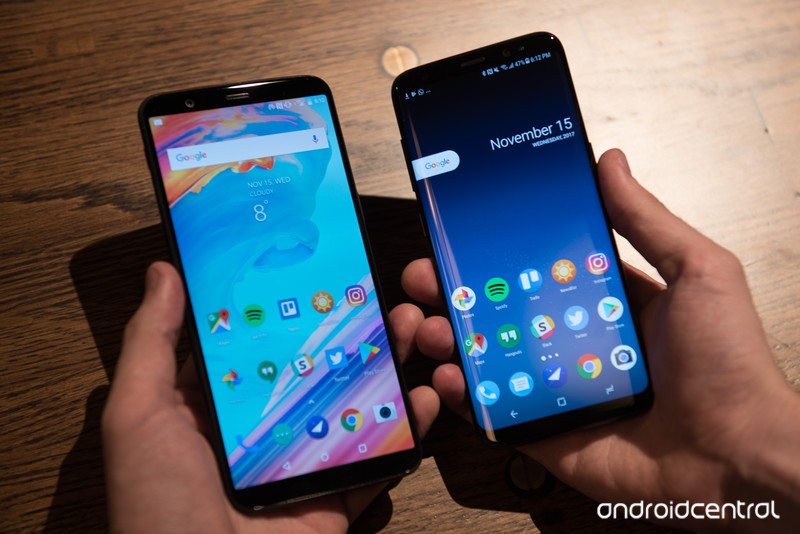
While it’s not a fair fight given the Galaxy S8 exacts a $200 premium over the OnePlus 5T, this comparison is more an exercise to see whether OnePlus can compete with the best phones out there today. The Galaxy S8 may be a few months old but alongside its larger counterpart, the Galaxy S8+, it’s by far the most popular and successful Android phone in the world.
To its credit, OnePlus hits a lot of the same notes for significantly less money, and while the camera continues to be the biggest sticking point, it’s good enough that a prospective buyer won’t feel short-changed.
OnePlus considers the 5T to be a slightly upgraded version of the 5, but essentially the same phone. When viewed that way, a $20 bump is a small price to pay for a larger screen, a great new face unlock feature, and the same awesome performance and software experience as before.
Who still wants a Galaxy?
See at OnePlus
OnePlus 5T and OnePlus 5
- OnePlus 5T hands-on preview: Relentless iteration
- OnePlus 5T specs
- All of the latest OnePlus 5T news
- Join the discussion in the forums
OnePlus
Amazon
Facebook adds live college basketball games to its Watch tab
Facebook has been getting more and more interesting content in efforts to build out its Watch tab, and now it’s added college basketball to the mix. The social network has partnered with Stadium, a multiplatform network for sports, to exclusively show 47 live college basketball games on Facebook Watch. It kicks off tonight, with Belmont at Middle Tennessee starting at 7:30 PM ET.
The games will be from conferences such as the West Coast Conference, Atlantic 10, Conference USA and Mountain West. Teams include Dayton, Saint Mary’s, Middle Tennessee State, Nevada, Florida Gulf Coast and Wake Forest. To add these games to your watchlist, you can visit the Live: Stadium College Basketball page under the Facebook Watch tab.
Facebook and Stadium teamed up this fall to show college football exclusively on Watch. The success of that partnership ensured that the two would partner again for basketball. But it’s not just games that are available on Facebook Watch. Stadium is producing a live weekly show about college basketball that will air exclusively on the Watch tab. This 30-minute show will air every Wednesday starting November 29th at 6:30 PM ET; it’s hosted by Dave Ross and Tim Dole, and will feature an ongoing dialogue with college basketball fans.
Apple Seeds Fourth macOS High Sierra 10.13.2 Beta to Developers
Apple today seeded the fourth beta of an upcoming macOS High Sierra 10.13.2 update to developers, less than one week after seeding the third beta and just over two weeks after releasing the macOS High Sierra 10.13.1 update.
The new macOS High Sierra 10.13.2 beta can be downloaded from the Apple Developer Center or through the Software Update mechanism in the Mac App Store with the proper profile installed.
It’s not yet clear what improvements the second major update to macOS High Sierra will bring, but it’s likely to include bug fixes and performance improvements for issues that weren’t addressed in macOS High Sierra 10.13.1.
No significant new features were discovered in the first three betas of macOS High Sierra 10.13.2, but we’ll update this post should notable changes be found in the fourth beta.
The previous update, 10.13.1, introduced fixes for some serious security flaws and brought new emoji to the macOS operating system.
Related Roundup: macOS High Sierra
Discuss this article in our forums
The best Nintendo Switch games
The Nintendo Switch is an excellent game console. If you don’t want to quit collecting Power Moons in Super Mario Odyssey but need a change of scenery from your living room, that’s entirely doable. Simply take the tablet out of its dock, slide your Joy-cons back on and you can pick up right where you left off, regardless of venue. But there’s so much more to play on Switch. The problem is, aside from the games you can buy at retail, they can be hard to find, because Nintendo’s digital storefront isn’t very well organized. Which is what our list of the best Switch games is for. Simply search for these games by name in the eShop and you’re guaranteed to have some fun.
AAA blockbusters versus indie darlings
At the end of the day, games are games are games, regardless of whether you downloaded them onto your device or bought them at a brick-and-mortar store. While The Legend of Zelda: Breath of the Wild and Mario Kart 8 have name recognition, indie games are chock-full of ideas and themes that might be too risky or experimental for a studio with millions of dollars on the line. And for now, at least, indies outnumber everything else on Nintendo’s latest console. The biggest difference is price. Splatoon 2 costs $60, while Stardew Valley will set you back only $15.
The Best Switch games
Mario Kart 8 Deluxe

Yes, Mario Kart 8 was great on the Wii U, and on the Switch it’s even better. Why? Because no matter where you are, so long as you have your Switch, you’re moments away from ruining someone’s day with a well-timed blue shell. Sure, you might’ve just handed them the Joy-con a few minutes earlier, but we could all use a few more frenemies in our lives. In addition to the portability, the Deluxe Switch version also packs in a smattering of new characters, karts and gameplay tweaks that weren’t in the original. All that is to say, yes, even if you owned it prior, it’s worth picking up again.
Splatoon 2

If you want an online multiplayer game on Switch, your best bet is Splatoon 2. It’s a brighter, better version of the shooter Nintendo created for the Wii U. Basically, it’s every squirt-gun war you had as a kid in video game form, except it stars mutant squid creatures (Inklings) that are at once terrifying and adorable. Unlike in other shooters, victory isn’t predicated on how many opponents you’ve killed. Instead, it’s all about how much of the arena you can cover in your team’s ink. If you’re used to playing a support role in games like Battlefield, you should be able to adapt pretty smoothly here, focusing on spreading your team’s colors while others train their sights on the opposing team.
Legend of Zelda: Breath of the Wild

Nintendo wasn’t joking when it said that for Zelda to survive as a franchise it needed to change, radically. Legend of Zelda: Breath of the Wild is the first game to alter the tried-and-true formula established by the franchise’s jump to 3D with Ocarina of Time in 1998. It borrows open-world and crafting elements from Western role-playing games like The Elder Scrolls V: Skyrim and blends them with something all too uncommon in modern games: respect for the player’s intelligence.
Wild expects you to learn by doing, not by its developers telling you how to do every last thing. The game world is absolutely gigantic, and around every corner there’s another mystery to explore, be it a challenge shrine to conquer or a pink-maned horse to tame. Yes, it’s also available on the Wii U, but that console is effectively dead, and besides, you can’t play it on your commute.
Super Mario Odyssey

Super Mario Odyssey sells the Switch within the game’s opening hour. Princess Peach has been kidnapped by Bowser once again and Mario has to travel across a multitude of diverse kingdoms to stop the unlawful union. He gets a new hat that allows him to possess enemies and use them to solve various platforming puzzles along the way. Moments later you’re controlling a T. rex, smashing through obstacles to unlock your first of many Power Moons.
Collect enough of those and you can move to the next kingdom and start the process over again. It’s a simple concept to grasp; coupled with Nintendo’s trademark charm and smart nods toward the series’ past, it immediately justifies buying the console. That Nintendo released this and Breath of the Wild in the Switch’s first year is impressive too — usually the company puts a few years between its big franchises; both of these games deserve to be in your library.
Mario + Rabbids Kingdom Battle

Getting strategy games right on a console can be tricky, but Ubisoft somehow married its adorable Rabbids franchise with Nintendo’s Mushroom Kingdom to great success. The result is the very X-com-ish Mario + Rabbids Kingdom Battle. Developing a plan of attack always feels satisfying, as does seeing how each party member’s (Mario, Luigi, Peach, etc.) disparate abilities work together. Seriously, watching an enemy get stuck in place on the battlefield because they crossed paths with Mario’s sticky-honey ability never gets old. The puzzle sections that bookend each battle level aren’t nearly as exciting as the main event, but the game is an otherwise perfect example of what can happen when two of gaming’s most recognizable universes mash up.
Thumper

“Rhythm violence” is an odd descriptor to throw around, but it really couldn’t describe Thumper any better. The trippy rhythm game has you coasting down a track as a scarab, banking off corners, jumping over spikes and “attacking” enemies by tapping the Switch’s face buttons in time with the music. It’s an awesome game when you’re on the go, but make sure you pack headphones and that you aren’t jostling around too much. One false move can send you back to the last checkpoint and reset your hard-won progress. Perhaps most impressive is that the game didn’t lose much going from VR headsets to Switch’s decidedly 2D version.
Super Beat Sports

As great as Rock Band is at parties, you aren’t going to want to whip out a plastic guitar on an airplane to kill time on your flight. Super Beat Sports takes developer Harmonix’s unrivaled beat-matching gameplay from its rock star simulator franchise, strips away the licensed music and replaces banging on plastic drums with clever and charming twists on stick-and-ball sports. Each of the five mini-games features local multiplayer for at least two people, and up to four people can play “Rhythm Racket” and “BuddyBall.” It’s a game that plays to the Switch’s core strengths as a fun, social platform, and proves addictive local multiplayer on the system doesn’t always have to involve go-karts and Italian plumbers.
Fast RMX

Describing Nintendo’s speed at releasing updates to its core franchises as “deliberate” is pretty generous. There hasn’t been a new entry in the futuristic racing series F-Zero since 2004, and even then, that was a Gameboy Advance title exclusive to Japan. Maybe that’s why the company has been keen to push Fast RMX, which is more or less F-Zero without Captain Falcon. The series got its start on the Wii U with Fast Racing Neo, and Fast RMX follows Mario Kart 8 Deluxe in that it’s an updated version of the original game with a boatload of additions. The first game’s downloadable add-on tracks are in tow, and a recent, free update added six new ones. Of course, four-player split-screen multiplayer is available, and racing online with up to seven other adversaries is an option too.
Stardew Valley

Of all the games on this list, Stardew Valley might be the most relaxing. Developer Chucklefish’s Zenlike farming simulator is a perfect chill-out game, offering the chance to plant crops, water them, take part in seasonal festivals, solve supernatural mysteries and even do a bit of spelunking if you’re feeling particularly adventurous. There’s something therapeutic about managing a virtual farm, getting your tract of land ready for spring after the long winter, picking vegetables, raising livestock and furthering relationships with fellow villagers. If Stardew sounds simple, that’s because it is. But not everything needs to have complex mechanics or crushing difficulty to prove its worth. No, sometimes all you need to unwind after a long day at the office is for Grandpa to hand you the keys to the family farm so you can rebuild it in your own image.
Spire’s health tracker sticks on clothes and never needs charging
Wearable fitness monitors promise a lot but research shows that nearly a third are abandoned in junk drawers because they’re too fiddly, require too much maintenance or users are simply forgetting to put them on. Health monitoring company Spire thinks it’s found the answer to these woes with the Spire Health Tag, the smallest ever fitness tracker that doesn’t need to be charged and never has to be taken off.
The tag — available in packs of three, eight or 15 — simply sticks onto the clothes you wear most often. It’s waterproof, so running it through the laundry is no problem, and its battery will last nearly two years. Just stick it on your gear and get on with your life. It measures all the usual metrics to provide personalized, real-time guidance for sleep and daily activity. For example, instead of simply telling you how many calories you burned at the gym, it’ll tell you how much quicker you’ll fall asleep as a result of that workout. And it monitors stress levels, thanks to respiratory sensors that measure breathing.
The tags are so discrete no-one will know you’re wearing them, which is great for people looking to work on their fitness without fanfare. Of course, this could be a downside for the people who enjoy bringing up their metrics at every possible opportunity (you know who you are). Prices range from $99 for a three-pack to $299 for a 15-pack.
OnePlus 5T packs a tall screen and upgraded dual cameras for $499
After more than a few leaks and not-so-subtle teasers, the OnePlus 5T is official — and it’s at once everything you expected and a bit more. The centerpiece, as you’ve no doubt guessed, is the 6-inch, 18:9 ratio 2,160 x 1,080 AMOLED display. The fingerprint reader is now on the back as a result of the taller screen, but it means a larger canvas for your apps and videos in a device that’s roughly the same size as its predecessor. It can auto-adapt to bright sunlight and other harsh conditions, and you can tune the display’s colors for accuracy (such as DCI-P3 or sRGB) or vividness. And thankfully, the trendy tall display isn’t the only improvement.
Most notably, the secondary rear camera packs a wider-aperture (f/1.7 versus the old f/2.6) secondary rear camera that should let in much more light. That tackles a core complaint about the OnePlus 5’s dual camera system — you no longer have to sacrifice photo quality at night just to zoom into your subject. This sensor combines pixels to improve low-light pictures, too. The other cameras haven’t changed, but this update still makes the 5T considerably more competitive if you’re a shutterbug.
The rest of the hardware is largely similar. You’re looking at a Snapdragon 835 processor, up to 8GB of RAM, 64GB or 128GB of storage and a Dash Charge feature that promises a day’s worth of battery in half an hour. OnePlus’ custom OxygenOS has received a facelift, though. In addition to tweaking the interface for the new screen, there’s a face unlock option (albeit not as sophisticated as an infrared system like Apple’s Face ID) and some behind-the-scenes improvements that should lead to faster updates.
Now for the big question: how much are you going to pay when the OnePlus 5T goes on sale November 21st? Unfortunately, there is a slight premium. The handset will start at $499 (£449) for a 64GB model with 6GB of RAM, or $20 more than the ‘plain’ 5. With that said, the recent surge of extra-expensive phones like the Galaxy Note 8 and iPhone X makes the 5T seem like a relative bargain. Yes, it’s ultimately a higher-end version of an existing phone (the Oppo R11s), but you might not complain given that you’re getting many high-end features for hundreds of dollars less than a typical flagship phone.
Source: OnePlus
OnePlus 5T hands-on: A slightly bigger, slightly better flagship
The OnePlus 5 isn’t that old, but it’s already been replaced. The company just unveiled its new flagship smartphone at a launch event in Brooklyn, and it’s understandably pumped about its new, almost-all-screen design. I’ve been playing with the 5T for a few days already, and it’s a shaping up to be a powerful, pretty machine that’s sure to make existing OnePlus 5 owners feel a little envious. If that’s you, well, you don’t need to feel too left out: In many ways, the 5T is still the same phone from earlier this year.
Frankly, it’s a little strange that the OnePlus 5T exists at all. The company set a precedent last year when it released the OnePlus 3 in June, and quickly followed up with the improved OnePlus 3T just months later. That’s essentially what happened here, but company representatives were quick to point out in conversation that the original plan was to focus solely on one phone — the OnePlus 5 — this year. You know what they say about best-laid plans. Note that this doesn’t mean OnePlus is committed to a two-phones-per-year strategy — it has never publicly committed to that. In this case, it just seemed like the company found the right big screen for the right price and said, “Eh, why not?”
And what a lovely screen it is. OnePlus went with a 6-inch, Samsung-made AMOLED panel surrounded by narrow bezels below it and on the sides. The amount of empty space around the panel is roughly the same as on the LG V30, so it’s no surprise that both are easy to grip. More importantly, the screen is bright and vivid enough that it’s easy to forget it runs at 1080p — for those keeping count, that works out to a 401-ppi pixel density. That’s a lower pixel density than what you’d get out of, say, a Galaxy S8 Plus, but the screen’s still crisp enough that you can’t spot individual pixels so the trade-off hasn’t left me wanting. Still, OnePlus says the decision to stay at 1080p mostly came down to power and performance considerations, though it’s worth noting devices like the S8 Plus handled the jump to 2K just fine. Maybe next year.

Chris Velazco/Engadget
The screen is definitely the biggest change to the OnePlus formula, but the tweaks don’t end there. Since there’s no longer room for a fingerprint sensor under the screen, OnePlus moved it to the back. This won’t sit well with some people, but I actually prefer this setup even if it requires you to pick up the phone to unlock it. (It helps that the fingerprint sensor is still super fast.) To mitigate some of the potential blowback surrounding this decision, OnePlus also whipped up a handy “Face Unlock” feature.
Just to make it absolutely clear, this is a much less secure way to unlock the 5T. There’s no clever technical trickery here, and no iPhone X-style infrared camera. Instead, the setup process has you staring at the screen while the phone uses its front-facing camera to spot “over 100” facial points it’ll use to identify you going forward. I haven’t been able to fool the feature with a picture of myself (yet), but it’s at least theoretically possible. And beyond that, the lack of any additional hardware to power Face Unlock means the feature doesn’t really work in the dark.

Chris Velazco/Engadget
This isn’t exactly an ideal solution, but it is a very fast one. Unlocking the 5T with my face was essentially instantaneous; most of the time, it felt like I was unlocking a phone with no security measures at all. Face Unlock’s performance is as impressive as it is convenient, and that’s exactly what the company was going for. You can’t use your face to authenticate Play Store purchases or anything; situations like that still require you to use the more secure fingerprint sensor.
OnePlus also made some tweaks to its dual camera, though it’s sometimes hard to tell. Once again, the 5T combines a 16-megapixel main camera and a 20-megapixel secondary camera, and that latter sensor got most of the attention. It now has an f/1.7 aperture to match the main shooter and is meant mainly to improve the phone’s low-light camera performance. When things around you get dark, the phone switches into that second camera that combines multiple pixels into one, all in an attempt to make pictures look brighter than they otherwise would have. The difference is noticeable, but I wouldn’t call it a game-changer.

So far, the photos I’ve taken with the 5T have been pretty good — I’m especially fond of some of the blurry-background portraits I’ve shot — but many shots are soundly outclassed by those captured with rival smartphones. Don’t get me wrong, improved low-light performance is always a good thing and the 5T is occasionally capable of excellent photos. It’s just that we’ve seen some truly incredible smartphone cameras this year. I’ll need a little more time with the phone to see how well it stacks up against the competition.
Other than that, the 5T is almost identical to the phone it replaces. It’s just a hair thicker, longer and wider than the 5, but these gains are so incremental they’re completely unnoticeable. And yes, those eagle-eyed phone fiends were right: The 5T bears a striking resemblance to other devices, especially Oppo’s R11S. OnePlus admits that it “leverages” the Oppo supply chain when it benefits the company, but insists that any similarities are purely coincidental. I’ll let you be the judge of that.

Chris Velazco/Engadget
Unlike last year’s 3T, which boasted a faster chipset than the 3, the OnePlus 5T uses the same Snapdragon 835 chipset as its predecessor. It’s available in the exact same configurations, too: 6GB of RAM with 64GB of storage, or 8GB of RAM with 128GB of storage. I’ve been working with the latter, and there’s no difference in performance between the OnePlus 5 and 5T. That’s mostly a good thing since the original 5 was already super-snappy, and the reliably clean version of OxygenOS (based on Android 7.1.1) definitely helps keep everything moving remarkably smoothly. While it’s sort of a bummer that a phone launching this late in the year doesn’t run Android 8.0 Oreo, OnePlus says a beta build of OxygenOS running on Oreo will be available by the end of 2017. (We’ll see about that.)
Also unchanged is the 5T’s battery — it’s the same 3,300mAh cell that was used in the 5, and in general I’ve easily been getting more than a full day’s use out of it before needing a recharge. That the 5T’s battery life is seemingly very close to the 5 is a pleasant surprise; I thought for sure I’d see the runtime take a bigger hit thanks to that bigger screen. That said, I haven’t put the phone through the full review wringer yet, so it’ll be a little while before the real differences in power consumption become apparent. If nothing else, OnePlus’s Dash Charging system still works well. Ten minutes of charging typically netted me an extra 15 and 20 percent of battery life, while fully charging a bone-dry 5T took about an hour.
I have a lot more testing to do before rendering a final verdict on the OnePlus 5T, but it feels like this is the device OnePlus 5 should’ve been in the first place. There’s nothing to be done about the past, though, and the 5T feels like a worthy successor to the 5 in just about every way that matters. Basically, your holiday smartphone shopping decision just got a little harder. That said, OnePlus still has its work cut out for it: There’s some lingering distrust among some users from when the company seemingly meddled with benchmark results, not to mention recent concerns about software snooping. We’ll soon see if the OnePlus 5T is enough to get smartphone fans feeling the faith again.
Create Instagram stories in your phone’s web browser
You don’t have to install Instagram’s app to create stories on your phone. The photo-centric social network is adding support for posting stories directly from your browser. You have to be content with still photos and text overlays (no video or clever filters here), but this gives you a way to join in the action when you don’t have room for the app or just don’t care to use it.
Also, the Pinterest-like ability to save posts is coming to your phone’s browser. If there’s a travel destination or savory meal you want to remember for late, you can bookmark posts and visit all your saved examples.
These features will take a few weeks to reach everyone, so don’t be disheartened if they aren’t available right away. When they do, though, the mobile web version of Instagram will be considerably closer to its native app version. There are still clear reasons to download the app if you can (receiving notifications and posting video in particular), but there isn’t as much of a rush as there was in the past.
Source: Instagram
Tidal is the latest music service to add direct control for Sonos
Sonos’s direct integration with Spotify is an incredibly convenient feature for subscribers to the streaming service. Rather than having to control music through the (somewhat clunky) Sonos app, users are able to stream to their Sonos speakers directly through the Spotify app. That same integration arrived for Pandora this week, and now, Tidal has announced that it now supports direct control with Sonos.
Music lovers can now enjoy the 51 million songs, 195,000 videos and more via TIDAL direct control with @Sonos. Learn more on https://t.co/4B5472I4tw pic.twitter.com/cfO4vZ1ODI
— TIDAL (@TIDAL) November 16, 2017
It’s great news for anyone who subscribes to Tidal and also has Sonos speakers in their home. The addition of direct control for Tidal leaves Apple Music subscribers in the cold, but when support for Airplay 2 arrives in 2018, it seems that the most popular music streaming services will be on relatively even footing with Sonos’ hardware.
Source: Twitter
 AIVAnet