


Amazon UK slashes the price of Echo ahead of Black Friday

Save big on the Amazon Echo and Echo Dot.
Both the Echo and Echo Dot are handy connected devices that allow you to run a wide array of commands with nothing but your voice. To provide something to customers to tie them over until Black Friday deals hit the UK, Amazon has discounted both Echo speakers allowing you to save up to 30 percent.
This brings the price of the Echo and Echo Dot down to £69.99 and £34.99, respectively. If the promotion wasn’t enough, Amazon is selling the TP-Link Plug for just £9.99 (usually £29.99) when bought with any Echo device. Now it’s really easy and affordable to create a connected home.
See Echo at Amazon See Echo Dot at Amazon
Ring Doorbell Pro is easily worth $200, so you should definitely buy it at $100
The Ring Doorbell is one of the best smart home products at full price — at half off, it’s an amazing deal.
Five years ago, I optimistically spent $170 on a connected doorbell from a hardware startup with dubious credibility and no success stories. That product, DoorBot, eventually shipped, but I never could get it to work. I wrote it off as the cost of doing early adopter business and forgot about it. (It’s still in a drawer somewhere.)

Two years later, I heard that the company behind DoorBot, Edison Junior, was rebranding to Ring and it was going to release an updated version of that poorly-received initial project, the Ring Doorbell. I was skeptical.
Then the reviews started rolling in, and they were so positive I threw caution into the wind a second time and bought one. When I moved into my new house in early 2016, I ripped off the old analog bell, installed a Ring, and sort of forgot about it. It worked as a doorbell that would ping my phone whenever someone was there. Cool. Thing is, I was home — I could hear the bell myself and wasn’t about to sit on my butt checking the camera in my doorbell when I could walk to the front door and look through the peephole.
A few days later, I was out of the house at a meeting and right before I walked through the door to the building, my phone pinged in my pocket. It was the Ring app telling me someone was at my door. I opened the app and in a couple seconds, I was staring at the FedEx guy, asking whether he could leave the package with a neighbor. It was a short conversation — maybe 10 seconds — but it was life-changing. The Ring hardware, the app, the LTE connection — it all just worked. It just worked. I was hooked.
To say the Ring Doorbell has changed my life would be an understatement. To say it is the most reliable piece of smart home tech I own would not be an exaggeration. I love this product. I regularly answer the door from other countries (I did so today, from New York City) and it feels like magic.
I recently got a Ring Doorbell Pro as an upgrade to my older model. Slimmer and more stylish, it also films at 1080p, and thanks to improvements in power transfer, is much faster to connect. I’ll be sharing my thoughts about it in the coming weeks, but suffice it to say, I would spend $200 on this thing.
Thankfully, you can get one for half that amount. Until Friday, November 18, as part of Thrifter’s ongoing Black Friday doorbuster deals, you can get a Ring Doorbell Pro for $99.95. Because quantities are limited, you need to apply for the chance to buy it at that price, but it’ll just takes a few minutes, and it’ll be worth — promise.
Thrifter Black Friday Doorbuster: Ring Doorbell Pro for $100
Accessibility Services: What they are and why Google is cracking down on their misuse
A lot of your favorite apps might use Accessibility Services for certain features, but this is why Google’s new limitations on them are important.
There are a lot of moving parts to all of our favorite applications. You might not think about this when scrolling through your timeline on Twitter or watching videos on YouTube, but the amount of stuff going on behind the scenes to make all of these apps work the way they’re supposed to is actually pretty incredible.

Certain apps like LastPass, Tasker, and Clipboard Actions tap into Android’s Accessibility Services to allow for deeper features that otherwise couldn’t exist, but Google recently announced that applications using them without directly benefiting those with disabilities could be removed from the Play Store.
Accessibility Services are an interesting tool, and to get a better idea of what exactly is taking place here, we need to take a closer look.
What are Accessibility Services?
Accessibility Services are found within Android and allow phones and tablets to be easier to use by those with disabilities. When you go to the Accessibility settings page on your Android device, you’ll see an array of controls that Google has enabled by default. Some of the items here include the likes of tapping items on your screen to have your device read them out to you, spoken feedback that reads aloud all of your actions, increasing the size of items on the display, etc.
As expected, the general theme here is to make Android easier and simpler to use for people that need some extra assistance.
In addition to the services that are built into Android by default, developers can tap into Accessibility Services with their own apps to create new features that take advantage of them. On the Android Developers site, Accessibility Services are described as follows:
Accessibility services should only be used to assist users with disabilities in using Android devices and apps. They run in the background and receive callbacks by the system when AccessibilityEvents are fired. Such events denote some state transition in the user interface, for example, the focus has changed, a button has been clicked, etc. Such a service can optionally request the capability for querying the content of the active window. Development of an accessibility service requires extending this class and implementing its abstract methods.
Why some apps use them
Although the main goal of Accessibility Services is to allow developers to create tools targeted at individuals with disabilities, we’ve seen a number of apps over the years that have tapped into this resource to create expanded features that can technically benefit everyone.
Android’s pre-installed Accessibility Services are all targeted at people with disabilities, and for a reason.
Accessibility Services can be used legitimately, but that, unfortunately, doesn’t always happen.
For example, LastPass’s App Fill reveals an overlay on top of whatever screen or other app you’re on so you can easily add username and password information without having to open up the full LastPass application. Clipboard Actions also taps into Accessibility Services so you can more easily manage links you’ve copied and take action on them without having to be in the full Clipboard Actions app.
This is a method that developers have been using for quite some time now, and while it technically works, it does create for vulnerabilities that Google doesn’t like to see.
Google’s reasoning for the new limitations
As great as Accessibility Services can be when used legitimately, it’s also possible for the service to be used maliciously. Apps that use Accessibility Services open up greater security threats than ones that don’t, and this leaves devices at risk for attacks.
Shortly after Google announced the decision to limit applications that can use Accessibility Services, it was discovered that the change was likely connected to a “toast overlay” attack that had been discovered by security firm TrendMicro. Essentially, the toast overlay attack allows malicious apps to display images and buttons over what should really be shown in order to steal personal information or completely lock users out of their device.
Apps using this toast overlay attack have since been removed from the Play Store and a patch with the September Security Bulletin resolves the vulnerability, but this is just one example of how an app tapping into Accessibility Services can cause serious damage.
The future is APIs
Apps that are using Accessibility Services to help the disabled in legitimate ways will continue to exist, but for those that aren’t targeted at this specific demographic, Google has a solution – APIs. In the example of LastPass, the new Autofill API with Android Oreo allows LastPass to offer similar functionality to its Auto Fill feature without having to use Accessibility Services.
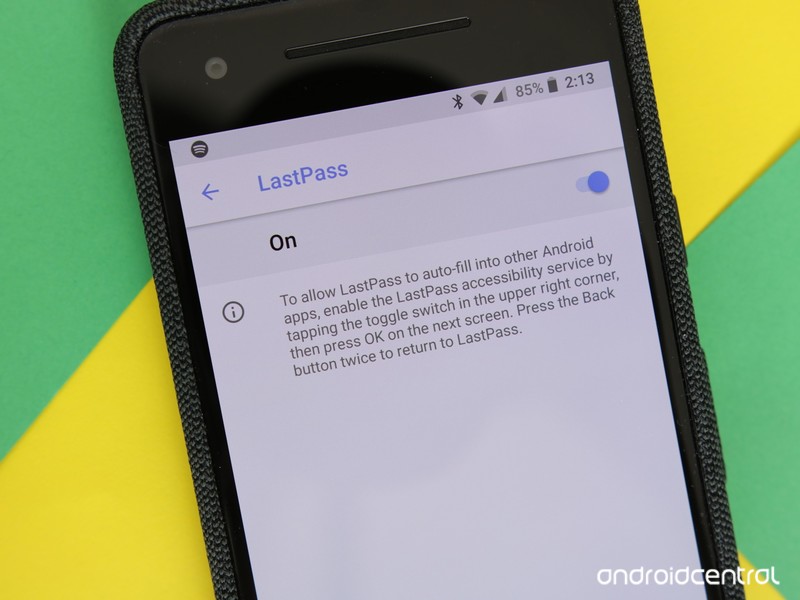
APIs allow for similar (and often better) experiences than what hacky dev tricks can produce.
This does mean that users need to be running newer versions of Android to access all of the features of some of their favorite titles, but at the end of the day, your functionality is remaining while also cutting down on possible security risks.
We understand the annoyance that some users have towards this change, but when looking at it from Google’s perspective, it’s a move that just makes sense. Accessibility Services were never intended to be used for a large portion of the ways that certain devs are tapping into them, and it’s something that Google needs to crack down on.
At the end of the day, once apps get updated to support Google’s numerous APIs, we’ll get similar features with greater protection from attacks. What more could you ask for?
Android Oreo
- Android Oreo review!
- Everything new in Android Oreo
- How to get Android Oreo on your Pixel or Nexus
- Oreo will make you love notifications again
- Will my phone get Android Oreo?
- Join the Discussion
The Morning After: Wednesday, November 15th 2017
Hey, good morning! You look fabulous.
Welcome to Wednesday. Firefox Quantum is here, and it may be time to consider a browser switch. Also, we have a few reports from the Engadget Experience and first impressions of HTC’s new VR headset.
A promising start.HTC Vive Focus hands-on

Richard Lai stuck his head inside the latest VR headset from HTC to try out its wireless 6DoF (six-degree-of-freedom) experience. While the Vive Focus may lack Google Daydream hooks, it does have “world-scale” inside-out tracking. It’s lighter than the original Vive while including a high-res AMOLED screen and Snapdragon 835 CPU. The tracking worked well in “less intensive” apps; however, it was apparent that developers didn’t have much time to port their experiences over. We’ll learn more about the Vive Focus as it gets closer to release, but there’s already a lot of potential here.
No, *your* hands are feet.Alternate Realities at The Engadget Experience

The Alternate Realities grant program at yesterday’s Engadget Experience event resulted in the debut of several immersive art projects. Even if you couldn’t make it, there’s plenty to learn about Dinner Party, Untrained Eyes, Dance With flARmingos and Your Hands Are Feet.
Lucky number 57.Firefox Quantum arrives

Mozilla claims its newest browser is over twice as fast as the version from 6 months ago thanks to both a new, multi-core CSS engine, tab prioritization and the elimination of bugs that were weighing the software down.
A hot take straight out of Moria.Amazon’s ‘Lord of the Rings’ prequel will need to forge its own identity

Bezos & Co. have some big decisions to make about what kind of Lord of the Rings story their new TV show will tell. According to Nathan Ingraham, “the series needs someone at the helm who lives and breathes Tolkien.”
Remember RIM?Can Tesla avoid becoming the BlackBerry of electric cars?

Tesla’s juggling production hell, harassment lawsuits, and increased EV competition from traditional automakers. That’s why Roberto Baldwin says the company “needs to focus less on car innovation and more on improving its manufacturing” to remain at the forefront.
But wait, there’s more…
- Oops: OnePlus inadvertently left a backdoor on its phones
- GameStop halts its PowerPass unlimited used game rental program
- CompuServe’s still-active forums are finally shutting down
- Why your favorite indie game may not get a boxed edition
- Apple’s 2019 iPhone could have a rear-facing 3D sensor
- Uber now locks in the fare for your scheduled ride
The Morning After is a new daily newsletter from Engadget designed to help you fight off FOMO. Who knows what you’ll miss if you don’t Subscribe.
Craving even more? Like us on Facebook or Follow us on Twitter.
Have a suggestion on how we can improve The Morning After? Send us a note.
Google adds salaries to its job search tool
Google already has some tools to help you find a job, but there’s been a missing ingredient: salaries. How do you know whether or not it’s worth pursuing a new role short of visiting another website? You shouldn’t have to worry much longer. Google is adding a suite of new job search tools, most notably salary info. In many cases, Google will display estimated salary ranges plucked from multiple sources (including Glassdoor, LinkedIn and PayScale) whether or not the listing itself mentions pay. If a position represents a big raise, you’ll know very quickly.
The updated search also lets you narrow the available jobs to within a specific distance. And if you’re ready to apply, you can choose where you submit your application if there’s a choice. That’s particularly helpful if you already have a profile at a favorite career page and would rather not spend ages recreating it somewhere else.
Google’s tool should become more useful for job hunts in the future, too. In a “couple of weeks,” you’ll have the option to save jobs inside Google search. You won’t have to bookmark them all or mark them as favorites at other sites. Between this and the other additions, it’s evident that Google wants to be a central destination for job search help. It won’t completely replace job search or salary sites, but you won’t need to visit them as often.
Source: Google
Channel 4 is making All 4 accounts mandatory early next year
Channel 4 is going the way of the BBC early next year, when it will begin forcing users to sign up for an All 4 account in order to access the catchup service. No doubt, like the BBC, this will give Channel 4 the opportunity to better tailor the All 4 experience to the individual. But switching accounts from optional to mandatory isn’t without an ulterior motive. Just as the BBC peeks at user data to catch out licence fee dodgers, Channel 4 will utilise it to serve targeted ads to nearly every All 4 streamer, whether they be watching on a phone, tablet, console or smart TV.
“From next year every All 4 advertising opportunity will be personalised or targeted,” said Channel 4 exec Jonathan Lewis. This won’t apply to the All 4 service on Sky and Virgin boxes, though, since Channel 4 doesn’t directly control those platforms. The broadcaster has its own ad format that literally calls the viewer out by name, but don’t expect every targeted ad to be this obvious. If you have an All 4 account you use regularly, chances are Channel 4 knows your location, age, gender, interests and viewing habits by now, meaning you’ve seen your fair share of personalised ads already.
Channel 4 isn’t just looking at serving targeted ads online, but to linear TV viewers too, and is looking at a range of potential partners including Sky. The pay-TV provider has its own technology called Adsmart, which paints a very detailed picture of individual households using data on income, family status, spending habits and even pet preferences. Marketers then use this to push certain ads at very specific audiences, delivered straight to their Sky boxes.
Source: Channel 4
SpaceX is launching a secret mission called ‘Zuma’
On November 16th, between 8PM and 10PM Eastern, SpaceX is sending a secret payload called “Zuma” beyond our atmosphere. The aerospace corporation test-fired a Falcon 9 rocket on November 11th with the intention of launching the mission on the 15th. While the latest target date was moved by a day, and it could be delayed again, Zuma needs to launch by November 30th. Why it absolutely needs to be in position by the end of this month isn’t clear, though — not when we know next to nothing about the mission.
According to Space, SpaceX is launching the payload, which was commissioned by defense technology company Northrop Grumman, for the US government. The publication tried to find out more about it, but a Northrop rep only had one thing to say: the payload is restricted. As Florida Today said, SpaceX is no stranger to launching top secret missions, including a spy satellite for the National Reconnaissance Office and another payload for the Department of Defense. However, no government agency has admitted to be the brains behind Zuma this time.
We do know, though, that the secret payload is headed to Low Earth Orbit and is blasting off from Kennedy Space Center’s historic 39A Launch Complex. SpaceX will also attempt yet another landing and will guide the rocket’s first stage to a landing site at Cape Canaveral. While Zuma is shrouded in mystery, you can at least watch it leave Earth live via SpaceX’s webcast.
Source: Space, NASA Spaceflight
Apple Agrees to Help India With Anti-Spam App After Initially Refusing Due to Privacy Concerns
Apple has agreed to help the Indian government develop an anti-spam app for iOS devices, after initially refusing to do so because of privacy concerns, according to Reuters.
In early September we reported that the Telecom Regulatory Authority of India (TRAI) attempted to get its Do Not Disturb (DND) software on the App Store. The app lets users share spam call and text message logs with the agency, which then sends the data to mobile operators for them to block the spammers.
Apple originally told regulators that the DND app violates its privacy policy, however today’s report suggests the tech giant has had a change of heart.
Facing public criticism from the regulator, Apple executives flew to New Delhi last month and told officials the company would help develop the app, but only with limited capabilities, according to a government official aware of the matter.
Apple’s executives have told India that its current iOS platform might not allow for some of the government’s requests, such as making call logs available within the app that would allow users to report them as spam, the official said.
According to Indian officials, Apple has offered to help develop an app that can solve the regulator’s requirements “to an extent”.
Meanwhile, an Apple spokesman has confirmed that the new iOS features to combat spam text messages would help the government build the app, but he didn’t comment on the app’s potential inability to access call logs for reporting spam. The spokesman also underlined the fact that Apple had not changed its stance on privacy.
Marketing cold calls and unsolicited commercial text messages have become a big problem in India. Mobile users have the option to register themselves under a “do not disturb” service to block marketers, but businesses have gamed the system by using multiple phone numbers for promotions, according to Reuters. TRAI’s Do Not Disturb app has been available on Android since last year and has been downloaded more than 100,000 times.
Before the app launches, it asks the user to allow it access to contacts and view text messages. Users can then start reporting numbers as spam. This kind of access has evidently concerned Apple. “The app can peep into logs, Apple had conveyed that their (privacy) policy does not allow this,” said a cited industry source familiar with the matter. Those concerns prompted Apple to ask for talks with state regulators, but the proposal has apparently frustrated officials.
“The whole exercise in organizing the proposed meeting would be a waste of resources … please share concrete solutions that have a likelihood of addressing the issues we have been discussing over the past one year,” the regulator wrote in September.
Later the same month, Apple told TRAI it had identified potential solutions, but that it would need to have further discussions with the regulator’s technical staff. Those discussions are said to have taken place in October, with Apple subsequently confirming that it would help develop the first version of the app with limited features.
Apple has been in talks with the Indian government to open retail stores and to gain permission to sell used iPhones imported into the country. The company is also seeking economic concessions including tax breaks as it sets up local manufacturing plants there, but those efforts could have been negatively impacted by Apple’s refusal to approve the anti-spam software.
Tag: India
Discuss this article in our forums
After a Year-Long Delay, the Nokia Steel HR Hybrid Smartwatch is Now Available for Pre-Order
Nokia has announced that its Steel HR hybrid smartwatch will ship in time for the holiday season, almost a year after it was supposed to launch under the Withings moniker.
The watch was first announced in September 2016, but its scheduled launch the following month never happened as Nokia began negotiating its takeover of Withings, which was eventually finalized in June.
Shortly thereafter, Nokia relaunched several Withings products under the Nokia brand, including the Nokia GO and Nokia Steel watches, as well as Nokia BPM+ and Nokia Body+ connected devices.
The Steel HR finally joins the existing line-up and will be available in 36mm and 40mm case sizes. It features a simple and stylish analog watch face with unobtrusive digital meters for tracking heart rate and movement over the course of the day. In addition, the watch features automatic and learned activity tracking for over 10 activities, a comprehensive sleep monitor, and text, call and event alerts.
Nokia says it has also made some software improvements to the smartwatch since its Withings iteration, including an improved heart rate algorithm to ensure more accurate tracking. A design change has also been made that replaces the face with sapphire glass to guarantee up to 50 meter waterproofing.
The Steel HR syncs with the Nokia Health Mate iOS app, costs $179.99, and is available to pre-order from the Nokia website in either black or white.
Tags: Withings, Nokia
Discuss this article in our forums
Drones are helping French traffic cops to catch hundreds of dangerous drivers
While Amazon’s vision of cops going around with shoulder-based “assistant drones” may be something for the distant future, their French counterparts are wasting little time in utilizing the remotely controlled flying machines in their daily duties.
Working in Bordeaux in the southwest of France, police are using their multi-rotor eye in the sky to catch road users breaking the law. The trial started in the summer and since then its drones have led to the handing out of “hundreds” of fines for traffic violations, Marketplace reports.
The camera-equipped flying machines provide live-streams to police on the ground, allowing them to survey wide areas in the hunt for dodgy drivers. When they spot one, they use the drone’s camera to track the vehicle before sending in traffic cops to pull the driver over.
Police captain Pascal Gensous told Marketplace that the operation in Bordeaux can result in between 15 and 20 vehicles being stopped every hour.
The report notes that while the technology is proving useful for pinpointing unsafe drivers, it doesn’t yet have the ability to detect vehicles breaking the speed limit, though roadside cameras can still take care of those kinds of violations.
Those opposing the French police’s use of drones include Pierre Chasseray of the lobby group Forty Million Drivers, who fears that some motorists will now be taking their eyes off the road and looking skyward to see if they can spot one of the aerial surveillance machines. But the government is reportedly interested in expanding the system to other parts of the country.
The U.K. has a 24-hour drone unit
France isn’t the only nation where police are experimenting with drone technology. In the U.K., cops in the southwest of the country recently set up the country’s very first 24-hour drone unit.
The unit is currently using DJI Inspire drones with powerful thermal imaging and zoom cameras attached. They can be used for a variety of tasks, including helping with missing person searches, gathering images from crime scenes and traffic accidents, and monitoring coastal and woodland searches to fight wildlife crime.
“Drones can even help police track and monitor suspects during a firearm or terrorist incident, as it will allow officers to gain vital information, quickly [and] safely, and allow us to respond effectively at the scene,” one of the unit’s officer’s said recently.
A couple of years ago, police in the Indian city of Lucknow took the controversial step of modifying a drone so that it could fire pepper spray at protesters. It’s not clear if the drone was ever used, though perhaps its mere appearance above protesting crowds was enough to maintain order at rallies in the city.
Drones are becoming increasingly popular among law enforcement and emergency units in the U.S., too. A report in April by New York’s Center for the Study of the Drone found that nearly 350 police, fire, and emergency units have brought in drones in the past eight years, nearly half of them doing so in the previous 12 months.
Privacy and safety concerns have hindered the incorporation of drones into the work of some law enforcement units, but over time these remotely controlled copters, and other incoming technology, are expected to be used more widely in the fight against crime.
Editors’ Recommendations
- 9 high-tech examples that prove Dubai is the world’s most futuristic city
- The best radar detectors you can buy
- AI could help stop people from dangerously texting and driving
- Drones can help when disaster strikes, but only when they’re allowed to
- Want a drone to deliver your online purchases? Move to Iceland
 AIVAnet