


A mirror exposes AI’s inherent flaws in ‘Untrained Eyes’
In July 2015, Google’s public-relations machine was in full-on crisis mode. Earlier that year, the search giant announced Photos, an AI-driven app that used machine-learning to automatically tag and organize your pictures based on the people, places and things depicted in them. It was an exciting step forward, but Photos wasn’t perfect. While the app was capable of recognizing some faces, it mistook others. It would have been easy to pass this off as a routine software bug if it weren’t for the nature of the failure.
Untrained Eyes was made possible through funding from the Engadget Alternate Realities grant program, established in May 2017. It will debut, along with four other prize-winning immersive-media projects, at the Engadget Experience on November 14th, 2017. For more information about the Engadget Experience, the grant program and the grantees visit our events page, and click here to buy your ticket to the event before they run out.
In at least one case, Photos automatically tagged a black couple as gorillas. When the news went global, there was one question on everyone’s minds: How could this happen?
Google pegged the issue on the failure of its image-recognition software to adjust for obscured faces and bad lighting. Others blamed it on algorithmic bias, or the tendency for developers to let their prejudice and often limited life experiences come through in their code.
@jackyalcine skin tones and lighting, etc. We used to have a problem with people (of all races) being tagged as dogs, for similar reasons.
— (((Yonatan Zunger))) (@yonatanzunger) June 29, 2015
The concept of algorithmic bias is the focal point of Untrained Eyes, a new interactive sculpture from conceptual artist Glenn Kaino and his frequent collaborator, actor Jesse Williams (Grey’s Anatomy). When I visited Kaino’s East Side studio — one of two in Los Angeles — the project was a functioning, albeit unrefined, prototype. At the time, it was a mess of laptops, wires and household electronics, but when it’s complete it will be a monolithic sculpture of reflective glass.
From a distance, the piece looks like a long decorative mirror, but when a viewer approaches and waves at his reflection, a Kinect sensor behind the glass triggers a small home-security camera to take a picture. The picture will be uploaded to a server where facial-recognition software “matches” the viewer’s face to images in a curated database. The resulting “reflection” is basically an approximation of how the computer sees you. It’s a simple interaction that takes seconds, but the underlying message is multilayered.
Kaino and Williams wanted to reveal how something as seemingly innocuous as a Google search can expose algorithmic bias. Kaino points out that searching for “man” on Google Images surfaces page after page of white men in business suits, looking confidently into the camera, while a search for “woman” brings up a grid of white women in various stages of undress. Untrained Eyes sheds a light on issues of representation, forcing the viewer to confront how a computer, and by extension, an unknown programmer, sees them.
“One’s subjective lived experience naturally biases their work,” Kaino said. “I think it is possible, however, to create a consciousness about our general instinct to be biased and to actually create systems and put systems in place to counteract what might be negative signifiers that are created because of bias. So humans will always be biased, but if we can create a level of consciousness that bias exists, then at least we’ll have an opportunity to create systems that are just and understand the notion of what equality means.”
In a room parallel to Kaino’s workshop, a large mirrored panel sits atop a pair of sawhorses. Kinect sensors and off-the-shelf security cameras litter the space where his tech team — made up of colleagues from his time as senior VP at the Oprah Winfrey Network — refine the image-recognition and motion sensors that drive Untrained Eyes. Just one month out from its debut, it is still an assemblage of wood, wires and mirrors. It’s hard to envision what it will ultimately look like, but Kaino is unfazed. The art, to him, is in the data.
“I think, now, people make the assumption that complicated technologies operate as simple as calculators, and they don’t realize the algorithmic apparatus that it takes to actually create technologies to do things like put things up on social-media feed or calculate insurance rates and risk,” he said. “What they don’t necessarily understand is that, within that, the nuance of the engineer coder person, who’s actually ascribed their lived experience into the code, has created and embedded these assumptions deep into the fabric of the technology.”
It was important to Kaino that his team have control over the image-gathering process instead of tapping into an existing repository like Getty or Google Images, so that they could experience first-hand the creation of algorithmic bias. The team started with an image of Kaino in order to test the facial-recognition software. With that in working order, they trawled the internet for images that fit descriptions of his team members for further internal testing.
When it was clear the machine was operating the way they’d hoped, they compiled a list of attributes like hair color and length, approximate age, eye color, skin color, ethnicity and so on. In order to expand the dataset and expose the biases inherent in data collection they then outsourced image-gathering to anonymous proxies. There were no limitations on where or how the images were procured.
That anonymity and the differences in process from one image gatherer to the next allowed for imperfections in the system and an accumulation of invisible biases. He likens it to an open-source library where a well-intentioned developer could unwittingly duplicate biased code.
“The notion that we’ve been through this process and these challenges and created this imperfect dataset, from our sense, it’s great,” Kaino said. “In that case, I’d say this project is intended on being a failure of representation.”
Failures of representation feature prominently throughout Kaino and Williams’ collaborations. Kaino is a world-renowned conceptual artist whose works exploring race, power, justice, violence and technology have appeared at the Whitney Biennial, the Andy Warhol Museum and the Museum of Contemporary art in Los Angeles, among others. Meanwhile, Williams, best known for his role as Dr. Jackson Avery on Grey’s Anatomy, has used his celebrity to draw attention to racial injustice through projects like the documentary Stay Woke: The Black Lives Matter Movement.
From their GIF keyboard with a social conscience, Ebroji, to their upcoming documentary about gold-medalist Tommie Smith’s raised fist of defiance at the 1968 Olympics, the two draw on their experiences as minorities while attempting to create positive representations for their communities. According to Williams, the act of collecting the dataset for Untrained Eyes, allowed them to wrest control of representation from the usual suspects.
“We’ve relied on and pulled from everybody else’s or the most popular dataset for our whole lives,” Williams said. “That’s what got us into this mess, frankly, is letting everybody else kind of compile the default, the go-to, the blank canvas — whiteness as default, whiteness as neutral setting to build from, as the start mark. And that’s just not our reality.”
Untrained Eyes may not be a wall of whiteness like the Google Images results Kaino references, but it’s confronting nonetheless. There’s something playful about approaching a mirror, waving at yourself and having a stock photograph reflected back at you in front of an audience. Time after time during my two-day visit, I watched as members of Kaino’s team and our own crew approached the mirror.
Amidst the laughter and exposed insecurities that lingered in the air, I found myself staring at what I imagined was a Creative Commons photo titled “man with long hair.” His nose was a little smaller, his face was a bit thinner and his mane just a touch more lustrous than mine, but we could be described the same way. Still, I couldn’t accept that he looked like me.
I kept coming back to a question Kaino presented on our first day at the studio: How did it come up with that? But I know the answer. It’s simple. Someone taught it.
“I think of those machines as children in some way,” Williams said. “We’re establishing some kind of root foundation. If a 5-year-old kid says something racist or sexist or homophobic to her classmate, she got that from somewhere. She wasn’t born with that. She got that from somewhere.”
Google extends Files Go offline sharing app beta to more users
A few days ago, Google briefly published a new app called Files Go on the Play Store. It was quickly removed, but it looked to be a file-transfer app focused on the Android Go initiative that Google announced back at I/O earlier this year. Today, Google made things official — Caesar Sengupta, VP of Google’s “Next Billion Users” team, tweeted that the app was again available “for a few more” users.
Looks like some of you found our Files Go Beta 🙂 We thought we’d make it available for a few more of you on the Play Store. Feedback welcome! https://t.co/qXLb1V0bKu
— Caesar Sengupta (@caesars) November 9, 2017
A big part of Android Go is a focus on slimmer, less data-hungry apps that’ll work on a wider variety of hardware, including the less expensive and less advanced devices that are popular in countries around the world. As such, Files Go helps users get the most out of their phone’s storage. It recommends apps that aren’t used often for removal, helps get rid of “spam and duplicate images” and helps users find everything on their phones by file type. The app also lets users files between phones without an internet connection, although it’s still not totally clear how that works just yet (one screenshot indicates Bluetooth is involved).
The app is available now for anyone who wants to give it a shot. Sengupta tweeted that the company was looking for feedback, and it doesn’t look like there are any restrictions on who can install it. But given how briefly it was live before, it’s entirely possible that Files Go will only be live for a limited time — at least, until it’s out of beta.
Source: Files Go (Play Store), Caesar Sengupta (Twitter)
Hulu is Nintendo Switch’s first streaming app
Your Nintendo Switch isn’t just a gaming device anymore. Today Hulu announced that it will be the first video streaming app on Nintendo’s hybrid console/portable system. Best of all? You don’t have to wait long. You’ll be able to grab the app from the eShop and use your Switch to stream The Handmaid’s Tale starting today. There’s a free trial on offer, and returning customers can use either Hulu’s live TV package or the traditional Hulu experience on the system. Nintendo has been coy about streaming services on its latest system, and Hulu comes as a bit of a surprise. Maybe, just maybe, Netflix will be next.
Sen. Al Franken slams Facebook and Google’s control of the press
Al Franken has again raised alarms about how Facebook and Google are misusing the “unprecedented power” they wield over how the public gets information. In a speech yesterday, he pointed out that while the firms control 75 percent of all news traffic referrals, both allowed Russia to interfere in US politics despite obvious signals. “The government has a responsibility to ensure that these corporations do not endanger our national security, our democracy or our fundamental freedoms,” Franken said.
The Minnesota Senator noted that news publishers spend money, time and talent chasing down stories, but are beholden to companies concerned with revenue, not informed public discourse. “The content creators that rely on [those] platforms to reach consumers have lost all their leverage,” he said. “Google, Facebook and Amazon have used their algorithms to extract unfair terms and fees from those dependent on their platforms.”
With this unprecedented power, platforms have the ability to redirect into their pockets the advertising dollars that once went to newspapers and magazines. No one company should have the power to pick and choose which content reaches consumers and which doesn’t.
A recent example of that is Facebook’s recent “pay to play” experiment that relegated publisher’s articles in six markets from the main News Feed to a harder-to-reach area called the Explore Feed. That caused a stark drop in organic traffic for sites in those countries, something that would force publishers to make up the deficit by buying ads instead. Facebook said that it wasn’t planning on releasing the service globally, but many publishers found the mere presence of the test alarming.
The speech came just a few days after US Congress grilled laywers from Facebook, Twitter and Google about their role in Russian meddling and abuse on the platforms. Franken participated in one of the three hearings, and was particularly critical over Facebook’s inability to detect Russian-based ads. “People are buying ads on your platforms with rubles … you can’t put together rubles with a political ad and go, hmm, those two data points spell out something bad?” he asked.
Facebook recently said that it would sacrifice profit to tackle the problem of fake news, but that doesn’t address it (and Google’s) outsize influence over the publishing industry. That could turn into an anti-trust issue, and with that, much closer government scrutiny. “With this unprecedented power, platforms have the ability to redirect into their pockets the advertising dollars that once went to newspapers and magazines,” he said. “No one company should have the power to pick and choose which content reaches consumers and which doesn’t.”
Via: The Guardian
Source: Facebook
Facebook Expands Apartment Rental Category in Marketplace With ‘Hundreds of Thousands’ of Listings
Just over one year after Facebook replaced the Messenger tab in its iOS app with “Marketplace,” the company today announced that the tab will now support an expanded section for listings related to house and apartment rentals. United States users looking to rent will be able to browse “hundreds of thousands” of listings in Marketplace thanks to Facebook’s partnership with real estate sites Apartment List and Zumper (via Engadget).
To begin with, the rollout will feature filters for location, price, amount of bedrooms and bathrooms, type of rental, pet friendliness, and square footage. Landlords renting the locations will be able to add 360-degree photos to each listing so interested renters can get a better view of the inside of each unit.
“Marketplace is a popular place for people to look for a home to rent,” said Facebook’s Bowen Pan. “Now that we’re adding listings from Apartment List and Zumper, people can search even more options in the U.S. to find a place to call home. First with vehicles and now with housing rentals, we’re partnering with businesses to bring more ease and convenience for consumers.”
Before today’s update, house and apartment listings on Marketplace were exclusive to those posted manually by Facebook users, so the partnership with Apartment List and Zumper will allow Marketplace to automatically populate with nearby listings from local real estate agents.
Facebook has been releasing frequent updates to its iOS app that aim to keep users on the social network, most recently adding in mobile food ordering and a “Work Histories” feature to profiles. A few weeks ago the company introduced another Marketplace expansion in the form of vehicle listings through partnerships with automotive dealerships.
Tag: Facebook
Discuss this article in our forums
Matrix PowerWatch hands-on: The promise of a world without chargers
When Matrix co-founder Douglas Tham handed me my review unit of the PowerWatch, I had to fight the instinct to ask for a charger. This thermal-powered wearable doesn’t need one — it gets energy by converting your body heat into electricity. It’s been a year since I saw an early prototype of the PowerWatch — a smart(ish) watch that tracks basic fitness metrics. Now, the self-proclaimed energy-harvesting company is finally ready to ship PowerWatches to the early adopters who backed its Indiegogo campaign. I spent some time with this first-generation watch in all its chunky, rugged glory and, while I still wish it were smaller and did more, I find its potential compelling.
There is no battery indicator on the PowerWatch (I mean, it doesn’t really need one since it should never run out of juice). A so-called Power Meter around the watch face indicates how much energy I’m generating at any given time, filling up when I produce more. The numbers “00,” “25,” “50” and “75” sit at the 12, 3, 6 and 9 o’clock positions in the watch’s bezel, but they don’t actually mean anything, which is not only redundant but very confusing. According to Tham, that’s just part of the design. Because its functions are pretty basic and its LCD screen is relatively low-powered, it doesn’t take too much electricity to keep the watch running.
The bigger the temperature difference between your skin’s surface and the surrounding air, the more energy the watch can produce. I noticed that the Power Meter showed two notches while I was sitting in my office, but it jumped up to about 10 units after my brisk walk home one cold evening. That increased output is due to the bigger temperature differential as well as the fact that I was moving about more, causing my body to generate more heat.
I removed the watch at 10PM, and it stayed on all the way till I picked it up again at noon the next day. Tham said the PowerWatch will keep running for up to 12 months if you don’t wear it, and a PowerSave mode kicks in to conserve energy by killing non-timekeeping functions. This didn’t happen when I took the watch off, though. But perhaps that’s because the PowerWatch was still able to convert energy because there was a temperature difference between the surface I placed it on and the surrounding air, which Tham said can happen.
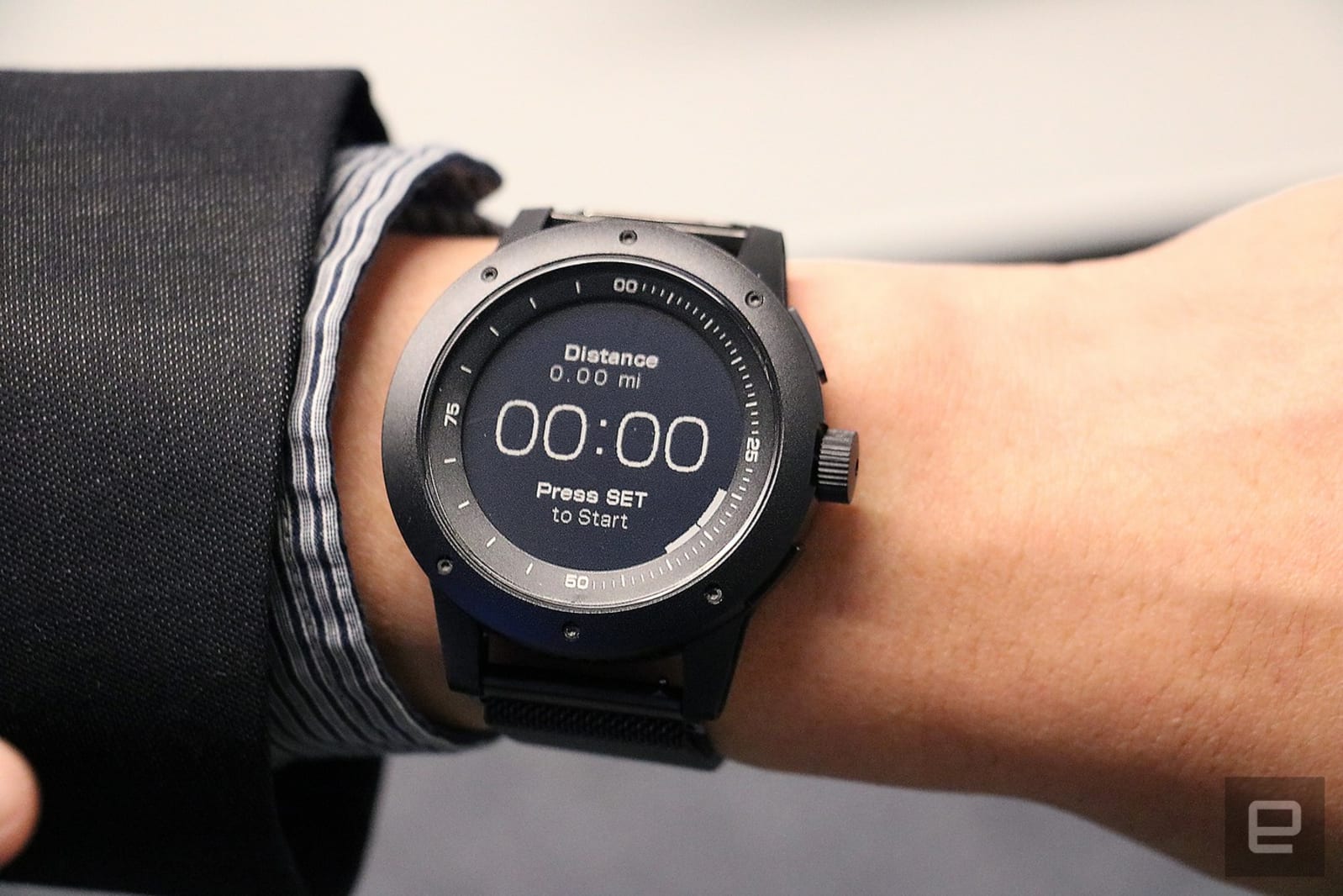
The PowerWatch can not only tell the time, set alarms and timers but also track your activity and sleep. For now, you have to press a button before you go to bed, but a software update will enable auto sleep-tracking. It also measures your calories burned differently than competing devices, which use your height, weight and daily activity to get a rough estimate. The PowerWatch uses the amount of energy you produce based on your body heat, along with your physical measurements to make a better-educated guess, making for a more accurate deduction because a calorie is defined as a unit of heat energy anyway.
The stopwatch is sort of strange. Two or three seconds after you start it, the watch just displays the word “Running” instead of the elapsed time. In fact, navigating the PowerWatch’s rudimentary black-and-white OS isn’t very intuitive. Because there isn’t a touchscreen, you’ll have to press the Mode button on the top right of the case to toggle through functions like Daily Activity, Running Mode, Stop Watch and Watch Settings. To go into any of these, you have to pause for about a second after landing on it. So to launch Running Mode, you have to press the Mode button twice, quickly enough that you don’t accidentally enter Daily Activity, then hold still.

The silver version of the PowerWatch feels chunky on my relatively slender wrist. It’s also the cheapest of the trio available, at $199. Tham’s unit — the $229 black model — looks more elegant, thanks in part to the $20 22mm Milanese band he paired with it. Finally, the more-advanced PowerWatch X costs $279, displays incoming alerts from your phone and has a better water-resistance rating of 20 atmospheres (up to 200 meters) compared to the 5 atmospheres (50 meters) on the regular watches.
Ultimately, the PowerWatch is too basic and hefty for me to keep wearing it, especially when I need to fit into the tighter sleeves of my winter coat. But I’m still intrigued by the PowerWatch’s ability to survive sans charger, and honestly, I hope Matrix can take this technology mainstream. I never want to charge a device ever again.
Tesla buys automation company to mitigate production delays
Tesla is buying private machining company Perbix, possibly in a bid to mitigate the woes the car manufacturer announced last week, when it blamed a $619 million quarterly loss on production “bottlenecks”. Perbix has been supplying Tesla with parts for nearly three years, but the acquisition will allow the company to produce more parts in-house, helping it fulfill its ambition to “build the machine that makes the machine”.
Unfortunately, Tesla is struggling to build any machines at the moment, announcing alongside its earnings report that it won’t be able to meet its target of producing 5,000 Model 3 sedans a week during 2017. It’s not been revealed how much Tesla paid for Perbix, but financial filings show owner James S. Dudley was given more than $10 million worth of Tesla stock for the deal. Perbix is an expensive solution to Tesla’s issues, then, but the cost pales in comparison to the sums Tesla will lose if it doesn’t get on top of its production problems.
Via: The Verge
Facebook Marketplace can help you find a new place to rent
Facebook is rapidly expanding its offerings in its Marketplace section, pulling oft-searched items like used cars into its Craigslist competitor. Now the company is bringing housing rentals from Apartment List and Zumper into the fold, letting US users browse and search “hundreds of thousands” or rental units in Marketplace.
The initial roll out will include custom filters for various features like location, price, number of bedrooms and bathrooms, type of rental, pet-friendliness and square footage. Landlords will be able to upload 360-degree photos to their listings, too, which will let potential renters see rental units more completely.
“Marketplace is a popular place for people to look for a home to rent,” said Facebook’s Bowen Pan. “Now that we’re adding listings from Apartment List and Zumper, people can search even more options in the U.S. to find a place to call home. First with vehicles and now with housing rentals, we’re partnering with businesses to bring more ease and convenience for consumers.”
Source: Facebook
TBS series will spotlight ‘Rocket League’ tournament’s top teams
We know that both TV channels and streaming services are getting in on eSports, but if there’s one game that can break through to the mainstream it’s (arguably) Rocket League. RC cars playing soccer in a gravity-defying stadium — what’s not to like? And, it seems TBS agrees, as it’s signed on to showcase a three-part series on the biggest teams from the Rocket League ELEAGUE Cup. The show will also feature action from the tournament and look at what makes the multiplayer sensation so darn addictive.
Meanwhile, the live action will be reserved for Twitch and YouTube, with the ELEAGUE Cup kicking off on December 1st at 2pm ET. The competition will see the world’s eight best teams battle it out for $150,000 in prize money — although, that’s peanuts compared to the tens of millions on offer in The International 7 Dota 2 championships (which TBS also gave the docuseries treatment in August). Unlike that strategy-fest, Rocket League’s simple gameplay (taking inspiration from a traditional sport) seems ripe for prime-time. And, like a conventional soccer tournament, the ELEAGUE Cup will start with a group stage, with the top two finishers from the two tables moving on to the playoffs.
The tourney will continue streaming live and direct from Turner Studios in Atlanta over the weekend, before concluding on Sunday December 3rd. The ELEAGUE Cup: Rocket League series will air at 10pm ET on Fridays on TBS, starting on December 1st.
Snoopy is your latest coding teacher
Snoopy is taking a break from lying on his doghouse and staring at the sky to help kids learn about computers and coding. As part of Computer Science Education Week (December 4-10), codeSpark Academy and the Peanuts brand are teaming up to release holiday-themed Snoopy Snow Brawl, a cute multi-player coding game that encourages kids to use problem-solving, strategy and algorithms in a snowball fight between Woodstock and his bird buddies, refereed by Snoopy.
The game focuses on sequencing, with codeSpark claiming that kids score up to 22% higher in sequencing tests after just three sessions. Kids (or adults — let’s not underestimate the universal appeal of the Peanuts gang) can play against each other or the computer, in one-on-one or two-on-two challenges, trying their hands at interactive puzzles and word-free block programming. There are four stages for learners of every level, and they’ll get step-by-step guidance along the way. Snoopy Snow Brawl will be released during code.org’s Hour of Code initiative, and will be playable for everyone until January 15, 2018 via the codeSpark Academy app on iOS, Android and the web.
 AIVAnet