


‘Erica’ blurs the line between game and interactive movie
Sony’s PlayStation 4 will never have the same widespread appeal as the Nintendo Wii. It’s a popular console with an extensive library, but it hasn’t captured the casual market quite like Nintendo’s machine did in 2006. Sony is trying to change that, however, with a slew of film-like experiences including Until Dawn and Hidden Agenda. The latest example is Erica, a live-action hybrid developed by London studio Flavourworks. It’s not quite a video game, but the level of control is also far beyond what classic FMV (full-motion video) titles usually offer.
The story follows Erica, a young woman haunted by a traumatic childhood. She’s contacted by an old family friend who believes her memories hold the key to catching a murderer. Everything gets more complicated, however, when the so-called killer contacts Erica directly and offers a different story. Suddenly, the game’s heroine is forced to investigate and find out the truth for herself.
Jack Attridge, creative director at Flavourworks, took me through a brief demo at Paris Games Week. He controlled everything with a PlayLink-enabled smartphone, though the final game will also support the regular DualShock 4 controller. It began with a simple Zippo lighter, which Attridge slowly opened and sparked to life with his finger. It then jumped to a scene with Erica standing in front of a fogged-up mirror. Attridge swiped to remove some condensation before wiping a tear from Erica’s cheek and brushing some of her hair away.
That last part made me uncomfortable — it’s the kind of thing a supervillain would do — but it showed the level of interactivity Flavourworks is shooting for. It’s certainly impressive, surpassing classic FMV titles like Night Trap and Dragon’s Lair, as well as recent examples like Her Story and Contradiction: Spot the Liar. There are no 3D models or big-budget CGI effects — according to Attridge, everything is “100 percent live-action.” But the game offers a degree of control that would be hard to pull off with smartly arranged video files. When Attridge opened the lighter, for instance, he could slowly drag it open, or stop and watch the lid bounce shut.
The company is staying tight-lipped about the technology behind the game. “We want people to focus more on the output,” Attridge said. “We like keeping the mystery behind it.”

Before long, the shot was replaced by a dark street with a telephone box in the distance. Using his smartphone, Attridge dragged a cursor and changed the point of focus between Erica and the receiver in the distance. There were no load times, pauses or stutters; everything was seamless. To demonstrate this immediacy, Attridge tapped on the telephone and instantly triggered a conversation between Erica and a mysterious woman. “I knew you couldn’t stay away,” the voice hissed. “Such a curious thing.” Words and phrases (literally) hang in the air, allowing Attridge to pick Erica’s response.
After a few cryptic exchanges, the strange caller warned Erica not to “break the seal.” Before I could contemplate what that meant, the scene changed again, this time to a small office. Attridge dragged his finger slowly to creak open the door and peer inside. It seemed to be empty, so he finished the action and guided Erica toward a nearby desk. “Everything kind of listens to us,” he explained. “So if I had opened that door really fast, it would have made a lot of noise. People might have heard me, and you would have seen Erica react to that.”
There were no load times, pauses or stutters; everything was seamless.
Most interactive movies have, ironically, few points of interaction. You might watch a scene that’s five- or 10-minutes long before making a crucial decision that sparks the next sequence. With Erica, however, Flavourworks is aiming for an experience that requires you to tap or swipe every 15 seconds. Inside the room, there were countless objects with a white circle above them, indicating that they could be touched or investigated. For the next five minutes, Attridge flipped through books, rummaged through drawers and searched for a safe combination. It was just like a point-and-click adventure game.
Later in the demo, Erica found a knife. Suddenly, a man in a suit strolled in and triggered a difficult choice: attack, or wait and hear what he has to say. At this point, Attridge turned to see what I (and a small group of journalists) wanted to see happen next. Of course, we chose the former. Attridge chuckled, tapped the corresponding prompt and sat back as we all let out a loud groan: Erica bumbled forward, allowing the man to easily grab her arm and deflect the attack. “We were a bit too late,” Attridge explained.
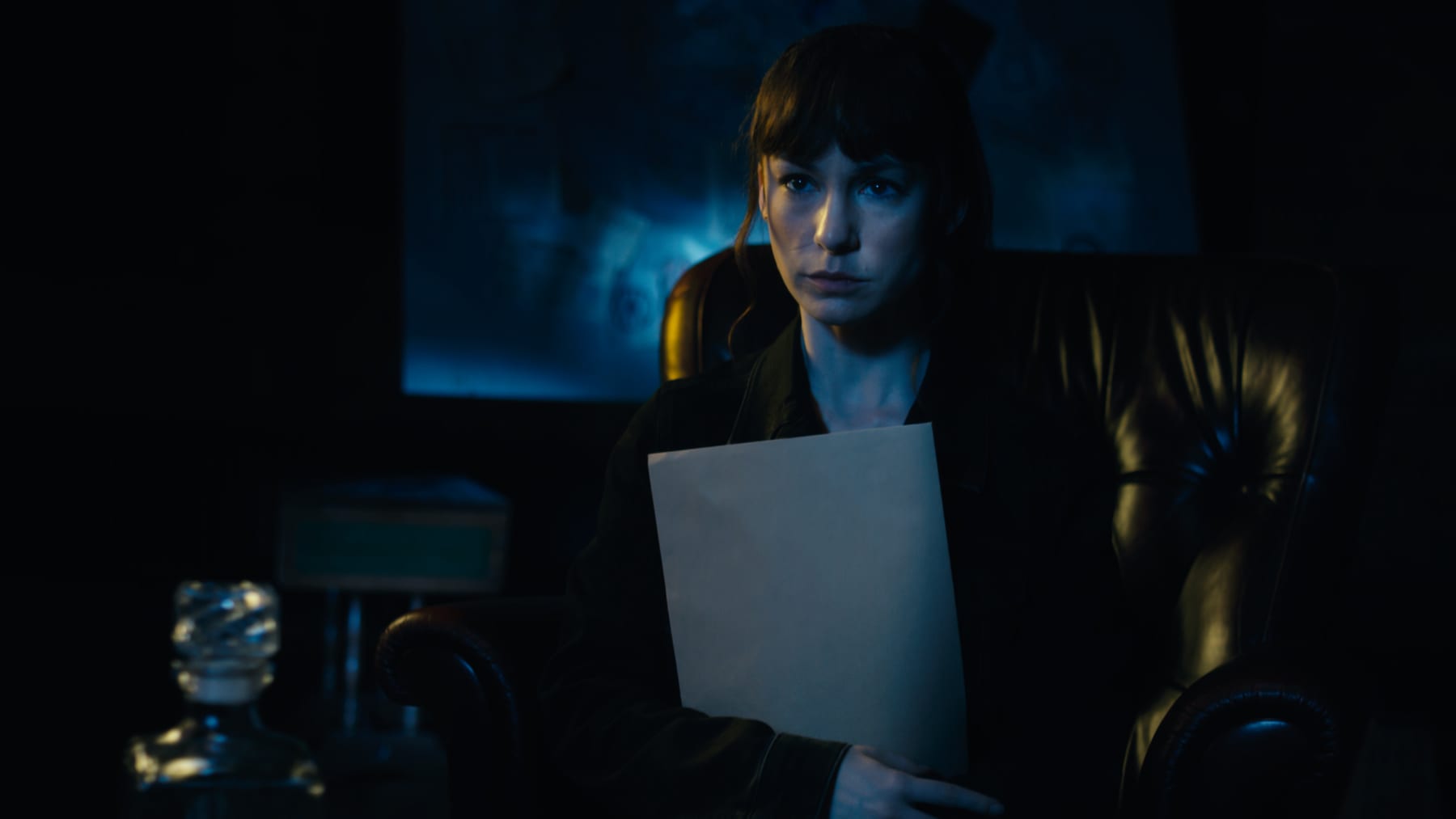
Erica is a single-player game, so unlike fellow PlayLink title Hidden Agenda, you can’t have a group of people voting with their individual smartphones. You can, however, take a quick poll the old-fashioned way and have the person holding the controller — or in this case, the handset — follow through with whatever everyone has agreed upon.
Erica and the strange man conversed for a while. Eventually, she was handed an envelope with a crimson seal, alluding to the mysterious telephone call from before. Again, Attridge asked for a vote, and we all agreed to see what was inside anyway. Without spoiling anything, the subsequent events caused the demo to end rather abruptly. As the screen went black, I was left feeling equally confused and intrigued.
According to Attridge, the demo was actually a year old. The team has been working on the underlying technology for years and didn’t want to reveal the project until it was further along into development. The story has now been finalized, but the studio is still filming scenes with Erica actress Sophia Del Pizzo (The Amityville Asylum, Philip K. Dick’s Electric Dreams) in London. For now, there’s no release date — just a short, cryptic trailer on YouTube and the promise of more information “in the coming months.”
Attridge confirmed the game will have a branching storyline of sorts. The choices you make will subtly affect the characters you encounter and the information that’s relayed to you. That, in turn, will inform your decision near the end of the game and the final outcome. “Every decision you make gives you a different sort of view on the truth,” Attridge said. “It’s not about, ‘Do I go left, or do I go right.’ It’s literally that you will be fed different information and different biases.” Ultimately, however, it will be for you to decide who is telling the truth.
Erica is a curious game and movie blend. Flavourworks says it’s aiming for a “movie-night appeal” with a runtime of roughly two to three hours. That’s perfect for parties and people who might not be comfortably pouring hundreds of hours into a RPG. It does, however, put greater emphasis on the pricing. Erica will effectively compete with movie rentals, rather than the latest Bethesda shooter or Uncharted adventure. The game will have some replayability, Attridge stressed, but for many, I suspect, it will be one-and-done. Anything more than $20, therefore, could make it a hard sell.
Follow all the latest news from Sony’s PlayStation event here!
DOJ may sue to block AT&T’s purchase of Time Warner
Today, The Wall Street Journal reported that the US Department of Justice may bring an antitrust case against AT&T’s acquisition of Time Warner. The DOJ may currently be in talks with both companies that could lead to a settlement with conditions for approval of the merger. However, the newspaper reports that the justice department isn’t close to an agreement with the two companies, and that the organization is preparing for litigation in case this is decided in the courts. It’s unclear how this situation will progress, and what the timing of any decisions might be.
Last year, AT&T announced that it would purchase Time Warner for $85.4 billion in cash and stock. If it goes through, it will give the telecommunication company control over a huge swath of movies and TV properties, such as HBO and Warner Brothers. AT&T hoped to close the deal by the end of 2017, but that might be difficult now.
AT&T has managed to avoid FCC scrutiny over the merger by dumping Time Warner’s FCC licenses, either by selling them to another broadcaster or dropping them altogether. Without the need to transfer over these licenses, the FCC does not have to approve the acquisition. The DOJ is a different story, however, and considering the competitive advantages this could give AT&T in the marketplace, it’s not surprising that the justice department has taken an interest. Many industry insiders believed that the deal would go through without a hitch, but it’s clear that there might be regulatory hurdles in front of the merger.
Via: CNBC
Source: The Wall Street Journal
Cosmic rays unlock new secrets in Egypt’s Great Pyramid
It turns out that the 4,500 year old Great Pyramid of Giza still has some secrets to share. Using cosmic-ray imaging, an international team detected a large chamber within the structure that was previously unidentified, according to Nature. It’s the first discovery within the Great Pyramid since the 19th century.
When galactic cosmic rays hit the Earth’s upper atmosphere, they produce particles called muons. Muons are partially absorbed by stone and other materials, so scientists can use the particles to detect the spaces within structures. Researchers have previously used muon detection to determine makeup of volcanoes and to map the inside of the Fukushima nuclear reactor.
In December 2016, Kunihori Morishima, a physicist at Nagoya University in Japan, led a team that placed muon detectors within the Queen’s chamber of the Great Pyramid. The devices would record the muons passing through the chamber from above. Because stone can absorb muons, a higher-than-expected number of muons hitting the detectors would mean that there was an unidentified chamber somewhere in the pyramid. After a few months, they saw some success, and asked two other physicist teams to check their results by placing their own muon detectors.
All three groups found a previously unidentified chamber within the pyramid’s structure, above the Grand Gallery. It’s about 30 meters (almost 100 feet) long. “It was a big surprise,” said Tayoubi to Nature. “We’re really excited.” It’s unclear what the purpose of the structure is, but Tayoubi suggests it could be a second Grand Gallery, based on its size and cross section. It also could be the location of the Earth’s Stargate.
Next, Tayoubi’s team wants to place muon detectors within the second-largest pyramid at Giza, Khafre’s Pyramid. While cosmic rays detectors were used in the pyramid in the 1960s, they were much more primitive, recording the data on magnetic tape. Tayoubi hopes that his experiments will find more hidden chambers in Egypt’s pyramids.
Via: Associated Press
Source: Nature
CIA releases Bin Laden’s personal files with malware warning
Yesterday, the Central Intelligence Agency posted almost 470,000 files (around 321 GB) that were recovered during the raid on Osama bin Laden’s Abbottabad compound in May 2011. This is by far the largest release of material found during the operation that resulted in the al-Qaeda leader’s death.
Documents include bin Laden’s personal journal, home videos of both bin Laden and al-Qaeda, propaganda, speeches, audio correspondence and more. The CIA has withheld certain materials, including pornography, copyrighted items (Final Fantasy VII and Resident Evil are on the list) and malware. The documents shed interesting light on disagreements within al-Qaeda’s ranks and the organization’s problems with ISIS.
The CIA warns interested users trying to download the files to keep in mind that “this material was seized from a terrorist organization.” While the agency has done a preliminary review of the files and withheld any contents with malicious software attached, that doesn’t mean that it’s all gone. In other words, download judiciously and at your own risk — and it appears people are doing just that. At the time of this writing, the files aren’t currently available due to a “technical issue.” The organization is working to make the files available again as soon as possible — or possibly, just adding more bandwith to its servers.
Via: Ars Technica
Source: CIA (2), CIA (1)
Grammarly Debuts iOS Keyboard App to Help Improve Your Grammar in Messages, Twitter, and More
Grammarly this week announced the launch of the Grammarly Keyboard app for iOS devices, which is available on the iOS App Store right now. Once added as a new keyboard in Settings, the app will then use Grammarly’s grammar-checking software to proofread text you send in essentially any app that uses a keyboard.
Grammarly Keyboard will catch context-specific mistakes related to grammar, spelling, and punctuation, and Grammarly Premium users will be able to choose from various style improvements as well as gain more advanced word choice options. Above each correction is a short and clear explanation as to why Grammarly chose to fix the error, which the company says will help you “understand your mistakes and avoid them in the future.”
In the company’s blog post, examples are given of using Grammarly Keyboard in apps like Facebook, Twitter, Messages, Mail, Tinder, and more. The app can even warn you of when an auto-correct message has been typed and fix it before you send the message.
The keyboard integrates seamlessly with all your mobile apps and your mobile browser, so you’ll always look polished and professional, even on your phone.
Developed by some of the world’s leading authorities on linguistic technology, Grammarly’s algorithms not only catch context-specific grammar and spelling mistakes, but also the kind of confusing sentences that leave your colleagues (or worse, your boss) wondering what you’re talking about. For Grammarly Premium users, the keyboard will also improve word choice and suggest style improvements so the need for “Sent from my iPhone” can become a relic of the past.
After downloading Grammarly Keyboard for free [Direct Link], you’ll have to allow the app to have full access to your keyboard in the iOS Settings app. Then, just tap the globe icon to cycle through your keyboards until you see Grammarly.
Tag: Grammarly
Discuss this article in our forums
Lines Swell at Apple Stores Around the World as Customers Prepare for iPhone X Launch
As the launch of the iPhone X approaches, customers who are hoping to get one of the new devices on November 3 are lining up at Apple Stores around the world. Lines at many major stores started forming earlier this week, and some people have already been waiting for days to purchase an iPhone X.
Apple Store on West 14th Street in Manhattan with a line on Wednesday night via Instagram user checo7xdp
Apple has said that Apple retail stores will have the iPhone X available for walk-in customers, but the company has encouraged people to line up early as the device is in short supply. If pre-orders are any indication, available supply at stores could go quickly.
 Apple’s Covent Garden store in London via Instagram user dviznov
While we still have just under 24 hours to go before launch in the United States, customers in Australia will be getting their devices not too long from now, followed by those in Asia and Europe, so lines are longer in those countries.
 Apple’s Orchard Road store in Singapore via Yahoo Singapore
As it gets later in the day, lines, especially in the United States, will continue to grow. Once the first stores open in Australia, we’ll get hint at how much stock might be available, but it’s looking like supplies are going to be tight.
 Apple Store in Sydney, Australia via Instagram user hanskristensen1980
If you’re planning to wait in line to get an iPhone X, make sure to check out our guide for some tips on what to bring and how to choose a store.
Related Roundup: iPhone XBuyer’s Guide: iPhone X (Buy Now)
Discuss this article in our forums
Blizzard shows off broadcast-friendly ‘Overwatch’ features
Last week Overwatch game director Jeff Kaplan explained some of the tweaks Blizzard planned to make this game easier to follow for viewers, and now a new video actually shows them off. As Blizzard prepares to launch its professional Overwatch League next year (and presents Overwatch World Cup matches over the next couple of days), it’s going all-in to make the game TV-friendly, even for people who aren’t yet die-hard eSports fans.
During the Overwatch World Cup playoffs on Friday and Saturday, viewers will see new team uniforms for each country, complete with home and away colors that include heads-up displays and special abilities that are customized to match. It should make it easier for viewers to identify (and identify with — when’s the merch coming?) each team, better than they would with the standard game’s use of blue for allies and red for enemies.

We also got a peek at the previously-mentioned overhead map and third person smart camera, which we can already see will help people stay oriented on the most intense action and where it’s happening. It’s also key for the analysts to keep an eye on who is where at all times, and break down the action post-game with a new stats layout that puts every player’s metrics on one screen. A new easily-accessible instant replay (complete with bullet-time style freezes and camera movement) can take viewers flying through the scene without making things too confusing.

Is eSports really ready for the big time? We’ll find out soon, but these changes will definitely help give a regular viewer who hasn’t heard of Twitch a reason to stick with the broadcast long enough to tell D. Va from Doomfist.
Source: Play Overwatch (YouTube)
US could charge six Russian officials over DNC email hacking
Is Russia’s hacking of the Democratic National Committee (DNC) emails a “hoax,” as Donald Trump maintains? The US Department of Justice reportedly doesn’t think so. It has identified six Russian government officials involved in hacking the DNC and using the information against candidate Hillary Clinton during the 2016 election. Prosecutors have enough evidence to bring charges against those individuals by next year, according to a report from the WSJ.
The information supports claims that Russian President Vladimir Putin is behind a coordinated effort to influence US elections, as US intelligence has claimed since last year. Talks about a criminal case are in the early stages. The inquiry is being conducted by Robert Mueller, in cooperation with federal prosecutors and agents in Washington, Pittsburgh, San Francisco and Philadelphia, according to the report. The team has identified both military and intelligence hackers.
Russians hacked DNC emails and the account of 2016 Democrat campaign chairman John Podesta, according to insiders. Thousands of those emails were made public by Wikileaks at the time, something that likely impacted voting in the 2016 presidential election. No charges were ever brought against Clinton or any Democrats over the contents of the emails.
Russian President Vladimir Putin ordered an influence campaign in 2016 aimed at the U.S. presidential election.
Trump has called the claims of Russian DNC hacking “a big Dem scam and excuse for losing the election.” US intelligence officials, however, have maintained that Russians were indeed behind the hacking. “Russian President Vladimir Putin ordered an influence campaign in 2016 aimed at the U.S. presidential election,” it assessed in January.
Mueller’s team has already obtained a guilty plea from Trump campaign advisor George Papadopoulos in relation to his Russian dealings, and has filed numerous, serious charges against Trump campaign chairman Paul Manafort and his business associate, Richard Gates.
Facebook recently admitted that a Russian disinformation campaign reached 126 million users during the presidential election with ads that attempted to influence US users by exploiting social and political divisions, among other tactics. Sources say the Russian DNC hacking is not unlike the Yahoo attack, which allowed Russian hackers to steal the information from at least 500 million accounts, among the largest in US history.
It would difficult for the Department of justice to arrest any Russian officials. However, charges would make it nearly impossible for those folks to travel. More importantly, if charges are brought sometime next year, they will no doubt shine a floodlight on a case about which, so far, there has been little information.
Source: WSJ
MIT students trick an AI into classifying this turtle as a gun
We’re relying increasingly on AI to be able to detect things, from exotic states of matter to recognizing specific faces, but how easy is it to fool these mechanisms? That’s what researchers wanted to find out. A group of students took on the task of figuring out how exactly to reliably and consistently trick a neural network into consistently misidentifying an object.
They used what’s called an “adversarial image,” which is a picture that’s designed to trick this kind of intelligent computer program. It uses specific patterns to fool the AI. It’s not about what the image looks like; it’s about the pattern that’s in, or overlayed on, the image. It can be added as an almost invisible layer over an existing image. But these adversarial images don’t always work properly; properties like zoom, cropping, angle and other transformations can often corrupt or weaken the adversarial image, and result in a positive detection. The students were interested in figuring out how to create an adversarial image that would fool an AI every time.
The MIT-based team was able to generate an algorithm that would reliably fool an AI using adversarial images and could be applied to both two-dimensional images and 3D printing. These images will trick an AI, regardless of the angle of the object. The team fooled Google’s Inception v3 AI into thinking a 3D-printed turtle was a rifle. You can read the full paper on their results at arXiv.org.
It’s important because this issue isn’t limited to Google — it’s a problem in all neural networks. By figuring out how people can fool these systems (and demonstrating that it can be relatively easily and reliably done), researchers can devise new ways to make AI recognition systems more accurate.
Via: The Verge
Source: labsix, arXiv.org
Samsung’s 43-inch Frame TV is now available for $1,300
The 43-inch version of Samsung’s 4K TV that can disguise itself as an art piece is now available on Samsung.com and various retailers in the US. It’s the latest entry in the Korean conglomerate’s “The Frame” series, following the 55- and 65-inch versions’ debut back in June. This one will set you back $1,300 — definitely not cheap, but relatively more affordable than the biggest variant that will cost you $2,799.
Like its bigger siblings, the smallest Frame displays artwork when it’s not playing any show or movie. In addition to the 100 pieces of preloaded artwork, you can buy more from Samsung’s Art Store, which has over 400 pieces of artwork on offer curated by organizations, galleries and museums. The TV comes with a single transparent cable so it can look like a painting when you want it to look like a painting. Want to ensure it blends with your decor? You can buy bezels with different designs for $180 each. Because, hey, if you’re buying an expensive TV that would look good displayed in your home, you might as well go all out.
Since it could be hard to convince people to purchase a pricey experimental TV, Samsung is showcasing the 43-inch Frame at Starpower’s Southlake, Texas showroom on November 7th, 6 to 8 PM. That event’s exclusive to a select group of people, but don’t worry: We also took videos and photos of the Frame at IFA 2017 in Berlin, which you can check out right now.
 AIVAnet