


Amazon Updates iOS App With ARKit Support for Augmented Reality Holiday Shopping
Amazon is preparing its customers for the busy holiday shopping season, posting a detailed plan today on how it aims to help you get the items you want through Alexa voice shopping, curated gift guides, and a new “AR View” in the official Amazon iOS app. AR View was built using Apple’s augmented reality developer framework called ARKit, and the company said it’s meant to help customers “make better shopping decisions.”
Similar to IKEA Place, Amazon’s AR View lets you place virtual versions of real-world products sold on Amazon right into your home, helping you decide whether or not you like the item in a specific living space before you buy it. AR View can be found on the camera icon in the Amazon iOS app, which now has a new “AR View” option. Then you can select from “thousands of items” sold on Amazon, which includes home furniture, toys, Echo products, kitchen electronics, decor, and more.
Amazon’s latest augmented reality offering within the Amazon App launched today for customers with iOS 11 installed on their iPhone 6S or later. Using Apple’s ARKit, AR view helps customers make better shopping decisions by allowing them to visualize the aesthetic and fit of products in their own living space. Customers simply open the Amazon App, click on the camera icon and choose AR view.
They can then select from thousands of items – from living room, bedroom, kitchen and home office products to electronics, toys and games, home décor and more. Whether customers are buying a sofa or a kitchen appliance, they can overlay it onto their existing living space, move it and rotate it to get a full 360-degree peek in a live camera view to make sure it fits their style and aesthetic.
ARKit debuted in iOS 11 in September, and you’ll need an iPhone 6s or later running iOS 11 to use the new AR View feature in Amazon’s iOS app. Target also launched an augmented reality shopping feature last week, but it wasn’t in its iOS app and instead debuted in the Target mobile website. Additionally, Target’s new “See It In Your Space” option doesn’t use ARKit.
Amazon is available to download for free from the iOS App Store. [Direct Link]
Tags: Amazon, ARKit
Discuss this article in our forums
New York City Subway Entrance Turned Into Fake Apple Store With Line for iPhone X
Improv Everywhere recently turned a New York City subway station entrance into a fake Apple Store, complete with both fake employees and customers lined up for the iPhone X. It shared the entire act on YouTube today.
The improv group started by affixing a large Apple logo to a glass elevator at the corner of East 23rd Street and Park Avenue in Manhattan, which actually leads down to trains on the Lexington Avenue Line.
Next, they had 50 fake customers line up along the sidewalk. The fake employees, wearing blue shirts with Apple logos, stood near the entrance to the elevator and cheered as people went down to the trains.
The whole scene attracted the attention of many onlookers, who were told a new Apple Store was opening in the subway station since Apple’s iconic glass cube store on nearby Fifth Avenue is (actually) undergoing renovations.
The fake employees even tried to convince people to line up for the iPhone X. To make the act look more convincing, some of the fake customers came out of the elevator holding white bags while acting excited.
Many people that walked by were genuinely confused by what they were seeing, with some individuals stopping for interviews with fake camera crews. A few passersby may have even joined the queue for the iPhone X.
The improv act looks to have occurred a few weeks ago, based on a Reddit discussion full of confused New Yorkers.
“Anyone know what Apple event is going on at the 23rd street 6 train stop in NYC?” one user wrote. “Walked by and there was a long line for the subway elevator, and Apple employees lined up welcoming people into it one at a time.”
“Just spoke to one of the employees, looks like they’re doing a silent iPhone X release to advertise the new store,” another user replied.
In actuality, of course, the iPhone X doesn’t launch until this Friday. Many actual customers are already starting to line up at stores around the world for a chance to purchase the device on a first come, first served basis.
Related Roundups: Apple Stores, iPhone XBuyer’s Guide: iPhone X (Buy Now)
Discuss this article in our forums
Orbital ATK’s Taurus rocket finally makes it into space
Six and a half years after its last launch ended in failure, private spaceflight company Orbital ATK’s Taurus-XL rocket — now called Minotaur-C — has made it into space. Since its maiden flight in 1994, the rocket has seen six successful launches and three failures, one of which led to the loss of NASA’s Orbiting Carbon Observatory, in 2009. But after a redesign that sees the Minotaur-C reimagined as hybrid of the company’s Minotaur, Taurus, and Pegasus rockets, it successfully launched from Vandenberg Air Force Base in California on Tuesday. The rocket is equipped with four solid-fueled rocket stages, stands at 92 feet (28 meters) tall and can deliver payloads of up to 3,500 lbs into orbit.
This image shows the trajectory of this afternoon’s #MinotaurC launch pic.twitter.com/EFfqCMvpmp
— Orbital ATK (@OrbitalATK) October 31, 2017
Its primary purpose is deploying six SkySat satellites and four loaf-of-bread-sized Dove satellites into orbit around 310 miles above the Earth, to provide data to San Francisco-based Planet Labs Inc. The high-resolution multispectral images of Earth gathered by the satellites will be used by businesses, governments and other organizations. And they’ll be created in a much greener fashion than space is used to. Satellite propulsion systems are traditionally powered by highly toxic hydrazine, but the ones on board the SkySats run on High-Performance Green Propulsion thrusters, which are more efficient and safer to handle during manufacturing.
Via: Space.com
Apple makes it easier to change your registered email
Does it irk you that you can’t replace your Gmail, Outlook or any other third-party Apple ID with one of your Apple email addresses? Sure, it’s a minor inconvenience, but if you really prefer using an @icloud.com, @me.com or @mac.com email account to sign into your Apple devices, then you can now make the switch. A few weeks after a MacRumors reader emailed some Cupertino execs asking for the feature, the tech titan deployed its engineering team to implement it.
Now, if you check out Apple’s “Change your Apple ID” support page, you’ll notice a change in the “third-party email address” section. It says “when you change your Apple ID, you can enter another third-party email address or an @icloud.com, @me.com, or @mac.com email address.” However, if you opt to use one of the addresses Apple provides, you can’t switch back to a third-party email account. It’s not a bad tradeoff if that’s what you’ve always wanted to do anyway, just take note that it doesn’t seem to work for everyone yet. Lesson here is, Apple listens to its customers sometimes… but probably not if they’re asking for the return of the headphone jack.
Source: MacRumors
‘Concrete Genie’ is a game about bullying and street art
Back in the Dreamcast era, I fell in love with a game called Jet Set Radio. It was about a group of rollerbladers who leapt around a colorful, futuristic version of Tokyo spray-painting everything in sight. I consider it a classic and one of the best games Sega has ever published. Coincidentally, so does Dominic Robilliard, creative director of Sony studio PixelOpus. In fact, his first job in the games industry was at Sega, testing Jet Set Radio prior to its release. It’s no surprise, then, to hear that his next game, Concrete Genie, is heavily inspired by the cel-shaded platformer.
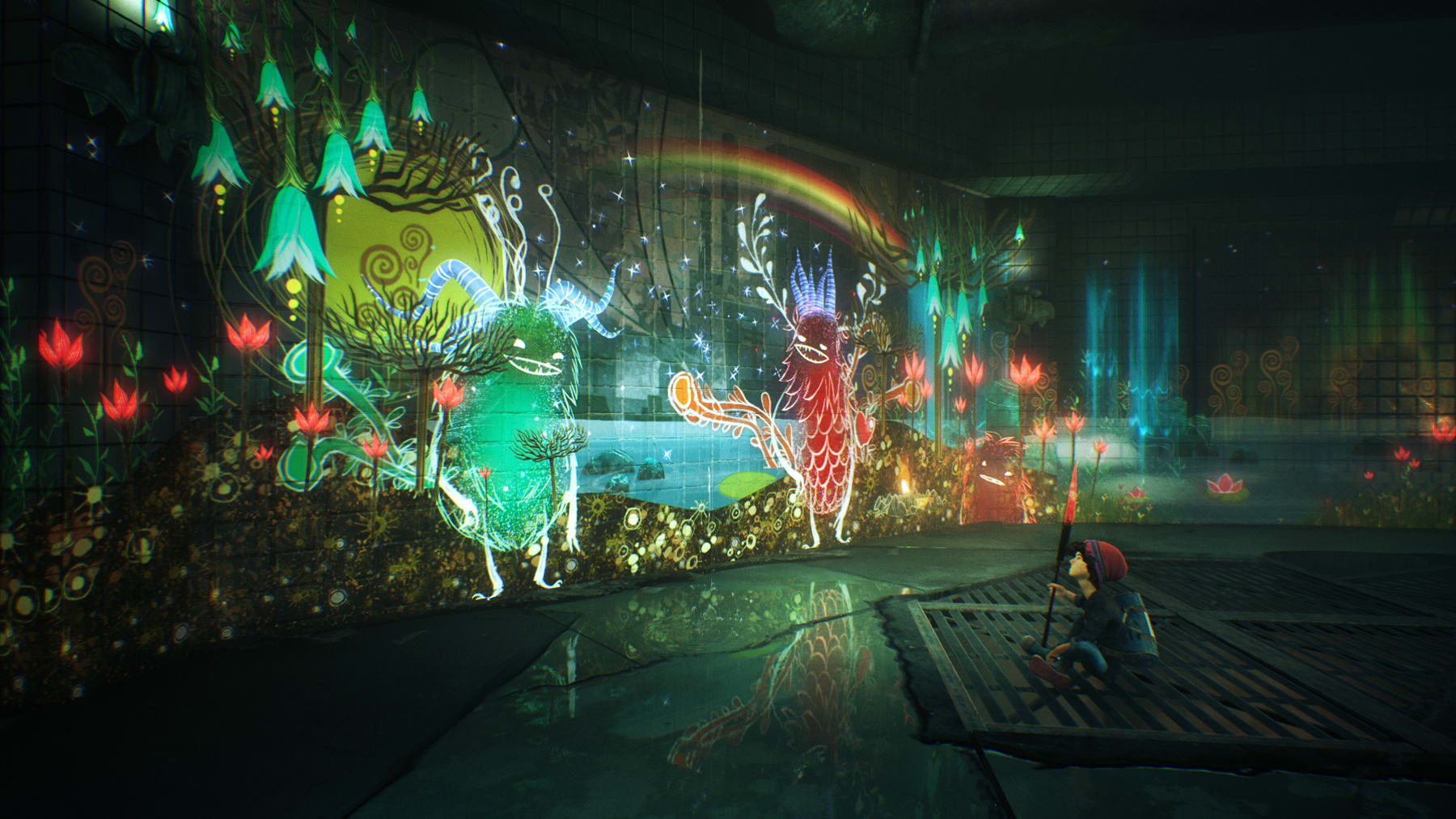
The PS4 title, unveiled at Paris Games Week, is about a young boy called Ash. He loves illustration and regularly doodles in his notebook. The story begins with a group of bullies stealing the book, tearing out the pages and scattering them across the city. Ash, undeterred, embarks on a quest to find them all and restore the notebook. Along the way, he discovers a paintbrush and the power to bring his creations to life. Suddenly, every building and back-alley is a canvas brimming with magical possibility.
With these newfound abilities, Ash can draw moving landscapes and helpful creatures. But the bullies from before are still on the prowl, ready to pounce on Ash if they catch him trying to make the town a brighter, friendlier place. Just like Jet Set Radio, Ash must traverse the environment and leave his mark while avoiding these enemies. Should he be spotted, you can climb up onto the rooftops with an expansive set of parkour moves. He doesn’t have rollerskates, but they’re impressive all the same.
Concrete Genie, then, is part puzzler, part action-platformer. Ash lives in a small town called Denska which has been abandoned by most of its citizens and ravaged by pollution. It’s a dark, gloomy place waiting to be lit up by Ash’s glittering artwork. At the beginning, however, you’ll only have access to a single neighborhood. Complete some puzzles, find a few pages and you’ll unlock the next chapter and a new section of the town.
Red brushes are associated with fire and can be used to burn down doors that have been boarded up.
The general concept was partly inspired by one of the game’s designers, who grew up in a fishing village in China. People were starting to leave the town and local children would paint in the streets to make them look more beautiful and lively. Robilliard had a similar experience in Bristol, England. There, the community would come together and clean large stretches of the town while graffiti artists taught residents how to paint those areas.
“I found that to be really inspirational,” Robilliard said.
Throughout the game you’ll acquire different “brushes.” There will be roughly 50 in total, spread across five different colors. Each shade has an elemental property which can be utilized to affect the broader environment. Red brushes, for instance, are associated with fire and can be used to burn down doors that have been boarded up. As the game progresses, you’ll need to combine the different brushes to proceed.

All of the game’s core puzzles have a set solution. Otherwise you’re free to mess around and paint whatever you like. PixelOpus wants players to be creative and, like Ash, express themselves throughout the world. At any time you can walk up to a wall, look through your brushes and create a new mural. There’s an on-screen cursor that you move with the DualShock 4’s built-in motion controls, and a panel in the upper-left corner that shows your available brushes. Otherwise, it’s simply R2 to paint and L2 to undo. You can move, resize and rotate pieces to come up with a unique design.
Most brushes are like stickers, but others, Robilliard promises, will let you draw free-hand. So you can tag your name on a wall, or, if you lack imagination like me, create something obscene. (It’s okay, every game with player-created content is ultimately filled with dong-shaped art or levels.) “With anything that has player created content, it’s always out there like that,” Robilliard said with a chuckle. “I’m not too worried about it.”
“There is no punishment for doing something wacky or bizarre.”
PixelOpus wants the game’s art tools to be accessible. Everyone should be able to make something beautiful, regardless of their drawing skills in real life. The developer is, therefore, walking a tricky tightrope; it wants to amplify brushstrokes with dazzling and aesthetically consistent art, while staying true to the player’s original inputs. There’s a small disconnect between the buttons you press and what appears on screen. But ideally, you should be able to look at a wall and feel ownership over the different colors and shapes. “We’ve moved that ‘slider’ around to get the right balance between agency and assistance,” Robilliard explained.
Notably, your art will never be judged in-game. There’s no star-rating for the murals you make, or a score that’s handed out for covering the wall quickly. “There is no punishment for doing something wacky or bizarre,” Robilliard said. “Some people on the team do very abstract things with these brushes, some of them let you put them upside down, things like that. But it’s all part of exploring how the different brushes work.”
Outside of the puzzles, the art is for your own enjoyment and, possibly, other people. PixelOpus says it’s working on a photo mode, albeit one with a twist. “We’ve got something a little different that we’re hoping to develop,” Robilliard hinted. “But we can’t talk about it just yet.”
Concrete Genie deals with some fairly mature themes. At its core, the story is about bullying and the effect it has on people’s ability to forge friendships and freely express themselves. The subject matter isn’t unheard of for video games, but does need to be treated with the appropriate care and respect. PixelOpus says it’s drawing on the experiences of its staff, at different ages, to craft a narrative and gameplay hooks that feel both “legitimate” and “authentic.”
The painted creatures, for instance, are important not just for puzzle-solving, but expressing Ash’s feelings. “They’re really the friends he wished he had in real life,” Robilliard said. The concept bears some similarities to Where the Wild Things Are, the 1963 picture book (and later, live-action movie adaption) about a mischievous boy named Max, who imagines a world filled with monstrous ‘Wild Things.’
“The stuff that Ash paints gets darker as he gets pushed around more and more.”
The brushes you pick up in Concrete Genie and, subsequently, the art you create will reflect the hero’s emotional state. “So the stuff that he paints gets darker as he gets pushed around more and more,” Robilliard explained. In addition, the roaming bullies will cause your artwork to die. Creatures will freeze in place and the colors will slowly ebb away, as if the life is being sucked out of them. The idea is that Ash’s magical paintings are powered by imagination. The bullies don’t have it, so as you run away the power to see and interact with these creations disappears too.
When Ash’s enemies ruin your artwork, it’s supposed to feel painful. That’s why the customization is so important — it’s not just Ash’s art, but your art that’s being butchered. Naturally, you should feel the effects of bullying and better understand what the hero is going through in the story. “It’s an interesting way for a game to make a player understand what that would feel like in a very personal way,” Robilliard said.

PixelOpus hopes the mature themes, and the general quality of the game, will appeal to a broad audience spanning all age groups. The street art and roaming bullies certainly evoke the Jet Set Radio I fell in love with 17 years ago. But there are flashes of Super Mario Sunshine, The Legend of Zelda: A Link Between Worlds, and countless other games that involve 3D platforming, cleaning and graffiti art. Furthermore, Robilliard says the team is interested in a co-op system similar to Super Mario Galaxy, which allowed a second player to wave a Wii remote at the screen and pick up helpful coins and power-ups. A co-operative painting mode, perhaps, or a feature that allows younger players to directly control the creatures?
“It’s a really good idea, and we are currently looking into that right now,” Robilliard hinted. “I think there’s quite a natural split in there that could be divided between two people, and in a really fun, accessible way.”
The developer has also hinted at another, more significant feature that could affect how you play the game. So far, everything we’ve seen shows a clear divide between the 3D world, where Ash lives, and the two-dimensional plane where his creations thrive. The monsters you make are effectively restricted to the buildings they were drawn on. But later in the game? Well, that might change. “They can go round corners, but they’re landlocked,” Robilliard said, before pausing for a moment. “Initially.”
Color me intrigued.
Follow all the latest news from Sony’s PlayStation event here!
Leaked HTC U11 Plus video reveals a bigger battery and screen
A hands-on video featuring the upcoming HTC U11 Plus has been leaked to Facebook, showing that the flagship phone will be available in a translucent option, as well as black and silver. Evan Bass, who’s known for leaking tech specs, also confirmed the translucent option in a tweet. The video has since been taken down, but the inevitable copies still available online show the U11 Plus will have a six-inch display, 4,000 mAh battery and 128GB of storage (other storage options, if any, are yet to be confirmed). A closer look also reveals a coil beneath the shell, which could indicate wireless charging capabilities.
T-Mobile then got in on the action by “leaking” spec sheets for the forthcoming mid-range phone, the U11 Life, which apparently features a 5.2-inch display, 16-megapixel front and rear cameras, NFC, a 2,600 mAh battery, 3BG of RAM and 32GB of storage with microSD expansion. Both phones come with Edge Sense, which lets users squeeze the sides of the phone to launch customizable functions. With the iPhone X about to hit and the Pixel 2 XL recently launched to high praise, those in the market for a new handset won’t be short of options, but will the U11 Plus’ squeezy function and translucent option set it far enough apart from its competition to make it the go-to choice?
IKEA Launches HomeKit Support for Trådfri Smart Lighting System
After multiple false starts and delays, IKEA today has updated its Trådfri iOS app [Direct Link] with a note that states the company is finally rolling out “Apple HomeKit integration for voice control of your lights with Siri” (via Macerkopf) [Google Translate].
After updating the Trådfri gateway, owners of the smart light bulbs will have to enter an 8-digit code to manually add their bulbs into Apple’s Home app. If you have a newer version of the system, the code will be found on the underside of the gateway. For owners of older models, the Trådfri app will generate a code that they can then type into Home and begin controlling their lights with HomeKit commands and Siri.
What’s New in Version 1.2.0
– Amazon Alexa integration for voice control of your lights with Alexa skill
– Apple HomeKit integration for voice control of your lights with SIRI
– Colour and white spectrum bulb
– Warm white, chandelier bulb E14 and Warm white GU10 bulb
IKEA first confirmed the Trådfri lights were HomeKit compatible back in August, before quickly walking back that statement and announcing that the update would arrive in the fall. The same thing happened in October, when the company reportedly began rolling out HomeKit support in the Trådfri iOS app, only to once again delay the launch due to “technical difficulties.”
Tags: HomeKit, Ikea
Discuss this article in our forums
U.K. Mobile Banking Apps Begin Offering Face ID Authentication Support
Two U.K. banks today updated their mobile apps to support Face ID, the facial authentication feature exclusive to iPhone X, which officially launches on Friday, November 3.
Nationwide and Bank of Scotland became the first mobile banking apps in the U.K. to provide compatibility with Apple’s new facial recognition technology, which is set to replace Touch ID fingerprint authentication on all future iPhones and iPads, according to respected KGI Securities analyst Ming-Chi Kuo.
The two banking apps already provide a Touch ID option to authenticate customers when they attempt to log in to their accounts, so the fact that Face ID is being offered as an alternative option shows that the financial sector has full trust in Apple’s new security technology, despite tests showing that it can be fooled by identical twins.
Apple has admitted that Face ID may not be able to distinguish between identical twins and in such cases recommends users protect sensitive data with a passcode instead. Otherwise, Apple says the chance that a random person in the population could look at your iPhone X and unlock it with their face is about one in a million (compared to one in 50,000 for Touch ID).
Face ID has proved to be reliable in early iPhone X reviews and first impressions, and it’s also considered easy to set up and use, but Apple likely still has some work to do to convince the general public that facial authentication is the future. According to a research conducted by Top10VPN.com in October, over half (60 percent) of British consumers remain unconvinced by facial recognition. Only two in five (40 percent) consumers believing Face ID is a good idea, while 79 percent of Brits prefer to unlock their devices with a fingerprint or passcodes. (Poll sample size: 2,048 adults.)
Related Roundup: iPhone XTags: United Kingdom, Face IDBuyer’s Guide: iPhone X (Buy Now)
Discuss this article in our forums
Apple Says Apple Watch Series 3 Lasts Up to 7 Hours When Streaming Apple Music Over LTE
Following yesterday’s release of watchOS 4.1, which enables Apple Music and Beats 1 streaming over LTE on cellular-enabled Apple Watch Series 3 models, Apple has outlined how much impact the functionality has on battery life.
While all Apple Watch Series 3 models are rated for up to 10 hours of battery life when playing music from the watch’s built-in storage, Apple says the device gets up to seven hours of battery life when streaming Apple Music with LTE.
Apple also says the Apple Watch Series 3 has up to five hours of battery life when streaming live radio with LTE. watchOS 4.1 features a new Radio app with access to Beats 1 and other Apple Music radio stations.
For outdoor sessions with the Workout app, the Apple Watch Series 3 is rated for up to three hours of battery life with streaming audio, GPS, and LTE. That’s one hour less than an outdoor workout without streaming audio.
Apple says battery life varies by use, configuration, cellular network, signal strength, streaming quality settings, and many other factors.
Related Roundups: Apple Watch, watchOS 4Tags: battery life, Apple MusicBuyer’s Guide: Apple Watch (Buy Now)
Discuss this article in our forums
Why binge watch when you can binge experience? TV is about to seem old-school
You’ve just had a long, exhausting day: The boss was breathing down your neck, the commute was a stop-and-go nightmare, and your 756th TPS report just wasn’t as stimulating as the first. I know what you’re thinking — it’s time to binge. Time to put your feet up on the coffee table, crack open a beer and turn off the stresses of the day as you stream three more episodes of your favorite show.
But let’s be honest; watching other people pretend isn’t exactly the prize you worked all day to earn. So why not climb Everest instead? Or maybe drink that beer on a tropical beach as you talk trash to your friends, whose avatars are playing volleyball nearby? Hell, instead of spectating as actors perform that train heist, why don’t you leap from the back of a horse onto the speeding train? Wouldn’t you prefer to be the one throwing the touchdown pass for your favorite sports team rather than simply watching someone else get all the glory?
In the future, post-work relaxation isn’t about turning off and becoming passive.
In the future, post-work relaxation isn’t about turning off and becoming passive. It’s about coming alive to celebrate your freedom from the grind. It’s about selecting from an endless catalogue of visceral simulations and virtual realities that we can live inside and participate in, letting us become a part of the story rather than merely watching it pass by in front of us.
Studies have shown that VR headsets successfully hijack our brains in a way TV never has, giving users a sense of “presence” by blocking out all the cues that normally ground us to reality. Our limbic systems activate, and our bodies and minds suddenly believe the digital experiences we’re having are as real as our normal day-to-day life, allowing for a true sense of meaning and connection. With the exponential evolution of technology (consider that wireless version of the Oculus Rift — the Oculus Go — was announced only a 18 months after the wired version) it won’t be long until we find ourselves with lightweight glasses (or even contacts) and a pair of haptic gloves that bring the level of realism to an even more convincing level.
Westend61/Getty Images
The resolution goes up, the brain-hijacking becomes more efficient, and binge-watching becomes binge-experiencing.
At this year’s Seattle Interactive Conference, Adobe’s Director of Product, Video and Creative Cloud, Laura Argilla, told a conference room full of developers and designers about her company’s plans to empower VR creators. Imagine a Photoshop for virtual-reality experiences. In an age where the average person can create YouTube videos and Photoshopped images on the fly, is it possible that soon we’ll all be the creators of our very own relaxation realities?
Even the idea of entertainment begins to blur as personal-development and problem-solving become fun. For instance, Argilla says, imagine public-speaking simulations that put you in front of larger and larger crowds to help you gain comfort with all those eyes. Imagine amateur sleuths poking around precise 3D scans of real crime scenes, trying to solve crimes that stump detectives. Imagine physical therapy exercises that trick the senses, causing stretches to become more impactful and fun to perform — and you can perform them on the surface of the moon during a meteor shower, instead of in a sterile doctor’s office.
Join your friends at a virtual pub, winding down with a drunken walk along the Great Wall of China.
The future of binge-watching and entertainment will be about variety, about exploration and experimentation, participation and connection. Go and see a VR concert while you eat your post-work meal at home, then join your friends at a virtual pub afterward, winding down with a drunken walk along the Great Wall of China with that friend who lives on the other side of the country.
Subscribe to your favorite VR creators much like you already do for your favorite YouTube creators. Scroll through genres of experiences on Netflix and Hulu, rather than just through genres of film. Do virtually all the things you normally would have been too tired or too broke to do in the real world, and turn your binge time into a second lifestyle of fulfillment. And if you’re too tired from your long day to slog through the haptic hand gestures and run around on the VR treadmill, the binge-watching is still there for you in spectator mode; even then, you could still choose to be in the experience instead of just watching it from afar.
It may sound radical, but this is a future fast approaching. Consider that the master of binge-watching, Netflix, understands this so inherently that one of its newest releases OtherLife — an Australian film about a company that sells virtual reality experiences — isn’t even listed as “Sci-Fi,” but merely a “Drama.”
As the old cliché goes, the future is now, and thus your days of binge-watching are quickly transforming into a second life of binge-experiencing: a vivid and varied combination of entertainment, gaming, self-development, and relaxation.
But, hey, isn’t it about time you got to play as hard as you work?
Editor’s Recommendations
- 11 newly renewed TV shows that you should binge immediately
- When you run out of TV shows to binge, check out the best movies on Hulu
- Windows Mixed Reality hands-on preview
- Windows Mixed Reality news: Here’s everything you need to know
- What is Windows Mixed Reality? It’s simpler than you think
 AIVAnet