


‘The Grand Tour’ returns to Amazon Prime December 8th
Following a bit of a hiatus, Amazon Prime’s The Gand Tour will return with season two December 8th. Earlier this year co-host Richard Hammond was involved in a nasty EV wreck with a Rimac Concept One supercar. He fared “mostly OK” according to co-host Jeremy Clarkson at the time. Clarkson himself was hospitalized this year as well, but for entirely different reasons. Namely, he had a particularly nasty case of pneumonia that almost killed him.
Judging by the trailer embedded below it doesn’t seem like any of these events were lost on Amazon. Supercars, stunning mountaintop vistas and shots of the American southwest are accompanied by Paul McCartney and Wings’ “Live and Let Die.” Well played.
Source: The Grand Tour (Twitter)
Apple Watch Series 3 can stream up to seven hours of music over LTE
Yesterday, Apple released watchOS 4.1, allowing Apple Watch Series 3 users to stream music from their entire iCloud Music Library or through Apple Music rather than limiting them to tunes from playlists synced from their iPhones. And for Watch owners opting into the models with built-in LTE connectivity, the update now allows them to take advantage of these capabilities without having to tote around their iPhones. Now, as MacRumors reports, Apple has released a breakdown of how the Watch Series 3 battery fares during music streaming.
According to tests conducted by Apple on preproduction versions of the latest Watch models, users can stream up to seven hours of Apple Music tunes while using LTE. That’s compared to 10 hours of listening when sourcing music stored on the watch itself. Apple also says that the watch’s battery will allow users to stream up to five hours of live radio while using LTE. While those times are much shorter than the 18 hours of battery life Apple says the Watch Series 3 has with just basic use, they’re still a pretty decent amount of time for someone who wants to make sure their Watch’s music streaming will get them through a day of errands or a long workout.
Apple also detailed the Series 3 battery life in regards to talking, workouts, charging and CPU performance. You can check out those stats here.
Via: MacRumors
Source: Apple
GarageBand expands its music-making palette
Making music on a phone or tablet is generally an unpleasant experience. It’s easy enough to bang out a melody in a cute app like Bebot or whip up some controlled chaos in a soft synth like Animoog. But composing is difficult on a mobile device. One of the few apps that takes an honest (and semi-successful) stab at delivering a full mobile music production suite is GarageBand. Apple is making that app even better today with a pretty major update.
GarageBand 2.3 doesn’t reinvent the wheel, instead it focuses on making the wheel more versatile. There are a few new features, but they almost all focus on putting more sounds at your disposal. Perhaps the biggest addition is the Sound Library, where you can browse and download free instruments and sound packs from Apple. For now, third party developers are still kept to the App Store, where they can offer standalone tools that plug into GarageBand.
In the Library is where you’ll find a few of the additions Apple is most excited about, including a number of Asian instruments, like the koto, guzheng and taiko drums. These were already available in the China-specific version of GarageBand, but now they’re being offered to the rest of the world. There are other themed packs too, built around genres like reggaeton. The selection right now is small, but they all greatly expand the sound palette you can pull from. The Asian touch instruments in particular add some flair to your compositions. And, while the large display of fretless strings might be daunting for the uninitiated, Apple’s chord and autoplay functions make is easy to integrate the instruments into your workflow.
The new bit I got most excited about though is the Beat Sequencer. A drum machine step sequencer is a pretty handy (and common) feature for music creation tools. While the Drummer feature of GarageBand is handy for quickly throwing down a groove for you to start brainstorming over, it offer pretty limited controls. The Beat Sequencer on the other hand lets you control every hit in your drum pattern and customize the sounds (to an extent). A variety of packs are available in the library that are filled with classic and modern drum machine sounds, acoustic kits and even found sounds.
After just a few minutes of poking around I was able to pull together a quick (kinda chaotic) loop featuring a number of the new sounds. GarageBand continues to excel at letting you quickly sketch out musical ideas on the go. But it can still be a little complicated to arrange a full song. That being said, if you did choose to use the app as your primary DAW (digital audio workstation) you can feel confident in the audio quality at least. This update adds support for 24-bit audio. Apple also made some tweaks to make sure it will display properly on the iPhone X’s Super Retina display.
GarageBand 2.3 is available now in the App Store for free.
Google’s Poly is a one-stop shop for AR and VR objects
It isn’t easy to build a virtual reality app, especially when it comes to filling out those immersive worlds. Even a semi-realistic world requires tons of objects, which isn’t always practical for a small studio. What to do? Google might have an answer: it just introduced Poly, a library of free 3D objects for augmented and virtual reality apps. Some of them are simple (like trees and fortune cookies), but others are elaborate and interesting in their own right — yes, that Wonder Woman image you see above is 3D. You’re frequently allowed to modify the models in case they don’t quite fit your needs, and you can share them as GIFs or explore them in VR viewers.
The objects are platform-independent and should work in platforms like Google’s own ARCore or Apple’s ARKit. Will you suddenly see a glut of AR and VR apps using Poly? Not necessarily — many developers want to give their games a distinct look, and that usually means custom objects. This should help smaller developers at least get the ball rolling, though, and we could easily see developers of all sizes using this to quickly prototype an idea before they commit to it in earnest.
Source: Google, Poly
Amazon’s AR shopping feature previews products in your home
Augmented reality shopping tends to be limited to furniture or other large objects, and that’s a shame. Wouldn’t you like to know how that slow cooker or speaker system looks in your house? Amazon thinks you do. It’s launching an AR View feature inside its iOS shopping app that previews “thousands” of products in 3D, ranging from kitchen appliances to toys to electronics (naturally, this includes Amazon’s devices). It’s clearly something of a party trick, but it could come in handy if you’re wondering whether or not that vase matches your decor.
You’ll need an iPhone 6S or newer to give AR View a try. We’ve asked Amazon whether or not there will be an Android version and will let you know what it says. Don’t count on it showing up in the very near future, though. AR View revolves around Apple’s ARKit, and Amazon would have to switch frameworks (say, to ARCore) to bring the feature to Android devices.
Source: Amazon, App Store
Korg’s Gadget music production app is coming to Nintendo Switch
It looks like Korg is bringing its Gadget music-making app to the Nintendo Switch next spring. There isn’t a ton known about it at the moment, but given the name, it seems like it’s a port of the synth company’s end-to-end iOS and Mac music production suite. According to Japanese publication 4Gamer (translated), the software will support motion controls and work with the Joy-con. More than that, up to four people will apparently be able to “play” it.
Exporting sounds a bit tricky though. Rather than saving a beat to an SD card, as of now the plan is for users to run an aux cable from the Switch’s headphone jack into a 3.5mm input on a PC and record using something like Audacity. It isn’t ideal, but unless Nintendo adds an SD card export option via firmware update before next spring, it’ll have to do. Or, perhaps you’ll be able to share your tracks to Facebook and Twitter with the Switch’s built-in social features.
There’s no word on pricing yet, but the iOS version cost around $40 when it released back in 2014. As The Verge notes, Korg made a synth app for the 3DS prior, so this partnership isn’t out of the ordinary for the company. If the exporting situation is remedied before next year’s launch and the interface isn’t terrible, this could open up music production to an entirely different audience.
Gaming platforms have played host to music software before, but they were traditionally from game developers. Like Rockstar Games’ project with producer Timbaland, Beaterator on the PlayStation Portable, or MTV Music Generator 3 from the PlayStation 2 and original Xbox, which was developed by racing house Codemasters.
Via: The Verge
Source: Korg, 4Gamer (Japanese)
Miles Morales adds intrigue to ‘Spider-Man’ on PS4
Last year, Insomniac Games got our spidey-senses tingling with the announcement of Spider-Man for PS4, and a gameplay trailer at E3 2017 amped up the buzz even more. At Sony’s PlayStation Showcase event at Paris Games Week (PGW), we learned more about the characters, which will include Mary Jane Watson, villain Negative Man, Aunt May, and, intriguingly, Miles Morales. Engadget chatted with Insomniac Games’ Creative Director Bryan Intihar and Community Director James Stevenson about what role those characters will have in the game.
The studio decided early on that the best Spidey experience is when Peter’s and Spider-Man’s worlds collide. “You have to experience his private life in the games, not just the cut scenes,” said Intihar. “When Spider-Man fails, Peter has to succeed, and vice-versa.”
Parker is 23 and has been Spider-Man for eight years, so he’s “at the height of his powers,” Stevenson says. Mary Jane is a reporter for the Daily Bugle and Peter works as a scientist, barely scraping by. His (non-grey-haired) Aunt May is employed by philanthropist Martin Li, the alter-ego of villain Negative Man, setting up plot complications for Parker.
One website joked that Parker looks like a weird blend of several Spider-Man movie actors. Stevenson acknowledged they did study the comic versions and film actors (Tobey Maguire, Andrew Garfield and Tom Holland played Spidey in the last three film series). “There are so many over the years, you can’t make a Peter Parker that doesn’t resemble one,” he said. Insomniac worked with Marvel on Peter’s look and facial animations, however, and the studio is apparently satisfied with the work.

Intihar revealed a few character-related game details. “We’ve confirmed that you can play as Peter Parker, and Mary Jane Watson is more than just a person in the story,” he said. “You can also play as her at certain parts of the story as well. What would you imagine a reporter might do, and what kind of situations can they get into?” He wasn’t more specific, but by that, you might infer that MJ will be digging up clues that drive the story forward.
Miles Morales is a friend of Parker, and knowing that he actually was Spider-Man in the comic’s alternate universes makes his presence intriguing. On that front, Insomniac was less forthcoming. “We’re not talking about Miles right now, we’re only talking about Peter, but Miles does have a role in the game,” said Intihar. Stevenson elaborated a bit more, saying that he’ll give players a “different perspective” on Peter’s daily life.
Gameplay was a big priority too, of course. Marvel’s New York City environment will be Insomniac’s biggest open world ever, giving players plenty of space to explore. The idea was to create a “playground for players to use Spider-Man’s powers and play with speed,” said Stevenson. At the same time, there’s plenty attention to detail, and you’ll see a lot of Marvel Easter eggs, some of which were in the last trailer — look for a Dr. Strange reference and check out the poster in Peter’s room.

Insomniac learned a lot from its open world experience in Sunset Overdrive, both from a technical and design perspective. “I remember when Sunset came out, someone said its open world would apply nicely to Spider-Man, and here we are,” Intihar joked.
The game will take advantage of Spider-Man’s speed and agility, along with his intelligence. “We had to nail the swinging, as it’s the most iconic thing about the character,” said Intihar. There are also parkour aspects and “melee webs” that lets Spidey attack villains at close-to-mid distances or pull down objects like scaffolding. Improvisation, between the superhero and what’s around him, will also be a big part of the game.
Fans are excited about the game, but as always, there’s concern that it will be bloated or delayed if developers try to cram too much in. The lack of a specific release date (sometime in 2018 is all we have right now) has some folks worried, and with just over a year, max, until release, there hasn’t been any play time or in-game demos yet. Still, if Insomniac can pull it off, Spider-Man will have both the character elements and fast-paced, open-world action that the webslinger’s fans love.
As for what role Miles Morales will play — maybe a second Spidey to play at some point in the game? Amnesiac isn’t saying… yet. “He’s a great character,” says Stevenson. “We can’t wait to tell you more about him.”
Samsung’s work-focused Note 8 has better support than your phone
Wish your Android phone maker of choice would offer software updates for longer than the usual couple of years? You might want to ask your company’s IT manager. Samsung has released an Enterprise Edition of the Galaxy Note 8 whose centerpiece is its “PC-class” support. It’s the same hardware you can buy at the local store, but Samsung is promising up to 3 years of monthly security updates — why can’t all its Android devices get that kind of backing, regardless of who’s buying? We could see that extended update timeline helping personal users worried that their phones will be vulnerable to exploits that pop up after the usual support period is over.
Samsung is also promising that companies can buy the same models up to 2 years after their initial release, so they won’t have a hodge-podge of different devices unless that’s what they actually want. Beyond support, the differences mostly come down to corporate-friendly software. Samsung’s Knox tools make it easier for the IT crew to deploy custom configurations and schedule updates.
The Enterprise Edition costs $994, which isn’t that much more than the up-front price for a regular Note 8. Just don’t expect to snap one up for your own use. You’ll have to arrange a purchase through a sales rep — this is clearly meant for large-scale deployments where companies are buying devices in bulk.
Source: Samsung Newsroom
Amazon Echo Plus review: Alexa, is this all you’ve got?
Amazon’s new $100 Echo is a disappointment for anyone who looking to upgrade from the original model. Sure, it’s nearly half the price, but its sound quality is also significantly worse. With that in mind, the $150 Echo Plus seems like a far better successor on paper. It features better speakers and a built-in smart home hub. It’s still not a must-have upgrade — a testament to how much Amazon got right at the beginning — but it at least offers some improvements over its predecessor.
Hardware

You won’t find any surprises with the Echo Plus’s design. It features the same tall, cylindrical shape as the first model, except it has a metallic gray finish instead of matte black. The volume control dial makes a return, and it has buttons for muting the microphone and issuing voice commands (or “actions”) on top. There is one useful addition, though: It has a line-out auxiliary port, which lets you hook it up to a larger speaker or an audio receiver.
Amazon’s big pitch with both of its new Echo models was better sound, thanks to a new speaker design. The cheaper model didn’t live up to those claims, unfortunately. With the Echo Plus, though, you definitely get a slight bump in audio quality. It features a 2.5-inch woofer and a 0.8-inch tweeter — that’s a surprising configuration, since the original had a 2-inch tweeter, and normally I expect bigger speakers to deliver better sound.
In use
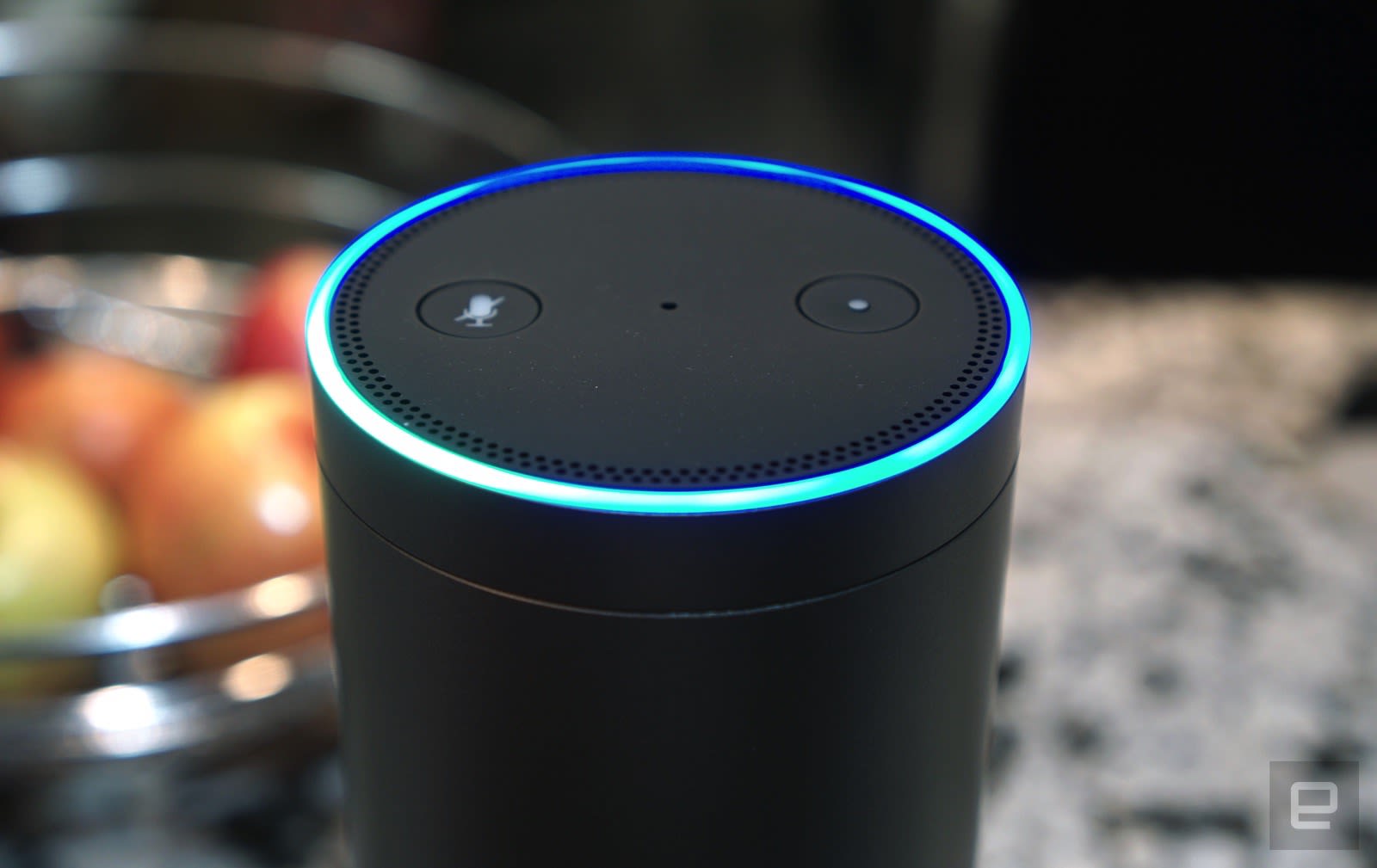
Configuring the Echo Plus takes a few minutes with the Alexa app. After joining the speaker’s WiFi setup network, you just have to select your wireless network, plug in your security details, and you’re good to go. If you’re not familiar with the Alexa app, it’s where you go to manage just about everything for Amazon’s virtual assistant. You can find and configure skills, as well as see a history of your commands.
Once it’s up and running, the Echo Plus works like Amazon’s other smart speakers. You just have to say “Alexa” and then issue a command — for example, “What’s the weather?” You can also ask it to relay things like the news, or just play some music. Naturally, it’ll have access to tunes from your Amazon Music library, as well as Prime Music, if you’re a subscriber. Alexa can also connect to other services, like Spotify, Pandora and TuneIn.
So what does the Echo Plus offer that its smaller sibling doesn’t? For one, it sounds much better. Engadget’s review editor, Cherlynn Low, and I could instantly hear the difference between the two speakers while playing The Weekend’s “In the Night.” The song’s bass-heavy opening notes felt flat and lifeless with the Echo, while the Plus delivered some noticeable thump (it actually shook the table a bit). The rest of the track also sounded crisper and more detailed.
The differences with the original Echo are a bit more subtle. At first, I didn’t hear a significant difference between the two when playing my local NPR station on TuneIn, or during podcasts. When it came to music, though, the Echo Plus has a slight edge. Its bass output is more defined, and vocals and high-end notes felt more detailed too. While it doesn’t sound anywhere as good as the Harmon Kardon Invoke, or the Alexa-powered Sonos One, the Echo Plus is better for rocking out occasionally than the original.

While Amazon made a big deal out of the speaker’s integrated smart home capabilities, there’s plenty of room for improvement. Setting up new devices is relatively simple: I plugged in two Hue bulbs, asked Alexa to “Discover Devices,” and the speaker automatically labeled them “first light” and “second light.” I figured out which was which by asking the speaker to turn one off. After that, I gave them more descriptive names in the Alexa app.
When it comes to controlling smart devices, though, Amazon’s software feels very basic. There’s no way to control individual color settings for multi-colored Hue lights, for example. That’s something the official Hue app handles easily. Strangely enough, you can control color settings with voice commands, but that’s not always the most convenient method.
Another issue? The Echo Plus only supports the Zigbee protocol, while any standalone smart hub worth its salt offers several standards, like Z-Wave and Lutron Clear Connect. Amazon deserves credit for trying to simplify the confusing world of smart hubs, especially since there still isn’t a definitive best option for most consumers.

While it’s too late to add support for new standards, Amazon could make the Alexa app and the Echo Plus more capable down the line. It took the company around six months to make the original speaker’s voice commands useful, and it steadily added new features after that. For example, Amazon just unveiled Routines for Alexa, which lets you tie together several different smart home actions. I found it helpful for turning on my living room lights and reading the weather in the morning. But, just like we noted in the Echo review, it’s very limited so far. You can’t start playing music or tune to a radio station in a routine, for example.
The competition

The $150 Echo Plus is in a curious spot when compared to the other smart speakers out there. Amazon’s $100 model makes more sense for anyone just dipping their toes into the Alexa ecosystem. And, if you’re looking for the best sound quality, you’re better off with the $199 Sonos One.
Of course, your choice of smart speaker also depends on the other ecosystems in your home. If you’re a diehard Android user, it makes more sense to look into the $130 Google Home, which sounds better than the Echo and sports the Google Assistant. Apple fanatics, meanwhile, might want to hold out for the $349 HomePod. It’s expensive, but based on our brief hands-on, it sounds great.
Wrap-up

In many ways, the Echo Plus feels like the true successor to the device that kicked off the whole smart speaker trend. But, aside from a slight bump in sound quality and semi-useful smart hub integration, there’s not much separating the two. It’s pretty clear that Amazon’s main focus is on making its Alexa ecosystem cheaper, rather than taking any major risks. But then, that’s what partners like Sonos are for.
Amazon Has $50 iTunes Gift Cards on Sale Right Now for $42.50
As we get closer to the holidays, iTunes gift card discounts are beginning to get more frequent, and today the latest sale comes from Amazon. The online retailer has marked down the $50 App Store and iTunes gift card by 15 percent in its U.S. store, so you can get the $50 credit added to your account for just $42.50 while supplies last. The gift cards are physical versions and are limited to 1 per order.
No other price tiers for the gift card are on sale as of now, so the $25, $100, and $200 options are all priced as expected. Like with any App Store and iTunes gift card, you can spend the money on an Apple Music subscription, app downloads or in-app purchases, iBooks, iTunes movies and tv shows, and more.
If you’re looking for any more sales going on this week, make sure to check out our Deals Roundup.
Note: MacRumors is an affiliate partner with Amazon.
Related Roundup: Apple DealsTag: Amazon
Discuss this article in our forums
 AIVAnet