


This week’s ‘live’ giant robot battle was fake
We’ve been following the development of the giant robot battle for years now, and it finally took place earlier this week. Engadget writer Saqib Shah said of the live stream, “the entire event may have been as choreographed as a WWE match, but it was strangely watchable regardless.” Well, it turns out that Saqib was right on the nose. Motherboard revealed, in a move that broke all our hearts, that there was absolutely nothing “live” about the “live streamed” fight. The actual epic robot battle took place over days, and the constant repairs were removed from the footage.
It’s worth mentioning that it’s impressive that the battle between the USA’s Eagle Prime and Japan’s Kuratas took place at all. These were two technologically complex robots, and it’s utterly unsurprising that they were delicate enough to need maintenance throughout the process. It’s encouraging to look at this as an experiment, and the start of something fun, rather than being disappointed that it was so scripted. The fact that it wasn’t actually live doesn’t take away from the fact that this did actually happen.
But the flip side is that it is disappointing. There’s no getting around that. You can’t bill an event as “live” and film it over multiple days and edit out important stuff. (Well, clearly you can and they did, it’s just. No.) If we don’t actually have actual giant robots that can fight one another in an epic robot-to-robot battle, then what do we have left in the world? What can we cling to for hope, if not giant robots? It’s a sad, sad day for us all.
Via: The AV Club
Source: Motherboard
You Can Now Pay Friends Through Facebook Messenger Using PayPal
Last year, PayPal launched within Facebook Messenger as a way for users to shop and complete payments directly through the messaging app. Today, the two companies are expanding the focus of this feature and opening up peer-to-peer payments for Facebook Messenger users who have linked their PayPal account to the app.
With a rollout starting today, Facebook Messenger users will be able to tap on the blue plus icon within the app, then select the green Payments button, and choose PayPal to send money. This functionality will work in one-on-one conversations, as well as in group texts. PayPal said this will make it easy to split a bill, pay rent, and more.
Although PayPal’s press release doesn’t specify, the company’s image depicting the new feature confirms that a user’s PayPal balance and linked banking accounts can be chosen for P2P payments in Facebook Messenger.
We’re excited today to announce an expansion of our relationship with Facebook with the addition of PayPal as a funding source for peer-to-peer (P2P) payments, right in Messenger. People will have the option to send and request money using their PayPal account, and this integration in Messenger is starting to roll out to U.S. consumers today.
As the leader in P2P payments with $24 billion in P2P volume during Q3 2017 alone (up 47% year-over-year), the ability to send and request money in Messenger – one of the most widely used apps in the world – gives people more choice and more convenient ways to get things done in different contexts. Whether it’s splitting a bill for a cab ride or a night out, paying for your share of the rent, or making sure you get paid back for Mom’s birthday present, PayPal makes exchanging money between friends and family simple.
There will also be a new PayPal customer service bot for Messenger, letting PayPal customers receive account support without leaving Facebook’s app. Specifically, with the company’s bot PayPal users will be able to reset passwords, ask for help with refunds or payment issues, and other general account inquiries.
PayPal’s new P2P solution in Facebook Messenger is debuting ahead of Apple Pay Cash, which still has an unclear launch date in a future update to iOS 11. When it releases, Apple Pay Cash will let users send money to one another within Apple’s Messages app.
Tags: Facebook, Facebook Messenger, PayPal
Discuss this article in our forums
Apple’s Craig Federighi Confirms There’s No October Event in the Works
This shouldn’t come as any surprise given that it’s already the 20th of October, but Apple has no plans to hold an event to introduce new products this month. Apple software engineering chief Craig Federighi confirmed there will be no October event in an email to MacRumors reader Luke.
“Will we see an October keynote event?” Luke asked. “I think we’re all Keynoted out for the season! :-)” Federighi replied.
Some people were expecting an event to take place this October because there was a Mac-centric event in October of 2016 that saw Apple unveil the Macbook Pro with Touch Bar, but there have been no rumors of a second 2017 event, nor are there any new products on the immediate horizon.
iPads and Macs were both refreshed in June, and while Apple is still planning to introduce the HomePod and the iMac Pro this year, those products are set to debut in December.
Apple is not likely to hold an event for the release of the HomePod or the iMac Pro as the two devices were previously introduced in June at the Worldwide Developers Conference. Instead, Apple will probably launch both via a press release, with no additional events to take place in 2017.
Aside from a “December” debut date listed for both the HomePod and the iMac, there’s no further word yet on when we might see them during the month.
Discuss this article in our forums
Nintendo Switch now supports wireless USB headphones
Turns out Nintendo rolled out another pretty useful feature with Switch OS version 4.0.0 but curiously kept it a secret. Some Reddit users have discovered that the update comes with support for USB devices, even wireless USB headsets like Sony’s Gold Wireless headset for PlayStation and PC. You simply have to plug the device’s dongle into the Switch dock, and you’ll notice a new volume slider for it. The feature supports a variety of other USB headphones, so you’re not limited to the PS Gold. However, it only works when the Switch is docked.
One possible workaround to make it work on handheld mode is to plug the receiver into a USB-C adapter — it’s not an elegant solution, but it’s a solution nonetheless. In addition to USB support, Switch version 4.0.0 has other sweet features to offer. It also gives you a way to record 30 seconds of play and, best of all, the ability to transfer saved games and user profiles to another system.
Source: Reddit, Neogaf
Harman Kardon Invoke review: The first Cortana speaker sounds amazing
Smart speakers are everywhere this year. So far, we’ve seen new entries from Apple, Amazon, Google and Sonos. Now, Microsoft is finally ready to join the party. The Harman Kardon Invoke is the first speaker to feature Microsoft’s Cortana virtual assistant. Since it’s coming from a brand known for audio gear, it promises better sound than the competition. And for the most part, it succeeds. The Invoke is miles ahead of Amazon’s original Echo and Google’s Home when it comes to audio quality. But Cortana still has to mature a bit before it can successfully take on Alexa.
Hardware
The Invoke is a large, cylindrical speaker that bears a striking resemblance to the Echo. It’s just as tall as Amazon’s, except wider toward the bottom. There’s also a huge difference in build quality: The Echo is made entirely of plastic, while the Invoke features a more premium feeling metallic case, with only a bit of plastic around the base. Even the control dial feels much better than the Echo’s; it’s turns more smoothly and seems like you’re controlling a piece of high-end audio gear. Don’t forget, Harman Kardon has been building things like receivers and speakers for years.

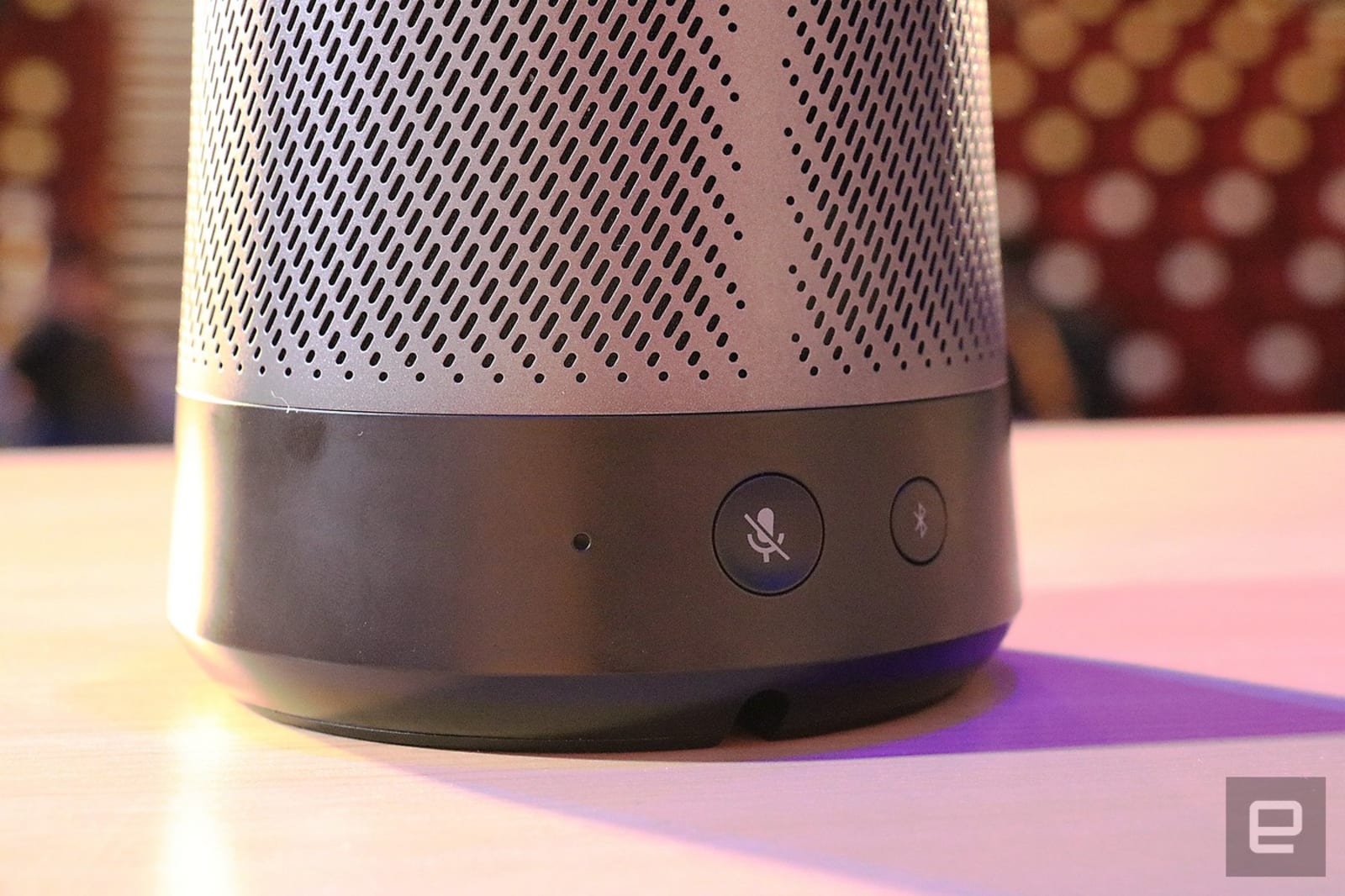
There’s a touch-sensitive area at the top, as well as a frosted display that shows you when Cortana is listening and the volume level. That top portion also houses the seven far-field microphone array, which lets the speaker hear you no matter where you are in a room. Overall, it’s a pretty streamlined device. There are only two buttons in the back, which let you mute and pair the speaker with Bluetooth devices. There’s also a diagnostic micro-USB port nestled near the power connection (which could be used for upgrading firmware or troubleshooting issues). My only real issue with the speaker is its ridiculously short three-foot power cord. You can easily augment that with an extension cord, but would it have been that hard include something longer?
Under the hood, the Invoke features three tweeters, three woofers and two passive radiators that fill up most of the case. In comparison, the new Echo has just one woofer and tweeter. The Invoke even has more speaker hardware than the Sonos Play 1, which only has a single woofer and tweeter as well. Apple’s forthcoming HomePod, meanwhile, has four small tweeters and a woofer. I’ll admit, it’s tough to compare speakers when you’re just looking at what they’re made of. What’s more important is how they sound, and this speaker sounds great.
In use

Devindra Hardawar/Engadget
To set up the Invoke, you’ll need Cortana’s iPhone or Android app. Alternatively, you can use a Windows 10 PC. The speaker shows up as a device in Cortana’s settings, and it takes just a few seconds to connect to it. After that, all you need to do is say “Hey Cortana” and start issuing commands. You could ask about the current weather, the latest news, or for directions. For the latter, it’ll read off basic navigation instructions and send a copy to the Cortana app on your phone. These are all things Cortana has been able to do for years on PCs and smartphones, but having it available in a standalone speaker is quite useful.
I started out testing the Invoke by doing just about everything I do with my Amazon Echo. It played New York City’s NPR station from TuneIn when I asked it to “Play WNYC.” And it had no trouble relaying the weather when I asked. (That might sound dull, but it’s something I end up asking my Echo several times a day.)
The Invoke’s biggest weakness at this point is the limited selection of audio streaming services that Cortana works with. So far, the list includes, Spotify, Tunein, and iHeartradio. There’s no Pandora support yet, which is a big disappointment considering this is being positioned as a music-first device. Still, Microsoft says it’s in talks to sort that out. The company also intends to work with other services like Soundcloud and Deezer, but it’s unclear when we’ll see those available on the Invoke. In Spotify, the speaker found my Discover Weekly playlist when I asked for it, and it also easily played music from specific artists and albums. It’s also a Spotify Connect device, meaning you can control what the Invoke is playing from any of the service’s apps, either on your computer or mobile.
I’ve mentioned this already, but it’s worth repeating: The Invoke sounds fantastic. Music from every genre sounded immersive, with detailed mid-range, crisp highs and some decent low-end thump. It can easily fill a room — but more than that, it does so in a way that’s enjoyable. It sounds more like a decent bookshelf speaker than a mere smart gadget. The better sound quality also makes radio shows and podcasts sound more natural. The Invoke simply blows the original Amazon Echo away. I haven’t tested out the new model yet, though, which is supposed to sound better.
I’ve listened to the Echo daily for years, and generally I’ve found it good enough for casual listening, but that’s it. The difference between Amazon’s speaker and Harman Kardon’s is readily apparent when you switch between the two back and forth (which is pretty easy using Spotify Connect). With Flying Lotus’s tracks in particular, the difference between the two is stark. The Invoke’s audio is much richer and nuanced, while the Echo sounds cheap and flat by comparison.
Cortana’s voice also sounds much more natural than Alexa at this point. When I asked her to tell stories and jokes, it was difficult to notice that I was listening to something completely artificial, and not lines read by her voice artist. Alexa is getting steadily better, but it still sounds vaguely robotic.
Amazon’s voice assistant wins out when it comes to controlling smart home devices, though. Cortana works with Wink, Nest, Smartthings and Hue, but it doesn’t integrate with devices from Sonos or Logitech’s Harmony platform like Alexa does. I was also disappointed at how unreliable Cortana was when it connected to my Philips Hue smart lights. At first, it had no problem turning lights on and off, or changing scene colors. Several hours later, though, it stopped working entirely. Resetting my Hue Hub and all of my settings didn’t help; it’s as if Cortana got into a fight with Philips and refused to talk to my lights anymore. I’ll chalk this up to growing pains for now, but I hope Microsoft irons out these issues soon.

Devindra Hardawar/Engadget
Since Amazon has had a head start in the smart speaker arena, it’s managed to get developers aboard faster. Altogether, they’ve built more than 20,000 Alexa skills. Microsoft only opened up Cortana’s Skills API in May, and it launched with just 46. That number is growing, but it has a long way to go before it catches up to Alexa.
One unique feature the Invoke offers is Skype calling. You can call other Skype users directly, along with normal phone numbers in your contacts and local businesses. When I asked it to call my friend, it found the appropriate contact and dialed the number without issue. He was able to hear me clearly, but he noted that it sounded like a speakerphone. The Invoke also comes with unlimited Skype phone calling, so you don’t have to worry about buying credit to make domestic calls.
While you can make calls to other Alexa users with an Echo, that’s not nearly as convenient as ringing a normal phone. Amazon’s Echo Connect changes that a bit, but it requires a landline. Unfortunately, while you can pair your devices with the Invoke over Bluetooth for music playback, you can’t use it as a speakerphone when it’s connected to your smartphone. (But that’s something the Echo can’t do either.)
Pricing and the competition

The Invoke’s $199 price puts it at twice the price of the new Echo, and $50 more than the smart home hub-equipped Echo Plus. It’s also significantly more than the $129 Google Home. Still, it’s cheaper than Apple’s $349 HomePod, which is also aiming for high-quality sound.
Really, though, your choice with all of these smart speakers really comes down to which ecosystem you want to be a part of. If you want something that works with the most services possible, than Amazon’s Echo line makes more sense. Android fanatics might be better off with Google Home and its integration with that company’s virtual assistant. Logically, you can assume the Invoke works best for Windows users. And while that’s true, it’s also a compelling option for anyone who values music quality. With Cortana available on iOS and Android, you don’t need a Windows PC to take advantage of this speaker.
Wrap-up

The Invoke is great piece of hardware hamstrung by Cortana’s fledgling ecosystem. It could get better over time, but most consumers would likely be better off with a competing smart speaker that might not sound as good, but can do much more. But if Cortana catches up and the Invoke’s price goes down, it could end up being a truly compelling smart speaker for music lovers.
Facebook Messenger lets you send cash to friends with PayPal
Messenger started making it easier to pay your friends for dinner back in 2015 when it introduced the option to transfer money in-app with a credit or debit card. If PayPal has always been more convenient, though, you’ll love this collaboration: Facebook and the payment service have teamed up to give you a new way to split the bill. You can access the feature the same way you’d pay with a card. Simply tap the blue plus icon and then tap the green Payments button to bring up the two existing options.
If you’d previously set up the feature to pay using your card, just tap the Change button and choose Paypal to connect your account with Messenger. The feature is now live on iOS and will soon be available on Android. Unfortunately, you can only use it if you’re in the US — everyone else will just have to find other ways to spend their PayPal balance.
Plex for Android Auto simplifies server-based music streaming
In-car entertainment will have to step up to accommodate our automated driving future. With an AI at the wheel, we’ll be free to watch movies, play games, and conduct video calls. It’s easy to imagine an all-round media player, like Plex, fitting into that scenario. For now, it’s making its way into regular cars, courtesy of Android Auto. Google’s in-car operating system is currently available in newer vehicles, head units, and as a mobile app. And, the next time you reach for its interface, you’ll have the option to stream your Plex music library. Okay, so that’s not the same as watching a 4K HDR flick, but it will have to suffice while your eyes are still needed on the road.
But, what if you already use the the Spotify app for Android Auto? Well, Plex is all about personalization. If you’ve somehow managed to amass a music library in the streaming era, and meticulously curated it into playlists, then this is a fine way to get it into your car. Plex supports virtually any file format (from AAC to FLAC), plus you’ll have access to playlists (including “recently played,” and “recently added”), and voice controls. With the latter, you can just bark ‘play Humble by Kendrick Lamar on Plex’ to get things started. You can even say self-explanatory things like ‘next song,’ ‘pause’ or ‘resume music,’ ‘play some music,’ or ‘play rock music.’
And, there’s the little extras that complete the experience, like the album artwork getting draped across the head unit and app interface. Plex for Android Auto will be available in supported vehicles and aftermarket stereos (and on the Android Auto app) over the coming days.
Source: Plex
Spotify Debuts Up-And-Coming Artist Spotlight ‘RISE’ With Features Similar to Apple Music’s Up Next
Spotify is expanding its music streaming service today with a new section of the mobile app and desktop site called RISE, which is “designed to identify and break the next wave of music superstars.” Spotify said that each artist highlighted in RISE will be showcased through multi-tiered marketing and editorial programming, including within the app itself and promotion on social media.
Additionally, RISE artists will receive special, mixed-media playlists for users to listen to, as well as personalized behind-the-scenes audio and video content to share their stories. In the future, Spotify will host “experimental” live events focused on its RISE stars, following in the footsteps of its first live festival in the United Kingdom last month.
Instead of just one artist, RISE will focus on four musicians every few months, each one representing a different genre. To start, there will be pop singer Kim Petras, pop/rock artist Lauv, country singer Russell Dickerson, and hip hop artist Trippie Redd.
RISE will first debut to Spotify users in the United States, Canada, and the United Kingdom, and Spotify said its goal is to support a total of 16 up-and-coming artists every calendar year.
By harnessing its unmatched cultural influence and 140+ million music fans, Spotify will launch these artists of exceptional talent into the world through a dynamic combination of multi-tiered marketing and editorial programming on Spotify.
“Spotify is committed to supporting the careers of artists of every level, including the next generation of global superstars” said Troy Carter, Spotify’s Global Head of Creator Services. “RISE is a powerful platform and an investment towards the future of emerging artists and the fans who discovered them first.”
Spotify’s new RISE program is very similar to Apple Music Up Next, which showcases an artist on the rise every month. Apple’s feature launched in April and normally includes episodic video content detailing the artist’s personal journey, a live performance, and an interview with one of the Beats 1 radio hosts. The Up Next page also includes the artist’s featured songs and albums, as well as playlists related to their work.

In terms of subscribers, Spotify’s last reported count hit 60 million paid subscribers at the end of July, and the service has over 140 million total users when accounting for its free tier. Last month, Apple Music executive Jimmy Iovine gave an interview to Billboard and mentioned that Apple’s streaming music service grew from 27 million paid subscribers in June to “well over” 30 million in September.
Tag: Spotify
Discuss this article in our forums
Sonnet Launches Thunderbolt 3 to Dual HDMI 2.0 Adapter Compatible With Mac
Sonnet Technologies this week launched a Thunderbolt 3 to dual HDMI 2.0 adapter compatible with Mac and Windows PCs.
The plug-and-play adapter enables the connection of up to two 4K Ultra HD displays with HDMI 2.0 to a single Thunderbolt 3 port at 60Hz on computers such as the 2016 and later MacBook Pro.
The adapter is powered by the computer it is plugged into and also supports monitors with lower resolutions such as 1920×1080 and 1920×1200.
The adapter is available now for a suggested price of around $90 in the United States on Sonnet’s website and Amazon. By comparison, StarTech and Plugable currently sell equivalent adapters on Amazon for around $110 and $90 respectively.
Tags: Thunderbolt 3, Sonnet, HDMI
Discuss this article in our forums
The Morning After: Friday, October 20th 2017
Hey, good morning! You look fabulous.
Good morning! Lyft got a big boost from Alphabet, and we’re ready to help you find a great phone for cheap, or figure out if you need a GoPro Hero 6.
Panos Panay explains what he learned from the first Surface Book.The Surface Book 2’s secret weapon is ceramic

Now that the Surface Book 2 has been revealed, we can dig into how and why it has certain changes from the first model. According to Microsoft’s VP of devices Panos Panay, “We redesigned the connection mechanism, we went to ceramics, we lightened the whole product,” in the name of stability. Another issue is reliability, after some of the glitches owners experienced last time. Now, Panay tells us that dealing with those issues created a closer connection with Intel, and a better understanding of how they’re straining the CPU, GPU and hinge components.
You could have an iPhone X or four of these.The best phones under $250

High-end flagship phones are tantalizing, but what about mobile devices for those of us on a budget? If you’re willing to give up features like OLED screens and super-sized storage, there are some deals to be had that will still run all of your favorite apps without a problem. Cherlynn Low explains why you should give choices like the Moto G5S Plus, Nokia 6 and others another look.
It’s what’s inside that counts.GoPro Hero 6 review

According to James Trew, the Hero 6 is an upgrade in important ways. As he puts it, “Voice control and other auxiliary features are nice, but it’s good ol’ photography that really matters, and there’s enough improvement here that I think it warrants the upgrade.” The only question remaining is if it’s worth the extra $100, but you should check out some sample pictures before making a final decision.
Play the post-‘RotJ’ timeline from the Empire’s perspective.‘Star Wars Battlefront II’ turns the Empire into an unlikely protagonist

We spent 90 minutes in Iden Versio’s Imperial Squad boots, to find out what this sequel has to offer in its single-player campaign.
For everyone, even the haters and the losers.‘The Daily Show’ library of Trump’s tweets opens in Chicago today

Back in June, we covered The Daily Show’s presidential Twitter library in New York. After all, the frequency at which our Commander in Chief takes to Twitter is surely to become a part of his legacy. The library is now moving to Chicago, and you can see it this weekend only. It’s free and open to the public from 10 AM to 10 PM CT through Sunday. The library is in the Burlington Room at Chicago’s Union Station.
But wait, there’s more…
- Google’s parent company leads a $1 billion investment in Lyft
- Google Play lets you test drive Android apps before installing them with Instant Apps
- Google and Microsoft troll each other over software vulnerabilities
- New definitions will be recommended for the ampere, the kilogram, the kelvin, and the mole
- Volkswagen is building an AWD electric supercar to tackle Pike’s Peak
- Huawei is already a smartphone giant, but making it big in America won’t be easy
The Morning After is a new daily newsletter from Engadget designed to help you fight off FOMO. Who knows what you’ll miss if you don’t subscribe.
 AIVAnet