


Do I need to Upgrade to the New PSVR?

Do I really need to spend $$$ to get a new PSVR? Let’s see.
The newest edition of PlayStation VR has been announced, bringing a new version of the headset that millions of people already love into your living room. There aren’t many details yet, but we’ve got everything you need to know right here!
See more at VRHeads!
Pixels and Nexuses now receiving October security patch from Google
It’s once again time to furiously tap that update button.
Google has released its October 2017 security patch, complete with a brand new website for Pixel and Nexus patches. As usual, the October update is pushing out for the Pixel XL, Pixel, Nexus 6P, Nexus 5X, Nexus 6, Nexus 9, Nexus Player, and Pixel C.

The latest security bulletin details the changes, which are mostly low-level patches against known and 0-day exploits. Fixes are in place across the frameworks and from chip-makers Broadcom, MediaTek, and Qualcomm.
This month we see a new change, as Google has built a page dedicated to Pixel and Nexus Security Bulletins. This is much like similar pages we see from Samsung and LG, and is there to provide exact details about what was changed on these phones as well as what wasn;t needed from the full Android Security Bulletin. This is a good place to see updates for vendor components the fall outside the standard Android Security Bulletin.
This page contains the available Pixel / Nexus monthly bulletins. These bulletins supplement the Android Security Bulletins with additional security patches and functional improvements on Pixel and Nexus devices. These bulletins apply to supported Pixel and Nexus devices.
Over-the-air updates will be arriving shortly for Google’s supported devices, but if you just can’t wait, Google already posted images and OTA files for you to flash yourself. You can download the OTA files from Google here, and if you’re not familiar with the process be sure to follow our guide with step-by-step instructions.
Also note that for some devices, like the Pixels, there are separate versions for some carriers like Verizon, Project Fi, T-Mobile and Deutsche Telekom.
If you’re a little more patient, the update should be arriving on your phone within the next 10 days.
Google Pixel + Pixel XL
- Google Pixel and Pixel XL review
- Google Pixel XL review: A U.S. perspective
- Google Pixel FAQ: Should you upgrade?
- Pixel + Pixel XL specs
- Understanding Android 7.1 Nougat
- Join the discussion in the forums!
Google Store
Verizon
Google-certified accessories could launch alongside Pixel 2
The program is called ‘Made for Google,’ and it’ll likely be announced alongside the Pixel 2 this Wednesday.
It’s hard to believe that we’re just two days away from Google’s big Pixel event this Wednesday, and while the Pixel 2 and Pixel 2 XL will undoubtedly be the stars of the show, a new report suggests that we may see some new Google-certified accessories released alongside the new hardware.
According to a couple of sources that are familiar with the matter, Google is working on pushing out its very own “Made for Google” initiative that would certify accessories as passing Google’s approval for use with its hardware.

Apple has been running something similar to this for quite some time with its own MFi Program, and according to the company, this provides “hardware connectors and components that are required to manufacture iPod, iPhone, iPad, and AirPlay audio accessories”, in addition to being able to use the “Made for iPhone” and “Made for iPad” logos to promote certified products.
Made for Google could apply to cases, battery packs, docks, etc.
We’re assuming that Made for Google will work in a similar fashion to this, but it’s too early to say with absolute certainty. However, if this does come to light in the fashion that we’re imagining, it means we might soon see all sorts of cases, chargers, docks, and more that will be “made for Google” hardware like the upcoming Pixel 2 and Pixel 2 XL.
It seems likely that Made for Google would be announced on October 4 along with everything else we know Google is working on, and while another source does say that Made for Google will be launching soon, we can’t confirm an exact date quite yet. Then again, being as we’re less than two days away from said event, we won’t have to wait too much longer to find out.
Google Pixel 2 and Pixel 2 XL
- Google Pixel 2 + Pixel 2 XL: Everything we know so far
- Our 2016 Pixel reviews
- Join our Pixel 2 forums
Everything you need to know about PhoneCast for Gear VR

PhoneCast VR lets you watch movies from your favorite media apps while using Gear VR.
Samsung’s Gear VR can take you on adventures, but sometimes all you want to do is settle in and watch a good movie. It used to be that you could only watch movies and videos through specific apps, but now that list has grown much, much, larger. Samsung PhoneCast VR is a new app that lets you watch movies from your favorite apps on a giant screen while in VR.
We’ve got everything you need to know to get the most out of PhoneCast VR right here!
Read more at VRHeads
Look at these huge Pixel 2 bezels
Google’s software is going to have to be really good to make up for this outdated design.
Earlier today, we received the best leak yet of the upcoming Google Pixel 2 XL. This leak showcased the Pixel 2 XL’s considerably smaller bezels compared to last year’s model, front-facing speakers, and rounded corners on all ends of the screen. This was just followed up with a similar render for the regular Pixel 2, and oh boy are there some bezels to talk about.

The render for the front of the Pixel 2 isn’t quite as clear as the one for its larger brother, but it’s enough to make out what could easily pass for a phone released in 2015. The Pixel 2 shares the XL’s front-facing speakers and new launcher UI, but the top and bottom bezels are … chunky.

Hmm 🤔
It’s hard to tell from the render just how the bezels on the Pixel 2 will compare to last year’s model, but from what we’re seeing right now, they don’t appear to have shrunk in the slightest. The 5-inch 1080p screen will likely look fine, and while the addition of front-facing stereo speakers does somewhat make up for the Pixel 2’s outdated look, I’m not sure it’ll be enough to deter buyers from other handsets.
Does it make sense shelling over $650 or more for a phone in 2017 with this design?
There’s no doubt the Pixel 2 will still be a fine phone, possibly one of the better ones we see in all of 2017. However, when we not only have devices like the Pixel 2 XL, but also the Galaxy S8/S8+, Galaxy Note 8, and LG V30 and G6, I think it’ll be hard to justify shelling out $650+ for a new phone in 2017 that looks the way the Pixel 2 (presumably) does.
Google will be announcing the Pixel 2 and Pixel 2 XL amidst a slew of other gadgets and accessories this coming Wednesday, so be sure to stay tuned to the site so you don’t miss out on the latest announcements as they happen.
Google Pixel 2 and Pixel 2 XL
- Google Pixel 2 + Pixel 2 XL: Everything we know so far
- Our 2016 Pixel reviews
- Join our Pixel 2 forums
‘The Agoraphobic Traveller’ confronts anxiety with Google Street View
Flying is Jacqui Kenny’s worst fear. Two months ago, the London-based New Zealander learned she would have to travel to New York for the first exhibition of her photography. She hadn’t traveled to the city in a decade, and the mental preparation began immediately.
She visualized every step of the journey: Boarding at the gate, hearing the plane engine rumble, watching passengers stuff luggage into overhead lockers, the taxi, the takeoff. “If I don’t visualize the next step, it feels too surreal,” she said. “I feel like it’s not really happening, and that is anxiety inducing.”
Kenny has agoraphobia, an anxiety disorder that, for her, means an irrational fear of busy, public areas and distance from safe spaces. A condition affecting 1.8 million Americans, it leads Kenny to fear losing control, which can spiral into imagining worst-case scenarios. “On a really bad day, even walking to the back aisles of my local supermarket is really difficult,” she said. “I think I’m going to have a full-blown panic attack and fall over and shelves are going to go falling. I might hurt somebody; I’ll embarrass myself.”
Last year, her condition spurred a project. Kenny’s production and marketing company The Rumpus Room closed down, and she started exploring the world on Google Street View as an escape from negative thoughts. Meandering through rural towns in Chile, Mongolia and Senegal, she took screenshots of her virtual travels, accumulating an archive of over 27,000 photos.
She would obsess over finding the right shot, exploring backstreets every day — “morning till evening, till wee hours of the morning,” she said — and began uploading them to Instagram under the moniker streetview portraits. Kenny admits she wasn’t brave enough at first to acknowledge the anxiety at the root of her project, but soon she changed her bio to Agoraphobic Traveller and began talking about her condition.

“Agoraphobic travel photographer” sounds like a paradox. Indeed, Kenny refers to herself as a “Street View photographer, not a real world one.” Yet a commonplace technology has allowed her to shoot places she thought she might never step foot into because of her condition. She hunts for the perfect shot within the limitations of what Google’s cameras have captured. She finds ephemeral moments that disappear without notice when the images are updated.
This can be seen in the links to Google Maps coordinates that she embeds in certain photos. In one instance, kids in Chile chasing the car have now been replaced by a desolate, dusty street. This transparency demystifies her process, allowing people to find and explore the same neighborhoods Kenny has. At her exhibition on Manhattan’s Lower East Side, which opened last month, cardboard VR viewers took visitors to some of Kenny’s favorite travel sites. In a 360-degree scene, a frame would slowly appear around the point where Kenny cropped out a photo as she explained in an audio track why she chose that sliver. Kenny says she does minimal editing in Photoshop and Instagram, in part because she doesn’t want her photos to look dissimilar from the same scenes in Street View.
Without the ability to maneuver a lens and tweak settings for an ideal shot, Kenny scours for specific elements in a shooting location. Usually, she starts by choosing a country that’s either close to the equator or very far from it, to get strong lighting with angular shadows. She lands in a major city before darting to smaller towns, where subjects can be more easily isolated. Then she roams street by street for the right moment.
The result is an aesthetic that attracts attention on Instagram. Clean lines form overexposed, minimalist backgrounds. Often, they will frame a vibrant yet desaturated subject that pops out. “I think it’s quite controlled, for one, which is very representative of me, but there’s definitely isolated loneliness in my shots,” she said.

Some pictures have a Wes Anderson-style flatness while others are warped by the 360-degree camera, leaving skewed perspectives and shadows. Combined with the blurred faces of humans, her photos can feel ominous or detached even within a bright, spacious locale.
People, in fact, are the most obvious missing element from Kenny’s photography, appearing fuzzy or too far away to connect with intimately. In place of the human interaction that an on-the-ground photographer might coax out of subjects, Kenny plays with reactions from kids (and animals) to the Google car. But without close-ups of the a country’s inhabitants, some of the arid landscapes start to look the same.
“A lot of people ask me the question, ‘Do you feel like you’re there when you’re going through Street View?’ But no, I don’t feel like I’m there,” Kenny said. “I know that there’s a complete disconnect, and I am just looking for that visual something. I’m not trying to really connect with a culture, because how much can you know without talking to people?”

The irony of the Agoraphobic Traveller, however, is the effect that it has had on her condition. Being open about her agoraphobia made Kenny realize how little it mattered to her friends, while channeling her creativity has brought her more focus, she said. Kenny trades messages through Google Translate with followers from Bolivia and Thailand who have agoraphobia too. “I never used to tell people about it, and now that I’m open about it, it’s almost like it doesn’t worry me so much if I have a panic attack,” she said. Her ability to take an eight-hour flight to the New York exhibit launch was testament to that.
Kenny’s next target is to actually visit the places she’s photographed — perhaps the Atacama Desert — to experience the elements of travel missing from Street View. Like her airplane-visualization exercise, the hours spent exploring Chile online have helped her envision what a trip there might be like, and therefore make it less intimidating. “It has made me want to travel more than I ever have before,” Kenny said. “I really can’t wait to go to these places and just smell these places and feel the heat.”
Images: Jacqui Kenny/Google
Jon Hamm is the latest A-lister to join Amazon’s ‘Good Omens’
Amazon’s quest to hire top-tier actors for its original shows is still in full swing. The internet giant has revealed that Mad Men star Jon Hamm is joining the main cast of Good Omens, the episodic adaptation of the novel penned by Neil Gaiman and the late Terry Pratchett. Appropriately for the former Don Draper, he’ll play Gabriel — Gaiman describes the character as the “good-looking, charismatic and impeccably dressed” archangel that serves as a foil to his more earthly counterpart Aziraphale.
He’s not the only big name in the cast given that Michael Sheen (Aziraphale) and David Tennant (the demon Crowley) are already on deck. And this isn’t Hamm’s first streaming rodeo, either. You’d recognize him in Netflix’s Unbreakable Kimmy Schmidt and Wet Hot American Summer: First Day of Camp.
However, the jump to Good Omens underscores just how fiercely competitive the streaming video market has become. Where the mere act of scoring a major actor for an online show was a big deal a couple of years ago, streaming video is now big enough that it’s more a question of which service gets their attention. In other words, the internet video space is becoming more like… well, Hollywood. Top-flight talent is more of a mainstay, and actors definitely won’t be loyal to any one distributor or studio.
Source: TV Guide
New York’s next Shake Shack doesn’t want your cash
Shake Shack is opening a new location later this month in New York City that will play host to a few functional experiments, CNBC reports. The upcoming Astor Place burger joint is going the self-checkout direction and will have digital kiosks rather than staff who take customers’ orders.
The company’s CEO, Randy Garutti, told CNBC that the changes introduced in this particular location are meant to “eliminate friction time,” and include a rearranged kitchen, the option to order via smartphone and not accepting cash. Customers will also get alerts that their orders are ready via text rather than by a buzzer like every other Shake Shack and Garutti says the restaurant will also be tweaking delivery practices in order to shorten delivery times and optimize packaging.
The digital move won’t eliminate all front-of-house staff, however. There will be “hospitality champs” to assist customers who use the kiosks and Garutti says they’ll be paid at least $15 per hour — a minimum wage that will likely be applied throughout Shake Shack restaurants in New York, California and Washington DC over the next couple of years.
However customers respond to the features at the new Astor Place location will help dictate if and how Shake Shack will adopt them in additional restaurants.
Via: TechCrunch
Source: CNBC
Meteorites may have helped seed life on Earth
There are many theories about how life evolved on the planet Earth, from formation under a layer of ice, protected from the UV radiation above, to vents in the deep sea that provided hydrogen-rich molecules. But now one team of scientists has found quantitative results that support a theory that is literally out of this world. Organic molecules from meteorites that landed in small, warm pools of water may have delivered the ingredients necessary for life to form on Earth.
The team reached this conclusion through a mathematical model. They took data about planet formation, geology, biology and chemistry and inputted these factors into a grand quantitative model they had designed. Their results support the theory that RNA polymers formed in small, warm ponds of water. Meteorites contributed to this process by transferring enough organic molecules to these pools to ensure that RNA started self-replicating in at least one pool.
What’s more, the team discovered that, according to their calculations, life may have have begun on Earth rather early. The process may have started just a few hundred million years after the planet cooled sufficiently to support liquid surface water. The results were published in Proceedings of the National Academy of Sciences.
This quantitative model is important because it’s the first time anyone has taken all these variables and run this kind of mathematical calculation. “Because there are so many inputs from so many different fields, it’s kind of amazing that it all hangs together,” said Ralph Pudritz, the paper’s co-author. “Each step led very naturally to the next. To have them all lead to a clear picture in the end is saying there’s something right about this.” Understanding these processes and how life evolved on Earth is not just crucial to our own understanding of how we got here, but it’s important to our search for life on other planets as well.
Source: Max Planck Institute for Astronomy
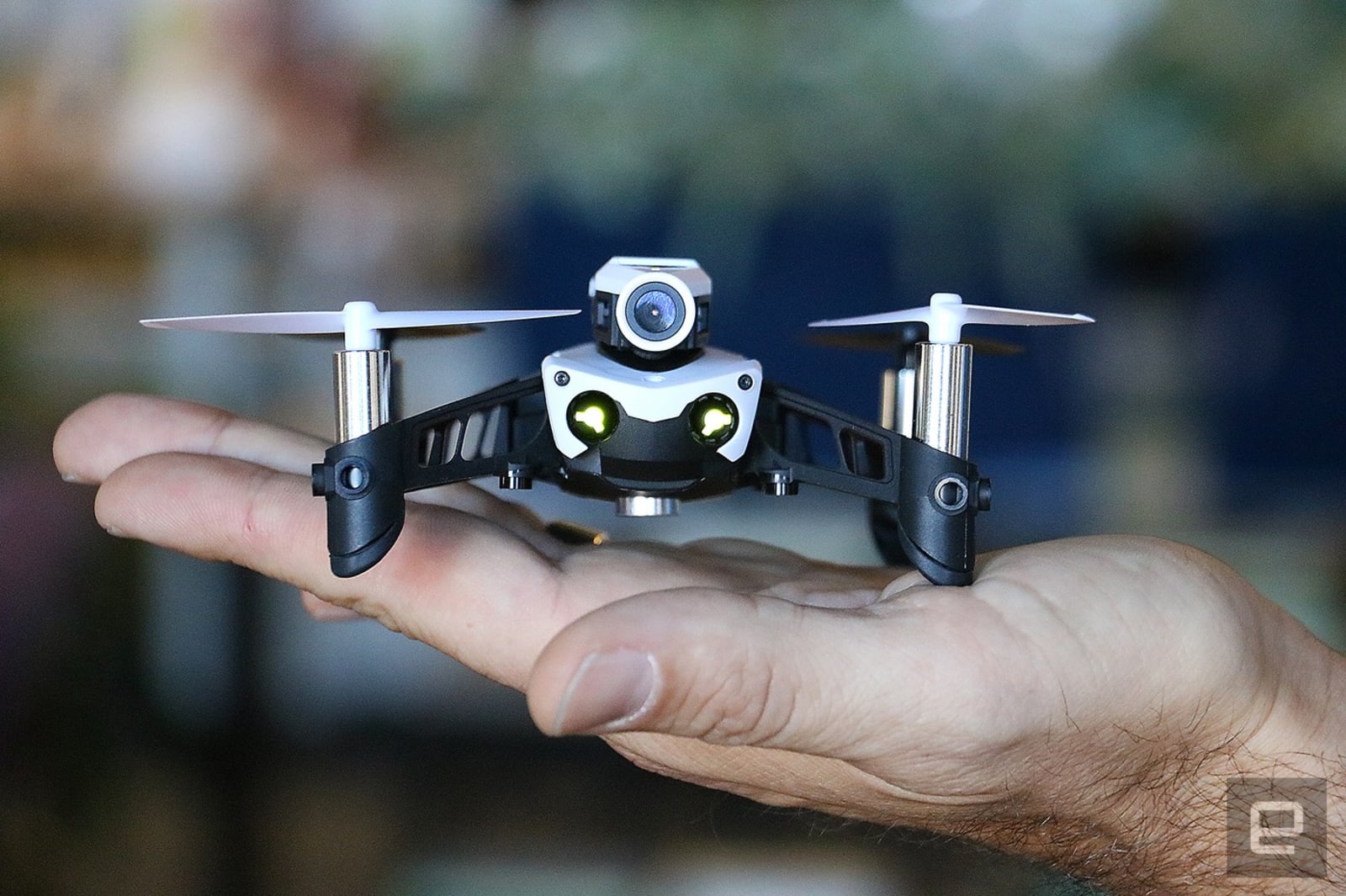
Parrot’s Mambo FPV puts you in the mini cockpit
With its cannon and claw accessories, last year’s Mambo drone from Parrot was more a toy than a photography tool. The latest version of the mini drone looks to be at least more fun, if not more useful, than its predecessor. The Mambo FPV comes with a camera attachment and a headset, so you can stream what the tiny flyer is seeing right into your eyes.
Last year’s Mambo came with a cannon that shoots six pellets up to six feet and a “Grabber” claw that picks up very small objects weighing up to four ounces. The new version isn’t physically different — it just comes with different accessories (the older ones are also compatible). Parrot increased the wireless range between the Bluetooth controller and the drone so you can now fly it up to 100 meters (330 feet) away, up from 60 meters before.
I didn’t get to fly the Mambo FPV myself, but I did check out the video it was streaming to an iPhone. Better yet, I stuck the phone in Parrot’s included goggles that the company (unfortunately) named Cockpitglasses 2. The camera records video to an onboard microSD card in 720p, but broadcasts to the phone in VGA (640 x 480).

The live footage I saw was somewhat pixelated, partly because of the VGA resolution, but also likely due to the WiFi connection between the camera and the phone. The HD clips that we got off the Mambo’s onboard microSD card were slightly better in resolution, and had trouble exposing for the harsh sunlight streaming in through our office windows, but its quality is fine overall. (Check out our video above for some samples.) Thanks to Parrot’s digital stabilizing technology (similar to the Bebop, although we can’t say if it’s the exact same), the video I watched was steady enough to keep me from feeling nauseated.
It’s not good enough to make high-quality movies with, but the Mambo FPV provides decent footage for those who want to get a bird’s eye view of special events like weddings or family gatherings. That makes it slightly more useful than its predecessors, which were primarily designed for fun. The first-person perspective stream and Cockpitglasses also make flying the drone easier, since you’re always facing forward and know which direction to turn.

The Mambo FPV comes with three new flight modes: Easy (labelled Normal in the app), which stabilizes both horizontal and vertical movement; Drift, which only stabilizes vertical flight for tighter turns and Race, which does not stabilize in either direction. Unfortunately, as I didn’t get to fly the drone, I couldn’t tell how easy it was to pilot the Mambo with any of these settings. Those who already own a Mambo drone can, in theory, try these modes for themselves once they roll out via a software update. Unfortunately, since you can’t buy the camera module separately just yet, you’ll either have to shell out for a whole new drone or wait till Parrot sells that accessory on its own.
At 2.2 ounces, the Mambo FPV fits comfortably in my hand, and takes off from there, too. A company rep started the Mambo from his phone, and I gently threw it in the air. The harder I threw the device, the further it fell back towards the ground before regaining composure and rising back up. I couldn’t quite tell if this was because of the Parrot rep’s expertise in flying or if there was technology built in to make that launch smooth, but it was definitely impressive. The Mambo also took off easily from two meeting tables during our demo.
After about 10 minutes of flying and stopping, the drone’s LEDs started flashing red to indicate its battery was running low. Parrot says the Mambo FPV can last up to 10 minutes of continuous flight (eight minutes if the camera is streaming), which is a three minute increase over last year’s model, and pretty good for a drone of this size.
The new model means Mambo is available in three different configurations — the FPV kit includes the drone, goggles, controller, camera module and propeller guards for $180. The other two bundles are last year’s Mission ($160) and the Fly ($110), with the latter containing just the drone and guards.
Parrot hasn’t mentioned if it will eventually sell the camera module on its own so existing owners of a Mambo can simply buy that to upgrade, but for now you’ll have to get the FPV bundle to get the camera. If you want a cheaper alternative and don’t mind making do without image stabilization built in, the Nano QX2 FPV drone ($100) offers similar video quality and also streams live to a headset. You’ll need to buy pricier FPV goggles for that feature, though.

We also got a brief look at the new Bebop 2 Power, which is the third generation of the company’s flagship drone. The new iteration comes with two battery packs in the box instead of one, so you have a bit more flying time out of the box. Each battery now lasts 30 minutes — five minutes longer than before, putting Bebop up there with the DJI Mavic Pro in terms of longevity.
The Bebop 2 Power has a full HD camera with a fisheye lens that sees 180 degrees horizontally and vertically; you select the 90-degree portion you want via the flight app. This way, Parrot doesn’t need a gimbal or mechanical parts to move the camera’s view — and it keeps the drone lightweight and relatively compact. Though a full gimbal typically provides better stability and image quality.
The Bebop 2 Power ($599) is also powerful enough to reach up to 65 kilometers per hour (40 mph) in flight. The companion app has also been updated with new modes to make aerial filmmaking easier. The Magic Dronies mode will recognize things like humans or vehicles and make the Bebop 2 Power circle your subject while you’re recording. There’s also a new Autoshot mode for landscape videography that makes the drone to move in a preset pattern (like a slow reveal from a low angle to a wide shot) with a single tap on your phone.
As much as I was itching to try these new features, we couldn’t fly the Bebop 2 Power indoors during our meeting or outside without knowing where exactly we were permitted to fly drones in New York. Until we can test the Bebop 2 Power for ourselves, it’s hard to tell how effective Parrot’s software will be. But based on some preview footage the company’s rep showed us, the Bebop 2 Power’s camera should make for some stunning panoramas or high-quality selfie videos for those not looking to spend the extra cash for the likes of DJI’s Phantom or Mavic.
 AIVAnet