


Google made its own earbuds because it killed the headphone jack
Google followed Apple’s “courageous” move to eliminate the 3.5mm headphone jack on the Pixel 2, and like the handset itself, Google designed a pair of headphones to (hopefully) best show off Assistant’s capabilities. Like real-time translation so you can have a conversation with someone who speaks one of 40 foreign tongues. They’re called Pixel Buds, which, let’s be honest, sounds adorable. As soon as you pair them with your Pixel or Android phone running Nougat or higher, Assistant is available.
Unlike Bose’s QC 35 II, they won’t require you to touch a button to activate Assistant. Instead, you swipe across the outside of the right earbud or tap it for things like music controls. The fabric loop should keep them securely attached to your noggin, too. Google claims you’ll get five hours per-charge, and that the case the Pixel Buds come with acts as a charger and can offer around 24 hours of music. They’ll run you $159, come in blue, white and black. Pre-orders open up today and they’ll ship in November.
Source: Google Play, Google
UK pricing for Google’s Pixel 2, Home Mini and Pixelbook
Even though many of the devices from today’s Google’s Pixel 2 event had leaked beforehand, there was still plenty left to surprise. Leading the way were the Pixel 2 and Pixel 2 XL, but we also got our first look at the Google Home Max and Mini, the 2-in-1 Pixelbook and the new wireless Pixel Buds. Some will be available in the UK soon, others will take their time to make their way across the Atlantic. Here’s how much some of that new gear is going to cost you.
Pixel 2 and Pixel 2 XL
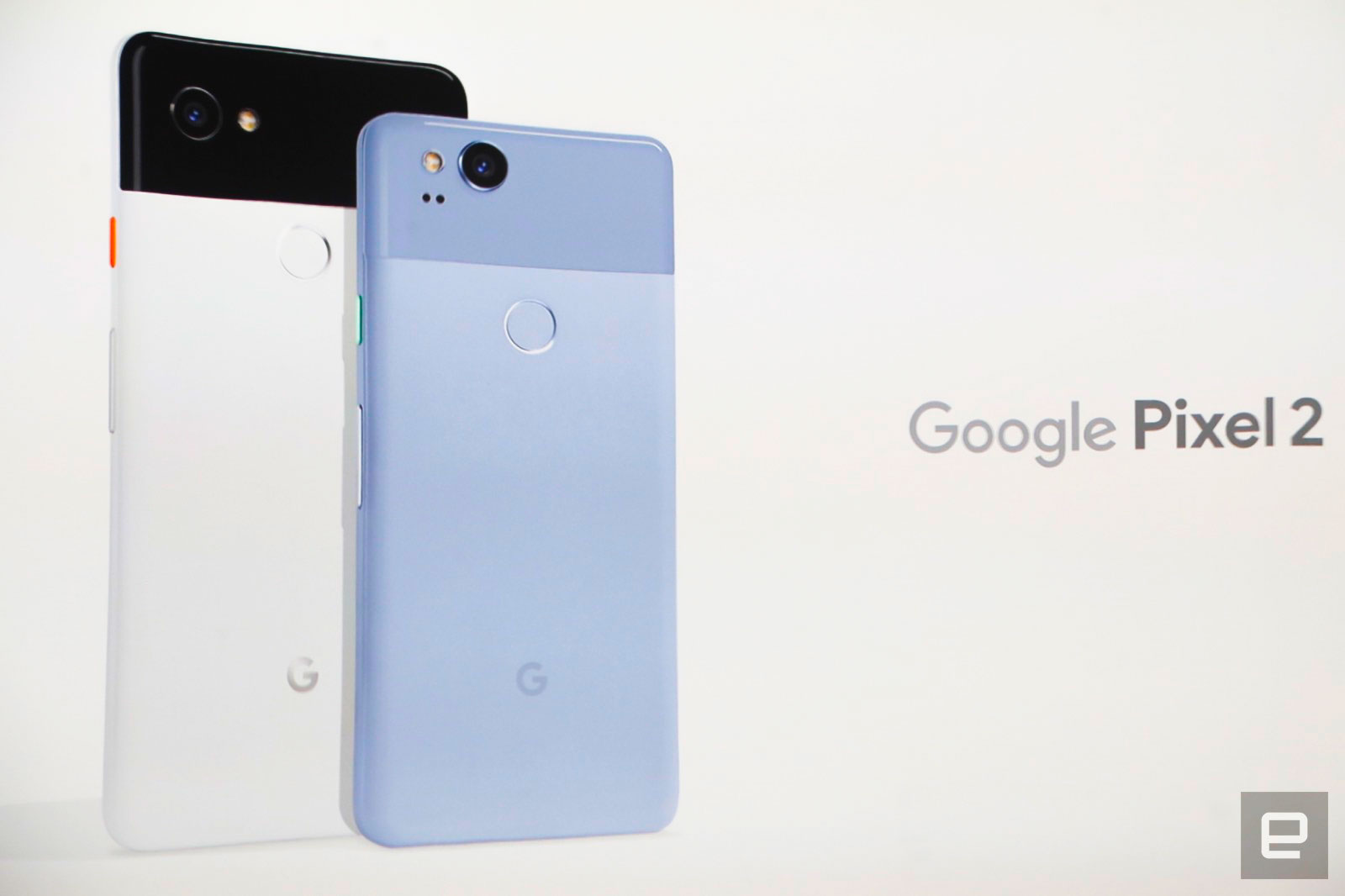
As expected, the Pixel 2 and Pixel 2 XL are vastly improved from last year’s models. The 3.5mm headphone jack is gone, just like the iPhone, but the 5- and 6-inch smartphones feature a 2.35Ghz Snapdragon 835 processor, 4GB of RAM, a 12.2-megapixel sensor with a f/1.8 aperture stereo speakers, Bluetooth 5.0, and 2700 mAh and 3520 mAh batteries, respectively.
The pricing works out as follows. The 64GB and 128GB variants of the Pixel 2 will set you back £629 and £729 respectively. The Pixel 2 XL and Pixel 2 XL — with the same storage — cost a little more, coming in at £799 and £899.
Pre-orders open today, with the Pixel 2 shipping by October 17th. The Pixel 2 XL, however, might take between five and six weeks to reach your doorstep.
Google Home Mini and Home Max

If the Google Home is the search giant’s answer to the Amazon Echo, the new Home Mini is its answer to the Echo Dot. The puck-sized, fabric-covered device doesn’t feature the same music-grade speakers found in its bigger counterpart, opting instead to concentrate on Google Assistant voice commands.
As you’d expect, the Home Mini comes with a lower price tag. Should you opt for one of the three different colour variants — chalk, red and slate — you can expect to pay £49, the same price as Amazon’s Dot. You can pre-order right now and it’ll ship by October 17th.

The Home Mini wasn’t the only new speaker announced today. Instead of opting for dedicated voice smarts, Google decided it needed a speaker “built for sound.” The Max will automatically tune itself to your space and adjust itself depending on the song. Thanks to its dual 4.5-inch high-excursion woofers and two custom tweeters, the Max is a whopping 20 times louder than the standard Home. Given that they can also be paired in stereo, Google isn’t just going after Amazon, it’s also setting its sights on Sonos.
The Home Max will come in two colours: chalk and charcoal. However, the speaker will only be available in the US when it debuts in December. You can expect to pay around £399 when it does make its way to the UK, given the close parity between the pound and the dollar.
Google Pixelbook

It appears Google isn’t done with premium Chromebooks. The Pixelbook is a mix between the Chromebook Pixel and Pixel C, existing as a 2-in-1 machine that can be folded around and used like a tablet. The company claims the 12.3-inch device this is its thinnest laptop ever, coming in at just 10 millimetres thick. It also weighs just 2.2 pounds or 1 kilogram.
The Pixelbook has plenty of power too. It’s powered by Intel Core i5 and i7 processors and can be configured to host up to 512GB of storage and as much as 16GB of RAM. The Pixelbook Pen can circle things on the screen and the Assistant will give you more info and links to other relevant pages.
At £999, the basic Pixelbook with 8GB of RAM and 128GB SSD isn’t cheap, but it’s not the most expensive hybrid in its category. The Core i5 model with 8GB RAM and 256GB SSD is £1,199 and the Core i7 model with 16GB RAM and 512GB NVMe SSD is £1,699. If you want to add the pen, expect to pay £99 extra. Both can be pre-ordered today and will hit stores on October 31st.
Pixel Buds

Google’s new Pixel phones drop the headphone jack (boo), so of course the company has some Airpod-style wireless buds to go with them. The Pixel Buds will cost you £159 and come with simple touch-based gesture controls for playback and hands-free calls. They’ll also give you quick access to the Google Assistant and real-time translations, which in theory sound like a godsend for frequent travellers. Like the Airpods, they’ll come with their own charging case and a quick pairing feature for Android phones running Marshmallow or higher. There’s currently no details on pre-orders but Google expects to begin shipping Buds from November.
Google Clips

Lifelogging isn’t dead, at least according to Google. Google Clips looks like any other wearable camera, but Google’s crammed in a ton of its AI tech to get the most from its own. The idea is you set it somewhere (or clip it to you) and it’ll “look” for great moments to take photos and small videos using machine learning algorithms.
Google Clips is currently listed as “coming soon” in the US with a $249 price tag. However, it doesn’t look like it’ll make its debut in the UK for a while.
Source: Google Store
Google will show off its new gear at NYC and LA pop-up shops
If you want to get a good look at one of Google’s array of just-announced devices, you’re in luck. The company has two pop-up shops coming October 19th to New York and Los Angeles where you can drop in, fondle the goods. Unlike like last year’s temporary retail spots, you’ll be able to buy products there rather than having order whatever you want to be shipped to your home.
One temporary retail space will sit at 110 Fifth Avenue from 10 AM to 8 PM daily, while you’ll be able to find the West Coast version at 8552 Melrose Avenue during the same hours. The Melrose store in WeHo (West Hollywood) has the same address as a fabric wholesaler, Maharam, while the Fifth Avenue store in the Flatiron district has no other businesses associated with it, according to Google Maps.
Update: Shortly have this post went live, Google confirmed visitors will be able to purchase products at the pop-up shops this year. We’ve updated the text to reflect the new information.
Follow all the latest news from Google’s Pixel 2 event here!
Source: Google
The Google Pixel 2 vs. the competition: Small packs a punch
Today Google gave us our first official look at its new Pixel phones, with both handsets sharing major features like 12.2MP cameras and Snapdragon 835 chips. Your main reason to pick up a 5-inch Pixel 2 over its bigger brother is probably that hand-friendly screen size or the “kinda blue” color, though we’re curious how it measures up against some of the competing “small” phones on the market. To start we’ve lined up the specs of similar devices like the Galaxy S8 versus the Pixel 2 in the chart below, while our full review for the pair of Pixels will come later this month.
Pixel 2
Galaxy S8
LG G6
iPhone 8
Pricing
$649, $749 (off contract)
$725 (off contract)
varies by carrier (ranging from $650 at T-Mobile to $719 at AT&T)
$699, $849 (off contract)
Known dimensions
145.7 x 69.7 x 7.8mm (5.7 x 2.7 x 0.3 inches)
148.9 x 68.1 x 8.0mm (5.86 x 2.68 x 0.31 inches)
148.84 x 71.88 x 7.87mm (5.86 x 2.83 x 0.31 inches)
138.4 x 67.3 x 7.3mm (5.45 x 2.65 x 0.29 inches)
Weight
143g (5.04 ounces)
155g (5.47 ounces)
162.73g (5.74 ounces)
148g (5.22 ounces)
Screen size
5.0 inches (127mm)
5.8 inches (147.32mm)
5.7 inches (144.78mm)
4.7 inches (119.38mm)
Screen resolution
1,920 x 1,080 (441ppi)
2,960 x 1,440 (570ppi)
2,880 x 1,440 (564 ppi)
1,334 x 750 (326ppi)
Screen type
Full HD AMOLED
Quad HD+ AMOLED
QHD Plus LCD with DolbyVision HDR
Retina HD IPS LCD
Battery
2,700mAh
3,000mAh
3,300mAh
1821mAh
Internal storage
64 / 128GB
64GB
32GB
64 / 256GB
External storage
None
microSD
microSD
None
Rear camera
12.2MP, f/1.8, 1.4μm pixel size
12MP, f/1.7
Dual cameras:
13MP, f/1.8
13MP, f/2.4
12MP, f/1.8
Front-facing cam
8MP, f/2.4
8MP
5MP, f/2.2
7MP, f/2.2
Video capture
4K at 30fps
4K
4K at 120fps
4K at 60fps
NFC
Yes
Yes
Yes
Yes
Bluetooth
v5.0
v5.0
v4.2
v5.0
SoC
Qualcomm Snapdragon 835
Qualcomm Snapdragon 835
Qualcomm Snapdragon 821
Apple A11 Bionic
CPU
2.35GHz octa-core
2.3GHz octa-core
2.35GHz quad-core
Hexa-core, speed not available
GPU
Adreno 540
Adreno 540
Adreno 530
Not available
RAM
4GB
4GB
4GB
2GB
WiFi
Dual band, 802.11ac
Dual band, 802.11ac
Dual band, 802.11ac
Dual band, 802.11ac
Operating system
Android 8.0
Android 7.0
Android 7.0
iOS 11
Other features
Fingerprint sensor, IP67 certified, USB Type-C
Iris scanning, fingerprint sensor, IP68 certified, wireless charging
Fingerprint sensor, IP68 certified, MIL-STD-810G-tested shock resistant, USB Type-C
New gyroscope and accelerometer, IP67 certified, wireless charging
Follow all the latest news from Google’s Pixel 2 event here!
Pixel 2 and Pixel 2 XL hands-on: More than the sum of their parts
Just like clockwork, Google officially revealed its Pixel 2 and Pixel 2 XL today. And just like clockwork, Google gave the rest of the smartphone industry reason to be concerned. I spent a few moments playing with both of the new devices and couldn’t help but get almost irrationally excited about them — a rare feat considering just how thoroughly these two phones have been leaked over the past few months. My excitement has less to do with the hardware, though — by most measures, the Pixel 2 and Pixel 2 XL are exactly what you’d expect a pair of high-powered phones to be in 2017. What seems more fascinating is how good Google’s Android smartphones can be because of how much control the company has over the process now.
Let’s get the basics out of the way first: both of these phones are fast. Crazy fast. A lot of that is thanks to the ubiquitous Snapdragon 835 chipset and 4GB of RAM inside, though I’m sure the clean version of Android 8.0 certainly doesn’t hurt. The commonalities don’t end there either — both are almost shockingly light, and both of their coated aluminum bodies look and feel more premium than I would’ve expected. If you’re the kind of person who cares about “handfeel,” I think you’ll be pleased.
Both phones also have Google’s Active Edge, which is suspiciously similar to HTC’s own Edge Sense. (I wouldn’t be surprised if some of the intellectual property Google licensed from HTC relates to this.) In any case, squeezing the bottom half of the phones launches Google Assistant, which then starts listening for your commands. Assistant did a surprisingly good job at picking up queries in the journalist moshpit that was Google’s demo area, but getting the phone to recognize a squeeze took more force by default than seemed comfortable. Here’s hoping Google also lets us re-map that squeeze action to do other things the way Samsung didn’t with Bixby and its button.
The cameras, meanwhile, are just fantastic. Imagine this: you’re in a cramped room with questionable lighting and lots of pretty gadgets in front of you. That doesn’t sound like the ideal situation for taking photos with a phone, but the 12.2-megapixel sensor working in tandem with Google’s nearly insane image processing and recognition produced consistently excellent photos. I thought the Note 8 and the iPhone 8 Plus were good, and they definitely are. It’s just that the Pixels seem better, even after such limited time.
Interestingly, Google didn’t spend much time today spouting off specs, which means some of the new Pixels most useful features were barely acknowledged. Both are IP67 water and dust resistant, so they’ll handle dips, spills and splashes much better than either of the existing models do. The Pixel 2s are also the first mass-market phones with integrated eSIMS, though Google didn’t have the guts — or the carrier support — to ditch traditional SIM cards entirely. If you’re a Project Fi user (T-Mobile support will come later), you’ll be able to activate your plan and manage everything without fiddling with a tiny plastic card. The nanoSIM slot is there for every other carrier, and will certainly come in handy for frequent travelers.
While both phones share a very powerful platform, the differences between the phone are notable. There’s no way you can look at the Pixel 2 and the 2 XL and not feel some sort of visceral pull toward the latter. That’s all because of its long 6.0-inch pOLED display — it’s not quite as punchy or bezel-free as other smartphones we’ve recently tested, but it’s still far more exciting than the Pixel 2’s more traditional 5-inch screen. It would’ve been nice of Google to bring those sweet, 18:9 screens to its smaller phone, but there’s probably no way the economics would’ve worked out.
To be completely honest, I wasn’t sure coming into this event that Google would be able to surprise. I was wrong. The Pixel 2 and the Pixel 2 XL don’t feel like phones to me so much as they are Android itself given physical form. I fully understand how cheesy that sounds. Still, no matter how good other flagships phones have been this year, it’s only now that we’ve gotten a clear sense of what Android could and should be.
Follow all the latest news from Google’s Pixel 2 event here!
Senate committee focuses on Facebook in Russia probe
During a press conference today, the Senate Intelligence Committee gave an update on its investigation into Russian interference in the 2016 presidential election. It also warned that those preparing for 2018 elections should work under the expectation that similar initiatives from Russian operatives will occur. “I recommend every campaign and every elected official take this very seriously,” said committee Chairman Richard Burr.
The committee has already looked at piles of documents from the Trump campaign and conducted interviews with those associated with the president’s campaign as well as members of the intelligence community. The committee also just received thousands of Facebook ads to look through that are thought to have been purchased by Russian operatives. Twitter has turned over some information as well and the Senate Intelligence Committee is expecting more.
Facebook, Twitter and Google have been invited to testify at a November 1st hearing. “I was concerned at first that some of these companies did not take this threat seriously enough,” Vice Chair Mark Warner said. “But I believe they’re recognizing that threat now, and they are providing us with information.” Committee leaders also said that while the committee wouldn’t publish the ads provided by Facebook, they did encourage Facebook to do so. “We don’t release documents provided by to our committee, period,” Burr said. “[It’s] not a practice that we’re going to get into. Clearly if any of the social media platforms would like to do that, we’re fine with them doing it because we’ve already got scheduled an open hearing. We believe that the American people deserve to know firsthand.” Warner added, “At the end of the day it’s important that the public sees these ads.”
BREAKING: @facebook commits to testifying at Senate Intelligence Committee Nov. 1
WHAT’S NOT CLEAR: Who from Facebook will show up
— Kasie Hunt (@kasie) October 4, 2017
What was made very clear was that this investigation is nowhere near finished and the issue of collusion between the Trump team and Russia is still very much open. The goal is to figure out as much as possible before election season starts to ramp up next year. “We’ve got to make our facts, as it related to Russia’s involvement in our election, before the primaries getting started in 2018,” Burr said, adding, “You can’t walk away from this and believe that Russia’s not currently active.”
Source: C-Span
Pixelbook hands-on: stunning hardware for Chrome OS aficionados
Google’s Pixelbook is the first new laptop hardware the company has released since 2015’s Chromebook Pixel 2. But that computer was only an iterative update on the original 2013 model. The Pixelbook is wildly different and reflects what we’ve come to expect from laptops over the last five years or so. And while the prospect of spending $1,000 or more on a Chromebook remains a stretch for just about everyone, my first impressions of the Pixelbook is that it’s one of the nicest pieces of hardware I’ve tried in a long time.
At first glance, the Pixelbook is a stunner. The outside uses the same design motif as the back of the Pixel smartphones, with an aluminum and glass design that feels extremely solid. The keyboard is similarly excellent — keys are nice and large, and I was able to type comfortably and accurately right off the bat. Some won’t like the minimal travel here, but it doesn’t feel quite as shallow as Apple’s butterfly keyboards. Speaking of the keyboard, Google has put in some new special keys. There’s now a dedicated button for the Assistant in the same spot you’d find the Windows key on a Windows laptop, and there are buttons for taking a screenshot and pulling up the settings menu in the function row.
The original Pixel laptop was a bit chubby and heavy even by 2013 standards, but this new model is both svelte and light (only 2.2 pounds), so much so that using it in tablet mode isn’t an entirely ridiculous proposition. Especially if you put it down on a desk and use it with the $99 Pixelbook Pen.
The 12.3-inch touchscreen also looks great and is very responsive when you start jabbing at it with the Pen. Flipping it around into tablet mode, I got to experience the low latency when writing or drawing that Google touted. It’s definitely quick — just as responsive as the Surface Pro or iPad Pro. I didn’t use it enough to make exact comparisons, but it’s far better than Samsung’s Chromebook Pro and its included stylus. While we’re talking about tablet mode, the 360-degree hinge feels just as reliable as the rest of the hardware.
The UI has changed a bit here to accommodate the Google Assistant and Google Play apps, but it’s pretty intuitive and should be very easy to pick up. There’s an assistant button in the lower left corner of the screen and there’s also a menu specifically for pen-related input. Clicking and holding a button on the pen will let you circle any part of the screen; that portion will then be dropped into Google Assistant. So if you circle a picture from a movie, you’ll get more info about the film and its character.
As with several recent Chromebooks, Android apps are supported — and this computer should definitely have the hardware to run them well. Google has started partnering with software developers to get apps that are designed with the Pixelbook in mind. One of those developers is Snapchat, a pretty big name for Google, but they’ll need more than just that for the Android app ecosystem to really take off on Chrome OS. At the very least, things felt snappier and more responsive than ever before when trying out Android on a Chromebook.
Speaking of hardware, Google’s offering this device in three configurations. The $999 model gets you a Core i5 processor with 8GB of RAM and 128GB of storage. That should be more than enough for most users, but you can step up to 256GB for $1,199 or an i7 model with 16GB of RAM and 512GB of storage for $1,649. I have absolutely no idea who Google is targeting with that computer, but I’m interested in giving it a full test drive nonetheless.
In actuality, $999 for the level of hardware quality and performance the Pixelbook offers is right in line with what you’ll find in the rest of the industry. But the question we’ve been asking since the first Chromebook Pixel arrived in 2013 still applies: should anyone spend that much money on a Chrome device? Google’s OS has improved significantly over the years, but it still may be a hard sell — even with such lovely and powerful hardware.
The Google Pixel 2 XL vs. the competition: Cameras rule
In a year where the Galaxy Note made a comeback and Apple is mixing things up by offering both the iPhone 8 and the iPhone X, it’s hard to know what to make of Google’s newest handsets at first. The Pixel XL isn’t particularly flashy on the outside, though the single 12.2MP camera looks promising. But can it compete against the dual camera rigs on other flagship handsets? To see what else this 6-inch handset has to offer versus some of its major competitors, we’ve stacked up their specs in the table below. Be sure to check back later this fall to see how both the new Pixels and the iPhone X fare in their respective full reviews.
Pixel 2 XL
Galaxy Note 8
iPhone X
iPhone 8 Plus
Pricing
$849, $949 (off contract)
Starts at $929 (off contract)
$999, $1149 (off contract)
$799, $949 (off contract)
Dimensions
157.9 x 76.7 x 7.9mm (6.2 x 3.0 x 0.3 inches)
162.5 x 74.8 x 8.6mm (6.40 x 2.94 x 0.34 inches)
143.6 x 70.9 x 7.7mm (5.65 x 2.79 x 0.30 inches)
158.4 x 78.1 x 7.5mm (6.24 x 3.07 x 0.30 inches)
Weight
175g (6.17 ounces)
195g (6.9 ounces)
174g (6.14 ounces)
202g (7.13 ounces)
Screen size
6 inches (152.4mm)
6.3 inches (160.02mm)
5.8 inches (147.32mm)
5.5 inches (139.7mm)
Screen resolution
2,880 x 1,440 (538ppi)
2,960 x 1,440 (521ppi)
2,436 x 1,125 (458ppi)
1,920 x 1,080 (401 ppi)
Screen type
Quad HD pOLED
Quad HD+ Super AMOLED
Super Retina OLED
Retina HD IPS LCD
Battery
3,520mAh
3,300mAh
2,716mAh
2,691mAh
Internal storage
64/128GB
64/125/256GB
64 / 256 GB
64 GB / 256 GB
External storage
None
microSD
None
None
Rear camera
12.2MP, f/1.8, 1.4μm pixel size
Dual cameras:
12MP, f/1.7 (wide angle)
12MP, f/2.4 (telephoto)
Dual cameras:
Wide-angle, 12MP, f/1.8
Telephoto, 12MP, f/2.4
Dual cameras:
Wide-angle, 12MP, f/1.8
Telephoto, 12MP, f/2.8
Front-facing cam
8MP, f/2.4
8MP, f/1.7
7MP TrueDepth, f/2.2
7MP f/2.2
Video capture
4K at 30fps
4K
4K at 60fps
4K at 60fps
NFC
Yes
Yes
Yes
Yes
Bluetooth
v5.0
v5.0
v5.0
v5.0
SoC
Qualcomm Snapdragon 835
Qualcomm Snapdragon 835
Apple A11 Bionic
Apple A11 Bionic
CPU
2.35GHz octa-core
2.3GHz octa-core
64-bit hexa-core, speed not available
64-bit hexa-core, speed not available
GPU
Adreno 540
Adreno 540
Not available
Not available
RAM
4GB
6GB
3GB
3GB
WiFi
Dual band, 802.11ac
Dual band, 802.11ac
Dual band, 802.11ac
Dual band, 802.11ac
Operating system
Android 8.0
Android 7.1.1
iOS 11
iOS 11
Other features
Fingerprint sensor, IP67 certified, USB Type-C
Iris scanner, fingerprint sensor, USB Type-C, 3.5mm headphone jack, wireless charging
Face ID, new gyroscope and accelerometer, IP67 certified, Lightning connector, wireless charging
New gyroscope and accelerometer, IP67 certified, , Lightning connector, wireless charging
Follow all the latest news from Google’s Pixel 2 event here!
Google’s Pixel 2 phones don’t need SIM cards
Google added a lot to the Pixel 2 and Pixel 2 XL, but one of its more intriguing upgrades comes from what it’s taking away: the need for a SIM card. Both devices still have a nano-SIM slot (contrary to a few rumors), but they also use eSIMs like that on the Apple Watch Series 3. So long as your carrier supports it, you just have to download a virtual SIM during the setup process to activate service. Needless to say, that’s a welcome change if you’re tired of the usual SIM swapping ritual needed for upgrading handsets.
Of course, it’s that support which may be the sticking point. To no one’s surprise, Google’s own Project Fi is the only carrier currently lined up to support eSIMs. You’ll still need to insert a regular SIM card with other networks for now, and it won’t be surprising if they’re hesitant to sign up. After all, this would let you easily activate or switch carriers without ordering a card or visiting a store. This is more about futureproofing the Pixel line than anything. If and when other carriers get with the eSIM program, your handset will be ready.
Follow all the latest news from Google’s Pixel 2 event here!
Apple watchOS update addresses LTE connectivity issues
Two weeks after Apple released watchOS 4.0, the company has pushed out an update that aims to fix a seriously annoying issue. It seems the brand-new Apple Watch Series 3 with the latest watchOS would tend to automatically switch from LTE to WiFi hotspots — even unusable ones — in efforts to save battery. The patch aims to prevent that specific model of watch from automatically connecting with those wireless providers.
The trouble sourced from the watch’s automatic connection. Some WiFi hotspots the Series 3 models latched onto were unauthenticated (aka captive) kind used by coffee shops or libraries that redirect users to a web page to confirm or further interact. Because the watchOS would link automatically without bringing up the prompted site, users were stuck in limbo, unconnected but locked to inoperative WiFi.
Device owners can download the 4.0.1 update from the Apple Watch app on their iPhones. Per the update’s language, according to 9to5Mac:
watchOS 4.0.1 fixes issues that in rare cases were causing Apple Watch to join unauthenticated (captive) Wi-Fi networks, such as those found in public places like coffee shops and hotels, which direct the user to a webpage before the network can be accessed.
Via: MacRumors
 AIVAnet