


Ofcom orders BBC to show more original British productions
Ofcom has told the BBC it needs to show more programming developed inside Britain. The new rules, part of a revamped operating licence, will require the broadcaster to show at least 75 percent original content on BBC One, Two and Four. From 6 to 10:30pm, or peak hours, that figure will rise to 90 percent on BBC One and Two. The change will effectively ban the BBC from showing movies and TV series bought from international broadcasters during the evening. Instead, the organisation will have to rely on BBC commissions to retain and grow its audience share at night.
The new licence will also demand that the BBC produce more of its programming in different parts of the UK. Half of the BBC’s schedule (measured by hours, rather than individual shows) will need to be developed outside of London. Ofcom is also creating minimum quotas for programmes developed inside Scotland, Wales and Northern Ireland. These will be proportionate with each nation’s population size, ensuring that the BBC is catering to each region with an appropriate amount of specialised content. Furthermore, the BBC will need to spend the same amount (on a per-head basis) on programming in each UK nation.
Ofcom wants the BBC to have a stronger focus on news and current affairs too. It will increase the relevant quotas for BBC One and Two, and introduce new ones for BBC Radio 1 and 2. Radio 2, for instance, will need to run three hours of news and current affairs during “peak time” each week. Radio 1, meanwhile, will have to run a set number of “major social action campaigns” each year, utilising its still substantial reach with young people across the UK. “Raising awareness of social issues among younger people and providing a platform on which to engage is one of the key ways Radio 1 can set itself apart from other radio stations,” the regulator said.
Workforce diversity will be another point of contention. Ofcom says it will, for the first time, make the BBC “publicly accountable” as it tries to improve representation on and off camera. The broadcaster’s targets include 15 percent of staff being from ethnic minority groups, and half of all staff and leadership roles being held by women by 2020. The BBC will need to report on its progress each year and Ofcom will scrutinise accordingly. “If audiences are dissatisfied, the BBC must explain itself and put in place measures on how it will improve,” the regulator said.
A BBC spokesperson described the new rules as “tough and challenging,” but agreed they would create a “distinctive BBC which serves and represents all audiences.” “We will now get on with meeting these requirements and continuing to provide the world-class, creative BBC the public wants,” they added. The quotas will, undoubtedly, put pressure on a broadcaster already facing budgetary constraints and fierce competition from streaming services such as Netflix. A greater focus on originals is arguably in line with its public broadcasting remit, but could diminish its influence as viewers seek an increasingly broad palette of pop culture.
Source: Ofcom
Motion Stills 2.0 Adds In-App Live Photo Capture, Collage GIF Export, and More
Google released version 2.0 of Motion Stills this week, bringing some notable improvements for frequent users of the app. For those unfamiliar with it, Motion Stills is designed to create unique GIFs from Live Photo images captured with iPhones that support the Apple camera feature. Users can add motion-tracked text overlays and emoji to their custom-framed creations and share them as a looping GIF to their favorite messaging app.
Previously, users of the app had to access their device’s photo library to add Live Photos to a Motion Still, but with version 2.0 it’s now possible to capture Live Photos and Motion Stills from within Google’s app. It’s still possible to import Live Photos stored in the native photo library, but Google has tried to make things more convenience for regular users of Motion Stills.
In addition, version 2.0 lets users delete Live Photos in the photo library with a swipe gesture, and there’s a new option to export collages as GIFs. Google’s updated Motion Stills app for iPhone and iPad can be downloaded from the App Store for free. [Direct link]
Tag: Motion Stills
Discuss this article in our forums
Activists Urge Apple to Remove App Store Games That Play Up Philippine Drugs War
A group of civil society organizations has demanded that Apple remove games from its App Store that promote violence and killings commonplace in the Philippines’ war on drugs (via Reuters).
The games in question, which the group said violated Apple’s own guidelines, include characters based on Philippines President Rodrigo Duterte and his national police chief, Ronaldo “Bato” dela Rosa, who engage criminals in gun battles and fistfights.
Tsip Bato by Ranida Games
“These games valorise and normalise the emerging tyranny of Duterte’s presidency and his government’s disregard for human rights principles,” the Asian Network of People who Use Drugs (ANPUD) said in an open letter to Apple CEO Tim Cook.
The group named 131 organizations from several countries as supportive of the October 10 complaint to Apple, with groups working on human rights, youth and drug policy reform among them.
They urged the tech giant to issue an apology for hosting such “insensitive content”. Apple has yet to respond to the letter.
Thousands have been killed in Duterte’s war on drugs, a 15-month-long campaign that has caused international alarm. Human rights groups say state-sponsored executions are taking place, but authorities vehemently reject the claim.
Games available in the App Store that have come in for criticism include Fighting Crime 2, Duterte Knows Kung Fu, Duterte Running Man Challenge, Tsip Bato, and Duterte Vs Zombies. The civil rights groups said the games “might seem harmless and fun” but are offensive and distasteful because of the reality and prevalence of state-sanctioned murder with impunity.
Ben Joseph Banta, a managing partner of Ranida Games, which developed Tsip Bato, told Reuters in an email that the aim of its game was “not to promote violence”, but that it sought to discourage drug use with the use of banner messages opposing drugs that were visible to players.
“We understand the human rights groups and we’re very much open to make changes in the game in order to remove the stigma that the game is promoting violence,” said Banta.
On Thursday, The Guardian reported that President Duterte had ordered police to end all operations in his war on drugs. In a televised speech he said he hoped a shift to target big networks would satisfy “bleeding hearts” and interfering western states fixated on the high death toll in his brutal crackdown.
Note: Due to the political nature of the discussion regarding this topic, the discussion thread is located in our Politics, Religion, Social Issues forum. All forum members and site visitors are welcome to read and follow the thread, but posting is limited to forum members with at least 100 posts.
Tags: App Store, Philippines
Discuss this article in our forums
iPhone With Apple Pencil Support Could Launch ‘As Early As 2019’
Apple is reportedly “mulling” the idea of launching a stylus compatible with iPhone, believed to be a new iteration of the Apple Pencil, which is currently only supported by the iPad Pro. The rumor comes from industry sources speaking to The Korea Herald (via The Investor), which claimed that Apple engineers “have recently been working” on a new iPhone device that “comes with a digital pen,” aiming for a potential launch in 2019.
The sources said that the iPhone stylus is likely to adopt a “supercapacitor stylus type” for price benefits, contrasting with Samsung’s Galaxy Note pen which is based on electromagnetic resonance technology that needs additional panel components to be installed underneath the smartphone display. “A supercapacitor type is cheaper to make compared to the EMR stylus. It also offers a more pen-like feel,” according to the industry sources.
Notably, Apple’s current A-series chip would see a “drastic upgrade” as well in order to fuel a better handwriting experience for the stylus on iPhone.
Apple is mulling something that its late founder Steve Jobs had outright rejected — adding a stylus to its iPhone, according to industry sources on Oct. 13.
“Apple is preparing to launch the phone as early as 2019,” an industry source told The Investor on condition of anonymity. “It is also in talks with a couple of stylus makers for a partnership.”
The Apple Pencil launched nearly two years ago in November 2015 alongside the 12.9-inch iPad Pro. Apple’s first stylus was designed specifically to work with the iPad Pro, and gives users the feel of using a real pen or pencil with sensors that determine the orientation and angle of the Apple Pencil, and pressure sensitivity allowing for darker or lighter pen strokes.
Former Apple CEO Steve Jobs was famously against launching a stylus for iPhones, during the original iPhone event stating: “Who wants a stylus? You have to get them, and put them away, and you lose them, yuck. Nobody wants a stylus.”
Apple executives and current CEO Tim Cook have repeatedly avoided referring to Apple Pencil as a “stylus” over the years, with Cook commenting in an interview last year that “we launched a pencil not a stylus.” The Apple CEO further stated, “I think that Steve would have loved” the Apple Pencil, and even gave early mention of a pencil device potentially supporting iPhones in the future: “if you’ve ever seen what can be created on an iPhone or an iPad with that pencil is really unbelievable.”
Tag: Apple Pencil
Discuss this article in our forums
Airbnb’s Select vetted homes may arrive next year
Back in June, reports came out that Airbnb has conjured up a project called “Select” that will offer vetted homes and rooms to the more discerning customers. According to a new report by The Information, Airbnb is planning a limited launch of that initiative sometime in 2018. It’s unclear how many Select listings will be available during the limited launch, but the company is reportedly aiming to offer hundreds of thousands of Select homes in the future.
To help home owners ensure their properties pass muster, the Select program will apparently give them the option to ask Airbnb for funds in advance. The company expects them to use the cash to fund the home improvements they need to make, such as remodeling their bathrooms or repainting their houses. Airbnb still seems to be working out the details, though, because according to hosts the publication talked to, the company couldn’t give them exact info on how the program will benefit them. In addition, dealing with inspectors and photographers in their homes has been eating up a lot of their time. One of them also voiced out being worried that the program will raise customers’ expectations, leading them to leave mediocre reviews for homes they would’ve given five stars otherwise.
Select is an entirely different entity from Airbnb’s initiative that focuses on luxury homes. When the news of the program first went around, a source told Engadget that the home rental company came up with the idea to better serve older guests who want more space and to stay in unique neighborhoods. Select will put a sharper focus on quality in order to cater to those customers.
Source: The Information
Samsung CEO Resigns as Tech Giant Forecasts Record Profits
In a surprise move, Samsung announced on Friday that its CEO and vice chairman Kwon Oh-hyun is to step down. Kwon was expected to take a bigger role at the company after de facto leader J Y Lee was arrested and jailed for bribery, but his surprise resignation has deepened concerns of a power vacuum.
“It is something I had been thinking long and hard about for quite some time. It has not been an easy decision, but I feel I can no longer put it off,” Kwon said in a letter sent to employees. “As we are confronted with unprecedented crisis inside out, I believe that time has now come for the company to start anew, with a new spirit and young leadership to better respond to challenges arising from the rapidly changing IT industry.”
The news came on the same day that Samsung forecast record third-quarter operating profit thanks to its thriving memory chip business, which has allowed the South Korean tech giant to brush off a punishing period in 2016 in which the fire-prone Galaxy Note 7 recall made the biggest tech headlines.
Semiconductors were Samsung’s top earner in the three months through June, making a record 8 trillion won ($7.19 billion). While memory chips were responsible for most of Samsung’s profits, its mobile phone business was given a boost by its new Note 8 smartphone which received the company’s highest number of pre-orders.
The timing of the announcement and Kwon’s references to an “unprecedented crisis” suggest that Samsung is gearing up for major changes to its operational structure and internal culture following Lee’s corruption scandal, but the move also increases uncertainty as to who will fill the gap that Kwon leaves.
Kwon has essentially functioned as the number two in Samsung Group, being not only the chairman of the board and a board director, but also head of the components business and Samsung Display. Also known as “Mr Chip”, Kwon was instrumental in making Samsung’s semiconductor business a global leader.
“We are fortunately making record earnings right now, but this is the fruit of past decisions and investments,” continued Kwon in the letter. “We are not able to even get close to finding new growth engines by reading future trends right now.”
Kwon said he will see out his term as chairman of the board and board director until March 2018, and will remain in his two other roles during the same period.
Tag: Samsung
Discuss this article in our forums
Virgin’s Sir Richard Branson climbs aboard the Hyperloop
Why it matters to you
Input from a global brand like Virgin has the potential to take this remarkable project to the next level.
Hyperloop enthusiasts may be finding it a challenge to convince everyone that the ultra-high-speed transportation project is for real, but entrepreneur Sir Richard Branson is clearly convinced.
The Virgin Group founder has announced his company is investing in L.A.-based Hyperloop One, one of several outfits that’s been making significant progress in developing the technology. Billionaire Branson has snagged a seat on the board, too, and the company will soon re-brand to become, what else … Virgin Hyperloop One.
Describing the Hyperloop system as “the world’s most revolutionary train service,” Virgin said it was “incredibly excited about the technology … and the way it could transform passengers’ lives.”
The Hyperloop, if you didn’t already know it, was dreamed up by SpaceX and Tesla CEO Elon Musk, a man so creative that he would likely self-combust in disgust were his brain ever to present him with an idea considered by the general population as “old hat.”
Having put the Hyperloop concept out there around five years ago, Musk decided to take a back seat with that particular project and instead concern himself with all of his other extremely ambitious plans, which include building a city for humans on Mars, a rocket-based travel service that’d fly you from New York to Shanghai in 39 minutes, and a vast subterranean network of transportation tunnels with high-speed “car sleds” to ease road congestion in busy cities. But that’s enough of that.
The Hyperloop would use propulsion technology to push passenger-filled pods through elevated tubes at speeds of up to 750 mph. At that kind of speed, a ride between L.A. and San Francisco would take just 35 minutes instead of the usual six hours by car. U.K.-based Virgin offers up another example, saying the Hyperloop could run you between London and Edinburgh in around 45 minutes. Anyone that’s driven it knows it can forever on a congested highway, and even longer if you take one of Branson’s Virgin trains and it gets delayed along the way.
Yes, Virgin already has plenty of experience with more conventional forms of transport. Besides its U.K. train service, it also operates an international airline. At the more ambitious end of the spectrum is Virgin’s space plane that could one day give moneyed tourists the ride of a lifetime.
Although Branson has declined to reveal just how much cash Virgin will be pumping into the project, Hyperloop One is known to have so far received nearly $250 million in funding — including a recent injection of an additional $85 million — from a range of interested investors since the firm was founded in 2014.
The involvement of a global brand like Virgin is a real boost for Hyperloop One, with development cash and wider exposure helping to propel the project forward, hopefully to a point where we can finally discover if the extraordinary plan is truly viable.
Xiaomi’s Mi Robot vacuum cleaner is on sale for just $276
The Mi Robot is one of the best robot vacuum cleaners available.
I love the Mi Robot vacuum, mostly because it saves me from having to clean the house every weekend. The vacuum has a white color scheme and a powerful 1800Pa motor, and like all Xiaomi products, it offers great value for money. It usually retails for $299, but Chinese retailer GearBest is selling the vacuum for just $276 with coupon code XMIVCHK.

The vacuum itself is manufactured by Rockrobo, one of Xiaomi’s ecosystem partners. The Mi Robot uses a combination of sensors — an ultrasonic radar sensor, a cliff sensor, a gyroscope and an accelerometer — to navigate around the house, creating a virtual map of its surroundings. Once the vacuum is finished cleaning a room, it automatically goes back to its charging dock.
Read: Xiaomi Mi Robot vacuum review
Best of all, you’ll be able to control the vacuum with your phone by installing the Mi Home app. Xiaomi rolled out an update earlier this year with the English language pack, so you’ll be able to see all the functions the vacuum is capable of directly in the Mi Home app.
You can see the cleaning time, battery life of the vacuum, and the area covered from the app, and there’s also the option to manually initiate a cleaning cycle or set an automated schedule. If you’re interested, hit up the link below and enter coupon code XMIVCHK to get your hands on the Mi Robot vacuum for $276.
See at GearBest
#WomenBoycottTwitter protest spreads across social media
Twitter has been home to many hashtag campaigns, but tonight one is trending that’s a little different: #WomenBoycottTwitter. Sparked by its “temporary lock” of Rose McGowan’s account yesterday, the movement’s purpose is to go dark “In solidarity w @rosemcgowan and all the victims of hate and harassment Twitter fails to support.” Participants include fellow celebrities, women who have experienced harassment online and men who support its cause.
The campaign’s source is Kelly Ellis, a software engineer and former Google employee who has previously written about the harassment she’s experienced and Twitter’s failure to address it. Last year Ellis wrote about a weeklong string of harassing tweets she received that Twitter would not act on, and just yesterday noted that while McGowan’s account was silenced, rape threats she had received stayed live on the service.
Signing off for the night and all day tomorrow in solidarity with @rosemcgowan + the women and survivors everywhere who deserve to be heard. pic.twitter.com/KjnFuxH05G
— raqtober (@raqueldesigns) October 13, 2017
#WomenBoycottTwitter Friday, October 13th. In solidarity w @rosemcgowan and all the victims of hate and harassment Twitter fails to support. https://t.co/G0my9EyKpQ
— Kelly Ellis (@justkelly_ok) October 12, 2017
MEN: if you are on here tomorrow, I urge you to AMPLIFY our voices. Call on your brothers to be better, go after ones who won’t. #ROSEARMY
— rose mcgowan (@rosemcgowan) October 13, 2017
By its nature, it’s hard to say exactly how many people have joined the campaign, but it rapidly gained steam yesterday, joined by McGowan herself, Alyssa Milano, Chrissy Tiegen, Jeffrey Wright and others. At the same time, even among people who support its message, there have been reactions asking why now, instead of at times when others, in particular women of color, have experienced harassment on Twitter or bans of varying degrees from the site itself.
Calling white women allies to recognize conflict of #WomenBoycottTwitter for women of color who haven’t received support on similar issues.
— Ava DuVernay (@ava) October 13, 2017
Suspended ESPN host Jemele Hill has been a frequent target of harassers, while comedian Leslie Jones experienced a sustained campaign including the hacking of her iCloud account, just last year. Ellis responded to those concerns before going dark, saying that “We can and should do better. It’s not ok for solidarity to only be for white women. I regret the timing. Finally, the “women” part of #WomenBoycottTwitter is exclusionary to nonbinary folks. I can and will do better in the future. I apologize.”
My mentions since posting #WomenBoycottTwitter 3 minutes ago #thisiswhy pic.twitter.com/c1GKSmBu32
— christine teigen (@chrissyteigen) October 13, 2017
The list of people who have been targeted by trolls and worse on social media is long — late last year Tim & Eric collaborator Vic Berger IV joined the list — but Twitter’s inability/outright unwillingness to deal with the nastiness that so frequently appears has been there from the start. Author and Engadget contributor Ariel Waldman wrote in 2008 about the harassment she received, and heard from (current Twitter CEO) Jack Dorsey at the time that “We’ve reviewed the matter and decided it’s not in our best interest to get involved.” (In the last 24 hours, he tweeted that “We do need to do a better job at showing that we are not selectively applying rules.”)
We do need to do a better job at showing that we are not selectively applying rules.
— jack (@jack) October 12, 2017
By its nature, it’s not immediately clear how many people are participating in the #WomenBoycottTwitter campaign, or how many are remaining active for various reasons. Still, it’s clear that nearly a decade after Waldman’s complaint, despite Twitter’s promises of transparency, revamped blocking tools and tweaked policies, many — starting with those most frequently targeted for harassment just because of who they are — are still not satisfied with the company’s reaction.
Source: Kelly Ellis (Twitter), #WomenBoycottTwitter
Raspberry Pi laptop teaches code with modular innards
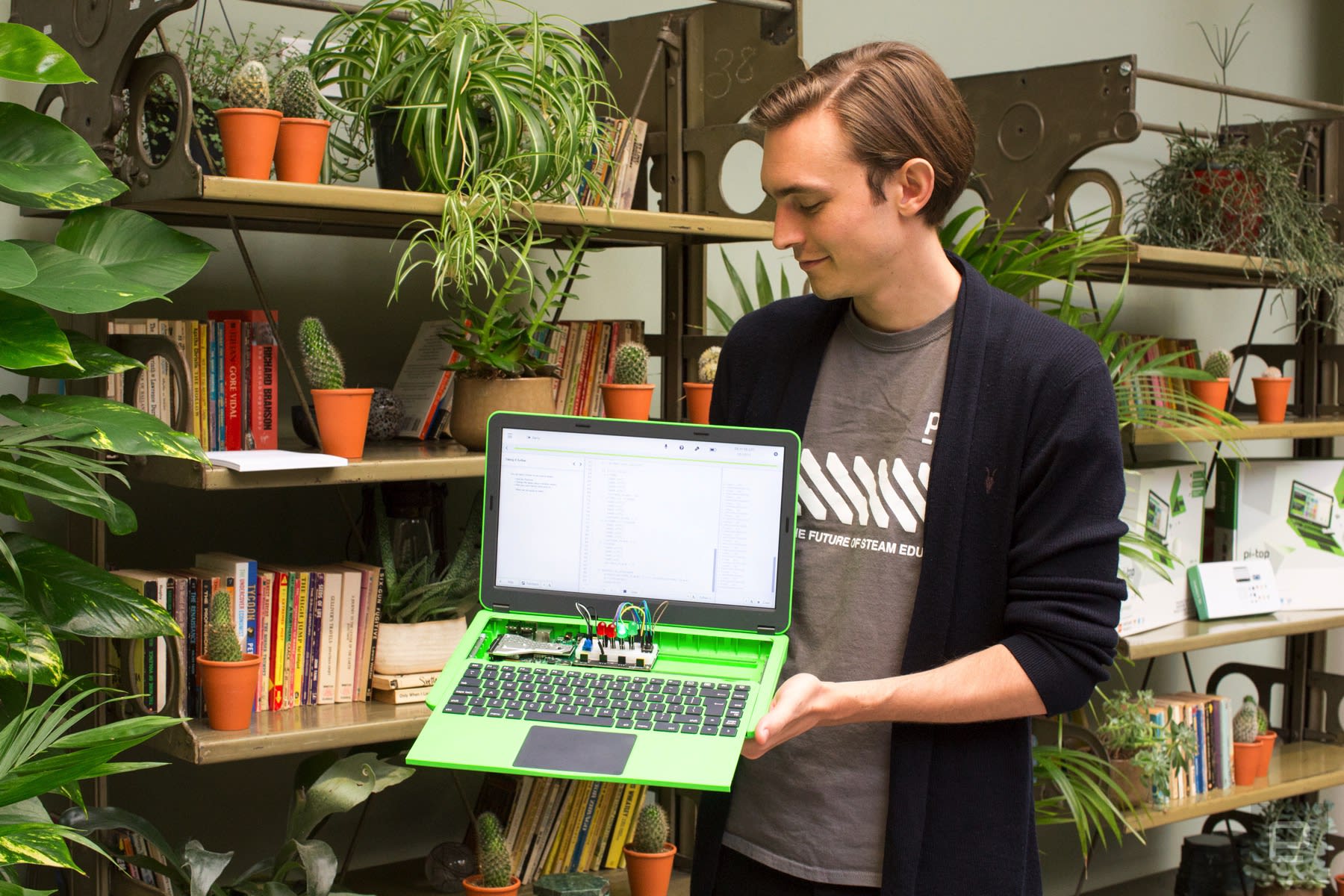
The power and affordability of the Raspberry Pi has given rise to a new type of computer. One that goes beyond the credit-sized board, with colorful shells and displays that make it feel like a normal laptop or PC. The latest is the all-new Pi-Top, a modular laptop with a unique sliding keyboard. Pull it toward you and a large tray is revealed underneath with a Raspberry Pi 3 board and space for additional parts. The idea is to tweak and upgrade its innards for different coding projects designed by the Pi-Top team, thereby learning about code and electronics simultaneously.
Pi-Top has experimented with this concept before. In December 2014, the company raised $193,000 on Indiegogo for its first do-it-yourself laptop. It was a functional, but unattractive machine with a cramped keyboard and small, right-aligned trackpad. A large, horizontal panel sat between the keyboard and the hinge, taking up valuable space. (You could keep your lunch there, I suppose.) To access the Pi and modular tray underneath, you had to slide the panel out through a slot hidden on the right-hand side of the machine. It worked, but clearly the design had room for improvement. One year later, the company returned to Indiegogo and raised $220,000 for the pi-topCEED, a $99 desktop computer powered by the Raspberry Pi.
The new Pi-Top is a slicker machine. It’s a drastically easier build — six steps, rather than 23 — which might sound like a step backwards, but in return you’re getting a design that feels more competitive with cheap Chromebooks and Windows laptops. It has a full-size keyboard and a centrally positioned trackpad. Above the hinge is a 14-inch, full HD screen that can tilt up to 180 degrees, besting the original’s 13.3-inch display and 125-degree opening angle. Around the back, you’ll find one ethernet and three USB 2.0 ports, a regular 3.5mm audio jack and a place for power.
Slide the keyboard down and you’ll gain access to the tray. This is where the Raspberry Pi sits, alongside a custom cooling system that Pi-Top claims will improve your productivity. If a Raspberry Pi runs too hot, it will start closing applications automatically. The Pi-Top’s extra cooling should, therefore, stop this from happening, allowing you to multitask with fewer restrictions and sudden app closures. Each laptop also comes with an “inventor’s kit” which includes a Pi-Top Proto Plus add-on board, LED lights, a microphone and motion sensor. Unlike the previous laptop, which required a screwdriver, they all snap into place magnetically.
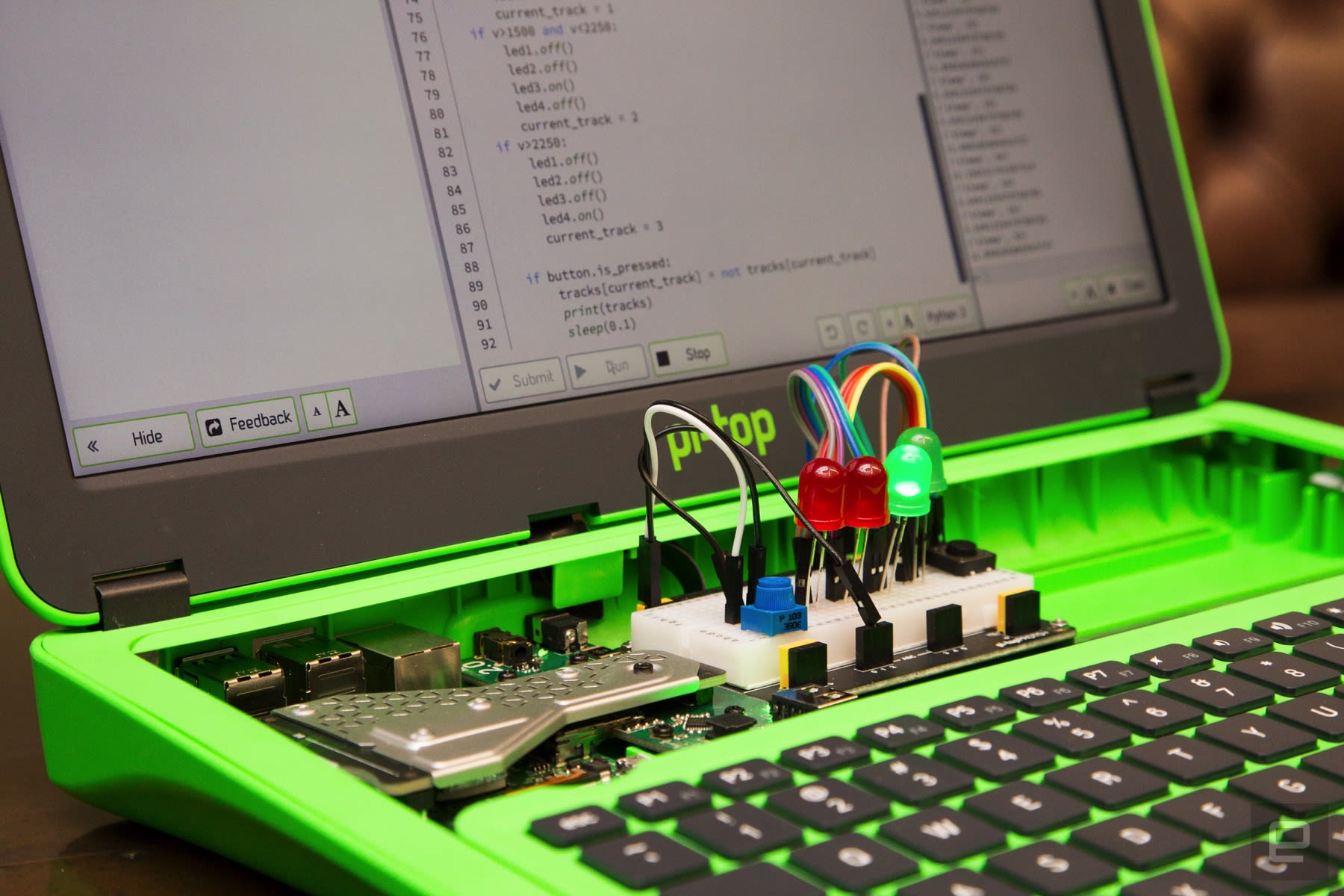
The inventor’s kit unlocks three coding activities, or “journeys,” inside the Pi-Top Coder app: Smart Robot, Music Maker and Space Race. The “Robot,” for instance, is a boxy cardboard shell that sits on top of the Proto Plus. Using code, you’ll adjust his blinking speed, teach him to talk as you walk by, or make him think that he’s being fed whenever you cover the proximity sensor. Each Pi-Top also comes with CEEDUniverse, a space exploration game that tests your creativity and problem-solving skills. You will, of course, be using and learning about code at the same time.
The Pi-Top runs a custom operating system called Pi-TopOS Polaris. It runs some basic software including Google Chromium, LibraOffice and Minecraft Pi Edition. So while it can’t compare to a Windows machine, it’s possible that a child or student could use it as their first laptop. The sticking point is the price: the new Pi-Top costs $320, or $285 without a Raspberry Pi. That’s expensive for an arguably underpowered laptop. In exchange, of course, you’re getting a device that’s easily customisable. You can upgrade the Pi board whenever you like and use external components in the tray (I’m told it’s possible to add a BBC micro:bit, for instance).
The laptop faces fierce competition from Kano, however. The London startup, which has a range of built-it-yourself coding kits, announced a “laptop” bundle last month that includes an all-in-one display unit and wireless keyboard. It doesn’t offer much in the way of hardware customisation, but is powered by Pi and offers similar learn-to-code software. (It’s also compatible with Kano’s standalone coding kits, such as the Pixel.) The “Computer Kit Complete” is also $50 cheaper than the Pi-Top, which might give parents pause while browsing for Christmas gifts.
 AIVAnet