


Google Home vs. Google Home Mini: Which should you buy?

Should you buy a Google Home or a Google Home Mini?
Big in importance but small in stature, the Home Mini was overshadowed by the Pixel 2 announcement at Google’s recent hardware event. But it’s an important addition to the company’s hardware canon.
At just $49, the rounded plastic puck, covered in fabric, is an inexpensive entry into Google’s burgeoning smart home ecosystem. It offers a speaker that while lacking in bass is adequate for most voice-based tasks. As it sits, its microphones listen for the “OK Google” hotword and, offers a growing number of commands through the Google Assistant, a cloud-based AI that hooks deep into Google’s Knowledge Graph — the same back-end that powers the company’s ubiquitous search engine.
For many people, the $49 price is right, and will likely prove to be an excellent holiday gift. But is it worth springing the extra $80 (when not on sale) for the larger, better-sounding Google Home? Let’s discuss.
Capabilities

Google Home is the company’s flagship smart speaker (for now, until the $399 Home Max comes out) and it was built with Google Assistant in mind. It has two far-field microphones that are designed to pick up one’s voice even when there is ambient noise around it. It has a touch-sensitive top area with four colored LEDs that light up and dance when activated. It’s powered by a proprietary DC power connection and a has a mute button on the back for times you don’t want the microphone to listen.
For some reason, Google chose Micro-USB instead of the more-versatile USB-C to charge the Home Mini.
The Home Mini is significantly smaller and doesn’t have the same number of features — for obvious reasons. It lacks the top touch controls of the Google Home (which turned out to be a critical design flaw in the hardware itself, forcing Google to permanently disable the feature), and has neither the absolute volume nor the microphone sensitivity of its larger counterpart.
It also charges with Micro-USB instead of a more power-hungry DC plug, and the mute function is a switch, not a button. Finally, changing the volume on the Home Mini involves tapping on the left or right edge of the front instead of the more tactile and, ultimately, functional way of moving one’s finger over the Home’s top touch panel.
At the same time, the units are functionally identical where it counts: Google Assistant. Each improvement made to Assistant — from supporting new smart home products to being better able to answer direct questions using the “OK Google” hotword — is rolled out to every unit. Both the Home and Home Mini will grow and improve in abilities over time, and neither should benefit disproportionately from software improvements made over time.
Sound quality

The main difference between the two speakers isn’t functionality but sound quality. Google Home has a 2-inch driver and dual 2-inch passive radiators, which drive a tremendous amount of low-end for a speaker of this size. It’s certainly better than the first-generation Amazon Echo, and very enjoyable to listen to when jamming to hip-hop, rock, or even jazz.
The Google Home Mini is a circumaural (or 360-degree) speaker, and lacks the size for a bass-generating woofer. As you can see in the video below, both sound good, but the larger Home definitely has a wider range and emphatic low-end.
Still, the Home Mini holds its own, and does so in a form factor that is less than a quarter the size of the Google Home itself. And if the sound quality from the Home Mini isn’t good enough, it supports outputting music to a Chromecast Audio-connected speaker system.
Which should you buy?

At $49, you can buy two Home Minis for the price of a single Home, with money to spare. Given that Google’s Home ecosystem supports multi-speaker groupings, for people with a large house it may be a better idea to purchase a duo of Home Minis over a single Home, especially if they’re going to work in conjunction with a Chromecast Audio-enabled speaker.
See Home Mini at Google Store
But for a smaller apartment, or the sake of simplicity, a Google Home is the right answer. It has the perfect balance of volume, sound fidelity, and bass for a small to medium-sized room, and its microphones are scary-accurate, even when music is blaring or the room is full of other sounds.
See Home at Google Store
Google Hardware

- Google Wifi review
- Google Home review
- Everything you need to know about the Chromecast Ultra
- Chromecast vs Chromecast Ultra: Which should you buy?
Google Wifi:
Google
Amazon
Google Home:
Google
Best Buy
Chromecast Ultra:
Google
Best Buy
People have mixed feelings about the Pixel 2/Pixel 2 XL
With Verizon stores now equipped with Pixel 2 demo units, people are starting to get hands-on time with the phone – here’s what they have to say.
Although we’re still waiting for Pixel 2 preorders to ship, Verizon recently received demo units of the device so that customers can get some hands-on time to hold them over until orders are finally sent out.

Verizon stores across the United States now have demos of the Pixel 2 and Pixel 2 XL that you can use to get a hands-on impression for yourself, and now that people are doing so, initial thoughts seem to be all over the place. It’s impossible to make a final judgment on a phone without carrying it around for a few days as your daily driver, but here’s what some people have to say so far.
Starting with the positive comments.
GTvert90
10-12-2017 10:35 AM“
Both phones felt great and are a definite upgrade. I only compared the 2XLs screen to my small OG Pixel because that’s all I really care about is that I think it’s better than what I have. The colors are a little different but I believe it to be an improvement.
Reply
effreyj
10-12-2017 11:45 AM“
I went to the store and compared the new Pixels to my OG Pixel XL. The new XL 2 feels a lot thinner and sleeker than the OG XL. I also took a photo of the red Verizon wall on the XL 2 as well as on the OG XL, and the colors were noticeably more accurate on the XL 2 and less oversaturated. I played a song by Pink! on the front facing speakers, and the sound was a lot better than the OG XL. They…
Reply
maverick7526
10-12-2017 12:22 PM“
I went in one and the XL wasn’t charging so it was dead. played with the pixel 2 it looked and felt great. the XL2 is a definite upgrade over my 6P
Reply
We were certainly impressed with our hands-on time of the Pixel 2 at Google’s October 4 event as well, but that doesn’t appear to be the case for everyone.
bonnie100th
10-12-2017 01:41 PM“
I have mix emotions about the XL2, does not feel premium at all, the aluminum in the back feels like plastic, I’m bummed, my current first generation Xl does feel like a premium phone, and the back aluminum feels real metal, this new one seems that they painted the surface and apply a plastic sort of clear coat. The speakers sounds inferior than my previous than Pixel …
Reply
10-12-2017 02:28 PM“
Just came back from using both phones at a Verizon store. I agree with others that have said the quality of the XL 2 doesn’t feel as nice as its smaller brother. The way the screen sits on the body and the edges of the phone don’t have a premium feel. The other thing I noticed (and somebody else next to me noticed too) was that the screen isn’t as bright as expected and the viewing angles were…
Reply
10-12-2017 03:37 PM“
This video shows the screens of the pixel 2 and xl2. I assume it was shot today at a verizon store and you can see what I said previously about the smaller pixel having better viewing angles than the xl. Kind of disappointed since i ordered the xl.
Reply
Our full review for the Pixel 2/Pixel 2 XL is coming soon, but until then, we’ve got a question for you – If you’ve had the chance to go hands-on with either the Pixel 2 or Pixel 2 XL, what are your initial impressions?
Join the conversation in the forums!
You can now download the Google Pixel 2 launcher on any phone
The Pixel 2’s updated launcher is here, and it looks pretty great.
Google’s been known to tweak its vision for Android’s home screen setup with each new release, that’s no different with this year’s Pixel 2. Thanks to the folks at Android Police, you can now download the Pixel 2’s launcher onto any of your devices.
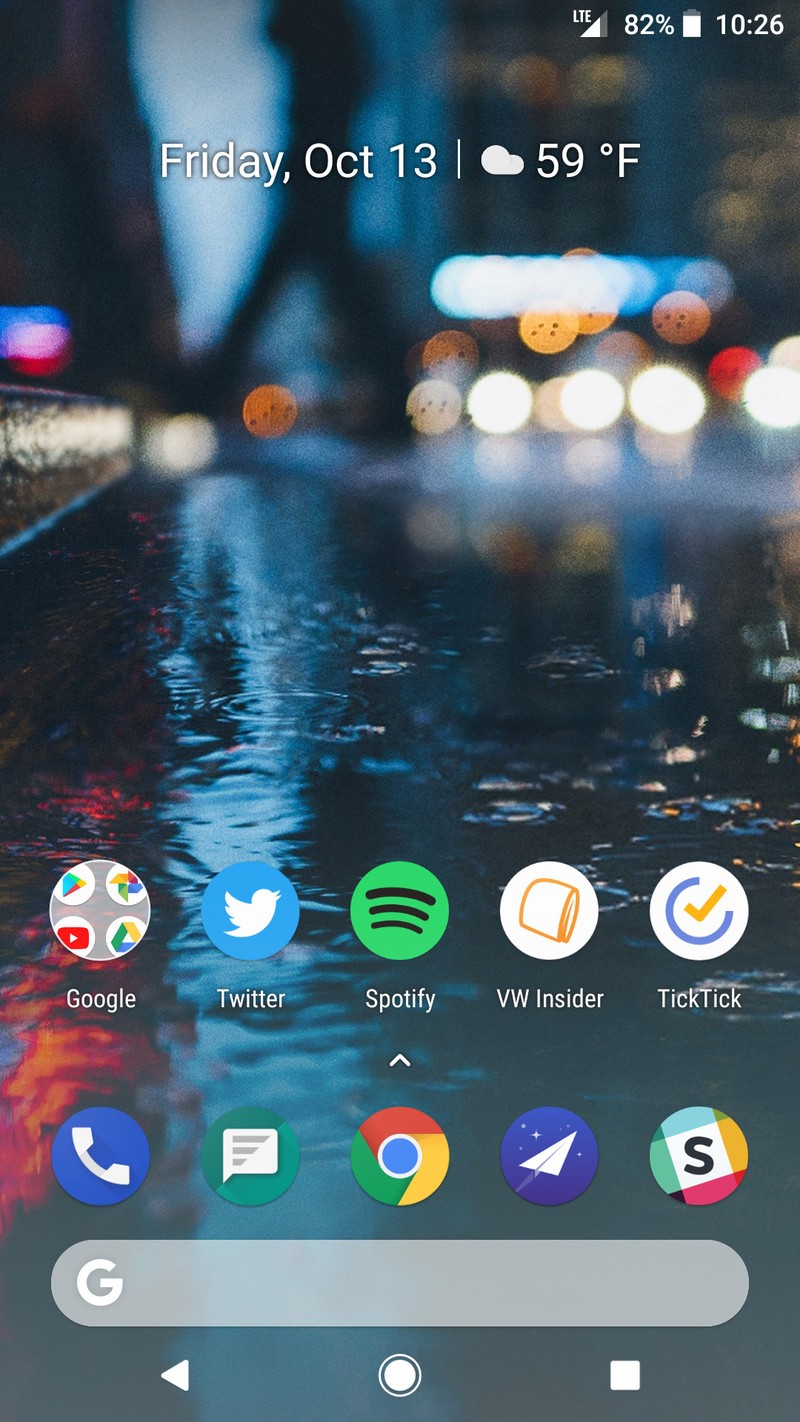
The launcher on the Pixel 2 isn’t as drastic of a change as we saw last year, but there are still a few changes that are worth checking out – most notably the repositioned Google search bar and updated weather/date widget.
Google’s search pill in the upper-left corner of the screen has been replaced with a more traditional search bar below the apps in your dock, and it now features a transparent grey color with a white “G” (although the “G” seems to be colored for some users). Tapping on the search bar still brings the regular Google search that we all know and love, and while its new placement does take some time to get used to, it does help tremendously for reachability.
The second big change is with the new At A Glance widget. This is the centered widget that shows you the date, time, and upcoming calendar events, and it’s also an improvement over what we had last year.

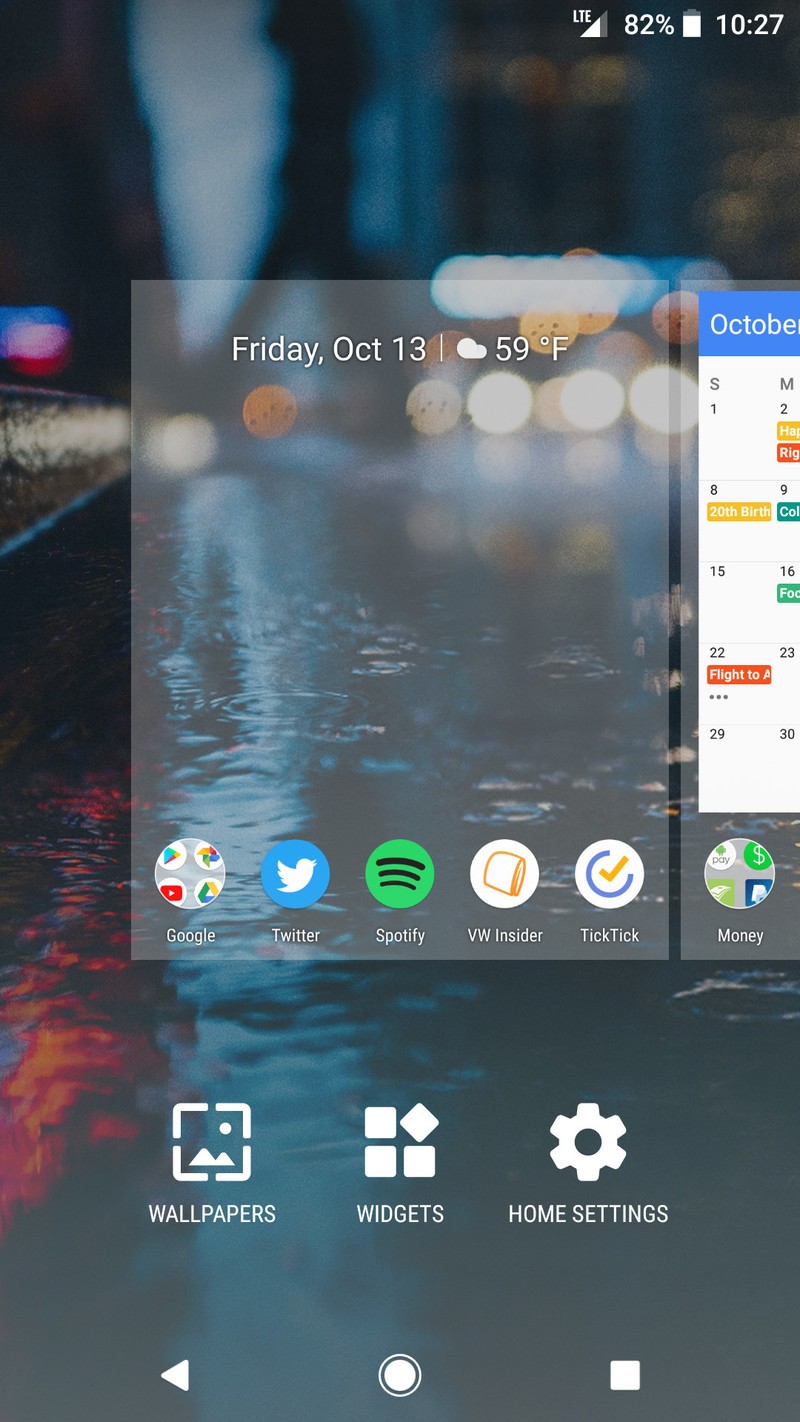
Tapping on the date will open Google Calendar, and tapping on the weather will open (you guessed it) Google Weather. If you have an upcoming calendar event, the weather icon will be shrunk down and the date will be replaced by information for that event, including the name, when it starts, and its duration.
Along with these bigger updates, there are smaller changes as well. The app drawer now shows slightly more apps than before (about half of an additional row), folders have a new opening animation, swiping quickly to the top or bottom of the app drawer now has a subtle bounce to it, and the clock app icon now updates accordingly to the actual time (similar to what iOS has done for years).


If you want to get the Pixel 2 launcher on your device, you can do so by downloading the APK file here. The launcher can be downloaded to the Pixel and Pixel XL without any sort of modifications, but if you want a working Google Feed on the left-most side of your home screens, you’ll need to install the launcher as a system app.
Google Pixel 2 and Pixel 2 XL
- Pixel 2 FAQ: Everything you need to know!
- Google Pixel 2 and 2 XL hands-on preview
- Google Pixel 2 specs
- Google Pixel 2 vs. Pixel 2 XL: What’s the difference?
- Join our Pixel 2 forums
Google Store
Project Fi
Verizon
Facebook’s food delivery feature now brings Five Guys to all
Facebook is already a place where people can check into restaurants and search recommendations to decide where they’re going to eat next. Now, the social media giant is taking that a step further. The company announced today that users in the US can use the platform to order food for takeout and delivery. Previously, this feature was only available to select users. The new service is rolling out today on iOS, Android and the web.
The release cites Five Guys, Panera, Chipotle and Papa John’s as a few of the chains that are participating in their program. The really interesting aspect of this, though, is that Facebook isn’t just partnering with individual restaurants and fast food joints to get this done. They are combining various delivery services such as ChowNow, EatStreet, Delivery.com, Olo and DoorDash. This provides the user with a one-stop shop to look at everything you can have delivered to your home, rather than having to visit individual apps and websites. Note that some of the larger delivery providers, such as Seamless and Caviar, do not appear to be working with Facebook on this feature.
If Facebook’s goal is to allow users to do pretty much everything from within their service, which keeps users engaged, then they’re doing a solid job of it with this new development. You do have to create an account with an individual delivery provider if you’re ordering through their service on Facebook (say Delivery.com), but you don’t have to leave the social network to do it. It’s a pretty easy, low effort way to have food delivered right to your doorstep.
Source: Facebook
An appreciation of 2017’s in-game shopkeepers
In-game shops are more than handy outlets to transform random metal scraps and tired old gear into new and useful items. Shops offer a reprieve from the action of whichever digital world you’ve entered, allowing you to take a moment, breathe and consider the situation from afar. Do you want to play as a gun-toting tank or a sneaky spy? Is your bow powerful enough for the battles ahead? Do you have enough health potions? Does your character look better in green or purple? Only the shop can provide the answers.
Overseeing all of these calculations — and guarding stores’ impossibly large piles of loot — are the shopkeepers. The past year has been incredible for video games, as we’ve discussed at length, and this infusion of creativity extends to the stingy store servants selling wares and wiles along our adventures.
From Cuphead to The Legend of Zelda: Breath of the Wild, 2017 has offered up a buffet of adorable, wacky and nostalgia-ridden shopkeepers for us to enjoy — so we might as well get to it.

Kilton, The Legend of Zelda: Breath of the Wild
It’s easy to imagine Kilton soaring through the skies of Hyrule in his patchwork hot-air balloon, whipping over fields and grazing mountaintops, surrounded by bundles of monster parts and masks. It’s easy to imagine, but we never actually see this — instead, Hyrule’s favorite five-head is always nearby (as long as it’s nighttime), ready to sell you a stockpile of exclusive clothing and accessories. You just have to find him first.

Crazy Cap clerks, Super Mario Odyssey
In a game all about hats, the Crazy Cap store does not disappoint. One of its most charming locations is in Tostarena, where friendly, bright skeletons stand by wearing caps on caps on caps while you browse their headwear.

All of the merchants, Splatoon 2
Nintendo does “charming” extremely well, as demonstrated by every one of the sea-creature shopkeepers in Splatoon 2. There’s Murch the emo sea urchin, Bisk the sneaker-obsessed spider crab, Flo the bohemian sea slug and her shrimp buddy Craymond, Jelfonzo the stylish jellyfish, and Sheldon the horseshoe crab and weapons expert. And then there’s Crusty Sean — he’s a food-truck operator who is, in fact, a giant tempura-crusted shrimp. It’s either irreverently adorable or incredibly morbid, but since this is Nintendo, we’ll go with the latter.

Porkrind, Cuphead
“Welcome,” Porkrind growls as you enter the Emporium. His voice is gruff and he has an eye patch over a twirled villain’s mustache. However, any danger in his demeanor is dispelled by his pink upturned nose and floppy ears — it’s hard to be scared by a pig in overalls. Cuphead is a feat of visual delight, and Porkrind fits into this retro world brilliantly, evoking the image of Porky Pig every time he waves goodbye and the screen circles to black.

Tae Takemi, Persona 5
Takemi is a punk-rock doctor on a mission to clear her name — she’s direct, intuitive and entirely badass. Fortunately for players worldwide, Persona 5 is a ridiculously dense game and we get to know Takemi better than shopkeepers in many other games, as she’s an important player in the overall story. Besides, who doesn’t love an in-game merchant that you can eventually, well, love (even if she is a few years older than the protagonist)?
Also, shoutout to another Persona 5 shopkeeper: Munehisa Iwai, the former Yakuza member with a heart of gold.

Emil, NieR: Automata
The only thing better than a shopkeeper you can love is one you can fight. Emil is an established and important character in the Nier anthology, and this time around his giant, grinning, bald head is attached to an item cart. Or it could be one of his clones (he used to be a boy, mind). Either way, Emil the shop(keeper) isn’t just a hub for all of your Android accessories — you’re able to battle him in an epic secret ending.

Baknamy merchant, Final Fantasy XII: The Zodiac Age
This one is an oldie but a goodie. The 2006 title Final Fantasy XII reappeared this year in high-definition with The Zodiac Age, and it brought the Necrohol of Nabudis’ secret merchant along for the ride. This Baknamy shopkeeper is tough to track down, which only makes buying his goods all the more sweet.

Xur, Destiny 2
Xur is the Destiny universe’s fickle exotic-gear dealer, showing up on the weekends to stuff your inventory with random, rare goodies. Xur is something that couldn’t have existed in a game before internet connectivity — he’s a living shopkeeper, always offering new secret items and popping up only when he sees fit.
IRS freezes its fraud prevention contract with Equifax
The IRS got a lot of flak from both ordinary citizens and lawmakers when it awarded Equifax a fraud prevention contract earlier this month. After all, they forged their partnership after the credit reporting agency revealed that it recently suffered a massive security breach that affected 145 million Americans. Now, after reports came out that an adware installer lived in the agency’s website, IRS has decided to temporarily suspend the $7.2 million, no-bid contract.
IRS commissioned Equifax to verify the identities of taxpayers signing up for a Secure Access account, which gives people access to online tax records and transcripts, on its website. Sign ups for Secure Access accounts have been suspended as a result, but anybody who already has one will not be affected.
The government agency didn’t elaborate why it suspended the contract, but it could have something to do with the faux Adobe Flash installer a security analyst found on Equifax’s website. After investigating the incident, Equifax admitted to Engadget that a downloader serving up malware lived in its website but stressed that it wasn’t hacked yet again.
“Despite early media reports, Equifax can confirm that its systems were not compromised and that the reported issue did not affect our consumer online dispute portal,” a spokesperson told us in a statement. “The issue involves a third-party vendor that Equifax uses to collect website performance data, and that vendor’s code running on an Equifax website was serving malicious content. Since we learned of the issue, the vendor’s code was removed from the webpage and we have taken the webpage offline to conduct further analysis.”
As for the IRS, spokesman Matthew Leas said Secure Access account holders have nothing to worry about. Yes, it froze the contract, but “there is still no indication of any compromise of the limited IRS data shared” with Equifax.” He explained that “the contract suspension is being taken as a precautionary step as the IRS continues its review.”
Source: Politico
Samsung vice chairman quits amid leadership ‘crisis’
Based on the earnings guidance Samsung has released for the third quarter of 2017, the Korean conglomerate is set to make a new record. It puts its operating profit for July to September at around $12.8 billion, almost thrice last year’s $4.6 billion. Despite the possibility of having the best annual earnings ever, not everything’s A-OK for the chaebol. Samsung Vice Chairman Oh-Hyun Kwon has decided to step down and leave his positions as vice chairman, board chairman and member, as well as CEO of Samsung display. He said the company is “confronted with unprecedented crisis inside out” and needs “a new spirit and young leadership to better respond to challenges…”
Kwon has been the face of Samsung after Jay Y. Lee was arrested and eventually found guilty of bribery and embezzlement. Lee, who was sentenced to five years in prison, apparently bribed officials to ensure that the controversial merger of two Samsung-controlled companies would go smoothly in spite of shareholders’ disapproval. While he was only a vice chairman when he was arrested, Lee was considered the company’s de facto leader after his father, Samsung Chairman Lee Kun-hee, suffered a heart attack in 2014. The younger Lee is responsible for conjuring up the company’s long-term strategic vision.
Samsung had a great quarter, thanks mainly to the increasing demand for memory chips with large storage capacities. The mobile division’s performance also got a boost from Galaxy Note 8’s sales, but we won’t know by how much until the full earnings come out. If the conglomerate wants to top Q3’s profit, though, it has to find a way to solve the “unprecedented crisis” it’s going through.
Source: AP, Samsung (1), (2), Reuters
PlayStation’s updated VR headset arrives in Japan tomorrow
You may want to hold off buying the current-gen PSVR, as its successor is imminent. We already knew the updated headset will come with integrated headphones and HDR passthrough support (courtesy of a new processor unit). And, now Sony is blessing us with a release date — for Japan, anyway. The company’s native home will be the first to get the refreshed VR device when it lands there on Saturday. Meanwhile, everyone else will have to wait. At 44,980 yen ($401), the new headset will match the starting price of the original (although, its older sibling now comes bundled with the PlayStation Camera at no extra charge).
The gradual rollout sets it apart from its predecessor, which was released simultaneously in the US, UK, Europe, and Japan one year ago today. To mark its birthday, Sony is giving PlayStation Plus subscribers 80 percent off over 50 compatible titles on its Store for a limited time. Word of advice to all the cat people out there: Set aside some change for the upcoming Neko Atsume.
Source: PlayStation (Japan)
The outcome of this virtual riot depends on your emotions
Consider what your first reaction would be if, during a protest turned violent, you came face-to-face with a riot cop barking at you from behind his clear shield. Not the words that come out of your mouth nor the moves you could make to escape. Before any of that, your emotions would already be fired up and broadcasting to the policeman what you might do next. In RIOT 2, an interactive film by Karen Palmer, controlling these emotions is the key to your escape.
Inspired by protests in Baton Rouge and Ferguson to Turkey and Venezuela, the goal of RIOT is essentially to keep calm. It is designed to make you fearful.
At a recent demo at the Future of Storytelling (FoST) Festival in New York, RIOT was installed in a stand-alone house where a man in a gas mask, helmet and olive-green outfit (actually Palmer’s fiancé, Gary Franklin) directed participants into position in front of a screen. A wrecked trash can, traffic cone and black-and-yellow safety tape littered the dark area — set-design elements added by co-producers from the British National Theatre’s Immersive Storytelling Studio. By the time participants watched real-life intro footage of a protest in Washington, DC, and absorbed the sirens wailing and jarring jungle-influenced soundtrack, their adrenaline was rising.
What follows is an encounter with the riot police and then, if players keep their cool, a cinematic urban chase around London’s South Bank, interspersed with more narrative forks in the road. These are like quick time events in video games, except instead of participants hitting a button, a camera trained on their faces reads their emotions.
Developed by collaborator Hongying Meng at Brunel University London, the software detects calm, fear and anger according to factors like eye width, frowns and mouth shape. The challenge is to stay calm at critical moments or the experience ends. It’s emotional conditioning through gamification.
Software that recognizes emotions — part of the field of affective computing — has made strides in recent years. Fueled by machine learning, companies like Affectiva are able to distinguish genuine from forced expressions and pick up micro-gestures that the human making them isn’t even aware of. While the opportunities for advertisers and political campaigners to understand a target audience are myriad, standout artistic experiences using these capabilities have been scarcer.
“Ultimately we are the original joystick. Our bodies are the way we already interact and process the world.”
Yet the ongoing melding of games and film into interactive narratives raises the question of how we should control these new experiences naturally. Motion sensors, natural language processing, haptics and perhaps even mind control have all been used. Emotions are another, lesser explored interface.
“Ultimately we are the original joystick. Our bodies are the way we already interact and process the world,” said Charles Melcher, director of FoST. “Conversation, facial expression, intonation of our voice, physical gesture — all of those are the natural language of human interaction. Technology is finally discovering what we are as a species and enabling it in the purest way.”


RIOT is part of a wave of narrative experiences that use technology to activate specific emotions. At FoST, there were projects meant to make you feel intimacy or even — purportedly — fall in love. If storytelling is about eliciting human emotions, Melcher said his goal is to find examples of technology augmenting that process to create “sensual media.”
“It’s a kind of storytelling that reminds us of the sensory joy of being alive,” he said. “And I think that’s a direct response to a lot of technology which has for many years been doing the opposite, disconnecting us from ourselves.”
“I believe that if you’re fearful or angry often your narrative in life doesn’t get to reach a conclusion.”
In RIOT, the primary emotion Palmer plays with is fear. “In my opinion, fear is the most powerful emotion,” Palmer, originally from London, said. “If you’re calm, your narrative will play out because I believe that if you’re fearful or angry often your narrative in life doesn’t get to reach a conclusion.”
It’s a recurrent theme in her work — how to face fear head on, and move through it — that comes in part from practicing freerunning for the past 13 years with international group Parkour Generations. An earlier project, Syncself, was a parkour simulator using an EEG headset to measure participants’ focus. If their brainwaves didn’t show concentration, they’d fail to make their leaps.
In the same way Palmer has managed her relationship with fear through parkour, she wants RIOT to help people understand their emotions. “I would like them to get an insight or confirmation into who they are,” she said. Though RIOT is filmed from a first-person point of view, it’s not as much about connecting with another character as learning about your reaction to pressure. You have to confront not only how you feel but also, crucially, how your emotions are projected to others. Research shows that the majority of communication is nonverbal, and it doesn’t matter if you feel calm should the cop think you’re angry and bring out his nightstick. RIOT is about understanding your subconscious, involuntary emotional expression and learning how to regulate it.
Palmer likens RIOT to a “gym of the mind” where you’re “programming yourself,” and it’s easy to see its pragmatic uses in conflict training or any other preparation for a fight-or-flight scenario. It’s a contrast to much storytelling, where your emotional openness to wherever the experience leads you — say, to be frightened in It or warmed in The Big Sick — enhances the enjoyment. In RIOT, you have to steel yourself. Like a traditional movie director, Palmer is still trying to manipulate your emotions. But you have to push back or you don’t get to see the ending.
[Image credit: RIOT 2 directed by Karen Palmer]
iOS Gained Market Share in Most Countries This Summer, Although Samsung Drove Gains for Android in UK
Apple’s portion of the mobile ecosystem market increased in eight major territories in the three months ending August 2017, according to new data collected and shared by Kantar Worldpanel. Over the summer of 2017, iOS saw growth in the following territories compared to the same year-ago period: Spain (4.4 percentage point increase), followed by China (4.3), the United States (3.7), Germany (2.3), France (1.7), the European Union (1.2), Australia (0.9), and Italy (0.4).
Specifically, iOS grew from 31.3 to 35 percentage points year-over-year in the U.S., and although Android still dominates the U.S. smartphone OS market at 63.2 percentage points, it has dipped slightly from its hold of 66.1 percentage points in the same year-ago period. Dominic Sunnebo, Kantar Worldpanel ComTech’s Global Business Unit Director, said that “Apple maintained strong momentum in the US one month before the release of iPhone 8 and iPhone 8 Plus,” so iOS should continue to see positive growth in future data that measures the holiday months.
Galaxy S8 compared with iPhone 8
However, Apple’s iOS decreased slightly in the United Kingdom/Great Britain in the summer months this year. The drop in iOS market share is said to be due to Samsung’s “significant” promotional activity for its Galaxy S8 and J3 smartphones eating into Apple’s pre-iPhone 8 sales. In total, Apple devices running iOS accounted for 33.9 percentage points during this summer period in the UK, dropping 2 percentage points from 35.9 one year prior.
Although this was “offset slightly” by strong sales of the iPhone SE, Samsung itself saw a 6.4 percentage point increase in the June-August 2017 period in the UK. Overall, Android OS grew from 58.9 in 2016 to capture 65.3 percentage points in the three month period. Of course, once Apple’s sales of new iPhones are accounted for in future data by Kantar Worldpanel, iOS should see a resurgence.
A few Galaxy S8 owners mentioned both promotional materials put out by Samsung and a “good deal” on the device as key factors to their purchases. At the time of its launch, Samsung said the S8 marked its “best ever” pre-order period for a smartphone.
“Samsung took full advantage of the weeks just before the iPhone 8 and iPhone X were released in Great Britain, with significant promotional activity that helped drive its overall share to a three-year high of 38.4% for the three months ending August 2017,” explained Dominic Sunnebo, Global Business Unit Director at Kantar Worldpanel ComTech. “More than one in four Galaxy S8 buyers cited a specific promotion as a key purchase influencer, and almost half said that a good deal on the price of the phone was key to their purchase. Both of these metrics experienced a large increase over the last two months of the period.”
Otherwise, the only other regression centered in Japan and accounted for just 0.1 percentage points lost by iOS between 2016 and 2017.
 Global smartphone OS shares data via Kantar Worldpanel
iOS market share is expected to see another boost thanks to the launch of the iPhone X, which has caused many people to put off ordering the iPhone 8 and iPhone 8 Plus in anticipation of Apple’s greatly redesigned smartphone. Pre-orders for the device go up two weeks from today on October 27, while the official launch date will come three weeks from today on November 3.
For more data on the global market shares of smartphone operating systems, check out Kantar Worldpanel’s research right here.
Tag: Kantar Worldpanel
Discuss this article in our forums
 AIVAnet