


Nothing but net: These six fantasy basketball apps are what dreams are made of
Fantasy basketball is extremely polarizing — you either get it or you don’t. Most people simply cannot rationalize the amount of time individuals choose to invest in fine-tuning their daily dream team. While the majority of fantasy enthusiasts will at least grudgingly agree with this sentiment, they will never deny their sheer love of the game.
Whether you’re just getting started in the world of fantasy sports or you’re a seasoned pro, we could all use an edge to stay at the top of our league standings. From all-encompassing league apps designed to start your friendly rivalry to some of the most sophisticated metrics available, there are plenty of apps to choose from. Here are our six of our favorite fantasy basketball apps to help you better waste your own time.
If you’re more of a fantasy football aficionado, you may also like to peruse our roundup of the best fantasy football apps.
Best league app
Yahoo Fantasy Sports (free)
To get the fantasy (basket)ball rolling, you’ll need to start a league. Fortunately, one league fantasy app stands out from the rest. For a few years now, the Yahoo Fantasy Sports app has been the basketball app for fantasy enthusiasts. While many fantasy apps on the market work just fine as rudimentary tools, most people will still prefer to log-in with their computers for a more enhanced experience.
The Yahoo Fantasy Sports app, on the other hand, works seamlessly in-app. From the live draft process to looking up player statistics on the fly, the user interface is second to none. One of the app’s best features is the trending add/drop tool, which allows you to see which players are being conspicuously gobbled up or dropped at any given time.
You can quickly add or drop players, making it easy to pad those stats (with a player) in a tight contest just seconds before the roster deadline. All is fair in love and fantasy war, after all. You can use this in tandem with the latest injury updates to keep your team from hobbling into the playoffs, or to simply grab that up-and-coming star from free agency. There’s even a mock draft feature to help you exercise your draft skills and strategy beforehand, because nothing says sports addiction like pretending to draft your professional fantasy team in advance.
Download now from:
iTunes GooglePlay
Best analysis
WatchESPN (free)
Now that you’ve assembled your fantasy squad, it’s time to to stay up to date on the latest news, scores, and speculation. You’ll need to log in with your television provider — and potentially your internet service provider — to access the premium WatchESPN streaming features, so not all aspects of the app are free. Thankfully, there are plenty of free features to keep the app relevant, such as scores, highlights, and expert analysis.
Available for both Android and iOS, the WatchESPN app grants users full access to live feeds from a host of ESPN networks — i.e. ESPN, ESPN2, ESPN3, ESPNU, SEC Network. Many ESPN shows, including SportsCenter and SportsNation, also offer helpful insights to keep you privy to the latest fantasy news.
Download now from:
iTunes GooglePlay
Best app for the obsessive enthusiast
NBA G-League App (free)
Yes, for the most part, the NBA G-League is irrelevant and you’ll never need to know the names of the majority of the players in this perennial, transitional purgatory. However, taking note of the daily statistical leaders could land you a solid rotation player over the course of a season. Roughly one-third of current NBA players have played in the G-League at some point during their careers, showing just how much the tier has progressed over the past decade. In deeper fantasy leagues, it’s important to know the full range of NBA and G-League talents.
If a player on your roster goes down midseason, for instance, knowing the cream of G-League crop could be quite handy. Similarly, at the end of the season, many teams who no longer have a shot at the playoffs will bench their star players to prevent unnecessary injuries. In these situations, some teams have called up promising G-League talents to fill out their rosters in the twilight of the season.
The rise of players such as Danny Green and Jeremy Lin may have come as a surprise to some however, those who paid close attention to G-League statistics knew the two had potential. Hassan Whiteside’s short 2014-2015 stint in the G-League speaks for itself. Owners who didn’t steal him from free agency are still kicking themselves to this day. The NBA G-League app is full of useful live (and archived) games, scores, news, and video content to help you overanalyze even the most irrelevant player metrics.
Download now from:
iTunes GooglePlay
Best app for metrics
Twenty Four (Free)
While most people cringe at the mere notion of sports metrics, fantasy fans know just how important these statistics can be. Understanding the behavior of an opponent or player going into a game may help you better predict which of your team stats may increase or drop on a weekly basis. If your league allows daily or weekly player adds — including an injury reserve spot — you can scoop a player from free agency who may be facing an inferior defense or primary defender.
The app also includes story-telling graphs and analysis, and the box scores automatically list players in order of game efficiency as well. Twenty Four is also your fantasy stop for the dankest NBA memes, if that’s your kind of thing. Sadly, the app is currently exclusive to the iPhone and iPad.
Download now from:
iTunes
Best app for live-streaming
NBA (free)
Like the WatchESPN app, you’ll need to have a subscription to access the premium benefits of this app. That said, if you have NBA League Pass, you probably already have the NBA app on all of your streaming devices. The app allows you to access live and on-demand events, so you’ll never miss a regular season or playoff game again (blackouts may apply).
Even if you don’t want to purchase the full season pass, you can still buy single game passes directly within the NBA App. This is super handy if you need to catch a certain game in particular. This isn’t entirely a pay-to-play app, however, and there are plenty of free features to help you with your fantasy conquests. Live scoring, injury updates, team schedules, and daily video clips make this app a must-have for fantasy ballers.
Download now from:
iTunes GooglePlay
Best app for opinion
Pocket Casts ($4)
Look, you can stream every NBA and G-League game and stew over in-depth sports metrics for hours, but sometimes it’s helpful to just hear an informed outside opinion on the matter. That said, the internet is brimming with a regular panoply of sports-centric podcasts to keep you up to date on the latest basketball brouhaha. The Pocket Casts app brings the ever-expanding world of podcasts straight to your smart device, including popular offerings like the Lowe Post, Dunc’d On, The Bill Simmons Podcast, and dozens of others.
Download now from:
iTunes GooglePlay
As the NBA season unfolds, be sure to check back in as we update our guides on how to stream the NBA All-Star Weekend, NBA Conference Finals, and NBA Finals.
Update: We added Pocket Casts to the list.
Apple may replace Touch ID with Face ID for its 2018 iPhone lineup
Why it matters to you
FaceID should help keep your phone much more secure than TouchID.
While Apple opted for Touch ID with the iPhone 8 and iPhone 8 Plus, next year’s iPhones could possibly abandon the feature completely. The 2018 iPhone lineup may adopt Face ID for all of its next-generation devices, reports 9to5Mac.
With Face ID, you can unlock your phone and allow access to other features on your device by scanning your features. It uses a neural engine to map the contours and shapes of your face in real time — but isn’t confused by hairstyles, hats, or beards. Apple also says there is only a one-in-million chance someone can find a way around the system — whereas Touch ID has a one-in-50,00 chance.
KGI Securities analyst Ming-Chi Kuo recently claimed that the future of Face ID was extremely dependent on the consumer reaction to the iPhone X. But his most recent statement explains that Apple is most likely going to lean toward 3D sensing completely.
Kuo also said the feature is key as far as selling points go for 2018 iPhone models. Even with the difficulty Apple is facing regarding the manufacturing of 3D sensing, Kuo believes TrueDepth cameras and Face ID will help Apple capitalize on its lead when it comes to this technology.
According to the analyst, Apple’s TrueDepth camera module — which is the hardware behind Face ID — is between one to two years ahead of comparable technologies. The infrared cameras, ambient light sensors, proximity sensors, and dot projectors, are reportedly a challenge when it comes to mass manufacturing.
But even with its challenges, Apple’s focus on 3D sensing leads Kuo to believe new iPhone models in the future will ditch fingerprint recognition completely. The decision will give Apple an edge against competitors because Face ID will allow all iPhones to include a full-screen design.
Earlier this week, Kuo also predicted Apple’s next iPad camera may also be compatible with Face ID. Specifically the next 10.5-inch and 12.9-inch iPad Pro will have an experience “consistent with the iPhone X.” Although, the report does not speculate what will happen to the fingerprint-scanning Touch ID sensor that exists on the current iPad Pro models.
While a few Chinese manufacturers may launch under-display fingerprint technology, that means a higher price point. Kuo believes manufacturers are leaning toward 3D sensing instead of having to go with in-display or the more common option — rear-placed fingerprint sensors.
Google’s $20 USB-C to 3.5mm headphone adapter is now $9
THANK YOU
When Google announced the Pixel 2 on October 4, one of the biggest complaints that fans and customers had was with the company’s decision to remove the 3.5mm headphone jack. Google is one of many companies making the push to Bluetooth and USB Type-C audio solutions, and in an effort to make the transition a bit smoother, Google includes a USB-C to 3.5mm headphone jack adapter in the box with every Pixel 2 and Pixel 2 XL.

Although adapters/dongles are never preferable, this is still appreciated on Google’s part. However, as anyone that uses phones, laptops, or other gadgets that are really pushing the USB Type-C lifestyle knows, adapters can be very easy to lose.
As such, when the Pixel 2 was added to the Google Store for preorder, another item popped up as well – a USB-C to 3.5mm adapter that you could purchase in case you want an extra one or ever lose the included one with the Pixel 2. The price? Twenty freaking dollars.
Google’s unnecessarily high pricing for the adapter was quickly met with a bit of justified outrage, and likely due to all of the backlash, the price has been dropped from $20 to just $9.

The new price is much more reasonable than what was previously being asked, and we can only hope that not too many people purchased one of these prior to the change.
See at Google Store
Google Pixel 2 and Pixel 2 XL
- Pixel 2 FAQ: Everything you need to know!
- Google Pixel 2 and 2 XL hands-on preview
- Google Pixel 2 specs
- Google Pixel 2 vs. Pixel 2 XL: What’s the difference?
- Join our Pixel 2 forums
Google Store
Project Fi
Verizon
Grab this 6ft LED light strip for just $6 to improve any home media display
Reduce eyestrain and class up your home media display.
Is this deal for me?
JackyLED’s 6.6-foot backlight strip is available for just $6 on Amazon when you enter promo code S7VUUUSU at checkout. That saves you $9 off this item’s regular price.

This 6.6-foot light strip features 60 multicolored LEDs, 20 different modes and 20 static colors to keep your display looking fresh. Having one of these strips behind your tv can seriously reduce strain on your eyesight because it improves the stark contrast ratio between your tv and the wall behind it.
This product best fits televisions sized between 24 and 60 inches. With its adhesive backing, you can easily stick the light strip where you need it without having to buy any extra tools or products.
TL;DR
- What makes this deal worth considering? – $6 is one of the best prices we’ve seen on one of these TV backlight strips in a while. And technically, you can use it wherever you like! Try it behind your computer monitor or in your bathroom as a night light.
- Things to know before you buy! – This product’s controls are all on the end of the light strip. You can buy a version of this product that comes with a wireless remote from JackyLED for $14.99.
See at Amazon
More from Thrifter:
- Discover the hottest holiday toys of 2017
- Amazon Prime Student is now available as a $5.49 monthly subscription
For more great deals be sure to check out our friends at Thrifter now!
Tomorrow’s firefighters will have near-superhuman abilities
Firefighting gear has evolved continuously since the 1600s to keep pace with the challenges that firefighters face, such as the numerous blazes that are currently ravaging Northern California. During the colonial days, structures routinely burned to the ground because firefighters simply lacked the necessary protection (any protection, really) to enter buildings and fight fires from the inside.
The development of the first helmet in the 1730s, self-contained breathing apparatus (SCBA) in 1863 and the telescoping ladder in the 1880s helped make the job safer. Though it wasn’t until the 1980s that modern Nomex- and Kevlar-impregnated gear became common. Today, however, the firefighting community is going through a technological revolution that could grant tomorrow’s firefighters near superhuman abilities.
A firefighter’s gear — known as Personal Protection Equipment (PPE) — consists of a helmet, hood, pants, coat, gloves, boots and SCBA. The outfit typically weighs around 40 pounds. Adding a thermal camera, light, radio, Halligan bar and axe increases that figure to around 75 pounds. On top of that, firefighters are expected to climb multiple flights of stairs and carry or drag fully grown adults out to safety. Dragging all that weight around takes a significant physical toll on first responders, which is why Melbourne-based designer Ken Chen of Monash University designed a powered exosuit to help lighten the load.
“Each year, an estimated 15,500 high-rise structure fires cause 60 civilian deaths, 930 injuries, and $252 million in property loss,” Chen told the Daily Mail in 2014. “High-rise buildings can hold thousands of people well above the reach of fire department aerial devices, once the fire is above the operational reach of aerial ladder or elevating platforms the chance of rescuing victims is near zero.”
Chen’s solution is an exo-suit concept that firefighters strap on over their PPE and can support up to 95 Kg (209 lbs). Like Hyundai’s recently-developed “power loader” exosuit, Chen’s design would transfer any load directly to the ground, relieving the physical strain of the wearer. Unlike Hyundai’s device, Chen’s doesn’t appear to have gotten off the drawing board just yet.
The water-propelled Dolphin jetpack, however, is real. And it is spectacular. It’s designed to help Dubai Civil Defence forces quickly move through the city’s network of waterways, avoiding the often gridlocked roads. The pack is attached to a jet ski which the firefighter rides to the scene of the fire, straps on the jetpack and uses the surrounding supply of water to lift himself above the flames and douse them.
The Dolphin is a clever solution for a city that’s suffered a spate of high-rise fires in the past five years, including a 2015 blaze at the 63-story Address Downtown hotel, but unfortunately isn’t much use against structural fires any distance from open water.
Now, you’d think that a fire’s most dangerous aspect would be the flames themselves. Nope. It’s actually the smoke, which can disorient and disable victims within minutes as well as obscure the view of firefighters as they move through the building. Many fire companies already employ handheld thermal imaging systems but you generally want to keep your hands free when running around inside a burning building.
That’s why UK-based Design Reality created the Sight on behalf of Scott Safety. It’s a thermal camera that mounts onto the side of the mask and projects a display onto the visor. This way every firefighter entering a structure fire has easy access to this data, rather than just the camera-wielding team leader. The 8.5-ounce device works for four hours on a set of standard AAA batteries.
Some of the most important work is done prior to ever stepping foot in a flaming inferno. The more information a firefighter has upon arrival, the better. This could be data on the building’s layout and orientation, whether there are flammable materials stored within, or the number of occupants (both human and non-human).
Virtually all of this data is available through city agencies like the building inspector or the Planning Department, but it’s often locked away in each different databases. Collaboration and data sharing is key, and New York City’s FireCast 2.0 system is the concept’s poster child. It takes the various pieces of data from NYC’s multitude of city agencies, mashes it into a central database and provides detailed information on all 330,000 structures within the city’s limits. When combined with on-the-ground data collection from body-worn sensors or UAVs, firefighters will be able to know exactly what they’re walking into.
As for actually fighting fires, first responders could soon wield a futuristic arsenal of extinguishing devices including freeze grenades, high-pressure water lances, and wands that knock down flames with electricity and sound. Take the FIT-5 from ARA Safety for example, this 10-pound canister is filled with potassium bicarbonate, which absorbs heat and interferes with the chemical process that produces flame. When thrown into an enclosed area, the heat ruptures the canister causing the potassium powder to escape and extinguish the flames. The $1,300 devices aren’t foolproof however.
“It can’t be a free-burning fire where it’s vented through the roof and the windows are all blown out because the powder has to be contained for it to work,” Port Jervis, NY Fire Chief Joseph Kowal told Fire Apparatus Magazine in 2009. “like in a basement fire or an attic fire.”
For structural fires that are too dangerous to enter, there’s the PryoLance. This device looks and operates like a cross between the water wands at self-service car washes and a water jet cutter. This thing is strong enough, and designed specifically, to bore a tiny hole through exterior walls and then blast a fine mist of water into the inferno.
“By using the Lance to penetrate through the outer structure in very quick time and allowing the ultra-high pressure water mist to flow directly into the thermal column,” the company’s website reads, “the ‘gas cooling’ effect will bring the interior temperatures down to well below flashover conditions.” What’s more, since the high pressure system increases the surface area of each water droplet it sprays (which drastically increases its ability to absorb heat compared to regular fire hose spray), the Lance can knock down flames faster and with less liquid than conventional methods.
But high pressure water is just the start. A pair of engineering students at George Mason University, Seth Robertson and Viet Tran, have developed a fire extinguisher that fights fires with low frequency sound waves. It’s similar to tests that DARPA carried out in 2012 but in a portable device. It focuses 30 and 60 Hz sound into a sonic beam that separates burning material from the surrounding oxygen, immediately destabilizing the chemical reaction that produces the flames. The 9Kg prototype only cost $600 to create and remains under development.
A team from Harvard has gone one farther and developed a wand that can disrupt fires at the molecular level with beams of electricity. Running off a 600-watt amplifier, the wand focuses the electric current into a beam. The researchers aren’t 100 percent sure why the the system is effective but they believe that since carbon soot is easily imbued with an electric charge and strongly responds to electrical fields once it is, hitting flames with the beam current “shakes” the combustion reaction loose. It’s the same basic idea as the sound cannon, just leveraging a different bit of physics to work.
Of course, it’s even better to keep firefighters out of harms way in the first place. Enter, the robots. The TAF20 and TAF35 from EMI Controls are equal parts remote-controlled bulldozer and water cannon. A ring of nozzles surround a central turbine and shoot atomized particles of water or fire-retarding foam into the air column. This produces a fine mist that can travel 60 to 90 feet but is fine enough to not hurt firefighters if they walk into the stream. The machine’s 64HP motor produces enough power to easily push vehicles out of its way and it’s 500 meter control tether, which keeps its operator away from the immediate danger zone, make these robotic heros ideal for tackling tunnel fires.
These are just a few of the high tech responses to the challenges of 21st century firefighting. In the coming years we can expect thermal imaging-equipped drones to become ubiquitous tools and robots to assume more first responder responsibilities — especially in the most dangerous of situations. And until we put climate change in check, you can bet that we’re going to face more devastating fires like the ones currently raging in Northern California, not less so the firefighters of tomorrow will need as much help as they can get.
Steve Wozniak just created his own online university
Apple cofounder Steve Wozniak has just launched Woz U, a new digital institute designed for those eyeing a career in the tech industry. “Our goal is to educate and train people in employable digital skills without putting them into years of debt,” Wozniak said in a statement. “People often are afraid to choose a technology-based career because they think they can’t do it. I know they can, and I want to show them how.”
As of now, Woz U only has online programs geared towards software developers and computer support specialists, but programs for data science, mobile application and cyber security are set to be available next year. And Woz U plans to build physical campuses in over 30 cities around the world. Other offerings from the institute include Woz U Education, which provides K-12 schools with STEAM programs, Woz U Enterprise that will help businesses recruit and retrain employees on new technologies and Woz U Accelerator — a 12 to 16 month program launching in 2019 aimed at identifying and developing elite talent. There’s also a mobile app that will help prospective Woz U students figure out which tech path best fits them.
“My entire life I have worked to build, develop and create a better world through technology and I have always respected education,” Wozniak said. “Now is the time for Woz U, and we are only getting started.”
Via: TechCrunch
Source: Woz U (1), (2)
Google Home Mini review: Taking aim at the Echo Dot
They say imitation is the sincerest form of flattery. If that’s true, Amazon must be tickled pink right now. The obvious inspiration for last year’s Google Home was the Amazon Echo, and it’s just as obvious that the new Google Home Mini is taking cues from the Echo Dot. To be fair, it’s a logical strategy: by packaging all of Alexa’s features into a smaller and cheaper package, Amazon expanded the Echo ecosystem and made it easier to blanket your house with voice-activated assistants.
Google is now doing the same, right down to the price. The $49 Home Mini does almost everything the larger Home does, at a price that makes the idea of buying three or four to place around the house a lot more palatable. For that to be worthwhile, though, the Google Assistant /and/ the Home Mini hardware both need to seamlessly integrate themselves into your home and make your life easier.
Hardware
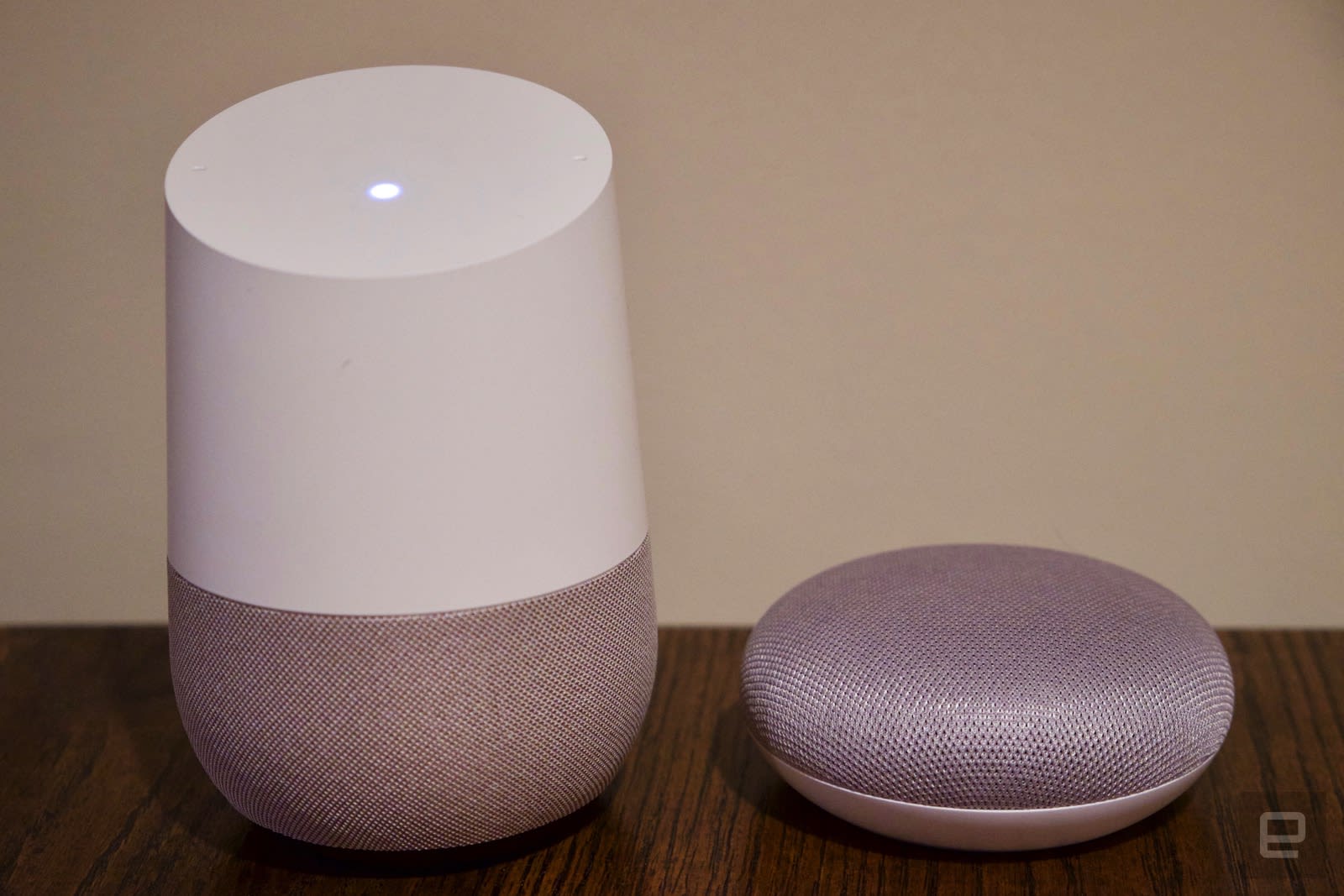
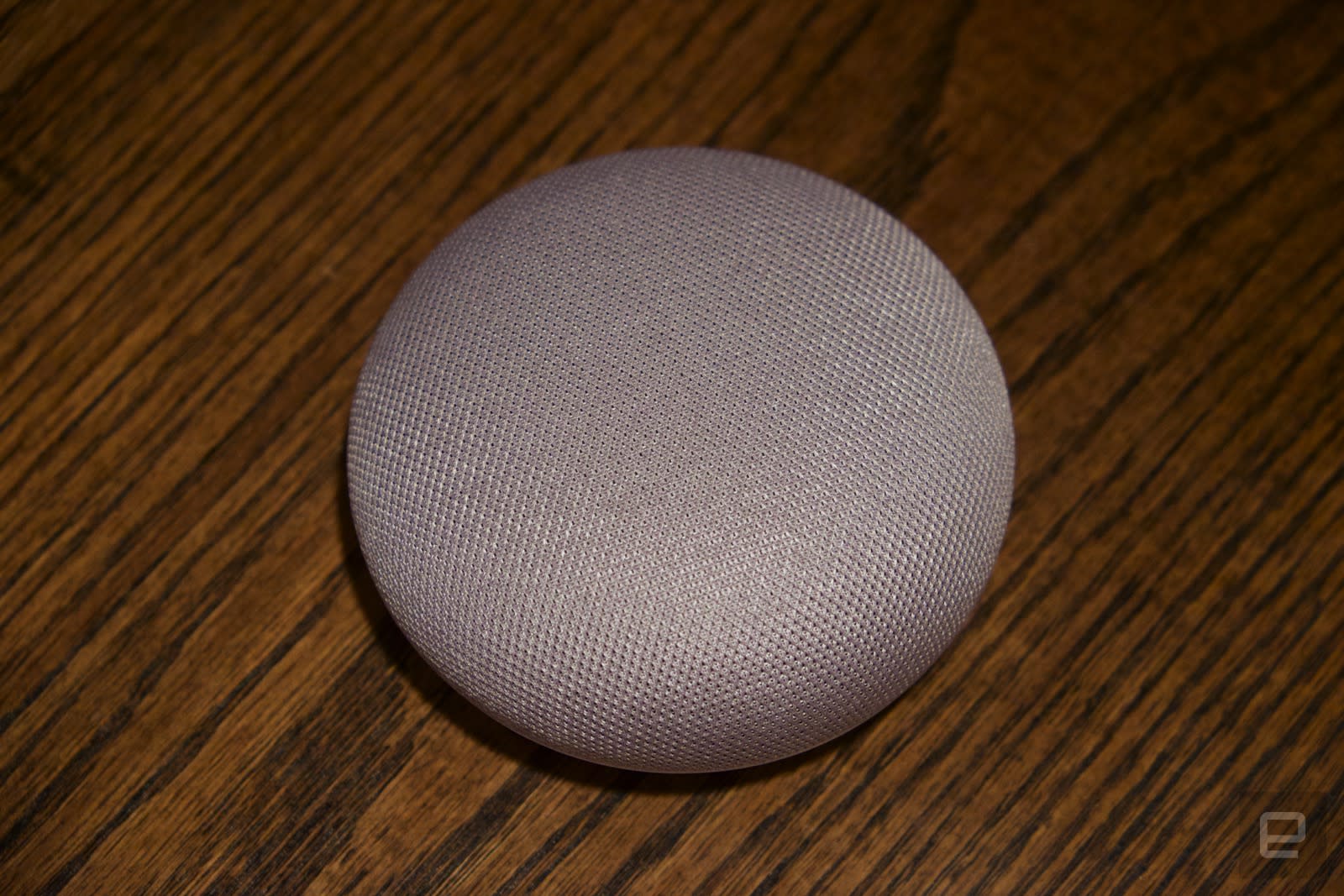
Google describes the Home Mini hardware as a donut, and that’s not a bad comparison. It’s about the same size as my favorite pastry (though there’s no hole in the middle). To me, it looks more like someone turned the original Google Home upside-down and flattened it. Instead of having a white top and a colored bottom, the Mini offers the opposite. But the top of the Mini is made of a new fabric that Google designed specifically for its pair of new smart speakers (the Mini and its giant brother the Home Max). The soft look of the light grey fabric and the Mini’s rounded corners make this a much friendlier gadget than the Echo Dot, and one that be happy to put just about anywhere in my house.
The company says it designed the fabric to be both acoustically and visually transparent so you can see the Mini’s four status lights when it’s listening and “thinking.” Those lights are much less gaudy than the Echo Dot’s bright LED ring, but they’re also not quite as good at showing you when the Home is in use. As for the fabric top, one potential downside is that it could get dirtier than a standard plastic shell and won’t be as easy to clean. There’s also no way to change out the top, unlike the bigger Google Home, which has a swappable base.
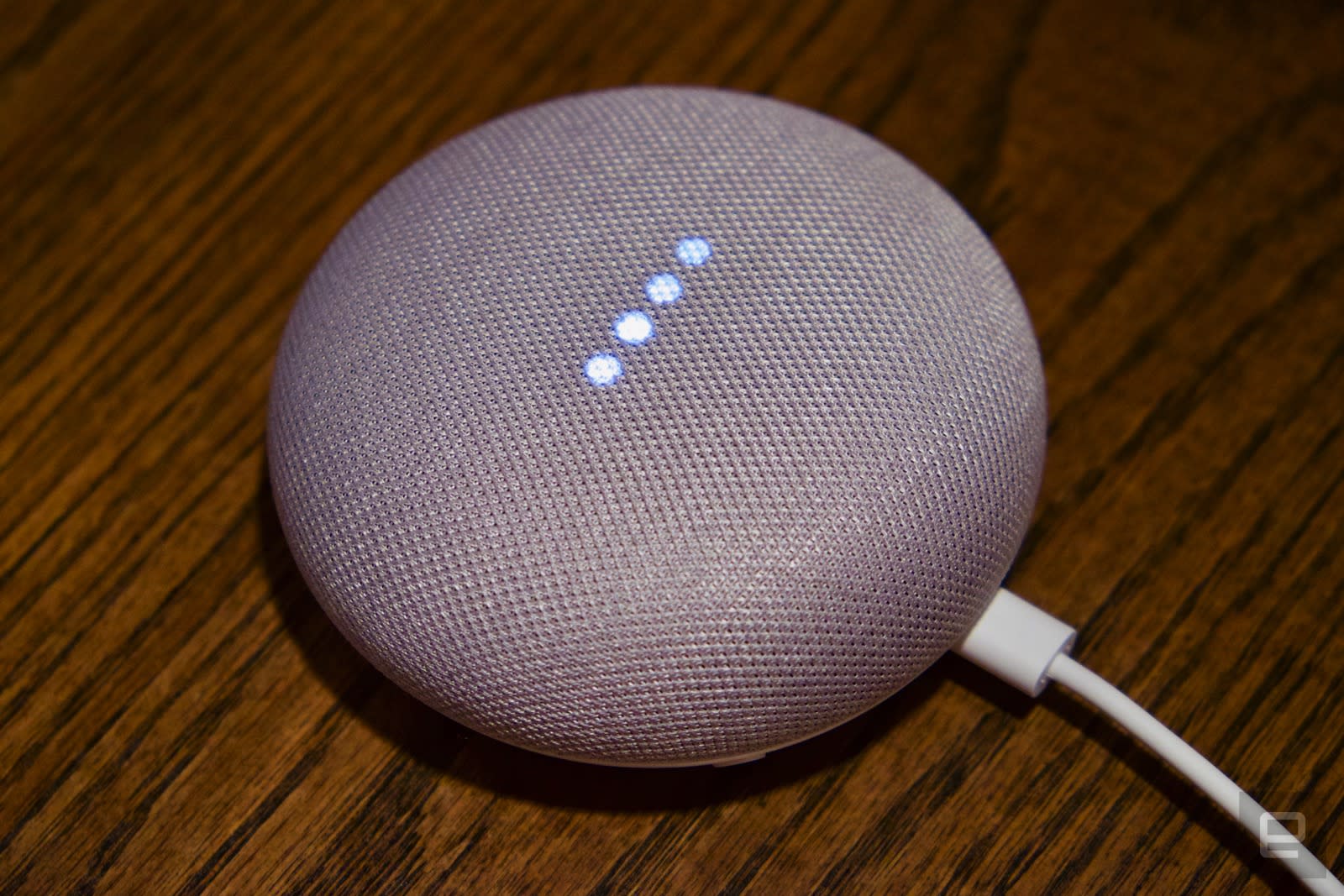
That said, I don’t think the Home Mini will get too grimy, because I rarely needed to touch it. Tapping the left and right sides of it turns the volume up or down, but it’s just as easy to do that with a voice command. Until a few days ago, you could also tap and hold on the center of the Home Mini to activate the Google Assistant, but Google just permanently disabled this feature. A few Home Minis were suffering from a bug where their touch panels activated inadvertently — this meant the device was able to record audio and transmit it to Google without a user’s consent, a privacy nightmare in the making.
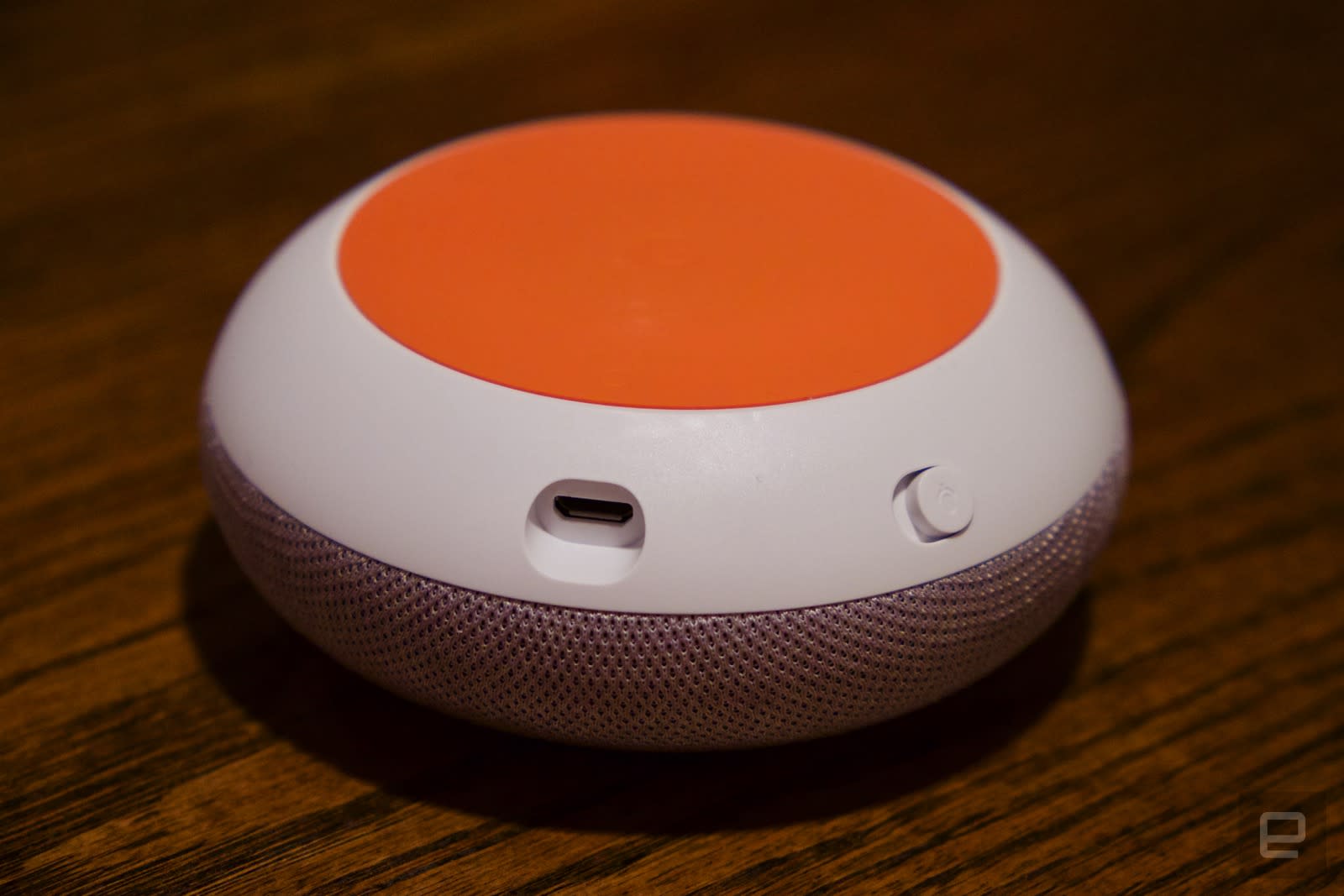
Google acted quickly in disabling the feature, and a review of all the voice commands the Home Mini sent showed no unusual activity for me. I believe that Google has fixed the issue, but it’s still something to be aware of if you’re on the fence about having a voice assistant in your house. For extra privacy, you can mute the device’s microphone with a switch on the back. Once muted, the four lights on the top of the Home Mini light up in orange. It’s a bit less elegant than the button found on the larger Google Home, but it does the job.
Setup
Setting up the Home Mini is identical to setting up the full-size Home. You plug it in, and the Google Home app walks you through the rest. Punch in your WiFi credentials, assign it to a room and you’re ready to roll.
But to get the most out of a Google Home, you’ll want to to customize a few things. In the Home app, you can sign into various music and video services including Spotify (free or premium), Pandora, TuneIn or IHeartRadio so that you can tell the Home Mini to play your streaming library. If you use Google-owned services like Play Music and YouTube, they’ll be automatically set up. Supported video services include CBS, the CW (both added over the last year) and Netflix.
You can also customize “My Day,” a daily briefing that tells you what’s on your calendar, what your commute is like, what the weather in the area is like, all pulled from your Google account. It also can follow that up with a quick news program, so it’s worth taking a minute to pick your favorite sources. Options include “traditional” news like Bloomberg, NPR and the Wall Street Journal, but you can also get programs focused on specific topics like technology and sports.
In use
Once you’re all set up, you can start asking the Home Mini questions and the Google Assistant will answer based on the company’s massive knowledge graph. You can also ask it to give you just about any info you’ve stored in your Google account, like calendar appointments, reminders and your commute, but there’s a bit caveat. It only works with personal Google accounts; G Suite is not supported. That’s crazy, particularly a year after the first Home arrived. Even Amazon supports G Suite calendars on the Echo! As someone who uses his work calendar much more than the personal one, I’d really like the Mini to work with G Suite accounts.
The Home Mini can stream audio, video or images from Google Photos to any Chromecast-enabled device (including another Google Home). Controlling audio and video was one of my favorite features with the original Google Home and that’s still the case here. The speaker is too small for dedicated music playback (more on that later), but I used the Mini to cast music and video to various speakers and TVs in my house with no issues.
Additionally, there’s a ton of other services you can talk to across categories like education, productivity, entertainment, games and trivia, news and more. They’re similar to Alexa’s skills, but you don’t have to “enable” these. You can just say, “OK Google, talk to the Wall Street Journal” to get whatever info the publication has posted recently. The best place to see everything you can ask the Google Assistant is currently in the official Assistant app, not the Home app you use for setup. That was a little confusing, but once I had both installed it was pretty easy to learn more about what the Home Mini was currently capable of.
Other features include getting step-by-step recipe directions from the Food Network, Dominos pizza delivery, calling an Uber, making a reservation with OpenTable and more. Naturally, the Home Mini can connect to a variety of smart home devices, as well. Google says that Home supports 1,000 devices from “more than 100” home automation partners. And you can use IFTTT to build your own custom actions, as well. One of the nicer things about the Google Assistant is that you don’t need to sign in or set up much before you start using these actions — I asked the Mini to make me a reservation for dinner tonight and went through the process without having to go back to my phone, which is how it should be.
What’s changed
That said, there are some differences to note about the Home Mini compared to the original, almost all of which come down to one thing: audio quality. Obviously, the much smaller Mini has a much smaller speaker, and that makes a huge difference for audio playback. It works fine for voice responses, alarms, timers and the like, but it’s not something you’ll want to use for music. The bigger Google Home doesn’t have outstanding audio, but it’s definitely better than your laptop speakers or most cheaper Bluetooth speakers. The Mini, on the other hand, is severely lacking in the bass department and generally lacks the clarity you’d want for listening to music.
For $49, that’s totally excusable, but it’s something worth being aware of. For what it’s worth,, the Mini absolutely outclasses the Echo Dot in audio quality. The Dot sounds tinny and hollow when Alexa speaks to you, and music playback is even worse. I compared the same songs across both devices and the Dot consistently came up short, without even a hint of a bass. I personally wouldn’t want to use the Home Mini for music outside of a few limited circumstances — I could see putting on a few songs while cleaning up the bedroom, for example, but for any longer listening session I’d rather just pop in some headphones than keep the Mini playing. Your milage may vary, of course — if you listen to a lot of audio through your phone’s speaker, the Mini will be an improvement.
The Mini’s tiny design also affects microphone performance. The Google Assistant hears me just fine, but voice calling is another story. When I called a few friends with the Mini, they all said that I sounded terrible. At least I could hear things fine on my end. This isn’t just a problem with the WiFi calling protocol that Google is using, either. I called the same people on the full-size Google Home and everyone said things sounded significantly better. If you were going to buy a Home product with the intent of using it as a voice-activated speakerphone, you’ll be better off springing for the larger model.
In addition to voice calls, new Google Assistant features including adding calendar items and reminders (something that really should have been there day one). Voice Match, which lets multiple users get personalized responses from the Home, was probably the biggest and most useful addition so far. If you want to try shopping with your voice, Google Express now lets your order products from giant retailers like Walmart and Target.
Google also announced a number of new features when it unveiled the Home Mini last week; unfortunately some of the most notable ones aren’t live yet. Users can build “routines” that stack a few actions together the way the “my day” briefing gives you a handful of different pieces of info. Saying “good morning” could turn on lights, set your thermostat, turn on the coffee pot and tell you what’s first on your calendar (provided you have the right smart devices to do those things, of course).
Another new feature will let you use the Home devices as an intercom — you’ll be able to “broadcast” a message from the Google Assistant (on your phone or through Google Home) to all other Home devices in the house. The Home also lets you send info from it to your phone if you need to see something visual, like directions.
The competition
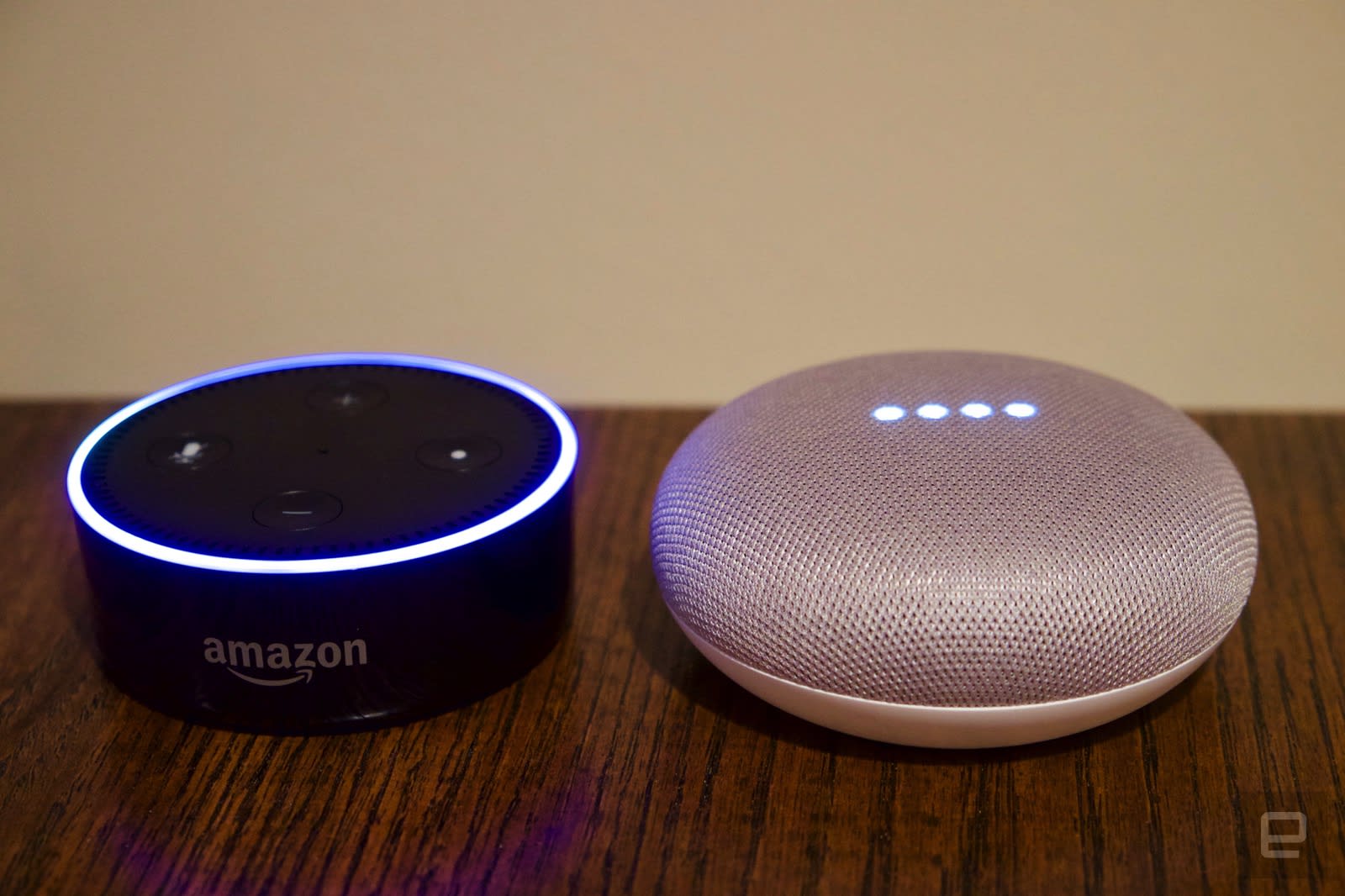
The question everyone will have to ask when considering the Home Mini is how it compares to the Echo Dot. The Mini beats the Dot in terms of audio quality, and I personally prefer its looks. But the Dot still has broader third-party support, with 20,000 “skills” and more added every week. The real question is whether Google supports the smart home products and features that you need, and at this point the Home Mini can control a wide variety of smart home devices. Amazon’s head start and the fragmented nature of the smarthome device market gives the Echo a lead, but I’m no longer convinced that going with Amazon is a must to have the best smarthome experience.
If you’re deep in Google’s ecosystem and prefer using its products and services, the Home Mini is a natural choice — provided you don’t rely heavily on a G Suite account, in which case the Echo is still somehow a better option.. And Google’s implementation of voice calling is much better, but the Mini’s terrible call quality negates that advantage
Wrap up
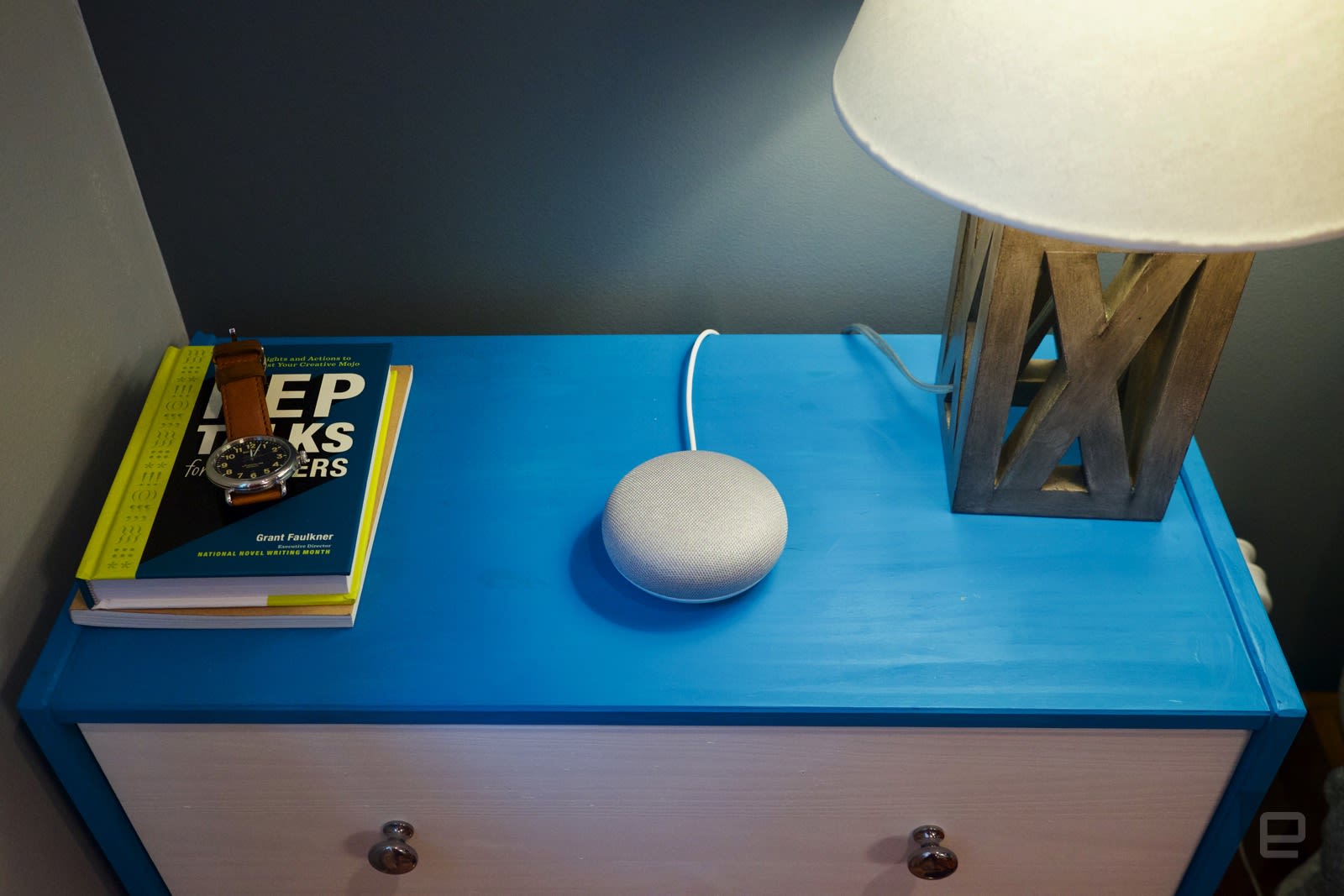
There’s no doubt that Google Home’s capabilities have improved significantly over the last year. I called the original device “little more than a toy” last year, but now it’s a legit competitor to what Amazon’s Echo and Alexa. The Echo might technically have a lead in compatible devices, but I’d urge you to do some research before committing to a smart speaker — chances are good that the Home Mini can do what you need it to.
Google’s undeniable advantage comes from the amount of info Google has about both the world and your own activities. Its knowledge graph is unrivaled, and Google is very good at answer any query you might have. As for the hardware itself, the Home Mini has a better speaker, a more attractive appearance and superior voice-calling features — it’s just too bad that the microphones don’t offer better call quality. Google has done a strong job closing the gap between the Assistant and Alexa over the last year — as long as the Home Mini works with devices and services you use, it’s well worth a look.
Google Assistant can finally control Chromecast from your phone
Google’s Assistant app is capable of lots of things, but before today, controlling a cast session by voice wasn’t really possible. Android Police reports that now the mobile app can do so, and you can even specify which Chromecast in your house is the target. Adjusting the volume, skipping or repeating tracks and tasking Assistant to play Urfaust’s latest on your Chromecast Audio while you beam a Minecraft video to the kids’ room all can be done with a simple voice command now — and all without a Google Home. On our iPhone with the Assistant app it worked as you’d expect, but Android Police says its devices weren’t working just yet; the publication received tips from readers about the functionality prior. Are you having any luck? Let us know in the comments.
Source: Android Police
Oculus’ standalone headsets point to a changing VR landscape
2016 was the year that VR went mainstream. The Oculus Rift finally shipped to consumers, as did the HTC Vive and the PS VR. But even as the VR industry is finally starting to take off, it’s already beginning to splinter. Before, we had phone-based VR the likes of Samsung’s Gear VR and Google’s Daydream, and then higher-end PC models like the Rift and the Vive. Now, the standalone VR headset is emerging as a category unto itself. And it stands to make the VR landscape a lot more accessible — and possibly more divisive — than ever before.
The idea of standalone VR headsets is not a new one. Intel explored the field with Project Alloy for a while before killing it earlier this year, Alcatel made one that didn’t quite take off and Google announced it’s working with standalone Daydream headsets from HTC and Lenovo too. But it’s Oculus — the pioneer of modern VR — that is the first to come out swinging with two different kinds of standalone VR headsets, one of which will be available to consumers early next year.
The latter is the Oculus Go, and it was the highlight of this year’s keynote at Oculus Connect 4. It’s attractively priced at $199 and shares the same DNA as the Gear VR — apps for the Gear VR should be compatible with the Go. The Go features a “fast-switch LCD” with WQHD 2560×1440 resolution that’s apparently better than OLEDs. It also has built-in audio so you don’t need headphones.
Will Smith, the CEO and founder of FOO VR — a company that builds talk shows in VR — was enthusiastic about the Go’s price. “$200 is fantastic. It makes VR so much more accessible and so much more compelling.” Also, as an iPhone user, he says the idea of a standalone headset is much more attractive than having to buy a Samsung phone on top of the Gear VR.
Sam Watts, a director of immersive technologies for MakeReal, a VR company based in the UK, was equally positive. “The price is just about an impulse buy,” he said. “You don’t need to buy a phone to use it, and as a developer, it’s nice to not have to worry about the ‘phone parts’ of the phone interfering with the experience.”
“An all-in-one, untethered, headset like this is the future,” Watts continued. “It’s a good step to wider adoption.” He also likes that the Gear VR and the Go will be software-compatible — Oculus has said the Go is also powered by Android — so it’s much easier for the same apps to work on both headsets.

Yet, the Go isn’t the only standalone headset that Oculus is working on. It’s also developing Project Santa Cruz, which is much more powerful than the Go. We had a chance to try it out at Oculus Connect 4, and the experience is much more akin to the Rift — with 6DOF (degrees of freedom) controllers and full positional tracking. The Go, by contrast, only has a 3DOF controller and orientation tracking like the Gear VR.
It seems that standalone headsets like Santa Cruz are the future of VR; untethered yet powerful. And while Go is less capable, having a cheap VR option is good too. Phone-based and PC-tethered VR already seem like they could get outdated in the next few years. Suddenly, though, it seems that Oculus has a divisive product portfolio on its hands.
But it’s early days still for VR. “Mobile drop-in, phone-based VR is going to be persistent,” said John Carmack, Oculus’ CTO, on the Oculus Connect 4 stage. “Standalone will probably take over and be a dominant form, but cell phone based VR will still have the largest number of users.” This, he said, is because phones will improve exponentially over time, and will probably drop in price. The Galaxy Note 8 of today will probably be very affordable in the future. “A cheap phone playing VR applications will still have significant value to users […] I don’t expect Go to do Samsung-like [sales] numbers.”

Watts remains enthusiastic too. “It’s great to have options,” he said. “These headsets have the same ecosystem, really. The cheap option lets you take a small bite of VR, and if you like it, you can upgrade, and still keep all your apps.”
“My guess is that the Go and the Santa Cruz will be one headset eventually,” said Smith, adding that Oculus will probably have just one standalone option in the future. Carmack seems to hint at the same, saying on stage that he thinks the two products will converge some day. Still, that’ll likely take a few years. While Santa Cruz is much more capable, the cost of making it right now is just too high. “$199 is a super power for Go,” Carmack continued. “It’s unlikely that we can throw all the other [high-end features] in at once.”
Besides, Carmack thinks, there’s still room for low-end VR. “You don’t need 6DOF for watching 360-degree videos,” he said, adding that Go and GearVR are for much more passive VR experiences.
Oculus won’t be the only one offering all-in-one headsets. As mentioned earlier, Google is working on standalone Daydream devices with the help of HTC and Lenovo. There’s room for independent companies to come forward with their own solutions too. Yes, the VR landscape will shift and split. But that could be a good thing.
“As with all tech, good things come to those who wait,” said Watts. “You just have to sit and be patient.”
Alphabet may have spun out Project Loon into its own company
Project Loon might be a strange project with a wacky name, but apparently Google’s parent company Alphabet believes in it. It appears as though the project, which began as a part of Google and was upgraded to Alphabet X’s innovation lab, has been spun out into a company of its own. Business Insider first noticed the organization was listed as “Loon Inc.” in a recent FCC filing. This signals that Alphabet may be ready to allow Loon to operate as its own corporation. We’ve reached out to the Project Loon media team for comment.
The project aims to provide high-speed internet to areas that don’t currently have access to it using self-navigating balloons. While this concept may seem a bit absurd, Alphabet has had success with Project Loon. The FCC filing in question was to assist in relief efforts in Puerto Rico — the regulatory organization granted an “experimental license” last week, allowing Project Loon to provide emergency LTE service to the devastated island. The company is currently working on integrating with Puerto Rico’s local networks.
Alphabet has a history of spinning out successful companies from under its umbrella, such as Waymo, Nest and Access. If they are indeed setting up Loon as its own company, it shows great faith in the product, despite the fact it’s only been used and tested in a limited number of places.
Via: Business Insider
Source: FCC
 AIVAnet