


Safety is Elon Musk’s chief concern for new SpaceX rocket
Over the weekend, Elon Musk hosted a Reddit AMA as a follow-up to his presentation at the 2017 International Astronautical Congress. During that speech, Musk unveiled quite a few different ideas that will revolutionize space travel, from a new rocket called “BFR” (for “big fucking rocket”) to a moon base and a trip to Mars by 2024. He took to r/space to answer questions about these many new ideas, and we’ve rounded up some of the most interesting answers from the AMA.
In response to a question asking what will be sent in the first missions to Mars, Musk responded that SpaceX’s goal will be to transport colonists and make sure the basic necessities for survival were in place. He compared it to building the transcontinental railway. “A vast amount of industry will need to be built on Mars by many other companies and millions of people,” Musk explained, which makes clear he’s not planning on SpaceX colonizing Mars singlehandedly.
Musk addressed safety issues when it comes to using BFR for transportation around the Earth. SpaceX’s goal is to reach (or even exceed) current levels of safety for passenger airlines. The focus of the Raptor engines is on reliability; they’ll have a flak shield to protect them, as well as more engines than most airlines to ensure redundancy. “That will be especially important for point to point journeys on Earth,” Musk said. “The advantage of getting somewhere in 30 mins by rocket instead of 15 hours by plane will be negatively affected if ‘but also, you might die’ is on the ticket.
Safety was also cited as the reason that the Raptor engines were downscaled from roughly 300 tons-force to 170 tons-force. After cheekily responding to a question addressing the downscaling with, “We chickened out,” Musk cited the possibility of engine failure as the reason behind the decision. The ship’s mass decreased between the previous IAC talk and this one; the engine downscaling is in proportion to that. “In order to be able to land the BF Ship with an engine failure at the worst possible moment, you have to have multiple engines,” he explained “The difficulty of deep throttling an engine increases in a non-linear way, so 2:1 is fairly easy, but a deep 5:1 is very hard.”

Musk also addressed his vision for a future city on Mars. The illustration provided shows ships that appear to have been used to construct the colony. One commenter asked whether that meant the first two spaceships would remain on Mars permanently as a part of the city. Musk’s answer was succinct: “Wouldn’t read too much into that illustration.”
Another commenter asked about landing sites for the Mars base. Were the priorities on science or safety? As was a theme throughout this AMA, safety and survival are the paramount concerns. “Landing site needs to be low altitude to maximize aero braking, be close to ice for propellant production and not have giant boulders,” he said. “Closer to the equator is better too for solar power production and not freezing your ass off.”
If you’re interested in technical specs and getting down into the nitty gritty, you should check out the full AMA for yourself. Musk answers quite a few detailed and well thought out questions (including a warning that the future design of the fuel tanker for the BFS will look “kinda weird.”)
Via: The Verge
Source: Reddit
The Analog Super Nt Mini is Nintendo’s SNES Classic for grown-ups
Just as the NES Classic Edition broke ground before the SNES Classic, Analogue is also following up on Nintendo’s wallet-grab on our childhood memories with another premium, no-compromise mini console that plays the gaming carts of yesteryear, and solves some of our issues with the official miniature SNES. This is all, however, for a premium price. Naturally.
The main selling point of the Super Nt Mini is that it doesn’t tap emulation to play retro games. You can use old cartridges to play your games exactly like they were — for better and worse. Yep, it’s accurate and lag-free, but there’s also no save state feature, like that found on the official mini console. The Super NT does, however, add aspect ratio preservation for your wide-screen TV, as well as multiple resolution options, scanlines and scaler options to make sure games look as old as you remember them looking. It’s also outputting your favourite 16-bit chip loops at 48kHz — high-fidelity (for a SNES) audio.
This is also the first complete FPGA (field-programmable gate array) Super Nintendo console — Analogue says it’s designed to “preserve video game history, with the respect it deserves.” But don’t worry, there’s still wireless controller options. I mean, we’re not savages.

Compared to Nintendo’s version, Analogue is positioning its mini-SNES as a premium product. There are black, see-thru and classic-colored consoles to choose from, each priced at $190, while wireless controllers (from 8bitdo) also come in the same color options at $40 a pop. Interestingly, this makes the console much cheaper than its predecessor, the Nt Mini. However, with those wireless controller prices — there’s none in-box — it still brings the price up to just below $300. In comparison, the SNES Classic retailed for $80.
While we’ve got the prices, we still don’t know an exact launch date. However, given we know everything else, and have plenty of images of it, we’d suspect it’s going to arrive sooner rather than later.
Google WiFi adds site blocking to its family-friendly features
Google WiFi is a router that prioritizes ease of setup and use; it’s a great option for people who want to combine quick setup with advanced family-friendly controls. Now, they’re adding even more to the mix. Today, the company announced that Google WiFi offers site blocking, which allows parents to control access to over 8 million explicit websites. It will be available over the next day from within the Google WiFi app.
The technology works by taking advantage of Google SafeSearch, which was created in 2009. The new Google WiFi feature allows parents to turn on SafeSearch for certain devices across their network, which will then block all identified sites with adult content. Because SafeSearch is constantly on the lookout for new sites with explicit content, the blocked list will update in real time.

Source: Google
Major Wi-Fi Vulnerabilities Uncovered Put Millions of Devices at Risk, Including Macs and iPhones
Mathy Vanhoef, a postdoctoral researcher at Belgian university KU Leuven, has discovered and disclosed major vulnerabilities in the WPA2 protocol that secures all modern protected Wi-Fi networks.
Vanhoef said an attacker within range of a victim can exploit these weaknesses using so-called KRACKs, or key reinstallation attacks, which can result in any data or information that the victim transmits being decrypted. Attackers can eavesdrop on network traffic on both private and public networks.
As explained by Ars Technica, the primary attack exploits a four-way handshake that is used to establish a key for encrypting traffic. During the third step, the key can be resent multiple times. When it’s resent in certain ways, a cryptographic nonce can be reused in a way that completely undermines the encryption.
As a result, attackers can potentially intercept sensitive information, such as credit card numbers, passwords, emails, and photos. Depending on the network configuration, it is also possible to inject and manipulate data. For example, an attacker might be able to inject ransomware or other malware into websites.
Note that the attacks do not recover the password of any Wi-Fi network, according to Vanhoef. They also do not recover any parts of the fresh encryption key that is negotiated during the four-way handshake.
Websites properly configured with HTTPS have an additional layer of protection, as all communications between the browser and the website are encrypted, but Vanhoef warned many can still be bypassed.
Since the vulnerabilities exist in the Wi-Fi standard itself, nearly any router and device that supports Wi-Fi is likely affected, including Macs and iOS devices. Android and Linux devices are particularly vulnerable since they can be tricked into installing an all-zero encryption key instead of reinstalling the real key.
This vulnerability appears to be caused by a remark in the Wi-Fi standard that suggests to clear the encryption key from memory once it has been installed for the first time. When the client now receives a retransmitted message 3 of the 4-way handshake, it will reinstall the now-cleared encryption key, effectively installing an all-zero key.
As a proof-of-concept, Vanhoef executed a key reinstallation attack against an Android smartphone. In the video demonstration below, the attacker is able to decrypt all data that the victim transmits.
iOS devices are vulnerable to attacks against the group key handshake, but they are not vulnerable to the key reinstallation attack.
Fortunately, the vulnerabilities can be patched, and in a backwards-compatible manner. In other words, a patched client like a smartphone can still communicate with an un-patched access point like a router.
Vanhoef said he began disclosing the vulnerabilities to vendors in July. US-CERT, short for the United States Computer Emergency Readiness Team, sent out a broad notification to vendors in late August. It is now up to device and router manufacturers to release any necessary security or firmware updates.
Despite the vulnerabilities, Vanhoef says the public should still use WPA2 while waiting for patches. In the meantime, steps users can take to mitigate their threat level in the meantime include using a VPN, using a wired Ethernet connection where possible, and avoiding public Wi-Fi networks.
Vanhoef is presenting his research behind the attack at both the Black Hat Europe and Computer and Communications Security conferences in early November. His detailed research paper (PDF) is available today.
Tags: security, wi-fi
Discuss this article in our forums
Apple Begins Selling Bose SoundLink Micro Bluetooth Speaker Online and In Stores
Apple recently added a new Bluetooth speaker to its retail and online stores, called the “SoundLink Micro” and created by Bose. Spotted by Japanese blog Mac Otakara [Google Translate], the $109.95 speaker seems to have appeared on Apple’s website around October 11, and has subsequently launched in some retail stores as well.
The SoundLink Micro is designed for durability and comes with an IPX7 waterproof rating, equivalent to the Apple Watch’s rating and ability to withstand submersion up to 1 meter for up to 30 minutes. The speaker’s durability can resist dents, cracks, and scratches, and the package also includes a tear-resistant strap to attach to a backpack or cooler.
In terms of music playback, the speaker can last up to six hours, and if you have two of them they can be paired together for stereo or “Party Mode” playback. When synced to an iPhone, the SoundLink Micro supports access to Siri and lets you take calls right from the speaker. Bose’s speaker measures at 3.87 inches tall by 3.87 inches wide, and includes a Micro USB charging cable.
Two-day shipping is available as of writing for the SoundLink Micro, and it appears that the device has already arrived at most Apple retail stores. For the locations that don’t have stock today, many list availability dates later this week, around October 18. Visit Apple.com to check out more information on the speaker, which also comes in Orange, Black, and Blue color options.
Tag: Bose
Discuss this article in our forums
Eddy Cue Says He ‘Disagrees Vehemently’ With Those Who Believe Apple’s Pace of Innovation Has Slowed
Just over a decade after the iPhone launched, and six years after Steve Jobs passed, some critics believe that Apple’s pace of innovation has slowed. Unsurprisingly, Apple’s services chief Eddy Cue doesn’t share that opinion.
“I disagree vehemently with that and I think we’ve been incredibly innovative,” said Cue, in a recent interview with Indian publication Livemint.
Cue pointed out that both the iPad and Apple Watch launched after the iPhone, while noting that revolutionary products take time. He also believes that Apple’s work on Mac, macOS, and iOS has led the market.
Apple historically has a track record of coming out with industry-defining products, whether it’s the Mac or iPhone or iPod. But over the past decade, there’s a been perception that the pace of innovation and the pace at which Apple has come out with game-changing, breakthrough products has slowed somewhat. What do you have to say about that?
No way! First of all, the iPhone is 10 years old. That is the last decade. The iPad came after that and the Watch came after that. So, I disagree vehemently with that and I think we’ve been incredibly innovative. That doesn’t even take into account the work that has been done on the Mac, iOS and MacOS, from that standpoint where I think we’ve led the market. When you think of the products that we’ve built over time, you own a lot of them. And you just assume that every year was a new product. But it wasn’t. You can’t do revolutionary new products, every two months or six months or whatever. They take time.
The rest of the interview was primarily focused on Apple’s roadmap for India, which Cue described as a “very long-term opportunity.”
Cue said Apple is focused on three areas in India, including the App Store, Apple Maps, and a bundle of other services such as iCloud and Apple Music. Of note, he said Apple is “working on” bringing Apple Pay to India.
The digital payments business is widely being seen as the biggest battleground in India now and in the near future. What are Apple’s plans on that front?
Our head of Apple Pay, Jennifer Bailey, is here with me. And Apple Pay is something that we definitely want in India. The challenge with payment mechanisms is that there isn’t really a lot of global scale. You deal with individual markets at a time … but India is one of those markets where we hope to bring Apple Pay to.
Cue said Apple doesn’t have an exact launch date to announce for Apple Pay in India at this point since it’s not “a 100 percent” yet.
In the full-length interview, Cue also reflects upon the leadership styles of past and present Apple CEOs Tim Cook and Steve Jobs, and on Apple’s increasing efforts to produce original content.
Related Roundup: Apple PayTags: Eddy Cue, India
Discuss this article in our forums
DxO Updates iOS App With Advanced Time-Lapse Features, Launches New Battery Pack Accessory
DxO today announced a new update for its DxO One iPhone-connected camera accessory, introducing a new time-lapse option with exclusive “Auto Ramping” technology and multi-camera Facebook Live capabilities. There are also a few new accessories that were revealed today, including an external Battery Pack, Cable Back Door, and Tilt Stand.
The version 3.0 update to the DxO One iOS app streamlines the app’s creation of time-lapse videos, and includes the company’s “Auto Ramping” technology, which avoids flicker effects by providing consistent exposure and white balance across all images. When users start a time-lapse shot, the iPhone can be used normally while the camera continues to take pictures.
For Facebook Live, DxO One users will be able to instantly create a live video stream through the DxO iOS app. With a new multi-camera mode, the app leverages both the DxO One itself and both iPhone cameras to give users the ability to experiment with their photography and capture photos that can’t be taken with just an iPhone.
This area of the app provides a mini control panel so users can preview all three camera views to compose shots, adjust lighting, and generally prepare for a live broadcast. The control panel also allows for easy jumping between camera viewpoints, and users can switch sound recording to come from the DxO One or the iPhone’s built-in microphone.
“While smartphones have made significant progress in terms of image quality, they don’t come close to the photos and videos a real camera like the DxO ONE can offer. Most importantly, you have to hold them in your hand, and you constantly need them for other things, like making calls, sending messages, or checking your social networks,” explains Jérôme Ménière, DxO’s CEO and founder.
“The DxO ONE is the first photo and video camera designed to operate as both a handheld and remote device. It’s even able to function remotely over a long period of time — for example, you can use it outside to record a time-lapse or Facebook Live video. Because it works in perfect harmony with your smartphone, it is the ideal photo and video assistant for this device.”
In regards to the new accessories, DxO is launching a Battery Pack to ensure that users can accomplish all of their photography and videography goals without having to worry about battery life. The Battery Pack includes a “Cradle,” two rechargeable batteries, and a USB adapter. Each battery adds up to one hour of battery life, and the USB adapter lets users charge the DxO one directly from an external pack.
 The DxO One attached to the new Battery Pack accessory
The Cable Back Door connects the DxO One to an external battery pack when the camera is being used with the company’s Outdoor Shell. DxO said this is mainly targeted at users who capture time-lapse videos and other content outdoors. Since DxO One can also be used in a standalone mode, the company is launching a Tilt Stand, which holds the camera at five different angles.
Version 3.0 of DxO One on the iOS App Store will be available for users to download today as a free update. In terms of accessory costs, the Battery Pack will be sold at $59.99, the Cable Back Door will be included with any purchase of the Outdoor Shell on DxO’s online store, and the Tilt Stand will be packaged into the DxO One moving forward.
The company is also launching an Android app and camera with USB Type-C in the coming weeks. The iOS-compatible DxO One camera is available for $499.99 on the company’s website.
Tag: DxO One
Discuss this article in our forums
Huawei Mate 10 hands-on: Faster, more helpful AI
The most important phones of the year have already been announced, but one company might still be able to pique our interest. Huawei unveiled its AI-focused Kirin 970 processor at IFA, saying the chip’s real world benefits would be shared at the launch of its next flagship. Now, the company is ready to reveal how the Kirin 970 performs in a phone. The Huawei Mate 10 and Mate 10 Pro were designed around AI — so much so that Huawei wants to call them “intelligent machines.” We don’t know how much these intelligent machines will cost yet, but Huawei told Engadget to expect the prices to be competitive. From my brief time with some preview units at a recent demo in New York, the Mate 10 and Mate 10 Pro certainly have useful AI features and could be worthy competitors to the latest phones from Apple, Google and Samsung.
Those who are familiar with the Mate series will notice how different the latest flagship looks compared to previous generations. In place of a matte metal finish is a glossy glass back with a horizontal inch-high gray stripe under the cameras. This band subtly blends in with the rest of the rear but catches your eye when it reflects light, making for a fetching effect. All four sides of the handset are slightly curved, too, so the device feels sleeker and easier to grip.
The Mate 10 and Mate 10 Pro differ in a few ways. The Pro has a larger 6-inch OLED screen than the regular model (which measures 5.9 inches diagonally and uses an LCD panel). Strangely, the Pro’s display resolution is just 2,160 x 1,080, while the smaller phone has a sharper 2,560 x 1,440 screen. Huawei said it did this to conserve the Pro’s battery, among other reasons it declined to share.

Other differences between the two phones include RAM and storage capacity, as well as the type of LTE radio. The Mate 10 has 4GB of RAM and 64GB of storage, while the Mate 10 Pro has 6GB of memory and 128GB of space. To compensate for its lower capacity, the regular Mate 10 has a microSD slot but its bigger brother doesn’t. The Pro also has a Cat 18 radio, which means it supports gigabit LTE speeds of up to 1.2GBps, while the smaller phone doesn’t. Finally, the Mate’s fingerprint sensor is built into the home button, while the Pro’s is located on the rear under the cameras. All these differences considered, the Pro doesn’t necessarily feel like the superior of the two; it has a slightly bigger and technically better screen, though I didn’t notice a change in quality as I switched devices.
I eventually learned to tell the difference between the phones by their overall shape. The Mate 10, with its 16:9 aspect ratio, is wide and squat compared to the Pro, which has a ratio of 18:9. Like many of this year’s flagship phones, the two Mates’ displays stretch across the front for an “all-screen” effect with almost no bezel. Despite the different resolutions and display types, both phones appeared equally colorful and crisp though they seemed a little dim under direct sunlight.

Both phones sport the same dual rear-camera setup, which Huawei co-engineered with Leica — a partnership that has been ongoing for several years now. A 12-megapixel RGB camera is paired with a 20-megapixel monochrome sensor here, and both lenses feature apertures of up to f/1.6 — which is the largest on smartphones to date, alongside LG’s similarly equipped V30. The V30 uses a glass lens, though, which may deliver better image quality than the Mates, and LG uses wide angle and telephoto lenses instead of color and monochrome sensors. Still, the Mate 10 phones yielded lovely pictures with vivid colors and sharp details.
That’s thanks in part to Huawei’s AI in the native camera app. When you point the Mate 10’s camera at an object, it recognizes the subject and automatically adjusts the settings. It’ll not only tweak capture settings like ISO, exposure compensation and white balance in real time, but post-processing effects as well. I aimed the phone at some cupcakes on a plate, and a food icon appeared at the bottom left of the screen. The phone then bumped up the saturation to make the colors richer.

Huawei says the camera can recognize up to 13 scenes right now, including landscapes, low-light, portrait, flower, sunset, snow, cat, dog and text. I don’t know why there are different settings for dogs and cats (Huawei has yet to answer my question on this), and I unfortunately didn’t get to try the camera out on those animals. But during my demo, the Mate 10 phones accurately distinguished between people, food, flowers and landscapes. Over time, Huawei says the AI-powered model will evolve so that it recognizes more scenes and learns to identify more objects. The company will train its AI using users’ photos in the cloud, and then push out updates periodically.
I was impressed by how quickly the cameras recognized things. An icon for the detected object appeared almost instantly after I pointed the phone at it, and even when there was a delay, it was never longer than a second. This is likely due to the Mate 10’s Kirin 970 CPU, which carries a dedicated neural processing unit (NPU) to manage AI-based tasks. While the graphics processing unit handles things like rendering the image on your viewfinder and the main processing unit takes care of saving the image to your phone or capturing metadata, the NPU focuses on processes like object recognition. On other chipsets without an NPU, the latter task would be slower since it would be performed by another unit that’s already in use.
The Mate 10’s 8-megapixel front camera doesn’t support scene recognition, but it does have a Portrait-mode feature for bokeh in your selfies. Unlike this year’s Huawei P10, which also features Portrait mode on the front cameras, the Mate 10 uses AI to better identify faces in your picture to apply the background blur more precisely. This was hit or miss during my demo; sometimes it recognized my coworker’s face next to mine and adjusted the blur to surround him. Other times, it blurred out his head or parts of his hairline. Still, this is an improvement over the P10, which routinely blurred out my friends’ faces in my group selfies.
The Kirin 970 chip offers other benefits as well. In addition to improving overall performance by pre-allocating resources to apps it predicts you’ll launch, the NPU can also be used by third-party apps to speed up machine learning tasks. Developers can choose to tap the NPU by using Huawei’s own API for the Kirin 970, Google’s TensorFlow Lite or Facebook’s Caffe 2 AI frameworks. So far, Microsoft has updated its Translator app to make use of the NPU to speed up the translation of signs. I tried this out on some Chinese sentences that Huawei placed around its demo area, and the process was indeed speedy. Since I’ve never used Microsoft Translator on another phone, I can’t say if it is faster than before.

Few other apps are tapping the NPU at the moment, so I couldn’t see if there would be other performance benefits during my demo.
The rest of the phone’s improvements are less exciting. The Mate 10 will run Android 8.0 Oreo with Huawei’s EMUI 8.0 skin, which has new features like a floating navigational button for easier one-handed control and the option to open incoming notifications in split screen when you’re viewing a full-screen video or playing a game.
Both the Mate 10 and the 10 Pro pack large 4,000mAh batteries, which can be recharged up to 58 percent in 30 minutes. The new flagships are also the first phone to be “end to end” certified for battery safety by German certification organization TÜV Rheinland, meaning the cells are tested on their own as well as inside the phones.

All told, the Mate 10 and Mate 10 Pro represent a refined focus for Huawei. While it continues to add popular features like all-screen displays and dual cameras to its flagships, Huawei is showing that it is capable of innovating in its own products. Concepts like the AI camera and NPU are not only novel, but helpful. Even though it’s too early to tell how they’ll perform in the real world, the new Mates already provide an intriguing preview of how well-executed AI applications can benefit users.
NBA’s first AR game lets you pop-a-shot with your iPhone
The NBA’s already cranked up its virtual reality output, and now it’s taking baby steps into augmented reality too. The league’s new iPhone game lets you play virtual pop-a-shot outdoors, which is as straightforward as it sounds. Just download the “NBA AR” app, point your phone at a chosen spot, and start shooting hoops on a virtual backboard and court. You’ll have to frantically flick your iPhone, though, as there’s a 30-second time limit on each round. When you’re done, you can share your high score on social media, iMessage, and email — and check how you stack up on the in-game leaderboard. NBA AR is available for free right now on the App Store.
The game relies on Apple’s ARKit AR platform, restricting it to newer iPhone models (including the 6S and beyond) running on iOS 11. The NBA is the latest big name to try out Apple’s tech, which Tim Cook claims will one day be as essential to brands as a website. The likes of Ikea and Edmunds have taken the bait, both releasing AR lifestyle apps aimed at shoppers. But, everyone else (it seems) is busy chasing the breakout success of Pokémon Go. According to recent data from Sensor Tower, games are by far the largest category of all ARKit apps on the App Store. So, don’t be surprised if the NBA’s small-scale release, which it touts as the first AR game by a US sports league, is followed by plenty others.
Apple Park ‘Nearly Complete’ as Construction Begins on Basketball Courts and Other Employee Amenities
Apple Park is officially nearing completion as 2017 winds down, according to a new drone video that has captured footage of the company’s campus. Shared by Matthew Roberts, the video comes nearly one month after an update in late September showed off Apple Park at sunset, and almost one year after “major landscaping changes” appeared around the campus.
Now, according to Roberts, Apple Park is “nearly complete,” with fewer pieces of construction equipment dotting the site. Landscaping remains a focus for the remaining work, and paths are being paved throughout the campus to connect buildings and areas of Apple Park for its employees. In terms of complete buildings, the new video showcases the finalized Visitor’s Center, which members of the media got to visit during the iPhone X event in September.
Roberts’ drone video also shared progress made on the sporting areas at Apple Park that the company has built for workers to unwind, including an outdoor spot for basketball and tennis courts currently in the middle of construction. Elsewhere on the campus, there’s also a 100,000 square foot fitness center for employees to work out in.
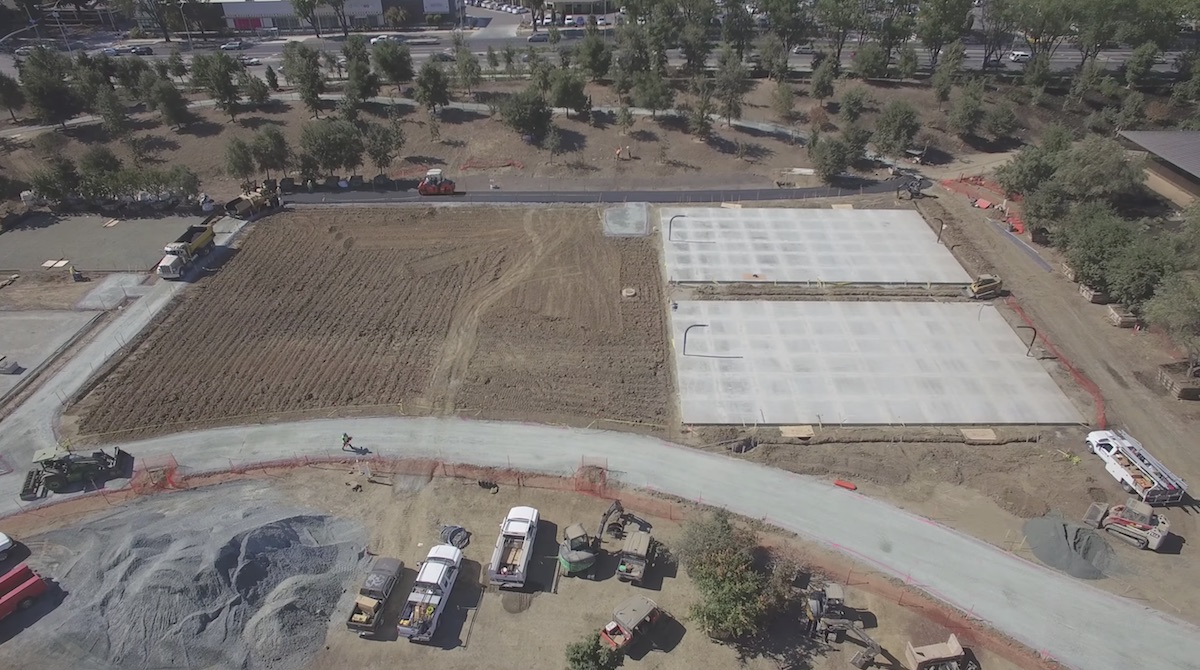
Although Apple Park isn’t yet officially finished with construction, some workers have already moved in to offices on the campus, and Apple hosted its iPhone X event at the Steve Jobs Theater last month. Once it is finally completed and all employees are moved in, Apple Park will house 12,000 workers across its 2.8 million square foot campus.
Tag: Apple Park
Discuss this article in our forums
 AIVAnet