


Misfit’s Vapor Android Wear watch goes on sale October 31st
Nobody can say that Misfit Vapor is vaporware anymore. The smartwatch will finally be available for purchase on October 31st from Misfit’s website, though its email subscribers will have the chance to get one earlier than that. We first saw Vapor at CES 2017 back in January when it was still running the company’s custom software. A few months later, Misfit changed its tune and switched its proprietary OS with Android Wear 2.0 — that’s the version we’re getting on the 31st.
Vapor has a 1.39-inch full round AMOLED display, 4GB of memory and a touch bezel you can use to browse apps. It can play music on its own without a phone, is water resistant up to to 164 feet and runs on Snapdragon Wear 2100 processor. The device also has all Wear 2.0’s features, including Google Assistant, which you can summon by saying “OK, Google.”
Misfit’s upcoming device is already one of the better-looking smartwatches we’ve seen. But as a nice bonus, you’ll be able to choose from various colors — jet black, rose gold, silver and gold — once it goes on sale on Misfit.com for $200.
Source: Misfit
Former HTC designer Scott Croyle has left Razer’s Nextbit
We haven’t yet seen Razer’s debut smartphone, but the team behind it is bidding farewell to an exec that played a crucial role back in its early days. Scott Croyle, who quit HTC as the Senior Vice President of Design, has left Nextbit as of September after a three-year run. His new gig? Going back to his design consultancy roots with the formation of Attic, a San Francisco-based studio covering hard goods (which obviously include consumer electronics), soft goods and furniture. Croyle is joined by former One & Co colleague Jony Ive Daniel Hundt, who was the lead designer of the Incredible, Incredible 2, Desire 816, Desire 820 and more. Prior to HTC’s acquisition, One & Co was also known for designing Microsoft’s Arc Keyboard plus Arc Mouse, as well as the original Amazon Kindle.
While it may be easy to assume that Croyle left Nextbit over creative differences post-acquisition, he insisted that this was not the case. He explained that between One & Co and HTC’s acquisition, his team suddenly grew from around 20 to over 100 people; he then joined Nextbit to focus on just one product, the Robin, but as the sole hardware guy at a small startup, he was also distracted by marketing, operations and engineering work. Hence his desire to go back to a smaller team and be closer to design work again.

“I wanted to work with a variety of clients and industries again,” Croyle said. “For me, it’s much more of a lifestyle choice and getting an opportunity to be back hands-on with design, wanting to really focus on what I really love which is actually working on products, and really working with a smaller group of designers and doing some really cool stuff.”
In fact, Attic is already up and running as a team of four, serving various clients including some stealth startups in Silicon Valley. I obviously had no luck getting Croyle to talk about his current projects nor the upcoming Razer smartphone, but he did confirm that neither of his fellow ex-One & Co principals will be joining him any time soon: apparently both Jonah Becker (Fitbit’s VP of Design) and Claude Zellweger (Director of Design at Google) are quite happy at where they are right now.
Source: Attic
Amazon vs. Roku: Which $70 4K streaming device is best?
Streaming video boxes just aren’t very exciting anymore. There, I said it. The Apple TV 4K was mostly intriguing because it dramatically lowered the price of 4K content. But most consumers don’t need an expensive streaming box, since most TVs today have a decent selection of built-in apps. That’s why I find cheaper portable video gadgets, like last year’s Roku Stick, to be far more interesting. Now we’ve got two new contenders for $70: Amazon’s new Fire TV, which looks more like a Chromecast dongle than a set-top box, and Roku’s Streaming Stick+.
Both devices support 4K HDR video and give you access to all of the streaming apps you could want. Plus they integrate voice searching in useful ways. But, of course, there are some major differences between them. And it turns out, picking a winner isn’t very easy.
Hardware
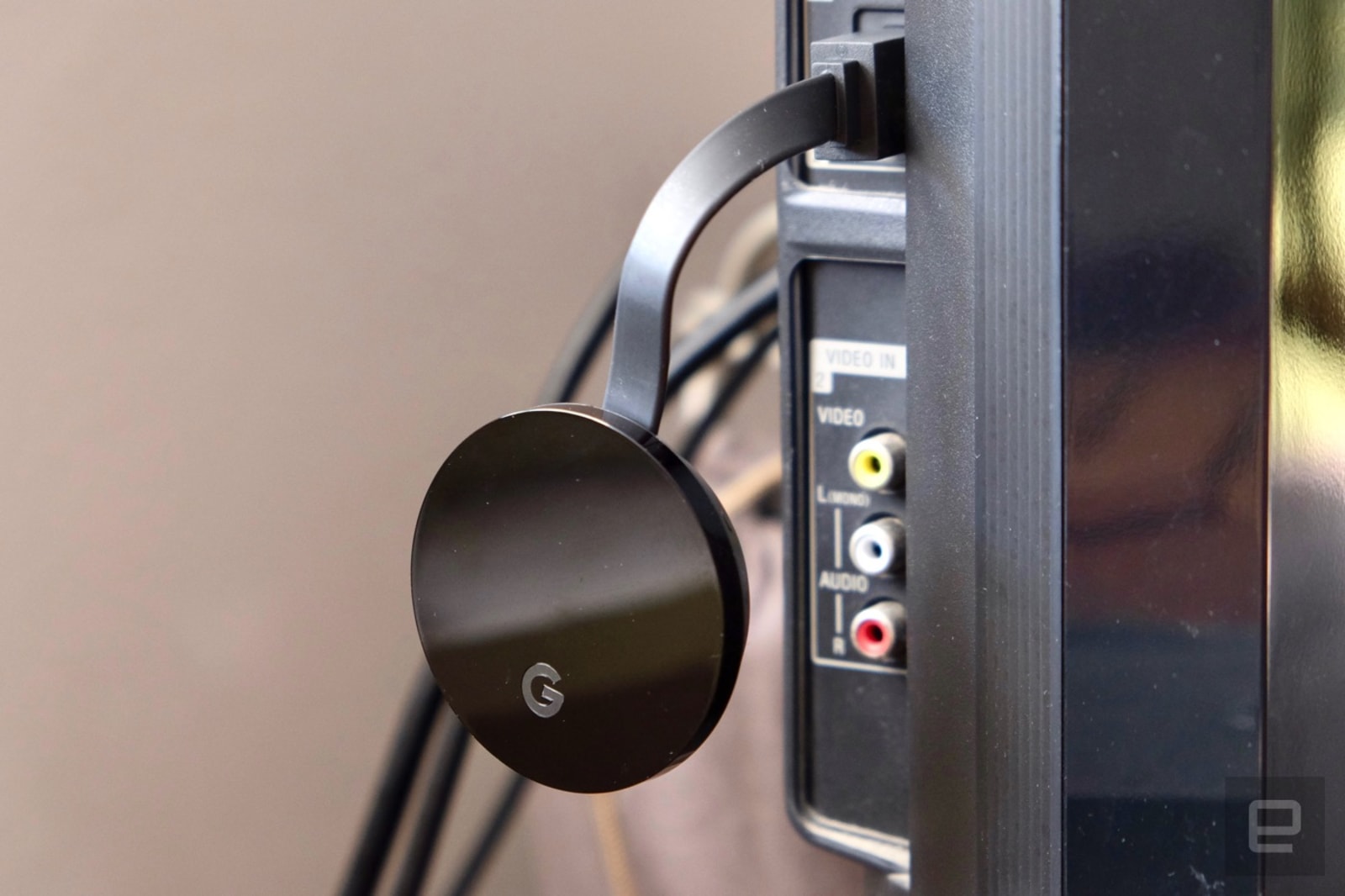
Amazon’s new Fire TV looks like a shrunken version of its last few models. It’s meant to hang off your HDMI connection like the Chromecast Ultra. It’s around twice as large as Google’s dongle, but it’s not heavy enough to stress and potentially break your HDMI port. While the new Fire TV is still boxy, Amazon smoothed out the (annoying) sharp corners from its earlier design. What we’re left with is a much more refined product than the last Fire TV.

The Roku Stick+, on the other hand, looks like an oversized version of its cheaper Stick. It juts out further from your TV but still manages to feel impressively compact. Partially, because Roku separated the wireless antenna from its body. That now connects to the Stick+ via a mini-USB port (we don’t see many of those anymore these days). It’s a unique design, but it makes sense: By pushing the antenna away from the back of your TV, Roku is able to avoid wireless interference.
Both the Roku Stick+ and Fire TV plug into AC adapters via micro-USB cables. But if you’ve got a TV with USB ports, you can also power the Roku device off that. That’s not foolproof, since some TVs don’t deliver enough power to their USB connections (Roku helpfully points this out in its setup instructions). But it’s worth a shot if you’re trying to reduce cable clutter.
The Fire TV supports Dolby Atmos, a next-generation format that even the Apple TV 4K doesn’t offer yet. The Roku Stick, meanwhile, only lists DTS as its distinguishing audio feature. Both devices will work with the ubiquitous Dolby Digital Plus surround format, of course. While there aren’t many streaming titles with Dolby Atmos yet, that still gives Amazon’s device a slight leg up for audiophiles.

While these two devices feature some drastic design changes, their remotes are less exciting. The Fire TV’s remote hasn’t changed a bit from two years ago — there’s an Alexa voice command button prominently up top, a plastic directional control ring and the usual playback buttons. It still feels good in your hand, thanks to a slightly curved back, but I would have liked to see Amazon modernize it a bit. Similarly, the Roku Stick+ remote features the same basic design we’ve seen over the past few years — except this time, there’s a PlayStation Vue shortcut button on the front, instead of one for Sling TV.
In use
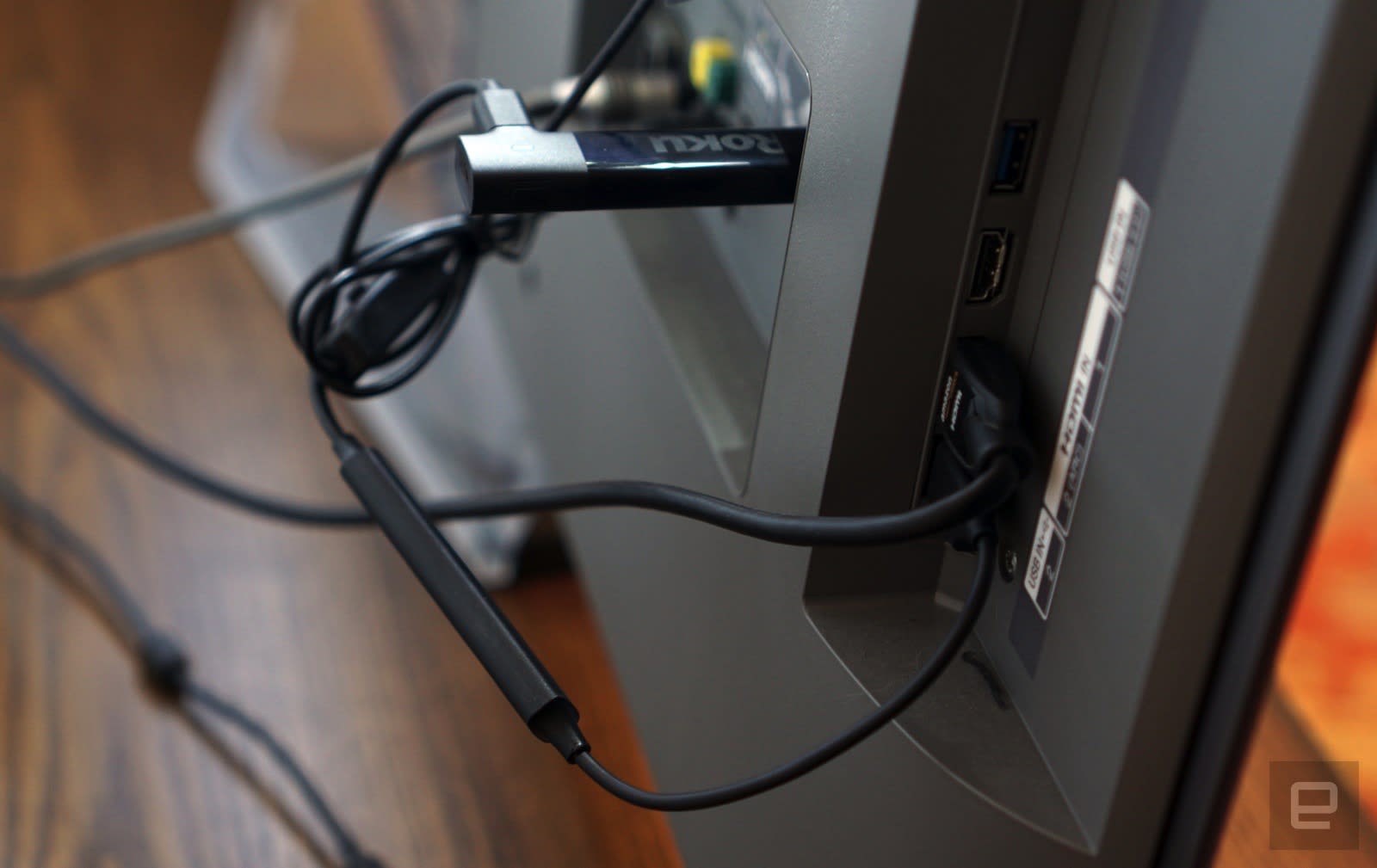
Since these are just streaming sticks and not complex set-top boxes, setup was relatively simple. The Roku Streaming Stick+ was particularly easy since I was able to power it from my TV’s USB port. While its additional antenna cable makes it look a bit more complex, it wasn’t that hard to figure out how to connect it all together. For the Fire TV, I had to clear out some room on my surge protector to fit its AC adapter, but otherwise there weren’t any issues.
It’s obvious Roku has a few years of experience on Amazon when it comes to designing a friendly setup. Roku’s remote paired with the Stick+ as soon as it booted up, and it immediately prompted me to enter WiFi details. After that, I just had to enter the onscreen access code into Roku’s site, using my phone to link the device to my account. If you’re a first-time Roku user, you can also create an account from their mobile site. It’s a nice way to avoid hunting and pecking at on-screen keys.
After I connected my account, the Roku Stick+ started adding all of my existing channels. The company’s website also surfaced a few new channels to follow from my phone, and it let me quickly link to services like Amazon, Hulu and Sling. That was a big time saver compared to manually logging into all of these apps, as you would with most other devices. I still had to plug in my Netflix details when I first launched that app, unfortunately.
To set up the Fire TV, I added my WiFi details and Amazon account information. Then, out of nowhere, it played a 90-second introduction video that showed off how to use the Alexa voice search features in the remote, as well as how to find different apps. It’s the sort of thing that could make less tech-savvy consumers feel more at ease with their new gadget, especially if they’re unaware of the Fire TV’s new features. The video also briefly showed off how to control your Fire TV from an Echo, which is shrewd since I imagine many of those smart-speaker owners would opt for Amazon’s streaming dongle.
The differences between Amazon and Roku’s streaming interfaces are really just a matter of taste. Roku’s simple, menu-based system is incredibly fast and easy to navigate. But it’s not exactly flashy. Amazon’s Fire TV UI is a lot more extravagant, relying on large images and bright colors to point you to its many offerings. While I’ve long hoped Roku would revamp its UI, I ended up preferring it to Amazon’s, which is a little confusing.
When it got down to actually watching video, though, there wasn’t a huge difference between the Streaming Stick+ and Fire TV. Both ran Netflix without a hiccup. Even when it annoyingly started playing trailers automatically when I highlighted a movie. Daredevil loaded in around a second, even in 4K/HDR. The show looked as great as it does on my LG’s built-in Netflix app and the Apple TV 4K. Hopping around to different portions of an episode took around three seconds on both devices, as well.

Surprisingly, they both performed about the same with Amazon Prime videos, too. Bosch loaded up almost instantly, and it took around five seconds before it crept up to full 4K/HDR resolution. Basically, we’ve reached the point where streaming boxes are at a performance standstill. These two devices, in particular, have fast processors and speedy networking that can handle 4K content with ease.
HDR was the big addition for the Fire TV, and both embraced the HDR10 standard. Dolby Vision, which Apple TV and Chromecast Ultra support, isn’t included. That’s not a huge deal since HDR10 is by far the more widely supported. But if you’re lucky enough to have a TV that supports both formats, you’re effectively robbing yourself of a slightly superior HDR experience by going with one of these dongles.
While Roku has a larger app ecosystem, both devices have all of the major streaming channels you’d actually care about. And even when it comes to finding 4K content, they each have mostly the same sources: Netflix, Amazon Prime and Vudu. The Roku is the only device where you can get Fandango Now, but that storefront doesn’t offer anything you can’t get elsewhere.
The one area where Amazon wins out is in voice search, mostly because the Fire TV packs Alexa. You can search for content on both devices, but the Fire TV also lets you ask about the weather, simple facts or set up reminders. More importantly, it works together with other Alexa-enabled devices in your home. After I linked the Fire TV with my Alexa app, I just asked my Echo to “Play Bosch on my Fire TV,” and the latest episode immediately popped up on my LG. You can also search for non-Amazon content via Alexa, but that won’t play automatically, only show search results.
Roku’s voice search is far more basic: It simply tells you where you can find specific movie titles, genres or films based on their actors or directors. It’s useful, but not nearly as versatile as Fire TV’s Alexa integration.
A big reason I recommended the last Roku Streaming Stick was portability. And while the Streaming Stick+ and Fire TV aren’t nearly as small, they’re still pretty easy to move around. If you travel a lot, though, and you’re unsure about what your power situation will be, Roku’s device has an edge since it can be powered just by some USB ports. I’d still pack the AC adapter to be safe, though.
Pricing and the competition
As I swapped between Roku and Amazon’s $70 dongles over the past weekend, it was tough to come up with a clear favorite. The Streaming Stick+, with its fast interface and simple setup, packs in just about everything I’d want in a 4K/HDR streaming device. But I also appreciated the Fire TV’s integration with Alexa. Ultimately, your choice between the two comes down to ecosystem. If you’ve got an Echo, the Fire TV makes the most sense.
And of course, they also compete with the $70 Chromecast Ultra. I really liked that Google device since it was a cheap path to 4K/HDR streaming. But now that there are full-fledged streaming gadgets at the same price, it’s far less appealing. Personally, I’d rather have something self-contained with its own remote and interface. Casting content from my phone and computer is never as smooth.
If you’re looking for something more advanced, the new $100 Roku Ultra is even faster and features an Ethernet port and support for USB storage. But you won’t be gaining any significant features. And of course, there’s the Apple TV 4K, which is basically the luxury choice at $179. I’d still recommend that if you’re an iTunes user, simply because it’s the easiest way to watch Apple’s content on your TV.
Wrap-up

You can’t really go wrong with either Roku’s Streaming Stick+ or Amazon’s new Fire TV. That’s not a very exciting conclusion, I suppose, but it’s where the streaming hardware market has been going. Everything is getting faster and cheaper, to the point where there’s very little difference between the many options out there.
Comma AI’s dash cams are a stepping stone to autonomous driving
I’m never sure what to expect when I walk up the steps of Comma AIs office (which is actually a house in a San Francisco neighborhood). Its founder and all-around rabble-rouser George Hotz (the iPhone and Playstation hacker more commonly known as geohot) has strong opinions about the automotive industry and how he can fix it. The company’s “ghost riding for the masses” tagline won’t win over regulators, but Comma AI’s longterm goal of running your car’s operating system seems doable. But first, it’s concentrating on dash cams that tap into your car’s data.
Comma AI’s latest piece of hardware is the EON dash cam developer kit. The $700 piece of hardware is a camera that also runs apps you’d use while driving, like Spotify and Waze. In fact, it’s actually just an Android phone (a OnePlus 3 to be exact) with a custom case and software that taps into the smartphone’s camera, gyroscope, GPS and accelerometer. That hardware, coupled with the new Chffrplus app (which is only available on the EON) allows Hotz and crew to distribute consumer hardware that also tracks your driving so it can train its self-driving AI system.
The info shared by the app means you can track your trips and, in case of an accident, have video proof, while Comma AI uses it to train its fledgling AI to power a self-driving car. Unlike the Comma One that Hotz showed off in Vegas that actually drove his Acura, the hardware the company actually sells only reads and analyzes data from vehicles; none of it will actually control your car.

Hotz is very clear on that last point: “We’re building out each component that we’re going to need to have a truly consumerized self-drive system and that is where Comma AI is going. We’re not there yet. I do emphasize that this is only a dash cam. Anybody who modifies it is completely on their own.”
He’s had his run-in with regulators about plans to sell self-driving hardware to the masses and he’s not eager to repeat that. At least, not before his system is ready to take on the infotainment and autonomous systems being built by the legacy automakers. Comma AI wants to be the Android of cars; it’ll build an operating system that sits in every vehicle regardless of make or model. That puts Comma AI in direct competition with the likes of Google, which has been working on the same thing with Waymo.
Currently, the automotive world is in a race, not just with Tesla and companies like Comma AI, but with each other to get a level 4 vehicle (completely autonomous in specific situations) on the road. The rub is that when that happens it’ll most likely be too expensive for the average consumer. That’s why companies like Ford and GM are investing and talking at length about “mobility,” with autonomous ride-hailing services that rival or work with Lyft and Uber.
In the meantime we have Tesla’s Autopilot, Cadillac’s Super Cruise, Audi’s new level 3 (autonomous in limited situations) Traffic Jam Pilot and others. Every automaker is taking a slightly different approach to the problem. It breeds competition (which is good), but also fragmentation (which is bad). None of the systems talk to one another right now, but eventually, they’re going to have too if we want an infrastructure that runs smoothly.

Hotz thinks they’re going about it all wrong, and that automakers, while good at building hardware are not so hot at software. “I’m doing this to beat the car companies. I don’t want to live in a world where there’s the Audi system and the GM system” he said.
In other words, he thinks they should stop worrying about building their autonomous systems and let companies like Comma AI and Google do it for them. They build the car, he builds the software that runs them

But for now Comma AI is selling a high-end developer dash cam that tracks trips and, when used in conjunction with the Panda OBD dongle the company released July, can log details about your drive using data from your car. Even without the dongle, the EON tracks and saves what it sees while augmenting that information by highlighting other vehicles and lane markers with its AI. It shares that information with the driver but also anonymizes it and the video and sends them securely to Comma AI. The EON, then, is a high-end hardware version of Chffr dash cam app for iOS and Android. It won’t drive your car for you. But if Hotz has his way, something very similar will do just that in the very near future.
Source: Comma AI
iPhone X Supply Estimated to Remain Extremely Tight Until Next Year Due to Earlier Production Issues
iPhone X shipments to customers will total around 20 million units through the end of the year, suggesting availability of the smartphone will be extremely tight through the holiday shopping season, according to Nikkei Asian Review.
The reduction, said to be only half of Apple’s originally planned amount for this year, is reportedly due to production issues with the iPhone X’s new TrueDepth camera and 3D facial recognition system that powers Face ID and Animoji.
The good news is that Apple’s manufacturers have supposedly improved their yield rate, but only towards the end of September. iPhone X is currently being produced at an estimated rate of 10 million units per month.
Apple is also believed to have already started negotiations with other manufacturers over additional production of certain parts, and there is a chance that output volumes could improve rapidly, according to the report.
Today’s report echoes what we’ve heard a seemingly countless number of times from multiple industry observers.
Yuanta Investment Consulting analyst Jeff Pu, for example, originally estimated there would be 45 million iPhone X devices available to purchase. His latest prediction has 36 million units available through the end of the year.
KGI Securities analyst Ming-Chi Kuo also cut his iPhone X shipment forecast for the fourth quarter to 25-30 million units, down from 30-35 million. He expects 2-3 million units will be shipped into distribution channels ahead of the launch.
iPhone X pre-orders begin Friday at 12:01 a.m. Pacific Time on Apple.com, while the device formally launches November 3.
Related Roundup: iPhone XTag: nikkei.comBuyer’s Guide: iPhone X (Caution)
Discuss this article in our forums
iPhone Users in U.S. Predicted to Increase App Store Spending to $88/Year by 2020
The average iPhone user’s spending on paid iOS applications and in-app purchases in free-to-play apps will increase by nearly 40 percent over the next three years, according to a new forecast based on data gathered by Sensor Tower. By the year 2020, iPhone users based in the United States will spend more than an average of $88 per year on both paid “premium” apps and in-app purchases in free apps.
Sensor Tower used previous app-based spending reports to predict how much users will spend over the next three years. Most recently, in 2016 it was estimated that the average iPhone user in the U.S. spent about $47 on apps, while 2017 is on track to increase that number to about $63/year. Afterwards, in 2018 the average U.S.-based iPhone user is predicted to spend $77/year on apps, and in 2019 Sensor Tower thinks that number will finally reach $88/year. That represents a 40 percent increase from the average user spending estimated for 2017, and an 86 percent increase from 2016.
U.S. iPhone users will spend an average of $88 per year on premium apps and in-app purchases (IAPs) by 2020 according to a new forecast based on Sensor Tower Store Intelligence data. Our projections place calendar year 2019 per-device revenue at approximately 86 percent higher than 2016 and about 40 percent higher than our forecasted average user spend in 2017.
While gaming apps will still dominate the spending landscape in the iOS App Store — accounting for “nearly 70 percent” of all per-device revenue — some other categories are forecasted to increase in popularity as well. This includes Entertainment, which Sensor Tower expects to overtake Music as the second-largest category of per-device spending in 2017, because of subscriptions in apps like Netflix and HBO NOW.
Specifically, in 2019 the Entertainment category is projected to account for about $8 of that year’s $88 average user app spending, increasing from $2.80 in 2016. That still won’t be anywhere near Games, with Sensor Tower anticipating the popular category to account for as much as $60 of the $88 spent by the average iPhone user in 2019.

In a separate story posted by Bloomberg this week, some of the reasoning behind the steady increase in user spending on paid games and IAPs can be connected to emerging technology being tested by game developers. A company based in Tokyo, called Silicon Studio Corp., has created a piece of software that uses deep-learning algorithms to predict how long users will play a game, what levels they might beat, and how much money they might spend and on what — all amassed into a “psychological profile of each player” that aims to “mold player behavior.”
The ultimate goal of the software is said to help developers maintain a healthy ecosystem, encouraging those who already spend a lot of money to keep doing so, while keeping non-spenders happy with the game. Besides smartphone apps, even massive multiplayer online game developers have approached Silicon Studio Corp. with interest in the software, which has been named “Yokozuna Data” after the highest rank in sumo wrestling.
Even more important, the technology lets game creators mold player behavior to keep them hooked.
“Game data is perfect for studying human behavior,” said Africa Perianez, chief data scientist at Silicon Studio and a former nuclear physicist at the European nuclear research organization CERN. “It’s going to change the industry, change the direction of personalized games.”
Apple recently updated the App Store in iOS 11, changing the layout and user interface with new tabs and editorialized content that updates every day. For Apple, the iOS App Store and other services consistently provide the company with yearly profit gains; in 2017 the App Store set a new quarterly record in May, while services did the same in August. This past June, Apple said that developers have earned more than $70 billion since the App Store first launched in 2008.
Tag: Sensor Tower
Discuss this article in our forums
Apple Says iPhone X Will Be Available for Walk-In Customers at Stores on Launch Day
Apple today announced that stores will have iPhone X available for walk-in customers, who it encourages to arrive early, on launch day. Presumably, this will include both Apple’s own retail locations and select authorized resellers.
iPhone X will go on sale in more than 55 countries and territories on Friday, November 3. On the same day, the first deliveries will begin to customers. iPhone X pre-orders begin this Friday, October 27 at 12:01 a.m. Pacific Time.
Due to a mix of reported production issues and strong demand, in-store availability of iPhone X will likely be extremely limited. Prospective buyers should be prepared for the possibility of waiting in long lines.
In a recent interview with BuzzFeed News, Apple CEO Tim Cook said “we’ll see what happens” in regards to iPhone X availability. “We’ll be working as hard as possible to make as many as possible,” he added.
Here’s the full list of countries and territories where iPhone X launches November 3:
• Andorra
• Australia
• Austria
• Bahrain
• Belgium
• Bulgaria
• Canada
• China
• Croatia
• Cyprus
• Czech Republic
• Denmark
• Estonia
• Finland
• France
• Germany
• Greece
• Greenland
• Guernsey
• Hong Kong
• Hungary
• Iceland
• India
• Ireland
• Isle of Man
• Italy
• Japan
• Jersey
• Kuwait• Latvia
• Liechtenstein
• Lithuania
• Luxembourg
• Malta
• Mexico
• Monaco
• The Netherlands
• New Zealand
• Norway
• Poland
• Portugal
• Puerto Rico
• Qatar
• Romania
• Russia
• Saudi Arabia
• Singapore
• Slovakia
• Slovenia
• Spain
• Sweden
• Switzerland
• Taiwan
• United Arab Emirates
• United Kingdom
• United States
• U.S. Virgin Islands
The majority of Apple’s retail stores will open at 8:00 a.m. local time on November 3.
Related Roundup: iPhone XBuyer’s Guide: iPhone X (Caution)
Discuss this article in our forums
Misfit’s ‘Vapor’ Smart Watch Launching on October 31
Misfit today announced the launch of its first smart watch, the Misfit Vapor. First announced at CES 2017, the Misfit Vapor features a 1.39-inch circular AMOLED touchscreen that’s attached to a traditional watch band.
Like many other smart watches on the market, the Vapor features an accelerometer, altimeter, gyroscope, optical heart rate sensor, GPS, and microphone. The sensors are used for a range of health and fitness tracking features.
Vapor runs Android Wear 2.0 and is compatible with both iOS and Android devices.
It offers customizable, personalized watch faces with quick access to calories burned and distance traveled, plus it includes built-in access to songs from Google Play or Pandora.
Since it runs Android Wear, hundreds of popular apps are available on the device at launch, and it supports Google Assistant and “Ok Google” queries.

Inside, there’s a Qualcomm Snapdragon Wear 2100 processor and 4GB RAM, along with Bluetooth and Wi-Fi support. Vapor is water resistant up to 50 meters and comes in Jet Black, Rose Gold, Silver, and Gold.
Misfit Vapor will be available for purchase on October 31 from Misfit.com, while Misfit Vapor email subscribers will be able to make a purchase earlier. Misfit Vapor is priced at $199.
Tag: Misfit
Discuss this article in our forums
Nokia 6 review: A great phone with one major drawback

The Nokia 6 has plenty to offer, but an underpowered chipset ultimately ruins the overall experience.
Nokia announced its return to the smartphone segment earlier this year, albeit in a new avatar: instead of manufacturing phones directly, it licensed its name exclusively to HMD Global, a Finnish company made up of ex-Nokia staffers. HMD Global would take care of the design of the phones, and the devices themselves would be built by Foxconn.
Under the new partnership, HMD Global rolled out three devices aimed at the budget segment: Nokia 3, Nokia 5, and the Nokia 6. The company also launched its flagship phone, the Nokia 8 late last month. We’ll talk a lot about the Nokia 8 in a few weeks, but for now, we’re going to take a look at the Nokia 6, Nokia’s best showing yet in the budget segment.
HMD Global’s decision to focus on the budget segment wasn’t without merit. After all, the entry-level Lumia 520 dominated Nokia’s sales charts for several years, and the company’s focus on emerging markets like China and India allowed it to build a loyal user base in both countries. That’s the target audience for the Nokia 6: customers from the Windows Phone days that have been clamoring for a device with Nokia’s hallmark design running Android. The Nokia 6 delivers on that promise, but the device isn’t without its drawbacks.
Hardware

Nokia has a storied history when it comes to design, and the Nokia 6 continues that tradition. The aluminum unibody design combined with chamfered edges make this one of the better-looking phones in this segment. The antenna bands are discreet and are tucked away at the top and bottom of the phone. If you’re using the black variant, you’ll be hard-pressed to notice them.
It’s great to see Nokia going after the same segment it attracted in the Windows Phone market.
The overall design language is classic Nokia, and that build quality is right up there with the best phones in the market. That said, the phone has huge bezels at the top and bottom up front, making it taller and wider than most phones in this segment. The Redmi Note 4, for instance, also has a 5.5-inch screen, but it isn’t as tall as the Nokia 6.
The sheer size combined with the flat back makes it uncomfortable to use the Nokia 6 one-handed. The power and volume buttons are located on the right, and they’re not as tactile as the ones you’d find on the Redmi Note 4 or the Moto G5. Furthermore, the lack of a textured button for the power key means you’ll end up hitting the volume down key when you’re trying to switch on the display.

Thankfully, the Nokia 6 has a 3.5mm jack at the top of the device. What’s not so great is the Micro-USB port at the bottom, which is starting to show its age. Round the back, the horizontal camera housing is reminiscent of the Lumia days, as is the Nokia logo emblazoned across the middle.
The camera sensor protrudes slightly from the body, making the phone wobble when you’re using it while laid flat on a surface. And while the Nokia 6 is made out of metal, it has a matte finish that makes it easy to grip the device, and the coating also does a great job of preventing smudges across the back.
The Nokia 6 is one of the best-looking budget phones available today.
The Nokia 6 comes with capacitive navigation keys, with the back button located on the left, overview button on the right, and a home button in the middle. The home key has a fingerprint sensor, but the surface area is limited. There’s a lot of wasted space on the bottom bar, and HMD could’ve done a better job of utilizing that by slotting in a larger home button. That said, the sensor itself is fast and doesn’t pose any problems, as long as you get the placement right.
Overall, the Nokia 6 is one of the best-looking phones in this segment, and like Nokia devices of old, it’s incredibly tough. The phone is definitely built to last, and if you’re looking for a device that brings the classic Nokia design aesthetic to the world of Android, you won’t be let down by the Nokia 6.
Coming to the display, the 5.5-inch LCD display on the Nokia 6 is one of the better panels in this category. Sunlight legibility is excellent, and I didn’t have any issues reading text when outdoors. You don’t have the option to adjust the color temperature, but the default setting should be plenty good for most users. Colors are accurate and vivid, and viewing angles are great.

The phone also has dual front speakers, with the earpiece doubling up as a secondary speaker. The second speaker certainly improves the experience when you’re watching videos, but the sound itself coming out of the dual speakers isn’t as loud as what you get on the Redmi Note 4.
Things take a turn for the worse when we come to the performance side of things. The Snapdragon 430 is a capable chipset, but it doesn’t do a great job of driving the Full HD display.
The Nokia 6 would have been a much more competitive device had it featured the beefier Snapdragon 625, a staple of the budget segment. As things stand, you’re bound to notice a lot of lag and stutters during everyday usage, including mundane things like navigating the interface and browsing the web. You do get 3GB of RAM and 32GB internal storage, and there’s also a microSD card slot if you’re looking to extend storage.
As for the battery life, the 3000mAh battery manages to deliver a day’s worth of juice with around three and a half hours of screen-on-time on average.
Software

All Nokia devices come with stock Android with nary a customization, and in a segment that’s chock full of phones offering a dizzying array of skins and layouts, it’s a refreshing change of pace. There’s little bloatware on the device — you get the Amazon and Kindle apps, and that’s about it. You do have the option to sign into Amazon while setting up the device, and there’s also the ability to restore your apps and settings from an older device and configure the Google Assistant.
As for the interface itself, the Nokia 6 features a Pixel-style launcher that lets you swipe up from the bottom of the screen to access the app drawer. The notification pane and overview menus are standard, but there’s no split-screen mode.
You do get the option to quickly launch the camera with a double press of the power key, and the ability to reject a call by turning the phone over on its side, and muting the ringer when you pick up the phone to take a call. The customizations end with the gestures and blue iconography, and the rest of the interface is unchanged from stock Android.
If you want quick updates, your only option in the budget segment is the Nokia 6.
That’s a good thing, because the lack of any modifications to the user interface allows Nokia to consistently roll out fast updates. Back when it launched its first Android phones, HMD said it would deliver timely updates to all of its devices. And it managed to do just that.
The Nokia 6 is currently running Android 7.1.1 Nougat, and HMD Global has commenced the Android 7.1.2 Nougat rollout to the device. As for security updates, HMD Global is one of very few manufacturers delivering monthly patches on time. Samsung also does a good job of rolling out patches to its flagships, but it doesn’t do so anywhere as fast (or as consistently) as HMD.

Xiaomi is also promising to roll out timely updates for its Android One device, the Mi A1, but we’ll have to wait a few months to find out if the Chinese company can deliver on its word. Motorola used to be great at delivering updates consistently, but with a vastly expanded portfolio of devices, the company is no longer able to do that.
Simply put, if you care about updates — both platform versions and monthly patches — then the Nokia 6 is the device to get in the budget segment.
Camera

The 16MP camera on the Nokia 6 is better than most phones in this segment. The Moto G5 Plus is still the standout in this category when it comes to imaging prowess, but the Nokia 6 can hold its own next to the likes of the Redmi Note 4 and the Honor 6X. The phone comes with HMD Global’s own camera app, which has blue accents at the top and bottom. You get toggles for the timer, flash, HDR, and switching between shooting modes and the front and rear cameras, and a button to access the camera settings.
The main problem with the camera is how long it takes to shoot images. There’s a noticeable lag when you press the shutter button to the time it takes for the image to save in the gallery, particularly when using HDR.


As for the images themselves, photos taken in daylight conditions come out with plenty of detail, but low-light shots are devoid of colors.
Bottom line

The Nokia 6 is available for $229, or ₹14,999 if you’re in India. While the device has a lot going for it — particularly when it comes to the design and updates — the Snapdragon 430 is a major letdown. The performance is just not as fluid as what you get on the dozens of Snapdragon 625-powered devices in this segment.
The Xiaomi Mi A1, for instance, costs the same and has a premium design aesthetic, stock Android with the promise of quick updates, and a dual camera that’s better than what you get on the Nokia 6. The Moto G5 Plus similarly continues to be one of the best options in the budget segment, and you get a clean software experience along with the best camera on a budget device. Then there’s the Moto G5S Plus, which builds on the foundations of the Moto G5 but with a dual camera at the back.
See at Amazon
If you’re looking to pick up a budget Nokia with a Snapdragon 600-series chipset, you may not have to wait long. The Nokia 7 made its debut in China earlier this month, and the phone should be heading to other markets shortly. The Nokia 7 is powered by the Snapdragon 630, and should hopefully fix the performance issues plaguing the Nokia 6.
The Morning After: Tuesday, October 24th 2017
Hey, good morning! You look fabulous.
This Tuesday morning, we’re already talking Stranger Things 2 (minus spoilers), Super Mario 64 speed-runs and a love letter to the Instant Pot Ultra.
New habits die hard.‘Stranger Things 2’ basically gives everyone a cellphone

ST2 arrives this week, and we’ve taken an early look at the second series. It’s interesting how the show’s creators have managed to sew in communication gadgets — walkie-talkies, a police radio and a video camera, specifically — in way that not only nods cleverly to a bygone 8-bit time, but drives the story, too. They also work together as a handy stand-in for a contemporary mode of communication: the cellphone. We also talked to Director of Photography Tim Ives about how the team keeps Stranger Things looking somehow lo-fi in a high-tech world.
Clearly, all those online conspiracy theories justify the studio’s faith.‘Star Trek: Discovery’ is returning for a second season

CBS is renewing Star Trek: Discovery for a second run. The show, which was used as a tentpole to launch the CBS All Access streaming service, has been enough of a success to justify a second season, which will presumably air at some point toward the back-half of 2018. The move comes as a vote of confidence for both the show and its platform, since it recently aired the sixth of its fifteen-episode first season.
So things are going well.‘Destiny 2’ is 2017’s best-selling game after just one month

Destiny 2 hasn’t been out long — and it’s only just now coming out on PC — but it’s already the best-selling game of 2017. Of course, a few heavy hitters are due to arrive later this week, but with the new version and DLC on the way, it could stay atop sales charts for a while.
Allan Alvarez can get 120 stars in 99 minutes (and 28 seconds).
The life of an elite ‘Super Mario 64’ speedrunner

Allan Alvarez can complete Super Mario 64 faster than anyone in the world, which means that most days he gets out of bed around 4 PM. He’s is a full-time speedrunner, and his primary game, the classic platformer Super Mario 64, is the most popular for speedrunners. Alvarez holds the world record for beating it: 120 stars, which essentially means conquering every goal in the game. It takes the average gamer about 24 hours to do this.
We’ve missed ‘Grabbed by the Ghoulies.’Play the first set of original Xbox games on the Xbox One

We finally have the first list of OG Xbox games ready for play on Xbox One, and it includes choices like Black, Ninja Gaiden Black and Star Wars: KOTOR. Microsoft will flip the backwards compatibility switch today, so it’s time to grab those old discs, or buy them on its store for $10.
But wait, there’s more…
- FBI tried and failed to unlock 7,000 encrypted devices
- Apple and Samsung are headed back to court… again
- What we’re buying: Instant Pot Ultra, Huel and Sleep Cycle
- What is the future of Puerto Rico’s energy grid?
- Android is getting a feature that encrypts website name requests
The Morning After is a new daily newsletter from Engadget designed to help you fight off FOMO. Who knows what you’ll miss if you don’t subscribe.
 AIVAnet