


Apple’s Craig Federighi Confirms There’s No October Event in the Works
This shouldn’t come as any surprise given that it’s already the 20th of October, but Apple has no plans to hold an event to introduce new products this month. Apple software engineering chief Craig Federighi confirmed there will be no October event in an email to MacRumors reader Luke.
“Will we see an October keynote event?” Luke asked. “I think we’re all Keynoted out for the season! :-)” Federighi replied.
Some people were expecting an event to take place this October because there was a Mac-centric event in October of 2016 that saw Apple unveil the Macbook Pro with Touch Bar, but there have been no rumors of a second 2017 event, nor are there any new products on the immediate horizon.
iPads and Macs were both refreshed in June, and while Apple is still planning to introduce the HomePod and the iMac Pro this year, those products are set to debut in December.
Apple is not likely to hold an event for the release of the HomePod or the iMac Pro as the two devices were previously introduced in June at the Worldwide Developers Conference. Instead, Apple will probably launch both via a press release, with no additional events to take place in 2017.
Aside from a “December” debut date listed for both the HomePod and the iMac, there’s no further word yet on when we might see them during the month.
Discuss this article in our forums
Nintendo Switch now supports wireless USB headphones
Turns out Nintendo rolled out another pretty useful feature with Switch OS version 4.0.0 but curiously kept it a secret. Some Reddit users have discovered that the update comes with support for USB devices, even wireless USB headsets like Sony’s Gold Wireless headset for PlayStation and PC. You simply have to plug the device’s dongle into the Switch dock, and you’ll notice a new volume slider for it. The feature supports a variety of other USB headphones, so you’re not limited to the PS Gold. However, it only works when the Switch is docked.
One possible workaround to make it work on handheld mode is to plug the receiver into a USB-C adapter — it’s not an elegant solution, but it’s a solution nonetheless. In addition to USB support, Switch version 4.0.0 has other sweet features to offer. It also gives you a way to record 30 seconds of play and, best of all, the ability to transfer saved games and user profiles to another system.
Source: Reddit, Neogaf
Harman Kardon Invoke review: The first Cortana speaker sounds amazing
Smart speakers are everywhere this year. So far, we’ve seen new entries from Apple, Amazon, Google and Sonos. Now, Microsoft is finally ready to join the party. The Harman Kardon Invoke is the first speaker to feature Microsoft’s Cortana virtual assistant. Since it’s coming from a brand known for audio gear, it promises better sound than the competition. And for the most part, it succeeds. The Invoke is miles ahead of Amazon’s original Echo and Google’s Home when it comes to audio quality. But Cortana still has to mature a bit before it can successfully take on Alexa.
Hardware
The Invoke is a large, cylindrical speaker that bears a striking resemblance to the Echo. It’s just as tall as Amazon’s, except wider toward the bottom. There’s also a huge difference in build quality: The Echo is made entirely of plastic, while the Invoke features a more premium feeling metallic case, with only a bit of plastic around the base. Even the control dial feels much better than the Echo’s; it’s turns more smoothly and seems like you’re controlling a piece of high-end audio gear. Don’t forget, Harman Kardon has been building things like receivers and speakers for years.

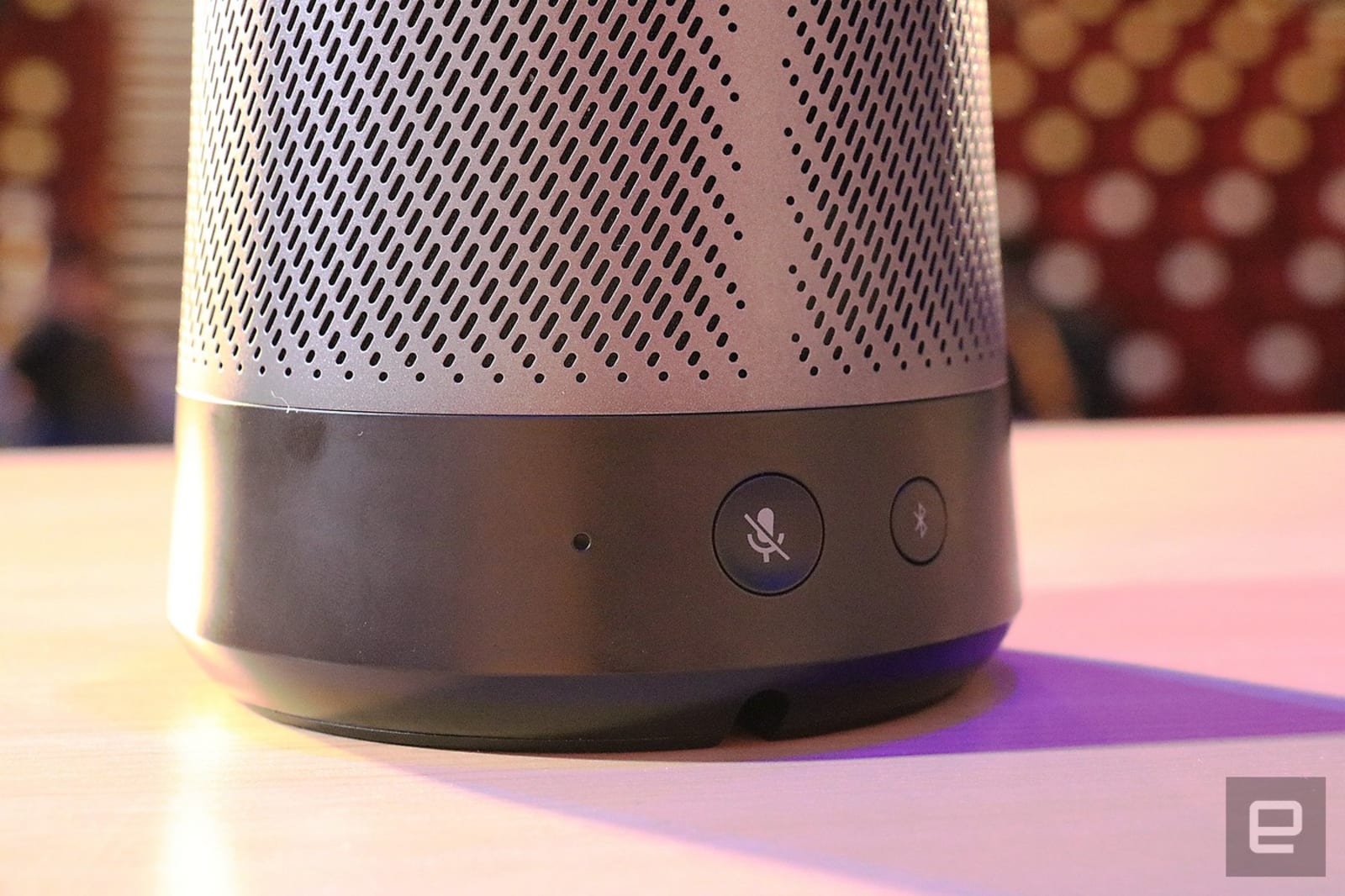
There’s a touch-sensitive area at the top, as well as a frosted display that shows you when Cortana is listening and the volume level. That top portion also houses the seven far-field microphone array, which lets the speaker hear you no matter where you are in a room. Overall, it’s a pretty streamlined device. There are only two buttons in the back, which let you mute and pair the speaker with Bluetooth devices. There’s also a diagnostic micro-USB port nestled near the power connection (which could be used for upgrading firmware or troubleshooting issues). My only real issue with the speaker is its ridiculously short three-foot power cord. You can easily augment that with an extension cord, but would it have been that hard include something longer?
Under the hood, the Invoke features three tweeters, three woofers and two passive radiators that fill up most of the case. In comparison, the new Echo has just one woofer and tweeter. The Invoke even has more speaker hardware than the Sonos Play 1, which only has a single woofer and tweeter as well. Apple’s forthcoming HomePod, meanwhile, has four small tweeters and a woofer. I’ll admit, it’s tough to compare speakers when you’re just looking at what they’re made of. What’s more important is how they sound, and this speaker sounds great.
In use

Devindra Hardawar/Engadget
To set up the Invoke, you’ll need Cortana’s iPhone or Android app. Alternatively, you can use a Windows 10 PC. The speaker shows up as a device in Cortana’s settings, and it takes just a few seconds to connect to it. After that, all you need to do is say “Hey Cortana” and start issuing commands. You could ask about the current weather, the latest news, or for directions. For the latter, it’ll read off basic navigation instructions and send a copy to the Cortana app on your phone. These are all things Cortana has been able to do for years on PCs and smartphones, but having it available in a standalone speaker is quite useful.
I started out testing the Invoke by doing just about everything I do with my Amazon Echo. It played New York City’s NPR station from TuneIn when I asked it to “Play WNYC.” And it had no trouble relaying the weather when I asked. (That might sound dull, but it’s something I end up asking my Echo several times a day.)
The Invoke’s biggest weakness at this point is the limited selection of audio streaming services that Cortana works with. So far, the list includes, Spotify, Tunein, and iHeartradio. There’s no Pandora support yet, which is a big disappointment considering this is being positioned as a music-first device. Still, Microsoft says it’s in talks to sort that out. The company also intends to work with other services like Soundcloud and Deezer, but it’s unclear when we’ll see those available on the Invoke. In Spotify, the speaker found my Discover Weekly playlist when I asked for it, and it also easily played music from specific artists and albums. It’s also a Spotify Connect device, meaning you can control what the Invoke is playing from any of the service’s apps, either on your computer or mobile.
I’ve mentioned this already, but it’s worth repeating: The Invoke sounds fantastic. Music from every genre sounded immersive, with detailed mid-range, crisp highs and some decent low-end thump. It can easily fill a room — but more than that, it does so in a way that’s enjoyable. It sounds more like a decent bookshelf speaker than a mere smart gadget. The better sound quality also makes radio shows and podcasts sound more natural. The Invoke simply blows the original Amazon Echo away. I haven’t tested out the new model yet, though, which is supposed to sound better.
I’ve listened to the Echo daily for years, and generally I’ve found it good enough for casual listening, but that’s it. The difference between Amazon’s speaker and Harman Kardon’s is readily apparent when you switch between the two back and forth (which is pretty easy using Spotify Connect). With Flying Lotus’s tracks in particular, the difference between the two is stark. The Invoke’s audio is much richer and nuanced, while the Echo sounds cheap and flat by comparison.
Cortana’s voice also sounds much more natural than Alexa at this point. When I asked her to tell stories and jokes, it was difficult to notice that I was listening to something completely artificial, and not lines read by her voice artist. Alexa is getting steadily better, but it still sounds vaguely robotic.
Amazon’s voice assistant wins out when it comes to controlling smart home devices, though. Cortana works with Wink, Nest, Smartthings and Hue, but it doesn’t integrate with devices from Sonos or Logitech’s Harmony platform like Alexa does. I was also disappointed at how unreliable Cortana was when it connected to my Philips Hue smart lights. At first, it had no problem turning lights on and off, or changing scene colors. Several hours later, though, it stopped working entirely. Resetting my Hue Hub and all of my settings didn’t help; it’s as if Cortana got into a fight with Philips and refused to talk to my lights anymore. I’ll chalk this up to growing pains for now, but I hope Microsoft irons out these issues soon.

Devindra Hardawar/Engadget
Since Amazon has had a head start in the smart speaker arena, it’s managed to get developers aboard faster. Altogether, they’ve built more than 20,000 Alexa skills. Microsoft only opened up Cortana’s Skills API in May, and it launched with just 46. That number is growing, but it has a long way to go before it catches up to Alexa.
One unique feature the Invoke offers is Skype calling. You can call other Skype users directly, along with normal phone numbers in your contacts and local businesses. When I asked it to call my friend, it found the appropriate contact and dialed the number without issue. He was able to hear me clearly, but he noted that it sounded like a speakerphone. The Invoke also comes with unlimited Skype phone calling, so you don’t have to worry about buying credit to make domestic calls.
While you can make calls to other Alexa users with an Echo, that’s not nearly as convenient as ringing a normal phone. Amazon’s Echo Connect changes that a bit, but it requires a landline. Unfortunately, while you can pair your devices with the Invoke over Bluetooth for music playback, you can’t use it as a speakerphone when it’s connected to your smartphone. (But that’s something the Echo can’t do either.)
Pricing and the competition

The Invoke’s $199 price puts it at twice the price of the new Echo, and $50 more than the smart home hub-equipped Echo Plus. It’s also significantly more than the $129 Google Home. Still, it’s cheaper than Apple’s $349 HomePod, which is also aiming for high-quality sound.
Really, though, your choice with all of these smart speakers really comes down to which ecosystem you want to be a part of. If you want something that works with the most services possible, than Amazon’s Echo line makes more sense. Android fanatics might be better off with Google Home and its integration with that company’s virtual assistant. Logically, you can assume the Invoke works best for Windows users. And while that’s true, it’s also a compelling option for anyone who values music quality. With Cortana available on iOS and Android, you don’t need a Windows PC to take advantage of this speaker.
Wrap-up

The Invoke is great piece of hardware hamstrung by Cortana’s fledgling ecosystem. It could get better over time, but most consumers would likely be better off with a competing smart speaker that might not sound as good, but can do much more. But if Cortana catches up and the Invoke’s price goes down, it could end up being a truly compelling smart speaker for music lovers.
Facebook Messenger lets you send cash to friends with PayPal
Messenger started making it easier to pay your friends for dinner back in 2015 when it introduced the option to transfer money in-app with a credit or debit card. If PayPal has always been more convenient, though, you’ll love this collaboration: Facebook and the payment service have teamed up to give you a new way to split the bill. You can access the feature the same way you’d pay with a card. Simply tap the blue plus icon and then tap the green Payments button to bring up the two existing options.
If you’d previously set up the feature to pay using your card, just tap the Change button and choose Paypal to connect your account with Messenger. The feature is now live on iOS and will soon be available on Android. Unfortunately, you can only use it if you’re in the US — everyone else will just have to find other ways to spend their PayPal balance.
Plex for Android Auto simplifies server-based music streaming
In-car entertainment will have to step up to accommodate our automated driving future. With an AI at the wheel, we’ll be free to watch movies, play games, and conduct video calls. It’s easy to imagine an all-round media player, like Plex, fitting into that scenario. For now, it’s making its way into regular cars, courtesy of Android Auto. Google’s in-car operating system is currently available in newer vehicles, head units, and as a mobile app. And, the next time you reach for its interface, you’ll have the option to stream your Plex music library. Okay, so that’s not the same as watching a 4K HDR flick, but it will have to suffice while your eyes are still needed on the road.
But, what if you already use the the Spotify app for Android Auto? Well, Plex is all about personalization. If you’ve somehow managed to amass a music library in the streaming era, and meticulously curated it into playlists, then this is a fine way to get it into your car. Plex supports virtually any file format (from AAC to FLAC), plus you’ll have access to playlists (including “recently played,” and “recently added”), and voice controls. With the latter, you can just bark ‘play Humble by Kendrick Lamar on Plex’ to get things started. You can even say self-explanatory things like ‘next song,’ ‘pause’ or ‘resume music,’ ‘play some music,’ or ‘play rock music.’
And, there’s the little extras that complete the experience, like the album artwork getting draped across the head unit and app interface. Plex for Android Auto will be available in supported vehicles and aftermarket stereos (and on the Android Auto app) over the coming days.
Source: Plex
Spotify Debuts Up-And-Coming Artist Spotlight ‘RISE’ With Features Similar to Apple Music’s Up Next
Spotify is expanding its music streaming service today with a new section of the mobile app and desktop site called RISE, which is “designed to identify and break the next wave of music superstars.” Spotify said that each artist highlighted in RISE will be showcased through multi-tiered marketing and editorial programming, including within the app itself and promotion on social media.
Additionally, RISE artists will receive special, mixed-media playlists for users to listen to, as well as personalized behind-the-scenes audio and video content to share their stories. In the future, Spotify will host “experimental” live events focused on its RISE stars, following in the footsteps of its first live festival in the United Kingdom last month.
Instead of just one artist, RISE will focus on four musicians every few months, each one representing a different genre. To start, there will be pop singer Kim Petras, pop/rock artist Lauv, country singer Russell Dickerson, and hip hop artist Trippie Redd.
RISE will first debut to Spotify users in the United States, Canada, and the United Kingdom, and Spotify said its goal is to support a total of 16 up-and-coming artists every calendar year.
By harnessing its unmatched cultural influence and 140+ million music fans, Spotify will launch these artists of exceptional talent into the world through a dynamic combination of multi-tiered marketing and editorial programming on Spotify.
“Spotify is committed to supporting the careers of artists of every level, including the next generation of global superstars” said Troy Carter, Spotify’s Global Head of Creator Services. “RISE is a powerful platform and an investment towards the future of emerging artists and the fans who discovered them first.”
Spotify’s new RISE program is very similar to Apple Music Up Next, which showcases an artist on the rise every month. Apple’s feature launched in April and normally includes episodic video content detailing the artist’s personal journey, a live performance, and an interview with one of the Beats 1 radio hosts. The Up Next page also includes the artist’s featured songs and albums, as well as playlists related to their work.

In terms of subscribers, Spotify’s last reported count hit 60 million paid subscribers at the end of July, and the service has over 140 million total users when accounting for its free tier. Last month, Apple Music executive Jimmy Iovine gave an interview to Billboard and mentioned that Apple’s streaming music service grew from 27 million paid subscribers in June to “well over” 30 million in September.
Tag: Spotify
Discuss this article in our forums
Sonnet Launches Thunderbolt 3 to Dual HDMI 2.0 Adapter Compatible With Mac
Sonnet Technologies this week launched a Thunderbolt 3 to dual HDMI 2.0 adapter compatible with Mac and Windows PCs.
The plug-and-play adapter enables the connection of up to two 4K Ultra HD displays with HDMI 2.0 to a single Thunderbolt 3 port at 60Hz on computers such as the 2016 and later MacBook Pro.
The adapter is powered by the computer it is plugged into and also supports monitors with lower resolutions such as 1920×1080 and 1920×1200.
The adapter is available now for a suggested price of around $90 in the United States on Sonnet’s website and Amazon. By comparison, StarTech and Plugable currently sell equivalent adapters on Amazon for around $110 and $90 respectively.
Tags: Thunderbolt 3, Sonnet, HDMI
Discuss this article in our forums
The Morning After: Friday, October 20th 2017
Hey, good morning! You look fabulous.
Good morning! Lyft got a big boost from Alphabet, and we’re ready to help you find a great phone for cheap, or figure out if you need a GoPro Hero 6.
Panos Panay explains what he learned from the first Surface Book.The Surface Book 2’s secret weapon is ceramic

Now that the Surface Book 2 has been revealed, we can dig into how and why it has certain changes from the first model. According to Microsoft’s VP of devices Panos Panay, “We redesigned the connection mechanism, we went to ceramics, we lightened the whole product,” in the name of stability. Another issue is reliability, after some of the glitches owners experienced last time. Now, Panay tells us that dealing with those issues created a closer connection with Intel, and a better understanding of how they’re straining the CPU, GPU and hinge components.
You could have an iPhone X or four of these.The best phones under $250

High-end flagship phones are tantalizing, but what about mobile devices for those of us on a budget? If you’re willing to give up features like OLED screens and super-sized storage, there are some deals to be had that will still run all of your favorite apps without a problem. Cherlynn Low explains why you should give choices like the Moto G5S Plus, Nokia 6 and others another look.
It’s what’s inside that counts.GoPro Hero 6 review

According to James Trew, the Hero 6 is an upgrade in important ways. As he puts it, “Voice control and other auxiliary features are nice, but it’s good ol’ photography that really matters, and there’s enough improvement here that I think it warrants the upgrade.” The only question remaining is if it’s worth the extra $100, but you should check out some sample pictures before making a final decision.
Play the post-‘RotJ’ timeline from the Empire’s perspective.‘Star Wars Battlefront II’ turns the Empire into an unlikely protagonist

We spent 90 minutes in Iden Versio’s Imperial Squad boots, to find out what this sequel has to offer in its single-player campaign.
For everyone, even the haters and the losers.‘The Daily Show’ library of Trump’s tweets opens in Chicago today

Back in June, we covered The Daily Show’s presidential Twitter library in New York. After all, the frequency at which our Commander in Chief takes to Twitter is surely to become a part of his legacy. The library is now moving to Chicago, and you can see it this weekend only. It’s free and open to the public from 10 AM to 10 PM CT through Sunday. The library is in the Burlington Room at Chicago’s Union Station.
But wait, there’s more…
- Google’s parent company leads a $1 billion investment in Lyft
- Google Play lets you test drive Android apps before installing them with Instant Apps
- Google and Microsoft troll each other over software vulnerabilities
- New definitions will be recommended for the ampere, the kilogram, the kelvin, and the mole
- Volkswagen is building an AWD electric supercar to tackle Pike’s Peak
- Huawei is already a smartphone giant, but making it big in America won’t be easy
The Morning After is a new daily newsletter from Engadget designed to help you fight off FOMO. Who knows what you’ll miss if you don’t subscribe.
Warriors, Cavaliers owners buy into ‘League of Legends’ series
As eSports has grown into the arena-filling behemoth it is today, traditional sports has been clamouring for a stake. Talent has been snapped up, tournaments established, and multi-million dollar investments made. The trend looks set to continue with news that two of the NBA’s biggest rivals are jumping on the competitive gaming bandwagon. ESPN is reporting that the Cleveland Cavaliers have nabbed a spot in the North American League of Legends Championship (LCS).
They join the Golden State Warriors, whose owner Joe Lacob (along with son Kirk) splurged $13 million on an LCS franchise last week. That’s the asking price for a new spot in the championship, whereas existing teams must fork out $10 million. And, if the latest reports are to be believed, FlyQuest (the team backed by Milwaukee Bucks co-owner Wes Edens) will be shelling out that sum for a permanent place in the LCS next year.
It may sound like the NBA is taking over, but it’s left room for others to squeeze into. On Thursday, the New York Yankees acquired a stake in Echo Fox, the eSports franchise owned by NBA alum Rick Fox. The deal forms part of a bigger partnership with Vision eSports, giving the Yankees a stake in an “ecosystem” of eSports properties, including a stats company and a content production outfit. On the flip side, the investment should help toward Echo Fox’s franchise fee too.
The Yankees have announced a new partnership with Vision Esports to help create and manage an “ecosystem” of esports properties. pic.twitter.com/gARezbFVtL
— New York Yankees (@Yankees) October 19, 2017
Source: ESPN (1), (2), New York Yankees (Twitter)
Designing the technology of ‘Blade Runner 2049’
This article contains spoilers for ‘Blade Runner 2049’
There’s a scene in Blade Runner 2049 that takes place in a morgue. K, an android “replicant” played by Ryan Gosling, waits patiently while a member of the Los Angeles Police Department inspects a skeleton. The technician sits at a machine with a dial, twisting it back and forth to move an overhead camera. There are two screens, positioned vertically, that show the bony remains with a light turquoise tinge. Only parts of the image are in focus, however. The rest is fuzzy and indistinct, as if someone smudged the lens and never bothered to wipe it clean.
Before leaving the room, K asks if he can take a closer look. The blade runner — someone whose task it is to hunt older replicants — dances over the controls, hunting for a clue. As he zooms in, the screen changes in a circular motion, as if a series of lenses or projector slides are falling into place. Before long, K finds what he’s looking for: A serial code, suggesting the skeleton was a replicant built by the now defunct Tyrell Corporation.
Throughout the movie, K visits a laboratory where artificial memories are made; an LAPD facility where replicant code, or DNA, is stored on vast pieces of ticker tape; and a vault, deep inside the headquarters of a private company, that stores the results of replicant detection ‘Voight-Kampff’ tests. In each scene, technology or machinery is used as a plot device to push the larger narrative forward. Almost all of these screens were crafted, at least in part, by a company called Territory Studios.
The London-based outfit is known for developing on-set graphics. These are screens, or visuals, that the actor can see and, depending on the scene, physically interact with during a shoot. They have the potential to raise an actor’s performance while creating interesting shadows and reflections on camera. Each one also gives the director more freedom in the editing room. If you have a screen on set, you can shoot a scene from multiple angles and freely compare them during the edit. The alternative — tailoring bespoke graphics for specific shots — is a time-consuming process if the director suddenly decides to change perspective in a scene.
Territory has worked on a bevy of science-fiction films including Ex Machina, The Martian and Guardians of the Galaxy. One of its earliest and most prolific projects was Prometheus, the divisive Alien prequel directed by Ridley Scott in 2012. The team was hired to design the computers and screens inside the titular spaceship, which is ultimately overrun by an alien virus. The bridge, the medical area, the ship’s escape pods — Territory designed them all. In post, the company also handled the crew’s hypersleep chambers, medical tablets and the HUD system that wraps around their POV helmet-cam feeds.
During the project, Territory worked with Paul Inglis, the film’s senior art director, and Arthur Max, the production designer. Years later, David Sheldon-Hicks, co-founder and creative director at Territory, was talking on the phone with Max about Alien: Covenant. Instead, Max suggested that he reach out to Inglis about Blade Runner 2049. “So I dropped him an email,” Sheldon-Hicks recalled, “and said, ‘If you’re on the project I think you’re on, I will give you my right arm to put us on there.’” Inglis laughed and told him that unfortunately, Territory would have to go through a three-way bid for the contract.
It was a big moment. The original Blade Runner is considered by many to be the greatest sci-fi film ever released. Directed by Scott in 1982, it stars Harrison Ford, fresh off The Empire Strikes Back, as retired police officer Rick Deckard. He’s forced to resume his role as a blade runner, tracking down a group of replicants who have fled to Earth from their lives off-world.
Blade Runner is a beautiful noir film filled with rain and neon lights. Based on the Philip K. Dick novel Do Androids Dream of Electric Sleep, it explores some heavy themes, such as what it means to be human, the importance of memories and how our obsession with technology could lead to societal and environmental decay. Critics had mixed reactions upon its release, but over time, the film’s reputation has grown to the point where it’s now considered a classic.
Blade Runner 2049 was, therefore, a huge creative gamble. Territory was awarded the contract in March 2016, before director Denis Villeneuve had released his award-winning sci-fi movie Arrival. The French Canadian was highly regarded, however, for his work on Prisoners, Enemy and Sicario. He had proven his ability to make powerful, thoughtful and visually stunning movies. Still, the stakes were enormous. So much time had passed since the original Blade Runner, and so many movies had riffed or expanded upon its ideas. To succeed, Blade Runner 2049 would need to be something special.

Peter Eszenyi was Territory’s creative lead on Blade Runner 2049. He joined the company in 2011 to help Sheldon-Hicks with some idents for Virgin Atlantic’s in-flight entertainment system. Eszenyi quickly moved on to movies, however, helping the team create computer screens, drone footage and satellite imagery for the 2012 political thriller Zero Dark Thirty. He’s since worked on Guardians of the Galaxy, Marvel’s Avengers: Age of Ultron and the live-action adaptation of Ghost in the Shell, to name just a few.
 Peter Eszenyi, Territory Studio’s creative lead on Blade Runner 2049.
The company’s work on Blade Runner 2049 started with a few cryptic calls. They were “terribly hard,” Eszenyi recalled, because the film’s producers were so secretive about the project. Territory was given a vague list of screens, or sets, that the studio thought they could help with. One line just read “K Spinner,” for instance. But when Eszenyi asked for more information, the answer would always be the same: “No” or “We can’t tell you.” Despite the lack of information, Territory started working on mood boards, trusting that some eventual feedback would steer them in the right direction.
Inside the company, Eszenyi and Sheldon-Hicks were joined by creative director Andrew Popplestone, producer Genevieve McMahon and motion designer Ryan Rafferty-Phelan. (The team would scale up to 10 during the project, but these five were the core.) Together, they started looking for inspiration. The film’s producers had given them one critical detail about the world: a massive, cataclysmic event had occurred since the previous film, wiping out most forms of modern technology. Blade Runner 2049 would still feature computers and screens, however. It was, therefore, Territory’s job to help figure out what that meant and what everything would look like.
Inspiration came from all sorts of places. “It might be something you see in a shop window,” Popplestone said. “You might be walking around here and see a piece of furniture that’s made out of glass, or a sculpture, something like that.” The team found a lot, unsurprisingly, online. They scoured Pinterest and other sites for interesting sculptures and photography. Slowly, they curated their images into themes, or ideas, that could be organized as Pinterest boards. The team would then get together and chat face-to-face, discussing their ideas before breaking off and pulling together more reference points.
“I vividly remember debating bacteria,” Eszenyi said. “‘Can they use certain types of bacteria to create green colors. Or blue ones?” They thought about jellyfish that often wash ashore and turn everything a startling shade of blue. Could they be harnessed somehow to create a primitive color display? How would that work? At one point they were imagining bacteria that could be genetically engineered to change color. They thought about computers that could excite them to trigger a color-switch, thereby altering the image. But then there was the screen. “Would this display be fast enough to be usable?” Eszenyi asked. “Or would it be a slow-changing kind of thing?”

A month later, four of the Territory team visited Budapest, Hungary, where most of Blade Runner 2049 was being shot. For Eszenyi, it was a surreal experience. He grew up in Hungary and remembers watching Blade Runner in secondary school. In particular, he recalled the sweeping, electronic score by Vangelis and his literature teacher gushing over the ending with replicant Roy Batty, played by Rutger Hauer.
 David Sheldon-Hicks, co-founder and creative director at Territory Studios.
With mood boards in hand, the Territory team were guided through studio security and into a meeting room with a table and a TV at the far end. It was completely empty, so the group started chatting amongst themselves. Then, suddenly, people started shuffling in. “We didn’t realise that, one, we’d meet Denis, or that he’d be there,” Popplestone recalled, “and, two, that it was going to be the entire visual effects team, and the producers as well.” Ten or 12 people in total took a seat. Then they all turned and looked at Popplestone. “So I was like, ‘Okay then!,’” he recalled. “Here’s what we’ve got…”
But the team needn’t have worried. Denis was warm but direct with his feedback. If something caught his eye, he would probe Territory about its meaning and how the group might develop the idea further. “It was always, ‘I like *this* because of *this*,’” Eszenyi said. “What would you want to do with this? Where do you want to take it from here?” Some concepts he dismissed immediately, however. Eszenyi, for instance, liked an artist who had drawn illustrations for the Soviet-era space program. Beautiful illustrations of quiet, analog vessels from the 1970s and ’80s. But they didn’t match up with Villeneuve’s vision.
The director disliked anything that felt too modern or sophisticated. If you could imagine it in a Marvel movie, for instance, he wasn’t interested. But if it looked optical, like a microscope or a projector, he took notice. Glass, lenses and harsh lighting. Villeneuve also leaned toward nature; images that felt organic and abstract. “The whole point of the story is that we don’t have digital-based technology,” Popplestone said. “So he wanted something that was completely removed from that.”
Before heading home, Territory visited the art department on set. The team was also given permission to step inside production designer Dennis Gassner’s room, which was filled with concept art and storyboards. At last, the group felt like they had a good grasp of the movie and the world Villeneuve was trying to build.

Back in England, Territory refined its ideas. At its Farringdon office, the team experimented with physical props and filming techniques. They tried shooting through a projector to see how different lenses would warp the final image. The group took macro photographs of fruit, including a half-eaten grape that someone had left in the office. Eszenyi even looked at photogrammetry, a technique that uses multiple photographs and specialized algorithms to build 3D models. It’s been used before to recreate real-life locations, such as Mount Everest, in VR and video games.
 Territory Studios’ creative director Andrew Popplestone.
“It was almost like being back at university again,” Popplestone said. The group operated like art students, experimenting with techniques that might produce abstract images or textures. A meeting room was eventually dedicated to the project, which the film’s producers had code-named Triboro. “We just gave up on meetings,” Sheldon-Hicks said. “The project took priority.”
Eszenyi also became quite friendly with his local butcher. An assortment of “meat-based stuff,” including pig’s eyes started to gather in the office fridge, much to Sheldon-Hicks’ displeasure. “I was like, ‘Seriously, I’m getting takeaway for the next few weeks. I’m not going in there. It’s horrible,’” he recalled with a chuckle.
Blade Runner 2049 was challenging because it required Territory to think about complete systems. They were envisioning not only screens, but the machines and parts that would made them work.
With this in mind, the team considered a range of alternate display technologies. They included e-ink screens, which use tiny microcapsules filled with positive and negatively charged particles, and microfiche sheets, an old analog format used by libraries and other archival institutions to preserve old paper documents. When the group was ready to present its new ideas, it was Inglis, rather than Villeneuve, that looked everything over and provided feedback. Inglis was working closely with the director and was, therefore, familiar with his ideas and preferences.

Slowly, Territory narrowed its focus. The team started shaping its abstract ideas into assets, or screens, that could be formally presented to Inglis and the rest of the film’s producers. Around this time, the studio gained proper access to the art department and received a full breakdown of the work that needed to be completed. The team switched to Adobe Photoshop and Illustrator for its designs, applying animation in After Effects and professional 3D modelling software Cinema 4D.
“As soon as anything got too clean, or too fine, it was instantly going down the wrong direction,” Popplestone said. The team created and curated libraries of textures and optical, line-based layers inspired by its real-world experiments. Distortion, warping and other artificial techniques were used to give the screens a grubby but beautiful look.
Territory was eventually given permission to read the script. The team had to fly to Hungary, however, to skim through the pages in an isolation chamber. “I had roughly half an hour to read the script,” Eszenyi recalled. As such, he only had a rough idea of how the different sets and story sequences fitted together. Back in London, the team would constantly ask each other what they remembered from their brief time with the script. Thankfully, Inglis was always available to confirm anything they had forgotten.
“He was the arbiter of all information,” Popplestone said.

Near the end of the film, Deckard is handcuffed and bundled into a large spinner, which the team calls the Limo. It’s owned by Wallace Corporation and is, therefore, a luxurious vehicle. Up front, barely in shot, you can see the pilot and a few screens with monochromatic designs. They’re simple, sophisticated screens, conveying information with minimal dots and triangles.
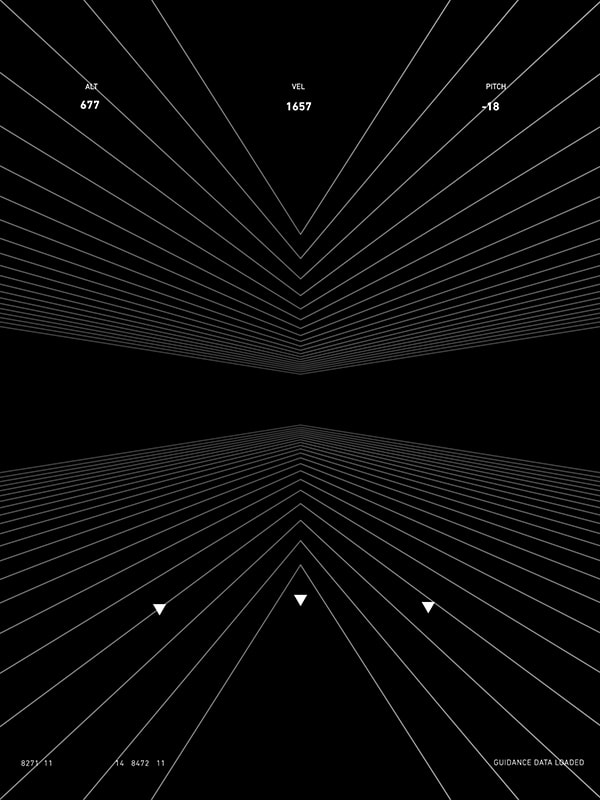
That same design language can be seen inside the rest of the Wallace Corporation. It’s a sparse but immediately recognisable look. Territory’s goal was to build something that felt like Wallace’s own, personalized operating system. So specialized, in fact, that Wallace wouldn’t require the usual labels and iconography found on mass-market platforms like Windows and MacOS. It was designed for him, and is, therefore, supposed to be an extension of his tastes.
Wallace’s employees, of course, aren’t Wallace. So the implication is that everyone inside the company is using an operating system designed for someone else. “It speaks of corporate arrogance and confidence,” Sheldon-Hicks said. “And a power that is beyond needing to worry about the masses.”
The LAPD is a little different. K reports to Lieutenant Joshi, played by Robin Wright. The monitors in her office are chunky and the screens have a blue tinge to them. They’re functional and better than what most of the public has access to, but a far cry from what Wallace Corporation uses. It’s a reflection of how law enforcement and emergency services are run currently. The UK’s National Health Service, for instance, still uses Windows XP. Police often have to wait to acquire new technology for their department.
Layering that context into screen designs can be tricky. The technology had to look outdated for 2049, but given the time period, also relatively futuristic. “It’s old technology compared to Wallace,” Popplestone explained, “but it’s still advanced for us. So we had to make it look modern and more advanced than what we’ve got, yet still somehow slightly knackered and dilapidated.”
Territory also had to be mindful of the original film and the off-screen events that Villeneuve had envisioned between 2019 and 2049. It was a relatively straightforward task; the sheer length of time and the cataclysmic event (partly explored in the Black Out 22 short by Shinichiro Watanabe) meant there was little the team had to reference or honor. That was by design. Villeneuve wanted a world “reset,” so everyone on the project could freely explore new ideas. The film has Spinners, rain-soaked cities, and Deckard’s iconic blaster, but otherwise there’s little in the way of technological tissue.
“It was a completely clean slate,” Eszenyi said.
Almost every screen Territory produced serves a specific purpose in the story. They help K uncover a new clue, or learn something interesting about another character. But each one also says something more about the world of Blade Runner 2049. What’s common or unusual for people in different jobs and social classes. They hint at the state of the economy, the rate of innovation and how the development of artificial intelligence — replicant and otherwise — is affecting people’s relationships and behavior with technology.
“It’s a much more subtle, contextual narrative,” Popplestone said.

Take the market. Partway through the movie K stands in the middle of a square, contemplating a series of photos. The film is focused on these images, but in the background you can see large, illuminated food adverts. They’re square in shape, doubling as buttons that dispense orders like a giant gumball machine. Up above, animated banners advertise Coca-Cola and other food and drink products. It’s one of the few times Territory designed graphics that didn’t have a specific story function. They’re still a point of interest, however, providing a rare look at how people live in this future version of Los Angeles.
Territory also had to think about how its screens would look in relation to the camera. Some were filmed up close, while others were only visible in the background. It was important, therefore, that designs were readable at different distances. To test this, the team constantly squashed and scaled up its graphics to see what they would look like on screen. “Does it have the detail to have a close lens on it? And can you go wide, and blur it out, and still read it?” Sheldon-Hicks said.

When a computer or machine is shown on film, it needs to be believable. Sometimes, a static display will do. But others require animation and multiple screens, or loops, to be chained together. Early in the movie, for instance, K steps into his personal Spinner. The screens lining the dashboard change as a call from Joshi comes in, and K scans the eyeball of a replicant he was hunting earlier. These are subtle, but necessary transitions to sell the idea that the vehicle is real.

Every shot was different, but generally Territory provided screens with an initial state, an action state, and then a looping state. Some screens had additional action states, if they were required to pull off a particular sequence. The different states were then triggered by actors or production staff on cue.
Territory could, in theory, design and code full-blown applications. But for a movie like Blade Runner, that would be a costly and time-consuming process. After all, a screen is largely redundant once the scene has been shot. There are also the practicalities of shooting a movie. An actor’s focus is already split between the lights, the camera, the lines they need to remember, and the positioning of other cast members. If a screen or prop isn’t simple, it could affect their focus and the overall quality of the performance.
Territory’s graphics also have to serve the dialogue, changing with a certain rhythm or when particular lines are delivered. When Luv was looking for K’s location, for instance, there needed to be a search tool, followed by a map that clearly showed his whereabouts. In the real world, you would probably get the following confirmation or prompt in Google Maps: “by The Cosmopolitan, did you mean…?” In a film, however, where pacing is critical, these intermediary screens are unnecessary and detract from the film’s entertainment value.
“There are these push and pull factors of narrative versus reality,” Sheldon-Hicks said. “You don’t want to completely break away from reality. So we’re always treading this line, or threading this needle on set in quite a tricky way.”

Territory sent Rafferty-Phelan to Hungary to provide support while the movie was being filmed. There, he could answer questions and make last-minute changes required by Villeneuve or anyone else on set. These are normally small: sometimes the lighting is different than the team expected, or the director asks if some text can be adjusted. If the edits are minor, they can often be done on location by a member of the Territory team, avoiding difficult delays in shooting or expensive tweaks in post.
For Sheldon-Hicks, there’s another reason to send his employees out on location. They’re building a relationship with the director, who might want to work with them again in the future. It’s also an opportunity for the company to collaborate and learn from some of the best creative talents in the industry. “It’s like free training for me,” he said. “I’m being paid to send my team out and see how Scott or Villeneuve tells a story. Of course I’m going to send them out.” The more talented and experienced Territory becomes, the more likely it is to win contracts in the future.

Territory strives to deliver screens that can be shot with a camera on set. But there’s always a chance something will need to be changed in post. Some films require extensive reshoots long after Territory has wrapped up its work on set. Other times, the film requires a particular look, or flourish, that simply isn’t possible with current technology. Every project is different. On The Martian, for instance, Scott was able to shoot almost everything in camera. “The whole thing just went through in lens, done,” Sheldon-Hicks recalls. Ex Machina, directed by Alex Garland, was the same.
Territory has been hired in the past to work on films, such as Ghost in the Shell, while they were in post-production. That means delivering concepts or assets that can be added to the movie after shooting has wrapped. With Blade Runner 2049, however, the company’s work was finished once the cameras had stopped rolling. The team provided some resources so that other companies could tweak their work in post, but otherwise, its work was done.
Handing over control can be difficult, but it’s all part of the filmmaking process. “There’s just nothing you can do about it,” Sheldon-Hicks said. “You know that they’re all working to make the work better, and you don’t want your graphics to look beautiful but be in a movie that sucks. So we all kind of accept that.”
Eszenyi is “pretty sure” that parts of the morgue sequence were changed in post. It was a highly choreographed scene, with multiple props and screens, so the odds of a post-shot tweak were higher than other scenes in the movie. Still, it gave the actors real, visual cues to act off, and a basis for the graphical adjustment in post. So it’s not like Territory’s efforts were wasted. Even so, the team felt a mixture of emotions when they watched the first trailer in December last year. “It’s like, yeah, that’s my kid,” Eszenyi explained, “but she’s not two years old anymore, she’s 18.”
Blade Runner 2049 is a beautiful movie. The gloom of downtown Los Angeles and the harsh, radioactive wasteland of Las Vegas clash with the design decadence of Wallace Corp and the steely cold of K’s apartment. The film’s visual prowess can and should be attributed to cinematographer Roger Deakins and everyone who worked on the sets, costumes and visual effects. Territory’s contributions can’t be understated, however. By blurring the line between technological fantasy and reality, the team has made it easier to believe in a world filled bioengineered androids. Which is pretty cool for any fan of science fiction cinema.

Images: Alcon Entertainment (Blade Runner 2049); Nick Summers (photography)
 AIVAnet