


Adobe’s ‘Cloak’ experiment is a content-aware eraser for video
Glamorous show-reels from shows like Game of Thrones get all the fame, but a lot of VFX work is mundane stuff like removing cars, power lines and people from shots. Adobe’s research team is working on making all of that easier for anyone, regardless of budget, thanks to a project called “Cloak.” It’s much the same as “content-aware fill” for Photoshop, letting you select and then delete unwanted elements, with the software intelligently filling in the background. Cloak does the same thing to moving video, though, which is a significantly bigger challenge.
Engadget got an early look at the tech, including a video demonstration and chance to talk with Adobe research engineer Geoffrey Oxholm and Victoria Nece, product manager for video graphics and VFX. At the moment, the technology is in the experimental stages, with no set plans to implement it. However, Adobe likes to give the public “Sneaks” at some of its projects as a way to generate interest and market features internally to teams.
An example of that would be last year’s slightly alarming “VoCo” tech that lets you Photoshop voiceovers or podcasts. That has yet to make it into a product, but one that did is “Smartpic” which eventually became part of Adobe’s Experience Manager.
The “Cloak” tech wouldn’t just benefit Hollywood — it could be useful to every video producer. You could make a freeway look empty by removing all the cars, cut out people to get a pristine nature shot, or delete, say, your drunk uncle from a wedding shot. Another fun example: When I worked as a compositer in another life, I had to replace the potato salad in a shot with macaroni, which was a highly tedious process.

Object removal will also be indispensable for VR, AR, and other types of new video tech. “With 360 degree video, the removal of objects, the crew and the camera rig becomes virtually mandatory,” Nece told Engadget.
Content-aware fill on photos is no easy task in the first place, because the computer has to figure out what was behind the deleted object based on the pixels around it. Video increases the degree of difficulty, because you have to track any moving objects you want to erase. On top of that, the fill has to look the same from frame to frame or it will be a glitchy mess. “It’s a fascinating problem,” Oxholm said. “Everything is moving, so even if you nail one frame, you have to be consistent.”
Luckily, video does have one advantage over photos. “The saving grace is that we can see behind the thing we want to remove,” says Oxholm. “If you’ve got a microphone to remove, you can see behind the microphone.” In other words, if you’re doing shot of a church with a pole in the way, there’s a good chance you have a different angle with a clean view of the church.
With 360 degree video, the removal of objects, the crew and the camera rig becomes virtually mandatory.
Perhaps the one thing making content-aware fill for video much more feasible now is the fact that motion-tracking technology has become so good. “We can do really dense tracking, using parts of the scene as they become visible,” said Oxholm. “That gives you something you can use to fill in.”
The results so far, as shown in the video above, are quite promising. The system was able to erase cars from a freeway interchange, did a decent job of deleting a pole in front of a cathedral and even erased a hiking couple from a cave scene. The shots were done automatically in “one quick process,” Oxholm said, after a mask was first drawn around the object to be removed — much as you do with Photoshop.
It’s not totally perfect, however. Shadow traces are visible on the cave floor, and the cathedral is blurred in spots where the pole used to be. Even at this early stage, though, the tool could do much of the grunt-work, making it easier for a human user to do the final touch-ups. I’d love to see Adobe release it in preview as soon as possible, even if it’s not perfect, as it looks like it could be a major time saver — I sure could’ve used it for that macaroni.
The best phones under $250
The iPhone X: $999. The Galaxy Note 8: $930. Even the more affordable Google Pixel 2 commands a significant investment of $650. Today’s flagship phones are expensive enough that spending a significant chunk of your rent on a handset is seemingly the norm. You can opt for an installment plan to pay it off more easily, and for some people it’s worth paying a service provider for two years to own one of the best devices available. But many other people can’t afford, or would prefer not, to spend that much money on something they’ll replace in two years (or less). Fortunately for the budget-conscious, you can find a better selection of phones for $250 than you could even a few years ago.
What to expect
Before we get into the best phones at this price, let’s talk expectations. First off, many of the devices we’re discussing come unlocked, so it’s imperative that you check to see if they’ll work on your carrier before you buy one. Many unlocked handsets are only GSM-compatible, so they’ll support only AT&T, T-Mobile and their subsidiaries. Sprint and Verizon customers should be especially careful when making their selections.
At this price, you’re not going to get high-end features like face-recognition cameras, curved screens or high-res, edge-to-edge displays. Most of these phones use older chipsets and often run Android 6 Marshmallow instead of the newer Android 7 Nougat (which itself is no longer the latest OS).
For daily use, you won’t really notice a difference in speed with these phones, but don’t expect much if you’re using these for heavy-duty gaming or intensive multitasking. If that’s going to be a problem, you’re better off getting a flagship phone on an equipment installment plan (EIP) instead.
Flagships on a budget
You can still get a premium phone for cheap if you have the time and patience to monitor deal listings. Some carriers and websites slash prices for older (but still perfectly respectable) phones in anticipation of new launches or when approaching the holiday season. If you can wait till Black Friday, you’ll probably find plenty of deals bringing down the cost of usually expensive phones. In 2016, T-Mobile offered the iPhone 7, the Galaxy S7 and the LG V20 for free to people who traded in eligible smartphones, while Huawei’s Honor 8 dropped that year from $400 to $300. Right now, you can even find an iPhone SE ($399 at launch) for less than $250, or the older (but still good) HTC One M8 for $160. A Google search for “iPhone SE” returns options as low as $150 at Target for an AT&T version in space gray with 16GB of storage.
Affordable by design
If you weren’t fast enough to snag one of those deals, you still have decent options. Bright, crisp screens with full HD (1080p) displays are common at this price, so don’t fall for cheap phones with piddly 720p panels. Sub-$250 phones run the gamut when it comes to size, too, so you can pick from a big 5.5-inch screen down to a more compact 4.7-inch option. Many budget handsets also pack fingerprint sensors, long-lasting batteries, and dual cameras for special effects in portrait photography (although these tend to pale in comparison with iPhones and Samsung phones when it comes to quality).
The best budget phones
Motorola Moto G5S Plus

One of the best offerings is the $230 Moto G5S Plus. It’s the successor to the Moto G5 Plus, which was already our favorite budget phone. The new handset features a 5.5-inch 1080p display, dual rear 13-megapixel cameras and a generous 3,000mAh battery, all wrapped in a body that feels more expensive than it actually is. The phone uses an octa-core Snapdragon 625 chip that can go up to 2.0GHz, which is powerful enough for the average person and quite good for the price. It also runs the relatively new Android 7.1 Nougat and works on all four major US carriers. The main downside is the absence of NFC support, so if you like using your phone for contactless payments, this isn’t going to work for you.
Nokia 6

In that case, you can consider the $230 Nokia 6, which has NFC and runs the same version of Android as the G5S Plus. It features dual front-facing speakers with a “smart amplifier” and Dolby audio enhancements for louder sound. The Nokia 6 sports a single 16-megapixel camera on its rear, though, and uses a slower Snapdragon 430 processor. Also, it’s unfortunately stuck in the past with its micro-USB charging port. That’s a minor complaint, but when the rest of the world has already moved on to USB-C, it feels like an antiquated feature. Still, the Nokia 6 offers newish components for a reasonable price, and if you don’t mind getting Amazon ads on your lock screen, the Prime exclusive version of the phone is even cheaper, at $180.
Alcatel Idol 5s
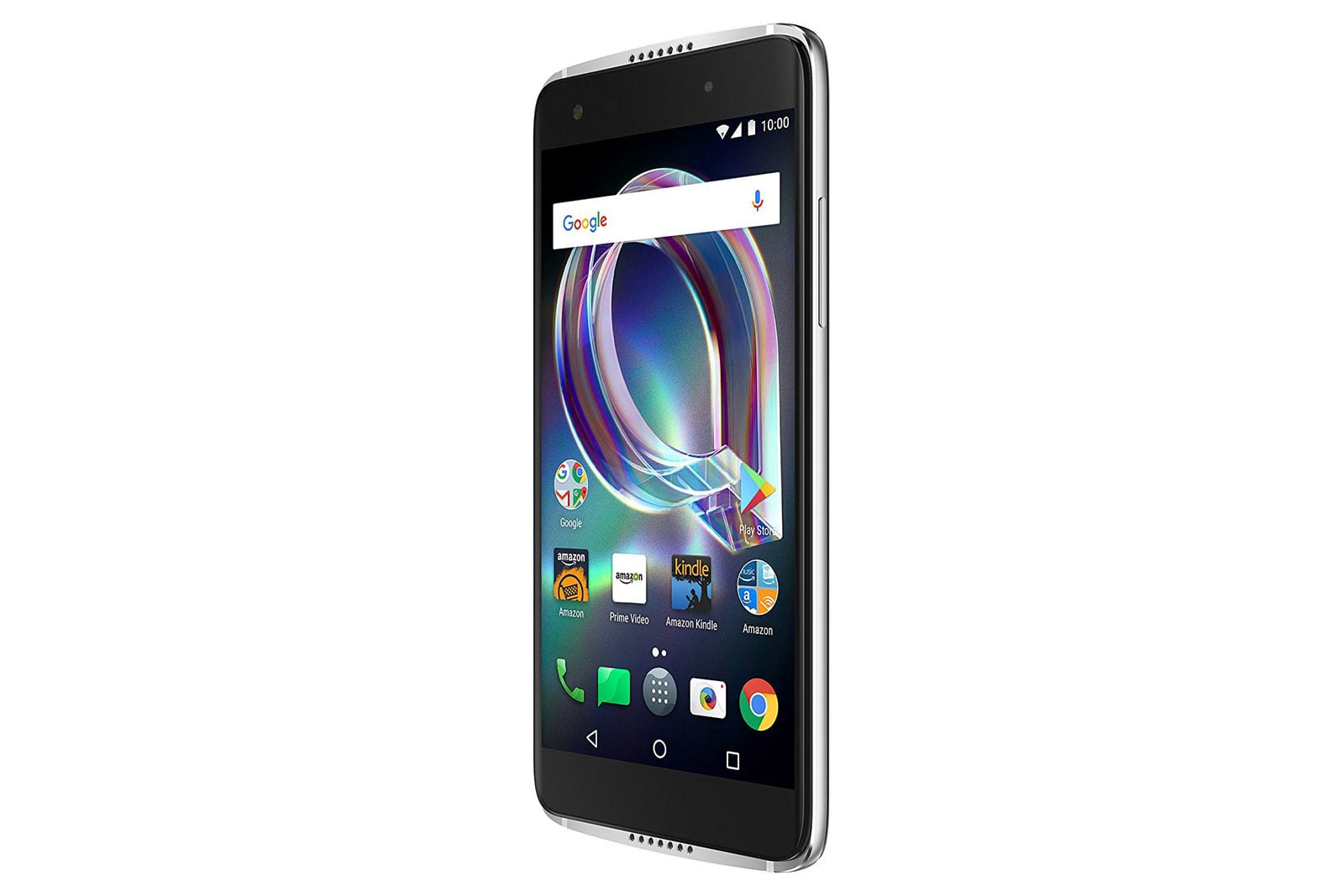
Also available as a Prime exclusive is the Alcatel Idol 5s ($200 with ads; $280 without), which has a vibrant 5.2-inch, a 1080p screen and a USB-C port and runs Android 7. Like the Nokia 6, the Idol 5s has only a single 12-megapixel rear camera, but it uses the faster Snapdragon 625 processor (the same chip used in the Moto G5S Plus). Alcatel’s handset has a smaller battery than the Nokia 6 and the G5S Plus, though, so you might need to charge it more often. The Idol 5s looks and feels like a lot of Alcatel’s previous handsets, with a rounded silhouette, chrome edges and a glass rear. Despite a slightly dated design, the Idol line is known for its good quality and affordable prices. Plus, this is one of the few budget phones to support all four major US carriers while packing a well-rounded feature set.
ZTE Blade V8 Pro

The ZTE Blade V8 Pro is a compelling option. It sports a 5.5-inch 1080p display and dual 13-megapixel rear cameras that enable Portrait mode for bokeh on your photos, although you won’t get iPhone-quality images here. The Blade V8 Pro isn’t as adept at detecting outlines when applying the blur, but in ideal conditions it pulls off the effect well. I liked the phone’s sturdy build when I tried it out in January, but it’s not as pretty as the other options on this list. The V8 Pro is equipped with the same Snapdragon 625 chip as the Moto G5S Plus and the Idol 5s, but it runs the older Android 6 Marshmallow instead. It does support NFC, though, making it one of the few on this list to do so and a good option for people who don’t want to give up Android Pay.
Runners-up
Huawei Honor 6x

There are several other options in this space, but we’ll cap off this roundup with two quick mentions. Huawei’s Honor 6x is very similar to the ZTE Blade V8 Pro: It has dual cameras, runs Android 6.0 and features a 5.5-inch full HD display. But it doesn’t support NFC and it costs $20 more. Also, Huawei’s EMUI Android skin makes the software look cartoonish, despite adding useful fingerprint sensor shortcuts. The main reason to spend more for this phone over the Blade V8 Pro would be the Honor’s more elegant metal body.
ZTE Blade ZMax
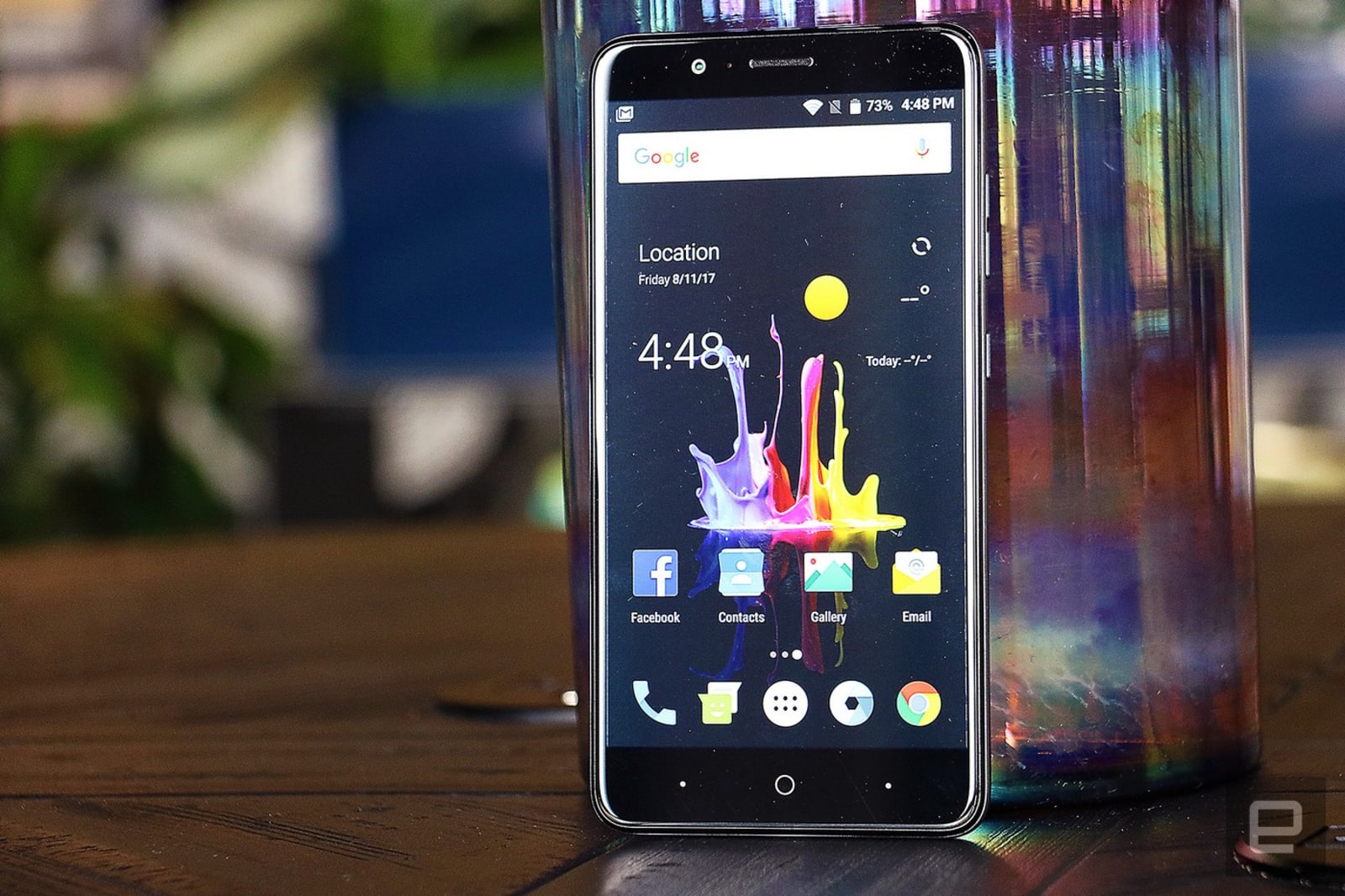
Finally, those who want a big screen at this price should consider ZTE’s Blade line of affordable large phones. In particular, the Blade ZMax sports a 6-inch full HD display, dual cameras and a large 4,080mAh battery for $129. It’s also impressively slim for such a large phone and was easy to use with one hand during a brief demo. Some caveats: It uses a relatively slower octa-core Snapdragon 435 CPU and is available only via MetroPCS for now, but we expect it to be sold unlocked soon as well.
Final thoughts
With all the improvements trickling down from high-end flagships to today’s budget phones, shopping for a sub-$250 device no longer feels like digging through a bargain bin of iPhone rejects. They won’t be the fastest or have the best cameras, but the options in this category are respectable handsets with relatively modern features. If you have a bit more cash to spare, you’ll find even better phones in the sub-$500 category that are nearly on par with flagships in terms of performance. We’ll be putting together those recommendations soon, so stay tuned.
Smart Lock Maker August Home Acquired by Major Lock Manufacturer Assa Abloy
Smart lock company August Home has been acquired by Swedish lock manufacturer Assa Abloy, the world’s largest lock manufacturer by sales volume and owner of Yale and multiple other lock brands. As is customary, the acquisition is “conditional upon regulatory approval,” but Assa Abloy mentioned in its press release that it should close sometime during the fourth quarter of 2017. Any further terms of the deal have not yet been disclosed.
According to Assa Abloy executives, the company’s interest in August Home comes from its ability to “strengthen” and “reinforce” Assa Abloy’s position in the residential smart door market. The acquisition will also fuel the Swedish company’s expansion into video doorbells and home delivery solutions.
“I am very pleased to welcome August into the ASSA ABLOY Group. August constitutes a strategic addition to the Group and reinforces our position in the residential smart door market,” says Johan Molin, President and CEO of ASSA ABLOY.
“August Home strengthens our residential smart door strategy with complementary smart locks, expansion into video doorbells and comprehensive solutions for home delivery,” says Thanasis Molokotos, Executive Vice President of ASSA ABLOY and Head of the Americas Division.
Speaking with TechCrunch, August Home confirmed that co-founder Jason Johnson will remain CEO of the San Francisco-based company following the acquisition. Additionally, August Home will keep its existing brand, but now operate under the Americas division of Assa Abloy.
The latest product launched by August Home was the $199 Doorbell Cam Pro, which has a full-color HD camera and microphone for two-way audio and one-way video, allowing home owners to see and talk to visitors even when they aren’t home. Otherwise, the company is well known for its smart lock devices, most recently including the August Smart Lock Pro that launched in September with HomeKit support.
Tags: August Smart Lock, August
Discuss this article in our forums
Rite Aid’s Website Now Accepts Apple Pay in Safari on Mac, iPhone, and iPad
Rite Aid today announced that it now accepts Apple Pay as a payment method on its desktop and mobile website.
iPhone, iPad, and Mac users accessing RiteAid.com through the Safari web browser will now see a “Buy with Apple Pay” option at checkout alongside existing credit card and PayPal payment options.
Rite Aid said it is the first pharmacy retailer to accept Apple Pay as a form of payment on the web, with nearly 12,000 items available in its online store.
Apple Pay on the web is a convenient and secure option for online payments, eliminating the need to repeatedly fill out account, shipping, and billing information for a more seamless checkout experience.
Checking out with Apple Pay on the web requires a Mac, iPhone, or iPad with Touch ID and Safari for macOS Sierra or iOS 10 or later.
Rite Aid began accepting Apple Pay at 4,600 of its retail stores across the United States in August 2015, nearly one year after the drug store chain initially disabled support for the mobile payments service nationwide.
At the time, Rite-Aid was a member of the Merchant Customer Exchange, a consortium of retailers that planned to launch their own mobile payments service called CurrentC, which was postponed indefinitely last year.
Related Roundup: Apple PayTags: Safari, Rite Aid
Discuss this article in our forums
The way scientific units are calculated is changing
Scientific units are set to receive their biggest shake-up since the inception of the modern metric system in 1960. The International Bureau of Weights and Measures (BIPM) — one of three committees that oversees this type of stuff — is presently looking into revising the ampere, the kilogram, the kelvin, and the mole. The higher-ups at the General Conference on Weights and Measures will then conduct a final vote on the recommendations next year, before ordering them into effect in May 2019. Although it may not impact everyday measurements, the redefinition is crucial for scientists, who require the utmost accuracy for their work.
Ever pondered the precision of the international system of units (SI)? (Why should you? You’re not going to be called on to measure the temperature in the Large Hadron Collider any time soon). You may be in need of a refresher, then. The kilogram is defined as the lump of platinum-iridium locked in a vault in Paris. The artefact is known to fluctuate in weight (due to surface contamination), making it tricky to define its exact mass.
But, it made the cut for its inclusion in the broader redefinition of units with the acceptance of the so-called watt balance method in 2015. This approach essentially compares mechanical power with electromagnetic power using two methods — which measure speed as well as experimental values relating the voltage and current in Planck’s constant.
An ampere (the base unit of electric current, often shortened to “amp”) is presently defined by an imaginary experiment involving the force between two infinite wires. In the near future, the unit could be measured using an electron pump. Meanwhile, the mole is the unit for the amount of substance in a system with as many elementary entities as there are atoms in 0.012 kilograms of carbon-12. In just a couple of years, it could be defined using the silicon sphere (the device that gives scientists Avogadro’s constant).
Finally, the Kelvin — the base unit for temperature — relates to little more than water: The triple point of water to be exact. The redefinition would rely on the Boltzmann constant, which scientists measured using a dielectric-constant gas thermometer. By grounding the SI on an invariable foundation of constants, scientists should be able to pin down their definitions for good. Roll on, 2019.
Source: BIPM
Google’s AlphaGo AI no longer requires human input to master Go
Google’s AlphaGo already beat us puny humans to become the best at the Chinese board game of Go. Now, it’s done with humans altogether. DeepMind, the Alphabet subsidiary behind the artificial intelligence, just announced AlphaGo Zero. The latest iteration of the computer program is the most advanced yet, outperforming all previous versions. It’s also different from its predecessors in one uniquely significant way: Whereas the older AlphaGos trained in Go from thousands of human amateur and professional games, Zero foregoes the need for human insight altogether. Like the unpopular kid in class, it will learn simply by playing alone, and against itself.
What sounds like a sad, lonesome existence, is already paying dividends. Zero whitewashed the previous (champion-beating) version of Go by 100 games to nil. That victory came after just three days of training. After 40 days of internal Go playing, it beat the Master version (the same program that triumphed over world number one Ke Jie in May) 89-11 — making it “arguably the strongest Go player in history.”
There are other technical elements that define the new AI, which you can dig into courtesy of DeepMind’s paper, published in the scientific journal Nature. But removing the “constraints of human knowledge” has been the most liberating factor, according to the company’s CEO Demis Hassabis.
In doing so, DeepMind is even closer to decoding one of the biggest hurdles facing AI: The reliance on vast amounts of data training. Whether this approach will work outside the confines of a strategic board game, however, remains to be seen. DeepMind, at least, believes it could have far-reaching implications. “If similar techniques can be applied to other structured problems, such as protein folding, reducing energy consumption or searching for revolutionary new materials, the resulting breakthroughs have the potential to positively impact society,” writes the company in its blog post.
Source: DeepMind, Nature
Twitter took a year to close a fake GOP account run by Russians
The Russian troll farm that bought ads pointing to fake news sites on Facebook also ran a fake Twitter account impersonating the Tennessee Republican Party. While it has now been permanently suspended, Buzzfeed says the platform refused to take the account down for months even though the real party reported it thrice for impersonation since 2016. @TEN_GOP gained a huge following that reached 136,000 followers between November 15th to August this year just before Twitter finally yanked it offline.
Within that timeframe, the account consistently tweeted out pro-Trump, anti-Obama, anti-Clinton, anti-mainstream media and anti-Islam sentiments. The account is now gone, but we looked through some of the snapshots Wayback Machine saved to give you a taste of what it used to tweet:

As you would expect from the same people who bought fake news ads on Facebook, the account also dealt in falsehoods. According to Buzzfeed, it tweeted a photo of a Cleveland Cavaliers NBA championship parade and claimed it was a crowd waiting to hear Trump speak. @TEN_GOP’s real identity was first unearthed by Russian’s RBC News as part of a report that details its country’s efforts to influence politics in the US.
Tennessee Republican Party’s communications director showed her emails dated September 17th, 2016, March 1st, 2017 and August 14th, 2017 to Buzzfeed reporting the fake account. While Twitter took way too long to take action, something might have happened in between the reports, since @TEN_GOP changed its description from “I love God, I Love my Country” to one that says it’s the “Unofficial Twitter of Tennessee Republicans.” We reached out to Twitter for a statement, but don’t hold your breath: the company already refused to talk to Buzzfeed.
Source: Buzzfeed
Scoot is adding battery-swapping cars to its San Francisco lineup
If you spend any time in San Francisco you’ll see them. The red electric scooters with a white lighting bolt and the word “Scoot” plastered on the side of the cargo box. Scoot, the company behind these ubiquitous two-wheeled vehicles has been able to litter the city with over 700 of these bikes that can be picked up and dropped off via an app almost anywhere within the city. Now, the short-term rental company is eyeing cars.
According to Scoot founder and CEO Michael Keating, the electric scooter rental service has been used by almost 50,000 users since it launched in 2012. An impressive number, but as pointed out by Keating, not everyone is comfortable braving the perilous streets of San Francisco on two wheels. With that in mind, he announced a partnership with Chinese automotive startup CHJ to bring the automaker’s yet-to-be-released small electric car with swappable batteries to San Francisco.
The goal of the two companies is to recreate the scooter model with a small EV. Riders would find and reserve one of these SEV (small electric vehicles) via the Scoot app, get inside and drive it to their destination, then just leave the car on the street for the next Scoot customer. That sounds great, but it’s not allowed in San Francisco which is why the two companies invited the city council and policy makers to an event in the city’s Dogpatch district.
At the center of the shindig was the CHJ electric vehicle (which will be sold under the company name AmpGo) . A car roughly the length of a Mercedes Smart Fortwo but less than half the width. Small electric cars are nothing new, but the yet-to-be-named SEV has swappable batteries in the trunk that can be replaced in about a minute. That’s what makes it suitable for a floating rental service. If the car never has to be plugged into a wall, maintenance crews can just drive around and swap out batteries, and the vehicle is good to go. “We want to bring affordable electric transportation to every San Francisco neighborhood without needing more charging stations,” Keating said.
The biggest obstacle isn’t technology (the SEV is built to be part of a service like Scoot from its small size to it’s Linux/Android-powered infotainment system that talks to the cloud), it’s San Francisco regulations and lack of parking. In 2012, BMW launched DriveNow a service similar to Car2Go. The cars could be booked for one-way trips but the vehicles had to be parked in dedicated parking lots and the city just couldn’t deliver those spaces. So in 2015, BMW left and later rebranded the service ReachNow and relaunched in Seattle.

Scoot and CHJ are hoping that the small footprint of the SEV (four to five can be parked sideways in a typical parking space), its battery-swapping technology and Scoot’s history of delivering a one-way rental service in San Francisco will sway city officials. But that may prove difficult as the area has experienced an increase in traffic with, according to research by the Northeastern University and San Francisco’s Transit Authority, services like Uber and Lyft account for up to 20 percent of the vehicles on city roads. Adding another car service to the already congested roads could be difficult.
Keating notes this and hopes that adding Scoot’s car-rental service to complement the transportation options already available in the city could convince some residents to give up their gas-powered cars for something that’s more convenient and ultimately cleaner. The California DMV reports that there are over 413,000 privately owned cars in San Francisco according to 2016 registrations. Of those only 5,000 are electric.
The CEO also noted that ride-hailing systems like Uber and Lyft need a complimentary low-cost alternative for when someone needs to get to a destination quicker than public transportation can take them. He said that the SEV would cost slightly more than the $3 per half-hour the company charges for the scooters on the network. Anyone that’s used a ride-hailing services (which have rates that fluctuate wildly based on demand) knows that’s a deal.
So it’s an uphill battle, but Keating seems determined that it’ll happen. At the end of his presentation, he announced that Scoot and CHJ had come to an agreement to import as many of the small SEVs to San Francisco as the city would allow. That puts San Francisco on the spot to make a decision about how it works with companies like Scoot. It also puts a lot of pressure on a single tiny car.
Unfortunately, Scoot and CHJ would not allow any photos of the vehicle. Yet, even though we only have a few out of focus glimpses of the vehicle in the photos provided by the companies, I was able to take it for a spin. Well, a circle, I was able to drive it around some cocktail tables in a room.

It was far from a true test of the car’s capabilities, but I was impressed that all the top-line features (touch-screen dash, transmission, rear-view camera, brakes, doors) seemed ready to hit the road. One feature that really impressed me was that the company had installed two buttons on one of the small rear flares that allowed the driver to get out of the car and back it up or move it forward with these controls. This is how the car can be arranged four (or five) across in a typical parking spot.
At the end of the evening I was shown the power packs. Two 3.2kWh batteries that work in tandem to keep the car on the road up to 30 miles. It reminded me of Gogoro’s electric scooter. A new way to charge without loitering around a station. Scoot and CHJ are hoping that these two boxes and the car they go in won’t have them waiting around for the city as it tries to figure out if this unlikely partnership will help it reduce congestion while cutting emissions.
Apple Watch Series 3 Facing LTE Setbacks in China, Likely Due to Government ‘Security Concerns’
The cellular capabilities of the Apple Watch Series 3 remain unavailable to new carrier plan subscribers in China, after having been “abruptly cut off…without explanation” just one week after the device’s launch in September. A new report published today by The Wall Street Journal has looked into the LTE setbacks faced by the Apple Watch in the country, which is predicted to face ongoing issues over the next couple of months.
Originally, Apple Watch Series 3 models on launch were supported by the carrier China Unicom, but on September 28 — almost one week after the September 22 launch — Unicom cut off new LTE subscriptions for the device. Those who had signed up for a subscription prior to that date remain unaffected, but now anyone trying to sign up for LTE on their Apple Watch are unable to do so. Unicom said on its website that the feature had been available “on a trial basis” and didn’t specify when it might resume.
But in China, the feature was abruptly cut off for new subscribers, without explanation, after a brief availability with one telecom company.
Industry analysts say the suspension likely stemmed from Chinese government security concerns to do with tracking users of the device, which uses different technology than standard mobile phones.
On the Apple Watch Series 3 cellular support site, all Chinese carriers — China Mobile, China Telecom, and China Unicom — now say “coming later this year.” Previously, Unicom specified the following: “Cellular service available only for mobile lines opened in Guangdong, Henan, Hunan, Shanghai, and Tianjin.” A few days after September 28, Apple updated the page with the new reference to support later in 2017.
Industry analysts cited “security concerns” likely raised by the government in China related to tracking wearers of Apple’s device. Because the Apple Watch uses different technology than standard smartphones, China’s strict regulation policies can’t simply be outfitted for the new LTE product.
Specifically, analysts believe the problem lies in China’s user identification system. When users purchase a smartphone in the country, they register for a SIM card under their real names with a network carrier. But, the Apple Watch contains a tiny embedded SIM card (eSIM), which is placed in the device by Apple, not carriers. Analysts believe this raises questions of “how carriers and regulators can track the device user’s identity,” because the eSIM “isn’t mature enough yet in China.”
The benefit of a device carrying an eSIM is that, with software, users can choose a telecom operator and a communications plan. But in China, that new system raises the question of how carriers and regulators can track the device user’s identity.
“The eSIM (system) isn’t mature enough yet in China,” one analyst said. “The government still needs to figure out how they can control the eSIM.”
Now, officials at China’s Ministry of Industry and Information Technology are said to be studying how to resolve the issue before granting any broad cellular access to the Apple Watch. This process, according to analysts, “could take months.”
The Apple Watch LTE roadblock is the latest problem faced by Apple in China, after last year facing the shutdown of the iBooks and iTunes stores due to the release of a controversial independent movie. Over the summer, Apple then removed the majority of VPN apps from the App Store in China, following regulations passed earlier in the year that require such apps to be authorized by the Chinese government.
Related Roundups: Apple Watch, watchOS 4Tag: ChinaBuyer’s Guide: Apple Watch (Buy Now)
Discuss this article in our forums
iPhone 8 and 8 Plus Production Will Reportedly Drop Nearly 50% When iPhone X Launches
Apple has reportedly asked its suppliers to reduce iPhone 8 and iPhone 8 Plus production by nearly 50 percent in November and December, according to Reuters, which cited China’s Economic Daily News.
The report quotes an unnamed source who claims it is the first time in the iPhone’s history that new models face a major cutback so shortly after mass production began. iPhone 8 and iPhone 8 Plus officially went on sale September 22.
Apple shares declined around 1.5 percent in pre-market trading as investors reacted to concerns about low sales of the devices.
Apple hasn’t revealed iPhone 8 and iPhone 8 Plus sales numbers. The company will report its fourth quarter earnings results on November 2, including iPhone sales, but it doesn’t break out the number on a model-by-model basis.
Even if iPhone 8 and iPhone 8 Plus sales have in fact been lower than expected, it could be a sign of pent up demand for the upcoming iPhone X.
With an OLED display, nearly 82 percent screen-to-body ratio, and a TrueDepth camera system powering 3D facial recognition features like Face ID and Animoji, the iPhone X is unlike any other smartphone Apple has ever sold.
Apple analysts are patiently waiting to see how many customers are holding out to purchase the flagship smartphone when pre-orders begin October 27. iPhone X officially launches November 3, starting at $999 in the United States.
Related Roundups: iPhone 8, iPhone XTag: udn.comBuyer’s Guide: iPhone (Buy Now)
Discuss this article in our forums
 AIVAnet