


Google’s refined Security Checkup identifies account vulnerabilities
While Google might soon switch VIPs over to advanced protection in the form of physical keys, the rest of us are fine with typical security practices — so long as we follow them. To better secure your Google account, the company has a new version of its Security Checkup feature that points out vulnerabilities. Instead of needing to run through the same generic checklist of questions, the tool will instead identify weak areas in your account setup and bring them to your attention.
None of the security suggestions (removing certain extensions, for example, or enabling 2-step verification) are new, and it still uses green checks marking safe setup and yellow/red checks denoting areas that need fixing. Only the personalized system is new, but hey, any time not spent glossing over what you’ve already correctly set up is more mental bandwidth to make your account less vulnerable. Visit the Security Checkup page to see the updated version.
Via: TechCrunch
Source: Google blog
New Car Buyers Increasingly Interested in Apple CarPlay
CarPlay is becoming an increasingly important feature that consumers look for when purchasing a vehicle, according to a new report released today by Strategy Analytics.
In a survey querying future car buyers about their interest in Android Auto, CarPlay, and Baidu CarLife in the United States, Western Europe, and China, Strategy Analytics discovered the majority of consumers are interested in CarPlay.
In the United States, 23 percent of respondents said CarPlay was a “must have” feature, while 56 percent said they were “interested.” Just 21 percent were “not interested.” In Europe and China, the numbers were even higher. 36 percent of respondents said CarPlay was a must have feature in China, and 29 percent said the same in Europe.
No fewer than 30 percent of consumers surveyed said they were willing to pay more for a smartphone mirroring feature like CarPlay or Android Auto, provided it’s offered at a reasonable price point. For existing customers who have access to mirroring systems like CarPlay, they’re often used exclusively over the existing in-car infotainment options. From Strategy Analytics’ Derek Viita, author of the report
“All of our research suggests that consumers will soon be ready to adopt CarPlay and Android Auto for their infotainment needs, which is another round of bad news for embedded navigation suppliers and OEMs that want to sell upgraded navigation systems.” Continued Viita, “It also shows a missed opportunity: OEMs have been including these systems ‘as standard,’ when our research suggests that consumers would actually be willing to pay for them, even to the price of traditional navigation options.”
For the survey, Strategy Analytics queried 1,503 consumers in the United States, 1,607 in Western Europe, and 2,003 in China. To participate, respondents were asked to confirm whether they owned or leased a motor vehicle and a smartphone, and they were only asked about in-car mirroring systems available in their regions and compatible with their smartphones.
Though CarPlay has been available since 2015, car manufacturers didn’t begin widely adopting the feature until mid-2016. CarPlay is now included in many new 2016 and 2017 vehicles from a wide range of car makers like Ford, Cadillac, Honda, Kia, Audi, BMW, Mercedes-Benz, Volkswagen, Fiat-Chrysler, and more.
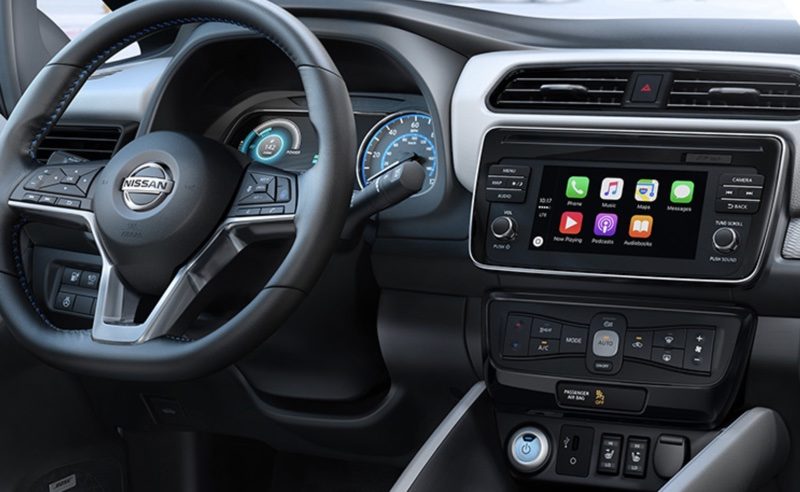 CarPlay in the new Nissan Leaf
More than 200 vehicles include CarPlay support, with Apple offering an official master list of all the CarPlay vehicles available in the United States on its website. CarPlay is also available in many aftermarket infotainment units from companies like Pioneer and Alpine.
Related Roundup: CarPlay
Discuss this article in our forums
Curious what your unborn child might look like? Just spit in this tube
Why it matters to you
If you don’t mind spoilers, this startup claims to be able to clue you in about your unborn kid.
When parents are expecting their first child, at some point during the nine-month waiting process, they naturally start to wonder what combination of traits the kid is likely to receive from each parent. It’s the kind of wonderful mystery that you’ll have to watch unfold in real time; patiently spending each day with the tiny bundle of joy as he or she grows into the person they will eventually become.
Or you could just pay $349 to a company called HumanCode who will tell you the whole thing up front via mobile app!
HumanCode’s creation is something called BabyGlimpse, a DNA-powered service which promises to let couples discover the genetic-related traits their children may inherit. Describing itself as the “brighter side of personal genomics,” BabyGlimpse offers users an at-home collection kit so that both parents can a saliva sample for DNA testing. This saliva sample is then processed at a DNA sequencing lab, before feeding back to you the relevant genomic information pertinent to your offspring.
The result is custom predictions about the various possible traits of your future child, delivered either through an iPhone app or via a secure customer web portal. The information covers ancestral origins, appearance and physical capabilities predictions, likely behavior, sleep quality, dietary requirements, and more.
So how accurate is it, then? “Unfortunately, there is no simple answer,” CEO Christopher Glodé told Digital Trends. “For some traits and users, the predictions can be very accurate, [when] both parents have very well known, high impact, dominant genetic markers. In other cases, we can predict the genetics of the child with high accuracy, but the genes that ‘science’ knows about are not highly impactful yet — or they just have a very low impact on the phenotype, such as trait outcome. In other cases, where there are thousands of genetic markers being evaluated by our neural network and algorithms, we cannot easily accurately predict what genetic markers the child could inherit, so we run simulations and pick the most common outcomes. We always convey probabilities and never certainties.”
In other words, it is probably best to treat it as a bit of fun, particularly when it comes to anything more esoteric than, say, eye color. But as a fun novelty gift for any expectant (geeky) parents in your life? This could definitely hit the spot. So long as they don’t mind spoilers, that is!
NBA augmented reality app lets you be an iPhone Steph Curry anywhere
Why it matters to you
The NBA is the first major sports league to feature its own augmented reality app.
You are not Steph Curry, but now you can shoot like him with your iPhone. On October 16, the NBA augmented reality (AR) app, NBA AR, was released, and it allows you to test your jump shot on a backboard and basketball court no matter where you are.
In NBA AR, once you load the app, you get to choose your the team whose logo you wish to have emblazoned on your augmented court. Then you will be prompted to move your iPhone left and right around the spot you wish to place your court and backboard so the camera can scan your surroundings before plopping some AR hardwood before you. The app suggests playing in a large space with good lighting, including outdoors, but I was able to get some AR court time inside the Digital Trends offices in New York City.
Once the game starts, you have 30 seconds to drain as many jump shots as you can by tapping the screen to have a ball materialize in front of you. You can shoot the ball by simply flicking your phone forward to shoot. Only two-point and three-point shots are counted in the game, but you are free to move around the court, depending on how much space you have in real life. After each game, you are given your score, and prompted with the next game on the schedule of the team you selected.
Augmented reality has started to heat up around the league this year with the Cleveland Cavaliers and Sacramento Kings releasing their own AR apps. “We’ve always said that basketball can be played virtually anywhere – and today that takes on an expanded meaning,” said Melissa Rosenthal Brenner, NBA senior vice president of digital media, in a press release. “Augmented reality presents a variety of fascinating engagement opportunities, so we hope our fans download the app and try out their skills wherever they might be.”
This news comes less than a week before the NBA starts its second season in virtual reality. Starting October 21, the NBA will live-stream 27 regular season games in virtual reality via the NextVR app.
NBA AR is currently exclusive to the iPhone and utilizes the new ARKit technology that Apple debuted earlier this year. The app is available for free on the App Store, and is compatible on iPhone models 6s and later running iOS 11. The NBA has plans to add more experiences to NBA AR later this season, so you might be dunking in augmented reality before Isaiah Thomas plays a single game for the Cleveland Cavaliers.
NBA augmented reality app lets you be an iPhone Steph Curry anywhere
Why it matters to you
The NBA is the first major sports league to feature its own augmented reality app.
You are not Steph Curry, but now you can shoot like him with your iPhone. On October 16, the NBA augmented reality (AR) app, NBA AR, was released, and it allows you to test your jump shot on a backboard and basketball court no matter where you are.
In NBA AR, once you load the app, you get to choose your the team whose logo you wish to have emblazoned on your augmented court. Then you will be prompted to move your iPhone left and right around the spot you wish to place your court and backboard so the camera can scan your surroundings before plopping some AR hardwood before you. The app suggests playing in a large space with good lighting, including outdoors, but I was able to get some AR court time inside the Digital Trends offices in New York City.
Once the game starts, you have 30 seconds to drain as many jump shots as you can by tapping the screen to have a ball materialize in front of you. You can shoot the ball by simply flicking your phone forward to shoot. Only two-point and three-point shots are counted in the game, but you are free to move around the court, depending on how much space you have in real life. After each game, you are given your score, and prompted with the next game on the schedule of the team you selected.
Augmented reality has started to heat up around the league this year with the Cleveland Cavaliers and Sacramento Kings releasing their own AR apps. “We’ve always said that basketball can be played virtually anywhere – and today that takes on an expanded meaning,” said Melissa Rosenthal Brenner, NBA senior vice president of digital media, in a press release. “Augmented reality presents a variety of fascinating engagement opportunities, so we hope our fans download the app and try out their skills wherever they might be.”
This news comes less than a week before the NBA starts its second season in virtual reality. Starting October 21, the NBA will live-stream 27 regular season games in virtual reality via the NextVR app.
NBA AR is currently exclusive to the iPhone and utilizes the new ARKit technology that Apple debuted earlier this year. The app is available for free on the App Store, and is compatible on iPhone models 6s and later running iOS 11. The NBA has plans to add more experiences to NBA AR later this season, so you might be dunking in augmented reality before Isaiah Thomas plays a single game for the Cleveland Cavaliers.
Microsoft Surface Phone rumors and news leaks
Why it matters to you
The latest news from Microsoft spells the end of the Windows Phone OS.
It once seemed inevitable that Microsoft would create a Surface Phone, a handset designed by the same engineering team responsible for the Surface Book and Surface Pro. The company has denied those rumors, but the rumors and leaks have continued, suggesting it’s something the company may still be considering — even if it may not be a product it’s actively developing.
Here’s everything we know so far about the mythical Microsoft Surface Phone.
Microsoft kills Windows Phone, putting the Surface Phone’s future in doubt
After months of speculation, it’s finally official: Microsoft is killing off Windows Phone, the mobile phone operating system that was widely expected to ship on the Surface Phone.
In a tweet on October 8, Joe Belfiore, Microsoft’s head of Windows, wrote that the company would no longer “support the platform [with] new features.”
Of course we’ll continue to support the platform … bug fixes, security updates, etc. But building new features/hw aren’t the focus. https://t.co/0CH9TZdIFu
— Joe Belfiore (@joebelfiore) October 8, 2017
He blamed lack of third-party support on Windows Phone’s demise.
We have tried VERY HARD to incent app devs. Paid money … wrote apps 4 them … but volume of users is too low for most companies to invest. https://t.co/ePsySxR3LB
— Joe Belfiore (@joebelfiore) October 8, 2017
Microsoft isn’t abandoning the Windows Phone platform altogether — a spokesperson told The Telegraph that it would continue to support its current line of Lumia phones and other Windows Phone handsets. But the wind-down in development puts the rumored Surface Phone’s future in doubt.
Microsoft may wait until late 2017 to release Surface Phone
After the Surface Phone failed to make an appearance at Microsoft’s 2016 BUILD conference, two reports from Windows Central quoting sources close to the matter said that Microsoft would wait until “at least” 2017 to release a phone. It also suggested that Microsoft was working on as many as three separate Surface Phone models: A consumer model, a business model, and a high-spec “enthusiast” model.
The Surface Phone’s delay follows statements by Microsoft CEO Satya Nadella in November 2016 that clarify Microsoft’s position on smartphones. Specifically, Nadella indicated that Microsoft does not want to simply compete with the industry leaders with a “me-too” device, but focus its efforts and develop the “ultimate” mobile device.
If one reads between the lines, it would seem that the Surface Phone was intended to be a high-end smartphone aimed at providing very specific value to the business market, serving as a halo device for Microsoft’s long-term mobile strategy.
Microsoft purchased surfacephone.com
If you’re looking for a hint that Microsoft will introduce a Surface Phone sometime in the future, then look no further than one Reddit user’s discovery in late January 2016. It appears that Microsoft owns surfacephone.com, and the company even went as far as redirecting it to the main Surface website.
Before you go jumping for joy, this is far from a confirmation that Microsoft is readying a Surface Phone. Often, companies like to stay out of legal trouble by registering domain names that correlate with a current product.
It’s important to point out, too, that surfacephone.com was actually registered in May 2007, so it’s not like Microsoft recently purchased it to get ready for a new Surface Phone launch.
Furthermore, Microsoft’s Surface page is within microsoft.com as in https://www.microsoft.com/surface/. Microsoft isn’t even using surface.com for its current crop of Surface devices, and so why would the company use surfacephone.com for a Surface Phone if it gets released? Case in point: Microsoft registered surface.com back in 1994.
Rumored change in mobile strategy as Panos Panay takes charge
A report from Windows Central suggests that the Surface phone rumored earlier in the year has been canceled in favor of a new Surface phone being built by the Surface team, led by Microsoft hardware lead Panos Panay.
The phone was previously referred to as the ‘Panos Phone’ according to Windows Central’s sources. Panos Panay is in charge of the team that designed the Surface Pro 4 and Surface Book, meaning we might see a smartphone with a similar design.
Bill Roberson/Digital Trends
Rumors have spread about a Surface phone for years. In a WIRED profile on Microsoft’s Head of Devices Panos Panay last year, it’s mentioned that work was going ahead on “a prototype of a new phone” at Microsoft’s HQ.
Only concepts give us a clue about design
Unfortunately, we have no idea what any Surface Mobile phone will look like, but concept renders were created by Nadir Aslam earlier this year. While the final Surface Mobile phone might not look like these renders, they give a good idea of its possible productivity attributes.
The Surface Phone remains far from official, but we’ll keep you updated here with news and rumors about the device.
Update: Added news that Microsoft has killed the Surface Phone
Google Wifi amps up parental controls with website blocking
Adult sites, begone!
Google Wifi might not have gotten any new hardware at Google’s October 4 event earlier this month, but that’s because it really doesn’t need any. Google Wifi is still an excellent option if you’re in the market for a mesh router system, and a new feature is now rolling out to the device that should make raising kids in the 21st century a whole lot easier.

That new feature is called “Site Blocking”, and it works pretty much how you’d expect. Turning on Site Blocking will allow you to automatically block over eight million website that Google deems to be not appropriate for your kiddos’ eyes, and it does this through the SafeSearch technology (initially created back in 2009 as a way for filtering out adult content within Google Search).
You can use the Google Wifi app to choose which Google account you want Site Blocking turned on for, and once you toggle it on for a certain person, it’ll be active for all of their connected devices. So, no matter if your son or daughter is getting on the Internet with their phone or tablet, their eyes will be deterred from things they shouldn’t be seeing.
Google Wifi already offers a decent selection of parental control settings, and the addition of Site Blocking is one that a lot of parents will likely come to appreciate.
Site Blocking is rolling out now to all Google Wifi devices.
Google Hardware

- Google Wifi review
- Google Home review
- Everything you need to know about the Chromecast Ultra
- Chromecast vs Chromecast Ultra: Which should you buy?
Google Wifi:
Google
Amazon
Google Home:
Google
Best Buy
Chromecast Ultra:
Google
Best Buy
Google Photos now recognizes your pets as people, like it should
This is a good update, Brent.
Google Photos’ growing feature set can be difficult to keep track of at times, but one that continues to impress me even to this day is its ability to recognize people’s faces and automatically organize photos that it knows they’re in. As if this wasn’t already good enough, Google is taking things a step further by identifying your pets in the same exact manner.

With this update, the People section in Google Photos will be updated to “People and Pets” to showcase both your human companions, as well as those that are a bit fluffier. You could previously search for your pets by typing in terms such as “cat” or “dog”, but for those that have multiple pets and want to look at pictures of specific ones, this will make doing so a lot easier.
Your pets will show up alongside people in your Google Photos library, and just like you’ve previously been able to do with humans, you’ll be able to set a profile photo and name for your furry friend so finding them is as easy as can be.
This new addition is rolling out to Google Photos now, and it’s one h*ck of a good update. 13/10.
Google Photos: Everything you need to know!
The tiny SanDisk Ultra Fit has huge storage options for a low price
It’s not the size of the flash drive, it’s what you store on it.
Is this deal for me?
The SanDisk Ultra Fit USB 3.0 flash drive is on sale at Amazon today only. You can get the 32GB for $10.19, 64GB for $15.19, or the 128GB for $27.99.
Except for a sale in early September, that’s the lowest price on every version of this thumb drive since March. This is part of a wider sale on SanDisk products for Amazon’s Gold Box deals of the day. That means there’s some other accessories you might be interested in, but it also means these prices won’t be here tomorrow.

These beautiful little thumb drives are so tiny you won’t even notice them resting in your USB ports. This might be a bad thing if you lose small objects, but it also means you can keep it plugged into your laptop without having to worry about taking it out each and every time you move your computer.
Features include:
- A fast way to move media between your devices
- Read speeds up to 150MB/s
- Write up to 15X faster than standard USB 2.0 drives
- Transfer a full‐length movie in less than 30 seconds
- Keep private files private with included SanDisk SecureAccess software
TL;DR
- What makes this deal worth considering? – The price is the lowest it has been since March, and because this is a one-day sale it’s not going to last much longer.
- Things to know before you buy! – Check out the full SanDisk sale, which covers a lot more than just these adorable flash drives!
See at Amazon
More from Thrifter
- Amazon Prime Student is now available as a $5.49 monthly subscription
- The hottest toys of the upcoming holiday season
For more great deals be sure to check out our friends at Thrifter now!
Honeywell will crowdfund a DIY home security system
In the tech world, Honeywell is a long-established (century-old!) brand known for its appliances and devices, which are just now getting hooked up to Google Home. But its next venture is usually a move made by less-resourced companies and startups. Soon, Honeywell will launch an Indiegogo campaign and ask folks to crowdfund its new product, a home security system you can install yourself.
A DIY home security setup seems intriguing, though details are scarce (we’ve reached out for more information). But it’s a little crazy that a well-resourced company like Honeywell would turn to crowdfunding for its next product. Their reason? Backers provide “very valuable feedback,” a Honeywell spokesperson told The Verge: “We can engage, look for new features, and improve the product based on that first launch via Indiegogo.”
They’re far from the first company to do so: Sony had a line of crowdfunded watches in the past few years, while electronics brand Anker launching a crowdfunding campaign for a soda can-sized bluetooth speaker weeks ago. Heck, even Atari is turning to Indiegogo to jumpstart their Ataribox console soon. Regardless, Honeywell’s mystery campaign goes live on November 1st.
Source: The Verge
 AIVAnet