


Essential Phone receiving update for 40% faster camera performance
Essential is promising 40% faster capture speed, better low-light performance, and more with this latest update.
The Essential Phone has left a lot to be desired since its release last month, but regular software updates have slowly been resolving one of the device’s biggest pain points — its camera. Essential just announced that it’s pushing out a new software update for the device and Essential Camera app, and there are some big promises being made this time around.
For starters, Essential says that this latest update will improve the brightness of photos and the quality of shots taken in low-light scenarios. Low-light performance is definitely one of the Essential Phone’s weaker points when it comes to the camera, so any upgrades here are greatly appreciated.

Along with this, Essential is also promising a 40% faster capture rate for regular and low light photography. That’s a substantial increase, and one that we’re sure many will be thankful to have considering that the Essential Phone’s camera has never been considered a fast performer.
40% faster capture speed should be a substantial improvement.
Essential is also throwing in some improvements for its 360 Camera attachment, including spatial sound when shooting 360-degree footage (supported locally and on Facebook and YouTube), a countdown timer, and the ability to use the volume rocker as a shutter button when you’re in 360 mode.
As for future updates, Essential says that it’s working on adding more HDR upgrades, the ability to livestream in 360 to Facebook and Periscope, filters and animated stills for 360-degree footage, as well as a Portrait and Pro Mode.
The latest software update will change your build number to NMI81C, and once you’ve done that, be sure to update the Essential Camera app through the Play Store to ensure that you’re able to access all of the new goodies that are included here.
Essential Phone
- Essential Phone review: First impressions
- Essential Phone specs
- The latest Essential Phone news
- Join our Essential Phone forums!
Amazon
Best Buy
Sprint
Telus
Google Pixel 2 vs. Samsung Galaxy S8: Let’s argue about bezels

This one’s set up for a serious fight.
When it comes to phone comparisons that people love to get passionate about, looking at the latest offerings from Google and Samsung is about as good as it gets. Google just announced the new Pixel 2, a proper flagship phone with a smaller-than-most display. The Galaxy S8 may have been announced earlier on in 2017, but it’s still the go-to flagship phone today, and with price drops in the last six months it’s gotten even more enticing.
Let’s take a look at the Pixel 2 and Galaxy S8 to see where they’re matched, where they differentiate and which one is best for you.
What’s the same
There’s more shared between these phones than you might think at first glance. Set them side-by-side and you’ll notice they’re actually roughly the same dimensions. The Pixel 2 is a tad shorter, wider and lighter — but when you hold these two together you won’t notice a difference in those terms.
The rising tide of hardware has lifted both phones.
Going inside, these two tick many of the same basic boxes when it comes to the specs. You get a Snapdragon 835 and 4GB of RAM running the show, and for most people getting 64GB of storage with an SD card slot in the Galaxy S8 is about a wash with the 64 or 128GB available out of the box with the Pixel 2. They both have AMOLED displays with high, which is definitely a “thing” some people look for because they just don’t like LCDs — and though their resolutions aren’t the same, they both have plenty high pixel densities. The Pixel 2’s 10% smaller 2700mAh battery is a concern, for sure, but the hope is that the aforementioned 1080p screen resolution helps balance it out.
Both phones are water- and dust-resistant, which is something Google is just now getting to in this generation but any Samsung owner will tell you is a wonderful to have feature. You’ll be able to use either one in the rain and not immediately panic if you drop it in the sink or splash it when you’re at the beach.
With so much of the industry going toward dual cameras (including Samsung on the Note 8), these phones are notably the same when it comes to the overall approach to photography. You’ll find a ~12MP sensor on both, with familiar “dual pixel” auto focus and a fast aperture — f/1.7 for the Galaxy S8, and f/1.8 for the Pixel 2. Google now offers OIS as well, matching Samsung, and while the Galaxy’s electronic stabilization in videos isn’t as good as Google’s it’s there helping smooth things out.
What’s different
Take a look at the Pixel 2 and Galaxy S8 from the front, and you get a real discussion starter. It’s all about the screen bezels here, folks. As noted these phones are almost the same size overall, but the Galaxy S8’s 18.5:9 5.8-inch display is much larger than the Pixel 2’s 16:9 5-incher. Credit to Google keeping the side bezels small … but the top and bottom bezels are quite massive. Functionally, it doesn’t really create many problems on a phone that’s still relatively compact — but people are already screaming over the aesthetics of the whole thing.
Getting less screen for the same size phone rubs some people the wrong way.
But perhaps it’s mostly just the optics of the whole setup. The Pixel 2, releasing at the end of 2017, has a “conventional smartphone” look — and aside from front-facing stereo speakers, there isn’t a whole lot extra to show for it. The Galaxy S8 has all of the same hardware capabilities, plus retaining the headphone jack, all while offering more screen real estate in the same basic overall size. Google showed it could even split the difference nicely with the Pixel 2 XL, which has the same sort of layout as the Galaxy S8 (well, the S8+ at least) but with stereo speakers.
But for many Google phone lovers, there’s a reason to put up with the bezels and somewhat bland design: the software experience. Even with improvements in the past couple generations of the “Samsung Experience” software suite, it just doesn’t match the Pixel 2 when it comes to smooth, consistent and clean daily use. Google’s apps and services are on the whole better than Samsung’s options, and they work even better on a Pixel when they aren’t competing for space with duplicates and imitations.
Bottom line
Landing at about the same price, and well underneath their top-end counterparts, both the Pixel 2 and Galaxy S8 will be on the radar for late-2017 phone buyers. And the great part about this decision is how much they share: the base specs, overall size and core features can be found in both. Which one is right for you comes down to just a few decisions on aesthetics, specific hardware features and feelings about software.
It comes down to screen size and software experience.
The Galaxy S8 is probably the default choice for so many people who are familiar with Samsung phones or are simply drawn in by its beautiful design. There are also legitimate spec and feature reasons to buy the GS8: a larger (and higher resolution) screen in a compact size, a larger battery, wireless charging and an increasingly rare headphone jack.
Anyone drawn to a Pixel 2 from the start probably has a relationship with Google’s software experience and services — and these people won’t be disappointed. There are fewer hardware and spec compromises in this phone than its predecessor, and Google has stepped up its game with things like waterproofing, an even better camera, a better display and more base storage at the same starting price. The choice to go with a Pixel 2 starts and ends with how much you value the clean, simple and hassle-free experience of a phone with one brand on the box: Google.
Google Pixel 2 and Pixel 2 XL
- Google Pixel 2 and 2 XL hands-on: Act two is great
- Google Pixel 2 specs
- Google Pixel 2 vs. Pixel 2 XL: What’s the difference?
- Pixel 2 vs iPhone 8: Camera Showdown
- Pixel 2 FAQ: Everything you need to know!
- Join our Pixel 2 forums
Google Store
Project Fi
Verizon
Samsung Galaxy S8 and S8+
- Galaxy S8 and S8+ review!
- Galaxy S8 and S8+ specs
- Everything you need to know about the Galaxy S8’s cameras
- Get to know Samsung Bixby
- Join our Galaxy S8 forums
Verizon
AT&T
T-Mobile
Sprint
Unlocked
This is BlackBerry Motion, the next TCL-built BlackBerry
BlackBerry Mobile’s next phone won’t have a keyboard, but it will have a huge battery.
According to known leaker Evan Blass, better known as @evleaks, the device formerly known as Krypton will be released as BlackBerry Motion.

The phone has been making its way through certifications and is largely expected to be announced at some point this month based on comments from François Mahieu, head of global sales for TCL. When it comes to specs, here’s what is currently rumored:
- Snapdragon 625 (or newer 626) processor
- Full HD 1920X1080 display
- 4GB of RAM
- 4000mAh Battery
- Home button with built-in fingerprint scanner
- IP67 water and dust-resistant
Needless to say, we’ll have to wait and see how accurate the spec rumors pan out but feel free to let us know in the comments what you think about how it’s shaping up and what you think of the BlackBerry Motion name, everyone always has strong opinions about the names the devices end up with, so let’s hear it.
BlackBerry KEYone
- BlackBerry KEYone review
- KEYone vs. Priv: Battle of the BlackBerry keyboards
- BlackBerry KEYone specs
- The latest KEYone news
- Join the discussion in the forums
Amazon
Best Buy
BlackBerry Mobile
Apple Music tunes are now available inside Facebook Messenger
We’ve known for a while that both Spotify and Apple Music were coming to Facebook Messenger. Spotify was integrated as a chat extension this past August with an AI-powered group playlist feature. Now Apple Music is getting its own presence as the streaming music service has officially launched inside the social network’s Messenger system.
To use the extension, simply tap the plus icon to the left of the chat field and add Apple Music to any conversation. You can also interact directly with the bot in a chat just like you would any other of your friends. Simply search for “Apple Music” from the Messenger home screen and start talking to it to discover new artists and genres. You can even send an emoji to the chatbot and it will suggest a playlist to match. It’s so 2017.
Even if you don’t have an Apple Music subscription, you’ll be able to listen to and share 30-second clips from any track you discover. As you might expect, you can sign up for Apple Music right in Messenger, which will then let you share and listen to full tracks after you commit to monthly payments.
Source: Facebook
YouTube reportedly alters search algorithm after Las Vegas shooting
YouTube has updated its search engine in an effort to promote more authoritative videos, hoping to diminish the reach of conspiracy theories, harmful messages and misinformation on the platform, The Wall Street Journal reports. The changes follow the mass shooting in Las Vegas this week, wherein a gunman killed 58 people and wounded more than 500 others at a music festival on the Strip. After the shooting, videos propagating conspiracy theories and misinformation started climbing the ranks in YouTube’s search results — Google and Facebook faced similar problems this week.
For example, The WSJ says on Tuesday night, the fifth result for “Las Vegas shooting” on YouTube was a video titled, “Proof Las Vegas Shooting Was a FALSE FLAG attack — Shooter on 4th Floor,” a rumor that has been repeatedly refuted by authorities.
YouTube rolled out the changes on Wednesday night, accelerating its existing plans to tweak the search engine. The update targets search results about major news events — including the NFL protests — and is designed to keep inaccurate videos at bay. The company didn’t provide details about how it defines “authoritative” sources, The WSJ says.
Google and Facebook both scrambled to fix their own news algorithms this week after promoting troll threads and false stories about the Las Vegas shooting.
“Unfortunately, early this morning we were briefly surfacing an inaccurate 4chan website in our Search results for a small number of queries,” Google said in a statement. “Within hours, the 4chan story was algorithmically replaced by relevant results. This should not have appeared for any queries, and we’ll continue to make algorithmic improvements to prevent this from happening in the future.”
Source: The Wall Street Journal
Chevy is building a hydrogen fuel-cell transport vehicle for the Army
Chevy’s venture into working with the Army on alternative-fuel vehicles isn’t stopping with the Colorado ZH2. No, the pair are pushing forward with the Silent Utility Rover Universal Superstructure (SURUS) that takes the ZH2’s hydrogen fuel cell power plant and mates it with what Defense One describes as a “flatbed truck trailer or even a railroad flatcar.” The idea behind SURUS — named for Hannibal’s war elephants — is to be an adaptable form of transport that can do anything from carrying injured troops to moving large amounts of cargo like diesel-powered generators in the theater of war.
Of course, the truck can also be outfitted with guns and rockets. Other plans include the potential for remote control or autonomous driving, rather than having a human behind the wheel. The head of GM’s fuel cell division, Charlie Freese, noted how capable SURUS is and that the truck has the potential to reduce the amount of vehicles the Army needs to keep on hand.
And since it’s powered by a near-silent fuel cell engine rather than in internal combustion one, SURUS will be able to travel behind enemy lines with decreased chance of being discovered. “They’re basically able to get 10 times closer without being detected,” Freese said. Unlike the ZH2, this sounds like it was built from the ground up for military applications, versus retrofitting fuel cell tech onto an existing truck like an off-road-equipped Colorado. It also shows that the military is pretty happy with the ZH2 so far.
The SURUS will be on display at next week’s Army AUSA trade show and convention in Washington, DC.
Source: Defense One
Russian hackers reportedly stole NSA cyber defense material
The Wall Street Journal reports today that Russian hackers stole documents detailing how US agencies defend their networks against cyberattacks, how they breach foreign networks and the computer code they use to do so. Sources told the publication that the stolen files were identified through Kaspersky security software used by an NSA contractor that had taken classified material from the NSA and saved it on his come computer.
The theft, discovered last spring, occurred in 2015 and those familiar with the incident told the Wall Street Journal that having this information could help inform Russian officials how to protect their networks against the NSA and possibly how to break into US networks. The NSA hasn’t confirmed this breach, and Kaspersky Lab told the Wall Street Journal that it “has not been provided any information or evidence substantiating this alleged incident, and as a result, we must assume that this is another example of a false accusation.”
Whether Kaspersky itself played a role in the breach is unclear as is how its antivirus software pinpointed the NSA documents. But Kaspersky Lab and its software have been a major focus of US government investigations this past year following Russian-led hacks into US election systems and political candidate networks. In June, the Senate proposed a bill that would ban the Department of Defense from using Kaspersky software and a US House of Representatives committee began looking into a number of agencies’ use of the company’s products this July. In August, reports surfaced that the FBI was actively warning companies against using Kaspersky software, which Best Buy stopped selling last month. And recently, the US government went ahead and banned the software in all federal agencies.
The contractor that opened the documents up to the hackers isn’t thought to have done so purposefully though he would have known that removing the material was against NSA policy. It’s unclear if he’s still employed by the NSA or if he’s set to be hit with criminal charges. Sources say the investigation is ongoing.
Source: Wall Street Journal
Netflix’s next original is a personal kind of superhero story
Finding superhero stuff on Netflix isn’t difficult whatsoever, but the streaming service and actor Michael B. Jordan have a new type of origin story in mind. Raising Dion asks what it’d be like to, as its name suggests, raise one from childhood. Dion has telekinetic powers, can summon blue flames in his hands (perfect for roasting marshmallows indoors), make himself literally invisible and teleport. He’s still very much a seven year-old boy though, and doesn’t quite have a handle on the hows and whys of his powers. For example, he asks his mom why his poop isn’t invisible too. It’s a fair question.
The only thing that might turn some folks off is that, at least based on the video below, a lot of the footage could be handheld and from various cameras Dion’s mom has placed around her apartment. So it might have a sort of found-footage or faux-documentary feel to it. That might change, as the clip is actually for a short film of the same name. Variety reports that Netflix has ordered 10 episodes of the show. No date was given for when it’ll premiere, but if you’re curious for an early look, you could always take a peek at the comic book the show and short film — written by showrunner Dennis Liu — is based on.
Via: Variety
Source: Raising Dion, Netflix
Samsung’s huge 49-inch gaming monitor is an ultrawide dream
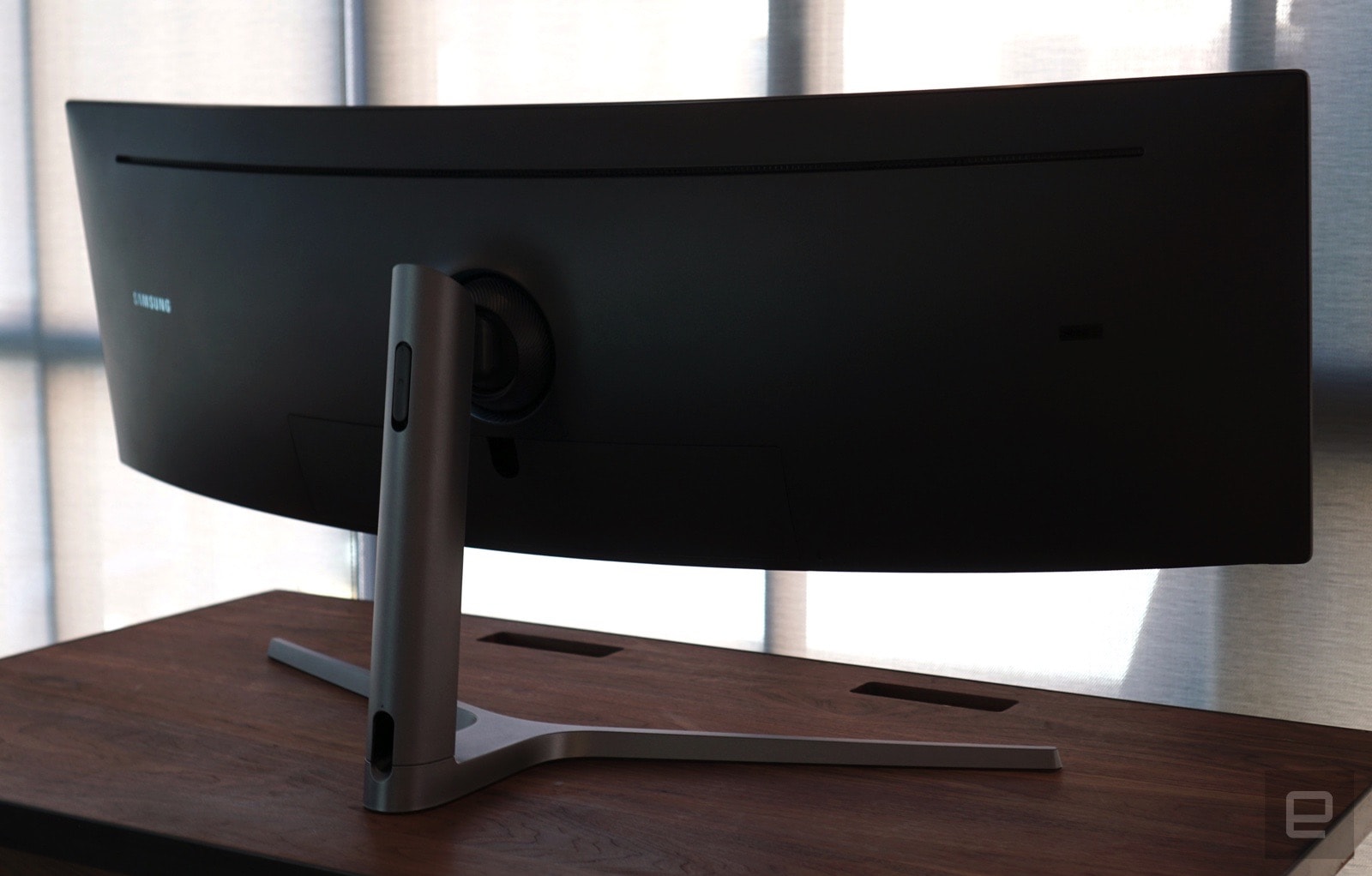
What’s better than dual monitors? An “ultrawide” display, that make games more immersive and multitasking easier than a standard widescreen monitor. But Samsung wasn’t satisfied with that. Its massive 49-inch QLED gaming monitor heralds an entirely new style — let’s call it “super ultrawide” — which can do the work of complex three-monitor setups. While it might look a bit awkward, it could be just what some gamers are looking for.
As you can imagine, Samsung’s 49-inch behemoth makes an impression. I use an ultrawide Dell screen on my gaming rig, so I’m familiar with giant displays. Still, this monitor surprised me with the amount of desk space it took up. Its 32:9 ratio is noticeably bigger than 21:9 monitors, which typically feature 34-inch or 27-inch screens. It’s base is also larger than most other displays, and the screen’s sides jut much farther out — almost comically so. Once I sat down in front of it though, I could easily see the appeal. It offers the most real estate I’ve seen in a single desktop display.
The monitor’s 3,840 by 1,080 resolution is a bit odd. Ultrawide monitors typically feature either 2,560 by 1,080, or 3,440 by 1,440 pixels, for a comparison. It also features a deep curve (1800R), which makes it easy to see all sides of the screen. The display has two HDMI ports and two DisplayPort connections (one of which is a MiniDisplayPort). There’s also a USB 3.0 hub on the back with three ports. The on-screen configuration menu is also a step above what we typically see today from other monitors. It’s large, easy to read, and clearly lays how to get to various settings.
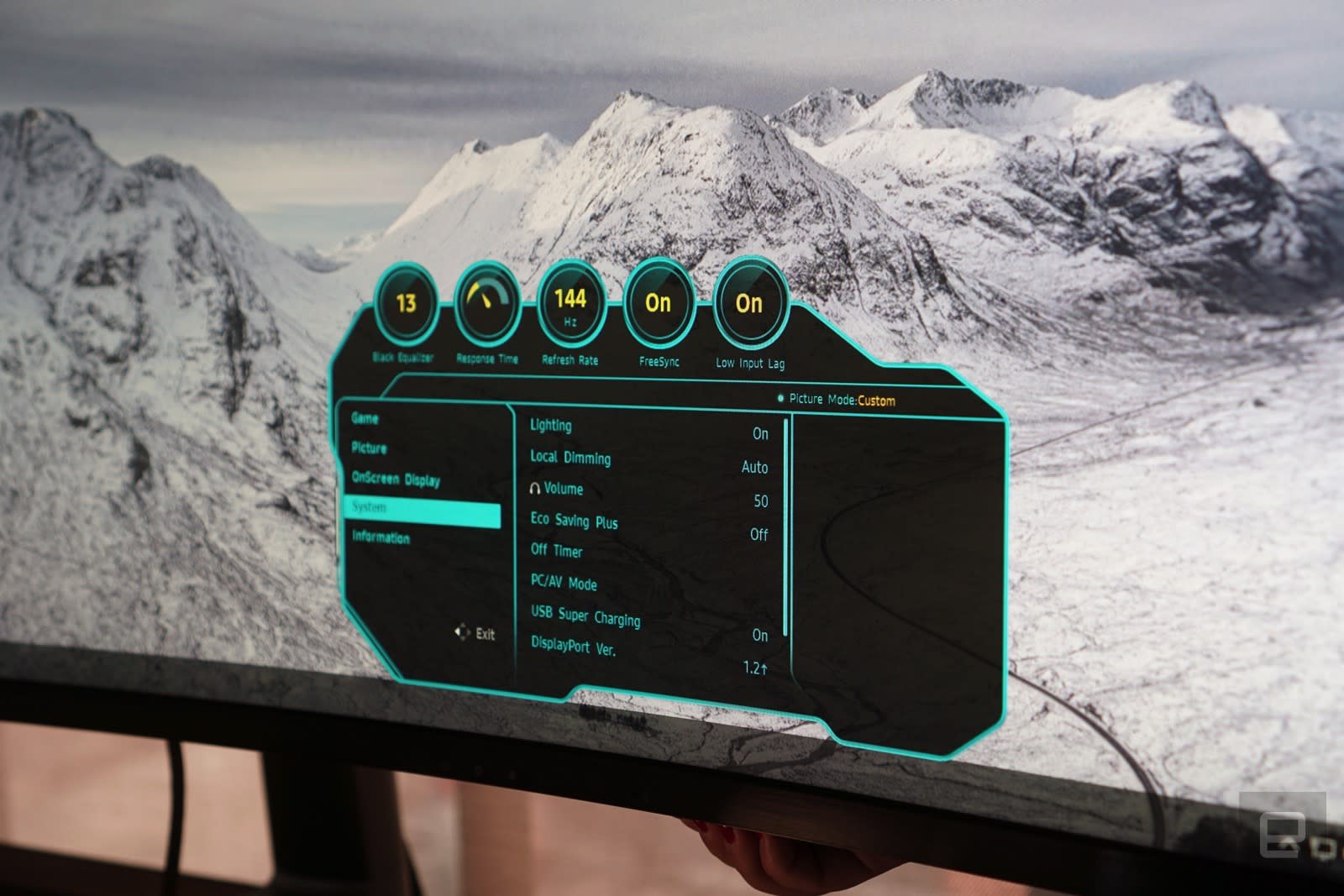
Gamers will definitely appreciate the monitor’s fast one-millisecond response time and 144Hz refresh rate. Both of those features will make first-person shooters like Call of Duty and Overwatch more responsive and perform more smoothly. As with most modern screens, it also sports HDR capabilities, as well as support for AMD’s Freesync 2 standard. The latter feature smooths out game performance so there’s no screen tearing. It’s also a part of Samsung’s new “Quantum Dot” QLED gaming lineup, which means it uses nanoparticles to deliver better lighting and color representation than typical LED screens.
I’ve tested plenty of gaming monitors over the years, but I was particularly eager to try out Samsung’s 49-inch display simply because its so unusual. And it didn’t disappoint. During a brief demo in New York City, I had a chance to play Battlefield 1 and Mass Effect Andromeda, both of which looked fantastic. The display had no problem keeping up as I moused around during firefights; Colors looked astoundingly realistic and the bright HDR elements popped off the screen. There was also plenty nuance in darker scenes, which was especially useful for Battlefield’s harrowing open mission.

Devindra Hardawar/Engadget
Mostly, I was impressed by how immersive the monitor felt. It effectively replicated the feeling of gaming on a three monitor setup, except I didn’t have to deal with annoying bezels in the middle. It was just pure screen. It’s one of the reasons I fell in love with ultrawide displays in the first place — Samsung’s new monitor just takes that sense of immersion to the extreme. Both games also took advantage of the unique resolution, but your mileage will vary on other titles. If you can get a game running on three monitors simultaneously, chances are it’ll look good on this screen.
You can do much more than just game on Samsung’s new screen. I was able to fit three full-sized windows side-by-side during my demo. It could be very useful for content creators who need to work in timeline focused apps for video and audio editing. I only wish there was a bit more vertical space. While I could comfortably read most websites on the screen, I was a bit disappointed by just how much I had to scroll up and down. Still, that’s an issue I could get around by zooming out, or tweaking Windows’ display scaling settings. You can also have the screen display two inputs side-by-side — something other ultrawide monitors can do, but is more practical with a 49-inch display.
At $1,499, Samsung’s 49-inch gaming monitor is surprisingly competitive with ultrawide monitors. Dell’s highest resolution 34-inch Alienware screen is also available for the same price, while LG’s latest model currently sells for just $1,000. Yes, these are certainly much pricier than normal-sized gaming monitors, but they’re not that much more expensive if you’re trying to put together a dual or triple-monitor setup.
If you’re a gamer looking at ultrawide monitors, it’s worth considering this unique Samsung screen. It’s unusual, but it also delivers an immersive experience like no other display.
The Essential Phone’s camera may be getting a lot faster
When Andy Rubin’s Essential Phone came out in September, our review called out its poorly-performing camera while also noting that there were two new updates to improve things in the week we had the device. Now, Essential users are getting another upgrade for the phone and Camera app that brings impressive performance to the device, including a speed boost of 40 percent in regular or low light.
According to Essential, they’ve been able to improve image quality via post-processing software updates. They’ve also upgraded the 360 photography system by adding spacial sound to the four ambisonic microphones in the Essential phone, along with a countdown timer so you know when to start taking the shot. The update also brings better brightness and performance in low-light, the ability to use the volume up and down keys as shutter buttons, and other bug fixes.
That’s not all, though. “Several additional improvements are in the works (more HDR improvements, live 360 streaming to Facebook and Periscope, animated 360 stills and filters, Portrait Mode and Pro Mode) and will continue to roll out through updates on Google Play,” wrote Director of Software Engineering Michael Kolb. The update comes with system build NMI81C and should roll out sometime today.
Via: DroidLife
Source: Essential
 AIVAnet