


iPhone X Impressions: ‘Striking’ Display and ‘Sensational-Looking’ Design Make High Price Worth It
Apple just officially announced the iPhone X, its all-new, drastically redesigned, tenth anniversary iPhone. Right after the keynote where it debuted, reporters were treated to the hands-on demo room within the Steve Jobs Theater where they got to be among the first people in the world to hold an iPhone X. Below we’ll round up some of the first impressions on the device, which many publications are describing as “beautiful,” “striking,” and a “sensational-looking” iPhone.
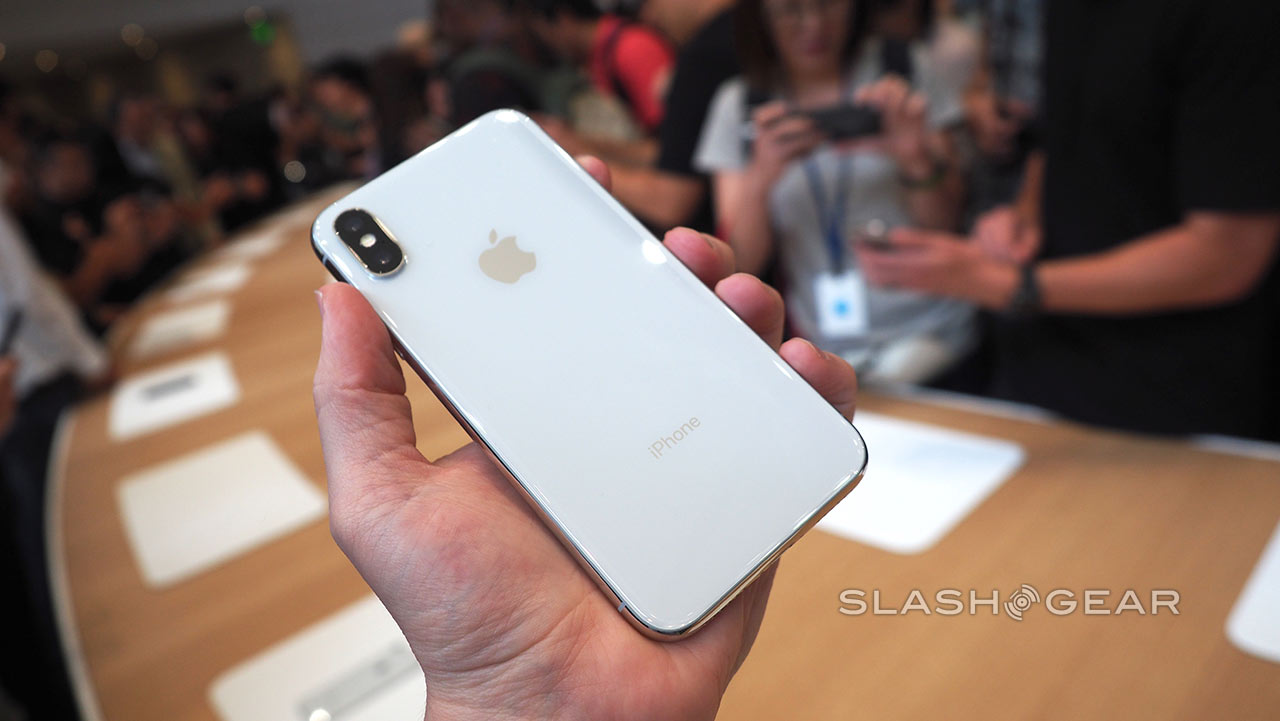
SlashGear called the iPhone X “familiar, and yet so very different,” alluding to the aluminum casing of the new iPhone that matches the original iPhone’s design, while also commenting on the “striking” OLED display. While other smartphones have had OLED screens, SlashGear said the iPhone X “takes it to another level,” with text and graphics that look “embedded into the toughened glass” of the display.
Images via SlashGear
Although the top “notch” of the screen looked intrusive in viewing some photos and videos, the site largely said that it shouldn’t get in the way much elsewhere.
Most striking, of course, is the display. Apple has not only pushed the 5.8-inch OLED panel to the very edges of the bezel, it has hugged the corners too. The much-discussed “notch” in the top – housing not only the new TrueDepth Camera, but various other sensors used for the new Face ID system – looks intrusive in photos but, in my brief use of the iPhone X, didn’t feel like it would get in the way.
You’re too busy marveling at Apple’s OLED screen, really. We’re used to bright, color-rich panels from OLED technology but the iPhone X takes it to another level, text and graphics looking like they’re embedded into the toughened glass that protects the phone front and back. It’s pleasingly smear and lag-free, even in fast-paced augmented reality games, too.
The Verge said that the “star of the show” for the iPhone X is its 5.8-inch OLED screen, which goes to great lengths in proving that an iPhone without a Home Button can actually work. Furthermore, the site said Face ID “actually works,” with a nearby Apple demo assistant repeatedly showing off the biometric security feature, which “worked every time” even under the bright and erratic conditions of the demo area.
The Verge continued by noting a few of the iPhone X’s control gestures will likely take some time to get used to, including swiping up to go home, but over time the site predicted it’ll become just as natural as current UI controls on iOS 10. Like many sites, The Verge noted the $999 price tag for the starting model of the iPhone X, but said that for most users it’ll feel “worth it.”
The thing that a lot of people want to talk about with the iPhone X is its $999 starting price, but when you have the phone in your hand, it feels… worth it. The X is an extremely beautiful device, with a stainless steel band and glass back curving into a 5.8-inch OLED display that stretches all the way across the front of the phone.
The screen dictates everything about the iPhone X’s design, including its lack of a home button. This will probably be one of the most controversial things about the phone among iPhone users, but Apple has done a lot of work to make iOS feel natural without a home button. I couldn’t test out the new FaceID authentication myself without setting it up, but it was configured for one of Apple’s demo assistants, and it worked every time he showed it off, even under the frenetic conditions and bright lights of the demo area.
TechRadar called the iPhone X “easily, easily the best-looking phone Apple’s ever made,” with rear glass that feels “solid and secure” in the hand and the rounded edges and light form factor make it “pleasant to hold,” although fingerprints will be a problem. Despite being slightly smaller than an iPhone 7 Plus, TechRadar noted that some iPhone X gestures will still require two hands, and pointed out that “you can’t reach the top right-hand corner as easily” for bringing up the new control center.
Unlike The Verge’s experience, TechRadar described a questionable demo experience with Face ID, where the demo worker had to keep turning the display off and on to active the facial recognition system. Still, it noted that daily testing will be required to truly see the potential of Face ID — as well as all of the iPhone X’s new features — and came away largely impressed by the smartphone, particularly the display.
It’s hard to overstate how beautiful this screen is – and that’s not hyperbole brought on by extreme fatigue. It’s deep, rich and smooth, and draws level with Samsung in the quality stakes easily. If the planned effect of the iPhone X was to wow with its display, it’s certainly done that. The colors are just so vivid on the all-screen front, and it truly feels like you’re holding one of the iPhone concepts we wrote about years ago.
We’re definitely going to need convincing with Face ID – Apple’s done a good job of explaining why its system is better than anything we’ve seen before, but without trying this day to day it’s hard to know whether it’ll be good enough to replace Touch ID and the demos weren’t anywhere near convincing enough. But while question marks remain, there’s no doubt that this is the futuristic iPhone from Apple we’ve been waiting for. Just be ready to pay a hefty sum for it.
The iPhone X will officially be up for pre-order on October 27, and then go on sale November 3, starting at $999 for the 64GB version and rising to $1,149 for the 256GB version. Apple revealed the iPhone X earlier today, alongside the iPhone 8, iPhone 8 Plus, Apple Watch Series 3, and Apple TV 4K.
Related Roundups: iPhone 8, iPhone X
Tag: September 2017 event
Discuss this article in our forums
How to clean Daydream View

Your Daydream View is probably easier to clean than you think!
As you play with a headset and share it with your friends, it’s going to take some minor damage and accumulate dirt. To keep your adventures in VR as awesome as possible, then you’ll need to know how to easily clean your headset. It can be a little bit trickier with Daydream View because it is covered in fabric and not plastic. Thankfully Google has made it easy to keep your headset in tip-top shape, and we’ve got a few tips to help you out.
Read more at VRHeads.com
Apple’s TV App Expanding to Seven Countries, Starting With Canada and Australia Later This Month
Apple today announced that its TV app for iPhone, iPad, and Apple TV will be expanding to seven additional countries by the end of the year.
The app will be released in Canada and Australia later this month, followed by France, Germany, Sweden, Norway, and the UK by the end of the year. The app has been available in the United States only until now.
Apple’s TV app simplifies the television-watching experience, and helps users discover new TV shows and movies to watch. The app provides a unified experience for accessing TV shows and movies across multiple video apps.
The announcement was made by Apple’s services chief Eddy Cue during the company’s iPhone X event at the Steve Jobs Theater today.
Related Roundups: Apple TV, tvOS 10
Buyer’s Guide: Apple TV (Don’t Buy)
Discuss this article in our forums
Best Clear Cases for Samsung Galaxy Note 8

Show off your Note 8’s design while keeping it safe with a quality clear case.
We get it — you just ordered your brand new Galaxy Note 8 and you can’t wait to show it off to your friends and family. But you also want to keep it protected, right?
A clear case is a great option for those of us who love to show off your phone’s sleek lines without worrying about the shattering from an accidental drop. We’ve rounded up our favorite clear cases for the Galaxy Note 8!
- Spigen Liquid Crystal
- Ringke Fusion
- Speck Presido Clear
- Caseology Skyfall case
- OtterBox Symmetry Series
Spigen Liquid Crystal

A great clear case is going to offer protection for your phone without drawing attention to the fact that you’ve got a case on your phone. In that regard, the Spigen Liquid Crystal is an outstanding choice.
Made of lightweight and flexible TPU material, this single-layer case is easy to pop onto your phone while adding next to no bulk to the phone. Precise cutouts and buttons means that your phone’s functionality is never affected, and it’s thin enough to allow for wireless charging, too.
Spigen has a couple other clear case options you might be interested in — the Rugged Crystal ($12) features reinforced corners to help with drops, and the Ultra Hybrid S ($15) features a built-in magnetic kickstand for hands-free media viewing. But if you’re just looking for a reliable and slim clear case, the Liquid Crystal is your best value at just $11.
See at Amazon
Ringke Fusion

The Ringke Fusion case is one of those case styles that’s offered for nearly every major phone release, and it’s a reliable option if you want to keep your phone protected without impeding the look and design of your new phone.
This is a two-layer case with a soft, shock-absorbing TPU bumper paired with a hard plastic back plate that offers serious protection against drops and scratches. There’s tapered lips around the corners to ensure the screen isn’t in direct contact with surfaces if you put your phone screen down on a table, and it’s been precisely designed so that all the ports and buttons are functional.
You can get the standard all-clear version for just $7.99, or opt to add some character to the bumper — Rose Gold or Smoke Black — for just $9.99.
See at Amazon
Speck Presidio Clear

Speck’s clear case is as minimalist as it gets — at a glance, you’d never know your phone has a case on it if not for the subtle Speck logo in the top-right corner.
This dual-layer case is rugged, having been test dropped from 8 feet by a third-party testing lab. If you’ve shied away from a clear case in the past because you’ve seen the yellowing effect that UV rays can have on them over time, you’ll be happy to know that the Presidio case is made with a custom-engineered material that resists turning yellow over time.
At just under $20, this is one of the more expensive clear case options for the Note 8, but if ruggedness and anti-yellowing are important features for you, don’t settle for anything less.
See at Amazon
Caseology Skyfall

The Caseology Skyfall series of cases for the Note 8 are the perfect choice for anyone who wants a clear case with accents around the edge to match the color of the phone.
These dual-layer cases combine a crystal-clear acrylic hard cover with an impact resistant PC bumper that comes in your choice of three colors — Blue Coral, Orchid Gray, and Warm Gray.
If you’re set on a specific color for your Note 8 and want a clear case that actually accents your phone rather than attempting to be invisible, get at Caseology Skyfall case starting at $13.
See at Amazon
OtterBox Symmetry Series Clear Case

OtterBox is a brand that’s become synonymous with outstanding quality and customer support — and that’s important because OtterBox cases always tend to be on the more expensive side.
The OtterBox Symmetry Series is an ultra-slim offering, available as a clear case or your choice of six other stylish options. It’s compatible with screen protectors and features a lip around the screen to protect the touchscreen from damage.
At $50 it’s a decidedly a pricy investment, but so is the Note 8 itself. Backed by OtterBox’s limited lifetime warranty, you can buy with confidence.
See at Amazon
Which clear case will you get?
These are our picks for best clear case — which one are you going with? Got a favorite that didn’t make our list? Let us know!
Samsung Galaxy Note 8
- Galaxy Note 8 review
- Complete Galaxy Note 8 specs
- Galaxy Note 8 vs. Galaxy Note 5
- Which Note 8 color is best?
- Join our Galaxy Note 8 forums
Verizon
AT&T
T-Mobile
Sprint
Best Buy
Apple Introduces ‘Animoji’ as iPhone X Exclusive Feature
With every new iPhone release, Apple introduces a new “magical” feature like Live Photos, and in the iPhone X, that new unique, Apple-only feature is Animoji, a new set of emoji-style characters that animate based on an iPhone user’s facial expression.
Animoji take advantage of the new TrueDepth front-facing camera, which powers Face ID and features several new 3D sensors to detect your facial expressions. The TrueDepth camera analyzes more than 30,000 invisible dots projected onto your face to get a precise depth map that’s able to accurately translate your own facial movements to the Animoji.

When used for Animoji, the TrueDepth camera is able to analyze more than 50 muscle movements in different areas of your face to mimic your speech patterns and expressions. It detects movement of the eyebrows, cheeks, chin, eyes, jaw, lips, eyes, and mouth.

There are 12 different Animoji to choose from, modeled after existing emoji characters: monkey, robot, cat, dog, alien, fox, poop, pig, panda, rabbit, chicken, and unicorn.

Animoji exist in the Messages app alongside stickers, emoji, and other Messages apps. You can use Animoji to record and send messages to friends, with the characters mimicking your movements and using your voice.

Animoji are exclusive to the iPhone X and won’t be available until the device launches later this fall. Apple plans to accept iPhone X pre-orders starting on October 27, with an official launch coming on November 3.
Related Roundups: iPhone 8, iPhone X
Discuss this article in our forums
Take it from a Note 8 user: temper your iPhone X Face ID expectations

Sometimes it turns out the solution to a problem is something you already have: a fingerprint sensor.
Alongside the predictably named and designed iPhone 8, Apple just announced the all-new iPhone X (pronounced “ten” by the way). With its very familiar “lots of screen and tiny bezels” design, the iPhone X ditched one of the most recognizable parts of an iPhone: its home button. And in doing so, it lost Touch ID — one of the key features of the iPhone and a real driver for the rest of the industry to get up to speed with fantastic, fast one-touch fingerprint sensors.
It’s replaced with what Apple calls “Face ID” instead. A complex set of purpose-built hardware and software that identifies hundreds of tiny details of your face in order to securely unlock your phone when you’re looking at it. It sounds wonderful. It even works in demos (well, mostly). But take it from me, as a Galaxy Note 8 user living with iris and face recognition every day: temper your expectations.

Apple, of course, isn’t the first to do away with a front-mounted fingerprint sensor in favor of other authentication methods. Many companies have done face and iris unlocking. Google unveiled a rudimentary face unlock as far back as Android 4.0. Samsung has popularized it with the Note 7, Galaxy S8 and now Note 8. While it works pretty well, months and months of people using these phones with these alternate authentication methods has given us lots of information on how it works in the real world. Here’s a glimpse into the daily life of using Samsung phones:
“Look here to use irises”
“Hold phone closer”
“Phone too close to face”
“Hold farther away”
“Irises not recognized”
And in the end, I wiggle my finger up to the fingerprint sensor on the back or just swipe on the screen and use my pattern instead.
Switching to Face Recognition, which can’t operate at the same time as Iris Scanning, improves unlocking performance but is, by admission, not as secure. (Apple claims its Face ID can’t be fooled by a photo — we’ll see about that.) And in the end, it still isn’t as fast as using a one-touch fingerprint sensor — even the awkwardly placed ones on the back of modern Samsung phones.

Now Face ID, as demoed today at the Apple launch event, seems to go one important step beyond Samsung’s implementation. The designated phone hardware isn’t looking at just your face or just your irises, but instead the entire profile of your face and eyes for authentication. That means the iPhone X can identify your “face” even if you change your hair, put on glasses, grow a beard, wear a hat or just stand in different lighting. Theoretically.
Face ID may very well be better than Samsung’s iris scanning — but it isn’t a fingerprint sensor.
But Face ID, as shown, no matter how good its scanning capabilities are, still can’t match fingerprint sensors in many situations we’re in every single day. With a properly-placed fingerprint sensor you can unlock your phone as you take it out of your pocket before it’s anywhere near your face, or with it sitting on a table, or in the dark, or in harsh sunlight … or while you’re wearing sunglasses. The only thing that can foil a fingerprint sensor, really, is a glove on your hand.
And that’s why I want you to temper your expectations for what Face ID can actually accomplish when it comes to the daily goal of simply unlocking your phone when you want to use it. I’m sure it’s quite secure, and Apple definitely isn’t going to sell the scans of your face to some advertising company. Based on what’s inside the iPhone X’s little screen cutout, and what Apple is saying about the technology, it very well may be better than what the Galaxy Note 8’s iris scanning can do — I’d actually be surprised if it wasn’t notably better.
But simply improving facial recognition isn’t what’s required to be a better authentication solution than a fingerprint sensor. The system, no matter how good it is, is going to have a tough time overcoming inherent constraints with facial recognition. Sometimes the best solution to a problem is something we already had: a fingerprint sensor.
Samsung Galaxy Note 8
- Galaxy Note 8 review
- Complete Galaxy Note 8 specs
- Galaxy Note 8 vs. Galaxy Note 5
- Which Note 8 color is best?
- Join our Galaxy Note 8 forums
Verizon
AT&T
T-Mobile
Sprint
Best Buy
Apple’s iPhone 8 and 8 Plus wrap more power in a glass-backed design
Today, Apple is likely to announce more phones than it has at any event in its history. The iPhone 8 and 8 Plus are two major parts of today’s showcase, and after all those tantalizing leaks, we finally get to hear all about them. You won’t have to wait much longer to handle one either: Both iPhone 8 models, which mark a return to glass-backed design, with a powerful-sounding new processor inside, will go on preorder September 15th, with a launch date of September 22nd. For the bigger handset, you’ll get to pick storage configs with 64, 128 and 256GB options with prices start at $799, while iPhone 8 shoppers will get 64GB and 256GB options, with an entry-level price of $699. And yes, all three colors (silver, space gray and gold aluminum) will be coming to both phones. Let’s take a look.
Let’s be frank: the design hasn’t changed hugely. While this is the iPhone 8, in a lot of ways it’s the iPhone 7S in all but name. There are some physical changes, and the major one is the return to a glass-backed phone design. Beyond aesthetics, there’s a major point to this: wireless charging. Apple has embedded Qi inductive wireless charging, which means that both phones will charge on compatible pucks and surfaces when they launch. The good part? Qi charging surfaces are already on sale pretty much everywhere. Even Ikea does them.

Apple claims that the new glass backing is the hardiest glass ever found on a smartphone, while it’s also used aerospace-grade aluminum with the iPhone 8, for 50 percent more strength compared with previous devices. (Challenge accepted, right?)
Display-wise, the iPhone 8 will pack a new 4.7-inch Retina HD display, while the iPhone 8 Plus has a 5.5-inch Retina HD display — what’s important here is the addition of Apple’s True Tone tech.
Similar to (but much more complicated than) how iPhones adjust their color temperature in Night Shift, True Tone will try to ensure that your screen’s color temperature looks accurate irrespective of whether you’re looking at it under a streetlight, sunlight or, well, candlelight.

Inside, Apple has added its latest, most powerful processor: the A11 Bionic. It’s a six-core CPU, which includes two high-performance cores, both of which are 25 percent faster than the A10 found in the last iPhone models. Heck, even the four high-efficiency cores are 70 percent faster than the A10. This is also the first phone to house Apple’s first-ever GPU. Technical specs inch forward elsewhere too, with the stereo speakers now adding 25 percent more shout to your music and/or Siri responses.
How about the cameras? The iPhone 8 has a 12-megapixel camera — it’s a new sensor with a new color filter, which Apple’s Phil Schiller says will capture “deeper pixels” (I don’t know either…), and the redesigned camera itself will also take in 83 percent more light. Fear not: optical image stabilization is still here, to keep your shots sharp, and at least half decent in low light.
Meanwhile, the iPhone 8 Plus, with its dual camera, gets a duo of 12-megapixel sensors. Notably, the wide-angle lens has a f/1.8 aperture (with optical image stabilization), while the telephoto one now has f/2.8. Lower numbers are good here, and it means more light taken in by the lens to improve the photos you take.
What would a new iPhone be without a fancy new camera mode? Portrait Lighting, still in beta at the moment, will separate your portrait from the foreground, analyze the lighting and add a different effect as wanted. The effect will be generated on the fly — it’s not a filter, and it is generated by the iPhone itself.(Don’t worry, you’ll also be able to tweak these later, after taking a shot.)
Apple also added its own image signal processor, to allow for wider color capture, faster low-light autofocus and better HDR shots. It’s also upgraded its True Tone flash with a slow sync to help uniformly light up both the background and foreground of your next karaoke dinner party.
Video gets some love too: faster frame rates for both iPhones, as well as image and motion analysis. Cameras are now calibrated to make the most of augmented reality, while there are also new gyros and accelerometers working away inside the phone. The iPhone 8 series will also have motion tracking built into the camera, meaning the phone will help to ensure you’re capturing smoother footage. Those higher frame rates apparently top out at 240 fps at 1080p, meaning crisp (if not 4K) slow-mo options.
The two phones will get a head start on the (more expensive) iPhone X, but now the thinking begins: Why go for model no. 8, when no. 10 is right there?
Follow all the latest news from Apple’s iPhone event here!
Apple’s new iPhones are designed for augmented reality
At WWDC earlier this year, Apple introduced ARKit, its take on an augmented reality platform. Since then, a whole slew of ARKit projects have cropped up, including exploded camera art, an A-ha style video, an IKEA furniture app and many more. Google followed up with its own ARKit competitor, ARCore, just a few weeks ago, thus lending credence to the burgeoning popularity of augmented reality apps on the phone. Now, at Apple iPhone’s event, the company said that all of the new iPhones were designed from the ground up to be AR-ready as well.

Apple’s Phil Schiller said on stage that the new phone cameras are calibrated for AR, and that they designed to handle low-light and 60 fps video, which is perfect for augmented reality applications. Further, there’s a new gyroscope and accelerometer, to ensure more accurate motion tracking.
Schiller also took some time at the event to talk about the latest cool ARKit apps. One was a Warhammer game that lets you fight virtual mechs in the real world. If you’re a baseball fan, you’ll love MLB’s new app that will let you hold up your iPhone at the game to see real-time information and stats superimposed on the field. There’s also an app that lets you view the constellation as you move your phone across the sky. Last but not least, Apple showed off a game called The Machines that let you go head to head with your friends in a virtual battlefield.
Even though the new iPhones — that’s the iPhone 8/Plus and the iPhone X — are designed specially for AR, ARKit is still available for the iPhone 6s and the iPhone 7 with the upcoming iOS11 update.
Follow all the latest news from Apple’s iPhone event here!
iOS 11 comes to your iPhone and iPad on September 19th
Months after its initial unveiling at WWDC this year, iOS 11 is finally (almost) ready for public consumption. Come Sept 19, you’ll be able to install Apple’s latest software update — should you choose to, anyway. The new iOS will ship with the newly announced iPhone 8 and 8 Plus when they arrive in stores on Sept 19, which is also most likely when the upgrade will roll out to the public. Those of us with aging iPhones (and iPads) will likely need to clear out old files and apps to make room for the update. But when you do eventually get iOS 11, you’ll enjoy cool new tricks like Live Photo modes, a more-intelligent Siri and a customizable Control Center.
iOS 11 may also create animated emojis based on your facial expression, and facilitate much better multitasking prowess on iPads. One of the most major new features the new system brings is Apple’s ARKit, to help developers make augmented reality content more realistic. It also adds an important security benefit: you’ll be able to dial 911 and disable TouchID by pressing the power button five times in a row. This helps prevent you from being forced to unlock your phone with your fingerprint.
It seems like there are plenty of reasons to upgrade to iOS 11 once it’s available, but as with most new software launches, there are bound to be bugs, so make sure you back up all your data before starting the installation.
Follow all the latest news from Apple’s iPhone event here!
Follow your favorite local sports teams with Apple’s latest TV update
Its venerable phone line wasn’t the only newly minted product Apple showed off at the iPhone 8 event on Tuesday. Eddie Cue announced onstage that the company will expand availability of its TV app to seven new countries by the end of the year and will be adding local news and sports programming as well.
The TV app will be available in Australia and Canada next month, the spread to Germany, France, Sweden, Norway and the UK by the end of the year. US sports fans (that is, those that live in the country), will be able to track their favorite teams and have Apple TV push an on-screen notification whenever a game starts. By the end of the year, Apple also announced that users will be able to ask Siri directly to switch to a game. Or, if the user is deep in a Netflix hole and don’t want to change the channel, they can simply ask the assistant “What’s the score of the Giants game?” to get a quick update (hint: the Giants are losing).
Follow all the latest news from Apple’s iPhone event here!
 AIVAnet