


Google’s next Pixel smartphones arrive October 4th
The next-gen Pixel smartphones will be launched on October 4th, just a day before rumors predicted, according a new Google YouTube video (below). The search giant hasn’t, naturally, revealed any details about it yet, but has made some pretty bold promises. It implies that the new models (reportedly a Pixel and Pixel XL, according to @evleaks) will have a better battery, more storage and a better camera than other models. It has even suggested that it will “understand you,” no doubt a reference to Google Assistant.
Google implied all this in a cryptic video (below) showing a search with a user asking “what’s wrong with my phone’s battery?” “why is my phone always out of storage?”, “why does my phone take so many blurry photos?” and others. The imaginary searcher also asked why his device is so “slow, hot, fragile, annoying, broken, cruel, impersonal and … dumb,” so Google is implying that it plans to fix all those things with the new Pixel phones.
According various reports from Android Police, Evan Blass, HTC itself (via the FCC) and others, the phones will pack either a shiny new Snapdragon 836 or 835 processor (XDA Developers cast the idea of a supposed Snapdragon 836 in doubt), squeeze controls, a 1,440P screen, 4GB RAM and 128GB storage. HTC will supposedly build the smaller Pixel model, while LG will build the 6-inch AMOLED XL variant. Judging by the photos above, if real, the latter models isn’t exactly an exercise in fancy design, but it’s by no means ugly, either. Supposedly, the models won’t have a headphone jack.
One thing Google should definitely fix is the lack of supply with the last Pixel. Not only was it never available in markets like France (ahem), but even where you could buy one, they were darn near impossible to find. As mentioned, the event will take place on October 4th, but we’re not sure exactly when or where yet.
Source: Google (YouTube)
MoviePass is struggling to keep up with all its new members
Despite the sluggish summer box office, it seems plenty of people are still interested in going to the movies. As long as it comes cheap, that is. Last month, MoviePass launched a $9.95 no contract, unlimited subscription that allows customers access to a standard film (no 3D or IMAX) per day in theaters, without blackouts. The offer was bound to attract a lot of attention. But, no one was prepared for the resulting frenzy (especially not MoviePass). The subscription service claims its website was overwhelmed by the ensuing volume of traffic from interested patrons. And, it’s still struggling with the load. Although its site looks like it’s running smoothly, it’s the card logistics that are causing issues now. That’s a big problem. You see, in the absence of a card, you’ll have to rely on e-tickets, which are only available at select locations.
MoviePass claims customers are currently facing a two to three week delay in card deliveries. As if that wasn’t enough, it also adds that it sent out some of the cards in the wrong order. The company is blaming the error on a “manufacturing queue” reshuffle, which has led to recent sign-ups receiving their cards before earlier sign-ups. To deal with the issues, MoviePass is increasing its manpower. CEO (and Netflix co-founder) Mitch Lowe told Bloomberg his company is boosting its team to 35, up from its starting tally of just nine people.
In the wake of its original announcement, Fox Film CEO Stacy Snider criticized MoviePass’ “wacky” business model. AMC Theaters even resisted the move by reportedly blocking users from purchasing e-tickets at locations in Boston and Denver. The largest theater chain in the country also threatened legal roadblocks.
Has MoviePass proved the skeptics right? Lowe says the service will be “up to speed in a month.” In the meantime, card-less members can grab e-tickets from Goodrich Quality Theaters, Studio Movie Grill, and MJR Theaters.
Source: MoviePass
‘Adventure Time’ role-playing battles come to your smartphone
There are more than a few Adventure Time mobile games out there, but deep games? Not as many. However, YouGnome and Cartoon Network want to improve this state of affairs. They’ve just launched Champions and Challengers, a tactical game for Android and iOS that has you gathering and outfitting a team from over 70 heroes (including Finn, Jake, Fionna, Cake and Princess Bubblegum) and pitting them against rivals in Final Fantasy-style, turn-based role-playing battles. There are over 120 battles in the solo game, where you take on the Dice Lord, but you can also square off against other players online.
This is a free-to-play game, so don’t be surprised there’s a hard sell on in-app purchases. With that said, it looks like there’s a fair amount of depth here — you’ll hopefully have a lot to do without having to fork over some cash. If nothing else, this is the kind of experience you’d expect with an Adventure Time game — you’re actually, you know, adventuring.
Source: App Store, Google Play
Dell’s $350 Windows Mixed Reality ‘Visor’ is now up for pre-order
Dell is finally ready to show you Microsoft’s mixed reality vision. The electronics maker has started taking pre-orders for its $350 Windows Mixed Reality headset called Visor, which it showcased at IFA this year. Visor is one of the fruits of Redmond’s partnerships with several manufacturers, including Acer and Asus, in an effort to release AR-and-VR devices much, much more affordable than its $3,000 HoloLens. It boasts 1,440 x 1,440 in resolution per 2.89-inch LCD panel for each eye, a 110 degrees field of view, a 360 panoramic view and a 90Hz refresh rate. The headset also flips upwards for convenient transitions from reality to mixed reality — just lower it down when you want to use it.
Dell says you don’t need to set up a lot of equipment to use the device, because it has the ability to scan your surroundings and adjust AR and VR experiences as needed. And yes, you’ll be able to access Steam VR on it. Take note that like all the other Windows Mixed Reality headsets, you’ll need a compatible Windows PC: Dell’s Inspiron 15 7000 gaming laptops and Inspiron gaming desktops will work with the devices, if you’re in the market for one.
That $350 price tag will get you a standalone Visor, while a pair of its accompanying controllers will cost you an additional $100. You can also buy a kit to get both, but it doesn’t come at a lower price: it’ll still set you back $450. To place a pre-order, visit Dell’s Visor page in the US and PC World in the UK. The headset and its controllers will start shipping on October 17th and will also be sold by Microsoft’s and Best Buy’s stores and websites, as well as by various retailers, at the same time.
Source: Dell, Dell Visor, PC World UK
UK publishes first draft of new, stricter data protection laws
The UK’s Data Protection Act 1998 is staring retirement in the face, as the government has now published the first draft of the new Data Protection Bill designed to replace it. We actually know quite a bit about the bill already. It was first mentioned in the Queen’s Speech in June, with many of the finer details revealed last month. Among the headline provisions is a new power for the public to request social networks delete anything they posted before the age of 18, informally known as “the right to innocence.”
This is in addition to expanded “right to be forgotten” rules. You’ll be able to ask Google, for example, to remove search results on the basis the information is outdated or irrelevant. Currently, you can only make a case to have your past erased if search results surface info that causes significant distress — something you did as kid that doesn’t reflect you as an adult but is still haunting you, for instance.
The bill also intends to create an environment where you can expect more control of your data and a higher level of protection as standard. As part of the “privacy by default and design” concept, services like social networks will have to set you up with the strictest privacy settings rather than assuming you’ll opt-out of anything you’re uncomfortable with later. They will also have to seek the explicit consent of parents and guardians before allowing anyone under the age of 13 to register.
One of the proposals that’s still not particularly well understood is an onus on companies to allow for “data portability.” In practice, this should let you take all your data from one service and move it to a competitor’s platform — swapping email provider and taking your inbox and contacts with you, for example. The bill also introduces tougher penalties for poor data handling, as well as a requirement for businesses to alert the UK’s Information Commissioner’s Office of any breaches within 72 hours.
Broadly speaking, the bill will write the EU’s freshly stamped General Data Protection Regulation (GDPR) into British law. Interestingly, though, the government said today it has “successfully negotiated” several exemptions from the GDPR. These don’t appear to be at odds with the general tone of European regulations, however. The exemptions basically give extra protection to or eliminate confusion around the processing of data of journalists, scientific and historical research organisations, sports bodies investigating doping and financial institutions looking for evidence of money laundering and other illegal activity.
The Data Protection Bill has now begun the standard process of being scrutinised by the House of Lords and House of Commons before eventually becoming an Act of Parliament. Just a few weeks ago, the government published a related set of proposals outlining the best-case scenario for how it can keep data flowing between the UK and EU post-Brexit. MPs hope that data sharing can continue uninhibited, on account of the Data Protection Bill reflecting the strictness of the EU GDPR.
The reality of the post-Brexit relationship could be a very different, though, as once we lose our seat at the round table, the EU might take issue with the UK’s digital surveillance powers. Particularly those in the Investigatory Powers Act, some of which take a certain disregard for data privacy when it’s deemed “necessary and proportionate” to aid certain intelligence investigations.
Source: Department for Digital, Culture, Media & Sport (1), (2), UK Parliament
‘Overwatch’ player toxicity is delaying game updates
As with many other popular multiplayer videogames, toxicity is a real issue. Some players make it their sole mission to grief teammates, while others threaten to throw the game if they don’t get to play their chosen character. It’s particularly prevalent in Blizzard’s team-based first-person shooter Overwatch, so much so that the game’s director, Jeff Kaplan, has said that the development of new maps and features are continually being pushed back in order to “make people behave better.”
Traditionally, Kaplan uses Blizzard’s Overwatch Developer Update videos to discuss the introduction of new characters or maps, as well as announcing changes to the existing roster of heroes. In this week’s bulletin, however, Kaplan spends the majority of his time talking about how the game’s reporting controls are faring, ending with a message to players stating that if things stay as they are, the rollout of shiny new features will slow down as developers focus more on introducing more measures to battle toxicity.
“We want to make new maps, we want to make new heroes, we want to make animated shorts,” Kaplan said. “But we’ve been put in this weird position where we’re spending a tremendous amount of time and resources punishing people and trying to make people behave better.”
Kaplan noted that while some are skeptical of the in-game reporting system, which has been available on PC for some time but only recently come to consoles, of the 480,000 players who received disciplinary action, 340,000 of those did so because someone reported them.
“I wish we could take the time we put into having reporting on console and have put that toward a match history system or a replay system instead,” Kaplan added. “It was the exact same people that had to work on both, who got re-routed to work on the other. The bad behavior is not just ruining the experience for one another, but the bad behavior’s also making the game progress — in terms of development — at a much slower rate.”
Overwatch is different to a lot of other online shooters. Matches require six players, often randomly matched, to pick a balanced selection of heroes that can act as a tank and absorb damage, lay down their own damage and support or heal the rest of the team.
In Competitive mode, players are often accused of insta-locking damage-heavy heroes and ignoring the needs of the wider team, causing other players to “tilt” or threaten to throw the game. Others simply create alternative or “smurf” accounts and don’t care if they’re being toxic because it won’t affect their overall rank if they’re punished.
This isn’t news to Blizzard, but the directness of this week’s Developer Update does suggest that the company is surprised by the behavior of its 30+ million players. Kaplan was also careful to say that he was “not trying to lay a guilt trip on everybody” and admitted that he may also be part of the problem.
“The community needs to take a deep look inward,” he said. “Think about all the times somebody’s said something negative to you in the game and imagine now if somebody had said something positive to you instead. There’s a way to spread positivity that I don’t think is really prevalent right now.”
Via: Kotaku
Hyperloop One is closer to deciding its first planned route
One of the ways that Hyperloop One is working out which routes it wants to build is through its “Global Challenge” program. It is, essentially, an X-Factor style competition in which candidate cities and states can audition for the prize of getting to buy their own high-speed travel systems. Now, the company has announced which regions are in the running to be the first to get their own Hyperloop route.
There are ten winners across five countries, and each proposal was judged by a panel of experts in infrastructure, transport and technology. Now, each one will be examined in extreme detail as Hyperloop One works out the best place to break ground on its first full-bodied line. Factors to be taken into consideration include the economic benefits, regulatory environment and proposed routes.
Notable routes include a line connecting Chicago, Columbus and Pittsburgh, joining up a population of nearly 14 million people. The Texas Triangle, meanwhile, would bring Dallas, Laredo and Houston within mere minutes of each other for harried business commuters. But it’s not just the US that is getting the love from the Hyperloop One team, in the UK, routes joining up London and Edinburgh, as well as Glasgow and Liverpool, are under serious consideration.
India, meanwhile, has two routes, the relatively short Bengaluru – Chennai line, covering 208 miles, and the Mumbai – Chennai journey, which spans 685 miles. Mexico and Canada round out the list, with proposed lines connecting Mexico City to Guadalajara and Toronto to Montreal.
Of course, none of these routes are going to be built unless Shervin Pishevar and Rob Lloyd can catch lightning in a bottle. Because the company will need to get local governments, investors and the public all singing from the same hymn sheet. Not to mention all of the people who may be annoyed that the view from their back garden will be interrupted by a vacuum tube shooting people around at near-supersonic speed.
In addition, the company is also announcing a deal with the state of Colorado (and AECOM) to begin investigating the possibility of bringing Hyperloop to the Centennial state. This partnership is still pretty nebulous, but also shows how serious some places are taking this potential new form of mass transit.
Route
Length (km)
Length (miles)
Urban Centers
Population
US Chicago-Columbus-Pittsburgh
Team: Midwest Connect
785
488
3
13,800,000
US Dallas-Laredo-Houston
Team: Texas Triangle
1030
640
5
18,771,000
US Cheyenne-Denver-Pueblo
Team: Rocky Mountain Hyperloop
580
360
10
4,831,000
US Miami-Orlando
Team: Miami/Orlando Hyperloop
414
257
2
8,500,000
India Bengaluru-Chennai
Team: AECOM India
334
208
6
17,710,000
India Mumbai-Chennai
Team: Hyperloop India
1102
685
10
43,190,000
UK Edinburgh-London
Team: HypED
666
414
4
19,151,514
UK Glasgow-Liverpool
545
339
6
9,715,488
Mexico Mexico City-Guadalajara
Team: Mexloop
532
330
4
33,530,000
Canada Toronto-Montreal
Team: HyperCan
640
400
3
13,326,000
Spotify Introduces iMessage App With Search Function for Sharing Music With Friends
Spotify has introduced an iMessage application in its latest update this week. As spotted by iGeneration, Spotify in Apple’s Messages app allows you to search the entire music streaming service for a specific song and send it to a friend. When they receive it, they’ll be able to listen to a 30-second clip, and then tap a button to jump into Spotify to check out the whole track.
This differs slightly from the Apple Music iMessage app, which lacks a search function completely. If you want to share a specific Apple Music song with a friend, it has to be in your recently listened track list, meaning you’ll have to jump to the Apple Music app, search for it, play it, and then navigate back to Messages to find it in the app drawer. Apple Music’s big advantage is that you can listen to the full track right in Messages.
The design is also different, with Spotify’s iMessage app displaying a larger image for the song’s album artwork, while Apple Music’s remains thin and more horizontally-aligned with a play button directly in the iMessage.

In recent Spotify news, the company’s Web Player is now incompatible with Apple’s Safari browser, reportedly due to Google’s Widevine media optimizer plugin, which Spotify requires for music streaming on the web and Apple opposes due to potential security issues. Spotify will also debut an official Apple Watch app in the future, although news of that release now dates back to April 2017 and there’s since been no other word from Spotify or the app’s developer Andrew Chang, besides a few mentions on Reddit over the summer.
Tag: Spotify
Discuss this article in our forums
50 New Features in iPhone X
Apple has officially introduced the iPhone X, its new flagship smartphone with dozens of new features. It won’t be available until November 3, but here’s a preview of 50 changes and improvements coming.
Design
Glass: iPhone X’s front and back are all glass, with a strengthening layer that is 50 percent deeper. Apple said a seven-layer ink process allows for precise hues and opacity, and a reflective optical layer enhances the colors. An oleophobic coating helps reduce smudges and fingerprints.
Stainless steel frame: A surgical-grade stainless steel band wraps around the edges of the iPhone X. It is an Apple-designed alloy.
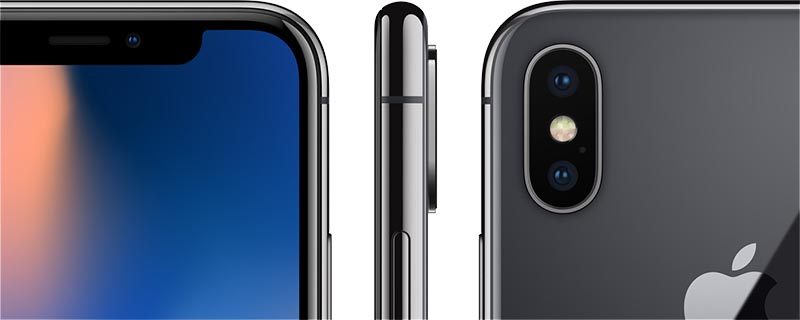
All-screen: iPhone X has a nearly edge to edge display with only a tiny notch at the top for the TrueDepth camera system. Thin bezels surround the display, and the Home button has been removed.
Side button: Apple lengthened the Lock button and renamed it the Side button on iPhone X. Double tap it to invoke Siri.
New accelerometer
New gyroscope
Super Retina HD Display
5.8-inch display: The largest iPhone display ever. Nevertheless, the all-screen design allows it to be between an iPhone 8 and iPhone 8 Plus in both size and weight. For that reason, the iPhone X is the best choice for a smartphone with the maximum display size vs. one-handed usability.
OLED: iPhone X is the first iPhone with an OLED display, which has benefits such as improved color accuracy, high contrast ratio, and true blacks.

True Tone: iPhone X automatically adapts the color and intensity of the display to match the color temperature of the light in its surrounding environment. If you are standing in a dimly lit room with incandescent light bulbs, for example, the display would appear warmer and yellower. If you are standing outside on a cloudy day, the display would appear cooler and bluer.
HDR: iPhone X has a true High Dynamic Range display. You can watch movies and shows in Dolby Vision and HDR10.
2436×1125 pixels: iPhone X has the highest resolution iPhone display ever. 458 pixels per inch.
1,000,000:1 contrast ratio
Tap to Wake
Front Camera
TrueDepth: The front camera system consists of an infrared camera, flood illuminator, proximity sensor, ambient light sensor, earpiece speaker, microphone, 7-megapixel camera, and a dot projector. It is used for Face ID facial recognition, Portrait Mode selfies, and Animoji.
Face ID: Apple replaced Touch ID with Face ID on iPhone X. Simply raise the device, look at it, and swipe up on the screen to unlock the device or authenticate your identity for Apple Pay. Apple said there’s a one in a million chance the facial recognition system could be duped by a stranger.
Portrait Mode selfies: Portrait Mode is supported on the iPhone X’s front-facing camera via the TrueDepth system.

Animoji: Animoji are Apple’s new set of emoji-style characters that animate based on an iPhone user’s facial expression. Animoji take advantage of the iPhone X’s new TrueDepth camera system, which features several new 3D sensors to detect your facial expressions in real time.
Rear Camera
Larger and faster 12-megapixel sensors
Vertically-aligned dual lenses

Dual optical image stabilization: iPhone X has optical image stabilization for both the wide-angle and telephoto lenses.
Quad-LED True Tone flash with Slow Sync: Slow Sync combines a slow shutter speed with a short strobe pulse. It helps in low light when you want a brighter foreground subject with a properly exposed background. The flash’s illumination is up to two times more uniform, helping to reduce hot spots.
Improved image signal processor: Apple says its image signal processor detects elements in the scene—like people, motion, and lighting conditions—to optimize photos even before you take them. It also delivers advanced pixel processing, wide color capture, faster autofocus, and better HDR photos.
Apple-designed video encoder: Real-time image processing with HEVC compression for reduced file sizes.
4K video recording at 60 FPS
1080p slo-mo video recording at 240 FPS

Improved video stabilization
Larger ƒ/2.4 aperture for telephoto lens: iPhone X’s telephoto lens has a larger ƒ/2.4 aperture, which affects exposure and depth of field. By comparison, the telephoto lens on iPhone 7 Plus has a ƒ/2.8 aperture.
Better low-light zoom
Improved Portrait Mode
Portrait Lighting: Apple says Portrait Lighting uses sophisticated algorithms to calculate how your facial features interact with light. Then it uses that data to create lighting effects, such as Natural Light, Studio Light, Contour Light, Stage Light, and Stage Light Mono.
Calibrated for augmented reality
Deeper pixels
Power
Wireless charging: iPhone X supports wireless charging based on the Qi standard. The device can charge by being placed on an inductive charging pad, such as Apple’s upcoming AirPower mat or third-party options from accessory makers such as Mophie, Belkin, and Incipio.

Fast charging: iPhone X is “fast-charge capable,” which means the device can be charged to 50 percent battery life in 30 minutes using Apple’s 29W, 61W, or 87W USB-C Power Adapters, sold separately and included with any 12-inch MacBook and 2016 or later MacBook Pro models.
Longer battery life: Up to two hours longer than iPhone 7.
Performance
A11 Bionic: Apple’s latest chip has two performance cores that are 25 percent faster, and four high-efficiency cores that are 70 percent faster, than the A10 chip in iPhone 7 and iPhone 7 Plus.
M11 motion coprocessor

Neural engine: Apple says the neural engine in its A11 Bionic chip is a dual-core design that recognizes people, places, and objects. It processes machine learning tasks at up to 600 billion operations per second as the driving force behind new features like Face ID and Animoji.
Faster Apple-designed GPU: Apple says its new three‑core graphics processor, part of the A11 Bionic chip, is up to 30 percent faster than the A10 Fusion chip in iPhone 7 and iPhone 7 Plus.
Wireless
NFC with reader mode: Apple recently introduced Core NFC, a new iOS 11 framework that enables apps to detect Near Field Communication tags.
Bluetooth 5.0: Bluetooth 5.0 offers four times the range, two times the speed, and eight times the broadcast message capacity compared to Bluetooth 4.2.
Location
Galileo support: Galileo is Europe’s Global Satellite Navigation System (GNSS), an alternative to the Global Positioning System (GPS) system owned by the United States government.
QZSS support: Quasi-Zenith Satellite System is a satellite-based augmentation system for the Global Positioning System (GPS) that is receivable within Japan.
iOS 11 on iPhone X
Simplified status bar: Clock on the left. Wi-Fi strength, cellular bars, and battery life indicator on the right.

Double-tap Side button for Siri
Press the Side button + Volume Up to take a screenshot
Swipe up to close apps
Swipe up and pause to view multitasking screen
iPad-like dock design

Selfie Scenes in Clips: When using Clips with an iPhone X, there’s a new “Selfie Scenes” feature that will use the TrueDepth front-facing camera on the device to immerse users in a selection of 360-degree animated landscapes.iPhone X can be ordered starting Friday, October 27, with in-store availability in limited quantities starting Friday, November 3.
The device is available in 64GB and 256GB storage capacities for $999 and $1,149 respectively in the United States. Prices vary elsewhere.
Related Roundup: iPhone X
Discuss this article in our forums
Google Teases Upcoming Pixel 2 Event, Aimed at Those Who Are ‘Thinking About Changing Phones’
Google has launched a new advertising campaign and teaser website for its upcoming “Pixel 2” smartphone. The site teases visitors with an October 4 event date, aimed at anyone who might be “thinking about changing phones” (via TechCrunch). The page presents no other information, and asks for the user’s email address to stay up-to-date with alerts regarding breaking news ahead of the October 4 event.
Since the original Pixel smartphone debuted in October of last year (it was actually announced on the exact same date in 2016), a similar date was expected for the new version of Google’s smartphone. Rumors about the Pixel 2 have been spreading over the summer in the lead-up to its launch, with current predictions aimed at a smartphone with a Snapdragon 835 or 836 chipset, 4GB of RAM, “squeezable” sides to perform different functions, and IP68 water and dust resistance.
The Google Pixel 2 will also come in standard and “XL” versions, similar to the first generation (launched in 5-inch and 5.5-inch sizes). The XL is rumored to have premium features, however, including a larger 6-inch display with “very narrow” bezels, which the smaller device will lack and reportedly appear similar to the 2016 design. There’s a chance other Google devices, like a new Chromebook and “Google Home mini,” will appear at the same event.
 The current lineup of Pixel Phone devices
Google’s tease comes two days after Apple revealed the iPhone 8, iPhone 8 Plus, and iPhone X, which have enticed many users who are ready to upgrade their smartphones — the customers that Google is likely aiming at with its new Pixel 2 campaign. If the rumored specs become true, compared to the iPhone X the Pixel 2 will have slightly better RAM (4GB vs 3GB), water resistance (IP68 vs IP67), and screen size (6-inch vs 5.8-inch).
Tags: Google, Google Pixel
Discuss this article in our forums
 AIVAnet