


Amazon’s new Fire TV is a 4K-capable, Chromecast-style dongle
One of our complaints with last year’s Fire TV stick is that there was no 4K support. Fortunately, Amazon now has an answer for that. Say hello to the new Fire TV, a dongle-based competitor to Google’s Chromecast Ultra. It has 4K HDR video at 60 frames per second and all of the features of Fire TV as before. Audio is also getting a big upgrade, as it now supports Dolby Atmos sound.
Like last year, it’ll also come with Amazon’s voice remote that supports voice commands and can also tap into just about everything that Alexa can do. It’ll cost $70, a good bit more than the old Fire TV stick, but there’s no doubt it’s a much more capable device — if you have a 4K TV, anyway. If you don’t, Amazon has another deal for you. The old Fire TV stick is now bundled with the Echo Dot for $60. That’s not a bad way to dive right into the Amazon’s whole ecosystem.
What’s more, you can get the new Fire TV and an Echo Dot for only $80 — given that the Fire TV is $70 on its own, you’re basically getting an Echo Dot for $10. That’s probably worth it for most people, and Amazon surely wants to get the Echo into as many homes as possible. This seems like a pretty good gateway drug to help accomplish that goal.
Nicole Lee contributed to this report.
Source: Amazon
Google is reportedly prepping a high-end Home ‘Max’
Google Home users looking for a higher-end audio experience may just have their wish. According to a report at 9to5Google, the tech company is currently creating a new version of its smart speaker with stereo sound. It’s also presumably larger and will come with a premium price. It’s not hard to think of this as Google’s response to Apple’s HomePod and quality speakers like those from Sonos.
This isn’t the first leak ahead of Google’s upcoming October 4th event. There have been plenty of reports and rumors about the company’s new Pixel smartphones, updated Daydream View VR headset and another speaker variant, the Google Home Mini.
There are few details on this reported larger, stereo Home Max speaker, though a 9to5Google source says that it appeared in a focus group that had some of the other products leaked above, like the Home Mini. We’ve reached out to Google for comment and will update this post when we hear back.
Source: 9to5Google
Amazon launches Echo Spot, an Alexa-powered alarm clock
Amazon’s Alexa-themed event apparently includes Echo speakers for every possible use case under the Sun. The tech giant has introduced the Echo Spot, a cute circular-screened device that’s basically an Echo Show squeezed into an alarm clock. You won’t watch movies on it (not with a 2.5-inch display), but it can do many of the things its bigger sibling can — you can look at a nursery camera, watch a video briefing or hold video calls.
The Spot is available to pre-order now, and will ship to the US in December for $130. That’s expensive compared to the audio-only Echo, but it’s enough of a discount over the Show that it might make more sense if you’re not concerned about screen size or audio quality.
Source: Amazon
Apple TV 4K review: Almost perfect
The Apple TV 4K is the streaming box we’ve been waiting for. It brings together the excellent interface from the 2015 model, along with the long-awaited ability to watch movies and TV shows in 4K and HDR. And perhaps most importantly, it seriously drives down the cost of digital 4K releases. Sure, competitors like Roku and Amazon’s Fire TV have had 4K/HDR capabilities for years, but Apple’s pricing model makes the format more accessible to consumers. While it’s not quite perfect, the Apple TV 4K is a solid step beyond HD video.
Hardware
At first glance, it’s tough to tell the new Apple TV apart from its predecessor. They both have the same boxy plastic design, with glossy sides and a matte top. There are a few small differences, though. The new model is raised up slightly to expose air vents, which helps to keep its faster processor cool. It also doesn’t have a diagnostic USB-C port on the back — instead it features an HDMI port, an upgraded gigabit Ethernet jack, and a power connection. Consumers likely won’t notice the omitted USB-C port, since it’s mainly used for IT administration.
Not much has changed on the remote either. A small ring around the menu button is the only noticeable tweak. That helps you hit the button easily in the dark, and it’s also a tactile way to let you know you’re holding the remote correctly. The buttons for heading back to the home screen, Siri voice control, play/pause and volume controls haven’t changed at all. Its motion control capabilities are still intact, as well, but you’ll mainly be using that for games.

This new model won’t win over haters of the original remote, who criticized its fragile design and touchpad controls. But as someone who actually liked the last model, I found it just as easy to use. It still doesn’t make much sense to throw glass on a slim remote that’ll inevitably get crushed in your couch, though.
Under the hood, the Apple TV 4K is powered by the A10X Fusion processor, the same chip inside of the newest iPad Pro models. That additional power is certainly helpful for dealing with huge video files, but it’s also something that games and apps will be able to take advantage of. The last Apple TV often had trouble running complex apps — like Sling TV and Hulu (with its redesigned interface) — without any slowdowns.
Software and setup
Setting up the Apple TV 4K was pretty simple: Just plug in your WiFi credentials, enter your iCloud account, and you’re good to go. If you have an iOS device nearby, you can also hold it near the Apple TV during setup to transfer all of your settings. The entire process took just a few minutes when I used my iPhone 6S.
Apple’s tvOS platform hasn’t changed much, but the company did add a new feature called “One Home Screen,” which lets you sync up your apps and their layout across multiple Apple TVs. It worked flawlessly as I transitioned away from my previous-gen Apple TV (though I did have to manually enable it before I unplugged that model). You’ll still have to log into all of your streaming services, but One Home Screen at least saves you the trouble of finding all of your apps and organizing them.
For the most part, tvOS still looks like a slightly blown up version of the iOS homescreen. It’s an interface that’s beginning to show its age, but it’s still more attractive than Roku’s and the Fire TV’s. The entire UI is also rendered in 4K/HDR, something that no other set-top box is doing yet.
In use
Devindra Hardawar/Engadget
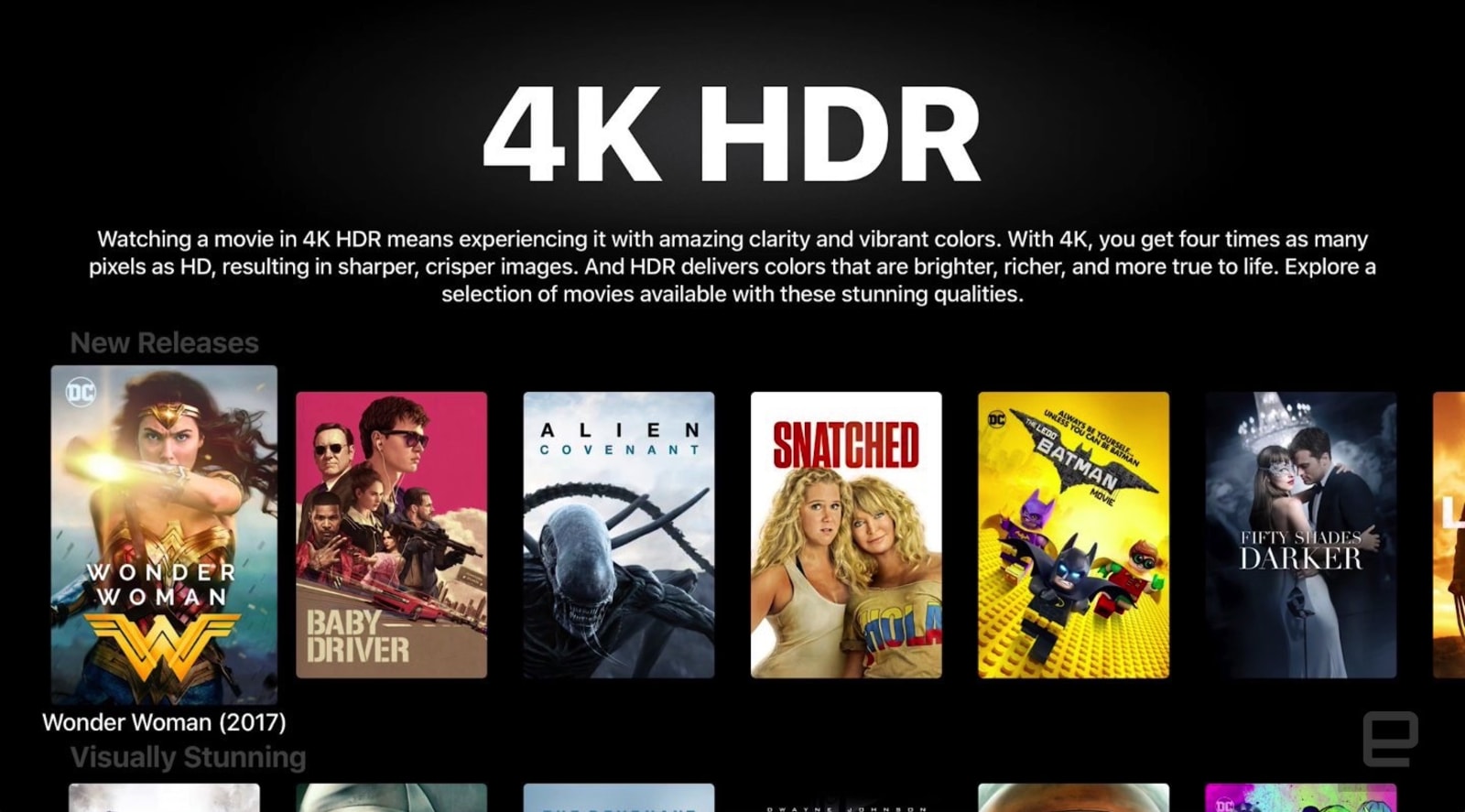
As you can tell by the name, the big difference with this new box is 4K support, which offers four times as many pixels as 1080p HD. That makes it ideal for bringing out very fine detail, like individual strands of hair and blades of grass. Most people won’t be able to see much of a difference with the jump to 4K from their normal viewing distance — you need to be sitting really close to a TV set 55-inches or larger to truly notice it.
Even if you have a massive TV, though, you’ll notice the addition of HDR, or high-dynamic range video, more than 4K on its own. On compatible sets, HDR lets you see more intense brightness, deeper blacks and a wider range of colors in between. On newer films, the difference can feel like night and day.
Apple wisely chose to support both HDR standards: HDR10 and Dolby Vision. But, in typical Apple fashion, it’s offering these new formats in a slightly different way. Unlike most devices, which enable HDR when you’re watching video that supports it, the Apple TV 4K always has HDR enabled. Apple says this helps to avoid annoying flickering that occurs on some TVs when they switch in and out of HDR modes. It might seem like a strange choice, but as Apple sees it, forcing HDR solves a fairly common usability issue. Some TVs take several seconds to jump into HDR mode — something that feels unconscionable in 2017.
By default, Apple says it forces the best HDR setting for your TV set. The definition of “best,” is up for debate, though. On my LG OLED B6, it automatically enables HDR10 at 60Hz. But I’d prefer to be viewing in Dolby Vision, since it can adjust to changes in lighting dynamically, something HDR10 can’t do. Since I had no trouble watching Dolby Vision titles, it appears as if the Apple TV is doing some sort of automatic translation between HDR modes. You can force the Apple TV to display specific resolutions and refresh rates, but at this point you can’t choose which HDR mode to output. We’ve asked Apple for more details about how it’s handling HDR, and will update if we hear back.

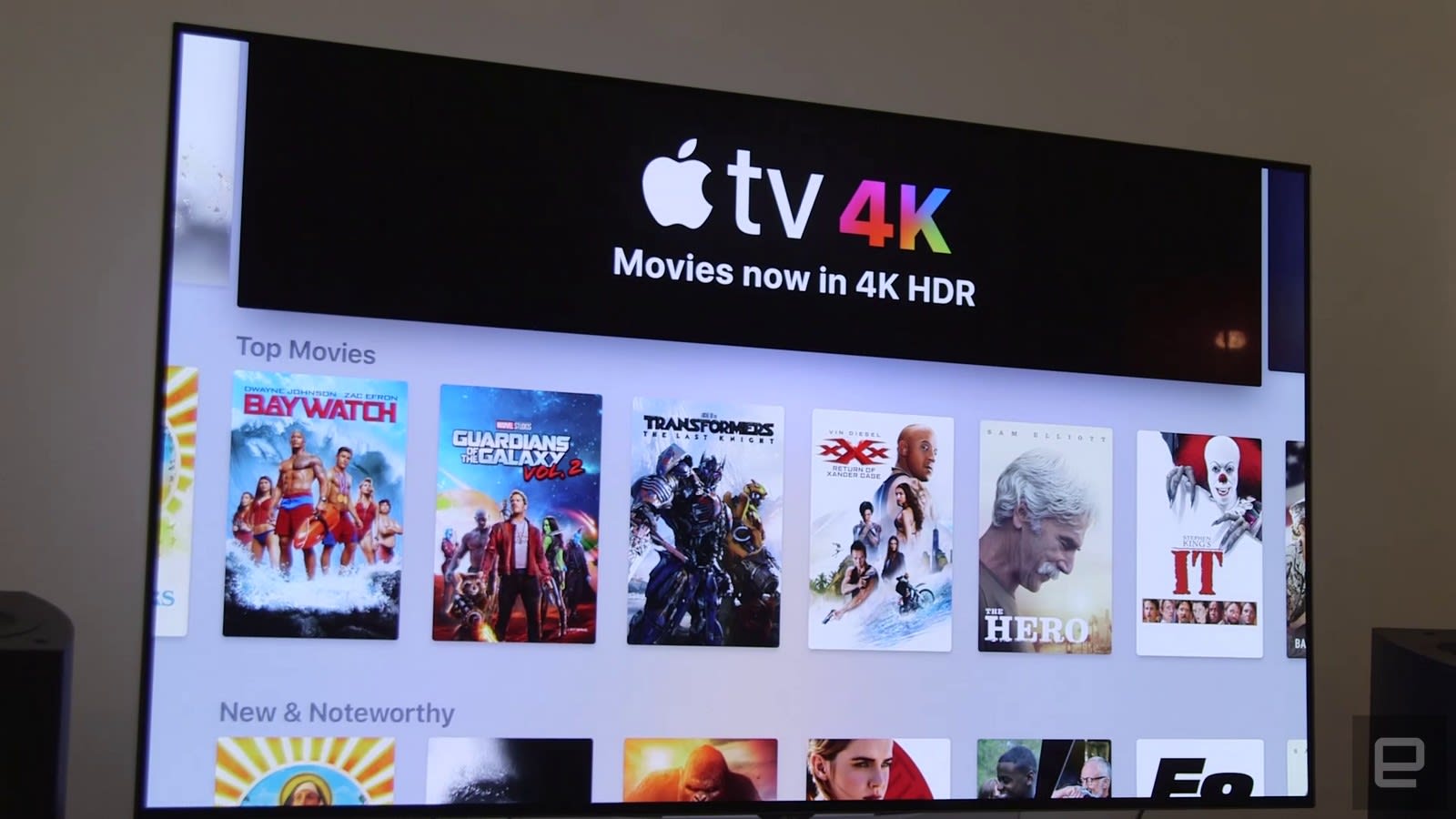
For now, the only 4K/HDR enabled content Apple is offering is in the iTunes Movies app. There’s a section dedicated to the higher resolution films, with a slim offering of more than 120 titles. That’s on-par with Vudu’s 4K library, Apple’s biggest competitor. Surprisingly, There aren’t any 4K/HDR TV shows on iTunes yet.
While adding 4K/HDR support is nice, it’s nothing revolutionary. What is transformative is that Apple isn’t charging a premium for 4K films. You’ll be able to buy them between $15 and $20, and rent them for $6, just like the company’s current HD library. And just as the company promised, your existing iTunes purchases will be upgraded to the new format for free. In my library of 50 films, my copies of Star Trek Beyond, Arrival, The Lego Movie, Kingsman, and La La Land were all instantly bumped up.
We’re already seeing the impact of Apple’s pricing on the rest of the streaming market: Google and Vudu have both started discounting 4K titles. Vudu used to charge $30 for 4K purchases and $10 for rentals. While the competition isn’t offering free 4K upgrades yet, it seems like it’s only a matter of time until they follow suit since they were so quick to match Apple’s prices. So even if you’re not even interested in the Apple TV 4K, you’ve got Apple to thank for pushing everyone towards sensible pricing. Given that most consumers are used to watching media via subscription services, it seems wiser to lower the cost so they don’t get turned off of digital purchases and rentals completely.

Brian Oh/Engadget
So how do the souped-up movies look on the new Apple TV? In a word, fantastic. Kong: Skull Island ended up being the ideal 4K HDR demo on my LG OLED TV set. It features scenes with plenty of bright elements, as well as detailed dark portions. At times, both extreme brightness and darkness show up at the same time, thanks to the versatility of HDR. I had to shield my eyes a bit when Kong stands in front of the bright tropical sun, but I could still make out details in his dark fur. The film’s many explosions, not to mention other giant monsters, also looked incredible thanks to all of the new video technology.
Quality-wise, Kong looked on-par with what I’ve seen from Vudu’s 4K streaming, but there was still the occasional compression artifact. That’s simply the reality of streaming video, though — if you want to be rid of blocky compression completely, you’d have to upgrade to 4K Blu-ray discs. When comparing the ITunes 4K version of Arrival to my 4K Blu copy, I didn’t notice any significant differences, aside from the occasional artifact on the streaming side.

Baby Driver is a much brighter film than Kong, but its colorful palette almost pops off the screen with 4K/HDR. The formats also help with the film’s many action sequences — there was a bit more oomph as every gun fired, and I could make out even more detail during the long chase sequences. In many ways, the film looked more impressive than it did in an actual theater.
The Apple TV also surprised me by how quickly it loaded up 4K films. Typically they’d launch in less than a second, and most of the time they also loaded up in 4K from the start. With Vudu, it would typically take a second or two before things got started. That’s not a huge difference, but it makes for a practically seamless viewing experience. Apple recommends that you have at least a 25 Mbps internet connection to stream 4K, which should technically be doable for many consumers in the US. I’d also recommend using a modern 802.11ac router to push all of that data — things could easily get stuttery on older gear.
On Netflix, I ran through my usual 4K/HDR demos and came away impressed. Daredevil, a show that tends to be very dark, looked just as good as it did on my TV’s built-in app. The new formats come in especially handy for the show’s night-time fight scenes — on my old 1080p plasma set, it was sometimes difficult to make out the intricacies of its incredible choreography. And I could almost taste the gorgeous meals on Chef’s Table.

Unfortunately, the Apple TV 4K is still way behind when it comes to third-party support. Netflix is the only app with 4K/HDR enabled today. There’s an Amazon Prime Video app coming, which will likely include that service’s UHD titles . There’s no 4K YouTube support either, because Apple hasn’t adopted Google’s open VP9 codec. Given that YouTube is home to plenty of 4K video, it’s something both companies will want to fix soon. Hulu also offers 4K streaming on game consoles, and Apple says it’s in talks with enabling that on the TV. And of course, there’s the recently launched Vudu app, which is also stuck with HD titles.
There weren’t any new games to show off, but Transistor did run a bit more smoothly than on the last model. In the future, you can look forward to Sky, the next game from Journey creator Jenova Chen, as well as an adaptation of the creepy indie game Inside. Apple TV’s gaming ecosystem has floundered the past few years, but the added horsepower here might help it recover. It could give developers just the push they need to port their games over without compromises.
Of course, there’s still plenty of room for Apple to improve. Its 4K library is missing major films from studios like Disney and franchises like The Fast and the Furious, and the company clearly needs to get more 4K-enabled services aboard. I also noticed some weird quirks with the Apple TV’s video processing — for some HD shows on Sling and HBO Now, it tended to over-emphasize sharpened edges and some lighting elements. It’d be nice to be able to turn off that image correction completely.
Perhaps strangest of all, the Apple TV 4K doesn’t support next-generation audio formats like Dolby Atmos and DTS:X yet. That’s something plenty of devices, including the Xbox One S and lower-end Roku boxes, have offered for a while now. Netflix is also offering it with some newer releases, like the film Okja. Apple says Atmos is coming eventually, according to The Verge, but it’s unclear when we should expect it. I’m currently running a 5.1.2 (5.1 with two upward firing speakers) Atmos configuration, and it’s simply disappointing that such a high-end device can’t take advantage of it properly.
Pricing and the competition

The Apple TV 4K starts at $179 for the 32GB model, up from $149 for the last version. There’s also a 64GB model for $199, but that’s mainly meant for people who plan to download plenty of games. In comparison, you’d have access to more 4K HDR content with a $100 Roku box or Amazon Fire TV.
The very idea of using a set-top box is beginning to seem anachronistic, now that more TVs are including most of the popular streaming apps. But the Apple TV’s ease of use, together with iTunes’ inexpensive 4K offerings and free upgrades, makes the case for investing in a separate device.
Wrap-up

The Apple TV 4K does everything you’d expect it to do — what’s surprising is how Apple is undercutting the competition in 4K pricing. In a world where people are buying fewer films, and the current best physical media format might not be sticking around for long, it serves an important role by making 4K and HDR films more accessible. It’s just a shame that we still have to wait for Apple to score more licensing deals, get more third-party support and fix curious omissions, like its lack of Atmos support.
Hulu adds ’30 Rock,’ ‘Parenthood’ and other NBC shows.
Last week, Hulu secured the 90s sitcom fave Will and Grace for its users to binge freely, but the streaming service isn’t done scooping up older shows. Thanks to a deal with NBCUniversal, subscribers can watch full runs of a handful of additional shows including Parenthood early next year and 30 Rock on October 1st — which is great timing, as the latter is just about to leave Netflix.
The deal also gets Hulu a few other old and new shows. Paul Reiser’s period comedy There’s Johnny exploring the life of The Tonight Show host Johnny Carson is one, along with the first 13 seasons of the UK reality show Made in Chelsea and the initial ten seasons of SYFY’s competitive makeup show Face Off. Both of the latter will hit Hulu early next year.
The evolution of video game cyberpunk: ‘Ruiner’ and ‘Tacoma’
What does it even mean, cyberpunk?”
It’s a strange question coming from Magdalena Tomkowicz, the narrative designer of Ruiner, a top-down action game that takes place in an anime-inspired, cyberpunk world. It just landed on Steam, PlayStation 4 and Xbox One this week from Polish studio Reikon Games, but fans of gritty sci-fi shooters have been looking forward to this one for months.
The thing is, Tomkowicz and creative director Benedykt Szneider never intended to create a cyberpunk game. They’re simply products of the 1980s, pulling inspiration from their favorite childhood stories — Alien, Die Hard, Ghost in the Shell — to create something of their own. Tomkowicz is also a former journalist covering emerging technology and consumer trends, and her professional curiosity informed Ruiner’s aesthetic far more than any desire to re-create the world of, say, Blade Runner.
Besides, the traditional Blade Runner version of cyberpunk — dense, dark city streets coated in smog and grime, eerily illuminated by walls of neon — is out of touch with today’s reality, according to Szneider and Tomkowicz. This aesthetic made sense in the ’80s, but sci-fi is all about extrapolating on current technological and social trends, not clinging to 35-year-old ideas about the future. Blade Runner completely missed the advent of cell phones, after all.
“It’s like it’s actually a retro-futuristic genre and something that is locked in its bubble,” Tomkowicz says.

Reikon isn’t the only video game studio playing with the definition of cyberpunk, pressing against its boundaries and forcing it to expand. On the other side of the cyberpunk spectrum sits Tacoma, Fullbright’s follow-up to the critically acclaimed exploration game Gone Home. Tacoma doesn’t scream cyberpunk in the same way Ruiner does — it’s brighter, filled with soft light and believable depictions of life on a space station in the year 2088. But, it tells a dark tale of corporate-driven inhumanity and greed, much like traditional cyberpunk stories.
Some players have taken to calling Tacoma “soft cyberpunk,” Fullbright co-founder Steve Gaynor says. He’s OK with that term.
“If somebody were to make the argument, I could see something like Tacoma legitimately being 2017 cyberpunk,” he says. “It doesn’t come from the ’80s and it’s not trying to reach back and look like Blade Runner or something, but I feel like we’re in that realm of talking about the underlying issues that led to that movement that established the term.”

Visually, Tacoma and Ruiner are opposites, but they both take a contemporary approach to cyberpunk — one that isn’t restricted to blue and pink neon. Their developers share similar philosophies about the evolution of cyberpunk and its place as a storytelling tool in the modern gaming world.
“It’s not very fun to make a game or a story about technology,” Szneider says. “We tried to focus on the people. We will always have people who use the technology in the wrong way and take advantage of others, and that’s what makes a story. It will never be black and white in this regard.”
Picking Apples in Tacoma
Apple doesn’t exist in Tacoma. The year is 2088 and you’re aboard an abandoned, state-of-the-art space station haunted by hologram recordings of the former crew. In this vision of the future, Google, Amazon and Tesla are all still around — Elon Musk even became president of South Africa at one point. These companies (and presidents) aren’t pivotal to the game; their inclusion is subtle. They exist as set pieces, grounding the story in a relatable reality and a likely future.
A future that doesn’t include one of Silicon Valley’s biggest names.
“Apple never comes up,” Gaynor says. “I don’t know if that means anything. It wasn’t really conscious.”

Developers at Fullbright didn’t have a meeting where they decided which technology companies were going to survive in Tacoma’s future — instead, they trusted their guts. And, apparently, their instincts were Apple intolerant. Something about the company didn’t feel as stable as Google or Amazon, so it simply didn’t make it into the game.
This process — extrapolating based on the innate energy of a specific company — is crucial to creating speculative fiction, and it’s emblematic of the cyberpunk genre specifically. For instance, the massive moving billboards in Blade Runner are legendary for their time-capsule-like quality, proudly displaying ads for companies that faded out of existence decades ago. The film was shot in 1982, but it depicts the year 2019 — and now that we’re closing in on this supposed reality, it’s jarring to see the Pan Am and Atari logos glowing over grimy, unfamiliar Los Angeles streets.
This isn’t a failure on cyberpunk’s part. Despite its propensity to imagine technological systems that become mainstream staples just years later, the genre has never pretended to predict the future. Even Neuromancer author William Gibson, the man who popularized the term “cyberspace” in 1984, has long denied his status as a techno-prophet. This is after his books laid down the foundation for modern internet communication, reality television, nanotechnology and dozens of other ideas we take for granted today.
“I was never able to predict,” Gibson told GQ in 2014. “But I could sort of curate what had already happened.”

That’s how Gaynor sees cyberpunk today. Even though these stories are set in futures that feel real, they’re actually a commentary on current events, not an attempt at prophecy.
“I think that there’s this underlying element of cyberpunk which is actually more ground-level, technologically based speculative fiction,” Gaynor says. “It’s not high sci-fi and it doesn’t have fantastical elements. It’s about extrapolating our current consumer and enterprise and military technological context into, ‘What is this like 20 minutes into the future?’”
Over the three years it took to build Tacoma, Gaynor and the Fullbright team focused on the labor market. Wisconsin governor Scott Walker was pushing a harsh anti-teachers’ union agenda, corporations in the United States were making moves to corral more power, and citizens were willingly feeding their personal information to faceless organizations. It felt like the perfect set-up for a cyberpunk-style story.
“We were reacting as much to things like the pendulum swinging back toward corporate power and away from organized labor, and away from workers having rights and being able to exert some influence on the economies of these different industries,” Gaynor says. “Things like the gig economy starting to deregulate and decentralize things like taxi cabs and hotels, which, on the one hand, that’s cool for convenience as far as the end user goes, but also it re-shuffles the power back, basically completely, into the hands of the company that owns the app that normal people are engaging with to go about their business. It gets around regulations that have been established over the course of decades.”

Ruiner and the great disconnect
Perhaps it’s a sign of the times, but Ruiner is concerned with corporate overreach and humanity’s willful disregard for privacy, as well. From a top-down perspective, you dash through a hellish industrial landscape in the year 2091, shooting and dodging enemies on a quest to save your kidnapped brother. This rampage is your only option, as corrupt companies and the government rule over a technologically advanced society that places little value on human life.
That last part isn’t speculative, to Tomkowicz — it’s the manifestation of a real, modern-day situation she researched as a journalist.
“We think that we’ve gotten rid of slavery, but it’s still very strong in the world,” she says. “If slavery was a country, it would have the population of Canada. It would be the third country in terms of the income and the created wealth. So slavery is present in everyday things, we just don’t know it because it’s hidden in the chain of supply.”
Szneider jumps in here to clarify an important feature of Ruiner. Though it’s a deeply thought-out game with a dense world, it isn’t trying to preach at anyone. These messages about corruption and slavery are touches to the game, not its focus.

“It’s present in games, a bit, the serious tone,” Szneider says. “It’s unnecessary. We don’t like that. We tried to have a solid background, a really interesting background for interviews, but it’s an action-oriented game. It should be fun. It should have this energy in it, not be played like a lecture or something.”
At its core, Ruiner is a rapid-fire action game set in a beautifully extrapolated world of murder, hacking and humanity. But behind that facade, it offers a deeper, classically cyberpunk narrative. Tomkowicz says at the heart of all cyberpunk stories lies the same driving notion, and Ruiner is no different.
“Human disconnection is the universal thing,” she says. “You have very little direct connection among human beings. It’s always through a thing, through an object, through a technology. The thing that we say, we play with human lives and human lives become the object or the fuel for entertainment.”
But, again, cyberpunk isn’t inherently predictive. Developers at Reikon may have crafted a terrifying slice of potential reality, but that doesn’t mean they think this world will actually manifest one day. In his personal life, Szneider actually sees the potential for technology to unite humanity, rather than push people apart.
“I don’t have any dark visions about technology overtaking [humanity]. To be honest, I’m very optimistic about the future of technology,” he says. “Let’s, for example, say that the internet will free us and let us get out of the city because we will not need to be in this confined space with other people, which is a bit unnatural, I think.”

Blade Runner proposes a dark, depressing future built on the back of technology, as does Ruiner — but both Szneider and Tomkowicz know that’s not the only potential outcome. Technology can and does improve lives across the globe, even in cities that look a lot like Ridley Scott’s Los Angeles, at least on paper.
Szneider and Tomkowicz were recently in Busan, South Korea for a convention, and they describe a bustling high-tech city with enormous apartments buildings nestled among the hills. However, they say, there was no disconnect among the people on the ground. Instead, it felt like a close-knit town, buzzing with people laughing, crying and living in the various restaurants, bars and shops.
In Busan, Blade Runner’s vision of the future feels incredibly far away.
“So I don’t know if bringing the fear and the loneliness and this kind of weird sensation, bringing it back — I think it’s kind of out of place right now,” Tomkowicz says. “Because people feel more at home with the stuff that they have, their mobile phones — it connects everyone on the planet.”
BMW will offer Alexa voice control in its cars next year
Amazon isn’t content with Alexa pervading every corner of your home — now, it’s bringing that technology to your car. BMW has announced that it’s making Alexa available in all its 2018 model year cars (including the Mini brand) starting in mid-2018 for the US, UK and Germany. You can use the voice assistant for typical Alexa tasks like the news or smart home control, as well as driving-oriented features like navigation or finding businesses. In many instances, voice responses will include relevant “visual cards” on your car’s control display.
The move isn’t at all shocking: this is Amazon’s attempt to claim a foothold in the automotive space before it’s too late. Apple and Google already have a strong presence thanks to CarPlay and Android Auto, and Amazon risked sitting on the sidelines if it didn’t announce some major deals. Regional availability could be a problem, however. Alexa isn’t an advantage if you can’t buy products that use it, so Apple and Google will still have free rein unless Amazon expands access.
Source: Amazon
‘Ex Machina’ director’s next film explores a dreamy otherworld
Frequent Danny Boyle film screenwriter Alex Garland’s directorial debut, the lauded 2015 sci-fi thriller Ex Machina, was a delightful and discomforting take on humans and the robots they create. His next film Annihilation comes out February 23rd, 2018, but check out its first trailer to see Natalie Portman explore a future United States starting to be overrun by a dreamy, otherworldly wilderness.
Annihilation is an adaptation of the first book (of the same name) in the Southern Reach trilogy, an award-winning science fiction series written by Jeff VanderMeer. Portman plays protagonist Lena, a biologist tasked with investigating Area X, a portion of the southern United States cordoned off from the outside world by a strange rainbow-slick membrane. Inside, she delves deeper into a surreal landscape, which may have played a part in her husband’s (Oscar Isaac) death after he returned from an expedition into Area X. Tessa Thompson and Jennifer Jason Leigh also star, though they have tragically little screen time in the trailer.
While Annihilation adapts the first part in the book trilogy, Garland didn’t make the film with two others in mind — it’ll be a standalone movie, he told Entertainment Weekly.
‘Eve: Valkyrie’ drops the VR requirement
If what’s been holding you back from playing Eve: Valkyrie has been the lack of a VR headset, that (very valid) reason has disappeared. In addition to the new subtitle, Warzone, there’s a new capture the flag gametype, new ships, ultra abilities and customizations for said ships and a pair of new maps. And, of course, now you can play the game on PC or PlayStation 4 sans an expensive and bulky virtual reality display hanging from your face.
All in all, it sounds like with this expansion, Valkyrie is actually a game versus the slightly deeper-than-average tech demo that launched on Oculus Rift and PlayStation VR last year. The game is available today for $30 on the PlayStation Store, Steam and Oculus Home, and the Warzone update is free for everyone who already owns Valkyrie. Best of all, you’ll be able to play against everyone regardless of platform. Enjoy it now before a possible Xbox port happens and Sony pulls its typical “cross-platform play isn’t safe for our users” card.
Source: Eve: Valkyrie forums
‘Assassin’s Creed Origins’ adds history lessons in early 2018
The Assassin’s Creed games have always had an element of historical realism to them, but it’s hard to appreciate that cultural authenticity when you’re five seconds away from being stabbed by a Templar. Thankfully, Ubisoft will take the pressure off for Assassin’s Creed Origins players. It’s adding a Discovery Tour mode devoted solely to giving you history lessons. There are “dozens” of guided tours led by Egyptologists and historians, focusing on subjects like the Great Pyramids (naturally), Cleopatra and mummification. And importantly, you’re free to explore on your own terms without combat or plot getting in the way.
The update doesn’t arrive until early 2018, but it’ll be a free update whether you’re playing on a PC, PS4 or Xbox One. It’s easy to see this as a slightly cynical ploy: it might get Assassin’s Creed into school curriculums and spur students to pick up their own copies after class. Frankly, though, it’s good to see a game series treat history as more than a convenient backdrop for the latest open world action blockbuster or real-time strategy game — you might come out of Origins with a greater understanding of human civilization.
Source: Ubisoft
 AIVAnet