


Sirin Labs is back with Finney, a less expensive, but even more niche smartphone
Why it matters to you
If you believe cryptocurrencies are the future, a smartphone with all the tools required to store and use them is what you need.
What do you do when one niche market smartphone isn’t a huge success? If you’re Sirin Labs, you make more hardware for an even narrower niche market. The company behind the $14,000, super-secure Solarin phone has announced Finney, an $1,800 smartphone and an all-in-one PC for the “blockchain generation,” and the “crypto crowd.”
What does this actually mean? The Finney devices aren’t made for the, “Instagram generation,” but for people who are into cryptocurrencies, like Bitcoin, and require the highest security to store the coins, P2P sharing systems for payment, and encrypted communication tools. In case you’re wondering, the name is a homage to computer scientist Hal Finney, who received the world’s first Bitcoin transaction.
When asked to explain further, Sirin Labs CMO Nimrod May told Digital Trends: “This particular line of devices is aimed at the existing cryptocurrency community, [which] is heavily vested in and passionate about the propagation of the space and blockchain-based products and services it can bring about.”
Surely, you may ask, this is an incredibly niche market? May’s answer: “You’re absolutely right, most people haven’t heard of cryptocurrencies, but the team is betting heavily that the future will be cryptocurrency based. This is an early adopter community — for now — but we believe there is a large market opportunity right behind them.”
Let’s say you’re part of the crypto crowd; what does Finney offer? It’s two devices. A $1,000 smartphone and an $800 computer, both of which run a forked version of Android called Shield OS and Sirin Labs Cyber Protection Suite. Here’s a taste of what makes that special for anyone who understands cryptocurrencies and blockchain technology: Secure P2P sharing, built-in crypto wallet, tamper proof verification, secure text and emails, biometric authentication, and a behavioral-based Intrusion Prevention System to stop device attacks. If some of this sounds familiar, it’s because Sirin Labs has taken security features used in the Solarin phone, adapted them for Finney, and repackaged it for use with cryptocurrencies.
The phone has a 5.2-inch screen with a 2,560 x 1,440 pixel resolution, 8GB of RAM, 256GB of internal storage, a 16-megapixel rear camera, and a 12-megapixel wide-angle selfie camera. Sirin Labs hasn’t listed the processor, and didn’t answer our question on which one the phone will use. In the promotional render above, the Finney phone has an almost bezel-less screen, making it look very modern, and certainly considerably more attractive than the Solarin. The accompanying all-in-one computer is also a mystery, including how it will connect to the phone. A system similar to Samsung’s DeX dock is possible, but that is speculation on our part.
While the Solarin phone was available to buy soon after its launch, Sirin Labs is going down the crowdfunding route for Finney. It has not stated which platform will be used for crowdfunding, or when the devices are expected to be released. When Digital Trends asked to see the Finney devices, we were told it was too early for prototypes, so don’t expect it to be in the immediate future.
Also, don’t expect to use cash or a credit card to buy the Finney devices. You’ll need SRN tokens, which will be the default currency on the Finney blockchain network. We’ll assume SRN is Sirin Labs own cryptocurrency, and it’s likely through this that the company is banking on long-term success, rather than sales from the actual devices.
Nokia 8 with 5.3-inch QHD display and Snapdragon 835 lands in India for ₹36,999
Nokia’s first Android flagship makes its debut in India.
After its global unveil late last month, the Nokia 8 has made its debut in the Indian subcontinent. The first Android flagship to bear the Nokia name has a lot going for it: you get a 5.3-inch Quad HD display backed by Gorilla Glass 5, Snapdragon 835, 4GB of RAM and 64GB storage, dual 13MP cameras, and a 3090mAh battery with Quick Charge 3.0.

Then there’s the design — the Nokia 8 is crafted out of a single block of 6000-series aluminum, with Nokia polishing the back to a smooth mirror-like finish. The phone features two 13MP cameras at the back, with a primary RGB sensor paired with a monochrome sensor. Both cameras work in conjunction to produce images with greater detail, and the cameras are tuned by Zeiss.
There’s a 13MP camera up front as well, and Nokia is offering the ability to shoot photos and videos from both the front and rear cameras simultaneously. The phone also offers three microphones, giving you the ability to record 360-degree audio by leveraging OZO Audio’s technology. Here’s a look at the specs on offer:
| Operating System | Android 7.1.1 Nougat |
| Display | 5.3-inch IPS LCD 2560 x 1440 (554ppi)Gorilla Glass 5, 2.5D curved glass |
| Processor | Qualcomm Snapdragon 835 (MSM8998)Octa-core up to 2.45GHz |
| GPU | Adreno 540 |
| RAM | 4GB |
| Storage | 64GB UFS 2.1 |
| Expandable | Yes, up to 256GB |
| Battery | 3090mAh |
| Charging | USB-C (USB 3.1 Gen 1)Quick Charge 3.0 |
| Water resistance | IP54 splashproof |
| Rear Camera 1 | 13MP RGB, Carl Zeiss optics, f/2.0, 1.12-micron pixels, OISDual tone flash, PDAF, laser autofocus4K 30 fps |
| Rear Camera 2 | 13MP monochrome, Carl Zeiss optics, f/2.0, 1.12-micron pixels |
| Front Camera | 13MP, f/2.0, 1.12-micron pixels, display flash4K 30 fps |
| Connectivity | LTE 3xCA, Cat 9Wi-Fi 802.11 ac MIMOBluetooth 5.0, NFC, ANT+GPS/AGPS, GLONASS, BeiDou |
| Sensors | Ambient light sensor, Proximity sensor, Accelerometer, E-compass, Gyroscope, Fingerprint Sensor, Hall sensor, Barometer |
| Audio | 3.5mm headphone jackThree microphones, 360-degree sound capture |
| Security | One-touch fingerprint sensor at the front |
| SIM | Dual SIM slot |
| Network | LTE: Band 1/2/3/4/5/7/8/20/28/38/39/40/41WCDMA: Band 1/2/4/5/8TD-SCDMA: Band 34/39GSM 850/900/1800/1900MHz |
| Dimensions | 151.5 x 73.7 x 7.9mm160g |
| Colors | Polished Blue, Polished Copper, Tempered Blue, Tempered Steel |
As for availability, Amazon is the exclusive online partner for the Nokia 8, but the phone will be sold via large format offline stores like Croma, Reliance Digital, Big C Mobiles, Sangeetha Mobiles, and others starting October 14.
Nokia is rolling out the phone in three color options at launch — Polished Blue, Tempered Blue, and Steel — and the Polished Copper variant will be available at a later date. The phone retails for ₹36,999 ($566), which is a great price point for Nokia. There’s a dearth of phones in that segment, and currently you just have two decent options: the OnePlus 5 and the LG G6. The Nokia 8 should give both phones a run for their money.
Will you be picking up the Nokia 8 once it goes on sale in the country next month?
See at Amazon
How does Android save your fingerprints?

And how secure is it?
The release of an iPhone without a fingerprint sensor has brought along some talk about using fingerprints for authentication and how securely the data is stored. That’s awesome. Even if you’re not concerned about how it’s done, you need a lot of other people to be concerned so that it’s done in a way you don’t have to worry about!
For starters, Apple uses a similar solution and if you have an older model with a fingerprint sensor you’re just as safe using it as you were before. The same goes for older Samsung phones that launched pre-Marshmallow and used Samsung’s own methods.
The way Google stores your fingerprint data is the most secure way possible with current tech. It’s also fascinating how simple the overview of the whole thing is once you have a look at it. Simple and secure is always a winning combo.

Storage is, by its nature, not very secure. It’s the same thing as writing something on a post-it note and putting it in a file cabinet. It’s there because it needs to be there, and the best thing you can do is control who has access to it. For a file cabinet, you use a lock, and for your phone, you use encryption. For your fingerprint data, things go one step further: a Trusted Execution Environment (TEE).
A TEE is a separate and isolated area in the phone’s hardware. A TEE might use its own processor and memory or it can use a virtualized instance on the main CPU. In both cases, the TEE is fully isolated and insulated using hardware-backed memory and input/output protection. The only way you will be getting in is if the TEE lets you in, and it never will. Even if the phone is rooted or the bootloader unlocked, the TEE is separate and still intact.
A separate processor with its own memory and operating system are used to analyze and store your fingerprint data.
Google uses what they call Trusty TEE to support this. A very small and efficient operating system, appropriately named Trusty OS, runs on the TEE hardware and kernel drivers allow it to communicate with the system. There are Android libraries (you guessed it: the Trusty API) for developers to use so they can ask what amounts to a yes or no question to the TEE. Not just fingerprint data is stored in the TEE. Things like DRM keys and manufacturer’s bootloader encryption keys also live in the TEE and work the same way your fingerprint data does — answer whether data presented to it by an application matches the known good data it’s storing.
Other manufacturers can use Trusty OS or then can use a different system. As long as all the criteria are met (listed below) and the TEE is isolated and insulated it will meet the security standards needed to use Pixel Imprint (formerly Nexus Imprint).
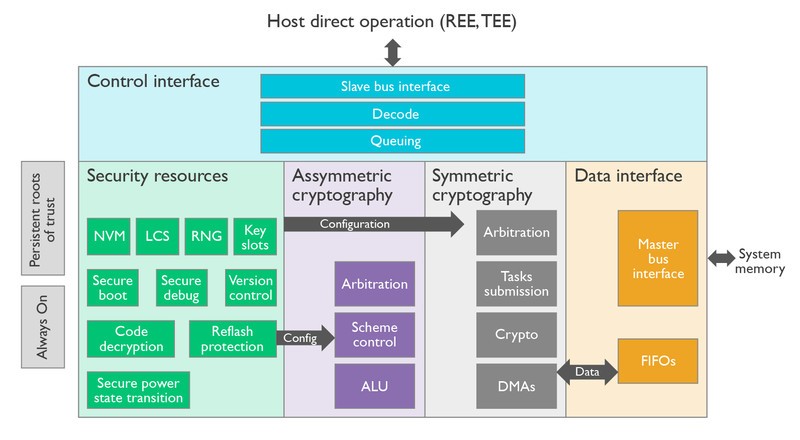 ARM TrustZone TEE block diagram.
When you register a fingerprint on your Android phone, the sensor grabs the data from the scan. Trusty OS analyzes this data inside the TEE, then creates two things: a set of validation data and an encrypted fingerprint template. This appears to be junk data to everything except the TEE who also has the key to decipher that junk data. This encrypted fingerprint template is stored in an encrypted container either on the TEE or on your phone’s encrypted storage. Three encryption layers mean it’s nearly impossible to get the data, and even if you could it’s useless without a way to decipher it.
Android requires your fingerprint data to be secured with a unique key, and you can;t take it to another phone or reuse it for another user.
The validation data is stored inside the TEE. When you place your finger on the scanner to try and do something, the scanner builds a profile of data. Through the Trusty API, the associated application asks the kernel to ask the TEE if it’s right. The TEE checks against the stored validation data using its separate processor and memory, and if enough of the data matches it says yes. If there isn’t enough matching data, it says no. This pass or fail response is sent back to the kernel as a software token that the API can read to see the result.
While the TEE itself uses a standalone OS and hardware to stay secure, the fingerprint template uses software-based encryption. It must be signed by a very specific key to be valid. This key is created using device-specific information, user-specific information, and time-specific information. In other words, if you remove a user, change devices or attempt to re-register a fingerprint (the system can tell if you’re overwriting an existing fingerprint) the key is no longer recognized and can’t be used to decrypt the fingerprint template.
The basic rules that every company making Android phones with a fingerprint sensor have to follow:
- All fingerprint data analyzation must be performed inside the TEE
- All the data associated with a fingerprint must be stored in the TEE or in trusted memory (memory that the main CPU can’t even see)
- Fingerprint profile data must be self-encrypted even if stored in encrypted phone storage
- Removing a user account must also securely wipe any data associated with that user’s fingerprints
- Where fingerprint profiles are stored must not be visible to any application, process, or user including the root user
- Fingerprint data of any kind must not be backed up to any other source, including the cloud or your computer or any application
- Fingerprint authentication must be used by the process that requested it (no sharing of any fingerprint data, even just the yes or no answer to see if it was correct)
When you have a few standard specifications that are clear, it’s not difficult to meet them. This is what makes sure that no matter what Android phone you’re using your fingerprint data will be stored safely and no other system process or app can get access to it. As cryptography evolves, especially hardware-backed encryption, so will this method of keeping your fingerprint data safe. It will be interesting to look back once Android Z launches and see how far we’ve come.
The Morning After: Tuesday, September 28th 2017
Welcome to Tuesday morning! Would you like access to Netflix on your next flight? You might get your wish. We also take a look at the biggest problem with Star Trek: Discovery — CBS All Access.
A smartwatch you don’t have to charge every day.
Fitbit’s Ionic smartwatch arrives October 1st for $300

Fitbit is only just now ready to deliver its first smartwatch, as the Ionic finally has a release date and price. We spent 24 hours with the device and found that its pre-release software could use some work. That said, it also has five-day battery life and it’s possible many of the wrinkles will be ironed out by the time it ships next week along with Fitbit’s $130 Flyer headphones.
It’s all about behind-the-scenes changes.
MacOS High Sierra is well worth the upgrade

MacOS High Sierra was never meant to be truly transformative. As we covered in our preview of Apple’s new desktop OS, it’s mostly focused on refining its predecessor, last year’s Sierra. At the same time, it also lays the groundwork for bigger changes down the line. Oh, and you can download it yourself now.
Almost interesting.
Kodi box piracy case comes to anti-climactic end
A UK man arrested for selling “fully-loaded” Kodi boxes has suddenly backed down from fighting his case. Brian ‘Tomo’ Thompson pleaded guilty to two charges under the 1988 Copyright, Designs and Patents Act. Going to trial could have cleared up legal murkiness over who is responsible for piracy that occurs via the platform, but we won’t get that resolution from this case.
And you can overclock them more than before.
Intel’s eighth-gen desktop CPUs boost gaming and streaming speeds
Intel’s eighth-generation mainstream desktop chips are the heavy-lifters you’d hoped for. It’s calling the flagship $359 Core i7-8700K its “best gaming desktop processor ever.” The biggest gains are with multitasking, and Intel says gaming, streaming and recording with Player Unknown: Battlegrounds will be 45 percent faster than before. It can also be overclocked to 4.7 GHz using Intel’s Turbo Boost 2.0, and 5GHz and higher speeds are easily achieved with air or basic liquid cooling.
Thank you, mobile-streaming tech.
In-flight Netflix will be available on more airlines in 2018

Netflix’s in-flight streaming is available through a few carriers around the world, but it’s still a surprise more than a fixture. More often than not, technological limitations will force you to download that new show before you leave home. Now, Netflix is launching an initiative that will use the encoding technology it developed for mobile devices to make the streaming service accessible on aircraft that don’t have the luxury of fast satellite internet access.
It’s very exclusive.
The new ‘Star Trek’ series is good, but there’s just one problem

Star Trek: Discovery seems just as good as anything CBS has on the air. So the question is: Why the requirement of a CBS All Access subscription just for US viewers? After all, it’s airing on Netflix in the rest of the world, except Canada, where it can be seen on the Space channel.
How to threaten a nation without being banned.
Twitter tries to explain why Trump’s posts aren’t like others

Two factors: Newsworthiness and “public interest.”
But wait, there’s more…
- Tesla Model 3’s touchscreen control panel detailed in new video
- Microsoft and Facebook’s massive undersea data cable is complete
- Google Home adds reminders to its voice-control repertoire
- Verizon gives up on its Android Wear watch after four months
Apple’s Safari update secretly mines data to protect your privacy
Apple’s newly launched macOS High Sierra may not be flashy on the outside, but there’s plenty going on beneath the surface. Admittedly, some of its high-profile upgrades are easier to spot: Like Safari muting autoplaying videos by default. However, another modification to the browser could go unnoticed. As noted by TechCrunch, Safari is now quietly collecting your data. If you opt-in, Apple’s differential privacy tech will gather your activity info in order to identify problematic websites. These are the types of murky domains that can debilitate the browser by using too much power, and can even cause it to crash by hogging memory. The tech giant plans to document the popularity of these sites to help it figure out which ones it should tackle first.
Differential privacy is already used by Google to amass Chrome data, whilst keeping individual user info hidden. In Apple’s case, the tech was unveiled at its WWDC event last year, and rolled out with iOS 10. Until now, it’s mainly been used to bolster the company’s Siri AI, and to monitor info from keyboard, Spotlight, and Notes. Like Google, Apple’s algorithm jumbles the data so it doesn’t mark an individual user, and then analyzes it wholesale for patterns.
There’s no direct mention about the tech’s introduction when you install High Sierra. Instead, it’s grouped in with the other device analytics data Apple collects. But, keep in mind, you still have the ability to stop it at any time. This can be done by turning off analytics altogether. Alas, that will also opt you out of sharing other device info, including details about system crashes, freezes, and third-party software.
Via: TechCrunch
The world’s first blockchain smartphone is in development
Sirin Labs, the company behind the $14,000 Solarin smartphone, is now developing an open-source model that runs on a fee-less blockchain. The Finney — named in honor of bitcoin pioneer Hal Finney — will be the only smartphone in the world that’s fully secure and safe enough to hold cryptographic coins. Or so says the company, which is launching a crowdsale event this October (date to be confirmed) to support the phone’s development.
According to Sirin, all Finney devices (there’s an all-in-one PC coming, too) will form an independent blockchain network powered by IOTA’s Tangle technology. The network will operate without centralized backbones or mining centers cluttering up the transaction process, using the SRN token as its default currency (only SRN token holders will be able to purchase the device). And it’ll all run on a Sirin operating system specially designed to support blockchain applications such as crypto wallets and secure exchange access.
The phone comes with all the bells and whistles you’d expect from a device with a $1,000 (£740) price tag, including a 256GB internal memory and 16MP camera, plus a hefty suite of security measures. A behavioral-based intrusion prevention system, physical security switch and blockchain-based tamper proof feature mean that, in theory, it’s going to take considerable effort to hack. But the question is whether anyone would want to. “The crypto community” is still a niche market, certainly more niche than the affluent business market the $14,000 Solarin was intended for, and that didn’t work out so well — only 10 months after its launch the company laid off a third of its staff, claiming it would be “pursuing new directions to a new product line”. Some have suggested the Solarin was a product ahead of its time, and the Finney may well be too.
Google Assistant can order around LG’s connected appliances
LG has placed its trust on Google Assistant and has given it the power to control its smart appliances. While it teamed up with Amazon earlier this year to give its refrigerators built-in access to Alexa, its partnership with Google is much bigger in scale. Now, you can control any of the company’s 87 WiFi-connected smart home appliances by barking out orders through a Google Home speaker or through a compatible iOS or Android smartphone.
Once you’re done setting voice control up through LG’s SmartThinQ app, you can use commands within a Home speaker’s range or through a phone to tell your fridge to make more ice or to tell your AC to adjust the temperature. If you have an LG washing machine, you can ask Assistant how much time is still left before your load is done. You can also ask it to check the quality of air in your home if you have LG air purifier or ask it to preheat the over before you get home from work.
To entice new customers to put the feature to good use, LG is giving away a free Google Home device with a WiFi-enabled LG appliance. The promo is available nationwide, but will only last from October 8th to 25th and is unfortunately limited to one Home speaker per household.
iPhone X Comes With 2,716mAh Battery and 3GB of RAM
Previously unconfirmed details about the internal specifications of Apple’s iPhone X appear to have been revealed on China’s official communications certification board, including the device’s system memory, CPU clock speed, and battery capacity.
First spotted this morning by mobile leaker Steve Hemmerstoffer, the filing with the Chinese Ministry of Industry and Information Technology’s Telecommunication Equipment Certification Center (TENAA) lists the iPhone X as having a 2,715mAh battery. For reference, the iPhone 8 is believed to have a 1,821mAh capacity battery.
The step up in battery capacity is probably a direct result of the iPhone X’s OLED screen, a display technology that despite usually requiring less energy than an equivalent LCD panel, probably draws more overall power because of its 5.8-inch size (iPhone 8 and iPhone 8 Plus have 4.7-inch and 5.5-inch screens, respectively).
For those who cares about #2, Tenaa just confirmed #iPhoneX comes with 3GB of RAM, reveals 2716mAh battery… pic.twitter.com/WCtvqg6e5j
— Steve H. (@OnLeaks) September 26, 2017
The TENAA listing also gives the A11 Bionic chip a 2.4GHz clock speed and says the handset is backed by 3GB of RAM, two details that are believed to conform with the iPhone 8 Plus.
iPhone X pre-orders officially begin on October 27 and in-store availability is expected on November 3, although rumors suggest the device will be in short supply until early 2018.
Related Roundup: iPhone X
Discuss this article in our forums
Amazon Music Mobile App Updated With Alexa Integration
Amazon has updated its Amazon Music iOS app so that its Alexa virtual assistant can now be used to play songs and discover new artists. After installing the update, users in the U.S., U.K., Germany, and Austria can ask Alexa to play music by genre, decade, mood, tempo, activity, and even lyrics.
The feature is activated from the app interface using a new Alexa button, which has been designed to feel like a natural extension to asking Alexa smart speakers around the home to play music, while aiding users who aren’t using two hands to interact with their phone.
Alexa is capable of responding to commands like “play the song of the day” or “play music for studying”, adding an extra level of discoverability to Amazon Music when using the iOS app. As noted by The Verge, music companies are also reportedly investigating whether Alexa can be leveraged to make Amazon’s music services more competitive, with song metadata like tagging and categorization being seen as potential entry points for more sophisticated voice-activated music features.
Set to launch in December, Apple’s $350 HomePod smart speaker uses Siri to enable similar voice-activated commands, which Apple hopes users will come to view as an intelligent “virtual DJ” that can learn and adapt to their musical tastes.
The Amazon Music app is a free download for iPhone and iPad available from the App Store. [Direct Link]
Related Roundup: HomePod
Tag: Amazon Music Unlimited
Discuss this article in our forums
Apple TV 4K Teardown Reveals 3GB of RAM and Larger Venting System With Replaceable Fan
iFixit has shared an Apple TV 4K teardown, providing a closer look at the device’s internal design and components.
We already know the Apple TV 4K is equipped with Apple’s 64-bit A10X Fusion chip, and now the teardown confirms the device has a total of 3GB of LPDDR4 RAM supplied by SK Hynix. That’s up from 2GB RAM in the previous Apple TV.
 1GB + 2GB of LPDDR4 RAM outlined in yellow for a total of 3GB of RAM
The new power supply is rated for 12V at 1.083A, a modest increase over the 12V at 0.917A power supply in the previous Apple TV.
According to the teardown, Apple merged the new fan with the heat sink/EMI shield assembly from the fourth-generation Apple TV to create a larger thermal assembly for cooling and ventilation.

iFixit said the bottom of the unit has been redesigned with a total of eight exhaust ports and a new, replaceable fan driven by a Nidec brushless motor.
Beyond the return of a Gigabit Ethernet port and the removal of the USB-C diagnostic port, which we learned about before the teardown, the Apple TV 4K’s design is largely the same as the previous Apple TV.
 Apple TV 4K has no USB-C port
iFixit gave the Apple TV 4K a repairability score of 8 out of a possible 10 points. The device is easy to open and has modular components, but they’re soldered to the logic board, so board-level soldering or full board replacements are required.
Related Roundup: Apple TV
Tags: iFixit, teardown
Buyer’s Guide: Apple TV (Buy Now)
Discuss this article in our forums
 AIVAnet