


PS4 and Xbox owners were able to play ‘Fortnite’ together
You know how Sony is adamant about not allowing cross-platform play between PlayStation 4, Switch and Xbox One? Well, something interesting happened in Epic Games’ Fortnite over the weekend: Xbox players were found in a handful PlayStation Battle Royale matches. A Reddit user noticed that someone in his PS4 game had a space in their handle (something allowed in Xbox Gamertags, but not on PS4), and then the thread picked up to include further examples like a father and son playing together on disparate consoles. A Twitch stream with video proof is embedded below. Curious, indeed.
We’ve reached out to Epic, Microsoft and Sony to see if this is a bug or a feature and will update the post should it arrive. Given Sony’s hardline stance against letting people on different consoles play together, it’s probably the former. As of press time, only Epic responded. “We had a configuration issue and it has now been corrected,” a spokesperson tells us. So, it seems like connecting the consoles is as relatively simple as we’ve been told
Watch live video from psnprecision on http://www.twitch.tv
Via: Eurogamer
Source: Reddit
Apple’s Venmo-like money transfers will arrive after iOS 11
A new payment service from Apple is set to launch sometime this fall through iOS 11 and watchOS 4 updates. Apple Pay Cash will allow Apple device users to transfer money between each other within Messages or through Siri.
Once it’s available, users can tap the App Store icon in the Messages app and then select Apple Pay from the app options. After inputting the amount and selecting a payment card, the transaction will then be authenticated via Touch ID or Face ID and completed. The funds will be available in the recipient’s Apple Pay Cash card, which can be used via Apple Pay or transferred to a bank account. And any card linked to Apple Pay can be used to send funds.
The new Venmo-like service has been in the works for a while and was initially expected to launch with iOS 11, but users are going to have to wait a bit longer. “Coming this fall with an update to iOS 11 and watchOS 4, Apple Pay users will be able to send and receive money from friends and family quickly, easily and securely. Pay and get paid right in Messages, or tell Siri to pay someone, using the credit and debit cards they have in Wallet,” Apple said in a statement.
Via: MacRumors
Source: Apple
Equifax stock sales prompt DOJ investigation for insider trading
Things are about to get even worse for Equifax, and rightfully so. According to reports from Bloomberg, the US Department of Justice (DOJ) has opened a criminal investigation into Equifax officials’ stock sales just before the announcement of the security breach that exposed data from 143 million US consumers. Equifax CFO John Gamble, President of US Information Solutions Joseph Loughran and President of Workforce Solutions Rodolfo Ploder dumped nearly $1.8 million in stock just after the company discovered the breach and about a month before it was announced. Equifax has maintained that the three didn’t know about the breach when they sold the stock.
The Securities and Exchange Commission (SEC) is also looking into the sales and what the executives knew beforehand to see if the move constitutes insider trading. The DOJ investigation will work alongside the SEC’s and will be headed by US prosecutors in Atlanta, say Bloomberg’s sources. Those agencies are joined by the Federal Trade Commission (FTC), which is also looking into the breach. Last week, dozens of senators sent letters to the DOJ, SEC and FTC requesting investigations into potential insider trading.
There are a lot of eyes on this breach and two executives have already left the company, though Equifax says they retired. Chief Security Officer Susan Mauldin and Chief Information Officer David Webb left late last week.
Source: Bloomberg
Intel’s self-driving tech will make Waymo vehicles fully autonomous
Intel has been so committed to break into the self-driving car market that it bought autonomous tech-maker MobilEye for $15 billion earlier this year. While Intel’s tech has powered Waymo’s test fleet of autonomous Chrysler minivans for a while, the chipmaker just entered an official partnership with Google’s self-driving offshoot. Part of their agreement: Intel’s tech will eventually enable Waymo’s cars to become fully autonomous.
This is likely good for both parties. Intel’s compute has powered the sensor suites and processing in Waymo’s current fleet of vehicles, and claims that its tech will be efficient and powerful enough to enable them to reach level 4 and 5 autonomy eventually. The latter of which represents true self-driving capability. Developing Waymo’s system will help the chip-maker get a better foothold in the self-driving market.
Or, read another way, it’s a growing network of technology and transportation providers on one side — Alphabet partnering with (and potentially pouring $1 billion into) Lyft, Waymo partnering with Intel — and Uber on the other. Google dropped all but one of its charges in its lawsuit against Uber, but both titans remain locked in litigation over patent infringement. Thanks to the case, emails surfaced revealing that the ride-sharing juggernaut had sought a partnership to tackle autonomous driving together, which Google turned down to launch Waymo.
Source: Intel
Lyft thinks it can fix Los Angeles traffic with fewer lanes
For the past several decades, cities have designed streets around the assumption that they’ll be used for personal cars. If you need a poster child for this, you just have to look at Los Angeles’ Wilshire Boulevard — it has a whopping 10 lanes for vehicles, and even the bus lanes are almost treated like afterthoughts. It’s no wonder gridlock is such a common problem, since LA is practically inviting more drivers and the traffic chaos that results. Lyft isn’t happy with this state of affairs, and it thinks urban planners need to reinvent the road if they want to reduce traffic and embrace the future. It’s partnering with designers at Perkins+Will and Nelson/Nygaard on a conceptual Wilshire Boulevard redesign for an era when car ownership fades away and public options dominate. There would be fewer lanes, but it could potentially serve up to 77,000 people per hour instead of today’s 29,600.
Lyft’s vision would only have three lanes for general-purpose driving. The rest would be intended for, well, everything else. There would be two autonomous bus lanes, and a loading zone would give ridesharing passengers a dedicated pickup space. Logically, many of these rides would be self-driving cars. You would also see two bike lanes, wider sidewalks and more landscaping. Lyft is clearly betting that you’ll be more likely to forego a personal car if the alternatives are treated as first-class options, and that increased autonomy could handle many more commuters. The bus lanes alone would handle as many as 35,000 people per hour, according to Lyft’s estimate.
This doesn’t mean that Los Angeles will implement Lyft’s redesign — it’s only an idea right now. With that said, it’s likely to find a receptive audience. Lyft is already working with the Southern California Association of Governments on a campaign for more intelligent streets, and Los Angeles is planning for half of all trips to rely on something other than a car by 2035. In that sense, the challenge isn’t so much phasing out LA’s notoriously car-centric focus as it is transitioning at the right moment. Self-driving vehicles are still in their infancy, and officials might spark more than a little outrage if they reduce lane counts before most Angelenos are ready to ditch their own vehicles.
Via: TechCrunch
Source: CNN
Shure puts its pro-audio chops to work in $100 Bluetooth earbuds
Shure, the UK audio company that made its bones early in the middle of the 20th century with its iconic Unidyne grill microphones, got into producing high-end earphones and headsets in the late 1990s. The company is finally joining the rest of the audio world by releasing its first-ever Bluetooth earbuds, along with a new $100 proprietary cable that enables older models to be used wirelessly, too.
Any of Shure’s noise-cancelling SE line, which all feature detachable earbuds, can be linked up with the Bluetooth Accessory Cable. The new $150 SE215 buds, the more expensive of the pair introduced today, operate this way (and come in several colors): Fans of the headphone jack can still plug in to a headphone jack with a separate cable if they wish, or they can pop off the SE215’s and use its cable to make fancier SE earbuds wireless. The cheaper $100 SE112 are a single cord-and-earbuds unit and only come in black. All of these options are Bluetooth 4.1-compatible, promise eight hours of battery life and have a 30-foot range.
Sure, Shure was late to the Bluetooth earbuds party. But with Apple’s next iPhones leaving the headphone jack behind for good and the glut of Bluetooth sets we saw at IFA 2017, it’s still savvy to get into the wireless audio market.
Via: The Verge
Source: Shure
PGA Tour taps Intel for VR coverage of six upcoming tournaments
Intel has been powering virtual reality sports viewing for some time now. The chip maker has enabled VR for the Olympics, Major League Baseball and the National Football League, and has taken virtual reality to the golf course with the PGA. It’s this last partnership in the news now, with Intel and the PGA Tour organization connecting to produce and distribute live VR and 360 video at six upcoming PGA events starting with the Tour Championship at East Lake Golf Club in Atlanta from September 21st to the 24th. It will continue VR coverage at the Presidents Cup at the Liberty National Golf Club in Jersey City from September 28th through October 1st.
Intel’s True VR tech gives golf fans panoramic, steroscopic camera access to the competition, which allows for naturalistic and realistic views from any direction, something you can’t even do on site. “From the Tour’s perspective, our goal with VR is to create an experience that is completely different than what you can get as a fan at our events or by viewers of our traditional media platforms,” said the PGA’s Rick Anderson.

The live VR events can be seen with Samsung Gear VR headsets via a PGA Tour VR Live app, which you can grab from the Oculus store. The 360-degree video will show up on Twitter and Periscope for those without a VR headset, and both types of coverage will focus on holes number one, 15 and 18 starting the 21st. Following VR coverage at the Presidents Cup includes views of the driving range and “fan chaos” from the opening holes, while the other tour events include the 2018 Waste Management Phoenix Open and the 2018 The Players, with more to be announced soon.
Source: Intel
Kuo: Apple Watch Series 3 Demand Higher Than Expected as iPhone X Anticipation Cannibalizes iPhone 8 Pre-Orders
Demand for Apple’s high-end flagship iPhone X is “very likely” to cannibalize iPhone 8 pre-orders, predicts KGI Securities analyst Ming-Chi Kuo in a note sent out to investors this morning.
iPhone pre-orders traditionally sell out in September due to high demand, but this year, many models of the iPhone 8 and the iPhone 8 Plus were available for launch day delivery through the weekend, and continue to remain readily available for launch day pickup in Apple retail stores.
Kuo, like many of us, believes this is because many customers are awaiting the iPhone X. KGI is “positive on demand” for iPhone X and believes the market will be conservative on iPhone 8 and its suppliers in the near term. High demand for iPhone X, which does not launch until November, could impact Apple’s fourth-quarter earnings results.
Historically, it takes 3-6 weeks or more to ship new iPhone models after they are available for preorder, due to initial tight supply and robust demand. However, our latest review indicates it will take less than 1-2 weeks for the iPhone 8. We believe this is because there is a strong likelihood that iPhone X demand will cannibalize iPhone 8 pre-orders
As for the Apple Watch Series 3, Kuo says demand for the LTE version of the device was “significantly stronger” than expected, perhaps due to the “low premium of $70” over the non-LTE version of the watch.
He believes pre-order weighting of the GPS + Cellular version of the Apple Watch to be 80 to 90 percent over the non-LTE version, though that prediction does seem somewhat questionable given the limited number of countries where the LTE version of the device was available for purchase.
Before the media event, we forecasted the production weighting of the GPS + Cellular version would be 30-40%. However, the pre-order website shows shipments of this version are taking much longer than those of the GPS version (3-4 weeks, from shipments launch day of September 22). We estimate the preorder weighting of the GPS + Cellular version is 80-90%.
Apple Watch Series 3 models equipped with LTE began selling out within 15 minutes of when pre-orders became available for the device on Friday, September 15. It will now take a good three to four weeks to get one of the LTE Apple Watch models, with no in-store pickup available at this time.
The first iPhone 8, iPhone 8 Plus, and Apple Watch Series 3 orders will begin arriving to customers on September 22, the official launch date for the devices.
Apple plans to begin accepting pre-orders for the radically redesigned iPhone X on October 27 ahead of a November 3 launch date.
Related Roundups: Apple Watch, watchOS 3, watchOS 4, iPhone 8
Buyer’s Guide: Apple Watch (Buy Now), iPhone (Buy Now)
Discuss this article in our forums
Apple to Open Spacious New Store at Century City in Los Angeles as Part of Mall’s $1 Billion Modernization
Apple is constructing a spacious new retail store at Westfield Century City in Los Angeles, California, as part of the shopping mall’s $1 billion expansion and modernization plans, according to a source familiar with the matter.
Apple’s upcoming retail store at Westfield Century City
Apple will be in a prime location at the center of the mall, described as the crossroads of the project. The new store will be next to indoor bike company Peloton, and opposite an upcoming Rolex watch store, the person said.
It’s unclear when the new store will open, but Westfield expects to complete the final phase of the mall’s renovation plans by the end of the year. Given that timeline, Apple’s grand opening should be no later than in the spring.
Apple’s current store at Century City opened in June 2005 and has significantly less square footage. The larger store will provide the space needed to accommodate more products, increased customer traffic, and Today at Apple sessions.
 Apple’s current store at Westfield Century City
The new store will also be based on Apple’s latest retail design, including large glass doors, sequoia wood tables and shelves, a large video screen for Today at Apple sessions, and light boxes spanning the length of the ceiling.
All new Apple retail stores opened since September 2015 have been based on the updated design, including Apple’s flagship Union Square location in San Francisco. Apple has also renovated over 40 existing stores with the newer look.
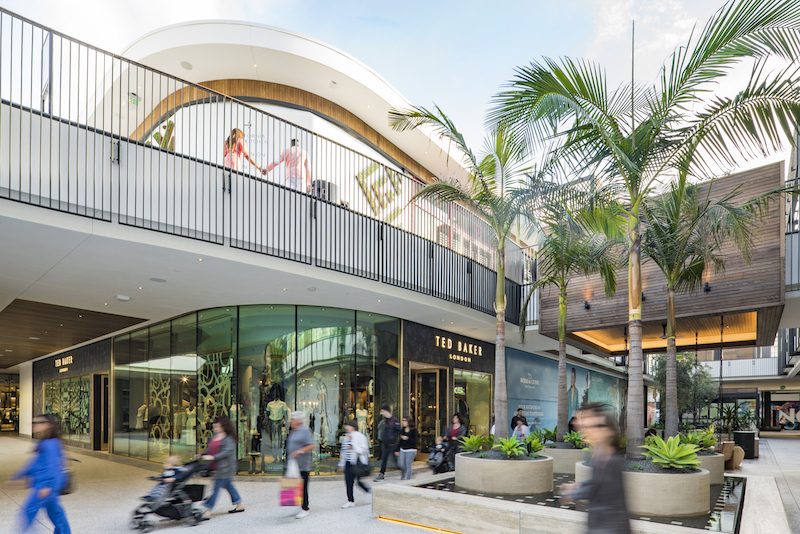
Westfield Century City’s makeover also includes the West Coast’s first Eataly, new public areas and landscaped open-air plazas, double its parking capacity, a new 156,000 square foot Macy’s, and dozens of other new shops and restaurants.
(Thanks, Peter Nichols!)
Related Roundup: Apple Stores
Discuss this article in our forums
iPhone 8 and iPhone X Don’t Support T-Mobile’s Upcoming 600 MHz LTE Network
Apple’s iPhone 8, iPhone 8 Plus, and iPhone X are not compatible with LTE Band 71, aka T-Mobile’s new 600 MHz spectrum the company plans on rolling out in the United States as soon as this year.
All new iPhone models in the United States support FDD-LTE Bands 1, 2, 3, 4, 5, 7, 8, 12, 13, 17, 18, 19, 20, 25, 26, 28, 29, 30, and 66, and TD-LTE bands 4, 38, 39, 40, and 41, according to the Tech Specs page for the devices.
Support for additional bands can’t be added retroactively, so Apple’s devices will not work with LTE Band 71 until support is added to future iPhones.
T-Mobile purchased the 600 MHz spectrum in an FCC auction in April of 2017. Shortly after, T-Mobile announced plans to use the spectrum to deliver 5G coverage starting in 2019, but later said it would use the spectrum to improve its network in rural America starting this year.
Unfortunately, by the time T-Mobile purchased the spectrum and announced plans for rapid implementation, the LTE chips and the hardware for the iPhone 8, iPhone 8 Plus, and iPhone X were likely already secured, giving Apple no time to build in support for a newly announced LTE band.

T-Mobile in August activated the first 600 MHz LTE site in Cheyenne, Wyoming and has said it will deploy the spectrum at a “record-shattering pace” with plans to roll out 600 MHz sites in Wyoming, Northwest Oregon, West Texas, Southwest Kansas, the Oklahoma panhandle, Western North Dakota, Maine, Coastal North Carolina, Central Pennsylvania, Central Virginia, and Eastern Washington, but whether T-Mobile will hit that goal and get 600 MHz support in those locations by the end of 2017 remains to be seen.
As Peter Cohen points out, deploying the 600 MHz network is a complicated, time-consuming process that will span several years, so most iPhone 8, 8 Plus, and X users won’t be heavily affected by the lack of support for the new LTE band at this time.
Like every other carrier, T-Mobile is entirely dependent on a nationwide industry of independent cellular tower owners, operators and technicians to get their hardware deployed. Even if T-Mobile had unlimited funds to get a 600 MHz network up and running, there simply aren’t enough people in the industry who can climb the towers, install the new hardware, test it and get it working for them. What we’re talking about is a huge infrastructure effort that goes way beyond just flipping a switch and turning it on.
T-Mobile says Band 71 adds increased building penetration and covers greater distances. When used in metro areas, it improves in-building coverage, and in rural areas, it improves the company’s LTE footprint.
There are no existing devices that support T-Mobile’s new spectrum at this time. Like Apple’s newest devices, for example, Samsung’s Galaxy S8 and new Galaxy Note 8 do not offer support. T-Mobile has said that LG and Samsung will launch devices compatible with the spectrum by the end of the year, and LG’s upcoming LG V30 will be one of the first devices to support it.
Related Roundups: iPhone 8, iPhone X
Tag: T-Mobile
Buyer’s Guide: iPhone (Buy Now)
Discuss this article in our forums
 AIVAnet