


The Engadget Podcast Ep 42: Everything Apple
Unless you’ve been living under a rock, you know that Apple held a keynote at its glass-empaneled new “spaceship” campus this week, during which it announced a boatload of stuff. So much stuff, in fact, that my colleague Chris Velazco and I devoted an entire episode of the Engadget Podcast to it. Join us as we talk about the new iPhones (all three of them), plus the Apple TV 4K and LTE-enabled Apple Watch Series 3.
Relevant links:
- Live from Apple’s iPhone X event!
- Our first look at Apple’s new ‘spaceship’ campus
- iPhone X hands-on
- The iPhone X vs. the competition
- iPhone 8 and 8 Plus hands-on
- Apple TV’s 4K movie pricing is exactly what the 4K world needs
- Apple Watch Series 3 hands-on
- The iPhone 8 won’t get lost in the shadow of the iPhone X
- When there’s the iPhone X, why bother with the iPhone 8?
- The iPhone X leaves a home-button-shaped hole in my heart
Subscribe on Google Play Music
Subscribe on iTunes
Subscribe on Stitcher
Subscribe on Pocket Casts
Chrome will make autoplay videos less annoying in 2018
Over the next few months, Chrome will gain abilities to minimize the impact of annoying autoplay videos until they no longer make you want to hurl your laptop across the room. Starting in January next year, the browser will no longer autoplay videos unless they’re muted and don’t have sound or you’ve shown interest in watching them. The feature will roll out with Chrome 64, though version 63 will also come with its own autoplay-busting feature: when it becomes available for download in October, it’ll give you the ability to permanently mute whole websites.
Wondering what Chrome considers as “showing interest in autoplaying videos?” On mobile, it’ll autoplay files on websites you’ve saved on your Home Screen. Chrome for desktop, on the other hand, will initiate autoplay if you typically play media on the website you’re looking at. Google says the feature will “unify desktop and mobile web behavior” and that the changes “will give users greater control over media playing in their browser, while making it easier for publishers to implement autoplay where it benefits the user.”
While the feature won’t officially come out until January, the new autoplay policies will go live in Chrome 64 Beta in December. Google also promised to release a built-in ad blocker for Chrome in 2018, though that will likely roll out after the browser’s new autoplay protocol goes live.
Via: VentureBeat
Source: Google
Nissan and Mitsubishi to launch 12 EVs and a ‘robo’ ride service
Renault-Nissan and Mitsubishi are joining forces to produce electric and hybrid cars and become “a global leader in ride-hailing services,” they announced. The group, called Alliance 2022, will partner up on 12 electric cars and 40 vehicles with autonomous driving tech by, you guessed it, 2022. “With the emissions rules coming in, it’s the end of gas,” said Alliance 2022 CEO Carlos Ghosn in a statement. “Between now and 2040 there will be no more diesel and gasoline. This is absolutely a scenario.”
Alliance 2022 didn’t have any vehicle designs or prototypes to show off. However, it did specify that it will launch four shared platforms with the aim of producing over 9 million vehicles on them. Around 75 percent of total sales from the group would come via the common platforms, and by 2022, it aims to generate $240 billion in revenues.
Alliance 2022 is going all in on ride-sharing, too. “Becoming an operator of robo-vehicle ride-hailing services is a major part of the new mobility services strategy,” the press release states. However, the group didn’t unveil many details on those plans, either, merely saying that it would launch 40 self-driving vehicles with different levels of autonomy.
Unlike, say, GM and Lyft, Alliance 2022 didn’t reveal any plans to team up with a ride-sharing service. It’s fair to assume that Renault’s recent acquisition of Karhoo, which is set to relaunch this year after being effectively dead, will figure into its plans, though.
Nissan is an EV pioneer, having launched the Leaf in 2010, a while before GM and even Tesla had mainstream EVs on the market. Until recently, the same couldn’t be said about its Japanese rivals Toyota and Honda, which had focused on hydrogen instead. In the last month, however, both companies have unveiled ambitious EV plans, Honda with the EV Clarity and Toyota via a Mazda alliance.
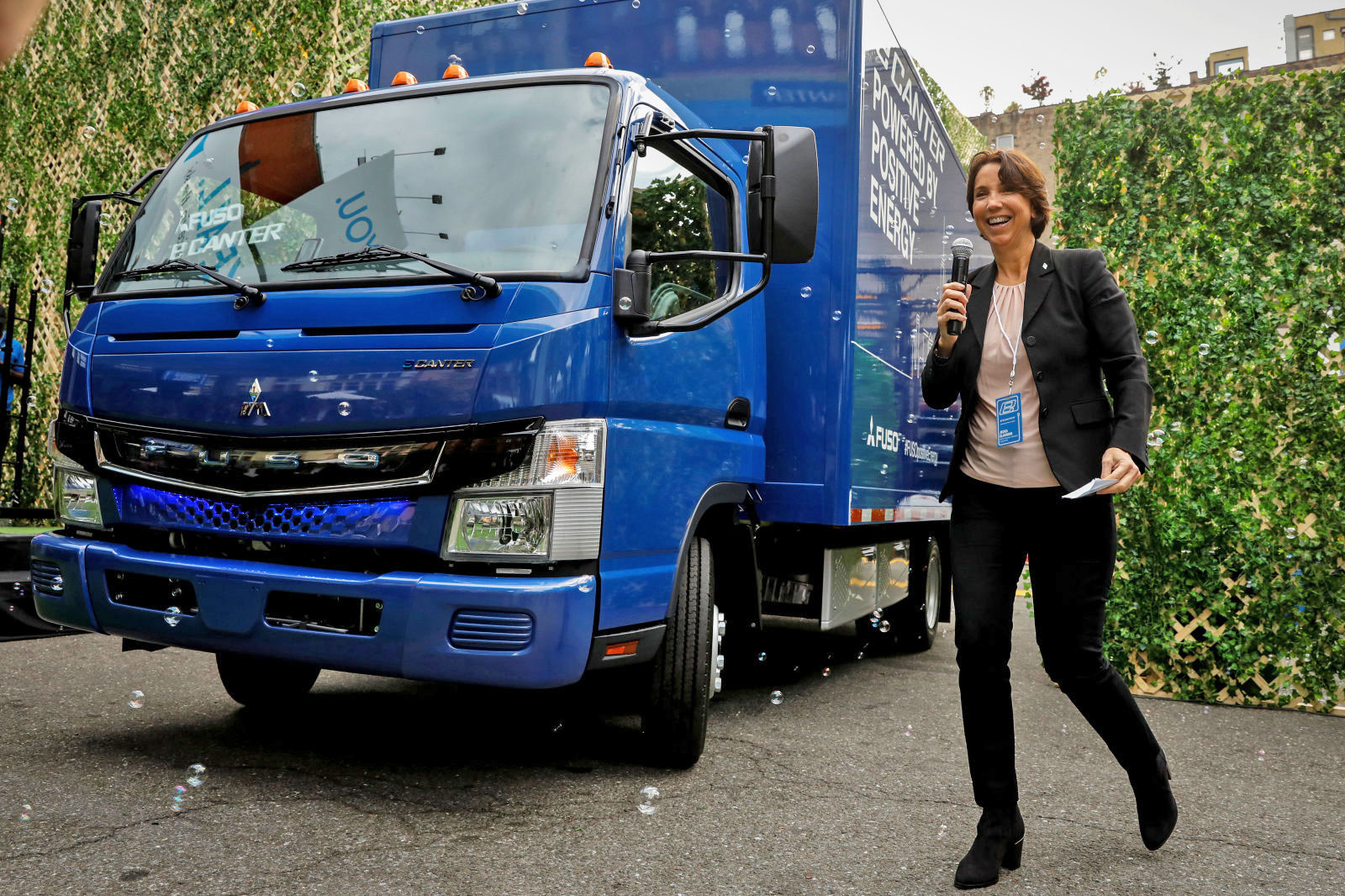
Renault, meanwhile, has had decent success so far with its latest Zoe, which can easily travel 300 km (about 200 miles) on a charge. Mitsubishi, meanwhile, is set to deliver some of the first electric trucks (above) in the US.
Source: Alliance 2022
Apple Pay Coming Soon to Dubai’s Largest Bank in Middle East
Apple has updated its website to indicate that Emirates NBD, the largest bank in Dubai, will soon offer Apple Pay.
Emirates NBD has confirmed Apple Pay is coming soon in a recent email to customers, including MacRumors reader Hafez.
@MacRumors Apple Pay is coming to Dubai pic.twitter.com/IsfjXCUP74
— Hafez (@hafezberg) September 15, 2017
Last month, Apple announced that Apple Pay will expand to Denmark, Finland, Sweden, and the United Arab Emirates by the end of the year.
The new page on Apple’s regional website for the United Arab Emirates now lists Apple Pay as “coming soon” in the country, suggesting a launch is imminent. The page has yet to go live in Denmark, Finland, and Sweden.
Other participating banks in the United Arab Emirates will include Mashreq Bank, Emirates Islamic Bank, Rakbank, Standard Chartered, and HSBC.
MasterCard and Visa credit and debit cards will be supported at launch.
Related Roundup: Apple Pay
Tag: United Arab Emirates
Discuss this article in our forums
Advertising Groups Ask Apple to ‘Rethink’ New Cookie Tracking Standards in Safari 11
In the upcoming version of Safari 11 on macOS High Sierra, Apple will implement a new “Intelligent Tracking Prevention” feature that builds upon Safari’s default blocking of third-party cookies. ITP will greatly limit advertiser reach by placing new safeguards into Safari that use machine learning to suppress cross-site tracking and purge ad retargeting data after 24 hours.
In response, six trade and marketing organizations have written an open letter to Apple asking for the Cupertino company to “rethink” its plan to launch Safari with these new “arbitrary” cookie standards (via AdWeek).
The organizations argue that the Internet’s infrastructure depends on consistent standards for cookies, saying that Apple’s new ruleset could “sabotage the economic model for the Internet.”
On the consumer side of things, the organizations stated that the blocking of cookies in Apple’s manner will result in ads that are “more generic” for users, while also being “less timely and useful.” The signed organizations include: American Association of Advertising Agencies, American Advertising Federation, Association of National Advertisers, Data & Marketing Association, Interactive Advertising Bureau, and Network Advertising Initiative.
We are deeply concerned about the Safari 11 browser update that Apple plans to release, as it overrides and replaces existing user-controlled cookie preferences with Apple’s own set of opaque and arbitrary standards for cookie handling.
Apple’s unilateral and heavy-handed approach is bad for consumer choice and bad for the ad-supported online content and services consumers love. Blocking cookies in this manner will drive a wedge between brands and their customers, and it will make advertising more generic and less timely and useful. Put simply, machine-driven cookie choices do not represent user choice; they represent browser-manufacturer choice. As organizations devoted to innovation and growth in the consumer economy, we will actively oppose any actions like this by companies that harm consumers by distorting the digital advertising ecosystem and undermining its operations.
On Apple’s WebKit site, the company explains that Intelligent Tracking Prevention is meant to ensure user trust is kept during the web browsing experience on Safari, because “the success of the web as a platform relies on user trust.” Also coming in Safari on High Sierra is an autoplay blocking feature, which will prevent videos from automatically playing when you open up a web page. This morning, Google announced a similar feature is coming to Chrome in January 2018.
The new Safari will launch when macOS High Sierra becomes available for download on Monday, September 25.
Tag: Safari
Discuss this article in our forums
Apple readies its 4K movie catalog for Apple TV pre-orders
If you’re sweet on the latest Apple TV, you’re probably also planning on stocking up on 4K downloads. After all, the bump in pixels is its biggest draw. And, if you head to iTunes right now, you’ll see that a bunch of content is available in 4K HDR. The same goes for the TV app for iOS, Macs, and tvOS. For now, the selection seems to be limited to movies, but you can expect the line-up to expand before the Apple TV’s September 22nd release date. The upgraded flicks carry both the “4K” and “Dolby Vision” tags, as spotted by MacRumors.
As we noted during the device’s unveiling, Apple won’t be charging more for higher resolution downloads. The likes of Wonder Woman, John Wick, and La La Land (all currently available in the format) still cost $20 to purchase. Plus, it’s promising to bump all your existing HD purchases to 4K at no extra charge. Pre-orders for the new Apple TV are now open. The $179 set-top box will ship on September 22nd.
Source: MacRumors
Motorola reveals which phones will get Android Oreo
Can’t wait to get Google’s shiny new mobile platform? If you have a Motorola, cross your fingers that you own one of its 10 devices getting the software update. Otherwise, you might have to switch phones to experience what Android Oreo can offer, which includes picture-in-picture multitasking and notification “dots” on your favorite apps. According to the Lenovo-owned phonemaker’s upgrade portal, it’s currently preparing Android Oreo updates for the Moto Z2 Force, Moto Z2 Play, Moto Z Force DROID, Moto Z, Moto Z Play, Moto G5, Moto G5 Plus and their premium counterparts, the Moto GS5 and the Moto GS5 Plus.
There’s one glaring omission from that list: the Moto G4 series, which might be stuck on Nougat despite being only as old as the Moto Zs. While Moto G5 and G5 Plus are already available, their mid-range predecessors only came out halfway into 2016 — some people’s devices might still look brand new. Even if your phone is in the list, you may still want to temper your excitement. The manufacturer didn’t reveal when the update will become available, and its exact rollout still depends on your carrier.
Via: Android Police, GSM Arena
Source: Motorola
What’s next for NASA as Cassini’s mission comes to a close
After nearly two decades in space and 11 years studying Saturn (and its myriad of moons), the Cassini spacecraft ended its mission at roughly 6:30 am Eastern on Friday, when it slammed into the gas giant’s suffocating atmosphere. It was an auspicious end for the $3.4 billion spacecraft, argues Curt Niebur, the program scientist for Cassini at NASA headquarters. “I find it exhilarating myself,” he said. “Instead of just crashing it into something and saying we’re done, we’re actually going after science questions that we never intended Cassini to answer. And we’ll be able to address those. It’s fantastic.”
Any melancholy felt in the JPL mission control room while Cassini hurtled to its demise at 70,000 MPH, was short-lived. However, as with virtually every planetary mission that NASA conducts, Niebur does wish that some elements had played out differently. “The first thing you realize on every mission you do,” he explained, “is that once you get there and get your first measurements taken, is you wish for better instruments.”
There’s a significant lag between the state of the art when a mission launches and when it finally reaches its celestial destination years later. Instruments used for the Discovery missions — NASA’s bread and butter expeditions throughout the solar system — are usually between five and eight years old once they start taking readings. And, given the rate of technological advancement these days, five to eight years is an eternity.

Second on Niebur’s list: more data. Just as with cowbell and Blue Oyster Cult hits, NASA can never have enough data. “Like on Titan, we still don’t have 100 percent coverage of Titan. We’re missing half of it, he explained. “We’ve only done flybys — now, we’ve done over a hundred of them — but a hundred flybys and all you cover each time is a strip of a noodle. Paste all those noodles together you still don’t cover the entire globe.”
Luckily, it won’t be long before we’re back investigating Saturn’s largest moon. There’s just so much to do there. “The things we’ve discovered are exciting enough that they definitely justified new missions,” Niebur said. “You can send any mission you want to Titan. It’s that great a place. Submarines, boats, helicopters, airplanes, rovers — anything. It all works on Titan.” Titan, as well as its smaller lunar sibling Enceladus and Saturn itself, are all on the approved list of targets for the next New Frontiers mission which is scheduled to launch sometime in 2025.
But will we really have to wait until the end of the next decade (assuming it still takes the same amount of time to reach Saturn and its moons that Cassini did)? Unfortunately yes, says Niebur. Solar panels and ionic thruster drives are great but solar only works within a certain proximity of the Sun (hence Cassini’s RTGs) and ionic thrusters take forever to get up to speed.

The recently selected Discovery mission, Lucy, will leverage an ionic engine when it inspects “trojan asteroids” circling the Sun. “It actually goes to one side of the sun to visit some trojans and then goes to the other side of the sun to visit others,” Niebur explained. “And if we were doing that with wet propulsion, it’d never work but with electric propulsion and one small xenon tank, it can go back and forth. It’s not quick but they have the ability to do it.”
Gravitational assists, such as the one used by Cassini to slingshot to Saturn, however, are far more effective. “Nothing beats a gravitational assist, Niebur exclaimed. “Getting a free boost, that is the ultimate in efficiency. You know the Voyager spacecraft are the fastest things out there and that’s because they’ve done so many gravitation assists. We could have never got them going that fast.”
Indeed, every time these ships spun through Jupiter, Saturn, Uranus and Neptune’s gravity wells, they picked up 20km/s of delta V (ie, speed) — for free. “We can never fit that much gas in a rocket” to accomplish the same, Niebur said. Potentially the only system that won’t have to rely on gravitational assists is the upcoming SLS. When it launches carrying the Europa Clipper around 2022, it should be able to reach Jupiter on a direct trajectory in under three years.

That’s a massive improvement over today’s propulsion systems and has been a long time coming. “Every mission builds upon the previous mission. That’s just the limitation we’re operating under,” Niebur said.
“A lot of times people come in and say you know let’s just skip all those steps and go for the brass ring,” he continued. “That sounds very dramatic and it’s very tempting. But it’s also the wrong way to go about doing this.”
That’s namely because we aren’t talking about spending two months coding a mobile app. These missions require decades of design and development, not to mention hundreds of millions if not billions of dollars of investment. “You don’t want to make that kind of gamble and get there and realize whoops I brought the wrong tool set,” Niebur explained. “You’d feel pretty stupid if you went to Mars with a boat. But you’d feel right at home if you did that on Titan.”
But before we set out exploring the solar system again, Niebur sees a couple of key technical challenges that must be overcome. “One of the most pressing and universal challenges is power generation,” he admitted. “Whether it’s a solar nuclear or what have you, every mission we do needs power.” Because of the current limitations in battery and solar collection technologies, NASA is routinely forced to use the lowest-power scientific instruments that it can find. “On planetary missions, we’re always power starved because we are always very concerned about mass,” he continued. “Most of our payloads take less than 50 watts for everything, which is ridiculously small. So power generation is a universal problem.”

Niebur also sees a need for smarter and more independent spacecraft — specifically what he refers to as “Autonomous Landing Hazard Avoidance Technology (ALHAT)” — which is what is installed on NASA’s prototype lunar lander, the Morpheus. For example, on the MER mission, the lander had a target zone 100 miles long by 20 miles wide. You just “pop a parachute and hope for the best,” Niebur quipped. However, for the Mars 2020 mission, the rover will be able to survey the ground below it and make adjustments to its landing path while it’s still falling through the Martian atmosphere. “If you can get pinpoint landing that avoids hazards that means you can land safely anywhere in the solar system — you don’t have to wait until you’ve completely mapped that body.”
This won’t be a fully-formed AI, mind you. The system won’t take the initiative to select and deploy to the landing zone of its choice. Instead, it will function under a “supervised autonomy” scheme wherein the system’s algorithms present decision trees to mission control and waits for humans to make the call.
That’s not to say AI won’t eventually find a role in future space missions. “I think there’s there’s definitely room for that because a lot of the observations we take don’t require a lot of creativity,” Niebur explained. “But I don’t think we’re anywhere near the point where that element of creativity that you get from humans the intuition of insight can be captured by a computer.”
He also hopes that our communications systems mature more rapidly because radio data transmissions just aren’t cutting it anymore. “As an extreme benchmark when New Horizons gets to MU69,” he said. “You’re talking about bits to kilobits per second for your downlink.”
Even dial-up connections put that data rate to shame. Laser transmission, however, would create data pipelines magnitudes of orders larger than radio. And with that extra bandwidth, researchers would be able to investigate cosmological phenomena far more thoroughly.
“As scientists we never have a problem filling up the bit bucket no matter what size the pipeline is, we will fill it,” he said. “It’s always more of a challenge to constrain the data we take to fit in the data downlink.”
And while NASA has been firmly focused on its low and mid-level missions, Discovery and New Frontiers, respectively, Cassini will not be the last flagship-class project that the agency undertakes. Turns out that these marquee missions are only taken up when the need arises. Specifically, “when, in working with the science community, we identify targets and missions that are important enough or complex enough.” Niebur explained. “That it’s beyond the capability of Discovery or New Frontiers to achieve them… just simply too complex it just fits within within the tight resource constraints” of those programs.
There may even be some room for public-private partnerships, though Niebur is a bit skeptical. “I think there’s always room for collaboration on all things. But I think you can’t expect a private company to undertake exploration for the sake of pushing back the boundaries of human knowledge,” he said. “At the end of the day they’re there to make a profit, they’re selling a service. We don’t earn any profits or cash for taking pictures of Saturn. We’re pursuing science.”
Images: NASA
You can disable the iPhone X’s FaceID if you’re in trouble
Ever since Apple unveiled the iPhone X with FaceID, people have been asking the same, very pertinent question. What if some mugger or unscrupulous cop snatches the device out of your hands and points the depth-sensing camera at your face? According to an email purportedly from Apple’s Craig Federighi, there’s a built-in safeguard for such an event.
Keith Krimbel was sufficiently moved by the worries about how FaceID could be abused that he emailed the Apple executive. He posted the response to his Twitter, where Federighi explains that there are two different ways that the FaceID system can be stifled. Firstly, if you don’t stare at the phone, it won’t unlock, and presumably that means you need to have your eyes open.
The second is that if you squeeze the power and volume buttons on either side of the device before handing it over, FaceID will be temporarily disabled. It’s not clear how long you need to squeeze them for, or how long FaceID will be blocked once you do so, but Apple has, at least, thought about the situation somewhat. We’ve reached out to Apple to confirm if Federighi’s email is genuine, and will update this if we hear back.
E-mailed #CraigFederighi about #FaceID and actually got a response! pic.twitter.com/3Ytt1k6WvK
— Keith Krimbel (@KeithKrimbel) September 14, 2017
Although it’s worth mentioning that some of the concerns surrounding FaceID were already resolved with TouchID, which first popped up in the iPhone 5S. For instance, a Court in Virginia Beach ruled in 2014 that while passcodes are protected by the Fifth Amendment, fingerprints are not. As a consequence, law enforcement officials in several other instances have placed suspects fingers on phones to unlock them. It’s likely, therefore, that your face would be as equally fair game.
It is worth noting, however, that while law enforcement officers can unlock your phone without your consent, they can’t search it without a warrant. Although it’s hard to wonder how many will simply start scrolling anyway if they feel their cause is sufficiently just.
Krimbel’s email also asked if FaceID would work with sunglasses, given that you don’t really want to have to take them off every time you wanna unlock your phone. Federighi explained that it will with “most, but not all,” saying that since the majority of sunglasses will allow infra-red light to pass, it’ll still be able to scan your face.
Source: Keith Krimbel (Twitter)
Chinese Firm Didi Now Accepts Apple Pay Across its Ride-Hailing Services
Chinese ride-hailing company Didi has added Apple Pay as a payment option to the full range of its personal mobility services (via TechCrunch).
Apple’s mobile payment platform can now be used to fund Didi Express, Didi Luxe, Didi Premier, and ofo, a partner bicycle rental service embedded into the main Didi app.
Image via Technode
Support of the digital wallet adds another Apple feature to the Didi service, with customers already able to use Siri to hail a ride and book one from within the Maps app and on their Apple Watch.
In addition to Apple Pay support, the company is also adding an English language service for Didi Luxe to offer luxury limousine services through the ride-hailing platform. Didi Luxe operates in Beijing and is expected to arrive in Shanghai in the next few months.
Last year, Apple made a much-publicized $1 billion investment in Didi, earning it a place on the company’s board, so the gradual inclusion of Apple services is to be expected.
The further support of Apple Pay also comes at a good time for Apple, which is seeking to boost use of the mobile payment platform in China and fend off popular rivals like Alipay and WeChat Pay.
Related Roundup: Apple Pay
Tags: China, Didi Chuxing
Discuss this article in our forums
 AIVAnet