


Long range, low power sensors may lead to better health wearables
For small electronic devices and sensors like those found in wearables that can decipher biological information from sweat and contact lenses that can measure glucose levels, there are a couple of trade offs that limit their function. In order to be small and unobtrusive, they need to run on very little power. Otherwise, they require large batteries. But reduced power requirements also tend to limit how far these devices can send their signals, many of which have to be within a few feet of their receivers. But researchers at the University of Washington have overcome the need to compromise on communication distances and they presented the work today at UbiComp 2017.
“Until now, devices that can communicate over long distances have consumed a lot of power. The trade off in a low-power device that consumes microwatts of power is that its communication range is short,” Shyam Gollakota, an author of the paper, said in a statement. “Now we’ve shown that we can offer both, which will be pretty game-changing for a lot of different industries and applications.”

The team’s system is made up of three devices — one that emits a radio signal, sensors that can shove information into reflections of that signal and a receiver that can decode that information. And the innovation is in how they transmit those initial signals — spreading them across a range of frequencies. They show with this setup that their sensors can transmit data across a house, throughout an office area with 41 rooms and across an acre of farmland. They even put the sensors to work within a contact lens and in a patch that attached to the skin. They found they could reliably get signals from those sensors across a large room and a 3,328 square-foot atrium. The sensors use 1,000 times less power than similar current technologies and can be produced for 10 to 20 cents each. Further, because they designed the system to work with off-the-shelf receivers, that component remains inexpensive as well.

In theory, these sensors could be used to detect soil moisture across a plot of farmland or pollution in a city as well as in a number of biological- and health-related applications. The team is commercializing the system and hopes to have it ready for sale next spring.
Images: Dennis Wise / University of Washington
Source: University of Washington (1), (2)
Ford wants self-driving cars to communicate with flashing lights
Here’s a question: how does a self-driving car reveal its intentions to you without an audio cue? Humans can gesture when they let you cross the street, but autonomous vehicles don’t have that luxury. Ford and Virginia Tech think they have the answer. They’re testing a communication method that uses light signals from dedicated strips to indicate what self-driving cars are doing. If a driverless machine is yielding, for example, it could flash two white lights side to side. Ford has also developed cues for launching from a stop (a rapidly blinking white light) and an autonomous mode (a solid white light).
Ford chose this method in part due to familiarity. People are used to lights on cars, so it’s not a stretch to use them to indicate intent. And it’s learning this through first-hand experience on the streets. The automaker and Virginia Tech are collecting data on reactions by driving Transit Connect vans modified to look like they’re driverless (human pilots even disguise themselves as car seats) and record video from every direction to garner reactions.
This isn’t just a theoretical exercise. Ford is talking to multiple industry organizations and standards groups about formalizing these light signals so that every self-driving car could use them. And no, it hasn’t forgotten about the visually impaired — it has a separate project that would alert pedestrians who can’t see the signals. There’s no certainty that light signals will become ubiquitous, but conversations like this will likely be necessary as self-driving cars enter the mainstream and regulators call for safety measures.
Via: Reuters
Source: Ford
Jaybird’s Run earbuds go fully wire-free
Long before Apple declared the headphone jack obsolete, Jaybird has been a pioneering force in the world of wireless earbuds. With last year’s Freedom, the company managed to deliver a solid combination of music quality, battery life and comfort. They weren’t just good for athletic gear — they were among the best wireless headphones we’ve ever heard. So, what’s next? Like Apple with its Airpods, as well as a slew of companies at IFA, Jaybird decided to lose the wires completely with its new $180/£170 Run earbuds.
While they don’t look significantly different from the growing market of wire-free options out there, the Run earbuds still have some Jaybird styling on the outside. The distinctive fin makes a reappearance, which helps to secure the headphones in your ear. And once you put them in, they’re hardly noticeable, which is more than I can say for some of the competition. The company also promises that they’ll deliver sound quality on-par with its current lineup.
Jaybird basically crammed everything it learned over the years into the Run to soften the pitfalls of wireless headphones. The company claims each bud will last for four hours, but they also come with a small battery case, which holds another eight hours of juice. And if you find yourself with completely drained earbuds, just five minutes in the battery case will get you one hour of listening time.
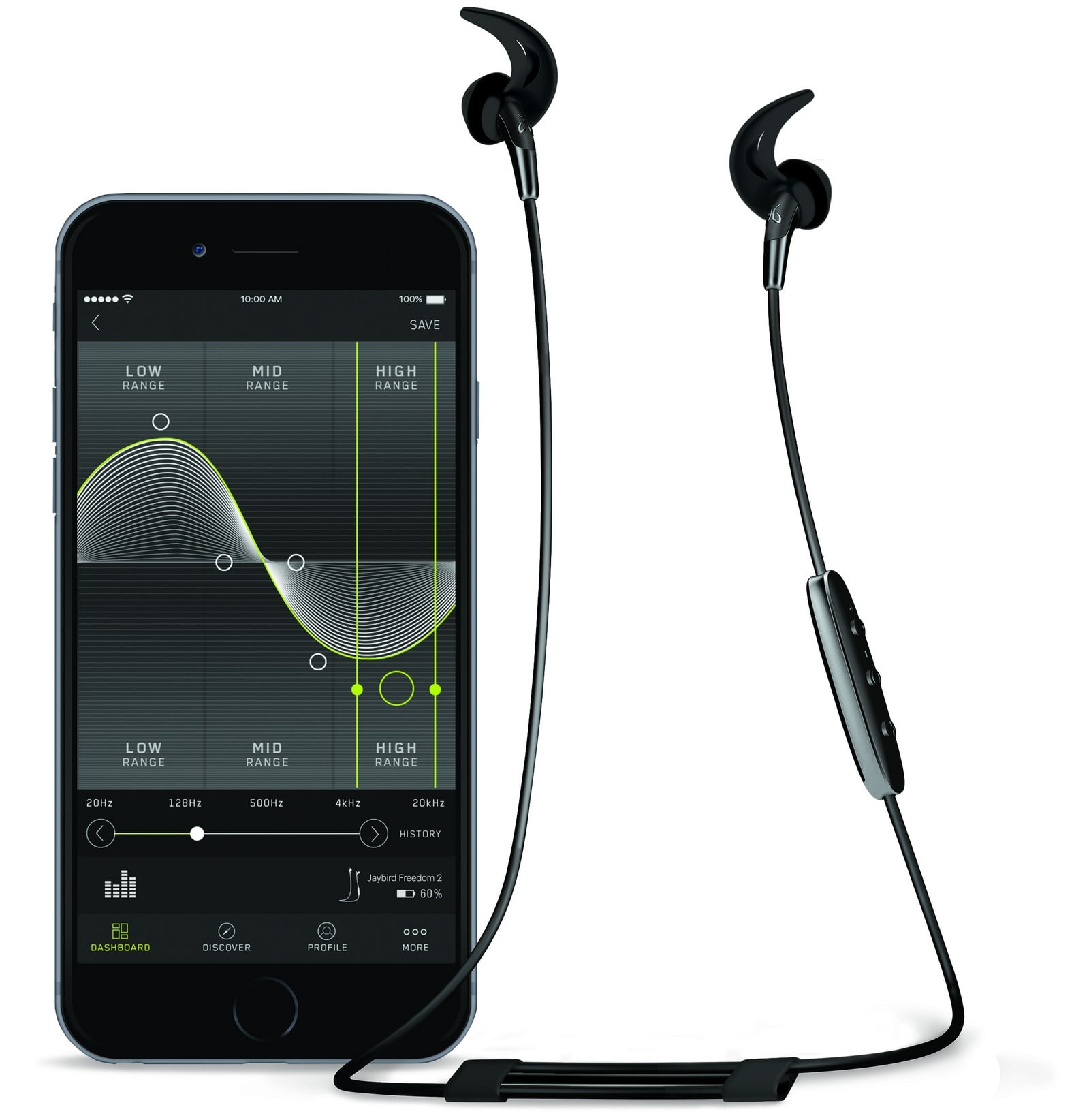
On top of the Run, Jaybird also announced the $150/£110 Freedom 2, which builds on the design of their predecessor in a few ways. They now sport oval tips and reworked flanges, both of which make for a slightly better seal in your ears. You can also switch between under-ear and over-ear orientations without removing the buds from your ears. That’s useful if you’re in the middle of an intense workout, and don’t want the cable dangling low on your neck. You’ll still get four hours of battery life from the Freedom 2, as well as another four hours from its tiny clip-on battery pack.
Since they’re meant for outdoor activity, the Run and Freedom 2 headphones are both sweatproof and water resistant. You might not want to wear them during a torrential downpour, but they should be fine for running in moderate rain. Jaybird’s MySound mobile app, which lets you tweak sound settings for its headphones, is also getting renamed to simply “Jaybird.” Notably, the company says customized settings will get saved directly to its earbuds’ firmware, which means those tweaks will work across other music apps and devices.
I’ll need to spend some time (and a few runs) with Jaybird’s new headphones to really test them out. But at this point, they seem like smart moves for the company. You’ll be able to preorder them today, and Jaybird expects to ship them out in October. At that point, you’ll also be able pickup the Run and Freedom 2 at retailers like Best Buy and Amazon.
With Apple once again foregoing headphone jacks on the iPhone 8 and iPhone X, and many Android phone makers following along, Jaybird is in the ideal position to prove why it’s time for everyone to consider wireless headphones.
‘Rocket League’ is almost ready for your next LAN party
More than two years post-launch, Rocket League keeps things fresh with regular updates to its car-based soccer game. We’ve seen a Dropshot mode added this past March, a basketball update in April, a cyberpunk look in June, a ton of freebies in an Anniversary update this past July, and some grappling hooks and giant boots this month. Now, developer Psyonix is announcing a massive Autumn update that will bring a host of new additions, including transparent goalposts, LAN play for PC and a Director mode that seems made especially for Rocket League eSports competitions. The new update should drop September 28th.
The transparent goalposts were teased last month; now we know exactly when they’ll be available in matches. The new transparency will allow you to see better when you’re in certain positions, like in the goal for defense. Players that don’t want the improved vision feature can toggle it off, of course. The beta Director Mode is aimed squarely at spectators; an AI-powered virtual camera will choose the most “relevant” viewpoint of the match based on what’s going on in the game. According to Psyonix, the AI can also “predict future shots and saves” to offer the best angles on the action for those watching a match.
There are also a ton of other new additions to Rocket League, including new arenas for exhibition and private matches (as well as in ranked playlists). A free seasonal arena will appear too. The Farmstead map places the action on a farm full of the reds and golds of fall for competitive, casual and private matches. More limited-time events will show up after the Autumn update, too.
There are also some rare items to find called Decryptors, which can unlock any crate, including the ones in limited events. You might even see a fresh Accelerator Crate, too, which could drop a Jäger 619 RS import car with new flashy trails, goal explosions and animated wheels. You can paint your battle-car with the new, rare pearlescent paint finish, and you’ll be able to grab some updated player banners. Season 6 of Rocket Leagues’ competitive series starts with the Autumn update; you can win some new player banner rewards if that’s your thing.
Source: Psyonix
Mars has a less dense crust than astronomers thought
Understanding the crust of a planet provides important information about the planet’s history and its interior structure. But getting details about the crust of another planet — like its thickness and density, for instance — is no simple task. However, NASA researchers have developed a new way of analyzing the crusts of our solar system brethren that allows for more accurate estimates based on less information.
A planet’s gravitational field is an important piece of the puzzle when it comes to understanding its crust. We have detailed measurements of our own planet’s gravitational field, but we have far less data on other planets’ fields, limiting what we can glean about their surfaces. For example, NASA’s GRAIL mission, which sent two space probes to analyze the Moon, provided much higher resolution data of the Moon’s gravitational field than we ever had before, which led to more accurate calculations of the density of the Moon’s crust and its interior structure.
To get more information out of the data we have from Mars, NASA researchers took into account the topography, or elevation changes, on the surface of the planet. That information combined with gravity field data provided calculations of Mars’ crust that depict a less dense surface than we thought it had. Based on what we knew about what makes up Mars’ soil — which is how we’ve estimated its crust density before — researchers believed the planet’s crust was about as dense as the ocean floors on Earth, but it turns out to be less dense than that. “As this story comes together, we’re coming to the conclusion that it’s not enough just to know the composition of the rocks,” Greg Neumann, a researcher on the project, said in a statement. “We also need to know how the rocks have been reworked over time.”
The team also learned that there’s quite a bit of variation across the planet’s surface, with volcanic areas being much denser than others. And the lower-than-expected density is likely due to porous soil. Overall, these findings give researchers a better jumping off point when it comes to figuring out what the inside of the planet looks like.
“The crust is the end-result of everything that happened during a planet’s history, so a lower density could have important implications about Mars’ formation and evolution,” said Sander Goossens who led the project.
The findings were published in Geophysical Research Letters.
Via: Phys.org
Source: Geophysical Research Letters, NASA (1), (2)
Equifax blames breach on a server flaw it should’ve patched
Equifax’s latest update on its unprecedented security breach notifies the public that its investigation has found the cause of the theft. Along with an unnamed security firm (ZDNet and others have reported it’s Mandiant) the company confirmed rumors that attackers exploited a flaw in the Apache Struts Web Framework. That bug, CVE-2017-5638, was revealed in March, but the criminals were still able to use it against Equifax to steal personally identifiable information (PII – including names, birth dates, social security numbers and more) for 143 million people in the US in mid-May.
A failure to patch a known security hole becomes more believable after hearing about an egregious security hole discovered just this weeks. Brian Krebs reports on a situation discovered by Hold Security, where Equifax’s Argentinian website left administrator access (including databases of consumer’s personal information) guarded by the ultra-difficult user/password login combo of admin/admin. It allowed anyone to add or remove employee accounts for the system, as well as see their passwords by simply viewing the source of a webpage, or access the personal data of anyone (including DNI — their equivalent to a social security number) who had ever disputed a report.
The site was taken offline after Krebs notified Equifax, but the existence of such an easily-accessed security hole is troubling. According to Reuters, over 40 US states have joined a probe against the company, and its CEO is expected to testify before a House of Representatives panel on October 3rd.
Equifax – September 13, 2017
1) Updated information on U.S. website application vulnerability.
Equifax has been intensely investigating the scope of the intrusion with the assistance of a leading, independent cybersecurity firm to determine what information was accessed and who has been impacted. We know that criminals exploited a U.S. website application vulnerability. The vulnerability was Apache Struts CVE-2017-5638. We continue to work with law enforcement as part of our criminal investigation, and have shared indicators of compromise with law enforcement.2) Temporary interruption to credit freeze sign-up link.
Due to the high volume of security freeze requests, we experienced temporary technical difficulties and our system was offline for approximately an hour at 5PM ET on September 13, 2017 to address this issue. We apologize for any inconvenience.3) More details on consumer exemption from arbitration clause.
Questions continue to be raised about the arbitration clause and class action waiver language that was originally in the terms of use for the free credit file monitoring and identity theft protection products that we are offering called TrustedID Premier. We have removed that language from the TrustedID Premier Terms of Use and it will not apply to the free products offered in response to the cybersecurity incident or for claims related to the cybersecurity incident itself. The arbitration language will not apply to any consumer who signed up before the language was removed.
Source: Equifax
Segway’s electric scooter offers a ride from your car to your desk
A year ago, CityGo Urban raised over $300,000 for its successful concept: an electric scooter that would zoom commuters to work. Today, it’s finally re-emerged in the news — but as a part of a newly-envisioned “Last Mile” system developed by Segway, which bought CityGo shortly after its Indiegogo campaign ended.
The CityGo scooters themselves don’t seem to have changed much in the interim: It’s an electrically-powered scooter with about a 12-mile range that can be plugged into a wall socket to recharge. Segway built out the concept a bit into a holistic “Last Mile” system with proprietary public charging stations that could be installed in, say, a parking lot to juice up before scootering the last little distance before work. Or there’s a charging unit that fits in car trunks.

Segway also augmented CityGo’s smartphone app. While it previously just monitored scooter battery life and a few other less-useful metrics, Segway’s connected it to the cloud with the auspicious plan to potentially network scooters, charging stations, auto companies and even city infrastructure, should anyone be interested.
Segway confirmed that it acquired CityGo and its designer “shortly after the Indiegogo project was published last year,” according to a spokesperson. While CityGo was already offering refunds due to shipping delays, a backer update three months ago stated that meeting Segway’s design requirements would delay the product even later. Segway’s press release didn’t mention when the scooter would ship, but orders seem to be on course for delivery in the first half of 2018 if that backer update is accurate.
Google billboard teases potential Pixel 2 event date of Oct 4
Well, it doesn’t get much clearer than that.
Initial reports pegged the Google Pixel 2 announcement for October 5, but it doesn’t get much clearer than this image sent to Droid-Life: a billboard, spotted in Boston, with the phrase “ask more of your phone” accompanied by a Google logo the date of October 4. Barring some weird coincidence, it seems like that’s the date for the next Pixel event.

Last year’s Google Pixel event, which was held in San Francisco, was (not so) coincidentally held on October 4 as well. It wouldn’t be surprising if Google wanted to keep that date going, and initial rumors only being off by one day isn’t too shabby.
Now, what exactly could “ask more of your phone” actually manifest itself as in the Google Pixel 2 and Pixel XL 2? Well, we don’t really know — that’s a pretty vague statement. Initially it could be taken literally in terms of what Google Assistant could do on the phones, but it could also be a figurative statement — we all want more from our phones.
But we do know what current leaks and rumors are pointing to: two phones from different manufacturers, with the smaller Pixel sticking with a design closer to the original and the larger phone going with something closer to an LG V30. Expect a slightly newer version of Android Oreo with a few extra features, and of course some app and service updates that make it all sing.
Google Pixel + Pixel XL
- Google Pixel and Pixel XL review
- Google Pixel XL review: A U.S. perspective
- Google Pixel FAQ: Should you upgrade?
- Pixel + Pixel XL specs
- Understanding Android 7.1 Nougat
- Join the discussion in the forums!
Google Store
Verizon
Facebook is now free to share government search warrants with users
When the federal prosecutors submitted warrants to Facebook requesting information on three users earlier this year, they also demanded the social network not inform the user in question. That ends today after a court filing affirmed the government is doing away with the non-disclosure orders (NDOs) that had gagged Facebook from telling its users that the authorities were looking at their account data.
Facebook had been fighting the government on the legality of the NDOs and lost the initial ruling, but a DC appeals court set a date for a public hearing — which was scheduled for tomorrow, September 14th. The prosecution’s retraction today of the NDO requirement doesn’t actually concede the legal arguments brought up jointly by Facebook and the civil and digital rights groups, according to Buzzfeed. The filing just noted that the investigation “progressed … to the point where the [NDOs] are no longer needed.”
The joint filing by Facebook and the US attorney’s office in Washington revealed that a lower court judge had vacated the NDO requirements, which made Facebook’s appeal unnecessary. Ergo, lawyers are asking the DC appeals court to dismiss the case.
9-13-17 Motion to Dismiss Appeal Facebook by zmtillman on Scribd
Source: Buzzfeed
Polaroid’s new $100 camera brings instant film back in style
The Impossible Project has spent the past decade trying to revive Polaroid photography, first by bringing back instant film for vintage instant cameras and eventually launching a new device, the I-1, last year. This week, the company goes full circle, renaming itself Polaroid Originals and releasing its second instant film camera under the familiar moniker OneStep 2.
The original OneStep dates back to 1977, and the sequel borrows a lot of the same basic design, with a cream-colored casing, big red shutter button and Polaroid’s distinctive rainbow stripe down the front. However, there’s been a few tweaks borrowed from the I-1, like a more open viewfinder and two rows of lights on the top indicating how many shots are left on your film cartridge. It’s simple and low-tech, which suits the camera just fine.
Each package of film only holds eight shots, which feels a bit dicey in a world where we can take thousands of shots on our phones. However, Polaroid Originals has also developed a new film for the OneStep 2, called i-Type. The film is specifically optimized for the new camera and won’t work with vintage models.

That’s partly because it doesn’t contain a battery: Old Polaroid cameras didn’t come with an internal power source, and were actually driven by a small battery embedded in each film cartridge. That also made the film expensive, something you don’t have to worry about as much with the i-Type film at $16 a cartridge. It’ll be available in both color and black and white varieties, and the sample pictures I took had good colors and a slight dreamy quality, just as I remember from my childhood. However, it doesn’t develop any faster when you shake it.
Fans of older Polaroid cameras won’t be left out in the cold, however. The company will continue to produce new film for the 600, SX-70, Spectra and 8×10 lines, which have been repackaged under the Polaroid name and styling. You can even pick up vintage Polaroid cameras on the site, if something like the Spice Cam is more your speed.
As for the OneStep 2, it’s available for pre-order on the Polaroid Originals site right now for $100 in white and graphite, with orders shipping out next month.
 AIVAnet