


Sony unveils its ‘true 4K’ projector that costs just $5,000
Buying a “4K” projector can be tricky since many companies have displays have lower resolutions and use technology like pixel shifting (JVC and Epson) or special processing (Optoma) to make up for the missing dots. Sony’s SXRD technology brings every one of the promised 4K (4,096 x 2,160) pixels but until now have been incredibly pricey. That changes with the VPL-VW285ES just unveiled at CEDIA 2017 in San Diego, a true 4K and HDR projector that has a sticker price of just about $5,000.
That may not seem cheap compared to competition like Optoma’s $2,000 UHD60, but last year’s new Sony projector still costs $15,000. Of course, if the price isn’t your biggest motivation, Sony has a step-up VPL-VW385ES model for just under $8,000 that uses an advanced iris to increase contrast and detail in dark areas. Or you could opt for its other new 4K projector, the compact VPL-VW885ES with a laser light source capable of 2,000 lumens that costs $25k.
To sweeten the deal, Sony is also partnering with not-dead Kaleidescape for a bundle offer of 10 free movies in the Kaleidescape store. You’ll need to bring your own Strato 4K player to watch them, of course, and buy both at some point between now and the end of March, but that should be easy.
Source: Sony (1), (2), (3)
Nissan’s 2018 Leaf is a smarter, longer-lasting EV
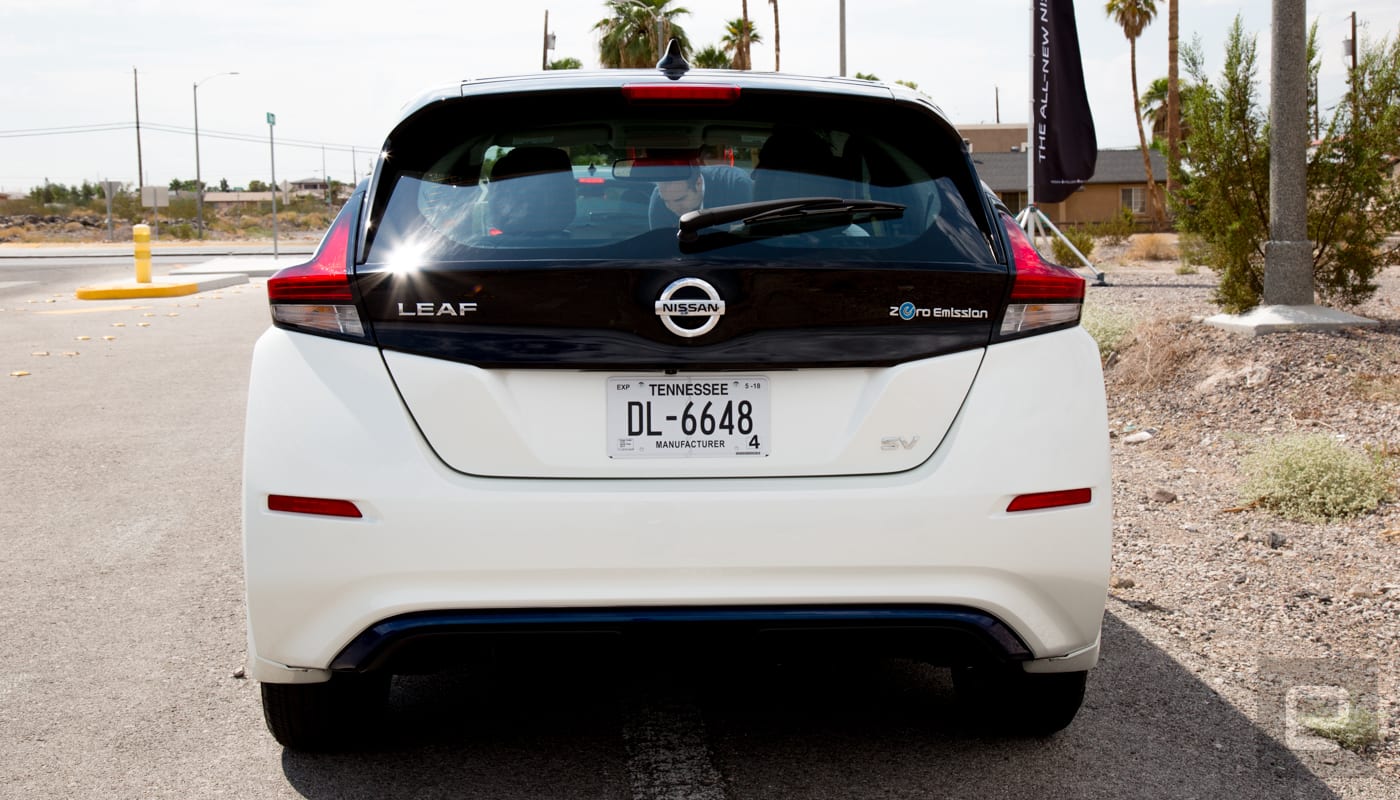
Nissan’s pure EV Leaf has been largely dominating the electric car market for seven years. So a refresh has been a long time coming. This week the company finally unveiled a vehicle with a higher range, an optional semi-autonomous feature and one-pedal driving. None of this is is necessarily groundbreaking, but while I was behind the wheel of a preproduction model in Las Vegas, it’s apparent the automobile is ready to take on the latest crop of electric cars.
The four-door hatchback has all the usual traits of an electric vehicle: super quiet ride, instant-on torque and no need to stop by the local gas station. But the big news is the Leaf’s 150-mile range. It’s a 43-mile improvement over the previous model but far below the Chevy Bolt (238 miles) and Model 3 (220 miles). But what it lacks in distance it makes up with in value. It’s about $5,000 cheaper than both of those cars, coming in at about $30,000 for the base model.
If you’re looking to take advantage of the ProPilot semiautonomous feature, be prepared to drop some cash. For the midrange Leaf SV, which starts at $32,490 (and adds Android Auto and CarPlay to the infotainment system), it’s part of a $2,200 tech package. On the high-end $36,200 SL, it’s a $600 option. Of course, all of these prices are before the $7,500 federal tax credit.
Fortunately, if you’re constantly stuck in traffic (and sadly, that’s pretty much the norm now), the ProPilot feature is worth it if you’re splurging for the SV or SL. That being said, the SL is easier to justify. Like nearly all of these sort of self-driving systems, its lane-assist is coupled with adaptive cruise control. Using a front-facing camera radar, the car keeps track of lane markers and the vehicle ahead of it.
During my test drive, it did a splendid job of staying in its lane and tracking the car ahead of it. One thing I did notice is that when you adjust the distance between yourself and the automobile in front of you, it’s slow to back off or speed up. It’s a smooth transition that some people might appreciate but more-aggressive drivers may find annoying. The actual lane tracking did a fine job handling gentle curves. Like other camera-based systems, though, it’s dependent on the contrast between the asphalt and the painted line. Snow and heavy rain will disable it while faded lines will hamper its ability to see where it’s going.
But on a sunny Vegas day this week, it worked without any issues. Unfortunately, during the test drive I never encountered stop-and-go traffic, so I couldn’t test how well the system handles coming to complete stop and moving again in ProPilot mode. Nissan says the car will come to rest on its own; when traffic moves again, the driver can press the ProPilot button for a few seconds to join the flow.

One feature that’s standard across the entire line is e-Pedal one-pedal driving. With this enabled, the car sets the regenerative braking to maximum and will bring the car to a complete stop and hold it there even on a hill. In my test, it held the car on some mild off-ramp grades. The automaker notes that the car uses the actual brake pads to keep the car stationary instead of just relying on the motor — a smart move that removes the strain from the drivetrain and reduces any sort of residual creep. It’ll be interesting to see how well the system works on San Francisco’s mini mountains.
I can see how e-Pedal could be helpful in both highway and surface street settings. Reduce pressure on the accelerator and the cars begins to slow; remove your foot completely and it stops. Its regenerative braking is great for optimizing efficiency, and after a few miles, its value becomes apparent. I will note that it didn’t slow down as quickly as I expected the first few times I tried it. But after some trial and error, I got better at judging when I could remove my foot from the gas.
For regular non-traffic driving, the new Leaf is a spirited little car. With 146 horsepower and 236 foot pounds of torque, it’s faster than its predecessor, but not as quick as the Bolt. The route picked out for the drive didn’t lend itself to any true handling tests, but the car’s suspension is on par with other vehicles in this range. It’s smooth, but you’re going to notice potholes.
The interior was roomy with a deeper than expected trunk. Typically that space is taken up by a spare tire or batteries. The back seat was also surprisingly roomy for my six-foot three-inch frame.

Behind the wheel, everything makes sense. The climate controls are physical buttons (woohoo!) with other aspects of the car shoved into the infotainment system. The dash cluster is informative, but can get a bit overwhelming as you enable more and more options. Like other automakers, Nissan has decided to use a weird shifter. It’s a black and blue puck that’s simple to operate even if it’s odd-looking.
Overall the 2018 Nissan Leaf is worthy successor one of the top-selling EVs of all time. It’s disappointing that it tops out at 150 miles, but Nissan has said that another version of the car will launch next year with more power and more range. The real question is, do you buy one now or wait until the next version of the Leaf hits showrooms? Throw in the quagmire of determining if a $5,000 savings is worth losing about 80 miles in range and the electric car market is starting to look more and more like the world of traditional gas cars. Slightly confusing but ultimately good for the consumer, because choice and competition push quality and innovation forward.
Source: Nissan
Students can subscribe to Spotify and Hulu for $5 per month
If you’re an undergraduate student, then I’m jealous of you today because Spotify and Hulu have announced a ridiculously great deal. Eligible students can sign up for Spotify Premium for Students and also receive a limited-commercials subscription to Hulu for just $5 per month.
Yes, you read that correctly. For $5 per month, students can have the equivalent of a $10 Spotify Premium subscription bundled with a $8 Hulu subscription. If you want to see if you’re eligible, you can visit Spotify Premium for Students’ webpage. You must subscribe directly through Spotify to take advantage of this deal (in other words, if your cell phone plan comes with a free Spotify subscription, you’re out of luck). And Spotify does verify enrollment through SheerID, so if you were hoping to use your old undergraduate email address to game the system, that’s probably not going to work so well for you.
Spotify has had a special pricing plan in place for US college students since 2014; it expanded the program to a total of 36 countries earlier this year. Apple Music and Amazon Music Unlimited also have student subscription options, but it’s going to be tough for them to beat the value of this Spotify/Hulu deal.
Pebble founder’s comeback is a battery case for iPhone and AirPods
After ushering in the smartwatch movement in 2012, Eric Migicovsky’s Pebble brand fell by the wayside. The company was saved from bankruptcy by Fitbit, which acquired its talent and software last year, but ditched its beloved devices. Now, the man behind the e-watch timepiece is returning to the site of his greatest success: Kickstarter. And, this time, he’s packing an iPhone case.
Okay, so the PodCase isn’t as revolutionary as the Pebble smartwatch, but neither is it trying to be. The charging case comes in two sizes that can accommodate an iPhone 7 or 7 Plus. But the likes of Mophie and OtterBox have been offering this type of functionality for years. What sets the PodCase apart from its rivals is the ability to store and charge your AirPods. Even Apple is aware of the fact that people keep losing its wireless ear phones. Therefore, offering somewhere to slot them is an interesting idea. At least it would be if the PodCase didn’t just place them in a great big bulge at the top of its rubber casing. But hey, the case will charge them too — so, there’s that. Its 2500 mAh internal battery boasts enough juice for a full iPhone charge, or up to 40 AirPod charges.

The PodCase is the first in a promised series of projects from Migicovsky and fellow Pebble alum Steve Johns. Joining them is Allan Evans, founder of Avegant, a startup trying to take on Microsoft’s HoloLens with its own mixed reality headset. Instead of launching another brand, the trio are planning to bring their products directly to the public (probably via Kickstarter) beginning with the PodCase. The funky iPhone case will be sold for $99 after its crowdfunding campaign.
Source: PodCase Kickstarter
Spotify and Hulu Team Up to Offer Students a $5/Month Combo Subscription Plan
Streaming companies Spotify and Hulu today announced a new partnership that will allow eligible students to sign up for Spotify Premium for Students at its normal $4.99/month price tag, and gain access to Hulu’s Limited Commercials plan at no extra charge. In Hulu’s press release, the company said that the offer streamlines two popular services commonly used by busy students into a single subscription plan.
The bundle is available to all qualifying new and existing Spotify student subscribers, immediately offering access to both Spotify Premium’s music streaming service and Hulu’s basic Limited Commercial, TV-streaming package. Users will also continue to use Spotify and Hulu through each brands’ respective apps.
“In bringing Spotify and Hulu together, we’re now able to offer students – both the millions already on Spotify Premium, and those who are new to Spotify – access to the world’s best music, TV and movie content in the simplest possible way,” said Alex Norstrom, Chief Premium Business Officer at Spotify. “We’re very excited to be partnering with Hulu – a like-minded company which is as focused as we are on delivering the very best in high quality streaming content.”
“We are proud to announce Spotify as our newest strategic partner – they’re an iconic brand in music streaming and a proven leader in reaching and engaging young consumers,” said Tim Connolly, SVP, Head of Distribution and Partnerships at Hulu. “By bundling our enormous catalogues of content together in a single, highly compelling offer, we’re making it easier for people to enjoy all of the TV and music they love, whenever and wherever they want.”
According to Hulu, “this is the first step” that each company is taking to bundle their services together, and in the future similar bundles will be targeted “at the broader market” beyond college students. Find out more information on user eligibility for Spotify’s student membership right here.
Tags: Spotify, Hulu
Discuss this article in our forums
Signal adds encrypted profiles to beta chat app
Signal, the encrypted chat app preferred by the US Senate, has finally launched profiles — but only as part of its latest beta release. You can now add a photo and a display name to make group chats less confusing. But since this is Signal we’re talking about, it’s not as straightforward as other apps’: your photo and name, like your messages, are end-to-end encrypted.
Your details are uploaded to the app’s server, but they’re encrypted using a custom profile key. Signal itself can’t see or read them, but your client shares that key with other authorized users, so they can see what you look like and what to call you. Of course, you don’t have to use your real pic or name if you want to keep your anonymity. Since you’ll still have to verify your account using a phone number, though, you’re still not completely anonymous.
Before you activate the feature, take note that your details will be available to all the contacts saved on your phone. You also automatically share your profile when you create a conversation, but you can choose to share or not to share your details when someone else initiates the chat.

Signal says the feature can “dramatically improve the experience in large conversations,” but it warns that its beta releases “are not for the faint of heart.” If you’re ready to deal with bugs and random crashes, you can get Signal beta for iOS by emailing support@whispersystems.org and using “Signal iOS Beta” as the subject line. You can also join the beta channel for Android via Google Play.
Source: Signal
A huge solar flare temporarily knocked out GPS communications
On the morning of 6 September the sun let out two pretty sizeable burps of radiation. Both were considered X-class — the strongest type of solar flare — with one of them proving to be the most powerful since 2005. If a solar flare is directed at Earth, which these ones were, it can generate a radiation storm that interferes with radio and GPS signals. The biggest flare ever recorded, in 2003, was so strong it even knocked out NASA’s solar measurement equipment. These recent belches weren’t quite on par with that, but they were enough to jam high frequency radios and interfere with GPS systems for about an hour on the side of the Earth facing the sun. Put your hand over your mouth, sun! Rude!
Via: New Scientist
Apple bolsters its TV unit with more top Sony talent
Seasoned execs from the world of network television are dotted all around video services. Netflix, YouTube, and Amazon have all made big hires from TV land to help boost original programming. And, it seems Apple has been taking notes. Keen to launch its own competitive line-up of exclusive shows, the tech giant is adding yet more execs to its TV unit. The same unit that has $1 billion to play around with for new content. And, that may one day shoot its productions on its very own Hollywood studio lot. You can’t accuse Apple of being shy about its ambitions.
The company’s new hires include former Sony Pictures Television exec Kim Rozenfeld — who will assume the role of head of current programming and lead on documentaries. Aside from its show Planet of the Apps, music docs seem to be Apple’s bread and butter. It already debuted a film about Puff Daddy’s Bad Boy Records in June, and also acquired the rights to a documentary about music mogul Clive Davis earlier this year. You can expect Rozenfeld (who produced the Emmy-winning non-fiction TV series American High) to rustle up more real-life shows in his new role.
It seems Apple is fond of Sony’s stable, having already lured alums Zack Van Amburg and Jamie Erlicht to head its video programming division. Soon they’ll be joined by two more of their former Sony TV colleagues; Max Aronson and Ali Woodruff. Between them, the execs have respectively worked on a wide range of shows including Breaking Bad, Amazon’s The Last Tycoon, CBS’s S.W.A.T. reboot, and Two Guys and a Girl. Rounding out the new hires is former WGN America head of publicity Rita Cooper Lee, who’ll lead communications for Apple’s burgeoning TV unit.
Via: Variety
What is Intel Optane?
A few months ago, Intel launched Optane, the first new memory technology to hit the PC market since Toshiba released commercial flash memory over three decades ago. Intel claims this new storage medium will be more durable than flash, and an order of magnitude faster.
As with all new technologies, things aren’t perfect yet, but Optane’s strengths are evident already. Join us on a brief journey through the past, present and future of PC storage, as we explain why you should (and shouldn’t) care about Optane right now.
Instagram is testing direct ‘Stories’ sharing to Facebook
You can mock Instagram for pilfering the Stories concept (and name) from Snapchat, but the popular feature quickly dwarfed the entire Snapchat platform. A very similar feature arrived to Facebook earlier this year, but has reportedly met with less success. That might explain why Instagram is testing an option for direct Stories sharing to Facebook, as spotted by TNW’s Matt Navarra and confirmed by Techcrunch and others. It’ll let die-hard Instagrammers post Stories to their granny on Facebook without the pain of doing it twice.
🚨 ALERT 🚨
Instagram is testing option to share your ‘Story’ directly to Facebookh/t @mruiandre pic.twitter.com/VTqI92dNJe
— Matt Navarra ⭐️ (@MattNavarra) September 6, 2017
The feature is working in Portugal, where it was apparently discovered by Lisbon user Mário Rui André. Facebook wouldn’t confirm that it’s testing it elsewhere, not a surprise since it’s normally tight-lipped about features that may or may not become permanent. However, enthusiastic Instagram users are bound to like it, as it’ll let them avoid the Facebook app without offending relatives. At the same time, Facebook would score extra content, so permanently adding the feature world-wide seems like a no-lose situation.
Zuckerberg & Co. have embedded Stories into pretty much every Facebook app, including Messenger and WhatsApp. Though perhaps less innovative than Snapchat, its wide range of apps gives it a lot more ways to introduce new features to its vast user base.
Via: Techcrunch
Source: Matt Navarra (Twitter)
 AIVAnet