


Now the free Windows 10 S upgrade period runs through March
Today Microsoft announced the availability of different colors of its Surface Laptop in 20 more countries, but that’s not the biggest news. Tucked in at the end is a note that buyers will be able to upgrade its Chrome OS-fighting Windows 10 S operating system to standard Windows 10 through March 2018. Originally the upgrade period only ran through the end of 2017, but Raphael Aquino Jose says this should provide extra flexibility for back to school and holiday gift buyers.
That’s probably a good call considering that in our review we found that Windows 10 S is too limited for most, and this way people can give it a fair trial without being pressed for time. The Surface Laptop came off as a great notebook, but the possibility of needing a $50 upgrade to install some critical software that’s not in the Windows Store is a tough restriction. As ZDNet notes, promised apps like iTunes are still missing from the store, which is probably playing into the extension.
Via: ZDNet
Source: Windows Blog
Kobo adds audiobooks along with an Audible-like subscription
Kobo is finally getting into the audiobooks biz. The Canadian company has added audiobooks to its offerings and already has an extensive catalogue sell, including bestsellers like the Harry Potter series. Even better, it has launched $10-per-month Audible-like subscription service, which sounds like a good deal if you regularly purchase audiobooks. The service gives you credits you can use to get any title from Kobo.com, even if its list price costs more than what you paid. You get a free 30-day trial period, so you can check out how it works before committing. But if you know you can go through a single audiobook real fast, you can also just straight up buy a three-pack credit for $30 and keep up to 24 credits in your subscription account.
You can find any audiobook and ebook you buy in one place within Kobo’s iOS and Android apps. Once you’ve chosen what to listen to, the apps’ built-in player will give you the power to choose your preferred narration speed. You can also see how much time you have left and program it to switch off after a certain amount of time if you tend to listen to your books in bed.
Kobo CEO Michael Tamblyn says the company decided to get into audiobooks, since “We have more books than time, always. Audiobooks let [the company’s] readers fit the books they love into more parts of their day.” In case you can’t find what you’re looking for in Kobo’s current catalogue, don’t worry: the e-book maker promises to add more titles every week. But if browsing through what’s available gets a bit overwhelming, you can always check out the personalized recommendations based on your previous e-book purchases. In addition to the US, Kobo’s audiobooks subscription offering is now also available in Canada ($13/mo), the UK (£6.99/mo), Australia ($13/mo) and New Zealand ($14/mo).
Source: Kobo
New 2018 Nissan Leaf Features Support for CarPlay
Nissan today unveiled its redesigned 2018 all-electric Nissan Leaf, and one of the features new to the vehicle is support for Apple CarPlay. The new Nissan Leaf comes equipped with a 7-inch display that’s compatible with CarPlay and Android Auto.
Nissan announced its first CarPlay-compatible vehicles back in June of 2016, and has thus far implemented support in the 2017 Maxima, Micra, and Murano.
Along with CarPlay, the Nissan Leaf features a range of 150 miles, ProPILOT driving assistance with speed maintenance, steering guidance, and braking, a single e-Pedal for braking and accelerating, and a revamped design.
Customers who reserve a Nissan Leaf are eligible for an exclusive gift that includes an Apple Watch Series 2, a GoPro HERO5 Black, or a Nest and Google Home bundle.
CarPlay support was slow to roll out following its initial introduction, but interest has picked up. Many 2016 and 2017 vehicles from a range of manufacturers offer the feature. Apple maintains a list of vehicles that are compatible with CarPlay on its website.
Related Roundup: CarPlay
Tag: Nissan
Discuss this article in our forums
Some people are already receiving their Note 8 pre-orders
Some Galaxy Note 8 owners have already received their devices.
Pre-orders for the Samsung Galaxy Note 8 went live last week, with an official shipment date of September 15. However, it seems that shipment date is just a formality: some of our forums users have already received their pre-ordered devices.

Our forum users are reporting receiving their devices as early as September 5, 10 days before the device is even supposed to ship. Users who purchased the device from AT&T, T-Mobile, Sprint, Verizon and directly from Samsung have all reported their devices have either begun shipping or already arrived.
TechnologyTwitt
09-05-2017 05:46 PM“
Ordered 8/26 Midnight Black (I’m in NJ).
Received text with FedEx overnight tracking #. As of 5:38 my time, it left the FedEx Facility in Fort Worth Texas. It’s scheduled to arrive by 8pm tomorrow.Reply
Carlo Villa
09-05-2017 10:34 AM“
I JUST GOT IT……MY NOTE8 and Hurricane Irma !!!
I was nice enough to give the FedEx man a bottle of water https://uploads.tapatalk-cdn.com/20170905/3afd1432f75c07c81252f89bfa96c527.jpg
Reply
The Galaxy Note 8 adds a second camera and the classic S Pen to Samsung’s 2017 baseline introduced with the Galaxy S8+. Samsung has received criticism that the Note 8 didn’t do enough to differentiate from the S8 series, but the device is clearly good enough for users to buy — and now receive — the device.
Has your Galaxy Note 8 pre-order shipped? Let us know down below!
Samsung Galaxy Note 8
- Galaxy Note 8 review
- Complete Galaxy Note 8 specs
- Galaxy Note 8 vs. Galaxy Note 5: Which should you buy?
- Which Galaxy Note 8 color should you buy?
- All Galaxy Note 8 news
- Join our Galaxy Note 8 forums
Verizon
AT&T
T-Mobile
Sprint
Best Buy
Moleskine planner syncs your handwritten schedule with the cloud
As helpful as online calendars can be, it’s hard to give up the satisfying feel of jotting down appointments in an old-school planner. Wouldn’t it be nice if you could use a pen and paper while still having all the benefits of the internet era? Moleskine sure thinks so. The company is expanding its connected writing sets with the Smart Planner, which syncs your hand-written schedule entries with Google Calendar and services that tie into it, such as Apple’s iCloud and Microsoft Outlook. It combines a Livescribe pen with sensor-laden paper to send your meetings to the appropriate sections of the calendar — so long as you scribble the time and subject, you can check it later on your phone or PC.
The Smart Planner will be available internationally on September 12th. It’ll cost $199 to get started with both the pen and a planner, while the planners by themselves will sell for $29. That’s not trivial, but it’s inexpensive enough that you could likely justify getting replacements every year. No matter what, this is likely your best shot at keeping your Moleskine relevant in an increasingly paperless era.
Via: TechCrunch
Control your own mammograms with new GE tech
GE introduced a new mammography system that gives patients a remote to control the compression part of the screening themselves. Giving them autonomy over the unpleasant, painful portion of the process ideally makes the whole thing more comfortable, which will hopefully bring in more folks who avoid mammograms — and catch more instances of breast cancer.
“Mammograms can be uncomfortable or even painful,” said Agnes Berzsenyi, President and CEO of GE Healthcare Women’s Health in a press release. “Engineered by a team of women for women, GE Healthcare has transformed mammography with the creation of patient-assisted compression to decrease pain associated with the exam, improve patient experience and increase outcomes for breast cancer screening which we know saves lives.”
The remote, called the Dueta, is the latest part of GE’s Senographe Pristina mammography system that the company launched back in fall 2016. An all-female team at the company’s Healthcare campus in Buc on the outskirts of Paris designed the Senographe Pristina to be far less alienating than the angular, cold metal machines they were used to.
Tech advances that reduce the need for further breast cancer surgeries are great, but so is making the scanning process less intimidating to get more people in the door. One survey found that a third of the US population eligible for screenings skips out on them, so making the screening process more comfortable — and in the remote’s case, more empowering — could literally save lives.
“Patients who used the remote control said the exam was more comfortable and they were visibly more relaxed,” Dr. Kathy Schilling, Medical Director of the Boca Raton Regional Hospital’s Christine E. Lynn Women’s Health & Wellness Center and the radiologist who reviewed the new remote, said in a press release. “Any breast radiologist knows that when patients are relaxed, we are able to get better images and better images lead to a more confident diagnosis. My hope is that increasing comfort during the exam and giving patients the option of working with the technologist to set their own compression will increase compliance, enable early detection and improve outcomes.”
Source: Business Wire
New Apple Park Drone Video Shows Off Steve Jobs Theater Ahead of Next Week’s Event
Construction on Apple Park is nearing completion and Apple is putting the finishing touches on the Steve Jobs Theater where next week’s iPhone-centric event will be held, according to a new video shared this evening by drone pilot Duncan Sinfield.
Sinfield’s video offers up a close look at the now-finished theater and it depicts landscaping progress at the campus, both inside and outside of the ring-shaped main building.
The theater is a 20-foot tall glass cylinder that overlooks the main campus building and is surrounded by greenery. It boasts the world’s largest freestanding carbon fiber roof and spans 120,000 square feet with an underground auditorium area that seats 1,000 people.

Apple named the theater in honor of late Apple co-founder and CEO Steve Jobs, who envisioned the design for Apple Park before his death in 2011.
Apple’s iPhone keynote, which takes place on Tuesday, September 12, will be the inaugural event at the Steve Jobs Theater. Apple announced Apple Park as the location for the event when it sent out media invites last Thursday.
Tag: Apple Park
Discuss this article in our forums
Nissan’s next Leaf is cheaper and can almost drive itself
The Nissan Leaf does pretty well for the automaker. It’s one of the best selling EVs ever and today the company introduced a redesigned $29,990 Leaf with ProPilot, a hands-on semi-autonomous feature for heavy traffic. With a 150 mile range and a price about $700 cheaper than it predecessor, Nissan is determined to stay at the top of the electric-vehicle sales-numbers pile.
Nissan unveiled the 2018 Leaf at events in Las Vegas and Tokyo with an aggressive new design for the four-door hatchback. With a 150 mile range (the current model has a 107 mile range), it doesn’t quite compete with the Tesla Model 3 or Chevy Bolt. But it has a price tag that’s $5,000 cheaper than those two vehicles which may have some potential customers debating the if 100 miles is worth the extra cash.
Nissan is well aware of the market though. “Competition makes everyone stronger and we welcome the competition,” said Brian Maragno, Nissan EV marketing and sales strategy North America at the Las Vegas launch event.
What’s interesting is Nissan plans on introducing a more powerful Leaf with more battery capacity in 2019 with the launch of its new EV platform. Cautious consumers might end up waiting a year to see just what the automaker has its sleeve before committing to the 2018 model.
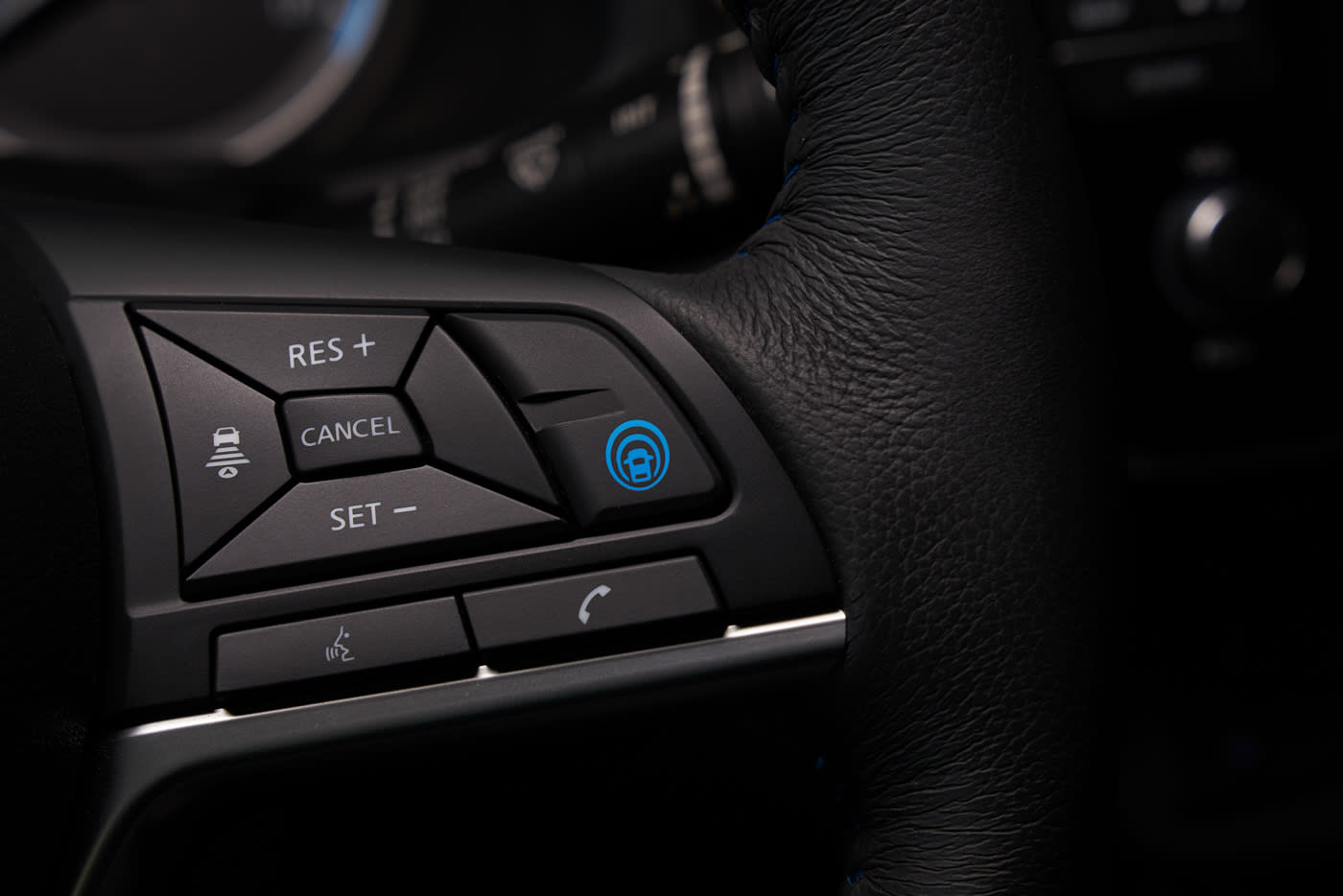
One way the automaker to get folks to purchase its transition vehicle is the inclusion of ProPilot. The semi-autonomous heavy traffic feature keeps the car in its lane while tracking the vehicle in front of it. The feature does require the drive keep their hands on the wheel at all times and if the car some to a complete stop, the drive needs to press a button for the Leaf to enable adaptive cruise control. But if you’re constantly stuck in traffic, anything that reduces the monotony of constantly swapping back and forth from the brake and accelerator helps.
The company also introduced e-Pedal, it’s one-pedal driving solution with the Leaf. It’s a straightforward system, depress the accelerator to speed up and release to come to a full stop. Nissan says with the feature enabled, the car will stop and stay put even on a hill.
The 2018 Nissan Leaf will ship with 147 horsepower and 236 pounds of torque and will go on sale early next year in all 50 states. If you can’t wait to see one in person to decide if you want one, you can reserve one now at Nissanusa.com.
Weird junk-seeking spacecrafts could soon ‘bag up’ our space debris
Why it matters to you
As trash accumulates in space we run the risk of a catastrophic collision. These crafts could potentially capture and incinerate this debris to minimize risks.
After more than a half century of launches to low-earth orbit (LEO) and beyond, there is plenty of leftover junk orbiting our planet. NASA estimates there may be nearly 500,000 individual pieces of debris currently whirling around Earth and, needless to say, these hunks of space junk pose a grave risk to the scientific instruments as well as our fellow humans in orbit. That’s why NASA may soon use a fleet of two-dimensional spacecrafts to catch space debris and tug these objects back toward Earth.
Orbiting at speeds up to 17,500 miles per hour, this vast collection of accumulated debris — some of which is as large as a school bus — has been the bane of space agencies and private companies for years. As we reported earlier this year, NASA has tinkered with an array of theoretical space janitors of sorts. What sets the Brane Craft apart though is its overall simplicity and affordability. The Aerospace concept conjured up by Siegfried Janson, is a flat (less than a human hair in thickness) 3-foot-square maneuverable spacecraft.
The units are constructed from a series of plastic sheets and each Brane Craft is printed with a thin layer of solar cells and electronics to power an onboard “electrospray thruster.” The propellant for this system is housed in tiny gaps (15-20 microns in length) between these flexible sheets. The Brane Crafts can transform their shape midflight using a series of “muscles.” This is done by sending an electric current between two metal plates on either side of an integrated polymer. This difference in voltage allows the polymer to bend. (If you’re imagining an expensive piece of flying cling wrap, you’re not too far off.)
“You can essentially think of it as one giant piece of Saran wrap covered with thrusters, and you can curl it however you want,” explained Jason Derleth, program executive of the NASA Innovative Advanced Concepts (NIAC) Program.
After a shipment of these crafts reach LEO, they can then be individually directed toward specific pieces of debris. Once deployed, the Brane Craft would then essentially envelop an item and then pull it towards the Earth’s atmosphere to be incinerated upon re-entry. Currently, space agencies would need to deploy conventional CubeSats to de-orbit debris. However, with a launch cost of $250,000 for a 3U CubeSat, NASA has estimated it would cost roughly $1 billion to remove 4,000 pieces of junk. Aerospace hopes to finalize a spacecraft that would cost only $5,000 to launch. Until these cosmic garbage-bots are deployed, we are simply biding our time before a seemingly inevitable large-scale debris impact event.
In 2015, astronauts aboard the International Space Station, were forced to seek emergency shelter after being notified of a potential collision with a piece of debris. This was the fourth time onboard astronauts had to prepare for such a scenario. The scientific community also fears that a major impact event could set off a domino effect of runaway, cascading collisions (similar to the event depicted in Gravity) that could render orbit impossible for decades.
“If that ever happens it will make space unusable essentially, and we’re pretty close to that,” Derleth warned.
Saved by the bill: 3D-printed beak gives Karl the hornbill a new lease on life
Why it matters to you
3D printing has a wide range of applications, but saving animals has to be among the best.
An Abyssinian ground hornbill at Washington D.C.’s Smithsonian’s National Zoo can feed himself once again, courtesy of a new 3D-printed prosthetic beak.
Having been left without his lower beak, due to wear and tear over time, the 27-year-old animal was unable to properly eat. However, a collaboration between the zoo’s animal, veterinary, graphics, and IT departments, as well as the Museum of Natural History, created a new photopolymer resin beak for him with added high-impact strength.
“Karl is doing fantastic,” Gilbert Myers, assistant curator at the National Zoo, told Digital Trends. “Before adding the prosthetic, Karl had to adapt and figure out how to pick up daily food items offered by his animal caretakers. Initially, he was fed multiple times per day, carefully monitored daily to make sure he was consuming enough and was weighed weekly to confirm he was maintaining appropriate body condition for his species. Although [this] was successful, he was limited to picking up larger diet items such as mice and meatballs, but unable to pick up smaller items such as mealworms and crickets. It was important to us that Karl was able to select what he wanted and when he wanted it. Now, Karl is not only able to consume any diet item that his caretakers provide, but he can hunt for earthworms, insects, frogs, toads, snakes, and small mammals that wander through his zoo habitat.”
The new 3D-printed prosthesis was modeled on the skull of a hornbill who lived at the Smithsonian’s National Zoo in the 1930s. The computer-aided design model was then 3D printed using a Formlabs printer and carefully attached to its new owner — to great success.
“Having a fully functional beak not only benefits Karl, but any future hornbills,” Myers said. “Ground hornbills are monogamous and male and females form strong pair bonds. This translates into strong courting behaviors involving beak slapping and presenting food to the female during the breeding season, supplying food to its mate when nesting, and helping to raise the young.”
While this is not the first time we covered veterinarians using 3D printing to develop prosthetics for animals, the stories don’t get any less heartwarming over time.
 AIVAnet
