


A look at the Android smartphones still to come in 2017

Like sands through the hourglass, so does the smartphone release cycle seem churn in perpetuity.
Samsung, LG, and HTC may have been first to bat with their flagship smartphones, but there are still plenty more device launches to look forward to. The year is only halfway through, and with the launch of the fourth-generation OnePlus 5, we’re officially headed into the summer smartphone release season.
What’s left to see? There’s plenty, actually. We’ve put together a list of some of the marquee Android-powered smartphone releases we’re still waiting on to hit the scene later this year.
- ASUS ZenFone AR
- Motorola Moto X 2017
- Essential Phone
- Samsung Galaxy Note 8
- LG V30
- Google Pixel 2
- Huawei Mate 10
ASUS ZenFone AR

At the beginning of 2017, ASUS announced the ZenFone AR. It’s been more than 6 months, and the only time we’ve had with it was on the ground at Google I/O 2017, where it was teased in various demonstrations. The ZenFone AR has yet to materialize into something you can actually buy.
In August, however, it’ll launch exclusively at Verizon, though it’ll also be sold unlocked. This is the first phone bundled with both the appropriate camera hardware and an optimized Snapdragon 821 chip that can handle both Augmented Reality and Virtual Reality. That’s also why it went missing for so long — the ZenFone AR underwent rigorous testing to ensure that both technologies could operate seamlessly on a mobile device.
For now, we’re waiting for the smartphone to hit Verizon before we take a dive into its abilities and test what it can really do with all that VR technology baked in.
Motorola Moto X 2017
As we learned from a revealing leak, the Moto X 2017 is part of the lengthy lineup of Motorola smartphones hitting the scene this summer. Following the launch of the Moto Z2, we should be seeing the Moto X 2017 debut fairly soon.
Motorola 2017 [via tip] pic.twitter.com/qahD9PIxrD
— Evan Blass (@evleaks) May 14, 2017
Thus far, leaks have pointed to the Moto X 2017 being powered by a Snapdragon 625 processor and 3GB of RAM, and that it’ll carry 32GB of onboard storage. It may also tout a dual camera setup— perhaps the “unlimited perfection” tagline that’s being used internally is a reference to a trick the main camera can do.
Essential Phone
 The Essential Phone.
Andy Rubin’s pet project is finally gaining some momentum now that we know a bit more about it, including the fact that it’s launching later this year. The Essential Phone comes with a 5.7-inch QHD edge-to-edge display. It’s also powered by Qualcomm’s Snapdragon 835 and offers 4GB of RAM, along with 128GB storage.
Other confirmed hardware specifications include USB-C, Bluetooth 5.0, NFC, LTE support for all major U.S. carriers, fingerprint sensor at the back, an 8-megapixel front-facing shooter, and a 3,040mAh battery with fast charging abilities.
We don’t know of the official ship date for the phones just yet, but for now, you can check it out (or pre-order it) here.
Samsung Galaxy Note 8
I like to refer to Samsung’s Galaxy Note as the summer’s repeat blockbuster hit. The company’s phablet-sized smartphone (can we really call it that anymore?) is usually announced rather loudly and with much fanfare in the Android scene during the month of August. The device also typically showcases some of Samsung’s future-facing mobile features; for example, the Note II was used to introduce the storable S Pen, while the ability to use iris scanning to unlock the phone was introduced with the Note 7.

Hot take: the Note 8 will probably look like the Galaxy S8 a bit, but with an S Pen in tow.
This year, the launch of the Galaxy Note 8 will no doubt be accommodated by a different air, considering last year’s fiery battery fiasco. That led way to a bit of unfavorable press about the Galaxy Note 7 and Samsung will have to act diligently to change the message behind this particular line of devices.
Fortunately for the company, the latest rumor sounds good so far. Our very own Alex Dobie offered some insight on the hearsay and what it can tell us about the Galaxy Note 8:
The Galaxy Note line has historically packed the latest and greatest specs, and that trend should continue in the Note 8. It’s likely we’ll see at least Snapdragon 835 and Exynos 9 series chips running the show, just like the GS8.
As Samsung looks to differentiate the Note line in ways other than sheer screen size, a jump to 6GB of RAM and 128GB of storage as standard is probable, too.
And that dual camera system we’ve been seeing in leaked Galaxy S8+ prototype photos is a good bet for the Note 8. Samsung showcased the Exynos 8895’s dual ISP (image signal processor) support in its announcement imagery, and chances are the company wouldn’t do that without having a specific product in mind.
We don’t yet have reliable evidence of what the Note 8 will look like, but it’s safe to say that it’ll resemble its sibling, the Galaxy S8. You can expect metal, glass, slim bezels, no buttons, rounded corners, and that extra-tall infinity display. Historically, Note devices have been a bit boxier than Galaxy smartphones, too, so slightly narrower corners and flatter sides are a possibility.
As for specs, we don’t know much about what will be inside the Galaxy Note 8, though we can infer that, like last year’s Note 7, it’ll operate on much of the same hardware as its predecessor. That means it’ll run on a Snapdragon 835 and 4GB of RAM, and shoot with the same 12-megapixel rear camera. Expect the battery size to be bigger, too — actually, expect a ton of emphasis on the battery.
LG V30
We actually don’t know if the V30 will be the moniker behind LG’s next smartphone, but we do know that whatever is next from LG will arrive ready to use with Daydream. At Google I/O, Google’s Clay Bavor had teased that the manufacturer’s next flagship would be compatible with the virtual reality spec.

Vice President of Virtual and Augmented Reality, Clay Bavor, teases the next LG phone in a slide at Google I/O 2017.
Since Daydream requires an AMOLED display, we can expect the V30 to have an OLED panel instead of LG’s usual choice of an IPS LCD display. (It seems the obvious choice if you consider LG has invested billions in OLED production.)
As for what else the LG V30 will be capable of? Well, that’s hard to say, since there isn’t much else out there on the forthcoming device. We can guess that it will likely employ a larger screen size, in addition to a G6-like 18:9 aspect ratio. It’s also likely to come equipped with a Snapdragon 835 and plenty of RAM, considering its virtual reality capabilities.
Based on the release pattern of its predecessors over the last two years, expect to hear more about the LG V30 later this summer.
Google Pixel 2
If you’ve been paying attention to the blogosphere, then you now that we’re mere months away from the debut of Google’s next Pixel device. Until recently, we figured we’d see two more additions to the stock Android lineup—essentially a big phone and a bigger phone. But then the rumor mill began churning, and now there are reports alleging that Google will scale it back a bit this year.

New Pixels are coming from Google. But how many will there actually be?
Here’s the low-down from our full Google Pixel 2 rumor roundup:
In March, it came out that a third potential Pixel device was being produced, codenamed “taimen”, likely bigger than both “walleye” and “muskie”.
At the time, we didn’t know much about the device, but in recent weeks it’s come out that “taimen” would be built by LG, not HTC, and would be larger than the “XL” version of HTC’s Pixel sequel, “muskie.” It was then revealed that Google in fact canceled the “muskie,” the larger of HTC’s Pixels, for “taimen,” leaving one HTC- and one LG-built Pixel phone for 2017.
We still know very little about what this LG-built Pixel looks like or its specs, but we can speculate as to why Google added LG to the equation this year.
Beyond that, we know very little about the Pixel 2, save for the fact that it will feature Android O. We don’t know what it will look like, nor do we know if the actual device will be water-resistant. We also don’t know what’s fueling it on the inside, though we figure it’ll at least come equipped with a Snapdragon 835.
Check back after the heat waves subside and the leaves begin changing colors. We’re expecting to hear more about the Pixel 2 in late September or early October.
Huawei Mate 10
There isn’t much to speculate about the Huawei Mate 10 at present, considering it’s been only 6 months since the Mate 9 has actually been on sale. But with the device’s top-notch build quality and the later addition of virtual assistants like Amazon Alexa helping infuse a bit of an edge, we can expect that the Mate 10 will be a major contender in the Android sphere, particularly overseas.
What are we missing?
The world of Android smartphones is big and vast, and there are likely more rumors headed this way. Are we missing anything you’re looking forward to? Let us know!
Best HTC Vive Experiences For Kids
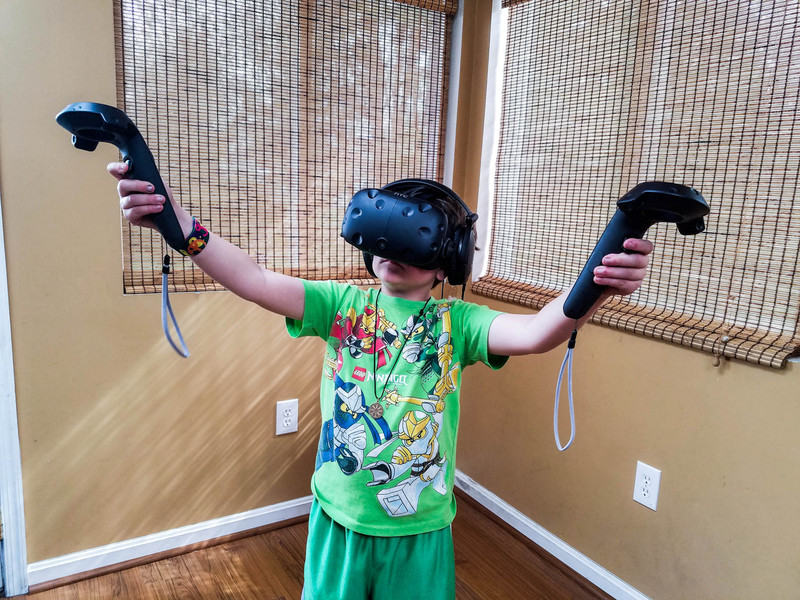
What games can kids play on HTC Vive?
The HTC Vive is a wonderful VR system that has an incredible library of games and other experiences thanks to support through Steam. A lot of VR is based around shooting or scaring the pants off of you — blame it on the gun-like Vive controllers and the immersion level — but there are plenty of great experiences that are also suitable for children.
Remember, it’s never a bad idea to follow the recommended age guidelines set by the manufacturer. In HTC’s case, they recommend 13 and up, but that isn’t set in stone as long as you remain precautionary.
Read more at VR Heads!
Best Selfie Sticks for Galaxy S8

But first… Let me tell you that they’re not as bad as everyone says.
I’m as against selfie culture as anyone, but when you and the missus (or mister) are out on vacation and don’t feel like bothering anyone to take a photo of you, a selfie stick and really come in handy. And I’d honestly rather use a selfie stick than hand my Galaxy S8 to a stranger.
Here are the best selfie sticks to use with your Galaxy S8.
- Mpow iSnap extendable monopod
- Fugutek FT-568
- Anker wired monopod
- Perfectday foldable selfie stick
- TaoTronics extendable monopod
Mpow iSnap extendable monopod

Mpow is Amazon’s best-selling selfie stick and 84% of reviews are 4- or 5-star. This Bluetooth selfie stick pairs with your Galaxy S8, and the shutter button the stick then operates the shutter button your phone’s screen.
The Mpow stick features a spring-loaded mount, an extendable handle, and a 270-degree adjustable head to help you take photos at just about any angle your arm is capable of. If you don’t want to spend a lot but still want a quality selfie stick, Mpow should fall right in your price range, at about $10.
See at Amazon
Fugutek FT-568

Fugutek’s FT-568 isn’t just a selfie stick — it’s a full selfie taking kit. It features a spring-loaded phone mount for your GS8, but it also comes with a screw-on mount for your DSLR (there’s even a mirror for selfies!), in case you’re serious about your selfies.
This one comes with a Bluetooth remote, rather than having it built-in, and there is even limited zoom function for certain Android devices (not confirmed if it works on GS8). The fact that each extension level has a lock like a real tripod is an excellent feature.
You can get this one for around $20.
See at Amazon
Anker wired monopod

If you hate fiddling around with Bluetooth and just want a secure connection that’s sure to snap a photo every time, then check out Anker’s wired selfie stick, which just hooks into the headphone jack on your Galaxy S8. It then sips power from your phone the way headphones do.
With a 32-inch reach, Anker’s stick is perfect for group shots. It’s also compact and weighs just over a quarter of a pound, making it super portable. You get an 18-month warranty, like you do with all Anker products, and this one’s only around $11, so it’s perfect if you just want to try things out.
See at Amazon
Perfectday foldable selfie stick

Perfectday’s selfie stick features a head that rotates 270 degrees and a built-in Bluetooth shutter button for wirelessly snapping photos with your Galaxy S8. All you have to do is turn it on and pair it and you’re ready to go.
When folded down, this selfie stick is only a couple inches taller than your S8 and not quite as wide, so it’s nearly pocketable. It comes with a lifetime guarantee and starts at $8.
See at Amazon
TaoTronics extendable monopod

TaoTronics’ monopod (selfie stick — let’s be real) is a bit more of a luxury option in that it’s probably the best-looking selfie stick on this list. With one charge, you can take 30 hours’ worth of photos, so you’d definitely have to charge your Galaxy S8 long before needed to charge this device.
Made of aluminum, this stick is nice and light and it features smaller joints than the average selfie stick, so it has more points of stability, meaning steadier photos when fully extended. The included wristband should also help if you’re a bit of a butter fingers.
You can grab this one on Amazon for around $20.
See at Amazon
Stick it
Do you have a favorite selfie stick? Would you prefer to pummel selfie stick users with the very implement they so flagrantly use and abuse? Sound off in the comments below.
McDonald’s delivery is here, thanks to a partnership with UberEats
Yes, you read that headline correctly, after 43 years of sticking its ground and not offering a takeaway service, fast food mega-chain McDonald’s has teamed up with UberEats to offer takeaway Big Macs, Chicken McNuggets and McFlurrys.
- Don’t fancy cooking? Here are five takeaway apps to get food just by picking up your smartphone
The takeaway service has launched initially on a trial basis, with 22 restaurants in London, seven in Nottingham and three in Leeds taking part. Food-craving customers that live within a mile and a half of the participating restaurants will be able to order their food through the UberEats app, pay a £2.50 delivery charge regardless of order, and patiently wait for a courier on a moped or bicycle to turn up at their front door, food in hand.
Orders can be placed between 7am – 2am, so if you wake up and need a McMuffin, or get in from a night out and need some chicken nuggets, you’ll be able to get your food. No longer will you need to ask your taxi driver to pull into a drive-through.
The partnership with UberEats is almost definitely a reaction to the success of rival food delivery services such as Just Eat and Deliveroo. Analytics company NPD Group said food orders through these sort of apps hit 599 million in 2016 and worth £3.6 billion.
The move will also be due to the fact Burger King and KFC, both rival fast food chains, both have their own delivery services, launching in 2015 and 2017 respectively. KFC has a partnership with Just Eat.
- What is Uber and how does it work?
If all goes well, and we have no reason to believe it won’t, McDonald’s says it will look at expanding both the number of restaurants and number of cities that can sign up to the service. For a full list of participating restaurants in London, Nottingham and Leeds, head to the McDonald’s website.
Estonia will back up its government in a ‘digital embassy’
The rules on what governments can, and can’t, do with your personal data is based entirely on where the information is stored. Since tech companies shunt your stuff to servers across the globe, there’s a risk that an oppressive regime can use its rights to start peeking at your stuff. That’s why it’s interesting that Estonia has signed a deal to open what it’s calling the world’s first “data embassy” in Luxembourg.
Rather than trust a foreign country with its data, Estonia has essentially signed a deal to declare a server room in Luxembourg as Estonian soil. As a consequence, the same rights and protections afforded in the country proper should extend to the information stored in the “digital embassy.”
Following the collapse of the Soviet Union in 1991, Estonia was left as a dirt-poor nation with zero technological infrastructure. It decided to skip decades of legacy technology — including turning down an offer from Finland for its soon-to-be-discarded analog telephone network — and start fresh. Within 20 years, Estonia had become a digital paradise, with most of the government managed online.
That’s caused a huge technology boom in the country, which counts Skype, TransferWise, Kazaa, Fitsme and Playtech, amongst others, as local heroes. But it also means the country is highly vulnerable to cyberattacks from its neighbors in Russia. Which happened in 2007, when a Russian-led cyberattack crippled Estonia’s government and infrastructure in response to the moving of a contentious war memorial.
By signing a deal to essentially back up Estonia’s government in a foreign country, it should help bolster the land’s digital resilience. Not to mention that it could represent a different way of storing people’s data that respects domestic rights of its citizens.
Source: Estonia
NASA’s Curiosity rover is just a speck in this orbiter photo
At this distance, Curiosity looks like a tiny beetle crawling over volcanic rock. Electric blue, its protective shell stands out against the rough, jagged mountainside. In reality, this is an image shot by NASA’s Mars Reconnaissance Orbiter, an observational craft floating 200 miles above the planet’s surface. We have, of course, seen Curiosity countless times before — it has a thing for selfies — but rarely from afar. In this photograph, you get a real sense of the planet’s natural beauty and how empty, or quiet it must seem compared to Earth. Not that Curiosity minds, of course.
The photograph was taken with the orbiter’s High Resolution Imaging Science Experiment (HiRISE) camera on June 5th. These “observations” are recorded in a red band, blue-green band and an infrared band, which NASA then converts into traditional shades of red, green and blue. It makes the images easier to parse, however they’re not particularly accurate from a color perspective. That’s why Curiosity looks so blue — in reality, it’s a mixture of white, grey and black (no doubt with some orange, baked-on dirt too). Still, it’s nice to see the car-sized robot in a different light.
Via: Popular Science
Source: NASA Jet Propulsion Laboratory
Amazon is prepping Echo Show for launch with visual Alexa cards
If you’re a fan of Alexa, then this announcement might be good news for you. Amazon announced that they are adding a Display Cards feature to the voice assistant that will allow Alexa to respond visually to certain queries.
Alexa will be able to produce visual responses to questions about the weather, to do and shopping lists, your calendar and show you Now Playing information for music. It’s currently only available to developers, who can use the AVS Developer Console to enable Display Cards, but it gives us a better idea of what apps will look like across screens in Alexa’s new GUI.
This announcement goes hand in hand with the announcement of the Amazon Echo Show, an Echo device with a 7-inch touchscreen that’s been criticized for its boxy appearance. It also comes packed with eight microphones, a front-facing camera and a Dolby speaker. You can pre-order the Echo Show now for $230 in the US; it’s scheduled to ship starting June 28.
Source: Amazon
Valve’s ‘Knuckles’ VR controller tracks individual fingers
VR fans have been steadily following the development of Valve’s new controller for SteamVR, called Knuckles. Now the device is being shipped to developers as a prototype, and as a result, Valve has released quite a bit of new information about Knuckles and how it will work.
To use Knuckles, users insert their hand between the main part of the controller and a soft strap that helps hold it in place. You can tighten or loosen the fit with an attached cord. This means that you can grab and interact with objects as you normally would without worrying about dropping the controller. Multiple capacitive sensors throughout the device also can help track your hand motions and whether your fingers are pointed straight, tightly curled or somewhere in between. It’s important to note that Knuckles contains individual tracking for each separate finger, a feature VR users have been asking for.
All in all, Knuckles appears to be a more ergonomic and natural controller for VR. It’s a pretty straightforward follow-up to controllers such as the Oculus Touch and Vive wand. It’s not clear when Knuckles will be available to the general public, but you can bet a lot of VR fans are itching to get their hands on it.
Via: NeoGAF
Source: Valve (1), Valve (2)
Your next favorite songs are the backbone of ‘Metronomicon’
Rhythm games live and die by their soundtracks. The problem is, if you’re holding a plastic instrument in your hand, you’ve probably played through the same songs over and over whether it’s in Rock Band or Guitar Hero. Regardless of how advanced the gameplay is, then, at the end of the day, if you’re tapping through Bon Jovi’s “Livin’ on a Prayer” in one game, you might as well be playing it on any of the popular franchises. That’s where The Metronomicon: Slay the Dancefloor makes a bold left turn.
Rather than featuring a list of staid genre staples, the rhythm-game/role-playing game hybrid (trust me, it works) features 50 highly curated songs. These aren’t your usual crowd-pleasers, either, with tracks including unreleased music from Shiny Toy Guns, an exclusive from Mindless Self Indulgence singer Jimmy Urine and tunes from synthwave artist Perturbator and rapper Mega Ran (among others). If there’s a common thread connecting the songs here, it’s that everything has a driving beat or a funky groove. Sometimes both.
“If any song is in the game, it’s because at least one member of the dev team totally loved it,” Metronomicon’s programmer and studio lead, Danny Garfield, said. It’s this personal touch that makes the game so easy to buy into. Because most of these songs are unfamiliar, they have an inherent “one more try” quality that makes playing them over and over on different difficulty levels so enticing.
As far as gameplay goes, you arrive at a dungeon, play a section of songs in any order you want, unlock more tracks and then take on the boss song/monster. You attack by finishing a perfect run of notes and then switch from one character’s note highway to the next.
You’ll level up, earn new abilities and recruit new party members along the way — standard RPG fare — but when was the last time you played a role-playing game with a Rock Band guitar or a dance mat? Much like The Metronomicon’s gameplay-genre mash-up, using these peripherals is a surprisingly perfect fit.
I didn’t try the dance mat, but playing through “Live It Up” by Shiny Toy Guns with a plastic Stratocaster felt incredibly natural. And thankfully it’s simpler than Guitar Hero, as you only need to press the fret buttons in time; you leave the strum bar alone.
The game’s narrative is just as silly as its core conceit. Dance parties have materialized throughout the land of Koras. These parties play host to massive amounts of monsters that boogie the night away and trash villages like rock stars do hotel rooms.
To combat them, The Neon Shield school was formed around a book called The Metronomicon to teach “warrior breakdancing.” Its lessons instruct your valiant party of sorcerers, healers, rogues and other RPG archetypes how to defeat the darkness and bring peace back to the land. In the game universe, dancing and music fuel magic, and if you’re the best dancer, you can shoot fireballs. Seriously.
So yeah, it’s a little different than getting a band together, touring and playing increasingly larger venues to accrue more fans, à la Rock Band.
Because of the premise, the game needed a smattering of upbeat songs to balance the moodier numbers. Ten percent of the tracklist was made in-house by members of the Puuba development team, but the remaining 45 songs are licensed tracks from established and indie musicians. Further in keeping with the game’s driving nature, each song needed to have at least a three-minute section that has a distinct beginning, middle and end. “YYZ” by Rush, for example, probably wouldn’t work here.
But that doesn’t mean a song had to be three minutes to make the cut. Garfield cited “Bed Down With a Monster” by Crushcraze as an example. It might as well be 10 different songs wrapped together into one five-minute track. The team eventually settled on an arrangement that blends the song’s different movements into a condensed but cohesive whole.
“If you listen to one minute, and then a minute later, you’d never know it was the same song,” Garfield said.
The track from Jimmy Urine was a different challenge, but one that ultimately paid off. Puuba asked the Mindless Self Indulgence frontman for a song that was instrumentally layered, had multiple rhythms happening simultaneously and that changed over time. “We love you; do what you like,” Garfield recalled telling the singer.
Urine came back with “Fighting With the Melody,” a bouncy, idiosyncratic acid-disco tune that couldn’t fit The Metronomicon’s tone any more perfectly.
So far, the response from the musicians featured in the game has been incredibly positive. After the game was released for PC earlier this year (it’s coming out for PlayStation 4 and Xbox One this summer), Urine released the song as a single and made its music video entirely with footage from the game — try getting that to happen with Foo Fighters or Modest Mouse.
Follow all the latest news from E3 2017 here!
Apple Confirms Sales of Apple Watch Pride Edition Band Will Support LGBTQ Groups
Apple began publicly selling its Pride Edition Woven Nylon band for Apple Watch during WWDC week earlier in June, one year after it handed out a similar band to its employees at Pride events in San Francisco.
During its first few weeks up on Apple.com, the company made no mention as to whether any portion of the profits made off of the band would go towards LGBTQ organizations, but a new change made to the band’s webpage has confirmed that Apple will be helping out such advocacy groups with profits made from the rainbow-emblazoned Pride band.
As spotted by Redditor N-Code, the new Product Information section of the Pride Woven Nylon band confirms that a portion of proceeds from its sales in the United States will help benefit LGBTQ groups including GLSEN, The Trevor Project, the Human Rights Campaign, and PFLAG. Internationally, ILGA will see the same donations. A new banner referencing the donation support was also added to the main Apple Watch page on Apple.com.
The changes were made yesterday, with the Wayback Machine internet archive providing a point of comparison dating back to this past Saturday, June 17.
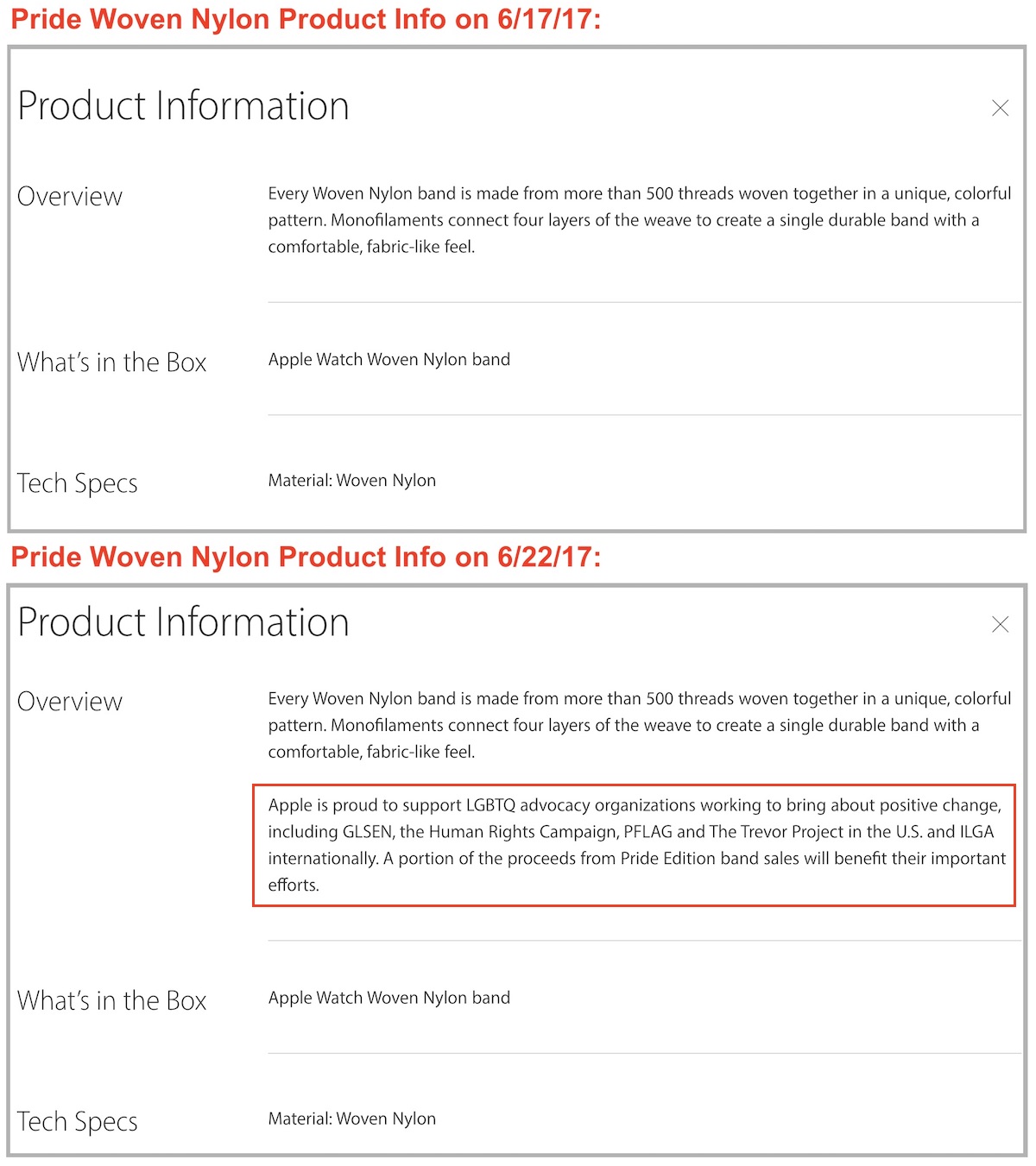
Apple’s full statement on the Pride band donations reads as follows:
Apple is proud to support LGBTQ advocacy organizations working to bring about positive change, including GLSEN, the Human Rights Campaign, PFLAG and The Trevor Project in the U.S. and ILGA internationally. A portion of the proceeds from Pride Edition band sales will benefit their important efforts.
Apple runs similar donation initiatives with many of its product lines, most popularly being (PRODUCT)RED. Apple devices sold with that banner have a portion of their proceeds donated to the Global Fund to help raise awareness and fight HIV/AIDS. Last year marked Apple’s tenth year anniversary in supporting (PRODUCT)RED’S causes.
At the time, Apple CEO Tim Cook commented on the company’s support of causes such as (PRODUCT)RED and pro-LGBTQ organizations, addressing critics who believe his and Apple’s public stances are made to endear millennial customers into buying products in the Apple ecosystem, among other criticisms. In response Cook said, “We haven’t shied away from being visible on a number of topics, and if it’s something in our wheelhouse, we’ll always be visible and stand up to protect as well as advance people’s rights.”
Note: Due to the political nature of the discussion regarding this topic, the discussion thread is located in our Politics, Religion, Social Issues forum. All forum members and site visitors are welcome to read and follow the thread, but posting is limited to forum members with at least 100 posts.
Related Roundups: Apple Watch Series 2, watchOS 3, watchOS 4
Buyer’s Guide: Apple Watch (Neutral)
Discuss this article in our forums
 AIVAnet