


NBC App Now Supports Apple’s Single Sign-on Feature on iPhone and iPad
NBC has updated its iPhone and iPad app with support for Apple’s Single Sign-on feature, as spotted by Engadget.
Now, iPhone and iPad users with a cable or satellite TV subscription can sign in once with their TV provider credentials to gain access to content in the NBC app alongside all other supported apps that their pay TV subscription includes.
Single Sign-on is available in the United States only for these providers: Blue Ridge, Cable ONE, CenturyLink Prism, DIRECTV, Dish, Grande Communications, GVTC, GTA, Hawaiian Telcom, Hotwire, MetroCast, Service Electric, and Sling TV.
To enable Single Sign-on on iOS devices, open the Settings app and scroll down to “TV Providers” to sign in. From then on, when accessing a supported app that requires a cable subscription, the app will ask to use the saved sign-on credentials.
NBC’s app, available for free on the App Store [Direct Link], also supports Single Sign-on on tvOS for the fourth-generation Apple TV.
Tags: NBC, Single Sign-on
Discuss this article in our forums
New Apple Patent Describes Sleep Tracking System With Bedtime Ritual Sensing and Power Nap Function
A new patent filed by Apple in 2015, and published today by the United States Patent and Trademark Office, shines some light on what the company could be working on in regards to sleep tracking technology and its recent acquisition of Beddit. Called “Adjusting alarms based on sleep onset latency,” the new patent describes in detail a system that could receive data from devices like an iPhone, Apple Watch, or a Beddit-like flat, flexible sensor, and intelligently track user behavior to help them get their best night sleep possible (via AppleInsider).
The patent explains that most people have typical bedtime habits recurring every night, such as going to the bathroom, shutting blinds, taking a shower, etc. These “sleep ritual activities” directly affect each person’s “sleep onset latency,” or the amount of time it takes you to fall asleep after first lying down and attempting to go to sleep. The problem with most modern alarm apps is that they can’t understand a restless night’s sleep, or a lengthy sleep onset latency period, and Apple’s new patent tries to address these issues.
The first step is for the sensors to determine your sleep ritual activities, and Apple’s patent has a few ways to go about doing that. One is by using sound data, so when the device detects someone brushing their teeth, taking a shower, “or any other activity that generates an identifiable or unique sound,” the sleep tracking system can start accumulating data for that night’s sleep because it knows you’re about to try to rest. Other tips related to sleep rituals for Apple’s sleep tracking system include user movement, light/dark levels in a room, and even app usage.
In some implementations, sleep logic can identify sleep ritual activities based on application usage. For example, the user may have a habit of using specific software applications installed on computing device immediately before going to bed. The user can check calendar application. The user can set a wake up alarm using alarm clock application.
The user can use social media applications, news applications, a game application, an e-book reader application, and/or other applications before going to sleep. Sleep logic can monitor application usage before the predicted sleep time (e.g., 1 hour before, 0.5 hour before, etc.) and determine which applications the user uses before the user’s predicted sleep time. Sleep logic can store the detected application use activities as sleep ritual activities in sleep ritual database.
Taking this information into account, once you actually try to go to bed, the sleep tracking system will begin looking at how long it actually takes you to fall asleep (heartrate and breathing are mentioned), remembering your sleep ritual activities and calculating how they affected your sleep onset latency. Apple’s theoretical system would also understand when you’re obviously not asleep, like if you’re currently on your iPhone on another connected device, and adjust tracking accordingly.
All of this data then feeds into how the system would be able to automatically adjust pre-set alarms because of a potentially inconsistent sleep pattern. The basic idea of the patent simply adds on sleep latency duration to the following morning, so if the system tracked that it took you 45 minutes to fall asleep, and you have an alarm for 7:00 AM, it would wake you up at 7:45 AM.
Of course, that risks some users getting a later start on their day than they are comfortable with, so Apple’s patent has a wide range of features that can prevent you from not waking up later than you intend to. The system would recognize calendar data, so if you have an appointment at 7:30 AM, your 7:00 AM alarm wouldn’t be adjusted. Likewise, travel time to your first appointment of the day would be taken into account.
Similar to nighttime rituals, the system is said to also track how long your morning rituals last over time. Using this data, it’ll also be able to figure out the best wake up time, so if you have a long morning ritual, your alarm might go off earlier than someone whose morning ritual is faster. Over time, all of the data gathered by the sleep tracking system would help users “feel more rested” throughout their day, according to Apple’s new patent.
Particular implementations provide at least the following advantages: the mobile device can help the user feel more rested by automatically adjusting an alarm or suggesting an earlier bedtime based on the determined sleep onset latency to ensure that the user gets enough sleep; the mobile device can automatically determine sleep onset latency using various sensors of the mobile device; the mobile device can automatically identify sleep patterns that may be adversely affecting the user.
Additionally, Apple’s patent even discusses an in-depth “nap function” for sleep tracking. In the user interface (seen below, image right), you would set up a nap schedule, determine when you want to wake up, and press and hold on the iPhone’s display to begin your nap. The system would know the sleep onset latency because of this applied pressure, so when you first apply your finger to the display, it’ll know the period has begun, and when you begin to release pressure (i.e. doze off), it knows you’ve begun napping.

An alternative “power nap function” describes a way for a device — here a “wearable device such as a watch” is specifically mentioned — to wake you up when the system determines that you’ve entered and stayed in a deep sleep for a period of previously-determined time. After figuring out when your heart rate and breathing rate have reached the “deep sleep threshold” for a period of time, the system would begin waking you up, so you can “realize the benefit of sleep without the grogginess that is experienced when a user is awakened from a deep sleep.”
The specific kinds of sensors referenced in the patent — including light- and sound-based sensors — are implemented in modern iPhones, but it’s unclear whether a sleep tracking system described in today’s patent would simply be an addition to an existing Apple device, a new iteration of a product like Beddit, or a combination of both. Apple slowly began expanding its sleep tracking support with “Bedtime” in the iOS 10 Alarm app, but that feature simply tracks the hours between when a user manually inputs a bedtime and when they silence the morning alarm, with no ability to understand how long the user is actually sleeping.
Of course, it’s still unclear exactly what Apple intends to do with Beddit’s technology, and today’s patent comes with the usual warning to take everything detailed in it with a grain of salt. For a closer look at Beddit, check out the technology behind the flexible sensor, as well as our own review of Beddit’s sleep monitor.
Tags: patent, Beddit
Discuss this article in our forums
Lyft aims for speedier trips with suggested pickup locations
Why it matters to you
Lyft’s suggested pickup locations can save you time, so if you’re in a hurry just tap the icon.
No one wants to be kept waiting at a pickup spot when they request a car on their ridesharing app of choice, whether Uber or Lyft. In an ideal world, the vehicle would instantly assemble itself in front of our very eyes the moment we hit the request button, though such a teleportation feature would admittedly do away with the need for transportation services of any kind.
Till then, we’re stuck with waiting around for our driver to arrive. Sometimes they’re quick, sometimes not so much. Sometimes we even have to watch the little car icon on the app as it heads in a direction away from you, perhaps negotiating a detour or stuck in a frustrating one-way system.
If you’re a Lyft rider, you’ll be happy to know that the latest version of its app now offers suggested pickup points so you can start your journey as quickly as possible instead of wasting time hanging around.
But there are other benefits with this feature than simply reducing the time you wait. Suggestions could be a short walk from a busy street to a quieter spot that helps to cut your journey time once you’re in the car.
To use the feature, simply request a ride as usual. Once you’re matched with a driver, the app will assess your location and destination, as well as the position of the driver and the traffic situation, and then suggest a pick-up spot. You’ll also see how much time you can expect to save on your journey compared to if you’re picked up at your current location. And yes, alternative locations will only be suggested if they’re going to save you time overall.
Lyft promises that suggested spots will always be a short walk away, and anyway, you don’t have to select it. If it works for you, tap “update” and head to the suggested spot. If not, just tap “no thanks” and stay right where you are.
If Lyft’s algorithms for selecting pickup points are on the money, then the feature is going to benefit both drivers and riders big time. And it will benefit Lyft, too, because happier riders should translate into more revenue in the long run, right?
Lyft’s biggest rival, Uber, has offered alternative pickup points for a while now, so it’s about time Lyft riders had a similar option.
Uber’s app can suggest several possible pickup locations at the same time — appearing as green dots on the display — and are usually places that have worked well for other riders. If you like the look of one of Uber’s suggestions, you just move your pin right to it and make your way there.
Google hit with a massive $2.7 billion fine in the EU for ‘abusing its market dominance’ in search
Google fined a record $2.7 billion for promoting its own comparison shopping service ahead of rival offerings.
A Bloomberg report from yesterday suggested Google could be hit with a record fine by the European Union’s antitrust regulator over the company’s alleged manipulation of search results. The regulator has now announced that it is levying a $2.7 billion fine on Google for abusing its dominance as a search engine by giving an “illegal advantage” to its own comparison shopping service.

The EU states that Google favored its own price comparison engine — Google Shopping — over rival services, thereby denying companies the ability to compete. From EU Commissioner Margrethe Vestager:
Google has come up with many innovative products and services that have made a difference to our lives. That’s a good thing. But Google’s strategy for its comparison shopping service wasn’t just about attracting customers by making its product better than those of its rivals. Instead, Google abused its market dominance as a search engine by promoting its own comparison shopping service in its search results, and demoting those of competitors.
What Google has done is illegal under EU antitrust rules. It denied other companies the chance to compete on the merits and to innovate. And most importantly, it denied European consumers a genuine choice of services and the full benefits of innovation.
According to the ruling, Google’s manipulation of search results has led to a significant decrease in traffic for rival comparison shopping services, amounting to as much as a 85% drop in countries like the UK. At the same time, the commission found that Google’s own service picked up a 45-fold increase in traffic in the UK. As noted by the EU:
These sudden drops could also not be explained by other factors. Some competitors have adapted and managed to recover some traffic but never in full.
The EU said it decided to impose the fine after conducting a thorough investigation in which the commission reviewed documents from Google and “other market players,” analyzed 1.7 billion search queries, pored through click-through rates along with financial
and traffic data.
The EU commission is giving Google 90 days to stop its “illegal conduct” and tweak its search algorithm to favor rival services just as favorably as its own:
Google has to apply the same processes and methods to position and display rival comparison shopping services in Google’s search results pages as it gives to its own comparison shopping service.
Failing to comply with the decision will allow the EU to fine Google up to 5% of its daily turnover. Given the impact of the EU’s investigation and the fact that it affects Google’s core business, the company is likely to appeal the decision. Google has previously affirmed that its practices were well within the confines of the law, and the search giant is doing the same this time around. In a statement, Google said:
We respectfully disagree with the conclusions announced today. We will review the Commission’s decision in detail as we consider an appeal, and we look forward to continuing to make our case.
This isn’t the only antitrust investigation Google is facing in the EU: the company is also facing charges for preferring its own services on its Adsense for Search platform, and bundling Google Search as the default search engine on Android.
How to listen to music on Google Home
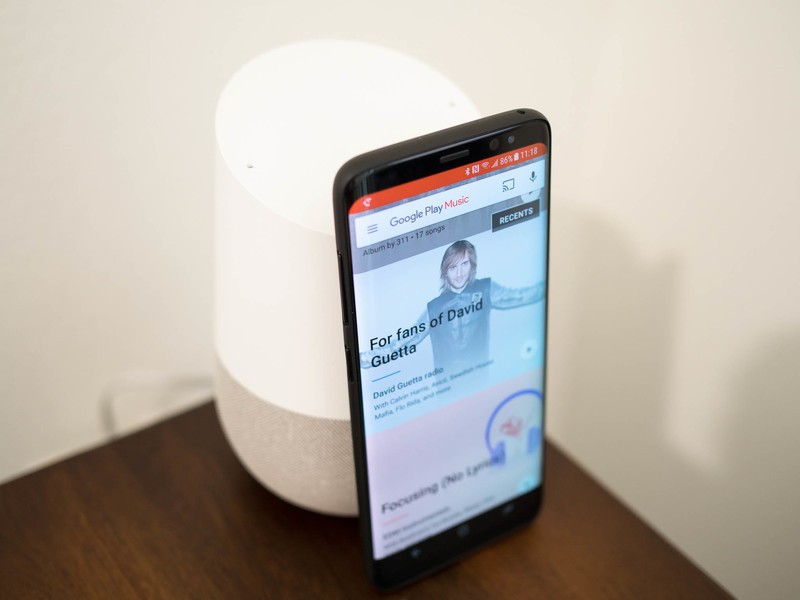
Google Home is more than capable of acting as your music player, and setting it up only takes a few moments.
Google Home has a great set of speakers, making it fully capable of filling the room with music. All you need to do is link up a music account, and you’ll be good to go. With options like Pandora, Spotify, YouTube Music and Google Play Music, you’ll always be able to listen to the music you’re craving, and all you have to do is ask Google Home to play what you want to hear.
We’ve got the details on setting up music with Google Home!
How to connect a music app to Google Home
By default, Google Home connects to a Google Play Music account, but if you want to play music or podcasts from somewhere else — Spotify, for instance — you have to connect it.
Open the Google Home app.
Tap the menu button (it looks like three horizontal lines).
Tap Music.
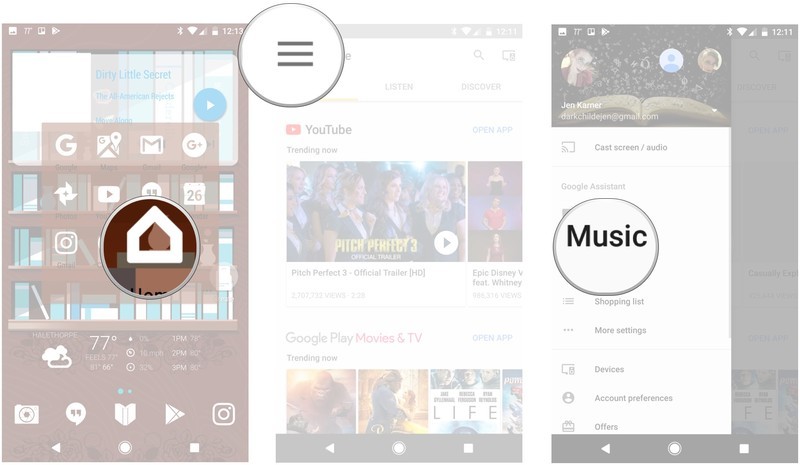
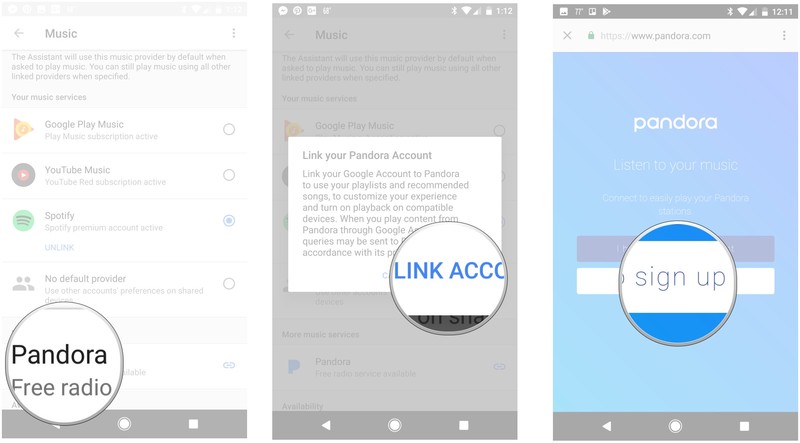
Tap the music service you want to link.
Tap link account.
Log in to the account you want to link.
How to unlink a music app from Google Home
If you don’t want a service connected anymore, you can simply unlink it from your profile!
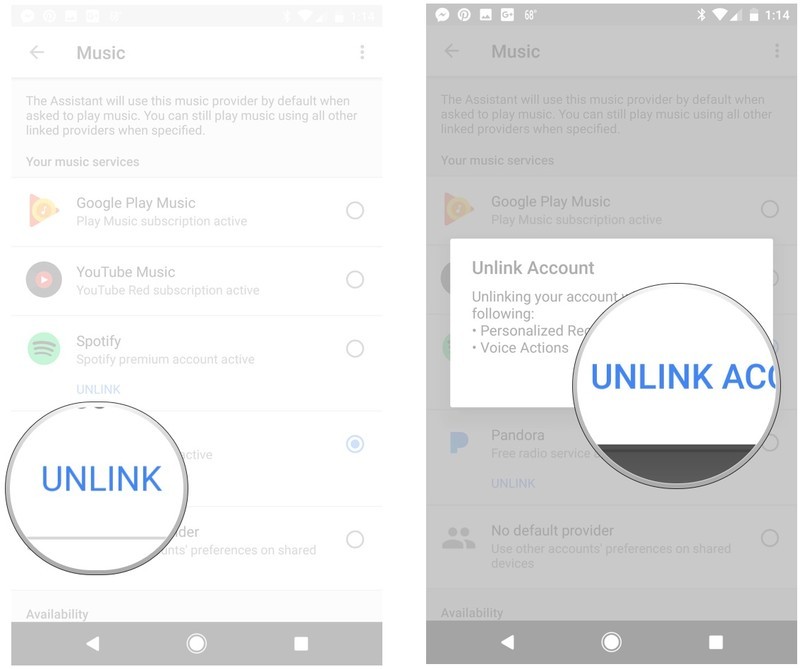
Open the Google Home app.
Tap the menu button (it looks like three horizontal lines).
Tap Music.
Tap Unlink on the app you want to disconnect.
Tap unlink account.
How to change your default music service
If you want to use something other than Google Play Music, but don’t want to keep saying, “Play X on Spotify,” then you should change your default music service.
Open the Google Home app.
Tap the menu button (it looks like three horizontal lines).
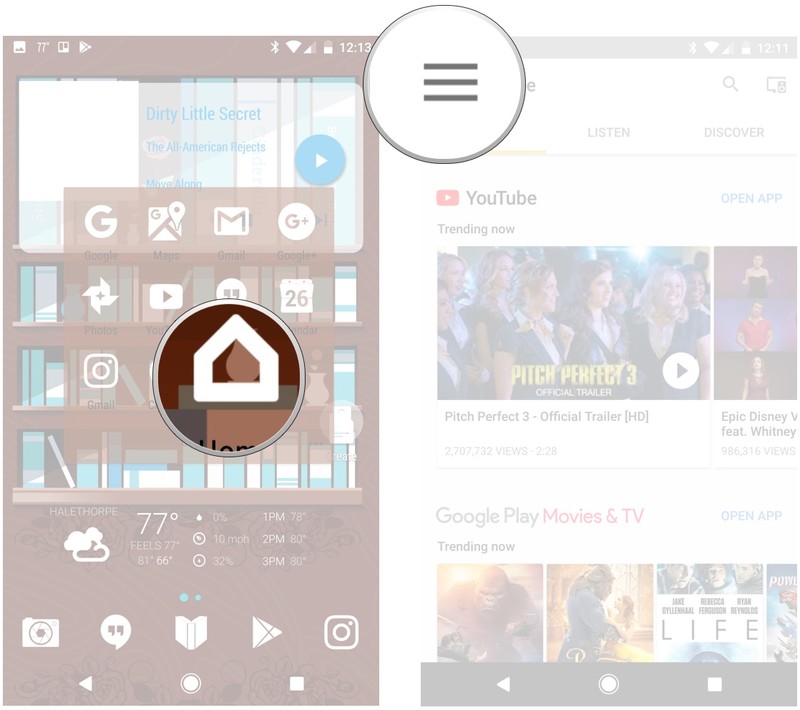
Tap Music.
Tap the circle next to the music service you want to change to.
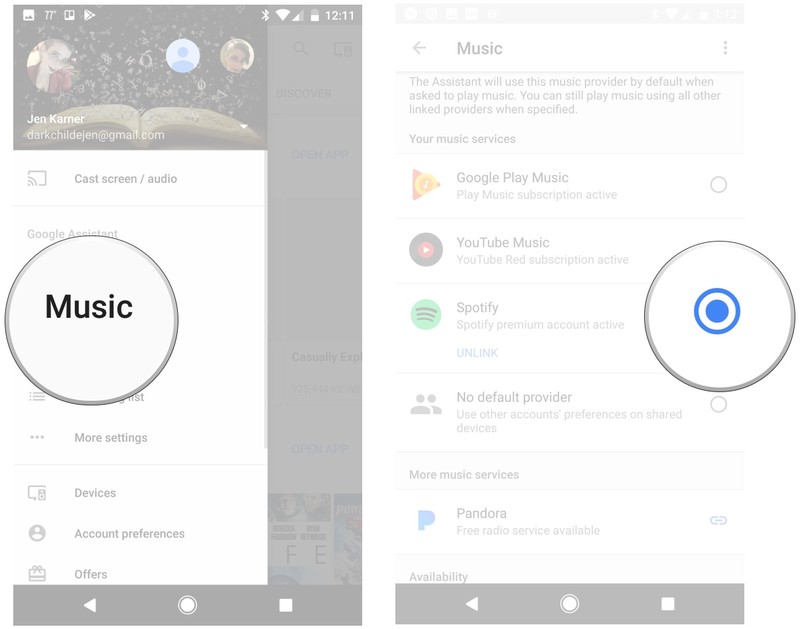
Questions?
Have you been using Google Home to play music for you? Is there a preferred music app when listening to music with Google Home? Do you still have questions? Drop us a comment below and let us know about it!
Google Home
- Google Home review
- These services work with Google Home
- Google Home vs. Amazon Echo
- Join our Google Home forums!
Google Store Best Buy Target
Honor 9 hands-on preview: The affordable flagship

The new flagship phone from Honor is cheaper and prettier than the OnePlus 5.
The “affordable flagship” segment — occupied by Huawei’s Honor brand and rivals like OnePlus and ZTE — is one of the most exciting areas of the smartphone market right now. It’s never been easier to get hold of a great high-specced phone without paying Galaxy or iPhone money. And while Honor might not have the instant recognition of the bigger names, it’s tough to argue with performance and build quality of its latest offering, the Honor 9.
For £379, you get most of the internal specs of the Huawei P10, encased in a beautiful metal and glass chassis, running software that’s light years beyond what you might remember from the Honor 8 at launch. It’s easily the best Honor phone yet, and it’s coming to Europe in July.
The design of last year’s Honor flagship has been refined and trimmed into an even more impressive slab of metal and glass.
First off, there’s a LOT of Honor 8 DNA in this phone — which is mostly a good thing. The rear is clad with a stunning 15-layer glass panel, which is now gently curved at the edges. The headline color for the UK is sapphire blue, with black and silver variants also available for the color-averse. This splash of color in continues through the aluminum side walls around to the front, where it spruces up the tapered 2.5D glass of the display.
The updated design hasn’t changed a whole lot compared to last year’s model, but subtle tweaks like the removal of a plastic rim between the metal and glass parts make it feel significantly more premium. And the curved back, of course, helps the Honor 9 fit more comfortably in the hand. The sharper joins between metal and glass also make it less slippery in the hand than I remember the Honor 8 being, helping with one-handed gripability.
The Honor 8’s hockey puck-like tendencies make an unwelcome return.
Unfortunately though, this phone remains decidedly slippery on… well, things that aren’t hands. The smooth glass rear will manage to slide its way across flat surfaces given the opportunity — one of my least favorite characteristics of the Honor 8.
Regardless, it’s a gorgeous-looking design, and a lustrous counterpoint to the unremarkable visuals of its main rival, the OnePlus 5. Sure, there are undeniable Samsung influences — the curved glass rear will remind a lot of folks of the Galaxy Note 5, and some of Xiaomi’s recent offerings. And from the front, it could just as easily be a Huawei P10 or either of the past three OnePlus phones.
While we’re mentioning OnePlus, the Honor 9’s button layout now mirrors that of the OnePlus 5, with a central fingerprint scanner that doubles as your home key, flanked by swappable capacitive keys. No more on-screen keys. No more rear-mounted fingerprint scanner. Both are matters of personal taste — and personally, I’m fine with the new direction Honor’s taking here.

On the front is a 5.15-inch 1080p IPS LCD panel which, while it’s not as pixel-dense as still looks fantastically vibrant, and is easily visible out in bright daylight. The smaller size may be a turn-off for some — it’s actually pretty rare to find high-end specs like this in an Android phone that’s so friendly to one-handed use. Yet after using a lot of phones at 5.5-inch and up lately, including this phone’s main rival the OnePlus 5, it’s kinda refreshing to go back to a smaller handset like the Honor 9.
It’s refreshing to see flagship-level specs paired with a display as small as 5.15 inches.
Sound is also a big focus for the new Honor flagship, with audio tuning by Grammy-winning engineer Rainer Maillard, and sound profiles inspired by Monster. (Part of the new partnership between the smartphone brand and the headphone giant that’s spawned new earbuds.) The verdict on sound quality is going to remain out until I’ve spent more time with the Honor 9, but at the very least the built-in loudspeaker seemed suitably punchy — if a little distorted at very high volume levels.
When it comes to internals, the Honor 9 is almost a carbon copy of the Huawei P10. Running the show is a Kirin 960 octa-core chip, a proven 16nm processor combining four ARM Cortex-A73 cores for power-hungry tasks with four efficient A53s for lower-powered stuff. There’s also 4 or 6GB of RAM depending on which country you buy it in — more on that later — and 64GB of storage plus microSD. There’s also an ample 3,200mAh power pack with quick charging — pretty capacious for this size of phone.
All the major internal specs from the Huawei P10, with a few exceptions.
Notable P10 features you don’t get in the Honor 9 include Huawei’s faster Super Charging tech, and Optical Stabilization in the main camera. I’m inclined to think neither is a huge deal, especially considering the price point.
Once again, Honor has gone with a dual rear camera setup, with a 12-megapixel color sensor and 20-megapixel monochrome sensor, behind f/2.2 lenses. Unlike the Huawei P10, there’s no Leica tuning in this camera, but it really doesn’t seem to be worse off for it. In my brief time with it, the Honor 9 was quick to capture images with vibrant colors and excellent dynamic range. And thanks to that 20-megapixel sensor, you also get the same hybrid zoom feature and portrait mode that we’ve enjoyed on the P10.

But we’ll have to wait and see how it shapes up in darker conditions, where the new low light mode with pixel binning is designed to produce clearer night shots. The current generation of smartphones — handsets like the LG G6 and OnePlus 5 in particular — is all about using software processing to pull great photos from run-of-the-mill sensors. Given what we’ve seen from the Honor 8 Pro already, I’m hopeful the Honor 9 will deliver in this area.
Software-wise, the Honor 9 runs Huawei’s EMUI 5.1 firmware, based on Android 7.0 Nougat — and Honor is already promising an update to Android 8.0 when it’s release, but there’s no timeframe for that yet. (Based on the track record of the Honor 8, early 2018 is a good bet.)

You’ll find more on EMUI 5.1 in our Huawei P10 and Mate 9 reviews, but the quick version is that it’s Huawei’s best software yet, though still highly differentiated compared to what you might be used to from Samsung, Google or HTC. However it is a vast improvement on earlier versions of Huawei’s software, as we saw on the Honor 8 last year. Nothing is broken, everything is fast, and nothing is too terribly offensive to the eyes.
Out of the box, EMUI 5.1 feels a lot more like Android than prior versions, and there’s a pleasant blue and white theme running through Huawei’s own apps — while other parts of the software can be endlessly themed and customized.
For just £379 in the UK, the Honor 9 is highly competitive.
The Honor 9 is shaping up to be one of the best affordable Android flagships available, delivering great specs, speedy software, a promising camera and a sharp design. And it does so at a highly competitive price point: All this stuff is yours for £379 in the UK, or €449 in Europe. (The UK and most other countries will get the 4GB RAM model, France and Italy will score an Honor 9 with 6GB of RAM, likely with a proportionally higher price tag.)
That balance of specs, design, feature set and price is truly impressive, and the Honor 9 looks set to give OnePlus a run for its money in the always-interesting “affordable flagship” space. Time will tell which one will come out on top.
Honor 9
- Honor 9 hands-on preview
- Honor 9 specs
- Join the Discussion
Honor 9 specs

Honor’s latest phone has specs broadly in line with the Huawei P10.
The Honor 9 is upon us, once again bringing top-tier performance and design to a more affordable price point — in the UK, just £379. When it comes to specs, you’re mostly looking at Huawei P10-level innards, with one or two exceptions.
That means you get Huawei’s high-end Kirin 960 octa-core processor, with 4 or 6GB of RAM depending on where you buy, and an ample 64GB of storage. And there’s a capable dual camera setup around the back — 12MP plus 20MP, with laser autofocus.
The top-level differences between the P10 and Honor 9: No OIS in the RGB sensor of the main camera, no Super Charging support — instead just regular 9V/2A quick charge — and fewer radio bands, meaning the European Honor 9 doesn’t have band coverage for U.S. LTE. (Sorry, importers!)
In any case, here’s your complete Honor 9 spec sheet. For more on Honor’s latest phone, check out our hands-on preview!
| Operating System | EMUI 5.1 / Android 7.0 |
| Processor | Kirin 960 octa-core, 4x 2.4GHz + 4x 1.8GHz |
| RAM | 4GB (6GB in some mainland European countries) |
| Storage | 64GB |
| Display | 2.5D glass front 5.15-inch 1920×1080 – 428 ppi |
| Main Cameras | 12MP RGB + 20MP monochrome, f/2.2 |
| Front Camera | 8MP |
| Connectivity | Wifi a/b/g/n/ac, 2.4/5GHz Bluetooth 4.2 Fingerprint USB Type-C supporting USB-OTG |
| SIM Card | Dual nano SIM or nano SIM + microSD |
| Frequency bands | 4G LTE: B1/B3/B5/B7/B8/B203G UMTS: B1/B2/B5/B8GSM/EDGE: B2/B3/B5/B8 |
| Battery | 3,200mAh, 9V/2A quick charging |
| Dimensions | 147.3 x 70.9 x 7.45 mm |
| Weight | 155 grams |
| Colors | Glacier Grey / Sapphire Blue / Midnight Black |
Honor 9
- Honor 9 hands-on preview
- Honor 9 specs
- Join the Discussion
Honor 9 isn’t coming to the U.S. anytime soon

An Honor 9 release in the United States is ‘not planned at this moment,’ Honor exec tells Android Central.
The new Honor 9 packs impressive specs, and offers a fresh take on the design of the Honor 8, with a curved glass rear and an upgraded dual camera setup. But unlike its predecessor, the Honor 9 won’t be coming to the United States when it launches in Europe this July.
At a meeting ahead of today’s launch, Eva Wimmers, VP of Honor Global and president of Honor EU, told Android Central that a U.S. release for the Honor 9 is “not planned at this moment.” That doesn’t completely rule out the phone coming to the U.S. at some point, but it sounds like it won’t be hitting American shores anytime soon.
So far this year, the Honor 6X is the only Honor phone to have graced the U.S.
Despite debuting at a glitzy San Francisco launch event last August, momentum (and presumably also sales) around the Honor 8 in the U.S. was described as “well below expectations” according to one source cited in an Android Police report in October.
The Huawei-owned brand has since launched the budget-centric Honor 6X in the U.S., but subsequent phones like the Honor 8 Pro haven’t been released there.
Wimmers told us that it’s still early days for Honor’s efforts in the U.S., compared to Europe and Asia, where the brand is better established.
Nevertheless, it seems to us that the failure of the Honor 8 to establish a U.S. foothold has led to a re-thinking of its strategy for this notoriously tricky market. Time will tell whether the Honor 9 or Honor 8 Pro — or something else entirely — will make it to the U.S. market.
Honor 9
- Honor 9 hands-on preview
- Honor 9 specs
- Join the Discussion
Honor debuts Band 3 wearable and Monster earphones
New wearable does fitness tracking on the cheap, as Honor announces partnership with Monster.
Alongside today’s Honor 9 launch, Huawei’s online brand has unveiled three new accessories targeted at its audience of so-called “digital natives.” The first is the Honor Band 3, a cheap, lightweight fitness band that comes in three colors, with a 0.19-inch PMOLED display. The Band 3 works with Android 4.4 KitKat and up smartphones, and iPhones running iOS 8.0 and up, and features a 3-axis accelerometer and PPG cardio tachometer.

It’s good for use underwater, with 5 ATM water resistance, and features sleep tracking through Huawei’s TruSleep tech, built with data from the Center for Dynamical Biomarkers at Harvard Medical School. Battery life is ranked at 30 days from the 105mAh internal battery, and the band will sell for £59.99 in the UK.

Next up are the Honor Monster Earphones, developed through Honor’s new partnership with the headphone giant. The goal is to produce crisp, lifelike 3D sound, and the two companies have brought Pure Monster Sound and Huawei’s Super Wide Sound (SWS) technology to the new cans. Other features include sound compensation and enhancement, and master tone tuning — along with a Hi-Fi mic for clear calls, and volume controls.

They Honor Monster earphones will go on sale for £44.99 with three sizes of earplugs, and color options including Dark Blue, Pearl White and Red with Black.
Honor is also getting into the Bluetooth audio game with the new Honor Sport earphones. Retailing for £59.99, these earphones are available in black, red and blue, boasting up to eleven hours of playback from their 137mAh battery. They’re also rated IPX5 for sweat resistance, ensuring they’ll hold up to intense workouts — if not a dunk in the pool.
For more on today’s Honor announcements — including the brand’s new flagship smartphone — check out our Honor 9 hands-on preview!
Honor 9
- Honor 9 hands-on preview
- Honor 9 specs
- Join the Discussion
Honor 9 is official: Flagship specs + curved glass for £379

New flagship builds on the well-received Honor 8 with a refined design and spec upgrades across the board — while keeping the affordable price tag.
At a launch event in Berlin, Germany, today, Huawei’s Honor brand took the wraps off a phone we’ve been eyeing since it launched in China a few weeks back — the Honor 9.
Like its predecessor, the Honor 9 is clad in aluminum and glass, only this time with a subtly curved back panel, and cleaner joins between the metal and glass. The phone now boasts 15 layers of glass in its curved back panel, which has a uniquely lustrous finish. The fingerprint sensor has also been relocated to the front, where it’s joined on either side by two (swappable) capacitive buttons, similar to OnePlus’s recent designs.
The latest Huawei hardware, packed into a gorgeous glass-backed chassis.
There’s a 5.15-inch screen diagonal, making the Honor 9 one of the smaller Android flagships available, and the display itself is a 1080p IPS LCD panel with DCI-P3 color space support. Like most high-end Huawei phones, the Honor 9 is powered by an octa-core Kirin 960 chip (four ARM Cortex-A73 cores at 2.4GHz, plus four Cortex-A53s at 1.8GHz), and that’s backed up by 4GB or 6GB of RAM depending on where you buy. There’s also 64GB of internal storage, plus microSD expansion via the second SIM slot.
And there’s a relatively large 3,200mAh battery inside, which can be refilled extra-quick via Huawei’s own 9V/2A quick charging standard.

More: Honor 9 specs
The Honor 9 also packs a familiar dual camera setup around the back, which is essentially the Huawei P10 or Mate 9 camera without OIS or any of the Leica software processing. Instead, Honor has built out its own image processing software, which includes a new low-light mode using pixel binning to capture clearer pics in night shots.
There’s also a new focus on audio quality in Honor’s latest phone, with new 3D sound system from Huawei, dubbed Huawei Histen. And thanks to a partnership with Monster, the Honor 9’s audio will be tuned to emulate the style of the headphone giant.
The Honor 9 will go on sale in the UK and mainland Europe in early July in sapphire blue, midnight black and glacier grey color options. In the UK, it’ll cost £379.99 SIM-free and come with 4GB of RAM. In Europe, the price starts at €449.99, and France and Italy will get a slightly upgraded Honor 9 with 6GB of RAM.
In the UK, Three is the exclusive carrier partner for the phone, with on-contract deals expected to be announced soon ahead of an early July launch.
Next: Honor 9 hands-on preview
Honor 9
- Honor 9 hands-on preview
- Honor 9 specs
- Join the Discussion
 AIVAnet