


Best iPhone 7 battery cases to keep your phone above 20 percent
Depending on how much you use your iPhone 7, a full charge is either enough to get you through the day, or not nearly enough to keep up with you. Sometimes you simply need some music, but when you’ve got Bluetooth turned on, music streaming, and cellular data running, your battery isn’t likely to last long. This is where battery cases come in handy.
There’s a general lack of battery cases out there for the iPhone 7 that take advantage of its capabilities, and there are even fewer that won’t interfere with the lightning port, which now doubles as the headphone port. However, there are enough available to give you exactly what you need from a battery case. Check them out below.
Apple Smart Battery Case ($85+)
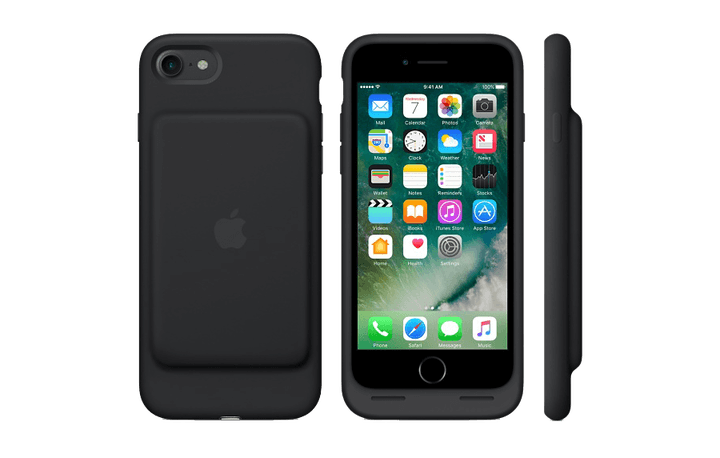
- Capacity – 2,365mAh
- Output – N/A
- Size – 5.45 x 2.64 x 0.28 inches
- Weight – N/A
Apple’s own Smart Battery Case is the go-to accessory if you want seamless integration with your iPhone 7. If you have any experience with the iPhone 6S’ Smart Battery Case, you’re in for much of the same with the one made for the iPhone 7, save for a different cut-out around the camera and none for the headphone jack (because the iPhone 7 doesn’t have one). The case will increase your call, internet, and video time by 26, 22, and 24 hours, respectively, meaning even heavy smartphone users should be able to use their devices without worrying about a full recharge.
Moreover, you can use the case with Lightning-supported accessories without removing it, including the Lighting to USB cable and the charging dock. As far as protection goes, this case is pretty basic. The interior is lined with a microfiber material, while the outside is made of silicone.
Buy one now from:
Apple Amazon
Mophie Juice Pack Air ($100)

- Capacity – 2,525mAh
- Output – N/A
- Size – 5.90 x 2.80 x 0.65 inches
- Weight – 99.5g (3.51 oz)
Mophie’s Juice Pack Air battery case is very similar to the battery cases the company has made for the iPhone 6 and iPhone 6S. The case will last for 500 recharges, and during use, can provide an estimated 27 hours of battery life to your iPhone 7 and iPhone 7 Plus. Just press and hold the button on the back for two seconds to begin charging your phone. The Juice Pack Air has LEDs on the back to show how much power is left, can be charged without removing the iPhone, and doesn’t block the speaker, microphone, camera, or any other important components of the phone. In fact, the case is designed to enhance the speaker’s audio quality, as it redirects sound from the bottom of the phone to the front. It’s also compatible with Mophie’s Charge Force wireless mount, so you can easily charge it while driving.
Buy one now from:
Mophie
Foxin Battery Case ($20)
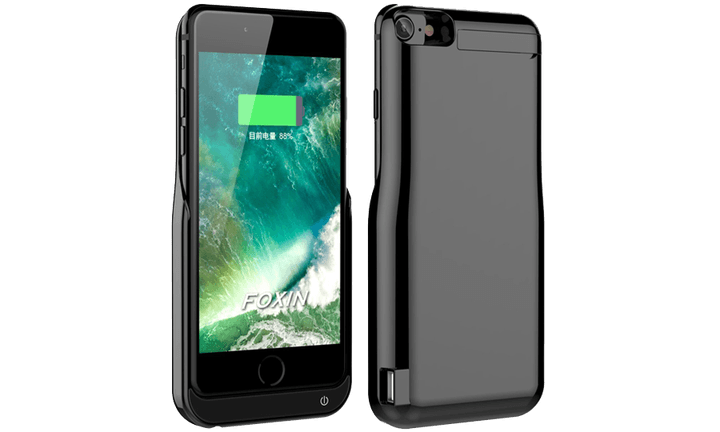
- Capacity – 6,800mAh
- Output – 1.0A
- Size – 7.2 x 4 x 1.1 inches
- Weight – 181g (6.4 oz)
If you power through your iPhone 7’s battery multiple times a day, Foxin’s battery case will be able to support you, as it’s capable of fully charging your phone two times a day, thanks to its own 6,800mAh battery. To complement that, you can charge your phone while it’s in the case, and once the iPhone battery is full, the charge will continue on to the battery case itself. There’s also a USB port on the side, allowing you to charge another device.
There is a flaw with this particular case, however, and it lies with the iPhone 7’s own Lightning port. Even though the port can be used to attach the phone to the case and to charge it, you’re unable to use the Apple earpods that come packed in with every iPhone. If that’s not a huge deal breaker, you can buy this case with confidence. Smartphone protection is standard with this case, so expect some defense against falls and shocks, but avoid bigger drops if you can.
Buy one now from:
Amazon
Maxdara Charging Case ($16)

- Capacity: 5,200mAh
- Output: 1.5A
- Size – 5.6 x 2.7 x 0.6 inches
- Weight – 82.2g (2.9 oz)
Maxdara’s battery case will keep your iPhone 7 charged and ready, and it’ll let you know just how much power your case has left, thanks to the battery indicator located on the back — White: 100 percent, Green: 75 percent, Blue: 50 percent, Red: 25 percent. When the time comes to charge your phone using the case, you use the On/Off switch (also located on the back) to start and stop the process. The case has precise cutouts for your phone’s microphone, buttons, and camera. It’ll also protect your phone from scratches and shocks. It’s made with a dull polished material that results in a comfortable case you can hold for all the hours you’ll be using your phone.
Buy one now from:
Amazon
Trianium Atomic Pro Battery Case ($40+)

- Capacity – 3,200mAh
- Output – N/A
- Size – 5.9 x 2.7 x 0.4 inches
- Weight – 158.7g (5.6 oz)
While Trianium’s battery case has one of the lower capacities on this list, it’ll still get the job done when it comes to keeping your phone alive. It can provide another full battery charge, or, as Trianium breaks it down: 14+ hours of talk time or 10 additional hours to browse the internet. The LED indicator on the back will keep you up to date on how much power remains.
Unfortunately, like other battery cases for the iPhone 7 so far, it doesn’t support Apple’s lightning headphones, or other headphones that use the lightning port. If you’re concerned about overall protection, the case ensures your phone’s safety by utilizing a hard back plate and a protective dual-layer bumper, resulting in protection against drops, shocks, and scratches. While it adds a bit of bulk, it does offer good protection.
Buy one now from:
Amazon
Alpatronix BX170 Charging Case ($30+)
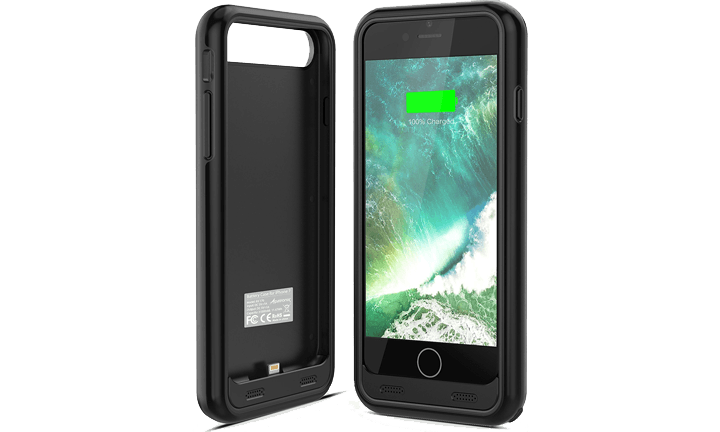
- Capacity – 3,200mAh
- Output – 1A
- Size – 6.05 x 2.87 x 0.63 inches
- Weight – 107.7g (3.8 oz)
Alphatronix’s case will get the job done when the time comes to recharge your phone, but like some other charging cases, it is not compatible with the packed in headphones Apple provides. Furthermore, the case isn’t charged using the Lightning connector, but instead requires a Micro USB cable — thankfully, there is one included. You can still charge the case without removing the phone, but it means keeping another cable nearby.
Aside from those minor setbacks, this is a great iPhone 7 battery case, and a decent protective case. The dual layer design combines a hard outer shell with a shock absorbing bumper, there’s a scratch-resistant finish, and the raised bezel will keep the screen away from surfaces when face down. All ports are accessible, there are LED indicators on the back, and it’s covered by a 1-year warranty when bought directly from Alphatronix.
Buy one now one:
Amazon Alphatronix
Anker PowerCore Battery Case ($50)

- Capacity – 2,200 mAh
- Output – N/A
- Size – 5.55 x 2.76 x 0.6 inches
- Weight – 68.03g (2.4 oz)
While the Anker PowerCore is made to work with the iPhone 7, it will also easily work with the iPhone 6 and 6S given the phones have similar exterior designs. The PowerCore employs the iPhone’s lightning port to charge your phone, and can give it an almost 100-percent charge, providing between 11 and 13 hours of extra battery life. To charge the battery case for future use, you need to use the included Micro USB cable with the case’s Micro USB port. When not in use, the PowerCore doesn’t need to be constantly connected via the Lightning port — meaning you’re free to use your headphones — and can instead act as a protective case that will help keep your phone secure. That said, since it’s not a dedicated iPhone case, or one that’s meant to prevent dents and scratches, Anker recommends not dropping it.
Buy one now from:
Amazon
ThinCase ($60)
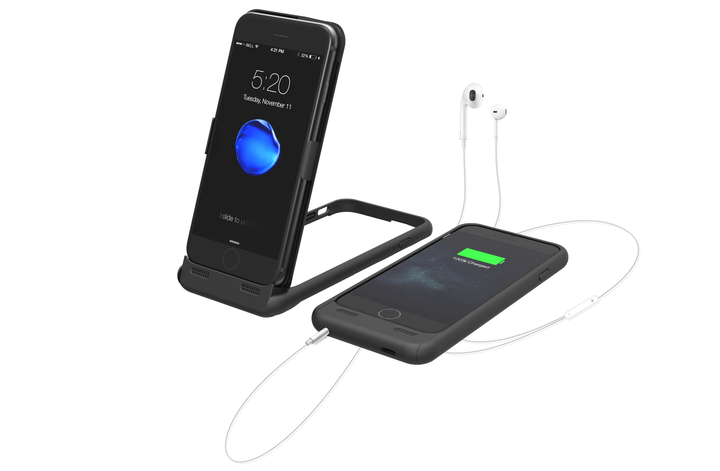
- Capacity – 3,000 mAh
- Output – N/A
- Size – N/A
- Weight – N/A
We’ve written about the ThinCase before, and now that it’s just on the horizon, we’re going to talk about it again. This is an impressive battery case, not just because of how well it charges your iPhone 7, but because it manages to bring back the headphone jack the current iPhone model left behind. The ThinCase also offers pretty decent protection, thanks to raised edges that keep the display away from surfaces when placed face down, as well as a durable design that prevents bumps, dents, and scratching. A kickstand feature is also built directly into the case, and can be used simply by opening the front cover and flipping it over.
The ThinCase doubles your iPhone battery life, providing an additional 14 hours of use, and doesn’t need to be removed in order to be charged again. In fact, both the case and the phone can be charged simultaneously due to its pass-through charging feature. According to its creators, you can charge the ThinCase in less than two hours, though charging the case and phone together will take about 3.5 hours. Few other iPhone 7 battery cases match the feature set the ThinCase provides, so it may prove hard to pass up.
Buy one now from:
Indiegogo
ZeroLemon Battery Case ($35)
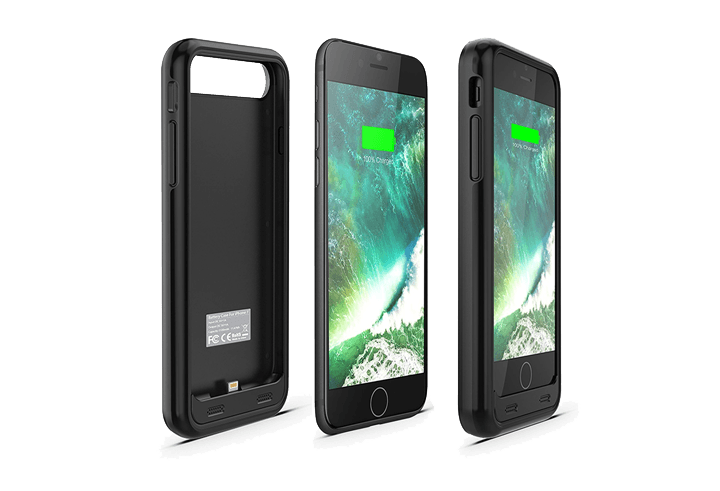
- Capacity – 3,100 mAh
- Output – 1.0A
- Size – 6 x 2.87 x 0.63 inches
- Weight – 108g (3.8 oz)
ZeroLemon’s battery case isn’t drastically different from other offerings on our list, but it’s another quality option if you’re searching for a way to keep your phone charged up and somewhat protected. You get about 12 hours of additional battery life using this particular case, and the four LEDs on the back will keep you updated regarding the case’s battery levels and charging status. Both the case and iPhone can also be charged at the same time using the included Micro USB cable, and your phone can be connected to your PC without removing it from the case.
As a protective case, it’s on the slimmer side, adds minimal bulk to the iPhone, and is sure to defend against everyday scratches and bumps. As for drop damage, it can handle a small drop from your coffee table, but maybe not a drop from the roof of your car. Also, keep in mind that you can’t use your wired headphones with this — just Bluetooth-equipped models.
Buy one now from:
Amazon
PhoneSuit Elite 7 Pro Battery Case ($80+)
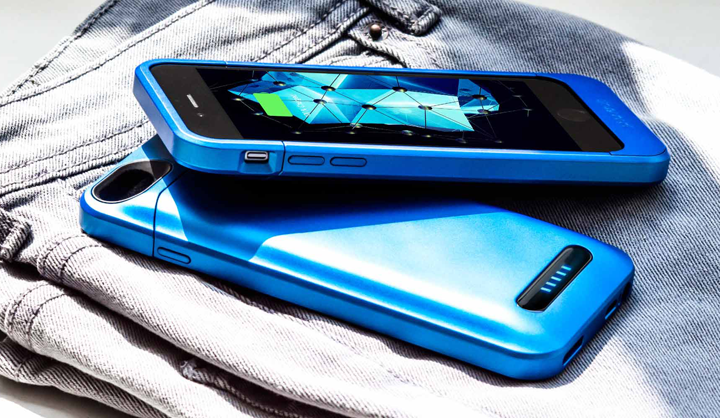
- Capacity – 3,000 mAh
- Output – 1.5A
- Size – 6.02 x 2.79 x 0.55 in
- Weight – 90g (3.17 oz)
The PhoneSuit battery case is definitely one of the more expensive cases on our list, alongside the offerings from Apple and Mophie, but you can see where the money went. At first glance, it looks a lot like other battery cases we’ve written about, but there are some small differences in how you interact with the case — namely how you activate the case to charge your phone. Typically, you press a button, but the PhoneSuit incorporates touch controls for a more modern feel. Touch the left side for a second to check battery status, or both the left and right sides for three seconds to start or stop charging.
The PhoneSuit also supports pass-through charging, PC sync, and will automatically turn off when it has charged your phone. It uses polycarbonate composite materials and a scratch-resistant coating, helping to keep your iPhone in perfect condition when out and about. The exterior design uses a rubber, soft-touch coating to provide additional grip, and though it’s expensive, it has everything you’re looking for in a quality battery case.
Buy one now from:
PhoneSuit Amazon
Keep the zombie hordes at bay in Dead Plague [Best New Games for Android]

What are the latest games worth checking out in the Google Play Store?
Updated June 3, 2017: Try out the early release of the top-down zombie shooter Dead Plague, check out the new take on the King of Fighters franchise, and then play the casual basketball game Bouncy Hoops!
There are thousands and thousands of games available in the Google Play Store, with more being added every month. With so much content hitting the app store, it can be damn near impossible to keep up with all the latest releases and determine which games are worth your time.
Here at Android Central, we want to help. We’ll be using this space to let you know about the latest gaming releases for Android that we think deserve your attention. We’ll be checking in and updating this page weekly as new games are released, so refresh often!
Dead Plague (Beta)
Dead Plague is in only in beta but it looks really promising. It’s a top-down twin-stick shooter where you must blast your way through wave after wave of zombies — imagine if they made a mobile-optimized version of Left 4 Dead.
That’s essentially Dead Plague, which at this point in production offers a basic storyline that drenched in zombie blood as explore an island that’s infested with the living dead. You’ve got a full arsenal of weapons to fight back with, and the game strategically provides ammo deposits throughout each level which is a nice touch and prevents you from becoming too trigger happy. Enemies will also be alerted to your location if you make noise near them, so if you’re too careless you’ll soon find yourself overrun by the horde.
The graphics are good and the touch controls are decent as well, but it’s not fair to judge this game too much considering it’s still in development. Either way, it’s free to check out in the Google Play Store and we think it’s worth your time to do so.
Download: Dead Plague (Beta)
KOF’98 Ultimate Match Online
King of Fighters has legions of fans, and KOF’98 Ultimate Match Online (shortened to KOF98 UM OL because that’s how you title, apparently) is an ode from SNK to those fans. But instead of offering more of the same arcade fighter gameplay, they’ve teamed with Hong Kong-based developers FingerFun Limited and mixed things up with this mashup beat’em up RPG that exists within the KOF universe and features all your favorite characters
If you’re a KOF fan looking for a fresh take on the franchise, you’re in for a treat. As you play you build out a team of eight fighters, each with their own unique skills and ultimate attacks. There’s a deep character upgrade system here, the character design is pretty great, and there’s a good variety of enemies.
The first chapter and a half of the campaign act as a tutorial of sorts to teach you the ropes, but from there you’re on your own to build your team, upgrade their skills and head into battle. It’s a free game, with the downsides of in-app purchases and the occasional add.
Download: KOF’98 Ultimate Match Online (Free w/IAPs
Bouncy Hoops
Bouncy Hoops is the latest game published by NoodleCake Studios which is reason alone to check this game out. The best way to describe this game is basketball-meets-Flappy Bird.
It’s a light, casual game with a simple goal: sink as many baskets as you can. You control the basketball by tapping to pop it in the air. If you shoot the ball over the net, it’ll reappear on the other side of the screen. There are two game modes to choose between: Arcade and Time. Arcade is the endless mode where you only have about five seconds to get the ball through the next hoop, which generates on either side of the court at different heights. You can link clean shots for combo bonuses and even earn a buzzer beater bonus if you time things right. Time mode works basically the same way, except you’re a minute to sink as many baskets as you can.
You collect coins as you play which can be used to unlock different ball styles, and there is the occasional ad to deal with. Bouncy Hoops is one of those fun and simple games that’s quick to pick up but hard to master, and a great game for competing against your friends in the Google Play Leaderboards.
Download: Bouncy Hoops (Free w/IAPs)
Get an NVIDIA Shield with a free Plex Pass subscription right now!
If you’ve been eyeing up an NVIDIA Shield TV for a while, now might be as good a time as any to pull the trigger. For a limited time you’ll also get a free Plex Pass subscription thrown in that’ll give you plenty of time to get to grips with what it can offer you.

With every purchase of both the 16GB Shield TV and the 500GB Pro model right now you’ll get yourself a free 6-month subscription to Plex Pass. Plex itself is free to use, but to access its best features you need Plex Pass. And the NVIDIA Shield is one of, if not the best Plex device around.
Plex is an easy to use home media center that allows you to catalog and access all your home music, movies, TV shows and photos, along with newer features like live TV and DVR capabilities. The NVIDIA Shield can even act as the Plex Media Server, serving media up to all your other Plex connected devices.
How to setup Plex Media Server on NVIDIA Shield TV
The offer doesn’t seem limited to the U.S. as well, being available on the European side of the Atlantic, too. Grab it while it’s hot.
See at Amazon
NVIDIA Shield Android TV
- Read our Shield Android TV review
- The latest Shield Android TV news
- Shield vs. Shield Pro: Which should I buy?
- Join the forum discussion
- Complete Shield Android TV specs
Amazon
Best Cheap Android Phones of 2017
Update, June 2017: The $229 Moto G5 Plus is now our go-to budget pick, and we’ve added the ZTE Blade V8 Pro as a great option for dual-camera fans. The Moto E 2015 has also been replaced with the Moto G4 Plus.
- Best overall
- Best for dual cameras
- Best for all-metal
- Best under $100
- Best for Europe
Best overall
Moto G5 Plus

See at Amazon
Motorola performed yet another pricing miracle with the Moto G5 Plus, the successor to last year’s excellent Moto G4 series and a contender for the best affordable smartphone today.
It starts with the excellent 5.2-inch Full HD display, but the real benefit to the G5 Plus this year is the excellent performance and battery life from the combination of a Snapdragon 625 platform and a 3000mAh battery.
Also of note is the improved low-light performance from the 12MP camera, which boasts the same hardware as (and similar results to) the Galaxy S7.
Bottom line: This is the best sub-$250 phone you can buy today, and it’s still a great device even if price isn’t a factor.
One more thing: Motorola.com is offering the Moto G5 Plus with inexpensive financing if you don’t want to pay up front.
Why the Moto G5 Plus is the best
Last year, we recommended the $199.99 Moto G4 over its $249.99 Plus variant, but this year the only distinction is between memory and storage amounts: the Moto G5 Plus comes in either a $229.99 2GB RAM / 32GB storage version, or a $299.99 4GB RAM / 64GB storage version — they are otherwise identical.
With either decision, you’ll be happy with your purchase. Motorola has changed up the phone’s design this year, adding a metal back and a more compact, mature look that complements the Moto Z series, and the excellent 5.2-inch IPS display is much more manageable in one hand. Also more manageable is the improved shape of the front fingerprint sensor, which is turned oblong and considerably easier to activate.
Motorola has also bestowed a fantastic camera on the Moto G5 Plus this year, giving it the same 12MP sensor and lens combination that’s in the Galaxy S7 — though the results aren’t quite as good. The phone isn’t perfect — there’s no NFC on the U.S. model, and it still uses the older Micro-USB charging port — but it’s close.
And if you buy it through Amazon, you can save $45 on the base model, bringing it down to $184.99!
Best for dual camera
ZTE Blade V8 Pro

See at Amazon
Who would have thought that a device with an absurd name like the Blade V8 Pro (it sounds like a weaponized drink) would end up on this list, but here we are. ZTE has done an amazing thing: make a big, plastic phone that adds up to far greater than the sum of its parts. The 5.5-inch 1080p display is fantastic, and it runs like a dream on the Snapdragon 625. There’s a massive 3,100mAh battery inside, too, to go along with the dual-13MP cameras, something you don’t see from this class of phone.
Bottom line: The ZTE Blade V8 Pro has everything going for it, including great hardware, endless battery life and competent cameras.
One more thing: The phone runs Android 6.0.1 Marshmallow, with no timeline for an upgrade to Nougat.
Best all-metal
Honor 6X

See at Amazon
For the new year the Honor 6X replaces its predecessor the 5X on this list. While you won’t be blown away by magnificent design or all of the top-end features, the Honor 6X is an exercise in what you can get for about $250. You get a good enough screen, expandable storage and a fingerprint sensor, wrapped in a metal body that’s better than the plastic offerings out there. There’s also a neat dual camera setup around back that can take interesting-looking shots.
Sure it’s stuck on Micro-USB and the software has yet to make the jump to Huawei’s new EMUI 5.0 (and we can’t wait for that to come), but you can’t get that complete of a package in a phone this inexpensive.
Bottom-line: It doesn’t offer everything, but it’s a solid package for the money.
One more thing: Keep an eye out for discounts and promotional “flash sales” at lower prices.
Best under $100
Moto G4 Play

See at Amazon
Though it’s the lower-end model of the last-generation Moto G, the G4 Play still has a place in this list considering its price — it’s just $149 now, or $99 if you’re willing to take Amazon’s “Prime Exclusive” version with lock screen ads. It doesn’t seem like a big difference from the Moto G5, but at these prices every dollar counts.
Looking at the phone itself, this is a very well-rounded product for the price. You get a 5-inch 720p display, a quad-core Snapdragon 410 processor at 1.2Ghz, 2GB of RAM, 16GB storage, and an 8MP rear camera, with all-day battery life from the 2800mAh cell, running Android 6.0 Marshmallow.
Bottom-line: The Moto G4 Play is the spiritual successor to the Moto E, but it has a bigger and better screen, more power, and a much nicer design.
One more thing: Don’t expect an update to Android 7.0 Nougat on the Moto G4 Play — that’s its one true shortcoming.
Best in Europe
Wileyfox Swift 2

See at Amazon
The Wileyfox Swift 2 is the British company’s latest Android phone and has every right to be taken notice of. It costs a ridiculously cheap £139 and packs Moto G-matching hardware with a bit different style and software approach.
The display is nice, the battery life is pretty good, the overall appearance is on point and the software provided by Cyanogen is slick, speedy and bloat-free. It’s not available officially outside Europe right now, but it’s absolutely one of the best cheap phones money can buy. And if you’re lucky, you can even snag it on special for as low as £99.
Bottom-line: For those in Europe looking something a little nicer than a Moto G4 Play, with a fresh software experience, the Swift 2 is a good choice.
One more thing: Don’t be tempted by the lower-end Spark or Storm. The Swift is the only one we recommend.
Conclusion
If you don’t want to spend over $250 and still want a great Android phone, the Moto G5 Plus is the best choice. You don’t get the best looking or feeling phone, but it offers a top-notch experience, especially for the price.
Best overall
Moto G5 Plus
See at Amazon
Motorola performed yet another pricing miracle with the Moto G5 Plus, the successor to last year’s excellent Moto G4 series and a contender for the best affordable smartphone today.
It starts with the excellent 5.2-inch Full HD display, but the real benefit to the G5 Plus this year is the excellent performance and battery life from the combination of a Snapdragon 625 platform and a 30000mAh battery.
Also of note is the improved low-light performance from the 12MP camera, which boasts the same hardware as (and similar results to) the Galaxy S7.
Bottom line: This is the best sub-$250 phone you can buy today, and it’s still a great device even if price isn’t a factor.
One more thing: Motorola.com is offering the Moto G5 Plus with inexpensive financing if you don’t want to pay up front.
Best Android phones under $400
Best Android phones under $100
Living a digital dream with Alex Andreev’s VR landscapes
“A lucid dream is a dream during which the dreamer is aware of dreaming,” says Wikipedia. Artist Alex Andreev offers that experience with his VR dreamscape paintings by messing with the part of your brain that distinguishes reality from fantasy. “Never did I take creation as a product of man’s intellect,” he says. “Our conscious awareness is only a thin film in the ocean of unconsciousness.”
His digital 360-degree VR artworks are full of fantastical imagery like floating islands and cargo freighters, dinosaurs and dystopic landscapes, all populated by people doing ordinary things like fishing or playing tennis.
The works are made possible by the digital tools at his fingertips. “It sounds paradoxical but digital art attracts me because it is free of technological influence,” Andreev explains. “In traditional arts, technologies dramatically limit the artist.”
It sounds paradoxical but digital art attracts me because it is free of technological influence. In traditional arts, technologies dramatically limit the artist.
A Russian who lives in France, Andreev has worked in game and film production, and uses tools like Photoshop and Blender to create his works. He adds that new 3D rendering technology has improved his creation methods: “[It] has become much friendlier for artists who want to see results immediately,” he told 2D Artist magazine.
Despite the fantastical aspects of his work, Andreev uses authentic visuals to ground the user in the acid-trip landscapes. “When the viewer interacts with an image, he compares what he sees now with his past experience,” Andreev said. “The more [it] relates to their experience, the greater the effect the artwork will have.”
Each piece places the viewer in the center a scene with multiple stories happening at once. Andreev says he tries to pry visuals from his unconsciousness mind by revisiting childhood memories or dreams, for instance. From there, the viewer is free to fill in their own narrative or meaning for the piece, as if it was there own dream.
Working with graphic designer Mikhail Ershov, Andreev developed an app for the VR paintings called “A separate reality,” on iOS and Android. Accompanied by music by Gumar Zaynullin, it gives VR headset owners the best way to view the paintings.
Via: Design Boom
Source: Alex Andreev (Behance)
The Morning After: Weekend Edition
Hey, good morning! You look fabulous.
Welcome to the weekend. It’s time to prep for Apple’s next big event and carefully consider what could happen if the government legalizes “hacking back.”
Tune in Monday.What to expect from Apple at WWDC 2017

This week Apple will put on a big show for developers but, as usual, we’re also listening. That’s because we could get news about everything from an Echo-fighting Siri speaker to refreshed MacBooks and iPads. On the software side, we’re expecting to find out how Siri will keep up with its AI assistant competition, and what’s next for both iOS and MacOS.
It begins.‘Need for Speed Payback’ adds higher stakes and familiar ideas

E3 is still more than a week away, but EA has already dropped off one big game announcement: a name, release date and trailer for the next Need for Speed. Payback is an open world game that seems to take a lot of hints from the Fast and Furious franchise. Ultimately, it’s about “building the perfect ride, getting behind the wheel and playing out an action driving fantasy.”
A new challenger entersThe Eve V came from nowhere to challenge the Surface Pro

Could a crowdfunded convertible really take on Microsoft’s pro mobile PC? Now that we’ve spent time with the Eve V at Computex, that seems realistic. There are still reasons to be skeptical, but its sturdy aluminum frame is coming together nicely.
That was fast‘Rime’ goes DRM-free after hackers crack the game in days

Publishers for the adventure/puzzle game Rime were worried that piracy could cut into first-week sales, so they applied Denuvo DRM technology to the PC version. Unfortunately, gamers report the DRM caused performance issues. The publishers promised that if the DRM were cracked, then they would release a version of the game without it, and within just a few days of its launch, that’s what happened.
Real life isn’t always like ‘Mr. Robot’Bad Password: If hacking back becomes law, what could possibly go wrong?

The Active Cyber Defense Certainty (ACDC) Act is getting closer to being put before lawmakers, but as columnist Violet Blue explains, they should think carefully before making it a law. That’s because as awesome as “hacking back” sounds, it could very easily send attacks flying both ways, with an impossible to enforce maxim that victims only mess with their stolen data. As-is, it’s like
trying to make gang warfare productive.”
Take that for data.Trump withdraws the US from Paris climate change agreement

By now you’ve heard that the President plans to initiate a withdrawal from the Paris Accords, an agreement reached to try and reduce greenhouse gas emissions. What you may not have heard, however, is the response of MIT scientists to data the president cited in his statement to claim the agreement would accomplish little. In a statement, researchers from the MIT Joint Program on the Science and Policy of Global Change said they “find this statement to be misleading,” and that “the Paris Agreement is an unprecedented and vital effort by nearly 200 countries to respond to the urgent threat of global climate change.”
But wait, there’s more…
- A 3D printer gave my Nintendo Switch a real D-pad
- Intel’s Core i9 Extreme Edition CPU is an 18-core beast
- Silk Road founder loses appeal and will serve life in prison
- North Korea has created its own ‘iPad’
- Computer Love: The semi-nude lives of webcam stars
The Morning After is a new daily newsletter from Engadget designed to help you fight off FOMO. Who knows what you’ll miss if you don’t subscribe.
Microsoft’s vision for connected PCs gives me hope for Windows
I wasn’t expecting a major news announcement from Microsoft’s Computex keynote this year — not on the heels of events in New York, Seattle and Shanghai. What else could there possibly be to unveil after the Surface Laptop, Surface Pro and new Windows versions and updates? Turns out, Microsoft was saving the best for Taiwan. It showed off plans for its vision of “Always Connected PCs”, teaming up with Qualcomm and Intel to make future devices work the same way whether you are at home or on the go. These computers will combine the best features of smartphones, like constant connectivity, all-day battery life and portable designs, to deliver a reliable, powerful and always-accessible Windows 10 experience.
“The PC is back in a big way,” Matt Barlow, vice president of Windows and devices at Microsoft, told Engadget in an interview. It may be too soon to tell if that statement is true, but with all the plans that came to light this past month, it’s clear the company has an aggressive strategy to slide into every aspect of our lives. In a matter of weeks, we learned about new Cortana skills for all kinds of assistant-enabled devices, along with Fluent Design for easier creation of apps across product categories and tools that know your habits and preferences thanks to the Microsoft Graph. And the most important piece of the puzzle is ensuring access to a full-featured Windows 10 wherever people are.
That brings us to the Always Connected PC — a grand vision that Microsoft doesn’t appear to have a very clear framework for just yet. It relied on its partners here at Computex to define the concept .

For Intel, contributing to this vision involves making its existing and future modems support e-SIM, which allows devices to connect to data networks without needing a physical phone card. This is an important part of a PC revival, although it would be nice to see e-SIM capability built into its processors, since Intel’s chips are so widely used. In fact, Intel powers so many types of devices that integrated e-SIM for all its chipsets could make for a diverse range of connected gadgets, including wearables, headsets and speakers. And the company already intends to make that happen with Microsoft, as we learned when the two brands teased their AR/VR collaboration called Project Evo. Though we didn’t hear much more about that this time, it wouldn’t be surprising if they shared more details soon.
On the other hand, Qualcomm’s news is more consequential and clearly defined. Not only did we get details on what Qualcomm-powered PCs would do, but this was also the first time we’ve seen a Snapdragon chipset run full Windows 10. And based on the demo we got in a controlled environment, the Snapdragon 835 holds up well, making it a capable stand-in for a typical laptop system. Since it supports gigabit LTE connectivity, the 835 also enables cellular speeds that are faster than fiber and keeps you online without the need to lug around a hotspot. Thanks to e-SIM capability, it also lets anyone buy data in bite-size portions through the Windows Store.

The chip’s smaller size and power efficiency allow for potentially all-day (and beyond) batteries, while manufacturers can experiment with different designs and ways to make slimmer, lighter devices that are easy to tote around. And Snapdragon 835’s processing muscle, typically reserved for powerful high-end phones, is also capable of managing desktop-level tasks like creating Pivot Tables and jumping across virtual desktops.
But what’s most impressive about Qualcomm’s news at the show is how focused and well-defined it is. The company makes clear the four main benefits of Snapdragon 835 for PCs, so we know what exactly to expect. Connected PCs are already available, but the new standard could make for smartphone-like endurance, portability and standby features. And we already know that ASUS, Lenovo and HP are onboard, having promised to make always-connected PCs.
The thing is, Windows on Snapdragon as news on its own is compelling. But when considered in tandem with all the other news Microsoft has shared recently, it is momentous. It’s clear that borrowing smartphone features is to help Windows devices do better, but the move toward constant connectivity could help PCs not only survive, but thrive.
Click here to catch up on the latest news from Computex 2017!
New tech lets us ‘speak’ with Holocaust survivors, even after they’re gone
Why it matters to you
How would you like to have natural conversations with friends or relatives or icons who have passed away?
If you could hold a natural, face-to-face conversation with someone who has passed away, would you? Would you sit down with Albert Einstein? How about a parent? A best friend? If you answered yes, then we have good news: technology has arrived that may soon have you holding that internal debate. It’s called New Dimensions in Testimony and it was created by the USC Shoah Foundation, the institute started by Steven Spielberg to help combat hate and violence, primarily by capturing and telling stories of Holocaust survivors.
Right now, it’s a method for bringing Holocaust survivors virtually to classrooms. A big screen TV is rolled into the class, flipped on its side (as you would do with your phone), and students just ask the virtual survivor questions. The survivor, in turn, answers as if this was actually a giant Facetime call. This isn’t video conferencing, though. Survivors are being brought into a dome of lights and cameras and captured answering 1,000 questions over five days — about everything from their favorite color to what was it like as a child seeing their parents taken away from them for the last time.
As you speak into a microphone, speech recognition software recognizes what you’re saying and translates it to text. Everything the Holocaust survivor said has also been turned to text. Once it has your question, the system then uses artificial intelligence to pair that question with the most appropriate answer, which it then puts back out in video form.
The video is two-dimensional at this time, but in order to future proof the interviews, they’ve been captured with spherical array of camera. That way, when hologram technology has matured, you can sit right across from a full 3D image of survivors. Circling back to the question of who you might like to capture and speak with even after they’re gone, an offshoot of the Shoah Foundation called Storyfile has been created for exactly that purpose.
New tech lets us ‘speak’ with Holocaust survivors, even after they’re gone
Why it matters to you
How would you like to have natural conversations with friends or relatives or icons who have passed away?
If you could hold a natural, face-to-face conversation with someone who has passed away, would you? Would you sit down with Albert Einstein? How about a parent? A best friend? If you answered yes, then we have good news: technology has arrived that may soon have you holding that internal debate. It’s called New Dimensions in Testimony and it was created by the USC Shoah Foundation, the institute started by Steven Spielberg to help combat hate and violence, primarily by capturing and telling stories of Holocaust survivors.
Right now, it’s a method for bringing Holocaust survivors virtually to classrooms. A big screen TV is rolled into the class, flipped on its side (as you would do with your phone), and students just ask the virtual survivor questions. The survivor, in turn, answers as if this was actually a giant Facetime call. This isn’t video conferencing, though. Survivors are being brought into a dome of lights and cameras and captured answering 1,000 questions over five days — about everything from their favorite color to what was it like as a child seeing their parents taken away from them for the last time.
As you speak into a microphone, speech recognition software recognizes what you’re saying and translates it to text. Everything the Holocaust survivor said has also been turned to text. Once it has your question, the system then uses artificial intelligence to pair that question with the most appropriate answer, which it then puts back out in video form.
The video is two-dimensional at this time, but in order to future proof the interviews, they’ve been captured with spherical array of camera. That way, when hologram technology has matured, you can sit right across from a full 3D image of survivors. Circling back to the question of who you might like to capture and speak with even after they’re gone, an offshoot of the Shoah Foundation called Storyfile has been created for exactly that purpose.
Your next heat source could come from a server, if Nerdalize has its way
Why it matters to you
Your laptop generates plenty of excess heat as it sits on your lap, and now, this Dutch startup wants to take that excess energy and have it heat your home.
The notion of “waste not, want not” has never been quite this high tech.
In an effort to ensure that our future is sustainable, one Dutch company is looking to turn servers into heat sources. Because if you’re running laptop is enough to warm your lap on a cold winter’s day, then shouldn’t servers (which emit a lot more energy in the form of heat) be enough to heat your home? That’s certainly the bet that Nerdalize is making. The startup hopes to “create free heat for everyone and make cloud computing sustainable and affordable.”
Its method? Placing cloud servers in individual homes, and turning them into heating systems. Your house will serve as a data center for companies that depend on cloud computing (which is to say, all companies), and in return, those companies will effectively provide you with heat and hot water.
It’s the 21st-century definition of symbiosis.
Nerdalize estimates that by turning common homes into data centers, homeowners can save up to $340 a year, while companies can forego the cost of expensive server centers, saving about 50 percent of their own operational costs. “This innovative set-up drastically reduces the household’s energy consumption while slashing the energy originally needed for server cooling,” Nerdalize claims. “Adding up all those free hot showers and avoided cooling, we can save up to three tons of CO2 per household per year.”
The plan is to start installing these servers in Dutch homes in August. 42 households will serve as guinea pigs, and if all goes well, they’ll be able to turn corporate data into hot water. Indeed, the company says, demand appears to be quite high for this innovative technology, as more than 3,500 people have signed up and expressed interest in a server heater.
The company has already hit 130 percent of its 250,000-euro ($282,000) funding goal, so if you’re looking for an alternative heat source, you may just want to look toward a server.

