


We still can’t cure Parkinson’s, but tech is making life easier for sufferers
Emma Lawton was 29 when she was diagnosed with Parkinson’s disease, and it changed her life forever. Lawton, a graphic designer by trade, could do nothing as her tremors worsened. Eventually, her symptoms became so severe that she could no longer draw a straight line — or anything close to it. There is no cure to Parkinson’s. She never thought she’d be able to draw again.
Lawton wasn’t about to take her diagnosis lying down. She connected with other sufferers online, engaging in video calls to hear about their experiences, and soak up any advice. She recorded her own observations in a journal, which would eventually be published as Dropping the P Bomb.
“Initially, I wrote it down for me,” Lawton told me when we spoke on the phone last month. “It was never meant to be a book; it was for me.” She had seen her father pen his own book when he started to deal with issues related to his sight. “When the going gets tough, you write it down,” she added.
Dropping the P Bomb was crowdfunded on Kickstarter, and as a result found its way into the hands of fellow sufferers, their relatives, and scores of people who never understood the first-hand experience of dealing with Parkinson’s disease. Just as her video calls helped her get to grips with her condition, Lawton provided a helping hand for people who were newly diagnosed — connections that wouldn’t have been possible without the internet.
My life is as normal as it can be, because of technology.
“It’s little things like that, all the way through to what’s happening now,” she replied, when we asked her how tech improved her life. “My life is as normal as it can be, because of technology. It’s not limited by Parkinson’s, it’s not limited by being in the same country as people, it’s not limited by what I can do physically.”
Last month, Lawton appeared on stage at Build 2017, in a segment dedicated to Project Emma, a device designed by Microsoft Research’s Haiyan Zhang to help her manage the condition. “It was an amazing experience — I didn’t really know what to expect, having never been to Build before,” she told Digital Trends. “We got a great response from people who wanted to collaborate.”
Project Emma counteracts the effects of Lawton’s tremor, allowing her to draw and write again. It’s a custom, one-off device, but Zhang is spearheading a research project that could help Parkinson’s sufferers on a much broader scale, with Lawton serving as a consultant.
“If anyone could help me, this woman could,” Lawton said when asked about her relationship with Zhang. “I knew she was bright from the start, but over time I’ve developed a more personal bond. We’ve forged ourselves into a weird partnership for life. We don’t know where it’ll take us.”
In addition to her role in Zhang’s research project, she’s a devices, apps, and gadgets strategists for Parkinson’s UK. Lawton is committed to using technology to help other people deal with Parkinson’s disease. And she’s not alone.
Meet the smart fork
Project Emma was designed for a BBC television show called The Big Life Fix, with the intention of remedying Lawton’s issues with drawing and writing. However, most people with Parkinson’s aren’t graphic designers. For them, being able to use cutlery is more helpful than being able to wield a pen.
When Anupam Pathak completed his PhD in mechanical engineering, he started to wonder how stabilizing technologies could help people who were affected by movement disorders. Eight years later, Liftware, the company he founded to pursue this idea, is thriving, and its products are helping sufferers across the United States.
“I remember first showing up with a plastic picnic spoon attached to a circuit board and motors that hardly worked,” Pathak told Digital Trends last month via email. “People were incredibly supportive, though, and were always eager to try my latest iteration, which often included changes to the firmware, exterior design, materials, and mechanical system.”
Liftware offers cutlery that’s purpose-built for users who can’t use standard utensils. The company’s debut product, Liftware Steady, uses motion stabilization technology to counteract mild to moderate tremor, which can be caused by conditions like Parkinson’s or essential tremor. It’s recently expanded its product line with Liftware Level, cutlery that counters the more extreme hand twists and rotations commonly associated with cerebral palsy, Huntington’s disease, and the aftereffects of a stroke.
“Our system works by measuring movements in an inertial frame (absolute motion), detecting whether these movements were due to hand tremor, and then correcting the disturbance by producing an equal and opposite movement,” Pathak wrote. “So, if the user’s hand shakes to the left, the device will move the spoon to the right an equal amount so that the spoon isn’t actually moving. The system makes these corrections thousands of times per second.”
The basic concepts that allow Liftware to counteract tremor were once used to stabilize gun barrels in tanks.
According to Pathak, the technology needed to affordably build Liftware wasn’t available until very recently. He and his team adapted commoditized inertial sensors and microcontrollers that were originally designed for use in the smartphone industry, to perfect their utensils. The basic concepts that allow Liftware to counteract tremor were once used to stabilize gun barrels in tanks.
Liftware was once an independent startup, but a few years back, the company was acquired by Verily Life Sciences, a research subsidiary of Google’s parent company Alphabet — and Pathak’s work has benefited greatly from the new arrangement.
“We were excited to join Verily in 2014, because it allowed us to scale our design and manufacturing processes so we could bring Liftware to more people who could benefit from this technology,” he explained. “The talent within Verily, and specifically within the hardware engineering team, has been invaluable in supporting new designs and improved sensors within our devices.”
Having Verily’s weight behind Liftware has allowed the company to go from strength to strength, to the benefit of people who need this technology in their everyday lives. “It is so meaningful to me when we receive positive responses from users who feel more confident when eating, or are more comfortable sharing a meal in public, or at the holidays,” said Pathak. “Our users have sent us heartfelt thank-you notes and cards which are proudly displayed on a wall in our office.”
Walking in another’s shoes
A blossoming field of research dubbed tele-empathy adds another dimension to the way medical professionals diagnose Parkinson’s, and helps relatives and loved ones understand how it affects day to day life.
Yan Fossat took the long road to his current role as head of the innovation lab at Klick. He studied mathematics, physics, and biochemistry, and spent some time working in graphic design and architectural CAD. He then went on to produce 3D animations and software in the medical industry. However, throughout his career, his work had two constants: technology and medicine.
“Because through my career I spent a lot of time with physicians, of various specialties, I think I have a fairly good idea of what their job is like,” Fossat told Digital Trends. “So it helps me design something that’s not just a fantastic idea in the boardroom, but actually would be useful in the real world.”

Klick SymPulse™ Tele-Empathy Device
Fossat’s work in tele-empathy began as a project commissioned by a client that wanted its healthcare representatives to better understand the conditions customers were suffering from. The project never went ahead, but he was fascinated by the idea.
“The problem was very interesting,” he remembered. “We thought about it because the research in the lab at the time was very much on the digitization of medical symptoms. The idea of treating a disease as a function, as a mathematical function, that disrupts physiology. So, we sort of went ahead with it and said, ‘Hey, what if we digitized the tremors?’ Not the shake of the tremors, but what if we digitized the muscle activity.”
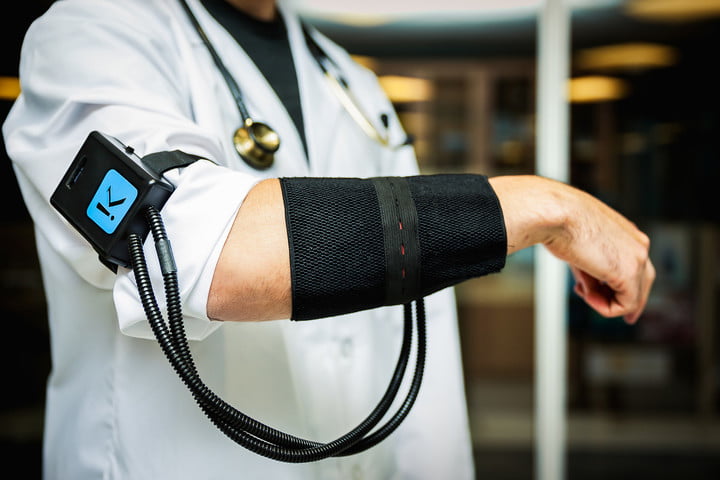
The result is SymPulse, a device that captures the muscle spasms that cause tremor in someone with Parkinson’s disease, and transmits them to a non-sufferer. Existing devices simulate tremor, but they serve as only a general simulation, and take the form of a large plastic glove with motors to shake your hand. SymPulse provides a more intimate window into the effect the condition has on a specific individual’s life.
“It’s giving you tremor, the fact that the hand is shaking is almost a consequence of that,” Fossat explained. “What it’s really transmitting to the non-patient is the muscle spasms.” The device doesn’t just show someone what it’s like to have Parkinson’s. It recreates what a specific patient is experiencing — in real-time, if necessary.
“We’ve seen it with the subjects we’ve tested, that it transforms them — they realize what it’s actually like,” said Fossat. “In fact, almost everyone that’s tried it — and I’ve tried it on maybe 150 people now — it’s at the end, when you flick the switch off that it truly dawns on them, that the patient doesn’t have that switch. That ability to say, ‘OK, I’m done now, turn it off.’ They don’t have that.”
It’s at the end, when you flick the switch off, that it truly dawns on them — and that the patient doesn’t have that switch.
Empathy can be a very important emotion when you’re caring for someone with a condition such as Parkinson’s. It can be useful for friends and relatives to experience tremor firsthand, of course, but Fossat also told us patients fare better with doctors that have higher levels of empathy. He and his team are currently planning a study that will attempt to quantify how much SymPulse can increase empathy, and for how long.
However, the hardware isn’t good for empathy alone. Fossat wants to help doctors treat patients from across the globe. Rather than simply listening to the description of symptoms over the phone, SymPulse could let them feel the patient’s condition.
“Especially with the cost of the hardware being so modest, or virtually negligible, it makes it much easier to do telemedicine like that,” he added. “You don’t have to send a giant videoconferencing system or an MRI scanner, you could send some kind of Arduino gizmo, and have the patient wear it.”
Much like the work being done by Liftware, Klick has been aided in its research and development by the availability of off-the-shelf hardware that promotes quick-fire prototyping, which Fossat describes as “transformative.” Now that there’s no need to order custom circuits from abroad during the early stages of design, iterative work that would once have taken months, now takes days.
The next step for Klick is getting its hardware properly accredited. There are numerous medical gadgets out there that claim to do great things, but Fossat knows from his experience with doctors that he needs to take a scientific approach if the hardware is going to be put into practice. “We want to make sure that this thing is validated,” he said. “I want to make sure that we validate what we do, and that we have proof and backing for our claims.”
Help Where It’s Needed
There was a time when it took an enormous amount of resources to create a new piece of tech — especially one that performed a function no previous product had. But that has changed over the last decade. Today, it’s much easier to grab a single-board computer, add any necessary external components, and run purpose-written code to produce the intended result.
This means companies like Klick and Liftware can design devices that cater to Parkinson’s sufferers, who make up a relatively small proportion of the global population. Custom technology is more workable than ever before, and that’s sure to help groups of people who can benefit from having hardware crafted to cater to their needs.
“There is a huge opportunity to bring technology and healthcare needs together, particularly for groups that are traditionally underrepresented in consumer technologies such aging populations or people living with disabilities,” Pathak told us. “Technology can help people with certain medical conditions maintain greater independence and improve their quality of life and the more we as technologists can meet their needs, the better off we all are.”
Innovative treatments for Parkinson’s disease are just one example of the growing symbiosis between the technology industry and medicine. In the future, we may see even rarer conditions receive attention from talented engineers and designers. It might not be possible to wipe out a disease like Parkinson’s, but it’s finally possible to find useful, affordable solutions for the people affected by it.
We still can’t cure Parkinson’s, but tech is making life easier for sufferers
Emma Lawton was 29 when she was diagnosed with Parkinson’s disease, and it changed her life forever. Lawton, a graphic designer by trade, could do nothing as her tremors worsened. Eventually, her symptoms became so severe that she could no longer draw a straight line — or anything close to it. There is no cure to Parkinson’s. She never thought she’d be able to draw again.
Lawton wasn’t about to take her diagnosis lying down. She connected with other sufferers online, engaging in video calls to hear about their experiences, and soak up any advice. She recorded her own observations in a journal, which would eventually be published as Dropping the P Bomb.
“Initially, I wrote it down for me,” Lawton told me when we spoke on the phone last month. “It was never meant to be a book; it was for me.” She had seen her father pen his own book when he started to deal with issues related to his sight. “When the going gets tough, you write it down,” she added.
Dropping the P Bomb was crowdfunded on Kickstarter, and as a result found its way into the hands of fellow sufferers, their relatives, and scores of people who never understood the first-hand experience of dealing with Parkinson’s disease. Just as her video calls helped her get to grips with her condition, Lawton provided a helping hand for people who were newly diagnosed — connections that wouldn’t have been possible without the internet.
My life is as normal as it can be, because of technology.
“It’s little things like that, all the way through to what’s happening now,” she replied, when we asked her how tech improved her life. “My life is as normal as it can be, because of technology. It’s not limited by Parkinson’s, it’s not limited by being in the same country as people, it’s not limited by what I can do physically.”
Last month, Lawton appeared on stage at Build 2017, in a segment dedicated to Project Emma, a device designed by Microsoft Research’s Haiyan Zhang to help her manage the condition. “It was an amazing experience — I didn’t really know what to expect, having never been to Build before,” she told Digital Trends. “We got a great response from people who wanted to collaborate.”
Project Emma counteracts the effects of Lawton’s tremor, allowing her to draw and write again. It’s a custom, one-off device, but Zhang is spearheading a research project that could help Parkinson’s sufferers on a much broader scale, with Lawton serving as a consultant.
“If anyone could help me, this woman could,” Lawton said when asked about her relationship with Zhang. “I knew she was bright from the start, but over time I’ve developed a more personal bond. We’ve forged ourselves into a weird partnership for life. We don’t know where it’ll take us.”
In addition to her role in Zhang’s research project, she’s a devices, apps, and gadgets strategists for Parkinson’s UK. Lawton is committed to using technology to help other people deal with Parkinson’s disease. And she’s not alone.
Meet the smart fork
Project Emma was designed for a BBC television show called The Big Life Fix, with the intention of remedying Lawton’s issues with drawing and writing. However, most people with Parkinson’s aren’t graphic designers. For them, being able to use cutlery is more helpful than being able to wield a pen.
When Anupam Pathak completed his PhD in mechanical engineering, he started to wonder how stabilizing technologies could help people who were affected by movement disorders. Eight years later, Liftware, the company he founded to pursue this idea, is thriving, and its products are helping sufferers across the United States.
“I remember first showing up with a plastic picnic spoon attached to a circuit board and motors that hardly worked,” Pathak told Digital Trends last month via email. “People were incredibly supportive, though, and were always eager to try my latest iteration, which often included changes to the firmware, exterior design, materials, and mechanical system.”
Liftware offers cutlery that’s purpose-built for users who can’t use standard utensils. The company’s debut product, Liftware Steady, uses motion stabilization technology to counteract mild to moderate tremor, which can be caused by conditions like Parkinson’s or essential tremor. It’s recently expanded its product line with Liftware Level, cutlery that counters the more extreme hand twists and rotations commonly associated with cerebral palsy, Huntington’s disease, and the aftereffects of a stroke.
“Our system works by measuring movements in an inertial frame (absolute motion), detecting whether these movements were due to hand tremor, and then correcting the disturbance by producing an equal and opposite movement,” Pathak wrote. “So, if the user’s hand shakes to the left, the device will move the spoon to the right an equal amount so that the spoon isn’t actually moving. The system makes these corrections thousands of times per second.”
The basic concepts that allow Liftware to counteract tremor were once used to stabilize gun barrels in tanks.
According to Pathak, the technology needed to affordably build Liftware wasn’t available until very recently. He and his team adapted commoditized inertial sensors and microcontrollers that were originally designed for use in the smartphone industry, to perfect their utensils. The basic concepts that allow Liftware to counteract tremor were once used to stabilize gun barrels in tanks.
Liftware was once an independent startup, but a few years back, the company was acquired by Verily Life Sciences, a research subsidiary of Google’s parent company Alphabet — and Pathak’s work has benefited greatly from the new arrangement.
“We were excited to join Verily in 2014, because it allowed us to scale our design and manufacturing processes so we could bring Liftware to more people who could benefit from this technology,” he explained. “The talent within Verily, and specifically within the hardware engineering team, has been invaluable in supporting new designs and improved sensors within our devices.”
Having Verily’s weight behind Liftware has allowed the company to go from strength to strength, to the benefit of people who need this technology in their everyday lives. “It is so meaningful to me when we receive positive responses from users who feel more confident when eating, or are more comfortable sharing a meal in public, or at the holidays,” said Pathak. “Our users have sent us heartfelt thank-you notes and cards which are proudly displayed on a wall in our office.”
Walking in another’s shoes
A blossoming field of research dubbed tele-empathy adds another dimension to the way medical professionals diagnose Parkinson’s, and helps relatives and loved ones understand how it affects day to day life.
Yan Fossat took the long road to his current role as head of the innovation lab at Klick. He studied mathematics, physics, and biochemistry, and spent some time working in graphic design and architectural CAD. He then went on to produce 3D animations and software in the medical industry. However, throughout his career, his work had two constants: technology and medicine.
“Because through my career I spent a lot of time with physicians, of various specialties, I think I have a fairly good idea of what their job is like,” Fossat told Digital Trends. “So it helps me design something that’s not just a fantastic idea in the boardroom, but actually would be useful in the real world.”
Klick SymPulse™ Tele-Empathy Device
Fossat’s work in tele-empathy began as a project commissioned by a client that wanted its healthcare representatives to better understand the conditions customers were suffering from. The project never went ahead, but he was fascinated by the idea.
“The problem was very interesting,” he remembered. “We thought about it because the research in the lab at the time was very much on the digitization of medical symptoms. The idea of treating a disease as a function, as a mathematical function, that disrupts physiology. So, we sort of went ahead with it and said, ‘Hey, what if we digitized the tremors?’ Not the shake of the tremors, but what if we digitized the muscle activity.”
The result is SymPulse, a device that captures the muscle spasms that cause tremor in someone with Parkinson’s disease, and transmits them to a non-sufferer. Existing devices simulate tremor, but they serve as only a general simulation, and take the form of a large plastic glove with motors to shake your hand. SymPulse provides a more intimate window into the effect the condition has on a specific individual’s life.
“It’s giving you tremor, the fact that the hand is shaking is almost a consequence of that,” Fossat explained. “What it’s really transmitting to the non-patient is the muscle spasms.” The device doesn’t just show someone what it’s like to have Parkinson’s. It recreates what a specific patient is experiencing — in real-time, if necessary.
“We’ve seen it with the subjects we’ve tested, that it transforms them — they realize what it’s actually like,” said Fossat. “In fact, almost everyone that’s tried it — and I’ve tried it on maybe 150 people now — it’s at the end, when you flick the switch off that it truly dawns on them, that the patient doesn’t have that switch. That ability to say, ‘OK, I’m done now, turn it off.’ They don’t have that.”
It’s at the end, when you flick the switch off, that it truly dawns on them — and that the patient doesn’t have that switch.
Empathy can be a very important emotion when you’re caring for someone with a condition such as Parkinson’s. It can be useful for friends and relatives to experience tremor firsthand, of course, but Fossat also told us patients fare better with doctors that have higher levels of empathy. He and his team are currently planning a study that will attempt to quantify how much SymPulse can increase empathy, and for how long.
However, the hardware isn’t good for empathy alone. Fossat wants to help doctors treat patients from across the globe. Rather than simply listening to the description of symptoms over the phone, SymPulse could let them feel the patient’s condition.
“Especially with the cost of the hardware being so modest, or virtually negligible, it makes it much easier to do telemedicine like that,” he added. “You don’t have to send a giant videoconferencing system or an MRI scanner, you could send some kind of Arduino gizmo, and have the patient wear it.”
Much like the work being done by Liftware, Klick has been aided in its research and development by the availability of off-the-shelf hardware that promotes quick-fire prototyping, which Fossat describes as “transformative.” Now that there’s no need to order custom circuits from abroad during the early stages of design, iterative work that would once have taken months, now takes days.
The next step for Klick is getting its hardware properly accredited. There are numerous medical gadgets out there that claim to do great things, but Fossat knows from his experience with doctors that he needs to take a scientific approach if the hardware is going to be put into practice. “We want to make sure that this thing is validated,” he said. “I want to make sure that we validate what we do, and that we have proof and backing for our claims.”
Help Where It’s Needed
There was a time when it took an enormous amount of resources to create a new piece of tech — especially one that performed a function no previous product had. But that has changed over the last decade. Today, it’s much easier to grab a single-board computer, add any necessary external components, and run purpose-written code to produce the intended result.
This means companies like Klick and Liftware can design devices that cater to Parkinson’s sufferers, who make up a relatively small proportion of the global population. Custom technology is more workable than ever before, and that’s sure to help groups of people who can benefit from having hardware crafted to cater to their needs.
“There is a huge opportunity to bring technology and healthcare needs together, particularly for groups that are traditionally underrepresented in consumer technologies such aging populations or people living with disabilities,” Pathak told us. “Technology can help people with certain medical conditions maintain greater independence and improve their quality of life and the more we as technologists can meet their needs, the better off we all are.”
Innovative treatments for Parkinson’s disease are just one example of the growing symbiosis between the technology industry and medicine. In the future, we may see even rarer conditions receive attention from talented engineers and designers. It might not be possible to wipe out a disease like Parkinson’s, but it’s finally possible to find useful, affordable solutions for the people affected by it.
FIFA 18: Release date, what’s new and everything you need to know
FIFA 18 details have been announced and Pocket-lint has had a chance to play an early build of the game for several hours ahead of E3 2017.
This year’s edition has plenty of changes too, with a second year of the Frostbite engine yielding some very impressive graphical results. And many gameplay elements have been rebuilt from the ground up.
So here is everything we know about the game so far, including the new features, official screens, trailers and, importantly, the release date and formats it will be available for.
FIFA 18 release date
FIFA 18 gets a slightly staggered release, depending on whether you have EA Access on Xbox One and/or pre-order the game.
Here are the different release dates for each option:
- 21 September – EA Access members can play the full game from this date
- 26 September – Pre-orders of FIFA 18 Ronaldo Edition and FIFA 18 Icon Edition are available from this date
- 29 September – Full global release date
FIFA 18 formats
FIFA 18 will be available for PS4, Xbox One (plus Scorpio) and PC through Origin.
There is also a FIFA 18 Legacy Edition for PS3 and Xbox 360, although, like last year’s game, it will not feature The Journey.
Please note that the new FIFA game for Switch is not being labelled as FIFA 18 and is likely to be a tweaked experience with a different feature set.
EA Sports
FIFA 18 cover star
FIFA 18’s covers are a case of two Ronaldos. Current FIFA World Player of the Year, Cristiano Ronaldo, is on the front of the Standard Edition. He also stars on his own special Ronaldo Edition box cover.
There is also an Icon Edition, this time featuring a previous Real Madrid star with the same name: Ronaldo Luís Nazário de Lima, known simply as Ronaldo. The three-time FIFA World Player of the Year leads the charge for the all-new, renamed Legends mode as it debuts on PS4 and PC, as well as Xbox One which had the exclusive in previous seasons.
FIFA 18 pre-orders
You can now pre-order FIFA 18 digital download versions from the respective console and PC stores.
Here are links for each of the different versions, on the different platforms:
PS4 (via PlayStation Store)
- FIFA 18 Standard Edition for £59.99
- FIFA 18 Ronaldo Edition for £79.99
- FIFA 18 Icon Edition for £89.99
Xbox One (via Xbox Store)
- FIFA 18 Standard Edition for £59.99
- FIFA 18 Ronaldo Edition for £79.99
- FIFA 18 Icon Edition for £89.99
Note, EA Access members get a discount for each version.
PC (via Origins)
- FIFA 18 Standard Edition for £59.99
- FIFA 18 Ronaldo Edition for £79.99
- FIFA 18 Icon Edition for £89.99
Note, Origin Access members get a discount for each version.
FIFA 18 editions explained, what you get in each
The pre-order versions of each edition come with added bonuses. We’re not sure whether the full release of each will also include additional offerings – we’ll update when we find out more.
EA Sports
FIFA 18 Standard Edition
Pre-order comes with a loan of Cristiano Ronaldo for Ultimate Team plus eight special edition Ultimate Team kits.
FIFA 18 Ronaldo Edition
As well as the same loan of Cristiano Ronaldo for Ultimate Team and eight kits, you also get three-days early access to the game with a pre-order of the Ronaldo Edition.
FIFA 18 Icon Edition
This super-deluxe edition comes with the same benefits as the Ronaldo Edition, however you also get Team of the Week loan player packs and a loan of the legend Ronaldo Nazário for Ultimate Team.
FIFA 18: What’s new?
Based on our play of a substantial early build, there is no doubt that FIFA 18 is a considerable update to last year’s game. The gameplay, graphics and The Journey mode have all been improved or tweaked dramatically.
Here then are the changes we’ve been privy to so far. We haven’t seen anything of the new FIFA Ultimate Team and there is plenty yet to come, including bigger reveals during Gamescom in August, but here are the main new features as we know them currently:
FIFA 18 graphics
FIFA 18 uses the Frostbite engine again, but with additional experience the development team has redesigned the graphics superbly.
There is a new dual-lighting system that creates a more realistic look across the board, from stadiums to players and even the pitch they play on.
Different regions around the world now have realistic lighting too, with sun-drenched South American stadiums having a more yellow-tinted filter, while European locations look greener and darker. Games look more like TV coverage of foreign matches depending on where they take place.
EA Sports
FIFA 18 animation
One of the biggest changes to not only the way the game looks, but how it plays is animation. The entire animation engine has been rebuilt from the ground up and as well as add tonnes more personality to players, they move more fluidly.
Unlike previous games, FIFA 18 now animates players and the ball frame by frame. That means you get less latency between movements of a gamepad and the player responding.
Before, a player had to finish a set animation before responding to your actions. And while that might have still been milliseconds, it made the game feel laggy – one of the biggest complaints FIFA has always had.
Now though, as a player can change direction mid-way through an animation sequence the game feels much more responsive. Players will still need to turn and control the ball, etc, like before, but different players can do so more quickly than others depending on their statistics. You finally feel in complete control over every motion.
FIFA 18 pitch
As well as look more realistic, friction on the pitch has been altered to make the ball travel slower a touch, but much more true-to-life. Passing, therefore, requires more thought and a defter touch.
FIFA 18 crowd
The crowd is another area that has been significantly improved. FIFA 17’s crowd animations look great from afar but get up close and there is a lot of repetition in animation and look.
With FIFA 18, much of the crowd has its own AI, meaning it responds more accurately to action on a pitch. Score a goal, for example, and some members of the crowd surge forward to get closer to the pitch.
EA Sports
FIFA 18 players
As we’ve mentioned about, new animations give players more personality.
Many of the big name players move more like their real-life counterparts – including Cristiano Ronaldo, who provided all-new motion captures.
Plus, different player sizes come into play for the first time. A smaller player, for example, takes more steps when running than a bigger defender. The bigger player might also lurch along a touch in comparison.
There are many more options to the kind of motions a player is capable of, making for much more variety in even standard models.
FIFA 18 dribbling
One of the other tweaks on a player-by-player basis is slow, close dribbling.
The dribbling engine has been overhauled to match individual styles. For example, Messi and Hazard are very different players when on the ball, and FIFA 18 now reflects that.
Slow dribble has now been moved back to the left bumper of the gamepad and better gamers will be able to move their on-field player around more quickly. It adds more skills for FIFA players to master.
FIFA 18 team AI
The in-match artificial intelligence has been improved, giving a more realistic ebb and flow to a game. Players make more intelligent runs, or support the ball carrier, for example. Through balls no longer go askew, depending on the skills of the passer.
FIFA 18 team tactics
The tactics engine has been refined to include new systems that work much more like their real-world counterparts. Tiki Taka, counter attacking, pressing and even long ball tactics each have their own styles and feel. Career mode games against the computer should gain wider variety, therefore.
FIFA 18 substitutions
In-match substitutions are now possible without having to pause the game and enter the menu. Just hit the right bumper and a substitution will be offered while you are playing, with the player to come on in the next dead ball situation.
You can set up you own preferred subs options before games, or let the game recommend the next sub depending on the context when you hit the bumper – if you have an injured player, for instance.
FIFA 18 wondergoals and crossing
Goal attempts and crossing have been tweaked to give a higher possibility to score a spectacular goal.
The default crossing mode is now more curled and flatter than before. FIFA 17’s crosses were too looping so easier for defenders to get to. You should have a better chance of getting a striker onto a cross now, depending on the skill level of the striker and the one making the cross.
Wondergoals can occur as the game has a better understanding of the sport and the context in which a striker finds himself. Volleys are a little easier too, although they have as much chance of flying in as in real life.
FIFA 18 defending
Of course, where attackers have been tweaked to have been chances of scoring, defenders have been tweaked too to stop them.
One change is that there is now a hard tackle option, between a standing and sliding tackle.
FIFA 18 The Journey – Hunter returns
EA Sports is yet to reveal a lot of the new season of The Journey – FIFA 18’s campaign/story mode. However, it did let us in on a few nuggets.
Alex Hunter is subject to a major transfer early in the game, which we suspect is to Real Madrid considering Cristiano Ronaldo’s presence as a player and character in the game.
We think there will be international matches too, considering we saw a South American vista in one of the early shots. Or maybe it refers to the pre-season tour, that was revealed in one of the screengrabs we got a glimpse of.
EA Sports has confirmed that the mode will be bigger this year, with old characters returning and some new ones.
We were told that there will be six distinct chapters this year, with different major goals to complete in each. However, there will be much more personalisation and choices to be made throughout, which will have a big impact on your own experience going forward.
There will also be customisation options for your version of Alex Hunter this year. You can’t change his physical look, but you will be able to choose the clothes he wears, his haircut and even add tattoos to his arms and neck.
Another addition is local multiplayer in The Journey. And there will be other characters you can play with through the story.
Inside The Mill’s mind-bending alternate reality art showcase
I stepped inside a small, dark room in a large, airy loft space in New York’s Soho district early Wednesday morning. Our host fitted me with an HTC Vive and told to explore the world around me. Within moments, I was trapped in a glass box, surrounded by other people, also wearing VR headsets, also trapped in glass boxes, one of whom continued to claw at the glass until both of our headsets were consumed by our own flesh. We were one with the machines.
Over the next two hours I watched semi-autonomous robots run in circles, randomly scribbling on large sheets of butcher paper; pulled the virtual puppet strings of a CGI llama that lip synced to Mariah Carey; watched as Reeps One, a world-famous dubstep beatboxer, created unique digital sculptures with the incredibly nuanced tones of his voice; and floated through a VR dreamscape using my breathing and brain waves to propel me upward.
And all of this before I’d finished my first cup of coffee.
This was the scene at The Mill’s first big open studio exploring the connection between technology and humanity, titled Move Me. That day, the Technicolor-owned “creative content and technology studio” (a fancy way of saying “we make visual effects”) expected to see just shy of 1,000 special guests move through its doors and experience the outer limits of its in-house technology and creativity. The Oscar and Emmy award-winning studio, has been around since 1990, and is responsible for the visual effects on the first two Harry Potter films, Gladiator, Black Hawk Down, and the latest reboot of Doctor Who. You might also remember The Mill from “Project Raven” Epic Games’ Unreal Engine augmented reality demo, which utilized the studio’s in-house technology to combine real time visual effects with live-action footage at GDC 2017.
Not all of the projects on display at Move Me had the same polish as a Ridley Scott production or an Epic Game’s demo — many of the experiences were built in the space of just a few weeks — but it was by far the most concentrated mix of truly creative applications for emerging technologies I’d ever seen.
Pop Llama, the most complicated and seemingly convoluted project also turned out to be the most engaging. The augmented reality karaoke puppet show, used graphics that felt like the design love child of Lisa Frank and Jeff Koons and pop ballads like Mariah Carey’s Emotions to show how a combination of Epic’s Unreal Engine and The Mill’s in-house production kit, Cyclops, can bring the real-world and CG together in real-time. (Cyclops was the same system used by Epic at GDC.)
A member of the crew aimed his camera at a black-and-white checkered box on an empty set, covered in multi-colored cones as lights faded in and out overhead. Just out of frame, I waved my hand above a Leap Motion controller, opening and closing my fingers to the lyrics. A hyper-glossy, metallic digital llama mimicked my movements on a monitor in front of me, replacing the black and white box on the soundstage to my left. Every shift in the light, every subtle shadow was rendered in near real-time as the lama rolled along on a digital disco ball that reflected the very real light bouncing off of its many tiny mirrors. It was a ridiculous scenario, yes, but one can imagine how being able to render CG objects on set in real-time could be boon to big budget action and scifi films.
Other installations lacked Pop Llama’s polish, but delivered on concept. Neon Knights, billed as an “augmented reality snythwave battle,” utilized Microsoft’s Hololens for a social AR video game experience. The game, which “pits you against the cosmic forces trying to thwart your awesome journey through multiple dimensions to spread sexy peace across the universe,” was essentially a proof of concept used to show how otherwise isolating mediums like AR and VR can be used in a cooperative environment.
Once my partner, Engadget’s director of video, Olivia Kristiansen, and I had our headsets in place and Rock Band controllers in hand, we were told to shoot at the bad vibes coming toward us in the neon-lit, 1980s-inspired virtual arcade world just in front of us. The game felt like a combination of Rock Band and Galaga wrapped in my middle school Trapper Keeper and set to the tunes of Electric Six. It took me a while to figure out how to shoot with a small plastic guitar, and Olivia never did get the hang of it, but it was, honestly, the first time my heart rate moved above sleep-mode while wearing a Hololens. Technical difficulties and user errors aside, Neon Knights, was, if anything, a promising look at the potential of multiplayer AR gaming.
The other projects on display varied in their thoughtfulness and execution but in nearly every instance, I was forced to face my own techno-skepticism. Virtual reality has yet to really take hold as many have predicted and while Pokemon Go may have brought augmented reality into the mainstream consciousness, we’re still nowhere near realizing its potential. It’s going to take more than a lip-syncing llama to sell me, but it’s refreshing to see groups like The Mill pushing the limits of how these technologies are used.
Watch EA’s E3 2017 event live right here at 3PM ET
The big names aren’t waiting until next week to reveal what they have for us at E3 2017. EA is kicking things off today with its event at 3PM ET/12PM PT. We’re expecting details on games like Star Wars: Battlefront II, FIFA 18, Madden 18, NBA Live 18, Need for Speed: Payback and much more. We’ll be there to bring you all of the breaking news as it happens, but if you want to following along live you can do so via Twitch and YouTube streams. Being the kind folks that we are, we’ve embedded the stream down below so you can watch right here when the time comes.
Follow all the latest news from E3 2017 here!
‘Madden 18’ story mode looks a lot like ‘Friday Night Lights’
The rumors were true: EA is bringing FIFA 17’s story mode to the realm of American football. EA has revealed that Madden 18 will include a Longshot campaign that sees you fill the cleats of Devin Wade, a “forgotten prospect” hoping to make the cut in the NFL draft. From the early glimpse, it’s akin to every football movie and TV show you’ve ever seen, complete with big name actors — there’s fatherly drama (Moonlight’s Mahershala Ali), the loyal best friend (appropriately, Friday Night Lights’ Scott Porter) and even real-world legend Dan Marino serving as a mentor.
EA has yet to dive into the specifics of how the story will work, although FIFA will likely serve as a good benchmark. However it works, it’s safe to say that EA sees the story mode as a way of keeping its sports titles relevant. Even if you’re not interested in roster updates or gameplay mechanic tweaks, you might be more likely to snap up the next game in a series just to see the next plot twist.
Follow all the latest news from E3 2017 here!
Source: EA Sports, YouTube
‘FIFA 18’ will continue ‘The Journey’ of Alex Hunter
One of the best additions to FIFA 17 was ‘The Journey’, a mode that put players in the shoes of a fictional young star called Alex Hunter. Today at EA’s E3 press conference, it was confirmed that FIFA 18 will pick up his story after the events of the last game. A brief trailer teaser shows a wealth of real-life stars including former Manchester United defender Rio Ferdinand speculating on Hunter’s future and a possible transfer. Presumably, you’ll be taking the up-and-comer to a new club, in the hope of impressing more managers and earning silverware. We can’t wait.
Follow all the latest news from E3 2017 here!
‘A Way Out’ is a splitscreen-only prison break game
It’s been a while since we heard anything about Hazelight, the Stockholm-based studio led by Brothers: A Tale of Two Sons’ director Josef Fares. The team broke cover at The Game Awards in 2014, a brief teaser trailer in tow that showed two men travelling on a train by moonlight. Today, at EA’s E3 press conference, the project has been re-introduced as A Way Out. It’s about two inmates who forge an unlikely alliance to bust out of prison. The game is splitscreen-only (local and online multiplayer will be supported), meaning you’ll need a friend in order to break out and escape the law.
Brothers: A Tale of Two Sons won plenty of praise in 2013 for its unique control scheme and puzzle design, which required players to control each sibling with a different analog stick. A Way Out is clearly the continuation of that idea, forcing two distinct characters to work together and, as a result, slowly forge a close bond. Because it’s splitscreen-only, there’s no way to play it on your own, or using a conventional drop-in, drop-out matchmaking system. The puzzles require two people, so you’ll need someone, whether that’s a friend or a stranger, to be with you at all times.
Fares is promising a “ton of variation” in the moment-to-moment gameplay. Head-scratching puzzles will be broken up with driving, exploration and tense combat sequences. Think of it like Uncharted 4, but if your buddy could fight alongside you as Sam, Elena or Sully. Missions will also have multiple solutions, rather like a Hitman or Deus Ex title. To sneak out of the laundry room, you might start a fight with Leo, or claim a machine isn’t working with Vincent — it’s entirely up to you. If nothing else, it’s a unique and ambitious idea. We’ll find out if it delivers in “early 2018,” when the game releases on PC, PlayStation 4 and Xbox One.
Follow all the latest news from E3 2017 here!
‘Anthem’ is BioWare’s brand-new open world
The team behind Mass Effect has something new up its sleeves. BioWare today revealed Anthem, a new open-world franchise seemingly set in a futuristic, jungle-ridden universe. The teaser shows a mech of some kind and a big beastie screeching into the lush wilderness. It definitely has Destiny, Star Wars and Far Cry vibes.
“It is vast, dangerous, beautiful and unexpected,” EA executive vice president Patrick Soderlund said.
BioWare will reveal more details about Anthem tomorrow during the Xbox press conference. We’ll be live from the show with all the news then, so stay tuned.
The latest Mass Effect game, Andromeda, came out in March to middling reception. It was riddled with technical issues and simply didn’t live up to many fans’ expectations. BioWare promised to fix the game’s most egregious issues in a series of patches coming out over the coming months. This means there’s a lot riding on Anthem — with this brand new IP, BioWare can either redeem its reputation or further flush it down the drain.
Follow all the latest news from E3 2017 here!
Google reveals when it’ll stop supporting Pixel and Nexus phones
Wondering when you should upgrade your Nexus or Pixel? Google has updated its support page to reflect when it will no longer offer telephone and online support for the devices, and you can use that info to make a decision. In the past, the big G promised that its phones will get Android updates for at least two years and security updates for at least three years after they’re released. Once it security updates stop, phone and online support stop, as well.
Based on the info Google listed on its support page, it’s staying true to its word. The Pixel and the Pixel XL, which were released in 2016, will get the latest Android updates until October 2018. They’ll get security updates until October 2019, the same month Google will stop providing customer service for them.
Mountain View will also stop supporting the Huawei-made Nexus 6P and the LG-made 5X in September 2018, a year after they stop getting new OS updates. If you still own a Nexus 6 or a 9, you’ll only get security updates until October this year — after that, you can’t call or chat with Google anymore in case you encounter issues with your device.
Via: 9to5Google
Source: Google Support
 AIVAnet