


‘Limbo’ and ‘Inside’ will make for one creepy retail disc
You’ve probably already beaten Limbo and Inside from Danish development team Playdead. But if you’ve wanted a physical version of the pair, that hasn’t been available. Well, until now. Publisher 505 Games is partnering with the studio to put its macabre sidescrollers onto store shelves in one package for $30. If you’re doing the math, that’s the same price as buying the digital bundle on PSN or each game separately. Except, of course, you’re getting a disc-based version.
Limbo has been available at retail before as part of the Xbox 360 Arcade Triple Pack along with Trials HD and Explosion Man. There was a deluxe version of the game with anaglyph (red and blue) 3D glasses and a few tchotchkes as well. So, no, this isn’t the first time you could walk into Best Buy and pick it up, but it is the first time you can get all of Playdead’s games in one package. Granted, there are only two, but, y’know. 505 says that the bundle will be available this autumn for PlayStation 4 and Xbox One on September 12th in the US, and three days later in Europe.
The ‘Futurama’ crew returns today in a new mobile game
Good news, everyone: after no small amount of hype, you can revisit the Futurama universe on your phone. Jam City’s TinyCo has released Futurama: Worlds of Tomorrow for free on both Android and iOS. It’s clearly another not-so-subtle attempt to cash in on a much-loved TV series, but this title promises to do more than trade on a familiar name. It has a relatively rich story created by Matt Groening, David X. Cohen and a writing team from the show, and the original show cast is on tap for dialogue. However, the most intriguing part may be its extremely varied gameplay — it’s more ambitious than many console or PC titles in some ways, even if it’s not necessarily as deep.
Worlds of Tomorrow has you restoring the fabric of spacetime through a mix of a social simulation (think The Simpsons: Tapped Out or, well, The Sims), Final Fantasy-style role-playing combat, exploration and a smattering of choose-your-own-adventure decisions. None of those are especially original, but they might maintain your interest where other, one-trick games can grow stale. Our main concern is simply that it’s a free-to-play title — it won’t be so fun if you have to fork over money (or spend hours grinding) every time you want to give Bender a new costume. If TinyCo hasn’t leaned too heavily on pay-to-advance mechanics, though, this could be a welcome return to a familiar cartoon.
Source: App Store, Google Play
The SNES Classic is probably the last retro console Nintendo will make
When Nintendo announced the SNES Classic earlier this week, nerd hearts everywhere were aflutter at another opportunity to relive old gaming glory. There was a hint of caution, though, as fans remembered how demand for Nintendo’s first retro console — the NES Classic — wildly outpaced supply when it launched last fall. The company hopes to forestall shortages this time around, and has improved a few other things (like adding a few feet to the controller cables). Either way, make your peace with the SNES Classic when it lands on September 29th. It’ll probably be the last retro console Nintendo releases.
Why? Because the next main console in the big N’s lineup — the N64 — isn’t anywhere near as likely to tug on our collective retro heartstrings, and thus rake in the nostalgia dollars as a revived SNES (and the NES before it). And there are a few other practical reasons, too.
First and foremost, the N64’s game library is far less suited to nostalgic throwbacks compared to its predecessors. Yes, there are sure-fire first-party games to tick off, like Zelda: Ocarina of Time, Super Mario 64, the original Super Smash Brothers and Star Fox 64. But some of its best titles would be difficult to license — especially classics like Goldeneye 007, Perfect Dark, Banjo-Kazooie and Jet Force Gemini — all made by second-party studio Rare in its heyday before it was acquired by Microsoft.
Even if Nintendo could get the rights, many of those titles recently appeared in Rare Replay, a collection released in 2015 for the Xbox One. Several of the N64’s remaining iconic games were transplanted to the company’s handheld consoles, like the 2004 port of Super Mario 64 for the DS or the graphically updated Zelda: Ocarina of Time in 2011 for the 3DS, so you’ve likely recently revisited the best games the N64 had to offer.
But overall, the system’s catalog is far more uneven than the SNES’s, especially since many third-party developers balked at the N64’s cartridge format and chose to develop for Sony’s CD-based PlayStation console instead. Compared to the SNES Classic’s lineup, which includes strong Konami and Square games, N64’s best third-party games (Rare titles aside) could be limited to Turok, Star Wars: Rogue Squadron and Harvest Moon 64.
There are also almost entire genres missing. Whereas the SNES Classic comes with legendary RPGs like Final Fantasy III (aka FF6), Secret of Mana and Super Mario RPG, its successor only has Paper Mario…flanked by Hybrid Heaven and Quest 64. Square’s best titles left Nintendo for the PlayStation, as did Capcom’s genre-leading fighting games.
Whether the games that did come out on the N64 look quaint or cringey is another question. Almost every game bundled with the SNES Classic features lush sprites or novel attempts at faux-3D animation — the last masterpieces in an era when gaming began stretching from two to three dimensions. But safely on the other side of that divide are some ungainly graphics.

As Wired’s Chris Kohler discovered last year when he unearthed a 21-year-old review of Super Mario 64 by his teenage self, the angular blots coming out of the system’s triumphant first steps were an obvious visual compromise, even then. Considering the Ocarina of Time remake released for 3DS six years ago got a nominal facelift, Nintendo would have to weigh the benefits of similarly revamping a whole lineup of N64 titles or let them languish in polygonal adolescence.
There’s another elephant in the room for an N64 revival, and it has three trunks. The console’s controller wasn’t just an aesthetic aberration — it featured one of the first mass-produced joysticks, and boy, it has not aged well. Anyone who owned the console can attest that the directional twig’s rigidity faded with age as the spry stick wilted away from its original center position, and it wasn’t terribly precise to begin with.
Plus, the N64’s games rarely ended up using the directional pad-equipped left third of the controller, meaning more plastic dead weight Nintendo would have to reproduce. The company could modernize the old controller, but given how much fidelity it has sought reproducing the exact look and feel of the appropriate gamepads for the NES and SNES Classics, it’s doubtful it’d stray from that for a hypothetical N64 edition.
So, if you want a retro N64 experience, you can either cross your fingers and see if Nintendo ignores these red flags or go underground for a hacked-together solution hobbyists have been releasing online for years. These setups rely on emulation, meaning you could far exceed Nintendo’s Classic series’ 20-30 game limits, and you can either order them premade or build your own. Note that the legal status of downloading and using emulators is still uncertain.
While it’s long been thought that playing is fine, but copying games into emulator-ready ROMs (or other file types) for download is not, Nintendo’s corporate position remains that “it is illegal to download and play a Nintendo ROM from the Internet” for any length of time. And Nintendo is pretty eager with its takedown notices, notably shutting off an experimental single-level browser-playable port of Super Mario 64 days after its release back in 2015.
This is a laundry list of reasons an N64 Classic probably won’t happen — but we at Engadget would still line up to buy one should Nintendo deign to do so. Like the mini NES and SNES editions preceding it, we’d love a compact, plug ‘n play nostalgia box to tote around to friends’ places for impromptu Super Smash Bros or Mario Kart 64 matches.
Despite it likely not including every memorable game in our idiosyncratic canon, a slew of games packed in a relatively cheap system would still be a great deal — especially if it came with Nintendo’s legendary commitment to quality and durability, especially so we wouldn’t have to wade through the murky waters of emulator solutions.
10 Years Ago Today, the Original iPhone Officially Launched
Exactly 10 years ago today, on June 29, 2007, the original iPhone went on sale, six months after Steve Jobs stood onstage at Macworld Expo 2007 in San Francisco and told the world Apple was reinventing the phone, revolutionizing an entire industry like it had done with the Macintosh in 1984 and the iPod in 2001.
Subscribe to the MacRumors YouTube channel for more videos.
The iPhone, with its 3.5-inch display, lack of a physical keyboard, Apple-designed touch-based user interface, and multi-touch support, was unique among phones of that era, and as Jobs promised, it changed everything. The product that some speculated would fail miserably shaped the smartphone industry and made Apple one of the most valuable companies in the world.

Even before the public had touched an iPhone, there was incredible hype, just like there is today with each new iteration. In the days leading up to the iPhone’s release, MacRumors shared dozens of stories, like sightings out in the wild, photos of training manuals, benchmarks, in-store displays, and banners outside of stores. And of course, before the first iPhone launched, there were already rumors of an iPhone 2.
 A banner at an AT&T location ahead of the iPhone’s launch.
iPhone sales started at 6:00 p.m. local time on June 29, 2007, but people started lining up days ahead of time. Hours before the iPhone launched, hundreds of people were lined up at AT&T locations and the then-164 Apple Stores across the United States and around the world.
 Employees decorate an Apple Store on iPhone launch day. Behind the scenes, iPhones allegedly arrived at stores under armed guard.
Apple Stores shut down at 2:00 p.m. to prepare for launch, and at 6:00 p.m. on the East Coast, the first iPhones were in the hands of customers. Apple Stores stayed open until midnight that day selling iPhones, and the rest is history. By October of 2008, Apple had sold 10 million iPhones, meeting an internal goal, and now, 10 years later on June 29, 2017, Apple has sold well over a billion iPhones.
 MacRumors founder Arnold Kim’s iPhone unboxing photo, taken on launch day.
When Steve Jobs introduced the iPhone, he presented it as three revolutionary products: a widescreen iPod with touch controls, a revolutionary mobile phone, and a breakthrough internet communications device. “An iPod, a phone, and an internet communicator. Are you getting it? These are not three separate devices,” said Jobs. “This is one device.”
Over the years, the iPhone has evolved and it’s not just three products — it’s over a dozen. What was once just a phone, an iPod, and an internet communicator is now also a high quality point and shoot camera, a camcorder, a GPS device, a scanner, a portable gaming system, a wallet replacement, an e-book reader, a TV, a newspaper, a flash light, and so much more.
As Tim Cook said in 2016 when Apple reached its 1 billion iPhone milestone, the iPhone is “more than a constant companion,” it’s “an essential part of our daily life.” These days, we don’t ever have to be parted from our iPhones, even in the shower. It’s indispensable.
 The 2016 iPhone 7 and iPhone 7 Plus
Love Apple or hate Apple, there’s no denying the impact of first iPhone. The story of how it was conceived and created is repeated over and over again in interviews and in books as we suss out every detail, no matter how small, to relive the legend of Steve Jobs and the Project Purple team toiling for two and a half years to conjure up a device “literally five years ahead” of every other mobile device on the market, as Jobs himself said.
Even 10 years later, there are new tidbits to learn and others to revisit. According to new anecdote from a recently published book, Jobs allegedly wanted a permanent “back” button to accompany the Home button, but he was ultimately talked out of the addition by longtime Apple designer Imran Chaudhri. Scott Forstall, who once led the software development team at Apple, also re-shared a story this month about how the idea for the tablet that preceded the iPhone came about because Jobs “hated” a guy at Microsoft and wanted show him up by creating a tablet with capacitive touch and multitouch. That tablet became the iPhone when the team shifted focus.
While Apple is a much different company today than it was 10 years ago, and there will never again be another “first” iPhone, we may see a little original iPhone magic in 2017. This year’s iPhone, which some rumors have said will be marketed and celebrated as an anniversary iPhone, is looking like it will include some of the biggest design changes we’ve seen made to the iPhone since 2007.
The Home button, an iconic user interface element that’s been present on iPhone for the last 10 years, is being eliminated in favor of an edge-to-edge OLED display that does away with the thick top and bottom bezels we’re used to seeing on the iPhone. The “iPhone 8,” as it has been nicknamed, will feature a glass body that allows Apple to take the first step towards wire-free charging. Touch ID, built into the iPhone since 2013, is expected to be built under the glass, an impressive engineering feat.
 Nearly bezel-free front panel and rear panel with vertical camera, both said to be iPhone 8 components
Most rumors have focused on design, but we’ve heard that additional biometric features like facial recognition or iris scanning could be built into the front-facing camera, and the rear camera is going vertical, perhaps to support new augmented reality and 3D scanning functionality. An Apple-designed A11 processor will bring CPU and GPU improvements that can power the augmented reality, artificial intelligence, and machine learning technologies Apple is heavily pursuing.
 iPhone 8 renders designed with iOS 11 screenshots
The iPhone’s design has remained largely unchanged since 2014, so there’s a lot to be excited about in 2017, so much so that analysts are predicting an upgrade supercycle. The design and technology advancements coming in the 10th anniversary iPhone will show just how far Apple’s come and will shape iPhone development for the next 10 years.
At the end of the original iPhone event, then-CEO Steve Jobs said something that still dictates Apple’s philosophy today. “You know, there’s an old Wayne Gretzky quote that I love: ‘I skate to where the puck is going to be, not where it has been.’ We’ve always tried to do that at Apple. Since the very beginning. And we always will.”
Related Roundup: iPhone 8
Tags: Tim Cook, Steve Jobs
Discuss this article in our forums
Huawei’s new MateBooks get pricing and availability, pre-sales start June 30
Why it matters to you
You have yet another option in the ever-growing Windows 10 notebook market as Huawei sets pricing and availability for its newest machines.
Huawei is known best by some smartphone users as the maker of Google’s Nexus 6P smartphone and a number of its own branded budget and midrange devices. The Chinese company is branching out, however, and looking to make its name in more markets. The Windows 10 notebook market is one such space, and the company initiated its project last year with the underwhelming MateBook 2-in-1. Now, the company is introducing three new MateBook machines, and it has just released pricing and availability information on the first wave of them, with a second wave of configurations to be announced at a later date.
Huawei MateBook X
First up is the MateBook X, a more traditional clamshell notebook that skips the 2-in-1 functionality to focus on being thin and light while incorporating legitimate seventh-generation Intel Core i5 and i7 processors. We reviewed the MateBook X TW-W09 and gave it a solid three out of five stars for providing solid build quality, an excellent keyboard, and a great display. Only a modest battery life held it back from a higher score.
The MateBook X’s claim to fame is an all-metal chassis that squeezes a 13-inch 3:2 aspect ratio display with a moderately high 2,160 1,440 (200PPI) resolution into a very narrow frame. The machine boasts an 88-percent screen-to-body ratio and 4.4mm bezels, keeping the chassis relatively small in spite of the taller screen. In addition, Huawei managed to keep the machine fanless for completely silent operation, which did drop performance a bit when the CPU was pushed too hard. The MateBook X will come in three colors, Prestige Gold, Space Gray, and Rose Gold.
Here are the specifications for the MateBook X:
Screen size:
13 inches
Screen resolution:
2,160 x 1,440 (200PPI) 3:2 aspect ratio
Processor:
Intel Core i5-7200U or Intel Core i7-7500U
Graphics:
Intel HD Graphics 620
System memory:
4GB or 8GB LPDDR3
Storage:
256GB or 512GB SSD
Audio:
Dolby Atmos Sound System
Connectivity:
2 x USB-C ports
3.5mm stereo headset jack
Wireless:
2 x 2 MIMO 802.11ac Wi-Fi, Bluetooth 4.1
Battery:
41.4 watt-hour lithium polymer
Dimensions (inches):
12.5mm x 286mm x 211mm
Weight:
2.31 pounds
The MateBook X will be available in two configurations to start. The machine will run $1,100 with a Core i5-7200U, 8GB of RAM, and 256GB, and $1,300 for a Core i7-7500U, 8GB of RAM, and 512GB solid-state disk (SSD). The $1,100 model is Space Gray, and the $1,300 model is Prestige Gold.
Pre-sales will be available June 30 through July 7, 2017 at Amazon and Newegg, with shipping to commence over the summer.
Huawei MateBook E
The MateBook E is the follow-up to the original MateBook 2-in-1, and will offer a 12-inch 2K (2,160 x 1,440) display at 216PPI with a screen-to-body ratio of 84 percent. An advanced Folio Keyboard will be available, and the tablet will sport an adjustable hinge allowing up to 160 degrees of movement. Color options will include blue, brown, and pink.
Powered by seventh-generation low-power Intel Core m3-7Y30 or i5-7Y54, the MateBook E will utilize a 33.7 watt-hour battery and offer fingerprint scanner support for Windows 10 Hello. The MatePen will provide for Windows 10 Ink support, and a new multi-functional MateDock 2 will provide for easy expandability.
Here are the specifications for the MateBook E:
Screen size:
12 inches
Screen resolution:
2,160 x 1,440 (216PPI), 3:2 aspect ratio
Processor:
Intel Core m3-7730 or Intel Core i5-7Y54
Graphics:
Intel HD Graphics 615
System memory:
4GB or 8GB LPDDR3
Storage:
128GB/256GB SSD
Audio:
Dolby Audio Premium
Wireless:
2 x 2 MIMO 802.11ac Wi-Fi, Bluetooth 4.1
Ports:
1 x USB-C
3.5mm stereo headset jack
Keyboard:
Huawei Folio Keyboard
Camera:
Front camera: 5MP
Battery:
33.7 watt-hour lithium polymer
Dimensions:
6.9mm x 278.8mm x 194.1mm
Weight:
1.41 pounds without keyboard, 2.43 pounds with keyboard
The MateBook E will also go on pre-sale at Amazon and Amazon on June 30 through July 7, 2017 for the initial configurations. Pricing will be set at $800 for a Core M3, 4GB RAM, and 128GB SSD, in Titanium Gray. Or you can pay $1,000 for a Core i5, 8GB RAM, and 256GB SSD, clad in Champagne Gold.
Huawei MateBook D
Finally, Huawei is going after the larger format notebook market with the MateBook D. Offering a 15.6-inch display with a narrow 6.2mm bezel and 83-percent screen-to-body ratio, the machine will measure 16.9mm in width. It will utilize a seventh-generation Core i5 or i7 processor, and Nvidia GeForce 940MX discrete graphics will be offered as an option.
The all-aluminum alloy chassis will be available in three colors, Space Gray, Champagne Gold, and Aurora Blue. Audio will be provided by the on-board Dolby Atmos Sound System powering speakers co-designed with Dolby. A 43.3-watt-hour battery will power the machine.
Here are the specifications for the MateBook D:
Screen size:
15.6 inches
Screen resolution:
1,920 x 1,080 (142PPI)
Processor:
Seventh-generation Intel Core i5 or Intel Core i7
Graphics:
Intel HD Graphics 620, Optional Nvidia GeForce 940MX
System memory:
4GB/8GB/15GB
Storage:
Up to 1TB hard disk drive (HHD), up to 256GB SSD
Some configurations with dual drives, HDD and SSD
Audio:
Dolby Atmos Sound System
Wireless:
2 x 2 MIMO 802.11ac Wi-Fi, Bluetooth 4.1
Ports:
2 x USB 3.0
1 x USB 2.0
HDMI
3.5mm stereo headset jack
Battery:
43.3 watt-hour lithium polymer
Dimensions (inches):
16.9mm x 358mm x 239mm
Weight:
4.19 pounds
Pricing for the MateBook D will start at $700 for a Core i5, 8GB of RAM, and 1TB of storage. The machine will go on pre-sales on June 30 through July 7, 2017 at Amazon and Newegg.
Canadian Supreme Court rules Google must block certain websites in every country
Why it matters to you
Canada’s Supreme Court decision against Google could affect copyright law and free speech protections across the globe.
Google must block certain websites and domains worldwide. That’s the decision handed down by Canada’s Supreme Court on Tuesday, June 27, which upheld a British Columbia ruling that the Mountain View, California-based company was legally obligated to remove listings from search results outside Canada.
Canada’s Supreme Court judges argued that Canadian lower courts had the authority to grant injunctions against “any [company] in the world,” characterizing Google — which controls 70 to 75 percent of all global internet searches, as a “determinitive player.”
“The problem in this case is occurring online and globally,” Justice Rosalie Abella wrote. “The Internet has no borders — its natural habitat is global,” wrote Justice Rosalie Abella. The only way to ensure the injunction worked “was to have it apply where Google operates — globally.”
The decision stems from case Google v. Equustek, which pitted Equustek Solutions Inc., a Vancouver-based network device manufacturer, against Datalink Technologies Gateways Inc, its distributor. The former alleged that Datalink Technologies was re-labeling products and passing them off as its own, and that it acquired some of Equustek’s proprietary technology and began to manufacture copycat products.
Equustek sued Datalink for damages, but the company ducked persecution by relocating outside Canada and continued to sell its products from an undisclosed location.
Google entered the picture when Equustek requested that the search giant drop Datalink from its search engine. Google complied in part, removing — “de-indexing,” in industry parlance — more than 340 web pages. But it only de-indexed listings on Google.ca, not Google.com or its other country-specific search engines, and refused to take down Datalink’s websites.
Datalink worked around Googlee’s blockade by creating new, unblocked pages on its websites.
A subsequent British Columbia court order imposed a broader injunction on Google’s listings of Datalink’s websites anywhere in the world, which the search giant appealed. It lost that challenge on Wednesday, in front of Canada’s Supreme Court.
“This is not an order to remove speech that, on its face, engages freedom of expression values,” Justice Abella wrote. “We have not, to date, accepted that freedom of expression requires the facilitation of the unlawful sale of goods.”
The court’s decision, which cannot be appealed, could have widespread implications “around the world,” lawyer Barry Sookman told The Toronto Star. “[It’s] a statement of general principles about the powers of courts, and will influence common law jurisdictions in Europe, Australia, New Zealand, Singapore, and elsewhere.”
Sookman says it might be used to prosecute parties who violate intellectual property, copyright, and trademark law.
But the ruling’s opponents, including rights organizations like Human Rights Watch, the BC Civil Liberties Association, and the Electronic Frontier Foundation (EFF), disagree, contending that it harms safeguards for free speech and access to information.
“The [decision] largely sidesteps the question of whether such a global order would violate foreign law or intrude on internet users’ free speech rights,” the EFF wrote. “Instead, the court focused on whether or not Google, as a private actor, could legally choose to take down speech and whether that would violate foreign law. This framing results in Google being ordered to remove speech under Canadian law even if no court in the United States could issue a similar order.”
A spokesperson for Google says the company is “reviewing the court’s findings” and “evaluating its next steps.”
Amazon Echo may land in India this year with regional language support
You’ll be able to converse with Alexa in three regional languages.
Amazon is investing over $5 billion in its Indian unit to turn the website into the largest e-commerce portal in the subcontinent. The retailer rolled out its Prime subscription service in the country last year, and introduced Prime Video a few months ago. Now it looks like Amazon may bring its Echo lineup to India by the end of the year.

That’s according to two anonymous sources speaking to Economic Times. This isn’t the first time we’re hearing about the Amazon Echo landing in India, but ET’s report also states that Alexa — Amazon’s voice-based assistant — will include support for regional languages: Marathi, Tamil and Hindi.
Amazon is said to initially offer Alexa in English, with support for local languages coming shortly thereafter. Alexa has turned into a robust platform over the last two years, with the assistant touting over 1,200 skills — everything from hailing a cab, ordering items on Amazon, sending a text with your voice, and more.
There are a few India-specific hurdles when it comes to using Alexa for purchasing items on Amazon India — all online transactions in the country require two-factor authentication — but it looks like Amazon is exploring workarounds:
We will work around these barriers using passphrases and other India-specific innovations.
As for pricing, Amazon is likely to offer lucrative discounts initially to incentivize customers to pick up the Echo:
We expect Amazon to launch (Alexa and Echo) in the Indian market with very attractive pricing offers in the beginning, a similar strategy used with Amazon Prime Video and something that worked well. These offerings are likely to be linked with existing users of Amazon’s services in India, making it more appealing for them.
As a Google Home user, I’m excited to see what Echo brings to the table. Google Assistant is great at understanding queries, but Alexa is compatible with a broader range of services.
Would you be interested in buying the Amazon Echo once it launches in India? Share your thoughts in the comments below.
Amazon Echo

- Amazon Echo review
- Echo Dot review
- Top Echo Tips & Tricks
- Tap, Echo or Dot: The ultimate Alexa question
- Amazon Echo vs. Google Home
- Get the latest Alexa news
Amazon
Xiaomi’s $1,470 projector brings cinema-quality visuals to your home
Xiaomi’s high-end laser projector is amazing.
Xiaomi is known for selling budget products that offer amazing value for money, and while its latest product costs $1,470, it comes out to be fairly affordable when you look at the features on offer. Xiaomi says that the Mi Laser Projector is the “world’s first truly cinema-level laser projector TV,” offering a Full HD resolution with 5,000 lumens brightness, 3,000:1 contrast levels, and covering over 85% of the NTSC color gamut.

It creates anywhere between an 80- to 150-inch projection, and the 0.233:1 large depth of field combined with the ultra-short focus lens means it’ll work even if you place it just 5cm away from a wall. The projector uses Appotronics’ ALPD 3.0 laser light source technology, and features a Texas Instruments DLP.
A speaker system with two tweeters and two woofers is built into the chassis, and the projector also has three HDMI slots, audio out, S/PDIF, Wi-Fi and Ethernet connectivity, and a USB 3.0 port. The Mi Laser Projector is powered by a quad-core Cortex A53 processor, and the Mi TV interface includes a lot of regional and international content. Xiaomi is also touting a shelf life of 25,000 hours for the laser.

The Mi Laser Projector will go on sale starting July 4 in China for ¥9,999 ($1,470). Like Xiaomi’s TVs, the projector isn’t likely to be available in other markets.
At the other end of the spectrum, Xiaomi rolled out the Mi Ultrasonic Toothbrush, an ultrasonic brush that vibrates at up to 31,000 times per minute. It comes with a 700mAh lithium battery that lasts for 18 days (provided you use it twice a day), and will go on sale for ¥199 ($30).
Galaxy Note 8 render gives us a better look at the dual rear cameras
It looks like the Galaxy Note 8 will also have a fingerprint sensor next to the camera.
We’ve heard a lot about the Galaxy Note 8 this week — the phone is allegedly launching in September with dual cameras at the back, and leaked CAD renders showed off what the device would look like. And now, accessory retailer MobileFun is serving up another look at Samsung’s upcoming flagships through Olixar case renders.

The phone looks nearly identical to the Galaxy S8 and S8+ in terms of design, featuring an Infinity Display at the front, a dedicated button for Bixby below the volume buttons, and a fingerprint sensor at the back. What’s new is a dual camera setup at the back, with the two sensors arrayed horizontally.
Samsung unveiled its 2017 ISOCELL sensors yesterday at MWC Shanghai, including a dual camera sensor that’s likely to make its way into the Note 8. The ISOCELL Dual has two 13MP sensors — a monochrome lens backed up by an RGB sensor.
The latest rumors regarding the specs suggest we’ll see a 6.3-inch QHD panel (slightly larger than the one on the S8+), Exynos 8895 or Qualcomm’s Snapdragon 835 chipset, 6GB of RAM, and 64GB storage. We’re still a few months away from launch, but if the leaks before the debut of the S8 were any indication, we should be hearing plenty more about the Note 8 in coming weeks.
If you’re interested, you can already pre-order the Galaxy Note 8 cases from MobileFun.
See at MobileFun
How to manage users on Google Home

Adding or removing an account from Google Home will only take a few minutes.
Google Home makes it easy to control your connected home, and linked accounts all with the power of your voice. While multiple accounts can use Google Home at the same time, the time may come when a roommate moves out and you need to remove their access. Have no fear.
We’ve got the details on how to add, or remove a linked account from Google Home, and it only takes a few short minutes!
- How to add a new user to Google Home
- How to remove a linked account from Google Home
How to add a new user to Google Home
Open Google Home on your phone.
Tap the menu (it looks like three horizontal lines).
Tap devices.

Tap the menu on the Google Home you are linking an account to (it looks like three vertical dots).
Tap Settings.
Tap Link your Account.
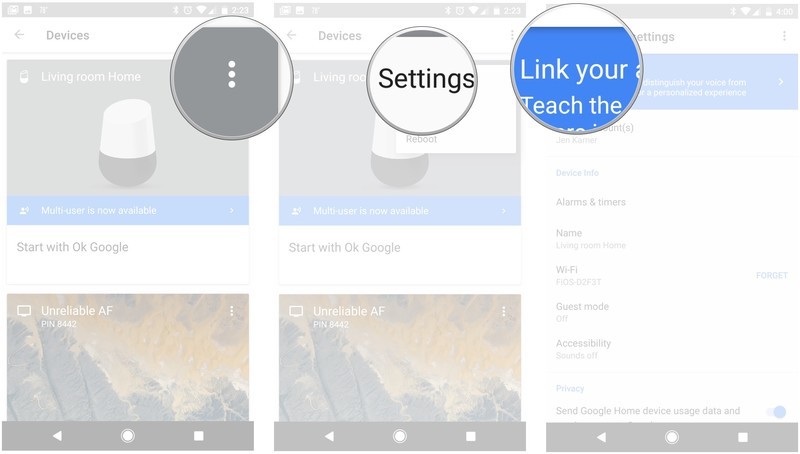
Tap continue.
Teach Google Home to recognize your voice by following the prompts on your screen.
Tap continue.

How to remove a linked account from Google Home
Open Google Home on your phone.
Tap the menu on the Google Home you are linking an account to (it looks like three vertical dots).
Tap Devices.
Tap the menu (it looks like three horizontal lines).
Tap Settings.
Tap Linked Accounts.
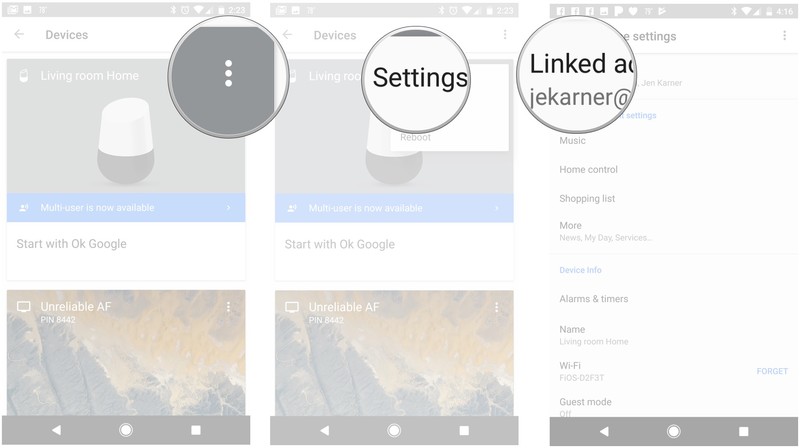
Tap the X next to the account you want to remove.
Tap Unlink.

Questions?
Have you had to unlink an account from Google Home? Do you have more questions about linking accounts? Drop us a comment and let us know about it!
Google Home
- Google Home review
- These services work with Google Home
- Google Home vs. Amazon Echo
- Join our Google Home forums!
Google Store Best Buy Target
 AIVAnet