


‘Bang! The Bert Berns Story’ Coming Exclusively to Apple Music This Fall
A documentary about “Twist and Shout” songwriter and producer Bert Berns is set to come to Apple Music this fall, reports Variety. “Bang! The Bert Berns Story” chronicles the life of Berns, a well-known record producer in the 1960s responsible for hits like “Brown Eyed Girl,” “Here Comes the Night,” “Piece of My Heart,” and more.
Berns started out as a songwriter before moving on to Atlantic Records, where he worked as a staff producer. Following his success and his work with bands like the Beatles and the Rolling Stones, he went on to form his own record labels, BANG Records and Shout Records, where he signed artists like the McCoys, the Strangeloves, and Neil Diamond.
The documentary covers Berns’ relationships with Carmine “Wassel” DeNoia, his manager and best friend, and mobster Tommy Eboli, once the acting boss of the Genovese crime family in New York. Van Morrison, Paul McCartney, Keith Richards, Ben E. King, Solomon Burke, and more, all make appearances in the film.

Berns’ son, Brett Berns, directs, and the documentary is narrated by Bruce Springsteen guitarist and “Sopranos” star Steven Van Zandt.
The documentary will first debut on iTunes Movies in the fall, and then it will be exclusively streamed on Apple Music. It will join several other documentaries Apple has secured for Apple Music, including Sean Combs’ “Can’t Stop Won’t Stop: A Bad Boy Story” and “Clive Davis: The Soundtrack of Our Lives.”
Tags: iTunes, Apple Music
Discuss this article in our forums
Nearly One in Four Windows Users Surveyed Plan to Switch to Mac Within Next Six Months
Nearly 21 percent of current Windows laptop owners and 25 percent of current Windows desktop owners intend to switch to a Mac within the next six months, according to a recent survey conducted by market research firm Verto Analytics.
Verto Analytics told MacRumors the survey is based on 6,000 current Windows PC owners age 18 and older in the United States.
Of the respondents, those with an average annual income of $150,000 or more showed the highest likelihood of switching to a Mac.
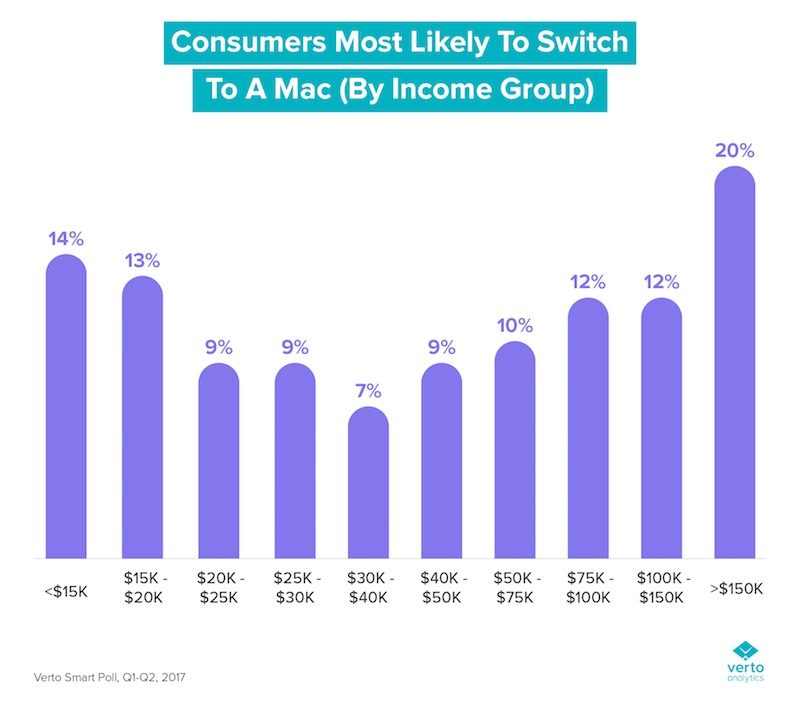
By comparison, the research firm said at least 98 percent of current Mac owners surveyed intend to stick with Mac as their next computer. In other words, only 2 percent of current Mac users surveyed are planning to switch to another computer brand, be it running Windows or another operating system.
Microsoft is experiencing a resurgence in the post-PC world with an attractive lineup of devices, such as the new Surface Pro and Surface Studio desktop computer, which have even caught the attention of some Apple aficionados.
Last December, Microsoft said more people were switching from Mac to Surface devices than ever before following the supposed “disappointment” of the 2016 MacBook Pro, particularly among professional users.
In April, however, Microsoft said Surface revenue declined 26 percent to $831 million last quarter, down from $1.1 billion in the year-ago quarter. By comparison, Apple reported Mac revenue of $5.84 billion last quarter, a 14 percent increase from $5.1 billion in the year-ago quarter, on the strength of a new MacBook Pro.
Microsoft’s new Surface devices should help it combat that decline, while Lenovo, HP, and Dell, the top three worldwide Windows PC vendors, saw shipment growth last quarter, according to market research firm Gartner.
Tags: Microsoft, Windows
Discuss this article in our forums
Most popular Android apps this week: Firefox Focus, Sonic, KingRoot, and more!

The Google Play Store is filled with many apps, which is great for consumer selection, but can often make app discovery difficult. Some apps just never make it to our homescreen. That’s why we’ve compiled a list of this weeks hottest Android apps that have most likely gone under the radar or are so new that they haven’t had enough downloads to be featured or make it onto a top list.
Firefox Focus |
|
|
App Info: Browse like no one’s watching. The new Firefox Focus automatically blocks a wide range of online trackers — from the moment you launch it to the second you leave it. Easily erase your history, passwords and cookies, so you won’t get followed by things like unwanted ads.
Free |
Sonic the Hedgehog |
 |
|
App Info: The Sonic game that started it all is now free-to-play and optimized for mobile devices! Race at lightning speeds across seven classic zones as Sonic the Hedgehog. Run and spin through loop-de-loops as you collect rings and defeat enemies on your mission to save the world from the evil Dr. Eggman.
Free |
KingRoot-2017 |
 |
|
App Info: KingRoot-2017 verify proper root (superuser or su) access is configured and working using KingRoot! Free, fast, easy, and used on over 10 million Android devices, Root Checker shows the user whether or not root (superuser) access is properly installed and working. KingRoot-2017 is a root tool for “lazy people” who just want to get root access but don’t want to flash any third party Recovery into their lovely device.
Free |
Clipboard Actions |

|
|
App Info: Clipboard Actions creates actions based on your copied text shows them in the status bar as notification or in a nice list in the App.
Free |
Network Signal Refresher Pro |
 |
|
App Info: Network Signal cannot be boosted by an app, Network signal can be refreshed and recovered. Network Signal Refresher is not a network signal booster. No network signal boost is achieved here. NSR tries to refresh the network several times till you get a better network signal.
Free |
If you like these apps then drop us a comment below with your thoughts. Also if you have spotted a new app that you think is worth a mention, leave a comment below with your suggestion and we’ll be sure to check it out.
Yahoo Mail gets a radical redesign and new ad-free subscription options
Why it matters to you
Yahoo Mail, the world’s third-most popular email service, just got its first major update in years.
It’s been 20 years since the launch of Yahoo Mail, the third-largest web-based email service in the world, and at least five years since its last major overhaul. But hot on the heels of a multibillion-dollar Verizon acquisition, Yahoo Mail is relaunching with a fresh coat of paint, a new ad-free premium tier, and a bevy of new features aimed squarely at competitors like Outlook and Gmail.
Yahoo Mail’s interface has been redesigned from the ground up. It’s minimalist, with increased spacing between elements and a library of switchable color themes (including some that change in response to the time of day). Rich previews show hover-over snapshots of links, and a revamped search mode lets you filter files, emails, and other attachments with a combination of names, keywords, and dates. There’s a new GIF library, too, and a collection of open source emojis and stationary.
Things are a lot more organized now. The new Yahoo Mail serves up quick links to auto-generated folders (like Photos and Documents) in the left-hand navigation bar, and the settings screen has been redesigned to reflect any changes you make instantaneously. And accessibility has been improved — there’s support for NVDA (NonVisual Desktop Acess), VoiceOver, and other screen readers, in addition to options for light-sensitive and low-vision readers.
A lot has changed behind the scenes, too. Yahoo says it’s using modern web technologies like Javascript, Ajax, React, Redux, and others to speed up browsing, which have helped to shrink its footprint by 50 percent compared to earlier versions of Yahoo Mail. In day-to-day usage, it should be a lot faster and more responsive.
Alongside the redesign this week. Yahoo took the wraps off Yahoo Mail Pro, an ad-free, premium version of Yahoo Mail that includes priority support of desktop and mobile. It starts at $35 per year/$3.50 per month, or $10 a year/$1 a month for a mobile-only version.
The new Yahoo Mail is available starting Wednesday for English users, but there’s an option to switch back to the old look if you decide it’s not for you.
The redesign is part of a broader effort by Yahoo’s new corporate parent, Oath. Earlier this week, for example, Yahoo backed out of a deal with AT&T that let the internet provider’s subscribers log into Yahoo websites with their subscription accounts.
But Yahoo has a lot to prove. This year, it suffered by two massive security breaches that affected more than a billion users, delayed Verizon’s acquisition, and knocked $350 million off its valuation. And an independent committee found Yahoo at fault for not sufficiently responding to the incidents.
These photos could be the best images shot with an iPhone this year
Why it matters to you
Find inspiration from a small camera in the gallery of this year’s winners for the iPhone Photography Awards.
The iPhone is now a decade old — and the iPhone Photography Awards (IPPAWARDS) continue to prove that small cameras can still pack a pretty big punch. This week, the IPPAWARDS announced the winners for the tenth annual global competition.
Brooklyn-based photographer Sebastiano Tomada took the grand prize as the iPhone Photographer of the Year with a photo of two children playing in Qayyarah, Iraq, as an oil well burns in the distance. The vertical shot utilizes leading lines and a punch of contrast to add artistic interest to the photojournalist’s shot.
The contest continues this global focus — with over 140 countries represented this year — and awards Branda O Se of Cork, Ireland, first place for the shot of a dock worker in Jakarta, Indonesia. The image, shot with an iPhone 6S is striking for the same reason that compelled the photographer to snap the shot — the texture created by the layers of dirt and grime on the worker’s hands.
The second-place photographer, Yeow-Kwang Yeo of Singapore, earned a slot in the honors for a behind-the-scenes shot of a performer in the Chinese Street Opera, a tradition that is quickly disappearing due to a lack of interest from younger generations. The photographer was struck by the light coming through a plastic curtain and the performer’s calm expression.
Kuanglong Zhang snagged the third-place title for a shot of a worker gazing out the window of a colorful Udaipur city palace in India. Zhang, a China native, took the shot with an iPhone 7.
The contest also hosted a special category for the tenth annual competition, The America I Know. Winners for the special category include Juan Carlos Castañeda of New York, Davis Bell of California, and Maria K. Pianu of Italy.
Along with the grand prize winners and special category, the contest also awarded the top three photographers in 19 different categories.
“We are amazed to see how IPPAWARDS has grown from a small circle of people and friends of friends into a truly global audience with thousands of participants,” said Kenan Aktulun, the contest’s creator. “In this time of political upheaval we feel very thankful to host such a truly diverse group of people and their view of the world.”
The IPPAWARDS is now both the first and longest-running iPhone competition in the world, launched shortly after the first iPhone was released.
Sony joins the 3D facial recognition trend by demoing tech on an Xperia phone
Why it matters to you
Facial recognition is expected to play a massive role in authentication going forward — not simply for unlocking your phone, but for authenticating payments as well.
One day in the not-too-distant future, you’ll be able to unlock your phone safely and reliably through facial recognition — not through a two-dimensional image capture, mind you, but with a camera that can sense three-dimensional depth. We know Apple is working on the feature, as is LG. And this week at Mobile World Congress Shanghai, Sony will reportedly demo the tech running on an Xperia phone in real time.
Considering there’s not a smartphone out there currently that supports three-dimensional facial recognition, and just a handful of Project Tango-enabled Asus and Lenovo products that can measure depth, it might seem like a great deal of buzz has been made over nothing. But there are a variety of far-reaching applications for depth-aware cameras besides authentication.
Augmented reality is perhaps the most obvious one, affecting everything from gaming to shopping. There have also been depth-sensing stand-alone cameras in the past, like Lytro’s products, that enable refocusing after the shot.
Sony’s test, however, will be centered around authentication. The company’s SoftKinetic subsidiary, responsible for building imaging components, has partnered with Swiss firm KeyLemon, based on a report from TechCrunch. The result of their cooperation will be shown at the Shanghai trade show, though there is no indication that the feature will launch in an upcoming Xperia phone just yet.
Much of the news surrounding 3D front-facing cameras has concerned Apple, which has been rumored to implement the functionality in the next flagship iPhone, expected to be released this fall. The company snapped up PrimeSense back in 2013, a developer of depth-tracking technology which previously worked on Microsoft’s Kinect sensor for Xbox. Since then, we’ve heard the phone may sport iris scanning capabilities as well, thanks to a report from one of Apple’s suppliers, Largan Precision.
Ironically, some have speculated Apple is precisely the reason why Sony phones in the United States have historically lacked a different form of biometric authentication: Fingerprint scanning. The iPhone maker received a patent for embedding the sensor inside the power button back in 2015, as Phandroid reported earlier this month. Although it has never used that solution in any of its devices, Sony has taken exactly that approach with many of its phones produced over the past several years, and may have had to disable it in the U.S. to avoid infringement.
If Apple isn’t the one responsible, it could be the carriers, as Sony has cited “business reasons” in the past while referring to the strange omission for stateside customers. Either way, if 3D facial recognition is truly the next wave of smartphone security, it’s probably best for Sony to start riding it as soon as possible.
Google launches redesigned Google News with an emphasis on fact checking
Why it matters to you
Google is making it easier to keep track of breaking and developing stories with a simpler, more customizable Google News.
Not to be outdone by Yahoo’s major redesign of Mail, Google on Tuesday, June 28 launched a streamlined, refreshed version of Google News, its one-stop news search tool.
The new version of Google News is divided into three distinct sections: Headlines, which features the day’s trending stories; Local, which lets users follow news from certain locations; and For You, which consists of topics in which users have expressed interest.
“Our goal here was to make every frequent task and every user need smooth and frictionless so they are connected to the news and journalism, which is why they come to Google News — to read the news and find out what’s going on,” Google News product manager Anand Paka told Neiman Lab. “To give them that multitude of facts, voices, and perspectives, you want the UI to disappear and not be a sense of overload or cognitive load on them but just be transparent.”
Stories themselves have a cleaner look, appearing as spaced-out cards with images, bold headlines, and links to related coverage. Longtime Google News features like videos and real-time coverage remain in place, but the new News interface lets users expand cards to show more coverage or follow a given publishers’ stories. And new settings permit a greater degree of control over the types of stories that populate the feed — now, it’s easier to specify which topics users want to follow and the news outlets they’d like to prioritize.
The new Google News places a greater emphasis on fact checking, in addition. A new widget on the right-hand side shows verified sources from PolitiFact, Snopes, and other third parties. Fact-checked recommendations are available in the United States for now, but Google plans to roll it out more widely in the coming weeks.
Google News’ new, more prominent “fact-checked” column follows on the heels of the search giant’s other efforts. In April, it began to showcase fact-checking sites in search and news results, and launched a series of initiatives to promote more accurate content across its services.
But for now, the redesign is focused on improving user interfaces.
“Because it’s a redesign, it’s more about the surface-type touches to the user for the most part,” Paka told Neiman Lab. “Under the hood, we continue to use and build upon all the best practices both from search and as well as from Google News … We take an open-web philosophy. As long as a publisher is actively publishing news content, they are included in News and we maintain that policy bar for the people who show up in Google News. Once you have these quality sources within our index, then it’s about ranking and picking the best article to show at any given time.”
Xiaomi Redmi Pro 2 and Redmi Note 2 Pro news and rumors
Xiaomi had quite a year last year with the Redmi Note 2 and the Redmi 2, and it looks like the company is set to follow up on those devices with a few new handsets for 2017. In fact, rumors have been circulating quite a bit about the new phones, called the Redmi Note 2 Pro and the Redmi Pro 2, and we now have a pretty good look at what the phones could have on offer.
The rumors are interesting for a few reasons — perhaps the most notable being that Xiaomi launched the Redmi Pro last year only in China — suggesting that it would be a one-off device. Does the existence of a follow-up suggest we’ll see the phone in other markets? We’ll have to wait and see.
Here’s everything we know about the Redmi Note 2 Pro and Redmi Pro 2 so far.
Xiaomi Redmi Pro 2
It’s looking more and more like Xiaomi will launch a follow-up to the Redmi Pro, called the Redmi Pro 2. In fact, press shots and specs have appeared online showing that the phone could offer some pretty nice specs. But when will we see the device? The latest rumors indicate it could be soon. Pocket Now has published a report suggesting the phone will be launched at some point in April.
First up in the specs department is the camera. While it was initially believed that Xiaomi might have decided to ax the dual-camera setup for the Pro 2, per Weibo, a more recent leak alleges it will return. GizChina provided a full spec sheet for the device this week, and reported it will feature a 12-megapixel Sony sensor coupled with another 5-megapixel Samsung unit. Around the front, the phone is purported to offer a 16-megapixel shooter.
Otherwise, GizChina’s report does not mention the processor, though it does say the Redmi Pro 2 could feature 3GB of RAM. In terms of the display, it seems we’re looking at a 1080 panel.
Information from Weibo previously stated phone will come in two variants, and with one offering 4GB of RAM and 64GB of storage, and the other boasting a cool 6GB of RAM and 128GB of storage. We don’t yet know exactly which processor the phone will feature, but some speculation suggests it could be the Qualcomm Snapdragon 660.
According to the leak, the phone should be quite reasonably priced. The 4GB variant will come at 1,599 yuan, which equates to $232, while the bigger 6GB version will come at 1,799 yuan, or around $261.
Samsung Galaxy S8: Everything you need to know
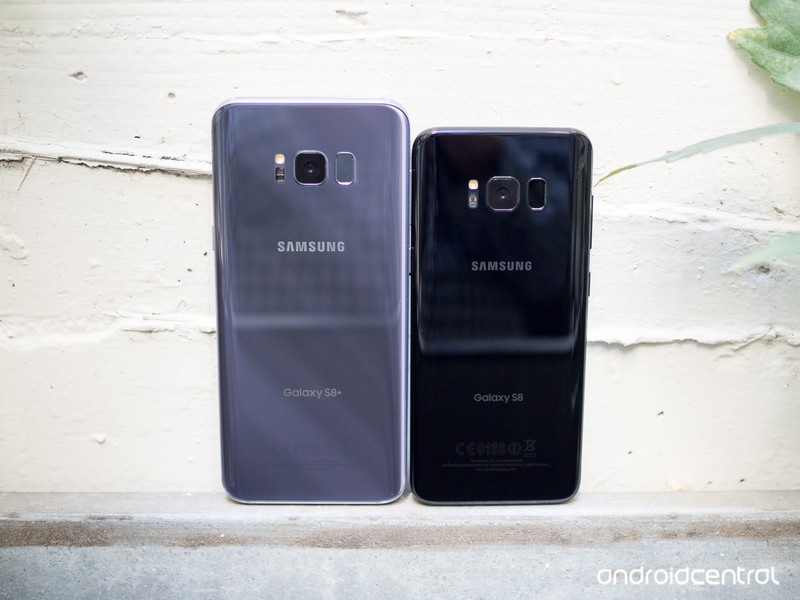
Get to know the new Galaxy S8 and Galaxy S8+ from Samsung.
Samsung is an absolutely massive player in the smartphone space, and that all comes down from up high with the flagship Galaxy S line. The latest in the lineup, the Galaxy S8 and its larger partner the Galaxy S8+, build on the core features and experiences from the Galaxy S7 and bring things into the future with great new design and a few eye-catching features that are all new for 2017.
Here’s everything you need to know about the Samsung Galaxy S8 and Galaxy S8+.
Galaxy S8 and S8+: The basics
The two phones, which are only differentiated by their screen size and battery capacity, come in at 5.8-inches and 6.2-inches with extra-tall 18.5:9 aspect ratio displays. That battery difference is pretty subtle: 3500mAh for the Galaxy S8+ and 3000mAh for the standard Galaxy S8. You may note that the Galaxy S8+’s battery is actually 100mAh smaller than the Galaxy S7 edge of last year, while the Galaxy S8’s is the same size as the Galaxy S7 despite being a larger phone.
Though the batteries haven’t increased in size, the hope is that the improved efficiency of the new 10 nm processor inside — that’ll be the Qualcomm Snapdragon 835 or the Samsung Exynos 8895, depending on the region — will provide some help. The processor is backed up by 4GB of RAM, an increase to 64GB of storage, and of course a microSD card slot. Waterproofing and wireless charging are still here as well, plus a new USB-C port on the bottom. The rear camera is unchanged in terms of its 12MP sensor and f/1.7 lens, but has improved processing thanks to new software and a new ISP (image signal processor).
This is some beautiful hardware all around.
The overall design for the phones is identical on both sizes, and is still shimmering glass and metal much like the previous generation. It’s punctuated by the long edges of the displays curving subtly off the side, more so like the Galaxy Note 7 than the more dramatic Galaxy S7 edge — and to that point, there is no “edge” model here, as both phones sport the curves.
Read: Samsung Galaxy S8 review
The displays have a new 18.5:9 aspect ratio with a QHD+ resolution, meaning they’re extra tall while staying relatively narrow. Samsung has also moved to on-screen buttons and reduced bezel size dramatically in order to fit as much screen into the body as possible. That necessitated the movement of the fingerprint sensor to the back of the phones, where it sits somewhat-awkwardly next to the camera lens. Iris scanning makes its return in a new-and-improved version from the Note 7 to try and pick up the slack.
Get familiar with all of the Galaxy S8’s specs
Samsung is trying to drive a narrative that we’ve moved beyond specs (and you can definitely argue that we have), but the enthusiasts will always want to know the details of what’s powering the latest phones. You get just about everything in here that you’d expect
| Operating System | Android 7.0 Nougat | Android 7.0 Nougat |
| Display | 5.8-inch AMOLED2960x1440 (570 ppi) | 6.2-inch AMOLED2960x1440 (529 ppi) |
| Processor | Qualcomm Snapdragon 835or Samsung Exynos 8895 | Qualcomm Snapdragon 835or Samsung Exynos 8895 |
| Storage | 64GB (UFS 2.1) | 64GB (UFS 2.1) |
| Expandable | microSD up to 256GB | microSD up to 256GB |
| RAM | 4GB | 4GB |
| Rear Camera | 12MP Dual Pixel, f/1.71.4-micron pixelsOIS | 12MP Dual Pixel, f/1.71.4-micron pixelsOIS |
| Front Camera | 8MP, f/1.7auto focus | 8MP, f/1.7auto focus |
| Connectivity | Wi-Fi 802.11ac MIMOBluetooth 5.0NFC, GPS, Glonass, Galileo, BeiDouLTE Cat.16 | Wi-Fi 802.11ac MIMOBluetooth 5.0NFC, GPS, Glonass, Galileo BeiDouLTE Cat.16 |
| Charging | USB-CFast chargingQi wirelessPowermat wireless | USB-CFast chargingQi wirelessPowermat wireless |
| Battery | 3000mAh | 3500mAh |
| Water resistance | IP68 | IP68 |
| Security | One-touch fingerprint sensorIris scannerSamsung KNOX | One-touch fingerprint sensorIris scannerSamsung KNOX |
| Dimensions | 148.9 x 68.1 x 8 mm | 159.5 x 73.4 x 8.1 mm |
| Weight | 155 g | 173 g |
As for the two different models, the Galaxy S8 and S8+ are identical internally aside from the batteries and of course screen sizes.
Notable camera improvements on the GS8
On the face of it, the spec hounds among us won’t be satisfied with the fact that Samsung has stuck with the same camera specs from the Galaxy S7 in the new Galaxy S8. Yes that means we’re looking at a 12MP “Dual Pixel” camera with an f/1.7 lens — but remember that the software and ISP (image signal processor) have been improved since last year, and this was arguably the best camera of 2016. On the other side, Samsung has completely revamped the front-facing camera to an 8MP unit with auto focus — all the better for your selfies of all types.
How does it all come together? Here’s Daniel’s take from our Galaxy S8 review:
Since the Galaxy S8 has the same fundamentals as its predecessor, it’s still one of the fastest, most reliable cameras on any phone. […] Unlike some of the other substantive hardware improvements, the Galaxy S8’s rear camera is another solid effort, but not more.
Compared to the Galaxy S7, the Galaxy S8 takes naturally sharper photos (meaning it uses less artificial sharpening), and also takes less-saturated and more accurate photos. Those are both overall quality improvements, while the GS8 also remains lightning quick with lots of extra software features to boot.
The Galaxy S8 has what it takes to capture wonderful photos with extreme reliability, but unlike this time last year it is challenged overall by the flagship competition — namely the LG G6, Google Pixel XL and HTC U11.
Everything you need to know about the Galaxy S8’s cameras
All of the new software features in the Galaxy S8
As Samsung often does, we got a good sneak peak at the Galaxy S8’s software experience in the form of the Android Nougat update for the Galaxy S7 and S7 edge. But there are some changes to make note of.


What you’ll find on the Galaxy S8 is very similar in terms of its design, core apps and behaviors, but you’ll also find a new launcher layout, new icons, on-screen buttons and of course a bunch of new features. Not the least of which being Bixby, DeX, S Pen-styled note taking features and more.
A complete look at the Galaxy S8’s software in our review
Bixby Voice is a whole new way to use your phone … well, soon
Bixby isn’t so much a head-to-head competitor with Google Assistant and Amazon Alexa, but instead an assistant to help you on the phone phone itself. That means Bixby is designed to help you locally throughout the phone using the screen, the camera and soon also your voice. The problem is Bixby wasn’t fully ready at the launch of the phones, and at the end of June just started rolling out Bixby Voice in beta. Without Voice, it only has a small set of features, limited to some intelligent information offered in “Bixby Home” on your home screen, and “Bixby Vision” for identifying objects using the camera.
Bixby is initially limited, but shows promise.
That’s frustrating, but the system itself has potential. Bixby Voice can basically respond to any command and perform actions within whatever app you’re using as if you tapped though the software yourself. Samsung also claims Bixby can fail more gracefully when it doesn’t understand your query entirely, getting you through the answer as far as it can before asking for more information. Samsung is betting this is the next interface paradigm, and it’s exciting to watch the developments on the Galaxy S8.
Everything you need to know about Bixby Voice
This is Samsung’s DeX desktop dock for the Galaxy S8
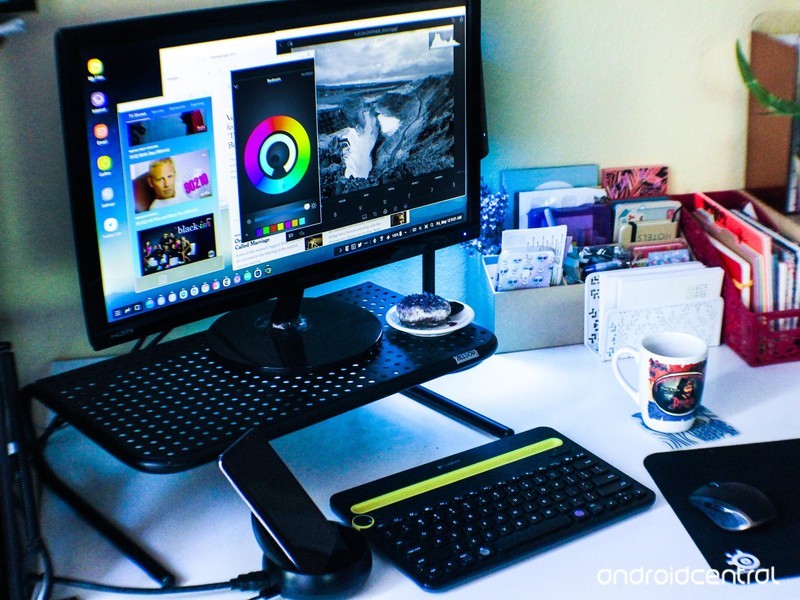
Far on the other end of interaction from Bixby is the new “DeX” desktop docking system for the Galaxy S8. It’s a little piece of hardware no larger than a wireless charger that lets you plug in your Galaxy S8, attaching it to a keyboard, mouse and monitor to transform it into a desktop-like environment. The Galaxy S8’s interface scales up gracefully to fill the large monitor, and Samsung’s own apps have been designed to be resized and operated with a keyboard and mouse.
Samsung has also struck deals with Adobe and Microsoft to bring their most popular apps to the big screen — the only question is how it works with other non-optimized apps, and who will invest in these docks and this setup to use DeX on a regular basis.
Samsung DeX review: This isn’t a replacement for your laptop
Compare the Galaxy S8 today’s hot devices
Plenty of people will just pick up the Galaxy S8 or S8+ because Samsung is the brand they know, but many of us will comparing it head to head with other leading devices. To help you make up your mind on which phone is right for you, we’ve compared the Galaxy S8 and Galaxy S8+ to the likes of the Pixel and Pixel XL, LG G6 and of course the iPhone 7 and 7 Plus.
Galaxy S8 and S8+ vs. Pixel and Pixel XL: Two ways to do a flagshipGalaxy S8 vs. LG G6: Tall, skinny and very similarGalaxy S8 vs. iPhone 7: Battle of the platforms
Which one should you buy?
So now that you have all the information, which one should you buy? You have a big phone and a bigger phone; one with a big battery and a bigger battery. There are so few differences between the Galaxy S flagships this year that it comes down to size and battery preference alone, and that may make your decision even harder.
Should you buy a Galaxy S8 or a Galaxy S8+?
Where to buy the Galaxy S8 or Galaxy S8+
The Galaxy S8 and S8+ are now on sale. In the U.S., you’ll have your choice of the Galaxy S8 or Galaxy S8+, both in 64GB storage configuration, in one of three colors: black, silver or orchid grey. You can also pick up a proper U.S. unlocked model from Samsung or Best Buy if you don’t want to bother with a carrier. Prices are in the range of $720-750 for the Galaxy S8, and $820-$850 for the Galaxy S8+.
Where to buy the Galaxy S8 in the U.S.Where to buy the Galaxy S8 in Canada
Updated June 2017: Article updated with new links and information on Bixby Voice and Samsung DeX.
Samsung Galaxy S8 and S8+
- Galaxy S8 and S8+ review!
- Galaxy S8 and S8+ specs
- Everything you need to know about the Galaxy S8’s cameras
- Get to know Samsung Bixby
- Join our Galaxy S8 forums
Verizon
AT&T
T-Mobile
Sprint
Unlocked
Get the Android O and Java Development Mastery Course for just $15
In today’s modern age, understanding coding is becoming more and more essential. So much so that some school districts are adding coding classes to their curriculum. Those who dove into the world of Java and other coding languages via a Computer Science degree or by self-taught methods a decade ago are well-positioned for a sustaining career.
Take your coding to the next level for less! Learn More
Are you second guessing your own career path, or simply interested in learning the basics of coding? Maybe you’re considering heading back to school to study Computer Science, but really who can afford to put their life on hold for more schooling? Even if you’re knowledge of computer programming could fit on the back of a postage stamp, you can still learn everything you need to know to get started coding with Android O and Java.

That’s where this great deal from Android Central Digital Offers comes in. You can get lifetime online access to the The Android O & Java Developer Mastery Course
for just $15. This package includes 214 lectures which translates to over 30 hours of content that’s yours 24/7.
The newest Android OS release is available for developers, so there’s no time like the present to learn the powerful new capabilities to this operating system as you learn how to build apps for Android. Even if you know absolutely nothing about coding, this course will introduce you to Java, the Android Studio, IntellJ IDEA, and other key concepts of creating apps for Android.
Save more than 92% right now! Learn More
An online course like this would typically cost $200, but for a limited time you can get the whole package at a steep 92% discount — you’ll pay only $15!
Buy now and you’ll be on your way to being a coding pro in no time.
 AIVAnet