


Valve’s ‘Knuckles’ VR controller tracks individual fingers
VR fans have been steadily following the development of Valve’s new controller for SteamVR, called Knuckles. Now the device is being shipped to developers as a prototype, and as a result, Valve has released quite a bit of new information about Knuckles and how it will work.
To use Knuckles, users insert their hand between the main part of the controller and a soft strap that helps hold it in place. You can tighten or loosen the fit with an attached cord. This means that you can grab and interact with objects as you normally would without worrying about dropping the controller. Multiple capacitive sensors throughout the device also can help track your hand motions and whether your fingers are pointed straight, tightly curled or somewhere in between. It’s important to note that Knuckles contains individual tracking for each separate finger, a feature VR users have been asking for.
All in all, Knuckles appears to be a more ergonomic and natural controller for VR. It’s a pretty straightforward follow-up to controllers such as the Oculus Touch and Vive wand. It’s not clear when Knuckles will be available to the general public, but you can bet a lot of VR fans are itching to get their hands on it.
Via: NeoGAF
Source: Valve (1), Valve (2)
Your next favorite songs are the backbone of ‘Metronomicon’
Rhythm games live and die by their soundtracks. The problem is, if you’re holding a plastic instrument in your hand, you’ve probably played through the same songs over and over whether it’s in Rock Band or Guitar Hero. Regardless of how advanced the gameplay is, then, at the end of the day, if you’re tapping through Bon Jovi’s “Livin’ on a Prayer” in one game, you might as well be playing it on any of the popular franchises. That’s where The Metronomicon: Slay the Dancefloor makes a bold left turn.
Rather than featuring a list of staid genre staples, the rhythm-game/role-playing game hybrid (trust me, it works) features 50 highly curated songs. These aren’t your usual crowd-pleasers, either, with tracks including unreleased music from Shiny Toy Guns, an exclusive from Mindless Self Indulgence singer Jimmy Urine and tunes from synthwave artist Perturbator and rapper Mega Ran (among others). If there’s a common thread connecting the songs here, it’s that everything has a driving beat or a funky groove. Sometimes both.
“If any song is in the game, it’s because at least one member of the dev team totally loved it,” Metronomicon’s programmer and studio lead, Danny Garfield, said. It’s this personal touch that makes the game so easy to buy into. Because most of these songs are unfamiliar, they have an inherent “one more try” quality that makes playing them over and over on different difficulty levels so enticing.
As far as gameplay goes, you arrive at a dungeon, play a section of songs in any order you want, unlock more tracks and then take on the boss song/monster. You attack by finishing a perfect run of notes and then switch from one character’s note highway to the next.
You’ll level up, earn new abilities and recruit new party members along the way — standard RPG fare — but when was the last time you played a role-playing game with a Rock Band guitar or a dance mat? Much like The Metronomicon’s gameplay-genre mash-up, using these peripherals is a surprisingly perfect fit.
I didn’t try the dance mat, but playing through “Live It Up” by Shiny Toy Guns with a plastic Stratocaster felt incredibly natural. And thankfully it’s simpler than Guitar Hero, as you only need to press the fret buttons in time; you leave the strum bar alone.
The game’s narrative is just as silly as its core conceit. Dance parties have materialized throughout the land of Koras. These parties play host to massive amounts of monsters that boogie the night away and trash villages like rock stars do hotel rooms.
To combat them, The Neon Shield school was formed around a book called The Metronomicon to teach “warrior breakdancing.” Its lessons instruct your valiant party of sorcerers, healers, rogues and other RPG archetypes how to defeat the darkness and bring peace back to the land. In the game universe, dancing and music fuel magic, and if you’re the best dancer, you can shoot fireballs. Seriously.
So yeah, it’s a little different than getting a band together, touring and playing increasingly larger venues to accrue more fans, à la Rock Band.
Because of the premise, the game needed a smattering of upbeat songs to balance the moodier numbers. Ten percent of the tracklist was made in-house by members of the Puuba development team, but the remaining 45 songs are licensed tracks from established and indie musicians. Further in keeping with the game’s driving nature, each song needed to have at least a three-minute section that has a distinct beginning, middle and end. “YYZ” by Rush, for example, probably wouldn’t work here.
But that doesn’t mean a song had to be three minutes to make the cut. Garfield cited “Bed Down With a Monster” by Crushcraze as an example. It might as well be 10 different songs wrapped together into one five-minute track. The team eventually settled on an arrangement that blends the song’s different movements into a condensed but cohesive whole.
“If you listen to one minute, and then a minute later, you’d never know it was the same song,” Garfield said.
The track from Jimmy Urine was a different challenge, but one that ultimately paid off. Puuba asked the Mindless Self Indulgence frontman for a song that was instrumentally layered, had multiple rhythms happening simultaneously and that changed over time. “We love you; do what you like,” Garfield recalled telling the singer.
Urine came back with “Fighting With the Melody,” a bouncy, idiosyncratic acid-disco tune that couldn’t fit The Metronomicon’s tone any more perfectly.
So far, the response from the musicians featured in the game has been incredibly positive. After the game was released for PC earlier this year (it’s coming out for PlayStation 4 and Xbox One this summer), Urine released the song as a single and made its music video entirely with footage from the game — try getting that to happen with Foo Fighters or Modest Mouse.
Follow all the latest news from E3 2017 here!
Apple Confirms Sales of Apple Watch Pride Edition Band Will Support LGBTQ Groups
Apple began publicly selling its Pride Edition Woven Nylon band for Apple Watch during WWDC week earlier in June, one year after it handed out a similar band to its employees at Pride events in San Francisco.
During its first few weeks up on Apple.com, the company made no mention as to whether any portion of the profits made off of the band would go towards LGBTQ organizations, but a new change made to the band’s webpage has confirmed that Apple will be helping out such advocacy groups with profits made from the rainbow-emblazoned Pride band.
As spotted by Redditor N-Code, the new Product Information section of the Pride Woven Nylon band confirms that a portion of proceeds from its sales in the United States will help benefit LGBTQ groups including GLSEN, The Trevor Project, the Human Rights Campaign, and PFLAG. Internationally, ILGA will see the same donations. A new banner referencing the donation support was also added to the main Apple Watch page on Apple.com.
The changes were made yesterday, with the Wayback Machine internet archive providing a point of comparison dating back to this past Saturday, June 17.
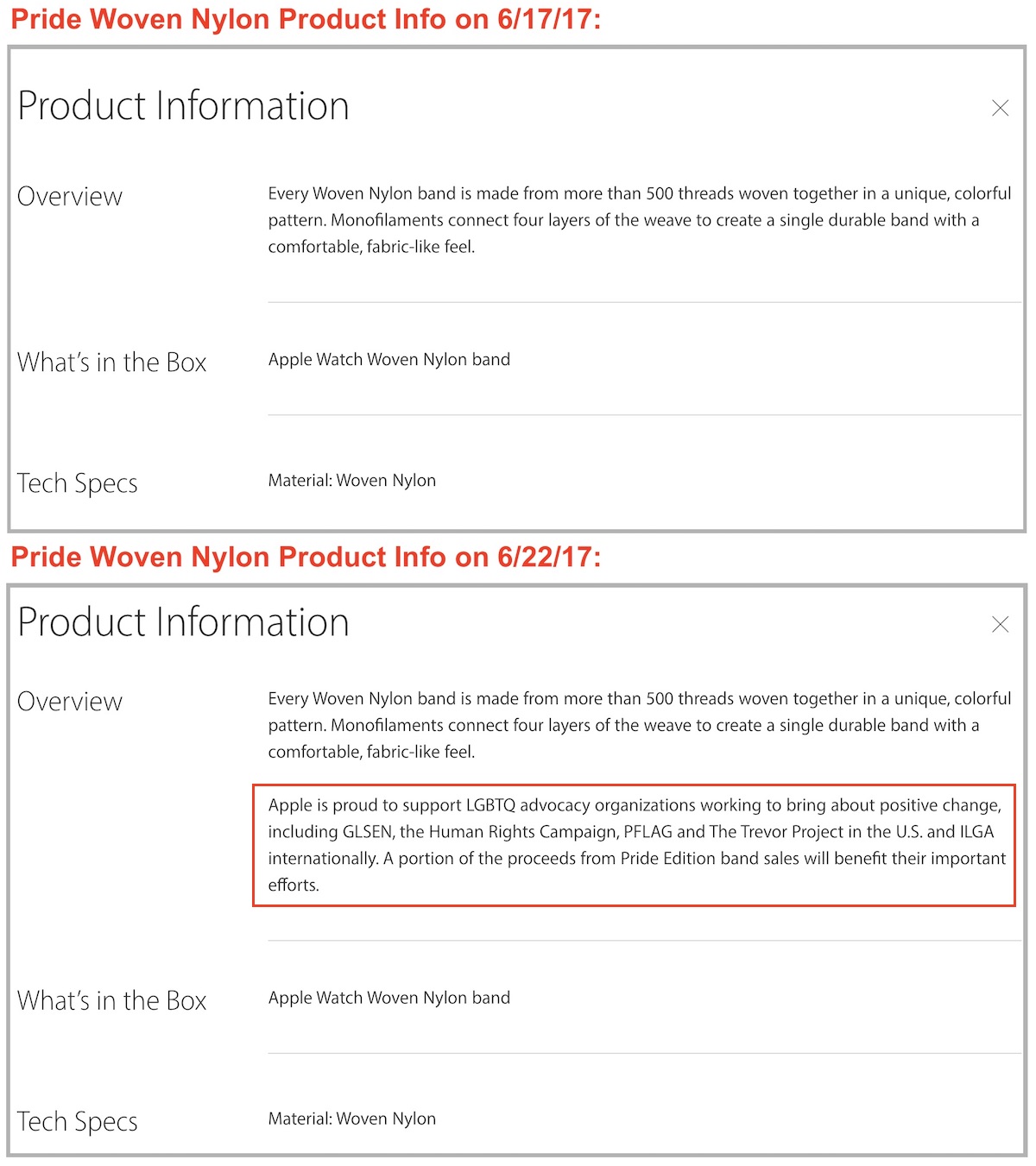
Apple’s full statement on the Pride band donations reads as follows:
Apple is proud to support LGBTQ advocacy organizations working to bring about positive change, including GLSEN, the Human Rights Campaign, PFLAG and The Trevor Project in the U.S. and ILGA internationally. A portion of the proceeds from Pride Edition band sales will benefit their important efforts.
Apple runs similar donation initiatives with many of its product lines, most popularly being (PRODUCT)RED. Apple devices sold with that banner have a portion of their proceeds donated to the Global Fund to help raise awareness and fight HIV/AIDS. Last year marked Apple’s tenth year anniversary in supporting (PRODUCT)RED’S causes.
At the time, Apple CEO Tim Cook commented on the company’s support of causes such as (PRODUCT)RED and pro-LGBTQ organizations, addressing critics who believe his and Apple’s public stances are made to endear millennial customers into buying products in the Apple ecosystem, among other criticisms. In response Cook said, “We haven’t shied away from being visible on a number of topics, and if it’s something in our wheelhouse, we’ll always be visible and stand up to protect as well as advance people’s rights.”
Note: Due to the political nature of the discussion regarding this topic, the discussion thread is located in our Politics, Religion, Social Issues forum. All forum members and site visitors are welcome to read and follow the thread, but posting is limited to forum members with at least 100 posts.
Related Roundups: Apple Watch Series 2, watchOS 3, watchOS 4
Buyer’s Guide: Apple Watch (Neutral)
Discuss this article in our forums
Rayz Plus Lightning Earphones Gain ‘Smart Mute’ Feature and Exclusive Colors at Apple Stores
Announced earlier in February, Pioneer’s Rayz Plus Lightning earphones allow Apple users to simultaneously listen to music or make a phone call while also charging their iPhone, thanks to the inclusion of an inline charging node. Today, the company announced a new feature called “Smart Mute” coming to the earphones as well as two new Rayz Plus colors launching exclusively on Apple.com and in Apple retail stores.
Rayz Plus and the basic Rayz earphones (the latter do not include an inline Lightning port) are both getting the new Smart Mute ability, which automatically mutes the microphone when a user is not speaking and unmutes it when they begin talking. Pioneer said that this will be perfect for any Rayz wearers who often find themselves taking calls on the earphones in noisy environments.
The update will be available through the Rayz app on the iOS App Store [Direct Link]. Pioneer worked with Avnera Corporation in developing Smart Mute, and Avnera CEO Manpreet Khaira said that it is “one of several smart technologies” being developed by the company.
“Rayz appcessories were launched with a commitment to deliver new compelling experiences for our customers through future software updates using the Rayz companion iOS app” said Munenori Otsuki, CEO of Pioneer and Onkyo Corporation. “In keeping with this commitment, we are pleased to announce Smart Mute today, a feature that will enable truly compelling call experiences.”
Customers are also now able to buy Rayz Plus earphones in new Black and Rose Gold color options only on Apple.com and in Apple retail locations around the world. Currently, the Rayz earphones are available in Onyx Black and Ice White, while the Rayz Plus are available in Graphite and Bronze.
Existing features of the Rayz and Rayz Plus earphones include AutoPause technology so music starts and stops automatically when the buds are placed in or removed from the user’s ear, HearThru noise cancelling, Smart Button controls, and dynamic audio adjustment via the iOS app.
The pricing on the earphones remains unchanged, with the Rayz available for $99.95 and the Rayz Plus available for $149.95. Those interested can purchase Rayz Plus in Black and Rose Gold exclusively on Apple.com beginning today.
Tags: Pioneer, Pioneer Rayz
Discuss this article in our forums
Today’s Google Doodle lets you compose your own music
If you’re looking to lose half an hour in service of making your own music, head on over to Google and click on today’s doodle. The company is celebrating the 117th birthday of Oskar Fischinger, the German-born artist and filmmaker who created geometric animations using paper and card. As Google’s Leon Hong explains, Fischinger’s work left him “awed and puzzled,” making him wonder “how could he make such magic without computers?”
Since much of Fischinger’s work involved putting music to geometric animations, Google builds a basic synth / sequencer for you to play with. Simply select one of the instruments and begin clicking to create a pattern that’ll produce a sound that’s unique to you. As each note plays, geometric animations will jump out, although it’s worth watching one of Fischinger’s originals just to see the scope of his achievement. An Optical Poem, for instance, was produced in 1938 by hand, which makes you really appreciate the scope of human ingenuity.
Source: Google
LG’s latest OLED display is flexible, transparent and gargantuan
Here at Engadget, we’ve covered our fair share of flexible and transparent displays. Small ones, slightly larger ones. But never one that measured 77 inches corner to corner. That particular milestone has now been broken by LG, with a new OLED panel that boasts an Ultra HD resolution of 3840×2160. It should be plenty sharp then, but also portable, given you can scrunch it up to a radius of 80mm without compromising any of its functionality. Neat. With a transparency level of 40 percent, it could also be used to replace windows and screens in a vehicle, storefront or home.

That’s the idea, anyway. As The Korea Herald reports, LG thinks the display has a future in digital signage, desks and in-car infotainment systems. Flexible screens could also be used in augmented reality applications and public spaces, such as aquariums and museums. For now, however, this enormous display is strictly a research project. Bendy panels have been used in smartphones and wearables before, but larger applications are still fairly uncommon. Price is likely the biggest issue — LG made this display, for instance, after beating Samsung to a government contract in 2012.
Source: LG, The Korea Herald
Motorola’s new Moto E4 isn’t exactly thrilling, but it’s cheap
Motorola is as well known for its cheap phones as it is for flagships, so no one was surprised when it revealed the fourth-generation Moto E earlier this month. For those not familiar, Motorola’s E line always felt like a curiosity, as though the company was challenging itself to build a phone for as little as possible without turning it into a smoldering pile of garbage. Its track record speaks for itself: Motorola does fine work on the cheap, and that hasn’t changed. The frills here are few, but after a little hands-on time, the Moto E4 seems to be a strong option for just $130.
Let’s start with the basics, which are, uh, pretty basic indeed. There’s a quad-core Snapdragon 425 in here with 2GB of RAM and an Adreno 308 GPU — that’s solid enough for basic web browsing and productivity, and some light gaming too. You’ll run into issues if you try to run anything too visually intense, though — Mortal Kombat X took quite a while before it started running. (Some games, like Afterpulse, refused to install altogether.) The phone also comes with 16GB of storage, but that’s sort of a technicality. Once you factor in the space Android 7.1.1 takes up, there’s only 9GB of space you can actually use. Fortunately, there’s a microSD card slot you can access by popping off the phone’s back and battery — it’ll take cards as large as 128GB.

Chris Velazco/Engadget
Right up front is a 5-inch, 720p screen that’s tough to complain about considering the asking price. There’s some graininess to be seen if you peer at the display long enough (a result of its modest pixel density), but it’s generally bright enough to easily read even under harsh sunlight. Color reproduction seemed pretty good too, if a just a little washed out. I’d like to see Lenovo make the leap to 1080p at some point, but screens are among the most expensive components in a phone’s bill of materials — getting a decent full HD display in a phone this cheap is going to take some time.
Thankfully, even modest Motos like this one run very clean versions of Android. It’s very, very close to stock, but with some of those handy Motorola experiences built-in. You can set the screen to display notifications while the screen is off and ditch those on-screen buttons in favor of one-button navigation with the built-in fingerprint sensor. It takes a little getting used to, but the option is nice to have if you want to maximize the amount of stuff you can squeeze onto the screen. Unfortunately, more complicated gestures — like twisting your wrist to launch the camera — don’t exist here.
Speaking of cameras, that’s one of the areas we’re looking forward to testing more thoroughly. The Moto E4 sports an 8-megapixel camera on its back, baked into a prominent classic circle above an LED flash. In our limited experience, it manages to take decent photos, but the results are too often hampered by lousy automatic exposure — if you’re taking shots of an area that’s partially bright and partially not, expect the bright bit to be totally blown out. Colors tended to come out on the drab side too, and detail was often sadly lacking. There’s a Pro mode here with more nuanced controls, though, which did help mitigate some minor issues.
This phone came in full retail regalia so this is very likely the camera experience you’re going to get too. Even so, we’re going to play with the camera more before passing a final verdict. The other thing I’m really looking forward to testing more thoroughly is the battery. There’s a removable 2,800mAh cell here, which should go a long away considering the modest power this thing produces. Motorola says it’ll last all day on a single charge, but we’ll be the judges of that.
All told, this is a pretty solid package for the price. Cheap as it is, the biggest knock against the Moto E4 is that it just isn’t that much less expensive than the fifth-generation Moto G series. Motorola and Lenovo have only made the Moto G5 Plus available in the United States and, and an additional $100 ultimately nets you a much, much better device. As I’ve said though, we’re going to keep testing the Moto E4 — maybe it’ll surprise us if given a little more time.
More hotels will let you watch your own Netflix
StayCast, a Google Chromecast-powered service for hotels, could fulfill your dream of being able to watch whatever you want to as a guest — especially now that it’s become much easier to get. AT&T has just announced that hotels can get DirectTV HD systems pre-loaded with StayCast, so make sure to look around or ask if you can stream your own stuff if the property offers the carrier’s satellite TV service. All you have to do is download the service’s Hotel Cast app for iOS and Android and connect to the hotel’s WiFi to start streaming your own Netflix, Hulu and other Cast-enabled apps.
An interactive content provider called Sonifi Solutions first launched StayCast as Sonicast in April 2016. The service has only recently become more available, though, thanks to the company’s various partnerships. Back in April, hotel chain titan Hyatt revealed that StayCast now comes integrated with the World of Hyatt mobile app. In fact, 14 Hyatt locations already offer the service, which means you can use the hotel’s app to watch your favorite shows on the in-room TV at any of them, including Hyatt Regency New Orleans.
In May, Samsung began offering hotels its Hospitality TVs that have StayCast integration, as well. You can simply pair your phone with the TV and continue marathoning that series you were watching at home. It’ll probably take a while before most hotels start providing a way for you watch your own stuff instead of forcing you to rent overpriced movies. Going forward, though, you can at least keep an eye out for services like StayCast and for any deals streaming services like Netflix cut with hotel chains.
Source: AT&T
You wouldn’t want to meet these robot sumo wrestlers in a dark alley
Why it matters to you
The robots offer an insight into the kind of ruthless moves we may have to face when the uprising occurs.
While some may be quick to dismiss the sport of sumo as a couple of fat fellas slapping each other about on a sandy floor, watch just a few bouts and you’ll soon come to appreciate the level of skill, strength, and agility that’s required to be a leading wrestler.
Likewise, robot sumo, which in recent years has become a popular pursuit for a dedicated group of Japanese computer geeks, may at first look like nothing more than bits of tech malfunctioning really badly. However, as with the human version, a closer look reveals that actually a good deal of talent is at work (OK, perhaps not with all of them).
To show the sport at its best, Canada-based YouTuber Robert McGregor has edited together multiple robot sumo clashes filmed at contests across Japan over the last few years.
As with regular sumo, a bout in the robotic version finishes when one of the machines succeeds in pushing the other out of the ring. Some of the robot challengers are autonomous while others are controlled remotely by a team member.
As you’ll see, the speed at which these tiny vehicles move is astonishing — and no, the video hasn’t been speeded up.
While most of the contraptions look fairly similar in design, with a ramp at the front and occasionally with attached flaps for sweeping the opponent out of the ring, the clever stuff happens with the software that drives the robots. As with regular sumo, the machines have to be able to move quickly and respond without hesitation to secure victory.
Be sure to check out the particularly amusing fight at 1:00, which ends with an all too easy victory for one of the robots. There’s also the briefest of bouts at 2.58 featuring an unusual yet highly effective design that somehow keeps within the rules, while the poor bot at 4:09 appears to spill its electronic guts into the ring before being unceremoniously shoved out of sight.
Robotic sports have proved a fun way for tech enthusiasts to develop and showcase their skills. Besides robot sumo, we’ve also seen robot soccer events and, just recently, robot volleyball players.
Breakthrough lens-less camera tech may mean the end of the smartphone camera bump
Why it matters to you
No-one like a camera bump ruining a smartphone’s sleek lines, and this lens-less camera technology may make it a thing of the past.
Engineers at Caltech may have solved one of those awkward smartphone problems of the last few years, the camera bump, by creating a super thin chip designed as an alternative to a glass camera lens. It’s called an optical phased array, or OPA, and it digitally replicates the same light-gathering ability of a glass lens to take a picture. Think of it as a lens-less camera, and you’re on the right track.
Ali Hajimiri, a professor at Caltech and principal investigator on the project, explained how it works. “We’ve created a single thin layer of integrated silicon photonics that emulates the lens and sensor of a digital camera, reducing the thickness and cost of digital cameras.”
This is great news. The camera sensor, lens, and other parts are one of the thickest components inside a modern smartphone, and as the quest to make devices thinner accelerated, designers were forced to house them inside raised sections. See everything from the iPhone 7 Plus to the Galaxy S7 for evidence of this unfortunate trend. Caltech’s OPA digital lens may be the answer the industry is looking for, enabling designers to make devices really thin, without compromising with an unsightly hump on the back of the device.
However, it’s not only aesthetic advantages that come with using the OPA digital lens. Hajimiri continues, saying that not only does it mimic a regular lens, “but it can switch from a fish-eye to a telephoto lens instantaneously, with just a simple adjustment in the way the array receives light.”
The camera and its abilities are a major smartphone selling point, and adding a more capable zoom feature, like Apple and Huawei, sets the device apart from the competition. However, features like optical zooms traditionally require even more space to operate. By manipulating the light using an OPA lens-less system to achieve the zoom effect will be attractive to manufacturers seeking smaller devices. It’s not the first time Caltech has experimented with small camera lenses, and worked with Samsung on a flat lens project earlier this year.
While we’re excited for this technology, it’s still in the early proof-of-concept stage, and the images captured by the lens-less camera so far are low resolution. The next stage is to scale up the camera so it can take higher resolution images. Project co-author Behrooz Abiri doesn’t hold back when talking about the impact this may have on the industry, saying, “Once scaled up, this technology can make lenses and thick cameras obsolete.”
 AIVAnet