


‘Aztez’ let me live my fantasy of being an Aztec warrior
When I heard someone had made a beat-em-up game based on the Aztec civilization and that I would be getting the chance to play it at this year’s E3, I couldn’t have been more excited. As someone of Mexican descent who’s passionate about his culture, I can immediately appreciate a strategy side-scrolling brawler that turns you into an Aztec warrior on a mission to take down Spanish conquerors. In a nutshell, this is the idea behind Aztez, an indie title from developer Team Colorblind that’s been in the works for about six years. The PC game, which is finally set to hit Steam in mid-July for $20, features a black-and-white theme with hints of blood-red every time your Aztec warrior slashes opponents.
When you play for the first time, you’ll notice the Aztez story takes place in “Late 15th Century: The Valley of Mexico,” and your goal in the opening mission is to beat guards and collect warriors as a reward. And you’ll need these to move through the world, since they’re the equivalent of lives. If you run out of warriors, your campaign restarts. To help you accomplish the tasks, you can choose between a sword, knife or spear, some of the traditional weapons used by the Aztecs. There’s also a rifle involved at some point, but I won’t spoil that for you.

But Aztez is more than just a beat-em-up game. There’s strategy involved, too, which means you can use the points you win after every battle to buy new cities and start building an empire of your own. For example, you can hire different characters to gamble your points and, hopefully, get you more resources along the way. Ben Ruiz, the game’s combat designer and artist, says the goal is to let the player rewrite history, adding that the game draws inspiration from platformers like Spelunky.
My favorite part of Aztez was when my warrior would hit a few combos and then perform a sacrifice ritual in the middle of a fight, which was made even better by the wild animations that show the Aztec gods accepting your opponent’s blood. Somehow I found that to be the most charming part of the game, and I can’t wait to play it again when it arrives next month. Speaking of, though Aztez is only launching for PC at first, though Team Colorblind does plan to bring it to the PlayStation 4, Xbox One and Wii U at some point.
Follow all the latest news from E3 2017 here!
New FDA policies could hasten approvals of ‘lower risk’ health tech
The FDA is making an effort to keep up with the digital world. The commissioner of the FDA said in a statement yesterday that the agency would be outlining ways to streamline the regulation of digital health devices.
Digital products are becoming a growing presence in the medical world. Examples range from simple apps, to digital pens that can predict brain conditions to systems like IBM’s Watson that can do everything from analyze medical images to devise cancer treatment plans. And the FDA wants to foster this industry by creating more efficient policies that will boost innovation rather than hinder it.
One change the agency plans to make is to bring some clarification to its policies regarding new technologies. The goal, said Commissioner Gottlieb, is to write policies that developers can easily work within without having to first consult the FDA on their position.
Secondly, for products representing a low risk to consumers, the FDA wants to make it easier for them to get on the market. To do this, the agency is considering how to create a third party certification program that, among other things, could assess a company’s history of testing and maintenance of their software designs as well as their quality. This would allow these products to hit the market without the FDA having to pre-review them first.
More details regarding this initiative are still to come, but for the developers of the estimated 165,000 health apps available to smartphone users last year, this streamlining is sure to be good news.
Source: FDA
Samsung’s art-inspired Frame TV will be available June 18th
Samsung’s The Frame TV, which looks like a piece of artwork when not in use, will be available for purchase this Sunday, the company said in an announcement. It comes in two sizes along with a handful of optional, interchangeable bezels.
The TV is not Samsung’s first attempt at trying to make your TV less TV-like — its Serif TV was meant to blend in with your furniture. The Frame is preloaded with 100 pieces of art, which includes a selection that ranges from landscape to architecture. A library with over 300 additional pieces of art will also be available to The Frame owners, who will be able to purchase individual pieces for $20 each. They can also subscribe to the whole library for $5 per month. Though that’s not the art’s only cost. The art mode setting reportedly uses the same amount of power as a cable box.
The 55- and 65-inch models are priced at $1,999 and $2,799, respectively. The wooden interchangeable bezels, which include white, beige and walnut shades, are available for $200 apiece for the 55-inch TV and $250 for the larger model. The TV and its bezels will be on sale starting June 18th.
Source: Samsung
Swing your arms to move in the VR shooter ‘Vindicta’
Movement is a tricky thing in virtual reality. If you move too quickly, you risk getting sick and disoriented. Because of that, most developers have opted for teleporting in VR games: the act of pointing to a spot that you can see, and instantly warping there. It’s an easy solution, but it also ruins the immersion of VR. Vindicta, a room-scale HTC Vive shooter from Beirut-based Game Cooks, has another idea for movement: just swing your arms.
Holding down the Vive’s touchpad buttons gets you moving slowly in the game, and if you want to move faster, you just need to swing your arms as if you were running in place. It’s a bit odd at first, but it didn’t take long for me to get the hang of it. Your direction depends on where your head is pointing, so you could be moving to your left without actually turning that way. And to move backwards, you have to turn around completely and swing your arms.
That mechanism, combined with decent gunplay, makes Vindicta unique among a torrent of VR shooting games. The game’s setting, which involves taking out evil robots in the future, is a bit more generic. But Game Cooks could hone all of that down the line. In my brief time with the game on the E3 show floor, Vindicta played very well as a shooter. Being able to move about with my own volition, instead of just warping, made the experience feel more immersive. I did deal with some tracking interference, though, since the E3 floor is full of other companies showing off their own VR games.
If you have a Vive setup, you’ll be able to play the game soon: Vindicta is launching on Steam Early Access on June 20th for around $30.
Follow all the latest news from E3 2017 here!
‘The Lost Legacy’ takes ‘Uncharted’ back to basics
Deep in the mountainous region of India’s Western Ghats, Chloe and Nadine are in trouble. The two treasure hunters have a clue to the whereabouts of the Tusk of Ganesha, a mystical artefact, but keep stumbling into an Indian rebel leader called Asav. They try to stay hidden, but are quickly discovered by soldiers out on patrol. Chaos ensues as the pair battle through enemy forces with a mixture of sharp-shooting and air-drop knockouts. It’s classic Uncharted combat, the kind Naughty Dog has been perfecting since Drake’s Fortune in 2007.
At E3, behind closed doors, I’m being shown a 10-minute slice from Uncharted: The Lost Legacy. It’s a standalone game that will be slightly shorter and cheaper than Uncharted 4: A Thief’s End, unpacking a side-story where, for the first time, franchise hero Nathan Drake isn’t the lead character. Mechanically, it doesn’t seem all that different from previous entries. Chloe and Nadine climb, shimmy and leap around the jungle with acrobatic ease, beating back soldiers and an armored truck along the way. There’s an energy to the combat sequences — a desperate, against-all-odds momentum driving the pair to safety.
“We’re going a little bit broader, to bring it back to that slightly more fantastical feel.”
Josh Scherr, a writer at Naughty Dog, says the game is about “going back to the basics.” Uncharted 4 was a more personal tale, one that addressed Drake’s life as an adventurer and the conflict it posed with his new marriage, home and nine-to-five job. There were grand, beautiful locations, but they were a little more subdued and believable than the first three games. With The Lost Legacy, Naughty Dog wants to go big again.
“The funny thing about Uncharted 4 is because it was about pirates, and a little bit more grounded — these were the most architecturally advanced pirates to have ever lived — but even still, we didn’t have quite some of the same grand vistas, of say, massive statues of Ganesh carved into the mountainside,” Scherr said. “So in a way, we’re going a little bit broader, to bring it back to that slightly more fantastical feel.”

Chloe and Nadine
The Lost Legacy will, however, continue the studio’s trend toward deeper and more complex character portrayals. The slower, low-key moments from Uncharted 4 will return, giving the player time to learn and think about the lives of Chloe and Nadine. “We try to see what these sorts of characters’ inner lives are, and more importantly, how we can use the gameplay and the story to reflect on it.”
Before The Lost Legacy went into production, the team considered all of the characters in the Uncharted universe and what their own stories could be. Nathan Drake was off the table — his story had been put to bed — but almost everyone else was explored. But Scherr and his colleagues kept coming back to Chloe, the impulsive thrill-seeker that first appeared in Uncharted 2: Among Thieves. They knew she was a fan favorite and were keenly aware that she hadn’t appeared in Uncharted 4. “We were thinking, ‘Does Chloe have a place in [Uncharted 4’s] story?’ and she really didn’t, so we thought, ‘Well, this would be a good reason to bring her back.’”

Chloe is a prominent figure in Uncharted 2 and makes an appearance in Uncharted 3. Despite this screen time, we know little about her history and motivations as an explorer. Scherr says the game will serve as “an introduction” to Chloe and “why she is the way that she is.” She’s half-Indian, for instance, and most of what she knows about the country comes from her father. The game will explore their relationship, past and present, as Chloe continues to chase the Tusk of Ganesha.
Nadine, meanwhile, is a relative newcomer. She was an antagonist in Uncharted 4, the head of a paramilitary organization called Shoreline. Tough and level-headed, she didn’t care for the treasure that captivated her sinister client, Rafe Adler. That position intrigued the writing team at Naughty Dog. For one, she was a villain. For another, she was the only antagonist to survive through to the end of an Uncharted game. “She has her own agenda,” Scherr said, “and she’s kind of above the whole treasure hunting thing. She’s not quite as insane as Nate or Rafe was. This is her means to an end.”
A tale of trust
The Lost Legacy is an exploration of their relationship. Thrust together by happenstance, they must work together to achieve a common goal. At first, “you’re going to see oil and water trying to mix,” Scherr says, as they struggle to trust one another or accept their way of thinking. Chloe is a capable fighter, but her approach to conflict is often improvisational. She’s also focused on self-preservation and will run if the odds are against her. Nadine, however, is more tactical and logical due to her military background.
In the demo I was shown, for instance, there’s a moment where Chloe and Nadine sneak up behind two guards. “Right, you take left, I’ll take right,” Chloe whispers. Before she can get close, however, Nadine has already strangled her target and kicked the other in the face, knocking them both out cold. “That works too,” Chloe says with a dollop of sarcasm. “Nice job.” Nadine turns and, referring to the soldiers, replies in a matter of fact tone: “Probably more where that came from.” “Right,” Chloe sighs.

The Uncharted series is known for these funny quips. Drake and his companions banter back and forth as they climb mountains and investigate tombs together. It makes sense because they’re supposed to be friends, people who have gone through hell together and know what makes each other tick. But with Chloe and Nadine, the effect has to be more subtle. “We would be looking at some of the early dialogue we wrote and were like ‘You know what, this is too friendly. They don’t know each other that well yet, they wouldn’t be asking each other these questions.’”
Later in the demo, the pair are forced to pick their way through some underground ruins. They discover a prison cell full of skeletons, which pushes Chloe to mutter: “Poor bastards.” Nadine instantly fires back: “I would prefer to be left to rot in a cell than to be tortured.” In almost defeated tone, Chloe responds: “Duly noted.”
Delivering depth
The Lost Legacy’s shorter length meant the team had to get creative with dialogue and cutscenes. Like The Last of Us and Uncharted 4, there will be optional conversations that you can trigger when a speech bubble appears above a character. In those instances, Naughty Dog knows that you’re willing to slow down and take the game at a more leisurely pace. The camera will focus in and prevent you from moving forward too far so that the pair can have a revealing back-and-forth. If you skip them, you’ll still get the gist of the story, but for Uncharted fans this is vital material to further understand the characters and universe.
The multiple choice dialogue sequences will return too. Like Uncharted 4, however, they’ll be used sparingly. “When we did that in 4, it was funny,” Scherr recalls. When we released that first trailer, people were like ‘Oh my god, is this going to be like Mass Effect?’ Well no. No, no, no. We did it to achieve a very particular effect in a few isolated locations.” As for The Lost Legacy? “We explored doing that in this game as well. You’ll see.”
Uncharted games are linear, story-driven experiences, but Naughty Dog is intrigued by open-world mission design too. One area will be “considerably more open” than the rest of the game and allow the player to tackle objectives in a random order. That means there will be a handful of different dialog permutations based on what you do first and last. “It’s going to be different, accounting for a lot of different scenarios,” Scherr hints.

Above all, however, The Lost Legacy is a blank slate. A fresh starting point for Naughty Dog to deliver a classic Uncharted story. Scherr thinks of it as “resetting the button.” While there will be references to other Uncharted games, anyone should be able to pick this up and appreciate Chloe and Nadine’s adventure. “For the people who have played the previous games, there will be some stuff there that’ll make them be like, ‘ooooh, that’s cool!’ but other than that, yeah we really wanted it to be as standalone as humanly possible,” Scherr said.
Which begs the question: Can we expect more standalone Uncharted games? The team did draft up stories for other characters, after all. “Never say never,” Scherr teases.
Follow all the latest news from E3 2017 here!
Neil deGrasse Tyson wants to take you on a ‘Space Odyssey’
Kickstarter games are, pardon the cliché, a dime a dozen. Everyone and their business partner wants to get in on the crowd-funded interactive entertainment business, even if things don’t always work out. Coleco failed on Indiegogo, but came to Kickstarter to try again. Kickstarter can be a mixed blessing, for sure: Double Fine mismanaged its successful campaign for Broken Age, while the team behind Banner Saga seems to be using the system fairly well. It’s no wonder, then, why celebrity astrophysicist Neil deGrasse Tyson has jumped onto the crowd-funding service to fund his own new title, a “scientifically accurate” Space Odyssey – The Video Game.
Unlike many science fiction video games, this one will use “scientifically accurate” topics in biology, chemistry, geoscience and engineering to get you to build and explore planetary systems with none other than deGrasse-Tyson as your guide. The astrophysicist’s daughter apparently convinced him to create the game, and he’s been talking it up since 2016. The development team also includes head of story Len Wein (Swamp Thing, Wolverine) and video game conceptual designer Jimmy Yun (God of War 3, Final Fantasy IX).
In addition to real science, Space Odyssey – The Video Game will also include futuristic concepts like dark matter, solar sails, ramjet fusion and nanotechnology to inform the gameplay. Will it be fun? That’s up to the team and its backers. The team is careful to point out that the Kickstarter funding — currently pledged at $58,000 towards a $314,000 goal — isn’t for the entire development, but will “grant us the ability to have this community play the game and engage with it while the final build is underway.” Backers will get to ask questions and provide feedback to help guide the course of game development.
Via: Fast Company
Source: Kickstarter
MacRumors Giveaway: Win an iPhone-Connected Hidrate Spark 2.0 Water Bottle
For this week’s giveaway, we’ve teamed up with Hidrate to offer MacRumors readers a chance to win an iPhone-connected Hidrate Spark 2.0 water bottle that’s designed to keep track of how much water you’re drinking each day.
First created as a Kickstarter project, the Hidrate water bottle has been around since 2015, but it’s on its second version, the Spark 2.0. The Hidrate Spark 2.0, available in a range of candy colors, features a stylish design, an easy-sip top, and a sensor that’s able to detect whenever you take a sip.
The Spark 2.0 connects to an app on your iPhone via Bluetooth so you can keep track of what you’re consumed in the accompanying app, which allows you to make sure you’re meeting your daily hydration needs. It uses a replaceable battery so you don’t need to worry about charging.

In addition to tracking how much you drink, the Spark 2.0 lets you know when you need to take a drink through a built in glow feature that comes on when it’s been awhile since the last sip. You can set your own hydration goal in the app and link up with friends so you can motivate each other to drink more water.

The app maintains a log of what you’ve consumed over time, and if you lose your bottle, you can see its last known location on a map. All of the data collected by the Spark syncs to the Apple Health app on the iPhone.
The Hidrate Spark 2.0 water bottles are available from the Hidrate website for $45, but we have five to give away to MacRumors readers. To enter to win, use the Rafflecopter widget below and enter an email address. Email addresses will be used solely for contact purposes to reach the winner and send the prize. You can earn additional entries by subscribing to our weekly newsletter, subscribing to our YouTube channel, following us on Twitter, or visiting the MacRumors Facebook page.
Due to the complexities of international laws regarding giveaways, only U.S. residents who are 18 years of age or older are eligible to enter. To offer feedback or get more information on the giveaway restrictions, please refer to our Site Feedback section, as that is where discussion of the rules will be redirected.
a Rafflecopter giveawayThe contest will run from today (June 16) at 11:00 a.m. Pacific Time through 11:00 a.m. Pacific Time on June 23. The winners will be chosen randomly on June 23 and will be contacted by email. The winners will have 48 hours to respond and provide a shipping address before new winners are chosen.
Tag: giveaway
Discuss this article in our forums
Battle Islands: Commanders (Review)

DISCLAIMER: We were provided with a code that provides us in-game currency. Boohoo, I know, but it has not influenced the review in any way.
Battle Islands: Commanders is a Clash Royale-style game (why does that concern me) made by 505 Games (I can feel my childhood coming back) that sets it’s premise to World War Two. You can see 505’s page on it here, where they provide links to download on Android, Apple, PlayStation 4, Xbox One, and Steam! Now that’s a collection!
Permissions and Storage
Me being me, I always like to disclose the permissions an app uses. In this case, I have zero issues with Battle Islands and what it wants. Just storage (since it’s a large app) and the basics for any game.
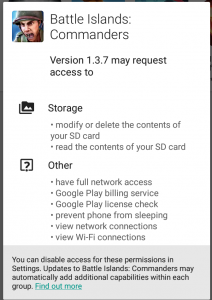 Very Clean, nothing unnecessary
Storage wise? As of writing, Commanders is using 291MB of storage. Those with newer phones shouldn’t need to worry, but you may need to if you have a smaller storage – say, 8GB. (Then again, Google Play Services is 473MB, so no worries!)
Now, For the main attraction…
(You are here to read a review of the game, after all.)
Gameplay!
The gameplay plays like Clash Royale, but with more things stuck onto it. If you aren’t aware, these deck-building/tower-defense hybrids have you build a custom deck of up to 8 units, which you then take into a real-time battle with another player. by charging points (Called ‘command points’ in this case) you can summon units into battle. The goal? Destroy all 3 of your opponents buildings in 3 minutes. In the last minute, the rate you get command points doubles. In a tie, you get an extra minute – if it’s still a tie after that minute, the game ends in a draw. Sounds simple, right?
 Taken Milliseconds before disaster.. at least for them.
Of course, winning games (or earning stars in a game, although this can be slower) earns you chests. These little guys give you money (or ‘supplies’, in this case) as well as some unit cards. Said cards can be used in the deck editor to upgrade existing cards(if you have more than 1 of them) or be swapped out.
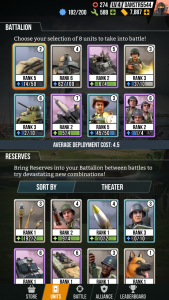 Gotta catch them a…. wrong developer.
Tutorials? Much like similar games, the tutorial is in-depth and covers everything it can. I won’t narrate it here, it is a long one, but be assured that you will know how to play after it.
There are also alliances, where you can team with players and give them cards. And then leaderboards, which allow you to watch some of the top fights.
As for looks and sound, 505 have done well. You can tell that a lot of detail has gone into every single unit. Oh, did I say each unit is individually voiced in a variety of languages and accents?
 -Via Giphy
English and American Accents? Got ’em. You want German and French units, with accents thicker than butter? Sure! But you must keep the Australian flamethrower guy. That accent warrants special powers. You must adhere to these powers.
In App Purchases!
What can I say? It’s what you would expect from this sort of game. The basic pack costs 99p (or cents) and the most expensive £/$99.99.
 Pretty average.
Conclusion
Overall? Not too shabby, 505. Not too shabby. I was expecting a disappointing clone of Clash Royale, but it’s gone beyond the base to make a feasible product. Fairly good gameplay, sounds and graphics are pleasantly surprising, and I can’t really complain over the IAP’s. Only real issue is that the game’s play store page can is a little confusing in its layout, but that’s not too bad. They just used PC screenshots, that’s all.
Canadian wireless regulator does away with costly cellphone unlocking fees
Why it matters to you
Soon, Canadian cellphone subscribers won’t have to pay a fee to unlock their smartphones.
Unlocked devices are the new law of the land in Canada, thanks to a ruling by the nation’s wireless regulator. On Thursday, the Canadian Radio-television and Telecommunications Commission (CRTC) announced that cellular service providers must unlock customers’ smartphones upon request, and that all newly purchased mobile devices must ship unlocked.
Unlocked phones are compatible with more than one cellphone carrier, generally speaking. But historically, obtaining them hasn’t been easy — Canadian carriers like Bell, Rogers, and Telus charge a fee (typically $50) to unlock phones if a customer wants to switch providers.
That’s changing. Starting December 1, Canadian telecom providers will have to unlock phones at no charge.
“The Wireless Code has helped make the wireless market more dynamic to the benefit of Canadians. While they appreciate the Code, they told us loudly and clearly that it could be more effective,” Jean-Pierre Blais, chairman of the CRTC, said in a statement. “We have listened to them. The changes and clarifications we are announcing today will give Canadians additional tools to make informed choices about their wireless services and take advantage of competitive offers in the marketplace.”
The shift comes after the CRTC’s February 2017 review of telecom policies, which the regulator introduced in 2013 and implemented in 2015. Initially, the bureau advocated for a compromise: A capped $38 unlocking fee imposed on all telecoms. But in the end, the CRTC decided to remove them altogether.
In March, the CRTC reported that Canadian telecoms made $37.7 million last year by charging customers to unlock their phones — a 75 percent jump in revenue compared to 2014.
Canadian carriers defended their unlocking fees at the time, arguing that phone locking prevents profiteering third parties from reselling high-end phones overseas. “We think it’s a lot more appropriate that people who actually have their device unlocked bear the cost of the unlocking,” said Howard Slawner, vice-president of regulatory telecom at Rogers.
Freedom Mobile, an independent Canadian carrier, told CBC News that it couldn’t afford to get rid of unlocking fees unless its competitors did so, but that it would benefit from the change in policy because it’d be easier for customers to switch. “A customer can go to … your local computer shop or whatever and get that phone unlocked anyway and perhaps in a dangerous way,” Freedom vice president Ed Antecol said.
The new unlocking clause will become part of the CRTC’s revised Wireless Code, a living document outlining the rights and obligations of carriers. It applies to “all wireless services,” according to the agency, and dictates that ambiguous parts of subscribers’ carrier contracts must be interpreted “in a manner that is favorable to the customer.” And it isn’t the only policy that changed on Thursday.
Cell providers will be required to obtain account holders’ consent before they charge data and roaming fees in a family-shared plan. International roaming charges will be capped at $100 a month and data overage fees at $50, unless a customer agrees to pay more.
And starting next year, cell customers will be able to cancel their contracts within 15 days and return their devices in “near-new” condition at no cost, as long as they have used less than half of their monthly usage limit.
The first phone with an on-screen fingerprint sensor could come from … Vivo?
Why it matters to you
Including the fingerprint sensor in the screen looks to be a standard going forward, at least for future flagship smartphones — and Vivo’s device could be the first.
The last few months have made it clear that the age of the standalone fingerprint sensor will one day come to an end. Apple is looking into packing its TouchID technology into the screen, and may actually pull it off. There was talk of Samsung doing the same with the Galaxy S8, but when that didn’t pan out, the conversation moved to the upcoming Note 8.
Either way, somebody sooner or later is going to make it happen, and when they do, the industry will likely follow suit. Nobody expected the first to be Vivo, however.
A post on the Chinese social networking site Weibo from industry analyst Jiutang Pan discovered by Android Authority shows a video of a Vivo device being unlocked through on-screen fingerprint recognition. Pan says the phone could make it to market in the coming months, before the next flagship iPhone’s presumed fall reveal.
Still, the analyst says the iPhone could be the first phone outside China to launch with the feature. As for Samsung, the situation is a bit murkier. The company had to pass on the technology in the Galaxy S8, reportedly because it ran out of time perfecting its solution. You’d think that would bode well for the Note 8’s chances, but rumors suggest it will miss out as well.
So yes, Vivo has a very real shot at being the first phone maker in the world to produce something other, much larger tech firms have been racing to ship. And while that would be surprising, it’s not completely ridiculous when you factor in the company’s modest history of innovation.
Four years ago, Vivo released the X3 — the world’s thinnest smartphone at the time, measuring just 5.75 millimeters thick. Last November, it brought the very first phone with 6GB of RAM to the market in the form of its XPlay 5.
Will it follow those achievements up with an even greater one? Only time will tell, but one thing is certain: don’t count on the device making it to our shores.
 AIVAnet