


Abarth 124 Spider review: Frivolous fun… if you can afford one
What happens when you take a Japanese roadster and give it an Italian heart? You get the Fiat 124 Spider. Dress that car up in some couture red, black and white body kit and you get the on-so-unsubtle Abarth 124 Spider, as you see above – a tuned-up rebadge with plenty of extras going on beneath its sporty exterior.
The Abarth 124 Spider isn’t just a rebadge, though, as it features a 168bhp tuned version of the 1.4-litre turbocharged engine as found in the Fiat, plus different suspension, making it a more powerful sports car… just not a particularly fast sports car. What makes it great fun, however, is the front engine position which, in this elongated two-seat form, gives it an unruly presence when behind the wheel.
If you’ve always liked the Mazda MX-5 – the car which provides the chassis for the Fiat 124 Spider – then does the Abarth version offer enough to make it worth the extra cash? We borrowed one for a long weekend to find out.
Abarth 124 Spider review: Better looking than Mazda MX-5 and Fiat 124 Spider?
Abarth sent us the most raucous of its available finishes: with a black bonnet and soft top, white body panels and red wing-mirrors, it’s certainly a head turner. And not because it looks like a cut’n’shut job, because it’s got attitude that matches the badge on the front. Some will disagree and say it looks horrid in this finish, but each to their own.
Pocket-lint
It’s not just the paint job that gives the Abarth a more aggressive stance than its Fiat cousin – although the way the black bonnet misses the panel edges and cuts in to fit the front grille gives its finish real focus – as there are different panels to be found here. The Abarth snarls, the Fiat looks like a punch-drunk Cheshire cat with a rounded smirk by comparison. Look at those front foglight panels: they’re got so much more attitude. The rear also hosts not two but four tailpipes, which is a statement in itself.
The interior from a driver’s point of view is almost a mirror of the Fiat, however, with fixed 6.5-inch screen on the dash, with a trio of aircon simple climate control knobs beneath. It’s actually not very fancy compared to, say, an Audi or BMW setup, but does the job well enough.
Look closer, however, and it’s the finer details in the Abarth that really set it apart from the Fiat: the leather steering wheel and hand brake each have red stitching; the soft-finish interior panels with the Scorpion subtly appearing, most noticeable when caught in the right light; those firm, leather seats. It’s a notable improvement all round, but that’s part and parcel of the reason this car costs in and around £30,000.
Pocket-lint
As a two-seater, well, there’s no much space either. But you don’t buy this car to do the weekly shop (unless you just don’t like eating) as the dinky boot and limited storage space attests. There is an additional storage space between driver and passenger shoulders, fronted with its own shiny plaque-like front.
Abarth 124 Spider review: What’s the tech setup?
As we alluded to above, there’s not a huge amount going on in the Abarth when it comes to tech. The Uconnect system is ok – handled by touch or the rotating dial and buttons to the driver’s side – but it’s not got the depth of options you’ll find from other brands.
Did we care? No, we were too busy with the top down, wind in hair (thankfully not too much to mess everything up), seeing what we could get out of the Abarth out in the Kent countryside.
Pocket-lint
The only real lacking, compounded by the lack of available space in a car such as this, is a lacklustre sound system. The included media system is upgradable to a Bose system, but it’s not particularly inspiring. We connected via Bluetooth most of the time, with the inclusion of a single USB socket for in-car charging proving useful.
In addition to music, the Uconnect system also handles built-in sat nav. Otherwise, there aren’t a great deal of additional settings and driving styles to dig into – leaving you free to drive.
Abarth 124 Spider review: How does it drive?
The long and short of it: you won’t buy an Abarth for its abundance of tech. You will buy it for the fun of the drive.
From each press of that start button, the snarling, noisier engine sound gives a sense of sports car – without being non-stop and over-the-top as you’ll find from something like, say, an Audi RS3’s relentless engine noise. Besides, we found the Fiat sounded a little too pedestrian.
Pocket-lint
However, for our test car, we had an unexpected surprise: an automatic gearbox. Yep, no manual box in this particular arrangement, which was rather unexpected for such a drivers’ car. We found it super easy to use, of course, making driving around towns and getting stuck in traffic jams a breeze. But there was that slight disconnect when wanting to get a little more from the Abarth’s torquey engine.
Our principal complaint with the Fiat 124 Spider was its turbo lag and general lack of oomph. The Abarth goes some way to fix that, with the extra kick of horsepower delivering more grunt from that 1.4-litre engine. It’s an improvement, but the Abarth couldn’t really be called super-fast: its 0-62mph mark of 6.8-seconds doesn’t feel like you’re pulling off several face-compressing Gs. It’s not that much quicker than the 2.0-litre Mazda MX-5, but it’s torquier so acceleration is better – and backed by a red rev counter to give even more of an impression of speed (however much that’s in the mind).
One of the things that makes the aforementioned MX-5 so much fun to drive – and potentially dangerous – is the ability to switch off its traction control. In a front-engine car with the right amount of throttle, that means you can kick its arse out almost sideways and keep on going around corners. The Fiat 124 Spider, on the other hand, has none of that: it’s a more rigid, suited-and-booted Italian affair, keeping things firmly on the road by computer control that limits the driver-to-car relationship.
Pocket-lint
The Abarth finds a middle ground, the kind of slipstream sensible that you’d want for track racing, while staying safe on the road. It has a limited slip differential and a Sport mode – activated by pulling back on the little S toggle behind the gearstick – which loosens things up somewhat, adding tightness to the steering and making aggressive cornering all the more fun. It doesn’t negate the understeer that’s present, though.
Abarth 124 Spider review: Should you buy one?
We can’t ignore the sheer cost of the Abarth 124 Spider. With a starting price of £29,620 (which increases to £31,920 with the auto box) it’s certainly not cheap.
Options are very limited, however, as almost everything is as standard. The only thing you’ll need to pay more for are paintwork options (between £400-600) and, if you want it, the Bose sound system (£795).
Pocket-lint
At its maximum, then, the Abarth 124 Spider could cost £33,115. Given that the latest Toyota GT86 can be had for around £26,000, and that Mazda’s 2.0-litre MX-5 is still an attractive option for around £24,000, that makes it a harder sell.
However, this is an Abarth. The clue’s in the name and the badge: it’s a niche car. One that, ultimately, offers the best performance configuration you’ll find out of the MX-5 chassis in our view. So you do get what you pay for – it’s whether or not you think it’s worth it.
Verdict
There’s something special about driving around in a rarely seen car like the Abarth 124 Spider. It makes the experience all the more fun. And, let’s face it, you’re likely to see a Lamborghini in London than you are this particular Abarth.
Does that make it worth its £30,000-plus cover price? Not entirely, depending on your point of view. There are far better value roadsters out there, including Mazda’s own MX-5 or the Toyota GT86. Thing is, this is an Abarth; its carefree and unapologetic in being what it is, and that will appeal to its fans.
Overall the drive could deliver yet more pomp, as it’s not a totally wild sports car, but the tuning finery the Abarth offers above and beyond the Fiat 124 Spider puts it head and shoulders ahead.
It’s a kind of frivolous experience, however, so while we’ve loved our short-term relationship with this car, our hearts don’t quite long to live with one forever.
The Morning After: Monday, June 12th 2017
Hey, good morning! You look fabulous.
Welcome to Monday, and the beginning of a very busy week in gaming news. While you can expect the usual mix of Gear, Entertainment and Tomorrow reports, E3 2017 has kicked off, and that means all of gaming’s biggest players have a lot to show off. We will be reporting live all week from Los Angeles.
It’s the XbOX, get it?Project Scorpio unveiled: Meet Xbox One X

A year after Microsoft promised the most powerful console ever, it has delivered the details. The Xbox One X will go on sale November 7th with specs built to enable 4K, 60fps gaming. The price? A cool $499. Many of the games coming out this fall will “Xbox One X Enhanced” for the new console, while older titles can gain improvements via a patch, similar to what we’ve seen with the PS4 Pro. Microsoft didn’t discuss any VR aspirations for its latest box — which is also the smallest Xbox ever, thanks to a new liquid cooled “vapor chamber” — but we’re guessing that’s in the plans too.
Crimson Skies!Original Xbox games are coming to Xbox One backward compatibility

Microsoft keeps adding to its catalog of Xbox 360 games that are playable on Xbox One (up over 400 at last count), and now it’s announced plans for something else: original Xbox games on Xbox One. So far the only one announced is Crimson Skies: Road to Revenge, and it sounds like it should work in a similar manner to Xbox 360 backward compatibility where your original discs will still work — if you haven’t tossed them in yet.
The new update puts almost every version on the Bedrock Engine. Almost.Microsoft will unify most ‘Minecraft’ platforms this summer

Minecraft is about to enter its final form. In August, the Better Together update will land and unify the game across nearly every platform, from iOS and Android to Xbox One and Nintendo Switch. This unification comes courtesy of the Bedrock Engine, which already powers all mobile, Windows 10, Amazon Fire and VR versions of the game. It soon won’t matter which platform your friends use to play Minecraft — every version will be the same, they’ll share DLC and updates, and all players will be able to create new worlds together. Well, nearly all. The PlayStation 4 and Xbox 360 versions of Minecraft are not included in the initial Better Together update.
Call and responseSony’s E3 2017 PlayStation event

Microsoft went first, but tonight Sony strikes back. Last year Sony showed off a lot of games that are due to arrive in 2017 and beyond, so we’re expecting updates on big name titles like God of War, The Last of Us 2, Gran Turismo Sport and much, much more. Follow along with our liveblog of the event, which is starting at 9PM ET (maybe take a nap first).
It’s time for the Imperial force’s story.‘Star Wars Battlefront II’ campaign looks like a spin-off movie

EA’s E3 2017 Battlefront II presentation did its best to balance new multiplayer goodies (Chewbacca, the planet Naboo, Yoda, Darth Maul, Rey and more) with a highly-anticipated campaign mode, which appears to center on the ‘good’ Imperials fight to beat the upstart Rebel Alliance. Battlefront II will apparently bridge the story gap between Return of the Jedi and The Force Awakens, similar to how spin-off movie Rogue One connected earlier Star Wars chapters.
It looks like a blend of ‘Destiny’ and ‘Far Cry.’‘Anthem’ is BioWare’s brand-new open world

The team behind Mass Effect has something new up its sleeves. BioWare today revealed Anthem, a new open-world franchise seemingly set in a futuristic, jungle-ridden universe. It definitely has Destiny, Star Wars and Far Cry vibes. The first gameplay reveal has the player venturing into the wilderness in search of some workers who have landed themselves in a bit of trouble and highlights the game’s expansive world, exploration and cooperative combat.
It could spot the first signs of a cyberattack or a disease outbreak.American military backs an entirely new kind of processor

DARPA is spending $80 million to fund the development of the world’s first graph analytic processor. The HIVE (Hierarchical Identify Verify Exploit) accesses random, 8-byte data points from the system’s global memory, crunching each of those points individually. That’s a much faster approach for handling large data compared to typical processors that access large chunks of sequential data and fill their caches as often as possible. If the concept works as promised, though, it could quickly spot major problems, like cyber-terrorism, before they become especially dire.
But wait, there’s more…
- ‘FIFA 18’ isn’t out yet and I’m already in love
- ‘Forza Motorsport 7’ makes the jump to 4K on Xbox One X
- ‘Need for Speed: Payback’ and the business of car crashes
- Watch EA’s E3 2017 event in 12 minutes
- EA’s VP explains What EA learned from ‘Mass Effect’
- SpaceX could send its biggest rocket to space in three months
- Uber considers sidelining its CEO
iPad Pro 10.5 review: Where execution and ambition meet
Never mind that Apple keeps updating its notebooks and desktops — Tim Cook once said the iPad represented the future of personal computing. That was one year ago, when the company revealed the 9.7-inch iPad Pro, and he seemed to mean it. Of course, you don’t need me to tell you that a lot can happen in a year.
The iPad that Phil Schiller revealed after Cook dropped that bombastic statement has already been discontinued, making way for the shiny new 10.5-inch model Apple unveiled at WWDC 2017. The Pro 10.5 ($649+) feels very familiar, not to mention surprisingly powerful, but that’s no surprise — every new iPad Pro that Apple releases is the best one out there. What’s more impressive is how finally — finally — Apple has put together an iPad that feels capable of living up to the company’s lofty words. It’s not perfect, and it’s not for everyone, but the iPad Pro 10.5 is still a bigger step forward than I expected.
Hardware
Chris Velazco/Engadget
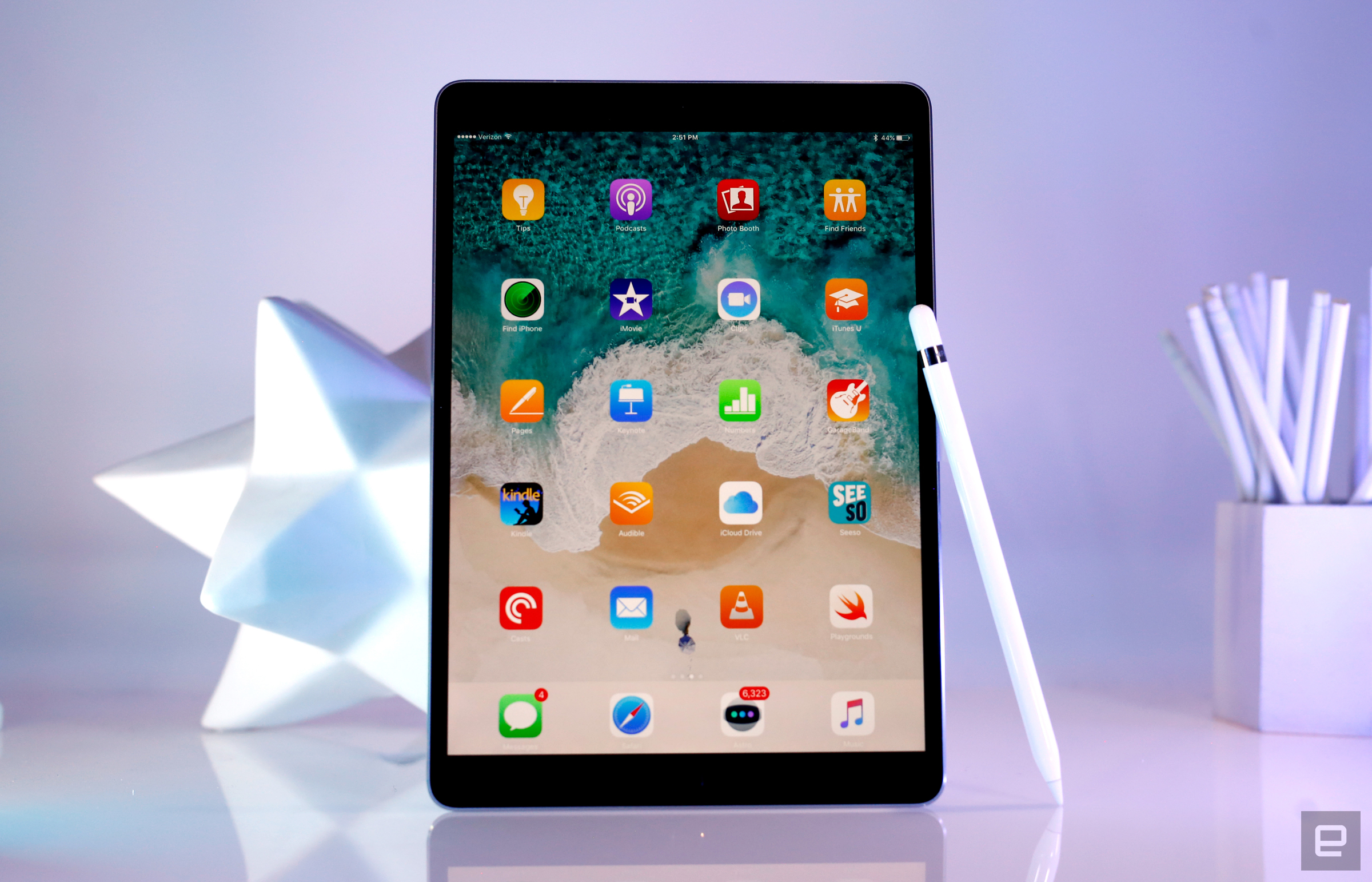
If you’ve ever so much as looked at an iPad Pro, you know what to expect. The Pro 10.5’s body is crafted from a single block of aluminum, and it’s as sturdy and seamless as the previous model. There’s a sleep/wake key on the top-right corner, and a few millimeters around the corner from that are the volume keys. Going down from there, you’ll find the nanoSIM card slot — that is, if you’ve splurged on a cellular model.
The usual quartet of speakers is back, too, etched in pairs into the iPad’s top and bottom edges. And on the left side: the three-pin Smart Connector that provides power and data connectivity for a slew of fancy Pro-series accessories.
Really, there’s only one clear sign that you’re looking at a different kind of iPad. Look at the screen — or more accurately, look around the screen. The Pro 10.5 has much smaller bezels because Apple squeezed a larger panel into a body that’s only slightly bigger than the 9.7-inch model.
The other changes are apparent only when you turn the iPad on. The improved Touch ID sensor in the home button is noticeably faster than the one in the last Pro, for one, and Apple raised the storage minimum across all Pro models. The base is now 64GB, though the model I’m testing has a whopping 512GB. That’s as much storage as the laptop I just bought, a sign that Apple wants the iPad Pro to be able to stand in for a traditional computer when needed.
Display and sound
Chris Velazco/Engadget
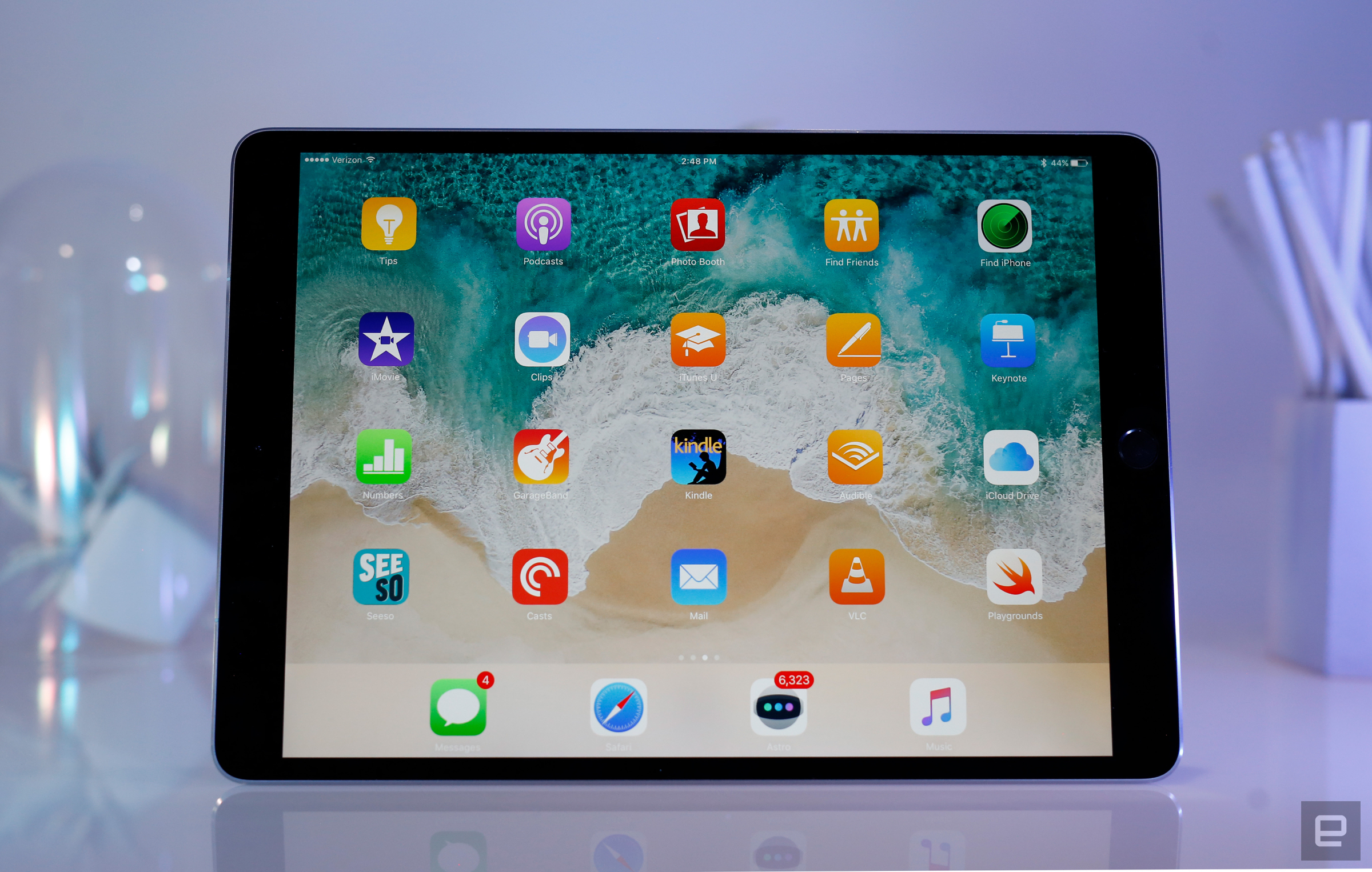
Both of the earlier iPad Pro models had good screens, but neither were all that exciting. Not so this time: The Pro 10.5’s display is fantastic. For one, it’s a little bigger than the panels Apple once used in its iPads. I really like the 12.9-inch Pro in theory, but it was always too hefty to lug around (especially since I often have a laptop with me, anyway). And the 9.7-inch Pro was fine for reading and video, but less than ideal when I needed to get work done. It honestly would’ve been nice to get an even bigger screen this time — say, 11 inches — but Apple’s size decision here was at least a step in the right direction. And because Apple bumped this screen’s resolution to 2,224 x 1,668, it’s just as crisp as every other Retina iPad display.
This is also Apple’s first ProMotion screen, which means it refreshes at a rate of 120Hz instead of the typical 60Hz. As a result, scrolling and animations are almost startlingly smooth. Your TV probably has a similar feature, which makes actors on-screen look like they’re walking around a soundstage instead of their fictional world. Here, it just makes the action look more fluid, as though the icons you’re pushing around a home screen are real objects. Frankly, I don’t want to go back to a non-ProMotion iPad after this.

While similarities to televisions are fresh in our minds, the Pro 10.5 also packs support for the DCI-P3 wide color gamut. This first debuted on last year’s iPad Pro, and it just means colors here are livelier and more saturated. Beyond that, this is also one of the brightest iPad screens I’ve ever seen. It tops out at around 600 nits, putting it ahead of many existing tablets, not to mention quite a few laptops. That brightness makes this model a champ for watching movies in well-lit environments, and an improved anti-reflective coating also means it’s great for outdoor use, too. Throw in True Tone, which changes the screen’s color temperature based on your surroundings, and you’ve got one of the most technically impressive displays Apple has ever made.
As mentioned, the 10.5 has the same four-speaker setup we’ve seen in earlier Pro models. They’re not quite enough to fill a room, but they offer loud, crisp audio without distortion. I spent a lot of time watching cooking videos on YouTube while futzing around in my kitchen, and the Pro 10.5 was always audible above the domestic din. I have Apple’s speaker design to thank for a lot of that clarity — all four speakers play low-frequency sound, but only the top two play the mids and highs. That clever trick makes for surprisingly good channel separation for movies and music, though the benefits are less clear for audiobooks and podcasts.
Performance and software

Chris Velazco/Engadget
Not to sound too enthusiastic, but the superlatives don’t end with the screen. Thanks to Apple’s A10X Fusion chip (a more powerful spin on the processors used in the iPhone 7), an updated GPU and 4GB of RAM, this is the most powerful iPad to date. Apple says CPU speeds here are 30 percent faster than last year’s Pro, and that graphics speed has improved 40 percent. Our usual set of benchmarks (below) certainly point to some big performance gains, but here’s the most important thing: Hardly anything I threw at the Pro over a week of testing managed to trip it up.
Working for Engadget involves a lot of multitasking, so I often had two apps — like Slack and Safari — running side by side in iOS’s Split View mode. Things sometimes felt a little cramped, but everything ran smoothly. Visually intense games like Monument Valley 2, Skullgirls and Telltale’s Guardians of the Galaxy were no problem for the Pro either and actually seemed to get a visual boost thanks to the ProMotion screen. Even editing multiple 4K video files in iMovie was a surprisingly painless process, partially because the updated 12-megapixel camera can shoot native 4K footage. (You’ll still look a little ridiculous taking photos and video with a tablet, but at least the results will be worth it.)
| Geekbench 4 Multi-core | 9,185 | 5,379 | 5,235 |
| Geekbench 4 Single-core | 3,885 | 3,012 | 2,930 |
| 3DMark IS Unlimited | 54,163 | 32,544 | 33,403 |
| GFXBench 3.0 Manhattan Off/onscreen (fps) | 109.5/58.3 | 79.3/33.6 | 51.2/34.9 |
| Mozilla Kraken (ms) | 1,003 | 1,499 | 1,512 |
| JetStream 1.1 | 203 | 141 | 139 |
| Kraken: Lower scores are better. |
But what about professional apps? You know, the high-end stuff artists, designers and doctors use? I threw a couple extra layers on top of a RAW image in Affinity Photo and tweaked the whole thing in real-time. I noticed the occasional hiccups when I tried to quickly leap into another app, but it wasn’t anything concerning. (Because I tested the Pro before its official launch, it’s also possible the version of the app I tried out wasn’t optimized for it yet.) Meanwhile, I suck at 3D modeling, but apps like UMake and Formit 360 gave me the tools to at least try cobbling 3D structures together; any failures of performance here belong to me, not the hardware.

Long story short, the Pro 10.5 acts the way you’d want an expensive tablet to. Nearly everything feels effortlessly fast — now we just need the software to catch up to the hardware. This Pro ships with iOS 10.3, which isn’t technically bad, it’s just that iOS 10 didn’t add many truly valuable iPad-specific features. That’s about to change. Apple calls iOS 11 a “monumental leap” for the iPad, with additions like a customizable dock for quick access to apps and the ability to drag and drop content between two apps running side-by-side. These may sound like minor changes, but they seem essential for anyone actually trying to get work done on an iPad Pro.
Remember Tim Cook’s words: The iPads are meant to be the company’s “clearest expression” of the future of personal computing. It was a nice sentiment and the hardware that accompanied it was very good, but iOS leaves much to be desired on bigger screens. With the eventual launch of iOS 11, though, iPads will finally get some much-needed flexibility — in other words, the iPad’s best days are yet to come.
Battery life
| iPad Pro 10.5 | 9:40 |
| Samsung Galaxy Tab S3 | 11:50 |
| Lenovo Yoga Book (Android) | 11:09 |
| iPad Pro 12.9 | 10:47 |
| iPad Pro 9.7 | 9:21 |
| Google Pixel C | 8:15 |
| Surface Pro 4 | 7:15 |
This version of the iPad Pro packs a 30.4Whr battery and, as usual, Apple claims you’ll be able to use it for up to 10 hours while watching movies or putzing around online. In general, Apple’s estimates were always on the conservative side; we’ve had our share of iDevices easily surpass the 10-hour mark in our battery-rundown test. This time, though, Apple’s figure was more or less right-on. On three occasions, I set the Pro 10.5 to loop a movie with Wi-Fi on and screen brightness set to half, and on average the tablet lasted for about nine hours and 40 minutes before needing a trip to a power outlet.
That’s actually a little better than last year’s model, but not by much. The Pro 10.5 has a bigger battery than the Pro 9.7, but it also has to deal with a brighter screen that refreshes twice as fast. (The A10X Fusion chip obvious plays a role here too, but it was designed to more efficiently sip power when needed.) Anyway, most of you aren’t sitting around running video benchmarks all day. With fairly consistent use (by which I mean I barely put it down) and screen brightness set to auto, the iPad Pro lasted about three days before needing a charge. If you’re the type who picks up an iPad, checks a few things out and tosses it back down again, expect it to last even longer.
Accessories

Chris Velazco/Engadget
Two accessories have been synonymous with the iPad Pro since the beginning: the $99 Apple Pencil and the $159 Smart Keyboard case. The former actually hasn’t changed since we first saw it two years ago. Thanks to the Pro 10.5’s improved screen, however, writing and sketching feel far more fluid than on older models. Let’s say you’re tracing a curvy line — there’s only about a 20-millisecond delay between moving the Pencil and seeing the line appear on-screen. I don’t know about you, but my eyes aren’t discerning enough to pick up on latency that subtle.
The keyboard situation is much improved, too. Because there’s never been a Pro this size before, Apple had to make a smart keyboard case that is slightly larger than the one it made for the 9.7-inch Pro last year. Despite that modest change in size, this year’s model is much, much more comfortable. For one, the keys are nicely spaced and bigger — I actually typed most of this review on the Pro with a smart keyboard, something I just couldn’t manage last year. In fact, it’s so much better that people with the smaller iPad Pro should seriously consider buying this keyboard instead. It’s not so big as to feel clunky when closed over the screen, and the improved keys are worth it.
The competition

Real talk: There just aren’t many premium tablets on the market. This iPad is obviously one of them. For not much extra, you could also move into the 12.9-inch iPad Pro, which quietly got the same upgrades. The brighter, ProMotion screen? The A10X Fusion chip? That camera from the iPhone 7? Yes, oui and ja. Aside from the shift in the size, the only real differences are the battery sizes and color options. Only the Pro 10.5 comes in rose gold, which I’m sure matters to some of you. That said, the bigger screen makes running multiple apps much less painful. That’ll be even more important once iOS 11 hits.
Meanwhile, if you’re on the lookout for a high-end tablet but just hate Apple, there’s always the Galaxy Tab S3. You’re not wrong to look at it as Samsung’s answer to the iPad Pro — it packs a relatively high-end (if somewhat older) mobile chipset, a great screen with HDR support and an S Pen for all you creative types. Even better, there’s an optional keyboard case for when the urge to get productive strikes. Here’s the rub: If you thought iOS wasn’t tuned for productivity, Android seems even worse. With prices starting at $600, it’s a fine alternative; I just wish there were more (and better) Android tablet apps.
Wrap-up

No matter how you slice it, $649 is a lot of money to drop on an iPad. In return, however, you get one of the most powerful tablets around. Most people like the idea of a second screen for occasional web browsing on the couch when they can’t be bothered to move to a computer or dig a phone out of their pocket. If that’s you, just forget it: The iPad Pro 10.5 is total overkill.
That said, it’s not hard to find scenarios where this pricey Pro actually makes sense. If you’re a photographer looking for a better way to edit RAW files in the field, this might be for you. Ditto for videographers and producers looking to piece together rough cuts without running for a workstation. And if you’re the kind of person contemplating a life without a traditional PC at home or in your bag, the power on display make the Pro 10.5 a good place to start … though you may want to wait until iOS 11 launches. Long story short, this is an excellent machine with tons of untapped potential. Just make sure that it actually fits your lifestyle before dropping the cash on one.
Report Reveals In-App Purchase Scams in the App Store
An investigation into App Store developer pay-outs has uncovered a scamming trend in which apps advertising fake services are making thousands of dollars a month from in-app purchases.
In a Medium article titled How to Make $80,000 Per Month on the Apple App Store, Johnny Lin describes how he discovered the trend, which works by manipulating search ads to promote dubious apps in the App Store and then preys on unsuspecting users via the in-app purchase mechanism.
I scrolled down the list in the Productivity category and saw apps from well-known companies like Dropbox, Evernote, and Microsoft. That was to be expected. But what’s this? The #10 Top Grossing Productivity app (as of June 7th, 2017) was an app called “Mobile protection :Clean & Security VPN”.
Given the terrible title of this app (inconsistent capitalization, misplaced colon, and grammatically nonsensical “Clean & Security VPN?”), I was sure this was a bug in the rankings algorithm. So I check Sensor Tower for an estimate of the app’s revenue, which showed… $80,000 per month?? That couldn’t possibly be right. Now I was really curious.
To learn how this could be, Lin installed and ran the app, and was soon prompted to start a “free trial” for an “anti-virus scanner” (iOS does not need anti-virus software thanks to Apple’s sandboxing rules for individual apps). Tapping on the trial offer then threw up a Touch ID authentication prompt containing the text “You will pay $99.99 for a 7-day subscription starting Jun 9, 2017”.

Lin was one touch away from paying $400 a month for a non-existent service offered by a scammer.
It suddenly made a lot of sense how this app generates $80,000 a month. At $400/month per subscriber, it only needs to scam 200 people to make $80,000/month, or $960,000 a year. Of that amount, Apple takes 30%, or $288,000 — from just this one app.
Lin went on to explain how dishonorable developers are able to take advantage of Apple’s App Store search ads product because there’s no filtering or approval process involved. Not only that, ads look almost indistinguishable from real results in the store, while some ads take up the entire search result’s first page.
Lin dug deeper and found several other similar apps making money off the same scam, suggesting a wider disturbing trend, with scam apps regularly showing up in the App Store’s top grossing lists.
It’s unclear at this point how these apps managed to make it onto the App Store in the first place given Apple’s usually stringent approval process, or whether changes to the search ads system in iOS 11 will prevent this immoral practice from occurring in future. We’ll be sure to update this article if we hear more from Apple.
In the meantime, users should report scam apps when they see them and inform less savvy friends of this scamming trend until something is done to eradicate it.
Tags: App Store, security
Discuss this article in our forums
U.K. Retailer John Lewis Offering Free Three-Year Warranty on all Macs and iPads Until June 28
U.K. high street retailer John Lewis is currently offering three year’s free warranty on selected Apple gear including new MacBooks, iMacs, and iPads through its online store, potentially offering buyers £159 on equivalent Apple Care.
The offer extends to all listed Macs and iPads. For example, customers can today order a Space Grey 2017 13-inch Apple MacBook Pro with Intel Core i5, 8GBGB of RAM, 256GB SSD, and Intel Iris Plus Graphics 640 for £1,449 RRP, which includes the three-year guarantee at no extra cost, with an option for three more additional years Added Care with accidental damage cover for £80.
Similarly, the retailer is offering a free three-year guarantee on a new Silver 27-inch iMac with Retina 5K Display, Intel Core i5, 8GB of RAM, a 1TB Fusion Drive and Radeon Pro 570 GPU for £1,749 RRP, with an extra three years Added Care with accidental damage cover for £30. The site lists the new iMacs “Coming Soon”, but this is likely just an oversight, since the Add to Basket option has been added and several listings claim more than 10 in stock.
Also included in the three-year guarantee offer are Apple’s new range of iPad Pros, which the online store currently lists as out of stock as the retailer waits for them to become available to resellers later this month. Given that the offer is open until June 28, John Lewis is presumably confident of receiving the iPad Pros before then.
The retailer is also offering £50 off all iPhones when bought with an Apple Watch. A two-year guarantee is also included for both devices.
Note that configuration options are not available from John Lewis and all Macs are only available with the listed specifications. Equivalent three-year Apple Care from Apple costs £159. For more information on John Lewis inclusive guarantees, see here.
(Thanks, Tony!)
Tags: retail, discounts, United Kingdom, John Lewis
Discuss this article in our forums
Getting fit with the Huawei Watch 2: Phone-free fitness, direct from your wrist
Whether you’re hitting the pavement, working it in the gym or going for a cycle, tracking your exercise sessions allows you to monitor your progressing fitness levels and gives you serious, irrefutable bragging rights over your mates when you break their PBs and can show them the proof.
While there are dozens of fitness trackers out there, most aren’t the most versatile of gadgets. The Huawei Watch 2, however, is a master of all trades; a sleek and stylish device that’s an accomplished specialist whether you want wrist-based alerts or focused fitness-tracking.
Thanks to the built-in Huawei Health app, the Watch 2 is the perfect device to accurately track all of your exercise efforts. It’s like having a personal trainer strapped to your wrist.
Here’s how the Huawei Watch 2 is designed to get you fit and keep you there.
Getting fit with the Huawei Watch 2: Ditch the phone thanks to GPS
Many smartwatches still need you to keep your smartphone to hand in order to get truly accurate distance tracking. The Huawei Watch 2, however, lets your free up your pockets and leave your phone at home. That’s because it builds on the standard accelerometer-infused sensor pack with built-in GPS and GLONASS positioning systems.
Pocket-lint
Whether you’re running around your local park, cycling to the coast or just going for a weekend stroll in the countryside, the Watch 2 tracks your movements to the metre rather than having a rough guess based on how much you’ve swung your arms.
This is about more than giving a pretty map of where your outdoor exercise has taken you. More accurate distance data means the Watch 2 can better track your calorie burn and help improve your fitness levels. It’s also key if you’re training towards a 10K or half marathon where precise data is crucial.
There’s no need to wait for an age for the GPS sensor to lock on to a signal either, as the Huawei Watch 2’s GPS is quick to secure a connection and steady once locked on.
Getting fit with the Huawei Watch 2: Constant heart-rate monitoring
Knowing how far you’ve cycled or how many steps you’ve taken is a great way to monitor your exercise levels, but it doesn’t show how your body is reacting to the effort you’re exerting. That’s where the Huawei Watch 2’s integrated heart-rate sensor comes in.
Pocket-lint
Located on the underside of the watch body, this optical heart-rate sensor accurately tracks the beats per minute of your life-giving organ. Again, like GPS-enhanced distance tracking, this heart-rate sensor allows the Watch 2 to offer more accurate calorie burn stats, plus show how your body is responding to exercise.
Being able to see how your heart rate reacts not just to exercise, but how quickly it returns to its resting rate is key to understanding your fitness levels, and it’s all possible directly from the Huawei Watch 2 itself – which lets you view a graph of your heart rate over the last six hours directly from the watch face.
Getting fit with the Huawei Watch 2: Real-time guidance
How far have I run? How much longer do I have left to go? Have I actually burnt off last night’s cheeky Nando’s yet or do I still have that second side order of fries still to go? Just some of the questions that pass through all of our minds while exercising, and now, thanks to the Huawei Watch 2, the answers are just a glance away.
Pocket-lint
Whether you’re running, cycling or simply enjoying an energetic stroll, the wearable relays all of your relevant metrics to your wrist in real time. Offering encouraging words of motivation as you go, you get goal achieving progress alongside lap, time and distance alerts and even live GPS maps and guidance on your current speed.
You’re not stuck with default metrics either, as you can customise the readouts to you own personal wants and needs. You need never wonder how you’re getting on for that personal best, as the answer is on your wrist.
Getting fit with the Huawei Watch 2: Monitor progress with workout data
It’s not just when you’re struggling to breathe and pouring with sweat that the Huawei Watch 2 presents you with all your fitness data. Finish your run and all of your session’s metrics will be presented in gorgeous and easy-to-understand fashion directly on your wrist.
Pocket-lint
Once you’ve scrolled through metrics – which range from distance covered, VO2 Max level, calories burned, time active and heart rate bands you spent the most time in – all of your data is stored for future viewing.
You can access these workout data reports at any time, whether you’re looking to compare your latest performance with a former personal best or just looking back and feel smug at that one time you managed 10K in sub-50.
Getting fit with the Huawei Watch 2: Power to your PB with offline music
Whatever your exercise of choice, keeping yourself motivated when your lungs are burning and your legs are aching is a tough ask. Music is always a great motivator, though, and with the Huawei Watch 2 it’s just a click away whether you’ve got your synced smartphone to hand or not.
Pocket-lint
With the Google Play Store hosted on the watch itself, the Huawei Watch 2 lets you download the Google Play Music app directly to your wrist.
As well as letting you access your favourite running playlist without the need for your phone, you can download tracks for offline listening with the watch’s 4GB of internal storage primed for fitness listening.
Getting fit with the Huawei Watch 2: Get instance exercise access
Your trainers are laced, your stretches are done, it’s time to go running. All you’ve got to do is setup your watch. On many devices this is a long, slow, time-consuming job that requires multiple swipes, taps and menu scrolls. With the Huawei Watch 2, however, you’re just one press away from a fleet of exercise-tracking options.
Pocket-lint
Push the lower of the watch’s two ride side-mounted buttons and it will drop directly into the Huawei Health app where you can select from a variety of sporty activities, from your usual run and cycle options to treadmill, walks and fat burning exercise classes.
Pick the one you want, give it a press and away you go. You’re ready to get fit with the Huawei Watch 2.
Secret’s saga ends as its creators head to Postmates
The years-long drama surrounding Secret is coming to an end. Postmates has hired Secret founder David Byttow and his teammate, Ben South Lee, shutting down their publishing platform Bold (and plans for a Secret revival) in the process. Byttow will lead the product development for Postmates’ app, and it’s clear that he sees bright prospects for the on-demand delivery service — the entrepreneur believes his new employer can “leapfrog itself.” Whether or not that happens, the career move underscores the volatility of internet startups, and Secret in particular.
In many ways, Secret was the poster child for every Silicon Valley startup with lots of investment money but no clear road to success. In 2014, it was one of the hottest social apps on the planet — it broke major news (such as Vic Gundotra leaving Google), raised tens of millions of dollars in funding and garnered plenty of buzz, at least in the San Francisco Bay Area. However, it quickly fizzled out as a combination of controversies (such as bullying and muckraking) and its singular focus dragged it down. The service closed shop within about a year, leading Byttow and Lee to work on the far more practical Bold and the anonymous publishing platform IO.
This isn’t necessarily a gamble for Postmates. Byttow and Lee are clearly experienced, and Byttow in particular has a track record for garnering attention. However, it does hint that the modern, app-centric Silicon Valley is growing up. Where Secret was ultimately a niche service without much to do once the novelty wore thin, Postmates is relentlessly practical. Byttow and Lee might not get as much attention in their new positions, but they’re not going to deal with the roller coaster ride of years past.
Source: TechCrunch, Bastian Lehmann (Twitter)
Buckle up! Here are the best game trailers to come out of E3 so far
Why it matters to you
E3 is a proving ground for game trailers and demos, and keeping tabs on them will help you decide which upcoming games you’re interested in picking up.

E3 is nothing if not a showcase for awesome, amazing, and breathtaking trailers. Game developers and publishers work tirelessly to create the sizzling gameplay snippets, cinematics, and cutscenes that tease these upcoming releases — and it shows. Below, we’ve gathered the best, most exciting, and jaw-dropping trailers we’ve seen at E3 so far, and we’ll keep you updated with the very latest as more trailers drop in the coming days.
Anthem
As the latest IP from legendary game developer Bioware, Anthem has some big shoes to fill — big robot shoes that you fill with your human feet while you fly around like a post-apocalyptic Iron Man. Okay, there’s a lot here, so it’s probably best if you just watch the trailer.
Assassins Creed: Origins
Assassins Creed fans, your prayers have been answered. As we’ve long suspected, the latest AC game takes players to Ancient Egypt, to witness the genesis of the Assassins’ Brotherhood. This gameplay trailer gives us a sneak peek at what it’s like to be a bird sometimes.
Metro Exodus
Longing to return to the dark and deadly sewers of a post-apocalyptic Moscow? Well, look no further. Actually, look a little further, because this new Metro installment takes you far beyond the claustrophobic warren of tunnels we got to know so well during the first two games. There’s a little more light, but the world is as dangerous as ever.
Star Wars Battlefront II
Please enable Javascript to watch this video
In a first for the Star Wars Battlefront series, the latest entry will feature a fully-voiced, fully-acted single-player campaign. This new story follows Infernal Squad, an elite unit of Imperial soldiers during the last days of the Empire, bridging the gap between Return of the Jedi and The Force Awakens.
Crackdown 3
In a return to a classic series, Microsoft rolled out a brand-new trailer for the upcoming Crackdown 3. The latest entry is a successor to the wildly popular super-hero open-world game on the Xbox 360, in it players take on the role of a super-charged-super-cop who does an awful lot of super things.
State of Decay 2
Microsoft unveiled a much more serious take on an Xbox 360 cult-classic, State of Decay, a post-apocalyptic game in which players dodge zombies and struggle to survive against all odds. Now players can do it again, with a grounded cast of characters and some tough choices along the way.
Evil Within 2
Nothing says Evil Within like bathing in thick milk-like liquid while being chased by nightmare monsters. Unveiled at Bethesda’s E3 event, this trailer for Evil Within 2 gives us a quick look at a fresh hellscape for you to explore on your journey through the tortured mind of a madman. Sounds like a lot of fun, so we’ll just let you get to watching that trailer.
Toyota is researching heart-monitoring cars that could prevent crashes
Why it matters to you
Although self-driving cars would do away with the need for such technology, in the meantime it could help make our roads safer.
As occasional news reports have shown, having a heart attack or some other medical emergency while driving can prove devastating for anyone nearby when it happens.
With that in mind, Toyota is looking at the idea of incorporating technology into its cars that can predict such an event and bring the vehicle to a quick and safe stop.
Of course, with self-driving cars expected one day to rule the road, there’d be no need for such technology. But with the widespread use of autonomous vehicles still a ways off, Toyota’s plans could prove an effective interim safety measure to prevent injuries (and potentially worse) not only to the driver and the vehicle’s occupants, but also to pedestrians close by.
To develop a system, Toyota’s Collaborative Safety Research Center in Ann Arbor, Michigan, has been working with Kayvan Najarian, director of data science at the Michigan Center for Integrative Research in Critical Care.
Najarian told Michigan Medicine that as healthcare facilities continue to improve, “there will be an increased number of older-age drivers, which could increase the number of medical events happening behind the wheel.”
The joint team noted that the solution involves embedding an algorithm-powered system inside the car that can monitor and predict an adverse cardiac event.
One of the central challenges is to create an effective algorithm capable of making accurate predictions regarding cardiac events, after all, any stops made in error would not only be an annoying inconvenience for the driver but also a highly stressful experience, with the person behind the wheel worrying they’re about to have a heart attack when in fact they’re perfectly fine.
Accurate monitoring is also dependent upon how the technology is incorporated into the vehicle. Discussing the issue, Toyota’s Pujitha Gunaratne said, “A challenge for vehicle applications is having a system that can detect small changes in heart rhythms but can also separate out the noise and motion that happens inside the vehicle.”
He added, “In an ICU, there are all types of mechanisms in place to ensure that the monitors are not experiencing electronic interference. That’s not as easy inside a vehicle.”
At the current time, the team is exploring hardware options for in-car sensors and monitors, which could be built into car components such as seat belts and steering wheels. It’s also collecting physiological data for its algorithm using officially approved heart monitors.
Although such medical emergencies are extremely rare considering the number of miles people travel in their vehicles, such a system could prove effective in preventing further injuries and fatalities should the driver lose control of the vehicle. It’s usefulness could be further enhanced if the system automatically sent a signal to the nearest hospital so that first responders could reach the driver to offer medical assistance.
BJ Blazkowicz returns to Nazi-occupied America in this October’s ‘Wolfenstein II’
Why it matters to you
Fans of the first installment, Wolfenstein: The New Order, finally get a sequel this October that should be bigger and better than Blazkowicz’s explosive gameplay in 2014.

During Bethesda’s E3 2017 press conference, the company revealed the sequel to 2014’s Wolfenstein: The New Order. Called Wolfenstein II: The New Colossus, it’s developed by MachineGames and based on id Software’s id Tech 6 game engine. The setting? A Nazi-controlled America of 1961, and once again, players take the role of BJ Blazkowicz, a member of the Resistance fighting back against the Nazis to reclaim the land of the free.
“Your assassination of Nazi General Deathshead was a short-lived victory,” Bethesda says. “Despite the setback, the Nazis maintain their stranglehold on the world. Only you have the guts, guns, and gumption to return stateside, kill every Nazi in sight, and spark the second American Revolution.”
Locations players will visit throughout the campaign include a “post-nuclear” Manhattan, New Orleans, and Roswell. Blazkowicz will have a huge arsenal at his disposal ranging from machine guns, pistols, and hatchets to “high-tech” weaponry such as the Laserkraftwerk and the Dieselkraftwerk. Players will even have the ability to dual-wield weapons, becoming a one-man army.
As you might expect from the franchise, Wolfenstein II’s take on Nazi-occupied 1961 America will include cyborgs, monster machines such as the beast-like Liesel, and “über soldiers.” If that weren’t bad enough, Blazkowicz will have family and friends to protect, as we discovered during Bethesda’s reveal that Anya Oliwa is pregnant with his two twin children. We also learn that Frau Irene Engel has been on the hunt for Blazkowicz ever since the end of the first game, and eventually finds him.
The reveal trailer opened with a Nazi-controlled city. The player sat at the bar of a local diner, presumably dressed as a fireman. A Nazi soldier entered the establishment and began talking to the player, commenting that Blazkowicz’s face looked very familiar. He asked for the player’s identification papers, and then the trailer moved to an entirely different, scene with Blazkowicz on the open sea fighting Nazis on a ship.
It’s here we see Blazkowicz’s cast iron-like armor, with a retracting full head piece that protects his noggin and hides his identity. In another scene, he’s wearing just the helmet as it retracts, while he tries to convince two potential Resistance recruits that he’s not a Nazi. He grabs one fighter while the other threatens to blow all three up with a grenade.
Eventually we get to see first-person gameplay, with Blazkowicz plowing through Nazis with a wide array of weapons to meet the needs of every gamer, whether they’re standard guns or over-the-top laser-shooting cannons of destruction. Heck, the gameplay footage ended with Blazkowicz feeling the blade of a hatchet and then chopping into a Nazi commander.
According to Bethesda, Blazkowicz will have new abilities in addition to the arsenal of new weapons. “Unleash your inner war hero as you annihilate Nazis in new and hyper-violent ways,” the company adds. “Regardless of your playstyle, invent all-new ways of stabbing, shooting, and killing Nazis.”
Sounds like fun — and a well-earned M rating! Wolfenstein II: The New Colossus is slated to hit the Xbox One, PlayStation 4, and PC on October 27, 2017. Bethesda also revealed The Evil Within 2 and Skyrim for the Nintendo Switch console. For more E3 2017 coverage, head here.
 AIVAnet