


Apple podcast updates will help you catch up on ‘Serial’
Podcasts have come a long way from the days when they represented a novel way to fill up your iPod. There are now shows with seasons (like Serial), teasers and other trappings that you’d normally expect from TV. Simply speaking, podcast apps need to evolve to keep pace with listening habits… and Apple knows it. The company has detailed changes to the specs for iOS 11’s Podcasts app that will make it easier to listen to shows as intended. The spec now supports seasons, and you’ll have the option of downloading an entire season in one go if you’re catching up. Creators can specify that a show is meant to be heard in chronological order, and they can tag podcasts as bonuses or teasers. And that’s not all — Apple is also helping podcasters make a better living through ads.
The company will start using anonymized data to help podcasters identify how many people are actually listening to podcasts, as well as those moments when they skip ads. They’ll find out whether or not they’re keeping their audiences, and sponsors will know if those mid-episode plugs are translating to more customers. You’d be more likely to get podcasts that reflect what you want to hear, and advertisers might be more likely to back your favorite series if they know their campaigns are working.
Apple’s updates also include “clear, concise” titles and a quick play feature in the iOS app to help you resume where you last left off.
All the changes appear to stem directly from last year’s heart-to-heart chats between Apple and the podcasting community. At the time, authors were worried that iTunes and the Podcasts app weren’t doing enough to nurture their content — how are you supposed to make money from a show if you don’t know reels in new listeners and sponsors? There are still some unanswered concerns about in-store discovery and paid shows (there’s still no official purchase mechanism), but Apple is at least addressing some of the fundamental issues.
Via: Six Colors
Source: Apple (PDF)
The Xbox One S will be $50 cheaper from tomorrow
Microsoft’s Xbox One S is getting a $50 price cut in the US tomorrow. That brings the regular, non-bundle price down to $199, which is $50 cheaper than the 1TB, gold PS4 “slim” which Sony announced last week. It’s not clear, however, if this is a permanent price cut or a limited-time offer. (We’ve reached out to the company for clarification.) Clearly, this is a move to push Xbox One S sales ahead of Project Scorpio’s launch. The new, high-specced system will be Microsoft’s focus this holiday, but the One S could still serve a purpose, and be successful, if it’s dramatically cheaper.
The new pricing will coincide with Microsoft’s E3 press conference tomorrow. Sony is holding its own the next day (June 12th), so will have a chance to counter-punch if it feels the PlayStation 4 needs to be marketed more aggressively. We’re hoping to actually see Project Scorpio tomorrow, along with a final name and pricing, which will show just how serious Microsoft is at taking down the PlayStaton 4 Pro. The system’s specs are certainly impressive, but it needs a price-point and software to match — if Microsoft fails on either, there’s every chance players will ignore it.
Summer’s coming.
Get ready to play with $50 off starting tomorrow, June 11: https://t.co/d5itkFCIx8 #XboxOneS pic.twitter.com/l5dIRKygcf— Xbox (@Xbox) June 10, 2017
Follow all the latest news from E3 2017 here!
Amazon star Richard Hammond involved in electric car crash
It’s a scary day for both The Grand Tour viewers and the motoring world at large. Amazon has revealed that show co-host Richard Hammond was involved in a crash while filming Grand Tour’s second season in Switzerland. Hammond thankfully escaped with only a fractured knee, but the incident destroyed the Rimac Concept One electric supercar he was driving (the photo above shows what’s left). While it’s not certain what led to the crash, Amazon notes that there was no one else embroiled in the incident.
It’s not clear how the incident will affect the Prime Video show (we’ve asked for details). However, it’s safe to say that any delays are far less important than Hammond’s well-being. Fellow host Jeremy Clarkson notes that it was the “biggest crash I’ve ever seen,” but adds that Hammond is “mostly OK.”
For fans, the crash is going to trigger unpleasant flashbacks to Hammond’s frightening crash during a Top Gear shoot in 2006. He suffered serious brain injuries after his Vampire drag racer blew a tire at high speed, flying off the track. While he eventually recovered, there’s no question that the event was life-changing for the TV star. This is a mild wreck by comparison, but it underscores the dangers involved in pushing cars to their limits in the name of entertainment — even something as relatively safe as an electric car.
Richard Hammond was involved in a serious crash, but very fortunately suffered no serious injury. pic.twitter.com/4Oib32IJvj
— The Grand Tour (@thegrandtour) June 10, 2017
It was the biggest crash I’ve ever seen and the most frightening but incredibly, and thankfully, Richard seems to be mostly OK.
— Jeremy Clarkson (@JeremyClarkson) June 10, 2017
Via: Recode
Source: The Grand Tour (Twitter)
What EA learned from ‘Mass Effect’ will shape its future
When I spoke to Electronic Arts’ executive vice president Patrick Soderlund last week, Kotaku’s report about why Mass Effect: Andromeda turned out so poorly hadn’t been published yet. Nonetheless, when I asked him about the flawed game’s development cycle, he was incredibly candid — just as he had been in 2013 when I’d interviewed him about his company’s move from myriad game design toolkits to just two. Here are his thoughts on several key topics.
The state of ‘Mass Effect: Andromeda’
In 2013, Soderlund told me that, if the experiment to move all non-sports game development to Frostbite didn’t result in games that looked, sounded, felt and played better, that would be cause for concern. “We can talk all day about the developer communities and the speed of development, but unless that yields better games for the consumers, it’s not worth anything — it’s a simple fact.”
Since then, pretty much every EA studio has shipped a game using the Frostbite engine. Most of them have been pretty good, but there are a few exceptions. Despite the game indeed looking and sounding better, Battlefield 4’s multiplayer barely functioned at launch, and more than that, dabbling in multiplayer had a nasty habit of wiping progress in the single-player campaign. The long-awaited follow-up Mirror’s Edge: Catalyst was effectively a dud that did little to capture imaginations the way its predecessor did in 2008. Visceral Games’ gritty tale of militarized cops and robbers, Battlefield: Hardline, failed to set the world on fire as well, sitting at 73 percent on review aggregator site Metacritic and prompting a return to historic wars for the series.

Which brings us back to Mass Effect: Andromeda from earlier this year. Here’s the full question and answer.
Engadget: “I know that you have said you are very proud of the team’s work and how the game turned out, but that isn’t the complete consensus on the consumer side of things with how the animations worked, glitches and bugs, I’d be remiss if I didn’t mention that.”
Soderlund: “No, and as you should. Here’s how I look at this: A game that we launched in the market that doesn’t function and is full of bugs, that’s not who we are and that’s not who we should be. Trust in me that that’s something I look at and I say there needs to be a change in process and a change in strategy. What I will say though is that we are a large organization with 6,000 developers. If one game comes out and we have those issues, then we come out and we attack that problem.
That doesn’t mean that the whole organization has that problem. But what you said, I can only agree with. It warrants a change in process, it warrants a change in approvals, which we’re going through. So all I can say to those people who feel that way is we hear you, and we agree with you. We will make sure that we rectify that going forward.
With Mass Effect, maybe the game wasn’t maybe as finished as people wanted it to be. Of course we take that seriously. What we do is we look at that toward the Mass Effect team themselves, but we also look at what learnings can we apply to the rest of the organization so that this doesn’t get replicated in another place around EA. Of course, anything that comes out of BioWare we’ll apply thorough dialog and change to ensure we get the best possible game in the market.”
On BioWare’s new big project, ‘Anthem’
Despite how Andromeda turned out, BioWare was in the spotlight at today’s media briefing with the long-in-the-works Anthem. Which, honestly, should show that EA still has plenty of faith in the role-playing studio.
Soderlund: “You’ll see us announcing a new IP from BioWare at EA Play, but that game, I think I can say without sounding like a complete arrogant prick, I think it pushes the boundaries of open world fidelity to a whole new level unlike anything you’ve ever seen before …It’s a new IP from BioWare, they’ve been working on it for quite a while. We’re gonna have a very short section of that at our press conference and then it will appear with a gameplay demo at a partner’s press conference the day after.
It’s cool for us because it’s been awhile since we came up with a new IP. We actually have several new IPs in development, but to create something from scratch and build something new takes time [laughs]. And this is the first out of more new IP you’ll see from us, and massive, hugely, hugely ambitious — almost to the point of too ambitious, but I like that — and I’m very bullish on it. I love it, I’ve been very personally involved in it and maybe that’s why I’m biased, but I hope people are going to like it.”
On proving naysayers wrong with Frostbite
Soderlund faced a lot of friction when he pitched Frostbite as being the one game engine that EA would use moving forward. The worry was that such a move would be impossible and could push the company deeper into the red than it already was in 2013. Plus, the idea of taking a game design toolkit that had primarily just been used for first-person shooters (the Battlefield series from developer and Frostbite architect DICE) and making racing games and role-playing games with it was pretty wild.
Soderlund: “I’ll be honest, there were even people inside the company who at the time who at the time when I started this project, if you want to call it that, who were questioning the viability of whether it was possible, and I was in some heated discussions where I said, ‘Listen, we are gonna have to do this. It’s the only thing that makes sense and let’s work on figuring it out.’
All in all, I think you will see…. If you look at the EA portfolio as a whole, whether that’s Battlefield 1 or FIFA or Star Wars Battlefront or whatever else comes out of EA, I don’t think people are going to look at us and say “I think they have subpar technology.” I think people would relate to the games that we do as great looking and with a tech platform that seems to be doing the job.”
On Frostbite Go, the mobile game engine
In 2013, EA also announced it would shift its mobile game design tools over to Frostbite as well. At the time, EA said it was “one of our most exciting current projects” and that it’d bring “true Frostbite experiences to all major mobile platforms.” Four years on and there hasn’t been much, if anything, said about the mobile toolset since.
Soderlund: “Frostbite Go is actually something that we’ve continued on, I would say in a slower form. Our mobile teams have applied… A lot of the work that they have done has been on Unity and we’ve slowly moved away from Unity, and we have a mobile engine that we call Osiris, that originated out of Firemonkeys in Australia, the Real Racing guys, that we believe is a good foundation for our mobile games, at least in the short term.
Given everything that we’ve been doing with Frostbite, we may end up going to Frostbite long-term, but we have a tech foundation that we like in Osiris that we’re pushing right now inside. I’ll have to get back to you longterm on what the plans on mobile are.”
Engadget: “Okay, but as of now Frostbite Go is at a standstill?”
Soderlund: “Well, both yes and no. There are people working on it, but it’s not something that I can say there’s gonna be a game on Frostbite Go in the next ten months or the next five months.”

On the long overdue follow-up to EA’s first sports game with a story, ‘Fight Night: Champion’
Sure, last year’s FIFA made headlines for bringing a narrative to the beautiful game, but it wasn’t the first time EA had added a story in a surprising place. In 2011 EA released Fight Night: Champion, and beyond the series’ trademark fisticuffs it took the franchise in an incredibly exciting direction: an M for Mature rating. That meant the game could be more violent and graphic with how it portrayed battles between its pugilists. Facial cuts looked much more painful and detailed, blood would stain the ring and your boxer’s trunks, your corner cutman would drop the occasional four-letter word of encouragement.
The story didn’t stray too far from Rocky territory, but rather than feeling cliche, it came off as incredibly earnest. Since then, EA has tried its hand at mixed martial arts games, but unlike Fight Night, the controls were overcomplicated (because they kind of had to be given the amount of moves and positions available) which limited the audience to hardcore MMA fans. And even then, they weren’t very well received by critics and players.
The good news for Fight Night fans is that Soderlund counts himself among us”
Engadget: “Before FIFA had a story mode, before Madden had a story mode, EA had another sports game with a story mode: Fight Night: Champion. We’re kind of overdue for seeing that again.”
Soderlund: “[Laughs] I can’t comment on that. You and I are very aligned. I love that game and we may or may not be working on one, but I can’t give you any information.”
Follow all the latest news from E3 2017 here!
The waiting is the hardest part of making cold brew coffee at home
Sweet, sweet coffee — some of us depend on it to survive through the work day, and others even consider ourselves connoisseurs. Whether you’re a casual drinker or a coffee addict, you can likely tell the difference between a good cup and a bad one.
Although you only need water and coffee beans to make decent cup of joe, it’s pretty easy to make crappy coffee. What makes coffee taste gross? How about when you make it too strong, too weak, use a bad blend, or when you leave the pot sitting on the burner too long? That’s why office coffee is often the worst kind — the pot sits for hours, the coffee develops a burnt taste, and you’re left with something that’s about as palatable as mud.
The key to a great cup of coffee is chemistry. Your cup of java contains organic acids like malic, acetic, and quinic acids, and it has inorganic acids like phosphoric acid. That’s why bad coffee tends to have a bitter, acidic taste. So, what’s the key to making a great cup of coffee that tastes even better than your favorite coffee shop blend? Try cold brew coffee.
Cold brew coffee has a much more pleasant flavor because you get the sweet flavors from the good-tasting acids, without the bad taste of the bitter acids. When some people think of cold brew coffee, however, they think of a long and tedious process or costly equipment and supplies. But, you don’t have to be Starbucks to cold brew your coffee. You can make easy cold brew coffee at home; and it takes only about 10 minutes of work, and a bit of knowledge.
What you’ll need
- Coffee
- Water
- A fine strainer
- Cheesecloth
- A glass pitcher or a large mason jar
How to make cold brew coffee
Grind your beans. You want your beans to be coarse ground, about the consistency of kosher salt. If you only have fine-ground coffee available (like what you’d use in your coffee machine), it will over-extract, leading to a bitter brew.
Mix the coffee and water. Pour 4 cups of water into your pitcher and add your coffee. If you want a regular brew, add 1/2 cup of coffee grounds, which produces a 1:8 ratio of coffee to water. For a stronger brew, add up to 1 cup of coffee grinds. This is personal preference, but both Blue Bottle and Kicking Horse Coffee suggest a 1:4 ratio.
Give your coffee and water mixture a quick stir to help get brewing started.
Refrigerate your brew for 12 to 15 hours.
Strain the coffee and water mixture using a fine strainer coated in some cheesecloth.
To serve, add water or milk to dilute the concentrate. Again, it’s personal preference, but start with a 1:1 ratio and go from there. We added a vanilla bean, 1.5 cups of skim milk, and 1/2 cup of sugar.
Store your cold brew in a sealed container in the refrigerator for no longer than two or three days. When you add milk, water, or other ingredients, this shortens your coffee’s shelf life. If you leave your cold brew as a concentrate, you can store it for about a week before its quality degrades.
Tips and warnings
- Use filtered water for best results. You can also use regular bottled water, but filtered water is your best bet.
- As tempted as you are to remove the brew from the fridge before it’s done, wait at least 12 hours. It’s well worth the wait.
- Cold brew coffee sits for extended periods of time, and it tends to sit in danger zone temperatures of between 39 and 140 degrees Fahrenheit. Be mindful of food safety and shelf life guidelines.
- Cold brew coffee tends to be stronger than traditional hot coffee, so dilute your cold brew if you don’t want to be bouncing off of the walls.
iPad Pro 10.5 vs. iPad Pro 9.7: Which iPad Pro has the edge
At this year’s Worldwide Developer Conference, Apple took the wraps off a new tablet — the iPad Pro 10.5 — which is designed to replace the iPad Pro 9.7. It’s filled to the brim with high-end hardware, including a Retina display with a 120Hz refresh rate, a six-core A10X processor, and a camera that’s on par with the iPhone 7. But at $650, it’s also more expensive than its predecessor. So is the iPad Pro 10.5 worth an upgrade if you’re using the older model? We pitted the two against one another to see if Apple’s new slate is really worth the investment.
Specs
iPad Pro 9.7

iPad Pro 10.5

Size
9.4 x 6.6 x 0.24 inches
9.87 x 6.85 x 0.24 inches
Weight
0.96 pounds
1.03 pounds
Display
9.7-inch Retina display
10.5-inch, 120Hz Retina display with True Tone
Resolution
1,536 x 2,048 (264 ppi)
1,668 x 2,224 (265 ppi)
Operating System
iOS 10
iOS 10
Storage
32, 128, or 256GB
64, 256, or 512GB
Processor
A9X (2.26 GHz)
A10X Fusion
RAM
2GB
TBA
Camera
5 megapixel (front), 12 megapixel (rear)
7 megapixel (front), 12 megapixel (rear)
Video
4k video at 30 frames per second
4K video at 30 frames per second
Connectivity
Wi-fi, Bluetooth 4.3, LTE Advanced
Wi-Fi, Bluetooth, LTE Advanced
Sensors
Touch ID, Three-axis gyro, accelerometer, abrometer, ambient light sensor
Touch ID, Three-axis gyro, accelerometer, abrometer, ambient light sensor
Battery
Up to 10 hours
Up to 10 hours
Marketplace
iTunes
iTunes
Price
$499+
$650+
Colors
Silver, Gold, Space Gray, Rose Gold
Silver, Gold, Space Gray, Rose Gold
DT Review
4 out of 5 stars
Coming soon
Speakers
The iPad Pro 10.5 boasts better speakers than the iPad Pro 9.7. The 9.7-inch model has a stereo arrangement: One left-hand tweeter and one right-hand tweeter, both facing forward. The iPad Pro 10.5 ups the number of speakers to four — two on the tablet’s top edge and two on the bottom edge — which allow it to blast crisp, AKG-tuned, stereo sound when the iPad is propped up in landscape orientation. The quad-speaker array is also louder on the iPad Pro 10.5 — as much as three times louder, according to Apple.
Winner: iPad Pro 10.5
Processor
Under the iPad Pro 10.5’s hood is a Apple’s A10X Fusion processor, which is quicker than the A9X chip in the iPad Pro 9.7. Compared to the A9X, the A10X Fusion is up to 30-percent faster when it comes to handling day-to-day tasks and 40-percent faster in the graphics department. In benchmarks, the A10X blows the A9X out of the water, achieving an average Geekbench score of 6,588 compared to the A9X’s 4,990. That’s about a 28-percent difference.
Moreover, A10X’s embedded M10 co-processor — compared to the M9 in the A9 — boosts performance even further by tackling low-intensity tasks such as activity tracking, recording sensor data (from the iPad’s accelerometer, gyroscope, compass, and barometer), and recognizing Siri commands.
Winner: iPad Pro 10.5
Storage
The iPad 10.5 ships with more room for pictures, apps, and files. Apple boosted the tablet’s base storage configuration to 64GB, up from the iPad 9.7’s 32GB. The iPad 10.5 is also available in more configurations, including 64GB, 256GB, and 512GB capacities. The iPad 9.7 is only available as either a 32GB and 128GB model.
Winner: iPad Pro 10.5
Design

From an aesthetic standpoint, it’s tough to tell the iPad Pro 10.5 and iPad Pro 9.7 apart.
The most obvious difference between them is size. The iPad Pro 10.5 is about as thick as the iPad Pro 9.7 at 0.24 inches, but slightly longer (9.87 inches versus 9.4 inches). It’s also wider at 6.85 inches, compared to the 6.6-inch iPad Pro 9.7. But you won’t notice any difference in heft — the two tablets weigh roughly the same. The iPad Pro 9.7 weighs in at 0.96 pounds and the iPad Pro 10.5 at 1.03 pounds.
Little else has changed. They both have a physical home button and Touch ID sensor, a Lightning connector, and physical power and volume buttons. And on the rear of both the iPad Pro 10.5 and iPad 9.7, the Apple logo is positioned in the center. One noticeable difference, however, is the rear camera in the upper-left corner. On the iPad Pro 10.5, it protrudes slightly and has a flash module, and on the iPad Pro 9.7, it’s recessed and lacks a flash.
The iPad Pro 10.5 comes in the same colors as the iPad Pro 9.7; both ship in silver, space grey, and gold.
Despite the similarities, we’re going to give the nod to the iPad Pro 10.5, simply because of the onboard flash module.
Winner: iPad Pro 10.5
Display
The iPad Pro 10.5’s screen is a subtle improvement over the iPad Pro 9.7’s. It’s an LED-backlit Retina screen that has the same pixel density (264 pixels per inch) and roughly the same resolution (2,048 x 1,536 pixels versus 2,224 x 1,668 pixels), but that’s where the similarities end.
The iPad Pro 10.5’s display, unlike the iPad Pro 9.7’s, is fully laminated, meaning there’s practically no gap between the surface of the glass and the touch-sensitive panel. In real-world terms, that means its brighter — up to 600 nits, according to Apple.
The iPad Pro 10.5’s screen also boasts Apple’s innovative True Tone and Pro Motion technology. True Tone automatically boosts color gamut and adjusts the temperature based on surrounding lighting conditions. Pro Motion, on the other hand, uses a combination of software and hardware to boost the iPad Pro 10.5’s screen refresh rate from 60Hz to 120Hz.
Winner: iPad Pro 10.5
Accessories

The iPad Pro 10.5, unlike the iPad Pro 9.7, has a Smart Connector port on one of its sides. It provides a power and data connection to plugged-in devices, and supports a range of first and third-party accessories. One of the most popular is Apple’s Smart Keyboard, a tactile keyboard ($150) that’s made of durable, water-resistant silicon and boasts water-resistant keys. With a Smart Keyboard attached, the iPad Pro 10.5 could conceivably replace a laptop. The inclusion of the Smart Connector port is a plus, even if you don’t utilize it.
Winner: iPad Pro 10.5
Battery life and charging
Despite the iPad Pro 10.5’s faster processor, brighter screen, and quad-speaker array, Apple’s newest tablet is actually more efficient when it comes to battery life than older models. Apple claims the Pro 10.5 can last up to 10 hours on a single charge, which is the same as the iPad Pro 9.7.
If the iPad Pro 10.5 charges as quickly as the iPad Pro 12.9, it won’t take long to recharge. When plugged into Apple’s 29-watt power adapter, the iPad Pro 12.9 charges from zero to 80 percent in 93 minutes. The iPad Pro 9.7, in contrast, doesn’t support rapid charging.
We’re crowning the iPad Pro 10.5 the winner here. The tablet’s fast-charging feature and 10-day battery life are impressive feats of tablet engineering.
Winner: iPad Pro 10.5
Camera
The iPad Pro 10.5 inherits the iPhone 7’s camera. The wide-angle camera on the rear has the same megapixel count as the iPad Pro 9.7 (12 megapixel), but features a Quad-LED True Tone flash, a f/1.8 aperture (compared to f/2.2), optical image stabilization, and high dynamic range (HDR).
The camera on the front has been beefed up, too. The iPad Pro 10.5 has a 7-megapixel camera compared to the iPad Pro 9.7’s 5-megapixel sensor, with a f/2.2 aperture, HDR capabilities, and support for 1080p recording. The iPad Pro 9.7, on the other hand, only supports a maximum resolution of 720p.
There’s no question that in terms of raw specs: The iPad 10.5 has a better set of cameras. We’ll have to put it to the test to see if they translate to real-world performance, but for now, we’re giving the win to the iPad Pro 10.5.
Winner: iPad Pro 10.5
Software

Both the iPad Pro 9.7 and iPad Pro 10.5 ship running iOS 10, Apple’s mobile operating system. But they’ll both benefit from the forthcoming, free upgrade to iOS 11, which is expected to be released in the fall. With it comes a slew of new features and refinements, many of which capitalize on the best parts of iOS 10.
In iOS 11, you’ll have access to full-size keyboard called the Flick keyboard, which supports more than 30 languages. A new predictive area in the iOS dock will also allow you to switch between apps, and a new drag-and-drop feature lets you move images, text, and URLs between split-screen apps by tapping and holding.
Those aren’t the only improvements in iOS 11, though. Infinity Photo, an editing tool, lets you mock up photos in real time. Notes will have a built-in document scanner that the Apple Pencil can launch directly from the lock screen. And a new app — Files — provides access to the iPad’s on-device storage. You can even search tags across third-party storage providers, and dive into nested folders, recent documents, and various iCloud content.
Finally, Apple has revamped some of the Apple Pencil’s tools for use with iOS 11. Once released, you’ll be able to mark up any document that prints using AirPrint, and create a PDF — or handwritten email via iOS’s Mail app — on the fly. What’s more, handwriting is searchable across apps.
Winner: Tie
Price and availability
The iPad Pro 10.5’s numerous upgrades don’t come free. At $650, the iPad Pro 10.5 is a little more expensive than the iPad Pro 9.7. Unfortunately, Apple has discontinued the iPad Pro 9.7, but you can still pick one up from retailers like Amazon. Here’s how the pricing currently breaks down:
32GB (Wi-Fi)
32GB (Wi-Fi + Cellular)
64GB (Wi-Fi)
64GB (Wi-Fi + Cellular)
128GB (Wi-Fi)
128GB (Wi-Fi + Cellular)
256GB (Wi-Fi)
256GB (Wi-Fi + Cellular)
512GB (Wi-Fi)
512GB (Wi-Fi + Cellular)
iPad Pro 10.5
N/A
N/A
$649
$779
N/A
N/A
$749
$879
$949
$1,079
iPad Pro 9.7
$499
$600
N/A
N/A
$600
$799
N/A
N/A
N/A
N/A
Some carriers and retailers are even throwing in a few bonuses with the purchase of an iPad Pro 10.5 (Wi-Fi + Cellular). T-Mobile, for instance, is offering the iPad Pro 10.5 on a payment plan, as are AT&T and Verizon. Starting this week, new and existing T-Mobile One customers can even pick up a tablet with an unlimited 4G LTE data plan for as little as $20 a month (with AutoPay). Prices vary slightly from carrier to carrier, and you’ll often receive a discount if you opt for a two-year contract. Below is a more detailed breakdown.
64GB
256GB
512GB
T-Mobile
$60 down and $30 a month for 24 months
$160 down and $30 a month for 24 months
$360 down and $30 a month for 24 months
AT&T
$39 a month for 24 months
$44 a month for 24 months
$54 a month for 20 months
Verizon
$32 a month for 24 months
$37 a month for 24 months
$45 a month for 24 months
Best Buy, on the other hand, is throwing in a gift card when you purchase one of the latest iPad Pro models. Those who opt for the 10.5-inch model will get a $25 gift card.
Some carriers and traditional retailers have deals and discounts on the iPad Pro 10.5, but even so, the tablet’s base pricing is higher than the iPad Pro 9.7 at every tier.
Winner: iPad Pro 9.7
Overall winner: iPad Pro 10.5
The iPad 10.5 is a step up from the iPad Pro 9.7 in almost every way. It has a larger screen, better speakers, a faster processor, and support for Apple’s Smart Connector. It’s slimmer, too, and lasts just as long on a charge as the iPad Pro 9.7.
The only downside? Apple’s charging a premium for all those upgrades — the iPad Pro 10.5 is a little pricier than the iPad Pro 9.7. But if you’re looking for an iPad that’ll stretch your dollar the furthest, it’s tough to do better than the iPad Pro 10.5.
Everything you need to know about Intel Optane, the next big thing in PC storage
Intel’s Optane technology promises to revolutionize the way we store and access data — but what exactly is it? Intel’s been rather secretive about how it works, but long story short, it provides much faster read and write speeds than even the fastest SSD can match, without RAM’s constant power requirement.
Indeed, Intel is making huge promises regarding Optane’s potential, and on paper, it’s an impressive feat that could change the way we read and write data. Users who want a piece of that action don’t have many options at the moment, however, and not much is known about Optane’s technical aspects.
Where can you find it?
At the time of this writing, there are only two actual, physical products powered by Intel Optane. The first to appear was Intel’s DC 4800X SSD. That name isn’t catchy, because it doesn’t have to be. It’s an enterprise product, where potential buyers are far more concerned with dollars per performance than branding or aesthetics.
Despite the name, this PCIe-based SSD wasn’t even really meant to act as enterprise storage — it was actually designed to replace DRAM in servers. There are situations where users needed a ton of memory — on the order of terabytes — where that would have been prohibitively expensive. While Optane solutions can’t quite match current volatile memory speeds, they certainly do a better job standing in for it than a 3D NAND SSD, so the storage can be assigned as addressable memory. The drives are only available in 375GB models, and only to companies working with Intel directly, for $1,520.

At the other end of the spectrum, Intel Optane Memory attempts to fill a similar role in consumer systems. Intel’s suite of Optane firmware and software automatically keeps the most commonly used files on that drive, giving old HDDs a boost of speed. We spent some time with the drive, and found that its use in enthusiast systems is limited. However, it certainly beats using just a mechanical drive and no SSD, something we don’t recommend when buying a new system.
Under the hood
So what exactly is Intel Optane? Well, we aren’t quite sure, because Intel won’t tell us. The company has even responded to questions of the underlying materials with cagey answers and “no comments,” which leaves us wondering what sort of digital witchcraft powers this fast, non-volatile storage.
What we do know is rather basic. Optane is based on a previously announced Intel and Micron project knows as 3D XPoint, and the details quickly grow complex from there. In essence, it allows for greater speeds by changing the resistance across bits in large batches, rather than one at a time, and packs in more of that memory by stacking the arrays in rows, which are turned 90 degrees on each layer. The image below lays out an example of how this looks at a microscopic level.

Don’t confuse 3D XPoint with 3D NAND, however, which is simply flash memory stacked in more efficient configurations. Instead, 3D XPoint operates on (possibly) different materials, with proprietary forms of data storage and transfer, the details of which are a closely guarded secret.
It also isn’t the end of the story, because 3D XPoint is just the storage type, while Optane is a collection of first-party Intel hardware, firmware, and software that turns that mysterious chunk of whatever-it-is into a device that’s usable in a myriad of situations. We saw that with the first two implementations, which couldn’t be more different.
The next episode
Intel Optane’s humble beginnings aren’t indicative of the big things to come. Intel says consumer SSDs based on the technology will roll out later this year, and have the potential to change the way we think about data access. What exactly these products will look like remains a mystery, much like the tech that powers them.
For now, we advise waiting to see what the future holds. Intel’s Optane Memory didn’t quite hold up to our expectations, especially considering the low cost of SATA SSDs, and the limited compatibility with all but the newest Intel processors and chipsets, although it’s a huge improvement over just using an HDD, something we don’t recommend in a new system. It’s a promising start, however, and we’ll make sure to keep this post updated as new information becomes available.
We still can’t cure Parkinson’s, but tech is making life easier for sufferers
Emma Lawton was 29 when she was diagnosed with Parkinson’s disease, and it changed her life forever. Lawton, a graphic designer by trade, could do nothing as her tremors worsened. Eventually, her symptoms became so severe that she could no longer draw a straight line — or anything close to it. There is no cure to Parkinson’s. She never thought she’d be able to draw again.
Lawton wasn’t about to take her diagnosis lying down. She connected with other sufferers online, engaging in video calls to hear about their experiences, and soak up any advice. She recorded her own observations in a journal, which would eventually be published as Dropping the P Bomb.
“Initially, I wrote it down for me,” Lawton told me when we spoke on the phone last month. “It was never meant to be a book; it was for me.” She had seen her father pen his own book when he started to deal with issues related to his sight. “When the going gets tough, you write it down,” she added.
Dropping the P Bomb was crowdfunded on Kickstarter, and as a result found its way into the hands of fellow sufferers, their relatives, and scores of people who never understood the first-hand experience of dealing with Parkinson’s disease. Just as her video calls helped her get to grips with her condition, Lawton provided a helping hand for people who were newly diagnosed — connections that wouldn’t have been possible without the internet.
My life is as normal as it can be, because of technology.
“It’s little things like that, all the way through to what’s happening now,” she replied, when we asked her how tech improved her life. “My life is as normal as it can be, because of technology. It’s not limited by Parkinson’s, it’s not limited by being in the same country as people, it’s not limited by what I can do physically.”
Last month, Lawton appeared on stage at Build 2017, in a segment dedicated to Project Emma, a device designed by Microsoft Research’s Haiyan Zhang to help her manage the condition. “It was an amazing experience — I didn’t really know what to expect, having never been to Build before,” she told Digital Trends. “We got a great response from people who wanted to collaborate.”
Project Emma counteracts the effects of Lawton’s tremor, allowing her to draw and write again. It’s a custom, one-off device, but Zhang is spearheading a research project that could help Parkinson’s sufferers on a much broader scale, with Lawton serving as a consultant.
“If anyone could help me, this woman could,” Lawton said when asked about her relationship with Zhang. “I knew she was bright from the start, but over time I’ve developed a more personal bond. We’ve forged ourselves into a weird partnership for life. We don’t know where it’ll take us.”
In addition to her role in Zhang’s research project, she’s a devices, apps, and gadgets strategists for Parkinson’s UK. Lawton is committed to using technology to help other people deal with Parkinson’s disease. And she’s not alone.
Meet the smart fork
Project Emma was designed for a BBC television show called The Big Life Fix, with the intention of remedying Lawton’s issues with drawing and writing. However, most people with Parkinson’s aren’t graphic designers. For them, being able to use cutlery is more helpful than being able to wield a pen.
When Anupam Pathak completed his PhD in mechanical engineering, he started to wonder how stabilizing technologies could help people who were affected by movement disorders. Eight years later, Liftware, the company he founded to pursue this idea, is thriving, and its products are helping sufferers across the United States.
“I remember first showing up with a plastic picnic spoon attached to a circuit board and motors that hardly worked,” Pathak told Digital Trends last month via email. “People were incredibly supportive, though, and were always eager to try my latest iteration, which often included changes to the firmware, exterior design, materials, and mechanical system.”
Liftware offers cutlery that’s purpose-built for users who can’t use standard utensils. The company’s debut product, Liftware Steady, uses motion stabilization technology to counteract mild to moderate tremor, which can be caused by conditions like Parkinson’s or essential tremor. It’s recently expanded its product line with Liftware Level, cutlery that counters the more extreme hand twists and rotations commonly associated with cerebral palsy, Huntington’s disease, and the aftereffects of a stroke.
“Our system works by measuring movements in an inertial frame (absolute motion), detecting whether these movements were due to hand tremor, and then correcting the disturbance by producing an equal and opposite movement,” Pathak wrote. “So, if the user’s hand shakes to the left, the device will move the spoon to the right an equal amount so that the spoon isn’t actually moving. The system makes these corrections thousands of times per second.”
The basic concepts that allow Liftware to counteract tremor were once used to stabilize gun barrels in tanks.
According to Pathak, the technology needed to affordably build Liftware wasn’t available until very recently. He and his team adapted commoditized inertial sensors and microcontrollers that were originally designed for use in the smartphone industry, to perfect their utensils. The basic concepts that allow Liftware to counteract tremor were once used to stabilize gun barrels in tanks.
Liftware was once an independent startup, but a few years back, the company was acquired by Verily Life Sciences, a research subsidiary of Google’s parent company Alphabet — and Pathak’s work has benefited greatly from the new arrangement.
“We were excited to join Verily in 2014, because it allowed us to scale our design and manufacturing processes so we could bring Liftware to more people who could benefit from this technology,” he explained. “The talent within Verily, and specifically within the hardware engineering team, has been invaluable in supporting new designs and improved sensors within our devices.”
Having Verily’s weight behind Liftware has allowed the company to go from strength to strength, to the benefit of people who need this technology in their everyday lives. “It is so meaningful to me when we receive positive responses from users who feel more confident when eating, or are more comfortable sharing a meal in public, or at the holidays,” said Pathak. “Our users have sent us heartfelt thank-you notes and cards which are proudly displayed on a wall in our office.”
Walking in another’s shoes
A blossoming field of research dubbed tele-empathy adds another dimension to the way medical professionals diagnose Parkinson’s, and helps relatives and loved ones understand how it affects day to day life.
Yan Fossat took the long road to his current role as head of the innovation lab at Klick. He studied mathematics, physics, and biochemistry, and spent some time working in graphic design and architectural CAD. He then went on to produce 3D animations and software in the medical industry. However, throughout his career, his work had two constants: technology and medicine.
“Because through my career I spent a lot of time with physicians, of various specialties, I think I have a fairly good idea of what their job is like,” Fossat told Digital Trends. “So it helps me design something that’s not just a fantastic idea in the boardroom, but actually would be useful in the real world.”

Klick SymPulse™ Tele-Empathy Device
Fossat’s work in tele-empathy began as a project commissioned by a client that wanted its healthcare representatives to better understand the conditions customers were suffering from. The project never went ahead, but he was fascinated by the idea.
“The problem was very interesting,” he remembered. “We thought about it because the research in the lab at the time was very much on the digitization of medical symptoms. The idea of treating a disease as a function, as a mathematical function, that disrupts physiology. So, we sort of went ahead with it and said, ‘Hey, what if we digitized the tremors?’ Not the shake of the tremors, but what if we digitized the muscle activity.”
The result is SymPulse, a device that captures the muscle spasms that cause tremor in someone with Parkinson’s disease, and transmits them to a non-sufferer. Existing devices simulate tremor, but they serve as only a general simulation, and take the form of a large plastic glove with motors to shake your hand. SymPulse provides a more intimate window into the effect the condition has on a specific individual’s life.
“It’s giving you tremor, the fact that the hand is shaking is almost a consequence of that,” Fossat explained. “What it’s really transmitting to the non-patient is the muscle spasms.” The device doesn’t just show someone what it’s like to have Parkinson’s. It recreates what a specific patient is experiencing — in real-time, if necessary.
“We’ve seen it with the subjects we’ve tested, that it transforms them — they realize what it’s actually like,” said Fossat. “In fact, almost everyone that’s tried it — and I’ve tried it on maybe 150 people now — it’s at the end, when you flick the switch off that it truly dawns on them, that the patient doesn’t have that switch. That ability to say, ‘OK, I’m done now, turn it off.’ They don’t have that.”
It’s at the end, when you flick the switch off, that it truly dawns on them — and that the patient doesn’t have that switch.
Empathy can be a very important emotion when you’re caring for someone with a condition such as Parkinson’s. It can be useful for friends and relatives to experience tremor firsthand, of course, but Fossat also told us patients fare better with doctors that have higher levels of empathy. He and his team are currently planning a study that will attempt to quantify how much SymPulse can increase empathy, and for how long.
However, the hardware isn’t good for empathy alone. Fossat wants to help doctors treat patients from across the globe. Rather than simply listening to the description of symptoms over the phone, SymPulse could let them feel the patient’s condition.
“Especially with the cost of the hardware being so modest, or virtually negligible, it makes it much easier to do telemedicine like that,” he added. “You don’t have to send a giant videoconferencing system or an MRI scanner, you could send some kind of Arduino gizmo, and have the patient wear it.”
Much like the work being done by Liftware, Klick has been aided in its research and development by the availability of off-the-shelf hardware that promotes quick-fire prototyping, which Fossat describes as “transformative.” Now that there’s no need to order custom circuits from abroad during the early stages of design, iterative work that would once have taken months, now takes days.
The next step for Klick is getting its hardware properly accredited. There are numerous medical gadgets out there that claim to do great things, but Fossat knows from his experience with doctors that he needs to take a scientific approach if the hardware is going to be put into practice. “We want to make sure that this thing is validated,” he said. “I want to make sure that we validate what we do, and that we have proof and backing for our claims.”
Help Where It’s Needed
There was a time when it took an enormous amount of resources to create a new piece of tech — especially one that performed a function no previous product had. But that has changed over the last decade. Today, it’s much easier to grab a single-board computer, add any necessary external components, and run purpose-written code to produce the intended result.
This means companies like Klick and Liftware can design devices that cater to Parkinson’s sufferers, who make up a relatively small proportion of the global population. Custom technology is more workable than ever before, and that’s sure to help groups of people who can benefit from having hardware crafted to cater to their needs.
“There is a huge opportunity to bring technology and healthcare needs together, particularly for groups that are traditionally underrepresented in consumer technologies such aging populations or people living with disabilities,” Pathak told us. “Technology can help people with certain medical conditions maintain greater independence and improve their quality of life and the more we as technologists can meet their needs, the better off we all are.”
Innovative treatments for Parkinson’s disease are just one example of the growing symbiosis between the technology industry and medicine. In the future, we may see even rarer conditions receive attention from talented engineers and designers. It might not be possible to wipe out a disease like Parkinson’s, but it’s finally possible to find useful, affordable solutions for the people affected by it.
We still can’t cure Parkinson’s, but tech is making life easier for sufferers
Emma Lawton was 29 when she was diagnosed with Parkinson’s disease, and it changed her life forever. Lawton, a graphic designer by trade, could do nothing as her tremors worsened. Eventually, her symptoms became so severe that she could no longer draw a straight line — or anything close to it. There is no cure to Parkinson’s. She never thought she’d be able to draw again.
Lawton wasn’t about to take her diagnosis lying down. She connected with other sufferers online, engaging in video calls to hear about their experiences, and soak up any advice. She recorded her own observations in a journal, which would eventually be published as Dropping the P Bomb.
“Initially, I wrote it down for me,” Lawton told me when we spoke on the phone last month. “It was never meant to be a book; it was for me.” She had seen her father pen his own book when he started to deal with issues related to his sight. “When the going gets tough, you write it down,” she added.
Dropping the P Bomb was crowdfunded on Kickstarter, and as a result found its way into the hands of fellow sufferers, their relatives, and scores of people who never understood the first-hand experience of dealing with Parkinson’s disease. Just as her video calls helped her get to grips with her condition, Lawton provided a helping hand for people who were newly diagnosed — connections that wouldn’t have been possible without the internet.
My life is as normal as it can be, because of technology.
“It’s little things like that, all the way through to what’s happening now,” she replied, when we asked her how tech improved her life. “My life is as normal as it can be, because of technology. It’s not limited by Parkinson’s, it’s not limited by being in the same country as people, it’s not limited by what I can do physically.”
Last month, Lawton appeared on stage at Build 2017, in a segment dedicated to Project Emma, a device designed by Microsoft Research’s Haiyan Zhang to help her manage the condition. “It was an amazing experience — I didn’t really know what to expect, having never been to Build before,” she told Digital Trends. “We got a great response from people who wanted to collaborate.”
Project Emma counteracts the effects of Lawton’s tremor, allowing her to draw and write again. It’s a custom, one-off device, but Zhang is spearheading a research project that could help Parkinson’s sufferers on a much broader scale, with Lawton serving as a consultant.
“If anyone could help me, this woman could,” Lawton said when asked about her relationship with Zhang. “I knew she was bright from the start, but over time I’ve developed a more personal bond. We’ve forged ourselves into a weird partnership for life. We don’t know where it’ll take us.”
In addition to her role in Zhang’s research project, she’s a devices, apps, and gadgets strategists for Parkinson’s UK. Lawton is committed to using technology to help other people deal with Parkinson’s disease. And she’s not alone.
Meet the smart fork
Project Emma was designed for a BBC television show called The Big Life Fix, with the intention of remedying Lawton’s issues with drawing and writing. However, most people with Parkinson’s aren’t graphic designers. For them, being able to use cutlery is more helpful than being able to wield a pen.
When Anupam Pathak completed his PhD in mechanical engineering, he started to wonder how stabilizing technologies could help people who were affected by movement disorders. Eight years later, Liftware, the company he founded to pursue this idea, is thriving, and its products are helping sufferers across the United States.
“I remember first showing up with a plastic picnic spoon attached to a circuit board and motors that hardly worked,” Pathak told Digital Trends last month via email. “People were incredibly supportive, though, and were always eager to try my latest iteration, which often included changes to the firmware, exterior design, materials, and mechanical system.”
Liftware offers cutlery that’s purpose-built for users who can’t use standard utensils. The company’s debut product, Liftware Steady, uses motion stabilization technology to counteract mild to moderate tremor, which can be caused by conditions like Parkinson’s or essential tremor. It’s recently expanded its product line with Liftware Level, cutlery that counters the more extreme hand twists and rotations commonly associated with cerebral palsy, Huntington’s disease, and the aftereffects of a stroke.
“Our system works by measuring movements in an inertial frame (absolute motion), detecting whether these movements were due to hand tremor, and then correcting the disturbance by producing an equal and opposite movement,” Pathak wrote. “So, if the user’s hand shakes to the left, the device will move the spoon to the right an equal amount so that the spoon isn’t actually moving. The system makes these corrections thousands of times per second.”
The basic concepts that allow Liftware to counteract tremor were once used to stabilize gun barrels in tanks.
According to Pathak, the technology needed to affordably build Liftware wasn’t available until very recently. He and his team adapted commoditized inertial sensors and microcontrollers that were originally designed for use in the smartphone industry, to perfect their utensils. The basic concepts that allow Liftware to counteract tremor were once used to stabilize gun barrels in tanks.
Liftware was once an independent startup, but a few years back, the company was acquired by Verily Life Sciences, a research subsidiary of Google’s parent company Alphabet — and Pathak’s work has benefited greatly from the new arrangement.
“We were excited to join Verily in 2014, because it allowed us to scale our design and manufacturing processes so we could bring Liftware to more people who could benefit from this technology,” he explained. “The talent within Verily, and specifically within the hardware engineering team, has been invaluable in supporting new designs and improved sensors within our devices.”
Having Verily’s weight behind Liftware has allowed the company to go from strength to strength, to the benefit of people who need this technology in their everyday lives. “It is so meaningful to me when we receive positive responses from users who feel more confident when eating, or are more comfortable sharing a meal in public, or at the holidays,” said Pathak. “Our users have sent us heartfelt thank-you notes and cards which are proudly displayed on a wall in our office.”
Walking in another’s shoes
A blossoming field of research dubbed tele-empathy adds another dimension to the way medical professionals diagnose Parkinson’s, and helps relatives and loved ones understand how it affects day to day life.
Yan Fossat took the long road to his current role as head of the innovation lab at Klick. He studied mathematics, physics, and biochemistry, and spent some time working in graphic design and architectural CAD. He then went on to produce 3D animations and software in the medical industry. However, throughout his career, his work had two constants: technology and medicine.
“Because through my career I spent a lot of time with physicians, of various specialties, I think I have a fairly good idea of what their job is like,” Fossat told Digital Trends. “So it helps me design something that’s not just a fantastic idea in the boardroom, but actually would be useful in the real world.”
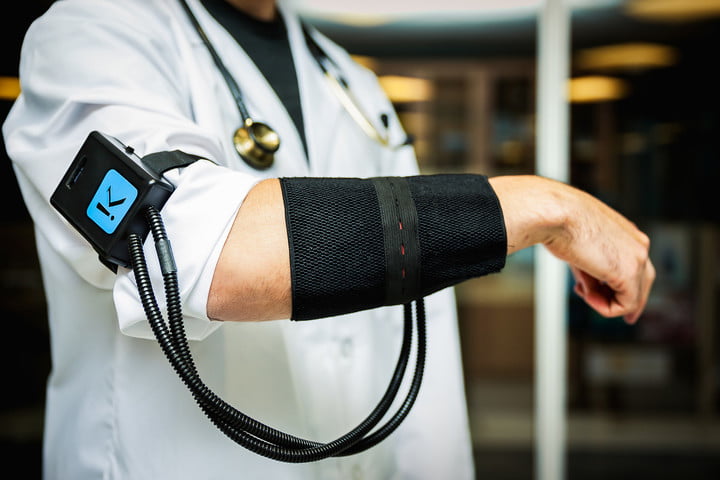
Klick SymPulse™ Tele-Empathy Device
Fossat’s work in tele-empathy began as a project commissioned by a client that wanted its healthcare representatives to better understand the conditions customers were suffering from. The project never went ahead, but he was fascinated by the idea.
“The problem was very interesting,” he remembered. “We thought about it because the research in the lab at the time was very much on the digitization of medical symptoms. The idea of treating a disease as a function, as a mathematical function, that disrupts physiology. So, we sort of went ahead with it and said, ‘Hey, what if we digitized the tremors?’ Not the shake of the tremors, but what if we digitized the muscle activity.”
The result is SymPulse, a device that captures the muscle spasms that cause tremor in someone with Parkinson’s disease, and transmits them to a non-sufferer. Existing devices simulate tremor, but they serve as only a general simulation, and take the form of a large plastic glove with motors to shake your hand. SymPulse provides a more intimate window into the effect the condition has on a specific individual’s life.
“It’s giving you tremor, the fact that the hand is shaking is almost a consequence of that,” Fossat explained. “What it’s really transmitting to the non-patient is the muscle spasms.” The device doesn’t just show someone what it’s like to have Parkinson’s. It recreates what a specific patient is experiencing — in real-time, if necessary.
“We’ve seen it with the subjects we’ve tested, that it transforms them — they realize what it’s actually like,” said Fossat. “In fact, almost everyone that’s tried it — and I’ve tried it on maybe 150 people now — it’s at the end, when you flick the switch off that it truly dawns on them, that the patient doesn’t have that switch. That ability to say, ‘OK, I’m done now, turn it off.’ They don’t have that.”
It’s at the end, when you flick the switch off, that it truly dawns on them — and that the patient doesn’t have that switch.
Empathy can be a very important emotion when you’re caring for someone with a condition such as Parkinson’s. It can be useful for friends and relatives to experience tremor firsthand, of course, but Fossat also told us patients fare better with doctors that have higher levels of empathy. He and his team are currently planning a study that will attempt to quantify how much SymPulse can increase empathy, and for how long.
However, the hardware isn’t good for empathy alone. Fossat wants to help doctors treat patients from across the globe. Rather than simply listening to the description of symptoms over the phone, SymPulse could let them feel the patient’s condition.
“Especially with the cost of the hardware being so modest, or virtually negligible, it makes it much easier to do telemedicine like that,” he added. “You don’t have to send a giant videoconferencing system or an MRI scanner, you could send some kind of Arduino gizmo, and have the patient wear it.”
Much like the work being done by Liftware, Klick has been aided in its research and development by the availability of off-the-shelf hardware that promotes quick-fire prototyping, which Fossat describes as “transformative.” Now that there’s no need to order custom circuits from abroad during the early stages of design, iterative work that would once have taken months, now takes days.
The next step for Klick is getting its hardware properly accredited. There are numerous medical gadgets out there that claim to do great things, but Fossat knows from his experience with doctors that he needs to take a scientific approach if the hardware is going to be put into practice. “We want to make sure that this thing is validated,” he said. “I want to make sure that we validate what we do, and that we have proof and backing for our claims.”
Help Where It’s Needed
There was a time when it took an enormous amount of resources to create a new piece of tech — especially one that performed a function no previous product had. But that has changed over the last decade. Today, it’s much easier to grab a single-board computer, add any necessary external components, and run purpose-written code to produce the intended result.
This means companies like Klick and Liftware can design devices that cater to Parkinson’s sufferers, who make up a relatively small proportion of the global population. Custom technology is more workable than ever before, and that’s sure to help groups of people who can benefit from having hardware crafted to cater to their needs.
“There is a huge opportunity to bring technology and healthcare needs together, particularly for groups that are traditionally underrepresented in consumer technologies such aging populations or people living with disabilities,” Pathak told us. “Technology can help people with certain medical conditions maintain greater independence and improve their quality of life and the more we as technologists can meet their needs, the better off we all are.”
Innovative treatments for Parkinson’s disease are just one example of the growing symbiosis between the technology industry and medicine. In the future, we may see even rarer conditions receive attention from talented engineers and designers. It might not be possible to wipe out a disease like Parkinson’s, but it’s finally possible to find useful, affordable solutions for the people affected by it.
FIFA 18: Release date, what’s new and everything you need to know
FIFA 18 details have been announced and Pocket-lint has had a chance to play an early build of the game for several hours ahead of E3 2017.
This year’s edition has plenty of changes too, with a second year of the Frostbite engine yielding some very impressive graphical results. And many gameplay elements have been rebuilt from the ground up.
So here is everything we know about the game so far, including the new features, official screens, trailers and, importantly, the release date and formats it will be available for.
FIFA 18 release date
FIFA 18 gets a slightly staggered release, depending on whether you have EA Access on Xbox One and/or pre-order the game.
Here are the different release dates for each option:
- 21 September – EA Access members can play the full game from this date
- 26 September – Pre-orders of FIFA 18 Ronaldo Edition and FIFA 18 Icon Edition are available from this date
- 29 September – Full global release date
FIFA 18 formats
FIFA 18 will be available for PS4, Xbox One (plus Scorpio) and PC through Origin.
There is also a FIFA 18 Legacy Edition for PS3 and Xbox 360, although, like last year’s game, it will not feature The Journey.
Please note that the new FIFA game for Switch is not being labelled as FIFA 18 and is likely to be a tweaked experience with a different feature set.
EA Sports
FIFA 18 cover star
FIFA 18’s covers are a case of two Ronaldos. Current FIFA World Player of the Year, Cristiano Ronaldo, is on the front of the Standard Edition. He also stars on his own special Ronaldo Edition box cover.
There is also an Icon Edition, this time featuring a previous Real Madrid star with the same name: Ronaldo Luís Nazário de Lima, known simply as Ronaldo. The three-time FIFA World Player of the Year leads the charge for the all-new, renamed Legends mode as it debuts on PS4 and PC, as well as Xbox One which had the exclusive in previous seasons.
FIFA 18 pre-orders
You can now pre-order FIFA 18 digital download versions from the respective console and PC stores.
Here are links for each of the different versions, on the different platforms:
PS4 (via PlayStation Store)
- FIFA 18 Standard Edition for £59.99
- FIFA 18 Ronaldo Edition for £79.99
- FIFA 18 Icon Edition for £89.99
Xbox One (via Xbox Store)
- FIFA 18 Standard Edition for £59.99
- FIFA 18 Ronaldo Edition for £79.99
- FIFA 18 Icon Edition for £89.99
Note, EA Access members get a discount for each version.
PC (via Origins)
- FIFA 18 Standard Edition for £59.99
- FIFA 18 Ronaldo Edition for £79.99
- FIFA 18 Icon Edition for £89.99
Note, Origin Access members get a discount for each version.
FIFA 18 editions explained, what you get in each
The pre-order versions of each edition come with added bonuses. We’re not sure whether the full release of each will also include additional offerings – we’ll update when we find out more.
EA Sports
FIFA 18 Standard Edition
Pre-order comes with a loan of Cristiano Ronaldo for Ultimate Team plus eight special edition Ultimate Team kits.
FIFA 18 Ronaldo Edition
As well as the same loan of Cristiano Ronaldo for Ultimate Team and eight kits, you also get three-days early access to the game with a pre-order of the Ronaldo Edition.
FIFA 18 Icon Edition
This super-deluxe edition comes with the same benefits as the Ronaldo Edition, however you also get Team of the Week loan player packs and a loan of the legend Ronaldo Nazário for Ultimate Team.
FIFA 18: What’s new?
Based on our play of a substantial early build, there is no doubt that FIFA 18 is a considerable update to last year’s game. The gameplay, graphics and The Journey mode have all been improved or tweaked dramatically.
Here then are the changes we’ve been privy to so far. We haven’t seen anything of the new FIFA Ultimate Team and there is plenty yet to come, including bigger reveals during Gamescom in August, but here are the main new features as we know them currently:
FIFA 18 graphics
FIFA 18 uses the Frostbite engine again, but with additional experience the development team has redesigned the graphics superbly.
There is a new dual-lighting system that creates a more realistic look across the board, from stadiums to players and even the pitch they play on.
Different regions around the world now have realistic lighting too, with sun-drenched South American stadiums having a more yellow-tinted filter, while European locations look greener and darker. Games look more like TV coverage of foreign matches depending on where they take place.
EA Sports
FIFA 18 animation
One of the biggest changes to not only the way the game looks, but how it plays is animation. The entire animation engine has been rebuilt from the ground up and as well as add tonnes more personality to players, they move more fluidly.
Unlike previous games, FIFA 18 now animates players and the ball frame by frame. That means you get less latency between movements of a gamepad and the player responding.
Before, a player had to finish a set animation before responding to your actions. And while that might have still been milliseconds, it made the game feel laggy – one of the biggest complaints FIFA has always had.
Now though, as a player can change direction mid-way through an animation sequence the game feels much more responsive. Players will still need to turn and control the ball, etc, like before, but different players can do so more quickly than others depending on their statistics. You finally feel in complete control over every motion.
FIFA 18 pitch
As well as look more realistic, friction on the pitch has been altered to make the ball travel slower a touch, but much more true-to-life. Passing, therefore, requires more thought and a defter touch.
FIFA 18 crowd
The crowd is another area that has been significantly improved. FIFA 17’s crowd animations look great from afar but get up close and there is a lot of repetition in animation and look.
With FIFA 18, much of the crowd has its own AI, meaning it responds more accurately to action on a pitch. Score a goal, for example, and some members of the crowd surge forward to get closer to the pitch.
EA Sports
FIFA 18 players
As we’ve mentioned about, new animations give players more personality.
Many of the big name players move more like their real-life counterparts – including Cristiano Ronaldo, who provided all-new motion captures.
Plus, different player sizes come into play for the first time. A smaller player, for example, takes more steps when running than a bigger defender. The bigger player might also lurch along a touch in comparison.
There are many more options to the kind of motions a player is capable of, making for much more variety in even standard models.
FIFA 18 dribbling
One of the other tweaks on a player-by-player basis is slow, close dribbling.
The dribbling engine has been overhauled to match individual styles. For example, Messi and Hazard are very different players when on the ball, and FIFA 18 now reflects that.
Slow dribble has now been moved back to the left bumper of the gamepad and better gamers will be able to move their on-field player around more quickly. It adds more skills for FIFA players to master.
FIFA 18 team AI
The in-match artificial intelligence has been improved, giving a more realistic ebb and flow to a game. Players make more intelligent runs, or support the ball carrier, for example. Through balls no longer go askew, depending on the skills of the passer.
FIFA 18 team tactics
The tactics engine has been refined to include new systems that work much more like their real-world counterparts. Tiki Taka, counter attacking, pressing and even long ball tactics each have their own styles and feel. Career mode games against the computer should gain wider variety, therefore.
FIFA 18 substitutions
In-match substitutions are now possible without having to pause the game and enter the menu. Just hit the right bumper and a substitution will be offered while you are playing, with the player to come on in the next dead ball situation.
You can set up you own preferred subs options before games, or let the game recommend the next sub depending on the context when you hit the bumper – if you have an injured player, for instance.
FIFA 18 wondergoals and crossing
Goal attempts and crossing have been tweaked to give a higher possibility to score a spectacular goal.
The default crossing mode is now more curled and flatter than before. FIFA 17’s crosses were too looping so easier for defenders to get to. You should have a better chance of getting a striker onto a cross now, depending on the skill level of the striker and the one making the cross.
Wondergoals can occur as the game has a better understanding of the sport and the context in which a striker finds himself. Volleys are a little easier too, although they have as much chance of flying in as in real life.
FIFA 18 defending
Of course, where attackers have been tweaked to have been chances of scoring, defenders have been tweaked too to stop them.
One change is that there is now a hard tackle option, between a standing and sliding tackle.
FIFA 18 The Journey – Hunter returns
EA Sports is yet to reveal a lot of the new season of The Journey – FIFA 18’s campaign/story mode. However, it did let us in on a few nuggets.
Alex Hunter is subject to a major transfer early in the game, which we suspect is to Real Madrid considering Cristiano Ronaldo’s presence as a player and character in the game.
We think there will be international matches too, considering we saw a South American vista in one of the early shots. Or maybe it refers to the pre-season tour, that was revealed in one of the screengrabs we got a glimpse of.
EA Sports has confirmed that the mode will be bigger this year, with old characters returning and some new ones.
We were told that there will be six distinct chapters this year, with different major goals to complete in each. However, there will be much more personalisation and choices to be made throughout, which will have a big impact on your own experience going forward.
There will also be customisation options for your version of Alex Hunter this year. You can’t change his physical look, but you will be able to choose the clothes he wears, his haircut and even add tattoos to his arms and neck.
Another addition is local multiplayer in The Journey. And there will be other characters you can play with through the story.
 AIVAnet