


Truecaller picks up huge update with Google Duo integration, payment support in India

Truecaller is doubling down in India.
Truecaller has announced that it is teaming up with Google to offer support for Google Duo from within its interface. The tie-in will boost the capabilities of Truecaller’s dialer, which will now offer the ability to make video calls via Google’s messaging client.
With Truecaller boasting over 150 million users just in India, the integration is a win-win for both companies. The integration will go live sometime on both Android and iOS in the coming months, and will be an opt-in feature.

India is Truecaller’s largest market by a significant margin, and the spam call detection service is now launching a series of initiatives aimed specifically at Indian consumers. The company has partnered with ICICI Bank to introduce a peer-to-peer payment solution, allowing its users to send and receive payments from within the app.

Truecaller is relying on ICICI’s Unified Payments Interface (UPI) tech for processing payments, and customers will be able to create a Virtual Payment Address to easily transact from the app. As long as your bank supports UPI, you’ll be able to use Truecaller to send money. As the payments are handled by ICICI, Truecaller won’t be able to access your bank account or credit/debit card information.
Truecaller has also announced that it is partnering with Airtel, the country’s largest carrier, to bring Airtel Truecaller ID to feature phones. The service works even without a data connection, with incoming calls getting screened against Truecaller’s vast database. The customers will then receive a flash SMS with the caller ID information, allowing them to identify spam calls. The service will be rolling out in the month of April to all customers using a feature phone on Airtel’s network.

While Truecaller started out as a filtering app for unwanted calls, it has introduced a dialer and messaging service in recent years. By rolling out payment services at a time when digital payments are on the rise and introducing video calls with a Google tie-in, Truecaller is looking to expand into a mobile platform. There are plenty of standalone apps that offer the same services as Truecaller, but by bundling them into a single app, the company is looking to make itself indispensable in India.
Citroen C3 (2017) review: Bringing back the oh la la
Citroen has been through something of a rough patch. With German cars often being the first choice, the French have been fighting to get back some of the verve and passion that they used to possess.
For Citroen, much of the small car amour found itself directed into DS. The DS3 is a wonderful little car, but its “avant garde” design, sitting alongside the old C3, makes Citroen’s car look rather boring.
Things have changed gear for the new C3, which was announced in late 2016 and will be tearing onto the roads in 2017. It brings passion and style back to this compact hatch. Make no mistake: this is no longer the option for Grandma, unless she’s very cool.
Citroen C3 review: Designed with flair
- AirBumps optional
- Contrast colour roof options
- Gets a crossover makeover
People will joke about small Citroens. There seems to be no way of removing the 2CV or Saxo from public consciousness, but it’s from these hugely popular small car models that the C3 springs, many years later.
Pocket-lint
In terms of design, though, the new C3 owes much the Citroen Cactus. This started life as a concept and became the C4, retaining one of the most distinctive exterior features – the AirBump, to avoid bumps and scratches – a love/hate feature that will divide opinion. On one hand it brings something unique to Citroen’s cars, rather than just another shaped metal panel, but some see this side bumper as rather ugly.
On the new C3, the AirBump is standard for the top level Flair trim level, but it costs nothing to have it removed, if you don’t like the looks. We’d advise against that, because without the AirBump, you take a step back to rather generic looks, from the side at least.
The Flair and Feel models get other exterior options, like the wheel arch extensions, which give this new C3 a rather rugged and urban look. It’s almost like a mini crossover, an SUV-lite sort of look.
Sure, the nose is a little large, opting for a high bonnet, again lending sort-of crossover looks. There’s no gulping grille and Citroen’s recent move to integrate the daytime running lights into the extended sweep of the iconic chevron badge mean things look a little squished, but there’s a cute Fiat 500 essence to the whole thing.
Pocket-lint
The lowest level Touch trim loses some of the features you might want, like body coloured door handles and alloy wheels, so we suspect that many will opt for Feel or Flair; fittingly the Flair looks the best and piles in more options. One of the desirable options, like in the DS3, is a different roof colour: with black, white and red available to let you create something more personal.
This all amounts to a Citroen C3 that’s distinctive on the road and we think it’s got a lot of style, shifting its attention to appeal to younger drivers.
Citroen C3 review: Interior chic
- Leather touch points on some models
- Cloth options for seats
- Ambiance colour options add a lift
The interior of the C3 is a refreshing design take. There’s a fairly heavy use of harder plastics where some models will be pushing soft touch and leather, but it’s nicely arranged. There’s the option for leather touch points on the steering wheel and gearstick (on top models only) and although there are no leather seat options, the cloth finish has a feel that suggests it will keep its shape and style well.
Pocket-lint
There are little details that make a difference however. Bringing some of the exterior colour inside with ambiance packs picks up on the sort of thing we’ve been seeing from Fiat and the red detailing brings a lift to the dash. Then there’s the luggage-style doorhandles, again a throwback to the Cactus which adds in something a little more fun again.
On this Flair level the centre of the dash of the C3 is dominated by the touchscreen interface. This results in the removal of a large number of buttons, leaving only front and rear windscreen heating, hazard lights and central locking. The thing we miss the most is climate controls, which find themselves in the touchscreen system, adding a little more fiddle to something you might use fairly often.
Otherwise we’re happy with the general layout, but we did find the driver’s footwell a little small: the pedals are close together and with a high biting point on the clutch, those with bigger feet might find it needs a little care. That said, there are any number of sports cars that suffer the same problem and it’s never too hard to adjust.
Pocket-lint
Importantly, the interior is comfortable. There’s plenty of elbow space and headroom for driver and passenger, although befitting this segment of car, it’s a little bit of a squeeze in the rear seats. That’s fine for the kids, but bigger rear passengers might knock their head getting in and find knees are a little cramped.
Citroen C3 review: It’s all about a comfortable drive
- Choice of 1.2-litre petrols, or 1.6 diesels
- Manual and automatic options
- Setup for comfort
- Very light steering
The C3 has been setup for comfort on the road too. That almost comes as a relief with so many small cars wanting to position themselves as sporty to appeal to the excitable young driver. Feeling the C3’s suspension soak away rough suburban roads is rather brilliant – there’s no thump like you’ll get with firmer suspension.
Pocket-lint
That’s particularly noticeable at the front, with the front wheels soaking up speed bumps happily, although the rear can come down with a bit of a crash. But coasting over rougher roads leads to a relaxing drive overall. Yes, you will notice the car rocking on hard acceleration and on braking and it’s not the sharpest in the corners, because there’s more body roll.
The manual gearbox is typically French with a long throw that’s not the most precise: we found ourselves failing to get it into reverse about 20 per cent of the time, despite managing to trigger the reversing camera. To us that just adds character and we can’t complain too much – the good thing about the longer throw to the gearstick is that you feel you’re actually driving the car.
The same can’t be said of the steering. It’s exceptionally light which urban drivers will probably like when conducting those tight manoeuvres into small parking spaces, but it does lack feel. This slight detachment is perhaps our biggest criticism of the drive, especially at low speeds.
Pocket-lint
There are a range of engines on offer in the C3, from the rather weedy 68bhp option, up to the most spritely 110bhp turbo. All are based on the same 1.2-litre 3-cylinder engine and there are small diesel options too. The diesels reward you with lower CO2 emissions, but it’s the PureTech 110 paired with the manual gearbox on test here that gives the most power.
It’s not hugely fast on paper – 0-62mph in 9.3 seconds – but the 3-cylinder thrum makes plenty of noise as you put your foot down. This might not be setup to be sporty, but in this configuration there’s at least a satisfying roar when you fire it over 3,000rpm. Some might say that’s a downside, but we can’t help admitting that we enjoyed it and it’s certainly nippy enough in traffic to give you an enjoyable drive.
We found ourselves averaging around 48mpg in mixed driving and we suspect with less urban stop/start and a little more attention to timely gear changes you could push that figure higher.
Pocket-lint
The top Flair model also gets features like automatic headlights and wipers, with convenience features like engaging the rear wiper when reversing in the rain.
Citroen C3 review: A nice tech selection
- Apple AirPlay and Android Auto on higher trim levels
- Standard driving safety features
- Bluetooth and DAB standard
One of the best aspects to the C3 is that you get a range of safety tech as standard. Lane departure, speed warning, sign recognition and cruise control are standard on all models.
Pocket-lint
You get a DAB radio and Bluetooth on all models, too, which is a great convenience – but it’s the inclusion of Apple CarPlay and Android Auto on the Flair and Feel models that really takes advantage of the 6-inch touchscreen system provided. Sat nav isn’t standard, but if you’ve got a smartphone, connecting via the USB socket will bring that function to your car.
As we’ve said, the touchscreen system means there are only four physical buttons (except those on the steering wheel), with the rest being controlled through the display. This is flanked by capacitive buttons for things like music, climate, navigation and phone. There’s an additional area for car settings and finally a rather sparse apps area, which only really offers the option to view photos, if you’ve plugged in a USB with photos on. Why? We’re not sure.
Citroen’s system doesn’t make the best use of the display size at times and there’s a general sense that you’re looking at a lot of unused dark space at times. This system is also a fan of overlays, for example engaging the automatic wipers will overlap a top banner on the display to confirm that.
That’s fair enough, but the worst is the volume control. Like the steering, it feels a little detached from the speaker output. You twist the volume knob and there’s a slight delay before you get the on-screen overlay and the resulting volume line moving on the screen, before the speakers seem to change.
Pocket-lint
There is a six speaker configuration on the Feel and Flair models and they are good enough in general use, but they can’t really handle heavier bass. Throw on Kiss Fresh and turn the volume up and you’ll find those speakers buzzing in the doors with a hard bassline, which isn’t great.
Citroen C3 review: There’s an integrated dashcam
- Smartphones connection needed
- Automatically saves “events”
- Instant sharing option
One of the tech treats that jumps into the new C3 is an integrated dashcam, called the ConnectedCam. This is something we’ve been expecting to see for a number of years and it’s finally here.
Pocket-lint
This dash camera works exactly like third-party cameras, constantly recording as you drive, buffering through the memory and saving clips when it judges that something of note happens by using the integrated motion sensors.
As an integrated unit, control of the camera is through an app on your Android or Apple phone and it’s perhaps surprising that there doesn’t appear to be any access through the car at all – not even an app in that empty space on the central display.
In operation, ConnectedCam is the same as other cameras then. You can generally ignore it until you want something from it, then you can download the video to your phone. That might be because you’ve had an accident and want to prove it wasn’t you, or that you weren’t speeding, and so on. Or it might be because you’ve seen something funny or amazing and want to share the video.
Pocket-lint
The app requires a connection to the camera using Wi-Fi and then you can change some settings on the camera, like setup your social accounts to instantly share photos with a touch of the button on the underside of the camera. Again, this is more for fun, as there’s no way of editing the text you’ll include when you’re driving – it just gets thrown out.
The app can be a little slow, especially when it comes to downloading the video onto your phone. We tested both the iPhone and Android with it and both were slow, suggesting the camera is the thing at fault. A little patience, perhaps, and you’ll get those videos you want.
Verdict
The new Citroen C3 comes as something of a surprise. The number of Citroen models we’ve been less enthusiastic about has outnumbered those that we’ve liked in recent years, but that balance is shifting and this new C3 is typical of the reinvention of Citroen.
Deservedly, this is a great small car, it has character and a lot to like about it. There’s technology, there are interesting design elements, plus it’s a comfortable and fun car to live with and drive.
There’s fierce competition from the cute Fiat 500 through to the better-driving Ford Fiesta, but if you’re looking for a new small hatch, make sure you look at the Citreon C3 as well. Oh la la, you might just be surprised.
Amazing leak shows Samsung Galaxy S8 and Galaxy S8 Plus coming to Carphone Warehouse
Samsung will finally take the wraps off the long-awaited Galaxy S8 and Galaxy S8 Plus tomorrow at an event in New York. When it is shown off, we fully expect mobile networks in the UK to present their best contract deals.
- Samsung Galaxy S8: Release date, rumours and everything you need to know
- Samsung Galaxy S8 Plus: Release date, rumours and everything you need to know
But even with around 24 hours to go until the event, the leaks haven’t stopped. Pocket-lint has been tipped off by Twitter user @Carleaks94, with an exclusive Carphone Warehouse deal that confirms the naming of the phones and what they’ll look like.
The deal is for a free Samsung wireless speaker worth £99.99 with a purchase of either phone, but the most exciting part is that we finally get to see how the phones will look, instead of having to rely on renders.
The image shows the two phones and a look at the front and back of both devices. As has been rumoured on numerous occasions, the Galaxy S8 will come with a screen that takes up the majority of the front side, although we expect them to retain similar dimensions to the Galaxy S7 and S7 Edge. The increase in screen real estate is due to Samsung removing the physical front-mounted home button.
The fingerprint scanner now sits on the back, next to the camera module, something else that has been previously rumoured, and you can just about see it in the Carphone Warehouse image.
While the leak doesn’t give away how much either phone will cost on a contract with the respective mobile networks, we expect them to cost between £750 and £900 SIM-free, depending on which model you go for.
- Samsung Galaxy S8 specs fully revealed
To ensure you get a Samsung Galaxy S8 or S8 Plus on launch day, you can register your interest on Carphone Warehouse’s site now, selecting which model you want to get.
The Morning After: Tuesday, March 28th 2017
Hey, good morning! You look fabulous.
Welcome to Tuesday, and we’re letting an AI influence our tweets, see cell division that looks like the intro to an X-Men movie, and hear about Andy Rubin’s new smartphone. In case you didn’t know, he was the guy behind Android. Not too bad for a Tuesday, unofficially the most average day of the week.
Plug inElon Musk’s latest project is Neuralink

So what’s next for a billionaire after launching rockets and mass producing electric cars? If you’re Elon Musk, the answer apparently is plugging computers into human brains. The Wall Street Journal reports his new venture, Neuralink, is working on “neural lace” technology that could allow us to upload and download our thoughts. We have our speculation about what that could mean for humanity (“I know kung-fu”), but Musk tweeted that a long post about Neuralink is coming to the Wait But Why blog in about a week.
Look carefullyThis is (probably) not CGI

Filmmaker Francis Chee posted a 23-second time-lapse video showing the cell division of a frog egg in stunning detail. According to Chee, he pulled it off with a custom-designed microscope, LEDs and optics, all set on an anti-vibration to capture the process that actually took about 33 hours.
Don’t throw out your hard-drive yetIntel’s ultra-fast 3D storage is ready for your home PC

The good news is that Intel’s speedy (at least 900MB/s in peak sequential reads) Optane storage will be available for home PCs and not just servers. The bad news? With a price tag of $77 for just 32GB, it’s intended for caching, allowing users to get SSD speed without needing to buy a more expensive drive that will hold all of their data. But don’t worry — if the price is no object and compromises are impossible, you can expect larger Optane SSDs to arrive later this year.
TeaseThis is one corner of Andy Rubin’s next smartphone

Andy Rubin already gave you Android and the Sidekick, and now he’s back with another new mobile device. His tweet shows the design features a minimal amount of bezel, but most of the details are still a mystery. The flagship smartphone from his new company Essential Products Inc. is expected to drop in the middle of this year.
How can something this black be green?‘Air-Ink’ uses carbon soot to make ink

Start-up Graviky has created an exhaust filter that can pull 95% of the carbon soot from diesel exhausts, and then transform this into useable, purified, black ink or paint. The resulting ink matches regular sharpies and adds the smugness of knowing you’ve picked a greener option.
But wait, there’s more…
- ‘Wilson’s Heart’: Inside Oculus’ new psychological VR thriller
- What’s on TV: ‘Planet Earth II’ UHD Blu-ray, ‘Legion,’ ‘Walking Dead’ and ‘Review’
- An AI taught me to be a better tweeter
- Fitbit Alta HR review: a successful follow-up
- Bloodhound SSC’s land speed record attempt is delayed again
Amazon’s new Prime perk gets you the best seats in the house
With the weather beginning to brighten up, Amazon’s introducing a new perk for Prime members that aims to get you to down your Kindle, drag yourself off your comfy sofa and venture out to see some live gigs and events. Starting this Thursday, Amazon Tickets — the UK-only service (for now) we’d also kinda forgotten about — will begin offering Prime members early dibs on gig and theatre tickets at least 24 hours before they go on general sale, starting with the upcoming tours of acts including Art Garfunkel and The Darkness. And if you really want to make a night of it, Prime subscribers can also splash their cash to get on the list for Amazon’s premium seating and luxury lounges at various London venues.
These include the fancy new Amazon lounge and Amazon Deck seats (with waiter service, no less) at the O2 arena, as well as the Prime backstage lounge at Wembley’s SSE Arena. There will also be an Amazon Prime Terrace at this year’s British Summer Time Hyde Park festival, with tickets also getting you into the Barclaycard VIP Summer Garden, and other exclusive seating available at more summer festivals such as Live in Chelsea and Kew the Music. It’s a good thing you took advantage of that Prime discount deal when new Top Gear The Grand Tour was first released, then.
Source: Amazon, Amazon Tickets
There are over 770,000 registered drone owners in the US
Over 770,000 drone owners have registered to fly in the US since the FAA made it mandatory in December 2015, Administrator Michael Huerta told drone group AUVSI yesterday. As Recode notes, that’s up from 670,000 at the beginning of the year, meaning 100,000 users have signed up in the last three months alone. The FAA has also issued 37,000 Remote Pilot Certificates that let drone owners do filming, inspection and other commercial operations.
It’s likely that a lot of folks are ignoring the pilot license and registration rules, so it’s hard to say how many drones that are supposed to be registered … aren’t. Nevertheless, there are only 320,000 manned aircraft registered, from ultralights to jumbo jets, and the FAA has been doing that process for 100 years.
And you ain’t seen nothing yet, says the FAA — it expects the hobbyist fleet to more than triple in size from 1.1 million UAVs to 3.55 million, and the number of commercial vehicles to grow tenfold to 442,000 by 2021. Pilot licenses, meanwhile, will jump from 37,000 to 281,300 in five years.
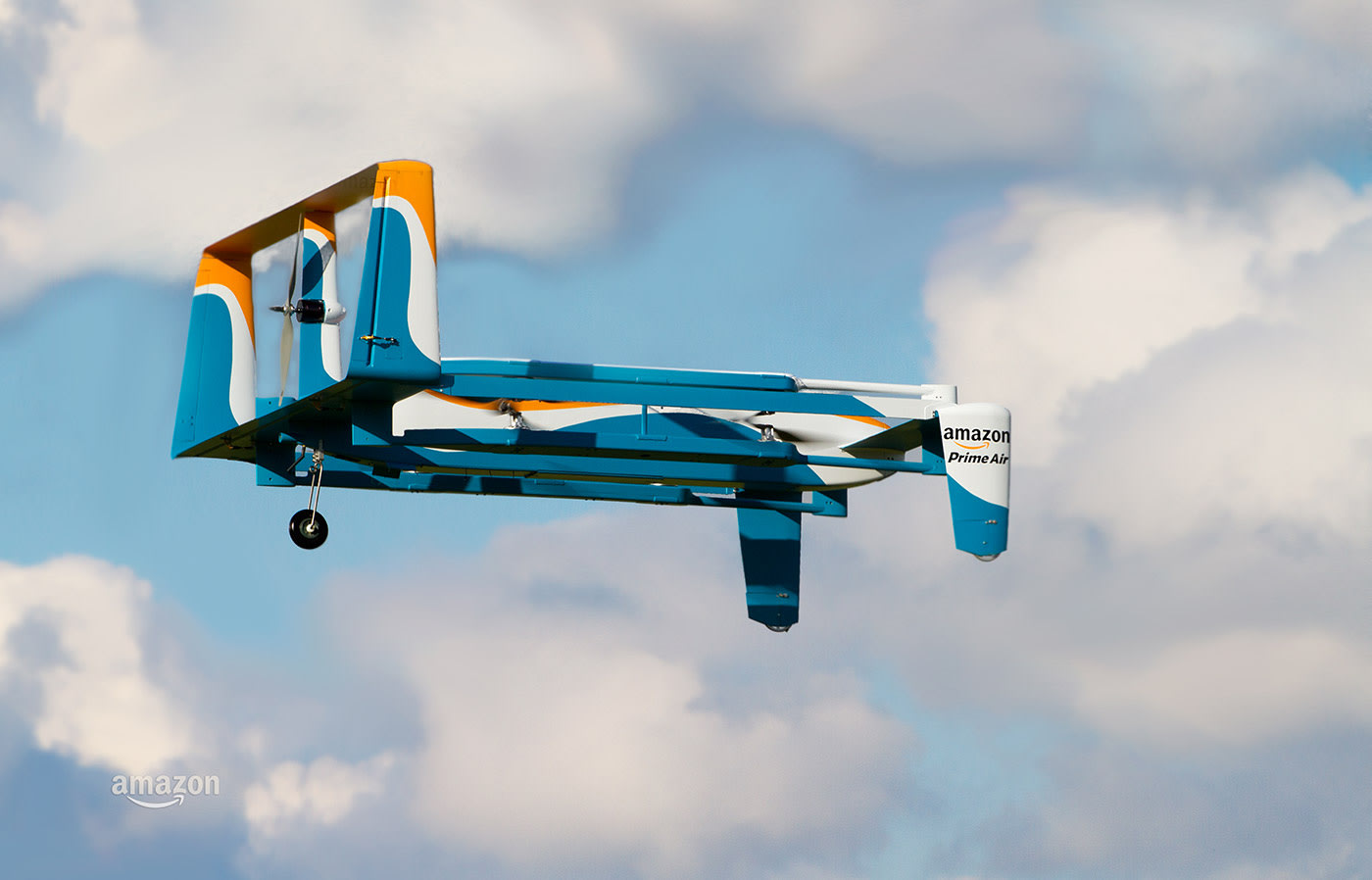
Amazon’s delivery drone
That, Huerta says, is going to make things tricky. “What happens to people on the ground if a drone flying overhead fails,” he asked. “How can we make sure unmanned aircraft don’t gain access to sensitive sites?” To figure that out, the FAA is launching an Aviation Rulemaking Committee, not unlike those that exist for manned aircraft. It’ll include members from aviation, technology, law enforcement and safety communities.
The FAA wants to figure out how to expand drone operations so they can safely operate over people and beyond a pilot’s visual line of sight. To do that, authorities will need to “remotely identify and track unmanned aircraft during operations,” Huerta said. That in turn would allow expanded operations in highly-publicized areas like drone deliveries, autonomous air taxis, and more.
Despite criticism that it’s stifling drone growth with rules, the FAA expects companies, not government to solve most of these problems. “For example, we’re already working with industry to test tools that can detect unauthorized drone operations near airports and other critical infrastructure,” said Huerta. “[The drone industry] is going to do it more quickly and efficiently than the FAA ever could through regulations.”
Via: Recode
Source: FAA
Urbanears built AirPlay and Chromecast into its WiFi speakers
The last time we covered Urbanears, the company was hawking headphones with quilted padding. Now, some six years later it’s getting into the crowded wireless speaker game. Long story short, the Connected Speakers are colorful noise boxes that you can network together for multi-room sound; you can set them to play the same track in sync, or separate ones. Each unit has Airplay, Chromecast and Spotify Connect capabilities built in too, so blasting Papa Roach’s “Last Resort” from every room while you’re trying to argue for an unpopular rule-change at your house should be pretty easy. If you want to kick it old-school beyond your song selection, there’s Bluetooth connectivity and an aux port too.
Their appearance is understated, with a pair of knobs that control playback and speaker mode (single or multi). Everything else, the company says, is handled by an app. The air-movers are available in a handful of colors to match your home including Goldfish Orange, Plant Green, Indigo Blue and Dirty Pink. If you prefer your music loud, but not your decor, Concrete Grey and Vinyl Black are available as well. The bigger Baggen (“ram” in English) model will run $450 each, while the slightly smaller Stammen (“strain” when translated from Swedish) is priced at $350. Both go on sale March 30th.
Vizio’s latest 4K TVs are dirt cheap
Vizio continues to push TV prices down to the point where it would be crazy not to go 4K on your next TV. With its latest D-Series, a 65-inch 4K (Ultra HD) model costs $900, while the 55-inch Ultra HD model is just $570. To be sure, these are not fancy HDR-equipped OLED or quantum dot models, but they do have full-array LED backlighting, built-in WiFi and Vizio’s own smart TV system with built-in apps like Netflix.
TVs this cheap will push more 4K TVs into the mainstream, which will in turn nudge holdout content providers into offering it. While Vizio’s D-Series offers middling panel tech and no Dolby Vision HDR, Google TV or other perks, current owners of basic HD sets will see a big difference in quality. Budget-conscious buyers will also get support for Ultra HD game consoles like Sony’s PlayStation Pro, Ultra HD Blu-ray players and 4K cable or set-top boxes from the likes of Google Fiber and Roku.
Vizio, which was recently bought by troubled LeEco, pushed out some interesting higher-end 4K options last month too, including a 75-inch 4K E-series model with basic HDR for just $2,000. If you really want 4K Dolby Vision HDR without spending too much, you’ll need to go for Vizio’s P-series, with 55-inch sets at $1,000, or switch to TCL, which offers a 50-inch 4K Dolby Vision TV for just $500. For the sake of comparison, Sony’s 55-inch 4K OLED TV costs $5,000, showing the wide gulf between the low- and high-end.
Vizio’s 4K sets are now available at Walmart, Target, Best Buy and other retailers. 4K models run $420 for a 43-inch set, $500 for the 50-inch model, $570 for the 55-inch version and $900 for the top-end 65-inch model.
Facebook adds nearly everything Snapchat does to its main app
Facebook’s quest to mimic Snapchat is undeniable at this point. In just the last few months, Instagram, Whatsapp and Messenger have all integrated some form of Stories — a disappearing slideshow format that Snapchat is famous for — while Facebook Live dabbled in Snapchat-esque selfie filters. Now, after months of experiments and tests, it’s time for the main Facebook app to get in on the action too. Today, the company is officially rolling out three new Snapchat-inspired features to its core app: a brand new in-app camera that’s chockful of filters, effects and masks; Facebook’s very own Stories; and Direct, which lets you share photos and videos with specific people for a set period of time.
As soon as you launch the updated Facebook app, you’ll see the new Stories navigation bar prominently featured at the top. On the far left is a shortcut for Direct sharing, the second bubble is for Your Story (you can tap it to add to it), while the rest are Stories of your closest friends. Each Story interface is almost identical to that of Instagram’s version — you can move back and forth through the slideshow by tapping left or right, and if it’s your own Story, you’ll be able to see the number of views as well as the names of the people who saw it. Additionally, you’ll be able to leave direct replies on other people’s Stories, which then appear on top of the content. The replies only live as long as the content, however, so once the photo is gone, the comment’s gone too.

“We’ve been very text-centric in the past,” says Connor Hayes, a Facebook product manager. “But what we’ve been seeing is that the way people create content is changing, from text to photos and videos. […] We’re trying to upgrade the app to be more centered around the way people are behaving and creating the content in social apps. And that starts with the camera.”
Which explains why the new camera is much easier to access. Before, the fastest way to launch the camera in the Facebook app was to tap “Photos” and then select the camera icon. Now, that camera icon is located to the left of the search field, and is visible the moment you launch the app. Alternately, you can swipe right from the home screen, and that’ll bring up the camera function as well.
The camera interface is completely different from before too. On the left side of the screen are little navigation dots, which correspond to different filters that the app has pre-selected for you. Simply swipe up or down to scroll through them, and you’ll see the filter take effect on the main screen. These pre-selected filters are chosen based on an algorithm that susses out whether you’ll like them, and also on your location. So if you’re in London, you probably won’t see a San Francisco themed filter, for example.

But if none of those filters strike your fancy, no worries, because you can tap an option that will reveal as many as 70 other options (that number will change depending on your region). You can choose anything from selfie masks to Prisma-esque style effects to simple frames. In a brief demo, I saw filters that showed animated pizza slices flying out of my mouth, round glasses superimposed on my face and a “I Miss You” message scrawled in front of me. Other options include a mirroring effect, one that shows a lazy sloth on top of your head, a mustache, a pride rainbow, a glitter beard and even an effect that makes you look like a minion from Despicable Me.
Indeed, Facebook not only partnered with different film studios for licensed content, it also commissioned two artists — Hattie Stewart from the UK and Doug Coupland from Canada — to come up with special artistic filter effects. One of Coupland’s filters, for example, shows concentric colors radiating from your head. Open your mouth, and the circles now form in your mouth and on your forehead.
Kristen Spilman, the director for Art and Animation in charge of the camera effects, says that she hopes these filters help people express themselves. “Our new camera puts visual content at the heart of the Facebook experience,” she says. “While we want our effects to be fun to use, it’s more important that they’re thoughtful and relevant in enhancing relationships.”

What I found particularly intriguing is that Spilman’s small team of effects artists took pains to really make sure that the filters resonate with the local culture. For example, when the team tested visual text filters like “OMG” and “LOL” in Ireland, they found that they weren’t really all that popular. But what did work were more regional examples like “Gas” (which translates to “astonishing”) and “Some Craic” (which means to have a good time).
After you’ve chosen your filter, you can write text on top of it or doodle on it with your choice of brush. Then, you can save it to your camera roll and do nothing with your creation, or you can choose to share it. You can post it to Newsfeed if you want your photo to live on forever, or you can post it to Your Story if you just want it up for the next 24 hours, or you can share it directly with your friends via the new Direct feature. If you do send your photo or video directly, note that your friends will only be able to view it once and replay it once. Once it’s over, it’s gone.
“Stories has become the format for people to create photos and videos and share them with one another immersively across social apps,” says Hayes. “This is something that Snapchat’s really pioneered. Our take is that Stories has become a format for people to share and consume photos and videos across all social apps.” When asked why someone would use Facebook Stories over Instagram Stories or vice versa, Hayes says that different people use the apps differently. “It depends on how they use each app, and who their network is on each app,” he says, pointing out that oftentimes the two have different audiences.
“Over the coming months, we plan to introduce new ways for the Facebook community to create their own frames and effects that can be used on any photo or video created with the new Facebook camera,” said Facebook in a statement. “Our goal is for the camera to be a home to hundreds of dynamic and fun effects that give you new ways to connect with friends, family, and your community.”
Facebook’s new camera, Stories and Direct sharing will be rolling out to all users on both Android and iOS throughout this week.
Questionable Rumor Claims Siri iCloud Integration and Contextual Learning Coming in iOS 11
Siri is set to gain contextual learning abilities and deep integration with iMessage and iCloud in iOS 11, according to an unverified rumor shared by Israeli site The Verifier.
Citing information “received directly from the development teams based in Israel and the U.S.”, the site says Siri’s AI codebase will receive a major update that will enable it to learn a user’s usage habits, similar to abilities claimed by Samsung for its new virtual assistant Bixby.
The upgrade is said to extend Siri’s capabilities beyond its current limited command pool by stacking multiple queries and offering different actions depending on the context. For example, Siri’s integration into iMessage means it will be able to offer suggestions relevant to the ongoing conversation, such as where to dine out, how to get there, and one-step Uber taxi booking.
In addition, the claim is that Siri’s integration with iCloud will enable it to identify meaningful connections between the various devices associated with an Apple ID account and offer practicable actions that crisscross Mac and iOS systems.
Moreover, Apple will embed Siri deeper into the Apple TV and Apple Watch experience, with significant updates to tvOS and watchOS. Advanced Siri abilities are also said to extend to a “smart clock” feature, although no other details were given.
The Verifier does not have an established track record for accurate rumors, making it unclear how reliable the information is, while the iMessage features described above can already be found in published Apple patents. Previously the site said that group FaceTime calls will be introduced in iOS 11, but so far we’ve been unable to corroborate the claim.
Details of what’s in store for iOS 11 have been scant in general, but it is expected to be released with new iPhones in the fall of 2017, while a preview of the new software could come at the Worldwide Developers Conference 2017 held in June.
Related Roundup: iOS 11
Tag: Siri
Discuss this article in our forums
 AIVAnet