


LG Watch Sport vs. Samsung Gear S3: Which should you buy?
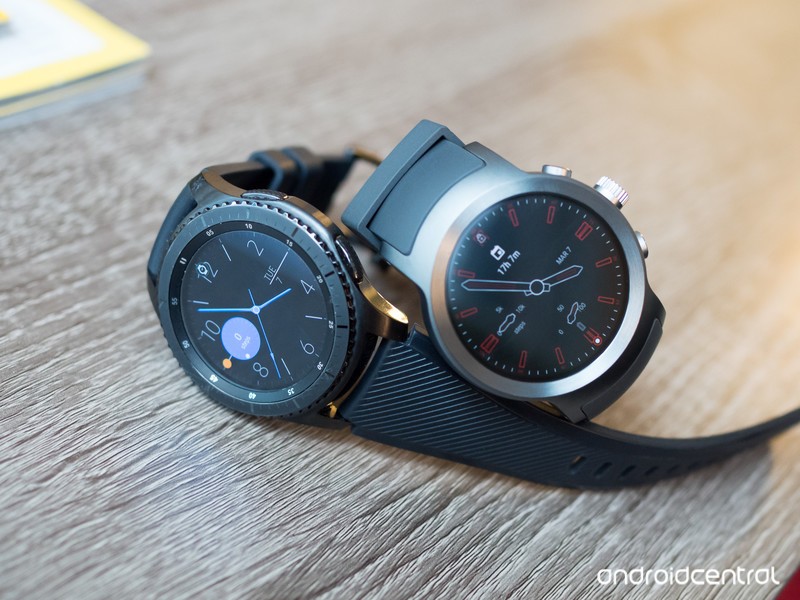
If you’re looking for a smartwatch, chances are these two will be on your radar.
Samsung’s Gear S3 Frontier has been around for a few months, but it’s still fresh in everyone’s mind as Samsung’s top-end wearable offering. Coming in just a tad later, The big and fully featured LG Watch Sport was a launch device for Android Wear 2.0 and matches the Gear S3 in more ways than one.
Both of these smartwatches are big, feature-packed and relatively expensive. So which one should you consider strapping to your wrist? Let us help you decide.
See Gear S3 Frontier at AmazonSee LG Watch Sport at AT&T
Hardware and design
Right from the start, these watches alienate a large portion of the potential market with their size. The LG Watch Sport’s case measures in at a very large 45.4 x 51.2 mm, while the Gear S3 has nearly the same footprint at 46 x 49 mm. The Watch Sport is incredibly thick at 14.2 mm, and the Gear S3 Frontier is 12.9 mm — svelte by comparison, but still large. With dimensions like that, neither of these watches will fit on smaller wrists, and even those with a wrist that can hold such a large watch may not be a fan of the size — the thickness, in particular, can be an issue on either watch when it comes to fitting underneath a sleeve.
Two huge, rugged watches with different overall looks.
The only thing to really differentiate the two is their external styling. The Gear S3 Frontier follows its name well with a rugged design that seems like it’d be at home in the woods or on a trail. Its dark metal exterior, large gnarled bezel and textured buttons give off a masculine look that’s definitely popular nowadays. Despite the “Sport” name, the LG Watch Sport is relatively tame by comparison. Its body is entirely smooth, lightly brushed metal that can fit with a wider variety of clothing but lacks a strong identity.
More: Our complete LG Watch Sport review!
Part of that identity on the Gear S3 is in its very nice rubber bands, which feel better than the LG Watch Sport’s. Further, the lug design on the Gear S3 gives the bands flexibility at their mounting point, which is more comfortable than the integrated bands on the Watch Sport. To complete the trifecta of wins, Samsung’s smartwatch lets you swap out the Gear S3’s bands for any 22mm bands you can find, giving you customization options down the road.
For its size, the LG Watch Sport does manage to give you more screen with a 1.38-inch display compared to the Gear S3’s 1.3-inch. That may not seem like a ton, but extra room is always welcomed on a (relatively) small device — especially when you’re getting it in the basically the same case size as the Gear S3. LG’s display is also higher resolution at 480×480 versus 360×360, though both displays offer automatic brightness and look great.
Software and experience
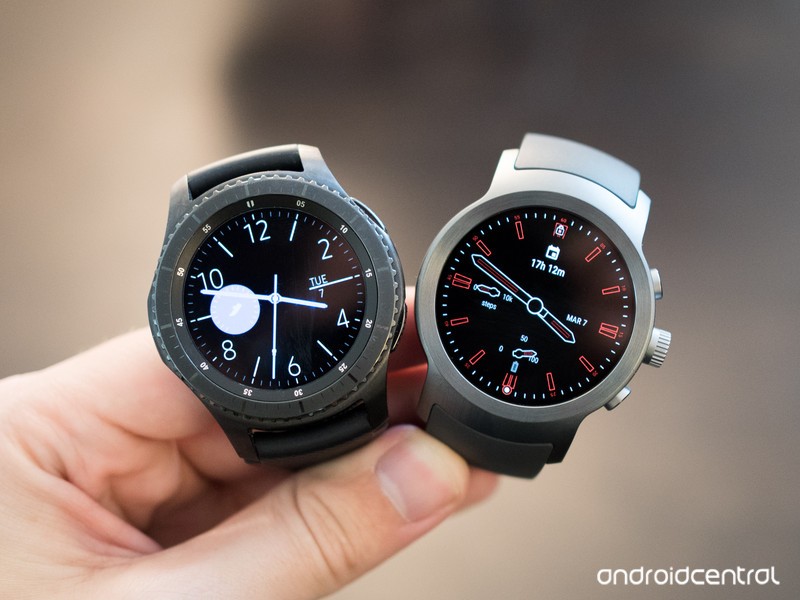
The differences here are bigger than the hardware styling of these two watches — starting, of course, with the different platforms. The LG Watch Sport has Google’s latest Android Wear 2.0 software, while the Gear S3 has Samsung’s own Tizen Wearable OS platform that is a small iteration from what we saw on the Gear S2.
Android Wear 2.0 gets the basics right, and has great watch faces.
Android Wear 2.0 a big step up in usability and functionality from previous iterations, focusing on feature-filled watch faces and manageable notifications. The API-based watch face complication setup on Android Wear 2.0 lets any watch face developer make great-looking dials that also integrate with any app on your watch designed for complications, and notifications are perfectly linked with your phone for a seamless experience. Though it can do more, Android Wear 2.0 really nails these basics.
More: Our complete Samsung Gear S3 review!
Tizen on the Gear S3 can be configured to be simple, but in general requires a bit more interaction with the watch in order to get the same tasks done. Some app notifications don’t play nice with the Gear S3, and while Samsung’s store has many great watch faces (plus the solid default set) it doesn’t have the same catalogue or potential of the Google Play Store. The same goes for installing apps directly on either watch, though both platforms hit the few big names you’d actually want to install on your watch so that’s a basically a wash.
You get all of the core specs and features — now pick a platform to get locked in to.
More important are the built-in features both watches offer — and with hardware this big, it shouldn’t be surprising that you get all of the bells and whistles on both. With either choice you’re getting a capable processor, 4GB of RAM, big battery, GPS, Bluetooth, NFC, IP68 water and dust resistance, heart rate monitoring and optional LTE connectivity. The Gear S3’s rotating bezel matches the LG Watch Sport’s rotating crown for non-touch input, and both give you a great way to get through the software on a daily basis. In my time with both watches the Gear S3 can offer better battery life, somewhere in the realm of 50-75% better than the Watch Sport, but chances are you’ll be charging both nightly anyway.
The only real question here is ecosystem lock-in for two big features: fitness tracking and mobile payments. The Gear S3 has S Health and Samsung Pay, while the LG Watch Sport gives you Google Fit and Android Pay. As far as payments go, the Gear S3 takes the advantage with MST technology that lets you pay anywhere a card can swipe. The fitness point may not be as big of a deal as you’d initially think, as you’ll be able to find big names like Endomondo, Map My Run, MyFitnessPal, Strava, Runtastic, RunKeeper and more (be sure to check compatibility before you choose) but daily tracking is still best handled by S Health and Google Fit.
Bottom line: Very similar smartwatches
The LG Watch Sport and Samsung Gear S3 Frontier have far more in common than you may think considering their different manufacturers and platforms. If you’re considering these watches, you’ve already decided that you can manage their large sizes. You’re also seeing value in a huge list of specs and hardware features that are shared between the two. It just comes down to which one you like the external design of more, and what platform you want to integrate with.
The Gear S3’s dark, rugged design with removable bands may speak to you more than the Watch Sport’s basic look and extra thickness with fixed bands. When you go with Android Wear on the LG Watch Sport, you’re going to see smoother integration with your Android phone and all of Google’s services, while the Gear S3 offers Samsung Pay and has a higher ceiling in terms of watch-only functionality.
Both watches charge the same $349 price and set the bar in many ways for what we want from a smartwatch today. Either one is a great choice if you don’t feel strongly about one platform or the other, so make your pick based on the design and few exclusive features that appeal to you most.
See Gear S3 Frontier at AmazonSee LG Watch Sport at AT&T
Android Wear
- Everything you need to know about Android Wear 2.0
- LG Watch Sport review
- LG Watch Style review
- These watches will get Android Wear 2.0
- Discuss Android Wear in the forums!
Get ready for more ads in Facebook’s Instant Articles
As part of its Journalism Project, Facebook has revealed that it will allow publishers to place more ads in Instant Articles. That will allow sites like the Washington Post and New York Times to eke a bit more money out of posts published directly onto the social network. Instant Articles are good for Facebook, because users stay on the site since they don’t need to click on a link. However, they’re not great for publishers, because you can’t see native ads, discover more articles or check out new videos — all of which help sites keep their doors open.
Facebook now lets publishers place adds every 250 words (about two paragraphs), rather than every 350 words like before. They can either manually choose video or static ads, in which case they keep 100 percent of the money, or use Facebook’s automatic ad placement feature,giving the social network a 30 percent cut.
As mentioned, Facebook’s walled off approach with Instant Articles is vexing to publishers who profit more by keeping users on their site, not Facebook. To address those concerns, Facebook launched the Journalism Project with initiatives like digests of multiple instant articles, helping users discover content from the same publisher. It’s also testing a feature with Germany’s Bild that will allow users to start paid subscriptions from within an Instant Article.
Despite that, website publishers regard Facebook with deep suspicion, since it hurts their business and doesn’t show much concern for journalistic integrity. At the same time, Facebook has become a necessary evil as a way to gain readership and eyeballs — in 2015, it reportedly surpassed Google as the primary driver of referral traffic.
Source: Facebook
Verizon FiOS streaming no longer counts toward your data cap
Since chairman and net neutrality skeptic Ajit Pal dropped an FCC investigation into data-free “zero-rating,” it’s full speed ahead for carriers on unlimited video streaming. Verizon is piling on with its FiOS Mobile App, which now lets you to stream some 140+ channels, recorded DVR shows and movies on the go without impacting your wireless data cap. The new deal applies to FiOS internet and TV subscribers on Verizon’s 5GB, Small, Medium and Large plans.
The app is likely a response to AT&T’s recent wireless plans that let you stream DirecTV Now with no data hit as long as you have both a qualifying mobile and DirecTV Now plan. T-Mobile offers DirecTV and Hulu with no data hit, too, though it has also used the offer to slam rival AT&T.
Verizon recently resurrected its Unlimited plan as well, again following the lead of AT&T and T-Mobile. Interestingly, zero-rated FiOS streaming is not included with the Unlimited plan, according to fine print on the company’s FiOS Mobile App page on iTunes, as spotted by The Verge. Instead, it counts toward the 22GB cap — so if you stream lots of TV and exceed it, your speeds could be throttled.
Verizon already zero-rated its Go90 video streaming app last year, something that perked up the ears of net neutrality advocates. While free video data sounds like a great thing, organizations like the Electronic Frontier Foundation and ACLU believe that by prioritizing their own content over rivals like Netflix, carriers are creating an uneven playing field.
As such, they and other groups wrote the FCC urging it to not eliminate net neutrality rules created in 2015. “In order to promote continued economic, social, and political growth and innovation, it is imperative that the Internet remain open and accessible to all people in the future,” the petition says.
Source: Verizon
Facebook will stream live MLS soccer matches this season
Liga MX isn’t the only pro soccer league you’ll be able to watch on Facebook this season. The social network has signed another deal with Univision to stream at least 22 live Major League Soccer (MLS) matches in 2017. In addition to action on the pitch the league will produce over 40 “Matchday Live” analysis shows that will be exclusively available on Facebook.
Just like with the Liga MX deal that was announced last month, live games will be available on the Univision Deportes page on Facebook. That analysis show will be streamed live on the MLS page. The move also follows reports late last year that the social network was planning to prime its video push with sports and scripted shows. Rumblings surfaced last month that Facebook was “in advanced talks” to stream live Major League Baseball games this year as well.
With soccer season already started in both Mexico and the MLS, Facebook has nabbed rights to select games from the two biggest leagues in North America. Of course, 22 matches doesn’t come close to the full slate of games. Like Twitter did with the NFL and Thursday Night Football, this is much more of a “game of the week” situation. Weekend MLS action is typically available to stream through both Fox Sports Go and WatchESPN, however both of those apps require a cable subscription. The league also has its own streaming option, MLS Live, that’s priced at $80/year or $15/month.
The first match available on Facebook will be Chicago Fire at Atlanta United FC at 4PM ET on Match 18th. A pilot episode of “Matchday Live” debuted on the opening weekend, but there will be a new installment this Saturday, March 11th at 4PM ET.
Via: Wall Street Journal
Source: MLS
Puzzle Game ‘The Witness’ Launches on Mac App Store, iOS Version Still Coming Soon
Jonathan Blow’s console and PC puzzle game The Witness has launched on the Mac App Store a little over a year after first debuting on PS4 and Windows PCs. Like other platforms, the game costs $39.99 [Direct Link] and tasks players with deciphering hundreds of puzzles set on a mysterious island.
Since its release early last year the game has received critical acclaim for its puzzle design, graphics, and secrets-filled backstory. The macOS version ports the same game and experience over to Apple computers running macOS 10.11.6 or later with 4GB of RAM and 5GB available storage space. The game also requires Apple’s new Metal graphics technology to run.
You wake up, alone, on a strange island full of puzzles that will challenge and surprise you.
You don’t remember who you are, and you don’t remember how you got here, but there’s one thing you can do: explore the island in hope of discovering clues, regaining your memory, and somehow finding your way home.
The Witness is a single-player game in an open world with dozens of locations to explore and over 500 puzzles. This game respects you as an intelligent player and it treats your time as precious. There’s no filler; each of those puzzles brings its own new idea into the mix. So, this is a game full of ideas.
An iOS port of the game has long been in development, and a few developers at Thekla — the game’s creators — mentioned in passing recently that the game is still being worked on for iOS, but a launch date is unspecified. Since The Witness is so graphically intensive, the iOS port will require a longer gestation to pare down the visuals in order to run properly on Apple’s smartphones and tablets.
The Witness is available today for $39.99 on the Mac App Store [Direct Link]. A Mac version of the game on Steam is also said to be coming in the next few weeks.
Related Roundup: macOS Sierra
Tags: Mac App Store, The Witness
Discuss this article in our forums
Tesla pledges to fix Australian state’s power woes
Lyndon Rive, co-founder of Solar City and head of Tesla’s energy division, believes that his company could fix an Australian state’s energy woes in just 100 days. Rive was talking to Australia’s Financial Review, claiming that Tesla could build between 100-300MWh of battery storage in that short a time. It’s a bet that his cousin (and boss) Elon Musk was eager to take up, later tweeting that Tesla would do the work for free if it missed that deadline.
The state of South Australia has been gripped by an energy crisis that has seen surging prices and frequent blackouts. The loss of two coal plants in the last few months have caused wholesale prices to peak at the state maximum of $14,000 per MWh. A lack of political will to solve the crisis and no scheme to build renewables means that the state stands on the precipice.
Adding battery storage to the system will, in theory, even out the state’s power supply issues in the short and medium terms. After all, they can be charged up when demand is low and release the energy back during spikes to ensure blackouts aren’t to frequent. Tesla does have previous experience in this space, getting a 80MWh battery plant installed in California in just 90 days. That plant was commissioned after the Aliso Canyon natural gas facility was unexpectedly closed after a massive leak.
@mcannonbrookes Tesla will get the system installed and working 100 days from contract signature or it is free. That serious enough for you?
— Elon Musk (@elonmusk) March 10, 2017
Australian billionaire Michael Cannon-Brookes, the co-founder of Atlassian, decided to contact Musk and Rive to enquire how serious the offer was. Musk responded in the affirmative, and later added that he would offer the system at US$250 per kWh of storage, with the project costing around $25 million in total. Financial Review believes that that’s around half the pre-discount price normally on offer.
@mcannonbrookes $250/kWh at the pack level for 100MWh+ systems. Tesla is moving to fixed and open pricing and terms for all products.
— Elon Musk (@elonmusk) March 10, 2017
Cannon-Brookes subsequently tweeted that he’s working to source the money and political consent to get the system working. The government is ready to “work with companies with serious proposals,” said Australia’s environment and energy minister Josh Frudenberg to Reuters. Tesla’s offer is being taken seriously, although it remains to be seen if the Australian government can get things moving within the seven-day deadline. That may not matter to Musk, who once again comes off looking like the great savior of the moribund energy infrastructure industry.
Via: Mashable
Source: Financial Review, (2), Reuters
Harmonix and Hasbro’s new card game mashes up hit music
The heyday of music games may have passed, but that hasn’t stopped Harmonix from experimenting with new ways for you to experience your favorite tunes. Sure, there’s a new Rock Band coming to VR, but for those who prefer something more a bit more old school, the company’s developing a new card game with toy company Hasbro. Dropmix is a music-mixing game about outscoring your opponent, building an awesome song collection and creating the dopest beats.
When you open the box, Dropmix doesn’t seem too different from other party games. There’s a board and a deck of cards. But the board is no mere piece of cardboard decorated with pretty pictures: It connects to your phone or tablet via Bluetooth and reads the NFC chips embedded in each card as you lay them down during a session. Each card represents a different song, like Carly Rae Jepsen’s “Call Me Maybe” or Childish Gambino’s “Heartbeat.”
While Dropmix has a free play mode where you can just mix and match songs to see what the app will come up with (it always sounds good), the game aspect is quite entertaining in its own right. The players take turns laying cards down on the board, matching them by color. Each card only plays a certain section of the song, so Ed Sheeran’s “Sing” will only play the vocals while Meghan Trainor’s “All About That Bass” focuses on, well, you know. To push an opponent’s card off the board, the hand you play needs to have a higher point value, as indicated by the volume graphic in the top left corner of each card. There are some special cards with more multiple abilities, ignoring the basic rules and sometimes even taking over the entire song.

Although the board itself may not have fancy decoration on it, the cards are absolutely gorgeous. The front contains a wealth of information, including a point value and what section of the song it represents (bass, beat, loop or vocals). But the centerpiece is the original illustration, eye-catching enough to make the cards highly desirable as collector’s items. They’re nice enough that I found myself just staring at them while playing, and I’m excited to see the whole set when it’s available.
This attention to card design isn’t surprising when you consider that Hasbro also owns Wizards of the Coast. That company created the highly influential collectible card game Magic the Gathering, known for its beautiful artwork. But it’s the interesting and addictive game mechanics that will ultimately keep this new game going.
I was never really into collectible card games as a kid, but Hasbro and Harmonix may have finally found a hook that snags the kind of people who probably have a large collection of game soundtracks on vinyl. The basic Dropmix set will include the board and a set of 60 cards across multiple genres, and it will cost $100 when it launches in September. But, just as with Rock Band, more songs will become available throughout the year, with genre-based “Playlist Packs” going for $15 each while randomly assorted “Discover Packs” will cost $5.
ICYMI: Airbus and Italdesign exhibit a Pop.Up future

Today on In Case You Missed It: Airbus and Italdesign demoed yet another flying car concept at the Geneva Auto Show this week. Dubbed “Pop.Up” the modular and autonomous vehicle can transform from a four-wheeled car to a quadcopter, depending on your destination and habits. The Pop.Up system uses an AI to determine which form will result in the most efficient travel method, and will then attach itself to air or ground pod modules to get you there. While the broader idea is to produce a fleet of Pop.Up’s that can be summoned at will by users, the concept faces some significant challenges in actual development such as battery technology and legal regulations.
Meanwhile, Italian artist Norma Jeane and the engineers at Codame have introduced a robot with an unusual mission to the Sonoran desert. The ShyBot’s only objective is to stay as far away from human beings as possible, at all times. For six days, the six-wheeled bot roamed the Coachella Valley area and was able to successfully avoid everyone — even the drones being used to track the experiment. GPS technology was used to track ShyBot in real time, and a camera on it transmitted its point of view to a San Francisco art gallery.
As always, please share any interesting tech or science videos you find by using the #ICYMI hashtag on Twitter for @mskerryd.
Apple Tops ‘Tech Support Showdown’ List for Third Consecutive Year
Apple has topped Laptop Mag’s Tech Support Showdown list for the third year in a row, receiving praise as “the best tech support in the business,” and beating out nine other computer-making companies in the process. Laptop Mag said that its list is aimed at helping customers see who has the most reliable and clear customer service in the tech industry.
To conduct the research, the magazine sent reporters undercover to make calls, query support chat online, and ask questions on social media, and accumulated data on the following top ten notebook makers: Apple, Microsoft, Acer, Razer, Dell, Lenovo, HP, Asus, Samsung, and MSI. Each company was given a grade on a 100-point scale, and Laptop Mag weighted 60 points towards online support and 40 points toward phone support.
For Apple’s winning spot, the company received a 56 for its web support score and a 37 for its phone support score, resulting in an overall mark of 93 for the Cupertino company’s tech support in 2017.
Laptop Mag went more in-depth about its experience with Apple support in various forms, discussing a six minute response time from the @AppleSupport Twitter account and a positive, snappy experience with the new Apple Support iOS app. The site also put Apple to the test by calling three separate customer service reps to test their knowledge of the newest changes to macOS and the Touch Bar on the MacBook Pro.
Call 1: Hayley then instructed me to disable iCloud Drive, and explained how to keep a local copy of the files. During the 2 minutes it took to download the files, I chatted with Hayley about the weather down in Florida, as he was positive and easy to talk to.
At the end of our chat, I asked if there was some way to turn iCloud Desktop and Documents off without disabling iCloud Drive. Hayley said there was not, which is, unfortunately, not the case. The call took 8 minutes in total.
Call 2: My next call connected me to Frank in Oregon, who explained that the physical fn key makes the Touch Bar show the Function keys. Frank also showed me how to set specific apps to use the Function keys in the Touch Bar, and he needed to place me on hold to ask colleagues if I could do the same for Finder.
After telling me that there was no such option, Frank directed me to a feedback page where I could ask Apple to add this option in a future version. In total, the call took 15 minutes, but Frank solved my main question in only 3 minutes.
Call 3: My last call connected me with the upbeat and chipper Letasha, who showed me the icon in the dock and menu bar that you click to activate Siri. Before we concluded, Letasha explained how to change the keyboard command used to start Siri. The call lasted 7 minutes.
On average, it took Apple’s reps 6 minutes per call to get answers — a minute less than its time last year.
Ultimately, Laptop Mag noted that while the customer service reps might have a few spots of incorrect knowledge about Apple’s software and hardware, they still “provided solutions in a speedy and positive manner.” While Apple’s web score was unrivaled at 56, the company’s phone score of 37 was beat out by Acer at 38 points. In total, Acer came in second with a total score of 88 points, making it the “top-rated Windows PC vendor for support” and gaining ground on Apple’s number one spot.
If Apple wants to improve its support, it should ensure support techs learn about all of the new features so that they can give completely accurate answers to questions on topics such as iCloud Documents. Its Twitter account could also improve by providing answers directly, instead of linking to posts where the content is found. Overall, though, Apple offers the best support of any laptop manufacturer, as it has for many years.
Last November, Apple won the “Gold” #Customer award for its helpful responses from @AppleSupport on Twitter. According to Twitter, Apple ranked #1 among support accounts for average engagements and average engagements for followers, racking up 150,000 likes and retweets since its launch in March 2016.
On Twitter, users can ask Apple questions between 5:00 a.m. and 8:00 p.m. Pacific Time, and the company’s support team normally responds within a few minutes. Although Laptop Mag said that it didn’t award Apple “any points for finally creating a Twitter support account,” the site noted that it’s one of the best parts of Apple’s expansive customer support system and it applauded “the team running that account for the timely, helpful replies.”
Check out Laptop Mag’s full report on Apple’s customer service performance right here.
Tag: Apple Support
Discuss this article in our forums
Google’s Jamboard to begin competing with Microsoft’s Surface Hub in May
Why it matters to you
You’ll have another option in enterprise collaborative whiteboards when Google ships its Jamboard in May 2017.
Microsoft’s Surface Hub collaborative whiteboard has been available for purchase since July 2015, with 55-inch and 80-inch models actually shipping in March 2016. The Surface Hub has sold more units than Microsoft expected, and Google decided to jump into that market with its own whimsically named Jamboard announced in October 2016.
The Jamboard was expected to cost $6,000 for a 55-inch model when it shipped sometime in 2017. Today, Google announced at its Google Cloud Next ’17 event that the Jamboard will arrive in May 2017, and will actually be priced at $5,000, as Engadget reports.
More: Google’s Jamboard is a connected, collaborative whiteboard for enterprise
Google’s whiteboard uses a 55-inch display at 4K (4,096 X 2,160) resolution, with a soft-touch plastic touchscreen panel capable of picking up 16 touch points at once with support for an optional Bluetooth rubber-tipped stylus. That’s a higher resolution than the 55-inch Surface Hub’s Full HD (1,920 x 1,080), but Microsoft’s product supports 100 touch point at a time.
The Jamboard connects via HDMI and sports a built-in camera, speakers, and wheeled custom stand for customers who don’t opt to mount the whiteboard. Google has also packed in Chromecast support, meaning the Jamboard can easily mirror a remote device’s screen or stream content from YouTube, Netflix, and other Chromecast-enabled apps and services.
Android is at the heart of the Jamboard, although it’s a highly customized version that’s been optimized for the whiteboard’s large display and collaborative features. Add-on functionality includes “jam session” whiteboard spaces allowing users to sketch, draw, type, and scribble with handwriting recognition on or off. Images can be imported, a miniature web browser is available, and Jamboards can connect and communicate to enable multiple users to sketch from multiple locations.
Of course, collaboration is at the heart of the Jamboard. Google Hangouts provides chat capabilities, and iOS and Android apps let coworkers view sessions as well as add photos, drawings, and sticky notes. The G Suite productivity apps area also integrated.
With cloud services growing by leaps and bounds, and organizations obviously attracted to digital whiteboard solutions that allow teams to work together across global distances, whiteboard solutions like the Jamboard and Microsoft’s Surface Hub are becoming popular. Now, Google will be able to take Microsoft on directly in this increasingly lucrative space.

