


Bioware: Expect ‘Mass Effect: Andromeda’ support info Tuesday
The latest installment of Mass Effect is here, but so far, Andromeda doesn’t look like it’s a high point for the series. A Metacritic score in the 70s puts it well below earlier games that all rate in the 90s, as concerns have been raised over facial animations, squad combat, game-breaking glitches, character romance options and more. Tonight, Bioware tweeted a message from the team behind the game, confirming that feedback is “an important part of our ongoing support of the game,” and promised to share its “immediate” plans on Tuesday, April 4th.
A message from the @masseffect Andromeda team: pic.twitter.com/PRyeZFBzmT
— BioWare (@bioware) March 30, 2017
There aren’t any details yet regarding exactly what will be addressed, but Bioware says developers are”listening, working around the clock to gather information and plan out solutions to improve and build on Mass Effect: Andromeda.” The game’s lead designer also tweeted about various issues the team is working on for upcoming patches but hasn’t provided a timeframe.
This all feels like deja vu after the disappointing launch and subsequent patching process for No Man’s Sky, but with a bigger budget game. We’ll check back on Tuesday to hear about the incoming fixes, but with options like Horizon Zero Dawn and Zelda out there, it’s hard to know if players will wait around to see the game we were expecting and hoping for.
Source: Bioware (Twitter)
Latest Tesla patch enables Autosteer at 90 mph for HW2 models
The new Autopilot features have been lurking in Tesla’s latest electric vehicles for a few months and now they’re ready to go live. For HW2 vehicles we’re talking things like the Lane Departure Warning system, Autosteer at much higher speeds (90mph versus the previous 55mph), Auto Lane Change and the Summon feature. Auto Lane Change, as you might expect, will swap lanes after you activate the turn signal while in Autopilot. Summon is pretty self-explanatory as well, activating a self-parking-and-retrieval system that you can control via the Tesla mobile app or your key fob. The newer HW2 vehicles (produced after October 18th, 2016) rolled off the assembly line with better sensors and cameras, but this new patch brings the functionality up to par with the older HW1 models.
If you just downloaded V8.1, tap the the T on center screen three times
— Elon Musk (@elonmusk) March 29, 2017
Both HW2 and HW1 Model X have few new features as well, like the ability to lower the height of its Falcon doors (for parking in cramped quarters) and more adjustment for the middle-row seat. In terms of creature comforts for both the HW1 and HW2 vehicles the onboard Maps app will display more info about businesses including operating hours, address and phone number. Headrests can be adjusted now as well, and the vehicle will curate a radio station based on what you’ve listened to and given the old thumbs up to.
The 8.1 update is rolling out domestically today, with worldwide availability coming throughout the week. With this patch and the features that preceded it, we’re seeing the steps Tesla is making toward delivering truly autonomous driving.
And being the nerd that CEO Elon Musk is, he hasn’t been able to keep the existence of another Easter egg to himself. As Electrek reports, tapping the T in the center screen three times will open up a sketchpad. Handy!
Motion-tracking projector puts a laser show on moving faces
The combination of face-mapping and video projections makes for a trippy experience. The technology transforms the human face into a canvas for digital art. When a bright red lightning bolt appeared on Lady Gaga’s face during her David Bowie tribute at the Grammys last year, the projection mapping technique went from niche studios to a mainstream audience. Now, the studio behind that performance has dropped a visual experiment called Inori to demonstrate the pace and precision of a new system.
Nobumichi Asai, creative director of a Japanese visual studio called WOW, is a new media artist who is known for experimenting with face-mapping and video projections. A couple of years ago, he created Omote and projected virtual makeup onto a model’s face. As the video gained momentum on the internet, he was brought in to repeat the task for Lady Gaga’s David Bowie tribute. What made the performance unique was that instead of using the projection system in a controlled studio environment, Gaga’s face was mapped and transformed live in front of a massive audience for the first time last year.
To create Inori (which literally translates to “prayer” in Japanese), Asai’s studio worked with TOKYO, an award-winning production company in Japan. The collaborators brought in a special high speed projector built by Ishikawa Wantanbe laboratory at the University of Tokyo to create a system that could keep up with a fast-paced dance performance.
To highlight the speed and artistic capabilities of the projection system, the collaborators roped in AyaBambi, a renowned Japanese dance duo that toured with Madonna and posed for Alexander Wang. The technical crew combined the performance of the projector, which runs at 1,000 frames per second, with 3D mapping for depth measurement and 2D tracking that has less than ten milliseconds delay to match the face and hand movements of AyaBambi’s performance.
While conventional projection mapping systems struggle to keep up with basic movements, the system built for Inori not only keeps up with complex dance movements but also opens up a world of visual possibilities for performance art.
Via: Prosthetic Knowledge
Apple Music Beats Spotify in Monthly Unique Users Thanks to 3-Month Free Trial
Apple Music doesn’t have the highest number of paid subscribers compared to Spotify, but it does have an edge up on its competitors — a higher number of monthly unique users on mobile devices, thanks to its generous three-month free trial.
According to a recent report published by mobile analytics firm Verto (via TechCrunch), Apple Music had 40.7 million unique monthly mobile users during February of 2017. Verto only tracks Apple Music usage on mobile devices, so Apple’s unique monthly user number could be higher.
Comparatively, streaming radio service Pandora had 32.6 million unique monthly users during February, while Spotify had 30.4 million. iHeartRadio saw the fourth highest number of monthly visitors on mobile at 28.5 million, while SoundCloud came in fifth with 25.7 million. For Spotify, Pandora, iHeart Radio, and SoundCloud, mobile and PC visits are counted.
According to Verto, which gathers its data from 20,000 users in the UK and US and then pairs it with analytics information, Apple Music has the most monthly unique users due to the three-month free trial the company offers, which doubles the number of people that are using the Apple Music app in the United States.
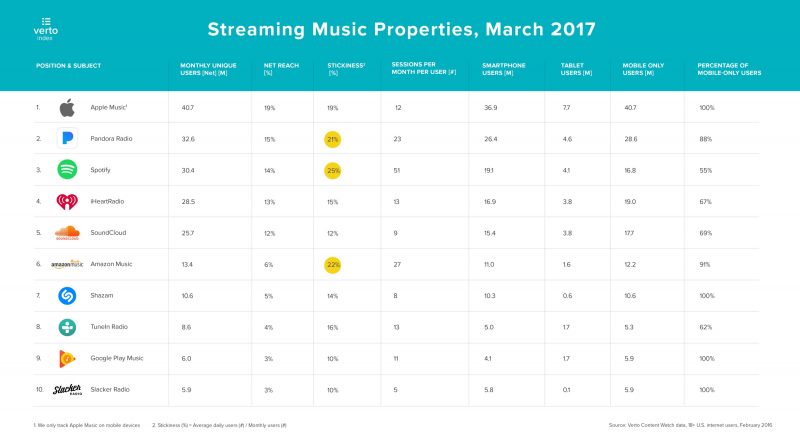 Click to enlarge
Apple has long offered three months of free music streaming when a user first signs up for Apple Music, two months longer than the trial period offered by Spotify.
As of December 2016, Apple Music has more than 20 million paid subscribers, a number that’s been growing steadily since the service launched in 2015. Spotify, meanwhile, reached 50 million paying subscribers earlier this month.
Despite its lead over Apple Music, Spotify is taking cues from Apple. Earlier today, Spotify announced plans to debut an original show called “Traffic Jams,” a copy of the “Carpool Karaoke” show Apple plans to launch on Apple Music.
Similar to Carpool Karaoke, in which celebrities and musicians will sing hit songs while in a car, Traffic Jams pairs well-known hip-hop producers and rappers, challenging them to produce a track in the backseat of a car.
Tag: Apple Music
Discuss this article in our forums
15 great websites for free audiobooks
Audiobooks can bring together the best of both worlds: The joys of a good story and the convenience of easy listening. They also often serve as a great way to pass time whether you’re cooking up your favorite dish or out for a long drive. While audiobooks may lack the feel and sweet smell of a traditional book, a well done voiceover can do more than make up for the loss of aesthetics. It can be an engaging ride that is both worthwhile and convenient on-the-go. Unfortunately, beaming books into your ears can be pricier than you might expect.
Related: Here are 100 of the best free books for Kindle (and other ebook stores)
For instance, an audio copy of Paula Hawkin’s best-selling novel The Girl on the Train will cost you a whopping $21 on iTunes. Even literary classics such as The Great Gatsby, Huckleberry Finn, and The Hobbit can be rather expensive when not on promotion. Luckily, the internet has a opened the door to a virtual library of audiobooks if you don’t mind forgoing top-notch narrations and sticking mainly with the classics. That said, here are our picks for the best websites for free audiobooks.
Open Culture, Project Gutenberg, Thought Audio, Lit2Go, and Podiobooks
Open Culture

Open Culture is one of the better gateway websites for educational and cultural media. The site compiles content from around the Web and has an admirable collection of audiobooks — primarily classics — that you can stream over the Web or download on a variety of audio formats for later consumption. The audiobooks are organized by genre (fiction and literature, nonfiction and poetry) and alphabetically listed by the author’s last name.
Project Gutenberg

Project Gutenberg houses one of the largest and oldest collections of audiobooks on the Web. The site’s audiobooks project — a collaboration with fellow pioneers LibriVox and AudioBooksForFree — breaks down its extensive collection of books by human and computer-generated narration. From there you can browse books lists by author’s last name, title, and language. However, we suggest avoiding computer-generated narrations if possible. No one should have to listen to Jack London’s Call of the Wild read by an incompetent Siri knockoff.
Thought Audio

Thought Audio works sort of like a podcast or Spotify in that the books only stream online. However, the company offers a “Zip Pass” that will essentially allow you to listen to offline downloads for $10 a year. The site’s selection and navigation are pretty similar to the other places on the list, offering everything from Franz Kafka’s The Metamorphosis to the works of Jules Verne and Charles Dickens, all of which are accessible through three separate pages or via the site’s routine newsletter. There’s no intuitive search function though, and each audiobook is broken up into multiple segments opposed to a single audio file for easy consumption and streaming.
Lit2Go

Lit2Go offers one of the finer looking free websites for audiobooks. The throwback site, run by Florida’s Educational Technology Clearinghouse, contains a comprehensive collection of downloadable short stories and poems that you can browse by author, title, genre, collection, and even reading level (grades K through 12). The bulk of the audiobooks can be downloaded as a single MP3 or as short, segmented passages of specific chapters. The homepage search option is also a nice touch, as is the black-and-white artwork that accompanies each title and book collection. Our personal favorites? We’re going to have to go with Proto-feminist Literature or Autumn in Verse — after all, nothing does inspire classic poetry quite like the turning of the seasons.
Podiobooks

Podiobooks showcases some of the best, off-the-beaten-path audiobooks the Internet has to offer, many of which are even modern. The site distributes serialized audiobooks via RSS; just click on any of the audiobook links to begin streaming or downloading the narration. Although the collection is rather limited, you can browse the book selection by contributing author, genre, award-winning collections, new releases, and title. The site also allows you to donate to your favorite author directly if you feel so inclined, whether his or her book falls under the “Hard-Boiled” or “Urban Fantasy” selection.
Free Classic Audio Books, LibriVox, Loyal Books, Storynory, and Librophile
Free Classic Audio Books

Free Classic Audio Books is pretty self explanatory. The basic site offers free recordings of Treasure Island, Emma and The King James Bible. The site itself is a bit difficult to browse, but as long as don’t mind sticking with the most popular titles or know exactly what you’re looking for, you can navigate it rather quickly. Everything available on the site is absolutely free, too, and can be downloaded as either an MP3 or M4B for listening on a variety of devices. As the apt title might imply, though, it’s not the site for listening to anything newer than Huckleberry Finn.
LibriVox

LibriVox asks volunteers to record different chapters or sections of books. As you might expect, this can make listening to a novel either more interesting or simply awful depending on the voice at hand. Thankfully, you can search book selections by “solo” if you prefer hearing a single voice the whole time, not to mention by author, title, genre, or even language (English, French, Balinese, Old Norse, etc.). The site claims it will accept any reader speaking in any language as long as they can be understood, but given there’s no audition process, people can pretty much submit whatever and whenever they want. The unique features opens the site up to a wealth of diverse content, but again, the narrations can be hit or miss. I guess voice actors need to start somewhere, though.
Loyal Books

Formally known as Books Should Be Free, Loyal Books is a family-friendly website that caters to the classic literature devotee. The site offers a nice collection of public domain novels and short stories in multiple languages, available in both Mp3 and MP4 format in addition to a podcast and an RSS feed. You can also stream book chapters online and browse titles by genre, language, and popularity, or search for specific books using the integrated Google search bar at the top of the page. Plus, most books offer ratings and reviews from fellow listeners, thus giving you a slightly better idea of what to expect before you hit the play button.
Storynory

There just isn’t always time for bedtime stories — no matter how amazing a parent you are. Thankfully, Storynory provides a solution for those who simply can’t find the time to read to their kids, offering a collection of original and classic fairy tales and short novels specifically tailored for children. The site currently only offers a couple hundred audiobooks to choose from, but it is steadily growing as it routinely publishes at least one new story each week. Storynory also touts some of the most exuberant narrators around, and given each story utilizes an HTML 5 player for playback purposes, you can listen to the audiobooks on nearly any smartphone, tablet, or browser available. The occasional story competitions only further encourage listening and creativity on behalf of your children.
Librophile

Librophile is another free alternative for accessing classic audiobooks. The site’s minimalistic design, clean layout, and bookshelf-like appearance make it easy to navigate through the vast array of titles by popularity, release date, and genre. Want to listen to James Joyce’s Ulysses or the inspiration for the longest running musical on Broadway? Not a problem. You can stream chapters right on the site or download entire novels for offline use with more than 500 different MP3 players. You can even subscribe to the site via iTunes, or save titles for quick reference if you don’t mind forking over your Facebook credentials.
Learn Out Loud, Miette’s Bedtime Story Podcast, BookRix and more
Learn Out Loud

Learn Out Loud is a hybrid audiobook library of sorts. The site features an enormous collection of audiobooks — more than 30,000 and counting — but they’re not all free. However, if you click the Free Stuff tab at the top of the homepage, you can access a fairly extensive collection of free audiobooks. From there you can browse by genre, popularity, and audio format. The site also continually spotlights the free audiobook of the month in the left-hand column, while offering a noteworthy selection of foreign language courses and video documentaries.
Miette’s Bedtime Story Podcast

Who doesn’t want to be soothed to sleep by the sultry sounds of a woman’s voice? Miette’s Bedtime Story Podcast is a collection of famous short stories read by Miette, a mysterious woman with an enthralling way of speaking. Every once in a while a guest vocalist will read a story or two but the real draw is Miette. She will bring whole new meaning to Faulkner’s A Rose for Emily because she forces the listener to pay attention to every word in a way most narrators only dream of. Moreover, you can browse audiobooks based on their author, recording date, or comment popularity. Sadly, commentators aren’t always the nicest group of folks on the Web.
Literal Systems

Literal Systems — formerly known as Verkaro — may not offer a huge variety of books, but it also doubles as an excellent fundraising platform designed to benefit a small community in Santa Fe. Moreover, the barebones site features a host of original stories and voicework, all of which features local talent. Each audiobook, whether you’re downloading classic novels like Nathaniel Hawthorne’s The Scarlet Letter or the complete poetry works of Rudyard Kipling, is available for download as an MP3, or listenable using an embedded YouTube compilation. There isn’t much in the way of content — in fact, the site only houses 50 audiobooks or so — but the quality is top-notch and everything can be found under the Contents section located on the side menu.
BookRix

If you’re tired of the classics and you’re looking for something new and different, BookRix may be able to help you out. The site serves a platform for independent writers to publish their work for free, allowing for a multitude of both written and audio content that doesn’t always fit the “classic” bill. It’s an extensive collection, too, one that features thousands upon thousands of pages worth of novels. You can filter search results based factors such as genre or popularity, or simply search for a specified writer. The active user community and comment threads are BookRix’s biggest assets, though, provide you with a method of engagement that goes beyond simple listening.
Your public library

We never said you had to actually go to your public library to pick up an audiobook — heaven forbid! Most public library systems now have extensive online databases where you can stream and download audiobooks completely free with or without using your library card. Although the browsing method and audiobook availability will vary from county to county, most public libraries typically offer more recent audiobooks that have yet to enter public domain. Search your local listings or head on over to publiclibraries.com to find your county library.
Samsung is upping its emoji game with 646 new icons for the Galaxy S8
Why it matters to you
If you send more emoji than words, good news: The Galaxy S8 packs 646 new ones.

A new artificial intelligence-powered assistant, an edge-to-edge screen, and a powerful camera are not the only new features Samsung’s Galaxy S8 is packing. It also comes with a host of new emoji. Hundreds, to be exact.
The 646 new emoji are courtesy of Android 7.0, the newest version of Google’s mobile operating system. Last year, the search giant announced support for Emoji 4.0 in Nougat, but the Galaxy S8 and Galaxy S8 Plus are the first phones to ship with them enabled by default.
More: Apple and Microsoft put the kibosh on a proposed rifle emoji
The pack that includes a female equivalent for every male emoji, and skin color you can swap in the keyboard app.

New characters are joining the fray, too. There is a giraffe, broccoli, a pretzel, and chopsticks, plus a scientist, judge, pilot, teacher, a laptop-wielding technologist, and a boy with bunny ears. Exclusive to the Galaxy S8 is a group of folks with Samsung-branded laptops.
It’s all the result of a 2016 proposal. Last year, the Unicode Consortium — the organization charged with approving letters, digits, and symbols for the encoding standard Unicode — published a list of 51 candidates for the next major revision of Unicode, version 10.
More: Here’s how you can get the newest emojis on your smartphone
Included in the proposal was everything from a vomiting emoji and flying saucer to a “nude person in a steamy room.” But it also revealed an effort to make emojis more representative of an increasingly diverse audience. There is a breastfeeding mother, a woman wearing a hijab, and a bearded character.

“More than 90 percent of the world’s online population use emoji, but while there’s a huge range of emoji, there aren’t a lot that highlight the diversity of women’s careers, or empower young girls,” Nicole Bleuel, Marketing Lead and Diversity Champion at Emoji, said in a recent blog post. “We hope these updates help make emoji just a little more representative of the million of people around the globe who use them.”
Emoji not included in the Galaxy S8’s launch-day software will come in an update later in 2017.
More: This 12-year-old girl is another reminder that using the wrong emojis can get you arrested
One emoji that won’t be coming to the Galaxy S8 is the rifle emoji, which Microsoft and Apple — both members of the Unicode Consortium — vetoed last year. It was intended to appear alongside a set of sports-themed icons — including handball, water polo, and gymnastics — timed to coincide with the Olympic game in Rio de Janeiro. But it faced pushback from gun control groups who claimed it would “familiarize” and “popularize” the image of a weapon.
It wasn’t the first time Unicode members voted down proposed emoji. Apple opted to exclude the gun and knife emoji from MacOS’s keyboard.
Report: Android app purchases could overtake iOS this year
Why it matters to you
With higher revenue numbers, Android could attract even more developer support, potentially leading to higher quality apps and more innovation on the platform.
This year is slated to be a pivotal one for app sales, according to a report from App Annie. The analytics firm projects Android app revenue to overtake that of iOS for the first time ever by the end of 2017 — but there’s a catch.
Apple’s App Store should pull in $40 billion, by App Annie’s estimation. This would make for an increase of $6 billion over last year’s numbers. Google Play, on its own, is expected to deliver a little more than half that in 2017 — $21 billion. So where’s the other $20 billion coming from?
More: Google Play celebrates anniversary with lists of its most popular apps

App Annie
If you combine Google Play’s revenue with that of other Android app stores, like Amazon’s, Samsung’s, and SlideMe, app spend on the platform could overtake iOS by roughly $1 billion, the report claims. While Google on its own may narrow the gap to Apple over the next five years — App Annie says by 2021, Google could be earning somewhere around $42 billion a year, compared to Apple’s $60 billion — the company will likely continue to lose significant sales to third-party marketplaces for the foreseeable future.
What makes Apple’s performance especially impressive is that the company managed less than half the app downloads Google achieved last year — 29 billion to 63 billion, respectively — and still raked in double the sales. App Annie attributes this to Apple’s relatively more affluent customers, but Android could somewhat compensate for this with its more dominant market share worldwide and rapidly growing install base in emerging markets like India, Brazil, and Indonesia.
Such markets are expected to play a major role in the growth of the app economy — particularly China, which is beginning to mature. The country far and away leads the rest of the world in terms of downloads, but App Annie sees this trend slowing in the next few years. At the same time, revenue from Chinese users may actually increase. The report predicts China could eventually account for as much as 41 percent of worldwide app spending by 2021.
Silicon Valley Warriors: Draymond Green discusses technology’s growing influence on the NBA
Golden State Warriors superstar Draymond Green sits in the top 10 in the NBA this season in assists but now, the enigmatic forward wants to help people off the court, as well. Digital Trends recently caught up with the popular Warriors player to talk technology’s influence on the NBA, how he plans to use tech to help people, and how Golden State’s specifically used it to reach NBA supremacy.
“One of my goals has always been to change the world and help people,” Green told Digital Trends. “Tech, it’s right there, we see it every day and that is what has changed all of our lives.”
More: All-VR team: NBA launches Google Daydream VR app with series featuring NBA legends
According to Green, one of those tech companies helping people is HotelTonight, a free-to-download hotel booking app available for iOS or Android users. The app specializes in aggregating the best deals from hotels with empty, discounted rooms and then passes those deals on to travelers. Green recently shadowed HotelTonight co-founder, Sam Shank and helped answer a few customers’ questions while acting as a digital concierge for a day.


Shank told Digital Trends popular hotels such as The Gramercy Park Hotel in New York City always have rooms available late into the night, no matter how busy. HotelTonight helps ensure those rooms fill up, allowing the hotel to avoid losing out. Green says the app is a lifesaver for him since an NBA player’s schedule remains consistently busy and one minor change leaves a six-footer looking for a King size bed at the last minute.
“I use it a lot during the off-season because I am a very spontaneous traveler,” Green added.
“Tech, it’s right there, we see it every day and that is what has changed all of our lives.”
The Warriors’ current home — Oracle Arena — resides in Oakland, California, less than an hour from the tech capital of America, Silicon Valley. Green says the close proximity gives the players early access to emerging tech such as virtual reality.
“One of our owners had a virtual reality headset on our plane and said ‘you guys are not going to believe this.’ He showed it to us and said ‘this is where the world is going,’” Green recalled of his first time experiencing VR. “It’s so far developed now from where it was two and a half years ago.”
The NBA recently announced it plans to use VR to help train referees. An oft critic of officiating in the NBA, the typically loquacious Green had little confidence to offer regarding virtual reality’s ability to enhance the quality of the league’s refereeing. When posed the question of its perceived impact, he offered up nothing other than a simple, “I hope so.”

While Green is in support of the NBA using technology, he does have a firm stance on where he’d like to see a line drawn.
“Basketball is still basketball, at the end of the day and there are some things you just can’t do with technology,” Green said. “No one is bringing you stuff we’re you’re like ‘yo, we’re playing basketball, what are we going to do with this?”
The Warriors are also one of a few NBA teams who use emerging tech to help its already stellar performance. During the ’14-’15 NBA season — in which the team won the franchise’s first NBA title in 40 years — the Warriors used Second Spectrum’s machine intelligence software to track meticulous details such as the arc Steph Curry achieves in his shot, or how many times each player dribbled the ball.
“They’ll have the heart rate monitor and different types of things of that nature where they are tracking different data,” Green said. “It helps your recovery with knowing what to do in recovery. Whether that’s taking a complete day off, or coming in and doing a 20-minute bike ride.”
Green and the Warriors plan to move into the team’s new $1 billion Chase Center arena in San Francisco next season. The neighborhood may look different but with neighbors like Uber and video game developer Zynga within walking distance, Green should expect a heavy dose of emerging tech to keep rolling in.
Asus UX370 Windows 10 2-in-1 details leak out in FCC certification process
Why it matters to you
Your choice of Windows 10 2-in-1 will get just a little more difficult in the near future, if a recent FCC certification filing is any indication.
The Federal Communications Commission (FCC) can be a hotbed of information on new and often unknown devices. Every gadget that utilizes the airwaves and might interfere with other gadgets has to make its way through the FCC eventually for testing and certification, and sometimes products hit the FCC before much else is known about them.
One such machine appears to be the Asus Zenbook Flip UX370, an upcoming Windows 10 2-in-1 device that would replace the UX360. It appears that the Zenbook UX370 hit the FCC certification process and some interesting information has been uncovered, Liliputing reports.
More: Asus may reveal a refreshed ZenBook Flip UX300-Series 2-in-1 in late February
Up to now, we’ve known that the UX370 was going to be a “hero” device for Asus, taking its place as the company’s top 13.3-inch 360-degree convertible device. Judging by the specs of the current UX360, the next model is likely to offer a low-power seventh-generation Intel Core Y processor and will sport up to a QHD+ (3,200 x 1,800) resolution display.

We reported on the UX360 specs previously and here is a refresher to aid in speculation on what might arrive with the UX370:
Screen size:
13.3 inches with Touch
Screen resolution:
1,920 x 1,080 at 60Hz
3,200 x 1,800
Operating system:
Windows 10 Home
Windows 10 Pro
Processor:
Intel Core m3-6Y30
Intel Core m3-6Y54
Intel Core m3-6Y75
Intel Core i5-7Y54
Graphics:
Intel HD Graphics 515 (integrated)
Intel HD Graphics 615 (integrated)
System memory:
4GB LPDDR3 at 1,866MHz (up to 8GB)
Storage:
128GB SATA 3 M.2 SSD
256GB SATA 3 M.2 SSD
512GB SATA 2 M.2 SSD
Webcam:
HD web camera (facing)
HD camera (back)
Connectivity:
Wireless AC (2×2)
Bluetooth 4.1
Audio:
2x 1.6-watt speakers
Digital array microphone
Asus SonicMaster technology
Battery:
54 Watt-hour
Ports:
1x Micro SD card reader
1x Microphone/headphone combo jack
2x USB 3.0
1x USB 3.1 Gen1 Type-C
1x Micro HDMI
Size:
12.71 x 8.66 x 0.54 inches
Weight:
2.86 pounds with battery
Some details apparently uncovered by the FCC documentation help to flesh out the machine. Interestingly, the machine would reduce the battery capacity from 54 watt-hours to 39 watt-hours. The machine might incorporate a fingerprint reader for Windows 10 Hello support. A second USB Type-C connection could be added for additional support of future peripherals.

In addition, Asus should offer its battery-powered pen for Windows Ink support. A mini-dock could be provided with some configurations providing HDMI, USB 3.0, and additional USB Type-C connections. Intel’s Core U-series processors could also be on hand rather than the low-power versions, but that might cause some concerns if the battery capacity is indeed significantly reduced.

There is no additional information on when Asus will release the Zenbook UX370. However, the fact that the machine is going through the FCC certification process implies that it could be arriving sooner rather than later.
Robots finally make themselves useful, will deliver Domino’s pizza in Europe
Why it matters to you
Hate pizza? Terrified of robots? Then Domino’s robot pizza delivery service is not for you. If you do like pizza and robots, on the other hand …
Did you order your pizza with sausage, garlic, and extra robot? Domino’s Pizza is happy to deliver. Literally.
Today Domino’s announced that it has teamed up with autonomous robot company Starship Technologies to enable customers in certain parts of Europe to soon have piping hot pizza delivered to their door by robot.
“Robotic delivery units will complement our existing delivery methods, including cars, scooters and ebikes, ensuring our customers can get the hottest, freshest-made pizza delivered directly to them, wherever they are,” Don Meij, Domino’s CEO and managing director, said in a statement. “With our growth plans over the next five to 10 years, we simply won’t have enough delivery drivers if we do not look to add to our fleet through initiatives such as this.”
More: Drones are now delivering pizza to paying customers in New Zealand
In a case of life imitating art (or maybe just technology catching up with ambition) Domino’s is actually now able to deliver in reality what it hinted at as an April Fool’s just a few years ago. Back in 2015, Domino’s claimed it was launching an autonomous scooter delivery program called “Domi-No-Drivers.” Jump forward a couple of years, and a variation on that dream has now come true.
Delivery company Starship Technologies was launched in July 2014 by two Skype co-founders, Ahti Heinla and Janus Friis, with the goal of changing how packages, groceries, and food is delivered. The robots drive autonomously, although they’re constantly monitored by humans who are able to seize control if need be. The robots can deliver goods inside half an hour within a 2-mile radius, and are capable of carrying up to eight pizzas at a time.
The robotic pizza delivery service will launch this summer in Hamburg, Germany, with plans to expand to the Netherlands after that. Previously, Domino’s tested autonomous pizza delivery in Australia and New Zealand, as well as dipping its toes into the drone delivery market.
If all goes well, hopefully it won’t be long before the rest of us can join in the fun. Robot-based fast food delivery? We’d sure like a pizza that! (We’ll show ourselves out …)
 AIVAnet