


NASA’s origami robots can squeeze into places rovers can’t
Imagine a Martian rover that can send small robotic minions to crawl into crevices or climb steep slopes — everywhere a full-sized vehicle can’t go to. That’s the scenario a team from NASA’s Jet Propulsion Laboratory hopes to achieve by developing small origami-inspired robots called Pop-Up Flat Folding Explorer Robots or PUFFERs. They’re made of printed circuit boards and can be flattened and stacked on top of each other on the way to their mission. Once they get to the location, they can pop back up and drive away.
PUFFER’s project manager Jaakko Karras conjured up its design back when he was experimenting with origami while working on robots at UC Berkeley’s Biomimetic Millisystem Lab. The team replaced the paper he used in his design with printed circuit boards and then 3D printed wheels for the machine. PUFFER’s latest set of wheels have treads and can inch forward one wheel at a time, so it can climb slopes. They can also fold over the robot’s body if it needs to squeeze into a tiny opening.
While the current prototype can already drive up to 2,050 feet on one charge and withstand extremely high temperatures, the team has more plans for the machine. They want to equip it with scientific instruments, which could make it as big as a breadbox. In addition, if it’s to explore Mars and other celestial bodies, it has to be autonomous and not a machine controlled remotely via Bluetooth.
Karras said PUFFERs “can do parallel science with a rover, so you can increase the amount you’re doing in a day.” Kalind Carpenter, who made the robot’s wheels, added: “If Curiosity had a stack of PUFFERs on board, each of them could go to separate spots, and the rover would just go to the most interesting one.”

Source: NASA
Android O teases big changes to save your battery
Google I/O is only a few months away — but just like last year, we won’t have to wait until then to get our first taste of what’s coming to Android. Today, Google is releasing a developer preview of Android O, just over one year after first dropping details on Android 7.0 Nougat. Just like last year, the company is highlighting a handful of major features and letting developers know how they can try it out. But as is often the case with preview releases, Android O is not ready for regular users and not for the faint of heart.
Judging from the info Google has released today, Android O doesn’t have a big, attention-grabbing consumer feature like split-screen multitasking. Probably the closest is a change to how the system handles notifications. Android will allow for new “notification channels,” which from Google’s somewhat-vague description sound like a way for developers to roll up various types of notifications into a bundle a user can browse. An example screenshot Google provided showed a news app with 10 different “categories” of notifications, so you can see all the tech news notifications in one shot. It’s the kind thing we’ll need to see in action to judge, but it could potentially help to simplify a messy notification window.
Another pretty major change is called “background limits.” While it’s not something a user will interface directly with, it could crucially save battery life, something Google has focused on in Android for a while now. Background limits will do just what it says: put limits on what apps can do in the background, across three main areas. Background services, location updates and “implicit broadcasts” will all be subject to automatic limiting by Android to help developers create apps that don’t trash your battery life.
Google’s initial release doesn’t give much info on how this will affect the functionality of apps, but the company admits that it’s a “significant change” to Android. Therefore, it’s providing a lot of documentation on what’s changing and how to make apps work in the new system — we haven’t had a chance to review it yet, but we’ll update this post with anything significant we learn.
Other features worth mentioning include a picture-in-picture mode for phones (the feature came to tablets last year), “adaptive” app icons that should look native to multiple phone launchers, better keyboard navigation for devices like Chromebooks and support for autofill apps. Google compares these apps to password managers; it sounds like it’ll be an improved way to manage all the info you get tired of having to enter over and over again.
Developers will be able to try Android O out in the official Android emulator, but if you want to try it on actual hardware you’ll have to download and flash your device. Google says that brave developers can do this with the Pixel, Pixel XL, Pixel C, Nexus 5x, Nexus 6P and Nexus Player. If you’re interested in building apps to work with Android O and Android Wear 2.0, that’s available in the emulator as well.
Android O isn’t being pushed out to the beta channel (where just about anyone can try it) just yet, so only try this if you’re really game for potentially wreaking havoc on your chosen device. For everyone else, Google says it’ll have a lot more details on Android at I/O in May — we’ll probably see the full beta release right around then, as well.
Source: Google
UK also bans devices from cabins on flights from Middle East
The UK has followed the US in restricting electronic devices on flights from several countries in the Middle East and North Africa. Though not identical to the measures implemented by the US, passengers on “select flights” coming to the UK from Turkey, Lebanon, Egypt, Saudi Arabia, Jordan and Tunisia will only be allowed to carry smartphones in the cabin. Any device bigger than 16.0 x 9.3 x 1.5cm, such as laptops, must be stored in checked, hold baggage. While the US ban went into effect today and will last for 96 hours, the UK government has not set an expiry time for its restrictions.
“The United States government made a similar announcement earlier today regarding flights to the United States and we have been in close contact with them to fully understand their position,” the announcement reads. “We will not hesitate to put in place measures we believe are necessary, effective and proportionate.”
While no explicit reason for the ban other than the generally beefing up security has been given either side of the pond, it’s the sort of temporary reaction you’d expect to a specific terrorist plot. Sources speaking to The Telegraph said the action is in response to UK agencies working with the same intelligence as their US equivalents, further substantiating that theory.
Source: UK government
March Madness is back in VR, but it will cost you
Last year, the NCAA streamed the Final Four and championship game in virtual reality for free as March Madness came to a close. For the 2017 tournament that’s already in progress, the college sports governing body is teaming up with Turner Sports and CBS Sports to offer VR streaming of not only those final three games, but of the Sweet 16 and Elite 8 as well. Those two rounds begin this Thursday, March 23rd and run through the weekend.
The live games will be available from the March Madness VR app inside the Oculus store that’s available for download today. Once inside, you’ll need to buy a “premium ticket” to watch the immersive action on the hardwood for $2 or $3 per game. For the cost of admission, you’ll get a virtual courtside seat where you can expect multiple camera angles, sound from inside the arena and dedicated commentary on the pricier Gold level. If you want to pay up all six games for this tier, you can hand over $8 to do just that. At $2 per game, you’ll get access to a single 180-degree camera angle and the regular CBS broadcast commentary from Jim Nantz and crew at the Silver level.
The tech that drives the whole thing is Intel’s True VR, formerly known as the live events-focused virtual reality setup from Voke, a small company that the chipmaker purchased late last year. Intel says that with Voke’s technology it can use VR to offer both live and on-demand games and highlights that will “bring the in-stadium experience to life from any location.” If you’ll recall, Voke powered the March Madness virtual reality streams in 2016. True VR will employ so-called pods that contain a dozen cameras each for the Sweet 16 and Elite 8. The plan for those two rounds is to use up to 48 cameras for the games. For the Final Four and championship game, Intel is bumping that total up to 84.
This is only the beginning of VR events with the NCAA, Intel, Turner and CBS. Part of today’s news is that this year’s March Madness coverage is the start of a multi-year deal between all four with Intel being named the exclusive VR live games partner of the NCAA. Even if you’re not a huge fan of VR, you can still expect to see Intel’s 360 replay tech during broadcasts of the Final Four and championship game on CBS.
Twitter triples suspensions of pro-terrorist accounts in one year
If it wasn’t already clear that Twitter is serious about stamping out pro-terrorist accounts, it is now. The social network has posted its transparency report for the second half of 2016, which reveals that it suspended over 376,000 accounts for backing terrorism. That’s triple the 125,000 it took down one year earlier, and a still-hefty 60 percent more than the 235,000 accounts it pulled in the first half of 2016. While some officials still don’t think Twitter is up to snuff (it’s not proactively reporting extremist material to police, the UK says), there’s no doubt that it’s considerably more aggressive.
This latest report is also Twitter’s first to directly tackle concerns about censoring journalists and media outlets… and there’s one main perpetrator. Out of 88 requests to pull content from verified media sources, 77 of them came from Turkey — a country whose current administration is notorious for trying to crush online dissent. Twitter says it did pull 14 accounts and 15 tweets in response to Turkish requests, but it also filed objections “whenever possible.” As it stands, the country didn’t have any success demanding info. Turkey made 493 requests for account details, but was denied every time.
There aren’t many other big revelations, but Twitter is promising more news on American data requests. The internet giant now has a space in its US report for touching on those national security letters that are no longer covered by gag orders. You aren’t exactly going to see a deluge (just a handful have been disclosed), but this should provide more insight into what law enforcement really wants.
Via: Recode
Source: Twitter
I don’t know how to drive and I may never have to learn
Whenever I’m hanging out with friends from out of state and I pull out my New York state ID, there’s always a bit of confusion: “What is that? Is it like a driver’s license? Is that valid? Can you fly with that? Why don’t you just get a real license?” And I have to give the same list of explanations: It’s just a good as a driver’s license for ID, since I have to provide the same level of documentation to the DMV to get one. I can use it to fly and get into bars. And, well, I don’t have a driver’s license because … I don’t know how to drive. I’ve never needed to. And, as I approach my fourth decade on this earth, I might never need to, because the world is increasingly made for people like me.
Usually the next line I hear is: “I guess it doesn’t really matter because you live in New York.” It is true that the city has some of the best transportation in the world, with a 24-hour subway system that reaches four boroughs, and buses to fill all the gaps in between. And for those times when New York’s MTA can’t quite cut it, there’s a plethora of for-hire cars roaming the streets, which have only gotten easier to hail thanks to apps like Uber, Lyft and Curb. We also have bike sharing now. And Car2Go. And when we can, we walk.

It’s easy to dismiss New York as an exception. Ditto for San Francisco. Except that they’re not. Public-transportation use is up across the United States in cities as disparate as Albany, Minneapolis, Tampa and even Wenatchee, Washington. In 2014, the American Public Transportation Association reported 10.8 billion trips taken — the highest number in 58 years. That number is only set to grow even further as cities gain new residents — eight of the 10 largest gains were cities in Texas like San Antonio and Houston.
However, car culture isn’t going away anytime soon in the US. Though people seem to be buying fewer passenger vehicles and sales might be leveling off, sales of trucks and other more commercial autos are still going strong — probably because these aren’t as easily eschewed or replaced. We’re still big on cars, and government policy isn’t looking likley to change any time soon: The federal budget proposed last week cuts transportation funding 20 percent, putting projects like Seattle’s light-rail extension and San Francisco’s new Transbay crossing at risk.
We may never fully get around to building the infrastructure needed to create a carless or even car-light society. We heavily invested in building out the highway system back in the ’30s at the expense of public transit — you might remember the conspiracy to dismantle L.A.’s streetcar system as a plot point in Who Framed Roger Rabbit? — but it’s something that actually happened to some extent.

The attachment to cars in this country makes sense when you consider that one of the most common jobs in more than 20 states is truck driver; it’s not a career that can be exported to another country like so many manufacturing positions. We’ve come to romanticize the idea of just hopping in our own personal vehicle and going where the highway leads. Final Fantasy XV even based its story around a group of boys on a road trip.
There’s also a certain level of invisibility for car-free people: For starters, they tend to be from a lower income bracket — a study from 2007 shows them averaging $39,000 per year vs. $44,000 for the general population. That difference partially explains why so many struggling millennials have forgone the idea.
Age and income combine to make transit users politically weaker than their car-using counterparts, meaning that politicians tend to be averse to improving our infrastructure: It’s a lot of money spent on something that is unlikely to benefit most of their base. At least until that base gets too old to drive: Senior citizens make up about 2.2 percent of transit users, and with baby boomers reaching retirement age, that number will only grow.

With so many people besides me leaning away from car use, then, how is that car culture adapting? Well, it depends on where you live. For many cities, it’s as simple as adding more service to an existing transit system. Some have taken the step of expanding their train lines, like the Silver Line in D.C., or the Second Avenue Subway in New York. A few towns, like Brunswick in Maine, are experimenting with public transit for the first time. But they aren’t expanding as quickly as demand, mostly because it’s tough to get the budget and contracts in place quickly.
For years public services have been supplemented with things like New York’s dollar vans, where private drivers hustle for fares as part of an informal shadow system. But now the tech sector is stepping in, aiming to disrupt transportation and make a little cash in the process.

In addition to the ride-hailing apps mentioned above, there’s even a service, Skedaddle, that lets you book entire buses. Companies have taken shots at running their own transit lines as well, like Leap and Chariot. These haven’t entirely taken off — partially because they’re being done in cities that already have robust, functional systems the services are competing with (they barely even touch New York because it would fail super-hard). But when they fill a real gap, they can be successful; as much as we love to hate them, the tech buses of Silicon Valley are an example of private industry stepping up where public systems falter.
The transportation revolution is coming as devices too. Last month I previewed a robot intended for carrying cargo, which could help people shop and companies make deliveries, taking vehicles off the road. But perhaps the biggest disruptor is the advent of driverless vehicles. They’re being tested now, with a relatively low rate of accidents (and presumably less as these vehicles increase and can communicate with each other). It’s a scary future if you depend on truck driving for your livelihood. But if you or your loved ones have ever been in a crash, it’s a godsend. And for people like me who don’t know how to drive, it’s a portent that I may never have to.
Check out all of Engadget’s “Adult Week” coverage right here.
Images: Getty (Crosswalk); Getty (Truck); Richard Levine/Getty Images (Subway); Josh Edelson/AFP/Getty Images (Bus)
Apple’s finally taken the wraps off the new ruby red ‘iPhone (RED)’
Why it matters to you
Apple has long contributed to the fight against HIV/AIDS, and the new iPhone (Red) is a continuation of that trend.
Move over, jet black. Red is the iPhone’s hot new color.
On Tuesday, in partnership with nonprofit Product (RED), Apple added a brand-new bright ruby red iPhone model to its roster: The iPhone (RED). Like the company’s (RED) iPod Nano, (RED) Beats headphones, and (RED) Smart Battery cases, the launch is intended to promote Product (RED)’s ongoing effort to combat HIV and AIDS, which remains one of the globe’s worst health problems. More than 35 million people have died of the virus, and 37 million are infected each year, according to Product (RED).
More: Apple iPhone 6 review
As with Apple’s other Product (RED)-branded devices, a portion of every iPhone (RED) sale will be donated to The Global Fund, a charitable organization that finances HIV/AIDS grants to roughly half a dozen countries in sub-Saharan Africa. “This is the biggest day in our 10-year partnership, (RED) CEO Deb Dugan told Mashable. “[We’ve] seen from the time we’ve begun with Apple that more than 18 million people have effective treatment. Having Apple make this very big statement, it takes our breath away.”
It’s another notch in Apple’s belt in its fight against the disease. The iPhone maker has made a tradition of marking World AIDS Day with a campaign to donate to Product (RED), and in 2012, it teamed up with Starbucks to offer a special iTunes eBasket that saw 5 percent of proceeds donated to The Global Fund.
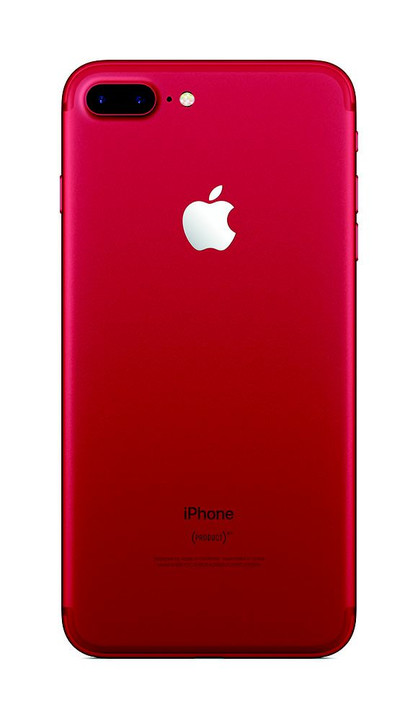
The iPhone 7 and 7 Plus Special Edition (RED) will ship starting Friday. Every model is constructed from brushed aluminum and features a bright red back, white front, and silver Apple logo. The design is the only difference between the Product (RED) phones and the current iPhone 7 and 7 Plus devices — functionally speaking, they’re the same.
More: Apple iPhone 5S review
Here’s how the pricing breaks down:
- iPhone 7 128 GB: $749
- iPhone 7 256 GB: $849
- iPhone 7 Plus 128 GB: $869
- iPhone 7 256 GB: $969
Apple said the percentage of each sale that goes to Product (RED) varies by channel, but historically, the iPhone maker’ has been one of the charity’s biggest contributors. It has donated $130 million to the cause thus far — an amount that’s more than many countries have contributed, according to Dugan.
The new iPhones will become available starting March 24 in Apple’s online and brick-and-mortar stores. Apple will try to inform potential buyers about Product (RED)’s mission through posters, pamphlets, and other promotional materials, Apple VP of Marketing Greg Joswiak told Mashable.
“It’s a nice recognition of our partnership with the (RED) team in fighting HIV and AIDS, Joswiak said.
All hail ‘The iPad,’ Apple’s most affordable full-size tablet yet
Why it matters to you
Apple is introducing a new iPad: The 9.7-inch iPad. At $330, it’s one of Apple’s most affordable tablets yet.
A red iPhone wasn’t the only thing Apple had up its sleeve this week. On Tuesday, the Cupertino, California company announced a new 9.7-inch iPad that’s intended to replace the iPad Air 2, which has been discontinued. It starts at $330.
The new entry-level new iPad, which Apple is simply calling “the iPad,” features the firm’s speedy A9 processor, a Retina (2,048 x 1,536 pixels) display, a battery that lasts about 10 hours on a charge, and virtually the same specifications as the outgoing iPad Air 2. It boasts an 8 MP rear iSight camera, a 1.2 MP front-facing FaceTime camera, two speakers, a Touch ID fingerprint sensor, support for Apple Pay, and accouterments you’d expect — namely, a 3.5mm headphone jack, Wi-Fi 802.11ac, and Bluetooth 4.2.
More: Apple iPad 2017: News and Rumors
“iPad is the world’s most popular tablet. Customers love the large, 9.7-inch display for everything from watching TV and movies to surfing the web, making FaceTime calls, and enjoying photos, and now it is even more affordable,” Philip Schiller, Apple’s senior vice president of Worldwide Marketing, said in a press release. “New customers and anyone looking to upgrade will love this new iPad for use at home, in school, and for work, with its gorgeous Retina display, our powerful A9 chip, and access to the more than 1.3 million apps designed specifically for it.”
The new 9.7-inch iPad will launch on Friday, March 24 in Apple’s online and brick-and-mortar stores. The first batch of launch countries include Australia, Canada, China, France, Germany, Hong Kong, Italy, Japan, Netherlands, Spain, Sweden, Switzerland, and the United Kingdom. The second wave, which includes Denmark, India, Mexico, Norway, Russia, Turkey, and other countries, will follow in April. Finally, Brazil, Taiwan, and others will get it in May.
Compared to the 9.7-inch iPad Pro, the new iPad is a step down in terms of raw processing power. The Pro features a 12 MP camera and a faster chip. But this time around, affordability seems to be the focus, and at $330, the new iPad is significantly less expensive than the $600 9.7-inch iPad Pro.
More: The new iPad models will reportedly debut in March 2017
That could help spur lagging iPad sales. Last fiscal quarter, Apple sold 13.1 million iPads, compared to 16.1 million from the same time last year. The company still dominates the tablet industry with an estimated 21-percent market share, according to Strategy Analytics, but the market overall is on a downswing. A recent report from market research firm IDC showed that table vendors shipped 52.9 million tablets in the fourth quarter of 2016, down 20.1 percent from a year ago.
With any luck, the new iPad will turn things around.
You can say ‘Alexa, order from Prime Now’ for ice cream and other necessities
Why it matters to you
Whether you’re sick, busy, or just not inclined to go out, asking Alexa to order via Prime Now is a great convenience.
Just used the last disposable diaper or cracked the last six-pack of beer? (Well, hopefully not at the same time.) In either case, though, you’ll be pleased to know that on March 21, Amazon added a Prime Now skill so you can get free two-hour delivery of select “daily essential” items with Alexa voice shopping. And in three cities, that includes alcohol.
Ordering via Alexa is now available in the 30-plus Prime Now cities. According to Amazon, tens of thousands of products are available through Prime Now shopping. Alcohol delivery, which also starts on this first day of spring, is limited to Seattle where you can order any type of booze, and Columbus and Cincinnati in Ohio where you’re restricted to ordering beer and wine.
More: Tell Alexa you’re hungry and she can help you order from Grubhub
Alexa Prime Now shopping works with Amazon Echo devices including Tap, Dot, Fire TV, and Tablet. In order to shop with Alexa’s Prime Now skill, you have to be an Amazon Prime subscriber with a default payment method and shipping address. The $99 Prime membership comes with a boatload of other benefits including free two-day shipping on millions of items, free access to Prime videos, music, and more.
When you order with Alexa’s Prime Now shopping skill the syntax is “Alexa, order from Prime Now.” Alexa will recommend a product from those available and if you confirm, will add it to your order. You can include as many items as you wish. When you’re done adding items to your order Alexa sets the 2-hour delivery time.
“Bringing Prime Now to Alexa voice shopping combines two of the most innovative shopping technologies available for an experience that our customers are going to wonder how they ever lived without,” said Assaf Ronen, Amazon’s vice president of voice shopping. “We’re excited to offer the full Prime Now catalog with Alexa, including tens of thousands of items, which allows you to refill everyday essentials you’ve just run out of like diapers or dish soap, or cater to unexpected guests with Merlot and ice cream, all without ever leaving your house or even getting up from the couch.”
Previously you could shop on Amazon with Alexa and use the Alexa Deals skill for daily specials. Prime Now orders with the Alexa voice assistant adds to the service’s menu of shopping aids.
Close to the Metal Ep 35: We’re not over the moon about Mass Effect: Andromeda


There have been a lot of exciting open-world RPGs lately, but unfortunately, neither of the big names have made their way to the PC world. That’s left enthusiasts with a lot of idle hardware on their hands, and we hoped Mass Effect: Andromeda might be just the game to solve that issue.
Those flames have been fanned by extensive teasing and hype-building surrounding the release, as well as some hot new GPUs entering the market around the same time. So we were actually a bit disappointed to find out the game doesn’t actually look all that nice. That’s despite the older, well-optimized Frostbite engine EA has been using for years.
So what’s causing the issues? Part of it has to do with the way the game handles resolution. Users can set their resolution wherever they like, but on medium and low, the game automatically applies render scaling, dropping the actual rendered resolution. The result is a blurry, blocky mess — one that offers a considerable performance boost.
More: ‘Mass Effect: Andromeda’ performance guide
Beyond that, the usual culprits result in the largest performance gains. Dropping ambient occlusion and light quality on their own can raise your framerate, without causing a lot of weird visual artifacts — except the weirdness inherent to this game — although realism suffers as lighting quality drops.
With the game rolling out the very same day we record our weekly computing podcast, Close to the Metal, it’s the perfect time to discuss our results and find out what went wrong.
Close to the Metal is a podcast from Digital Trends that takes a single topic from the computing world and takes a deep dive into it, exploring GPU performance, new software, or a lively discussion about hardware until we’ve covered every corner. Please subscribe, share, and send your questions to podcast@digitaltrends.com. We broadcast the show live on YouTube every Tuesday at 1pm EST/10am PST.
 AIVAnet