


Norway forced Tinder to change how it uses customer data
If you actually read the terms and conditions or end-user license agreement before you click the “agree” button, raise your hand. Okay, stop being funny, we know that you actually didn’t and you aren’t going to score any brownie points with us. In Norway, Tinder recently got into trouble over how its terms and conditions are worded, according to regional news publication Dagens Næringsliv (translated).
As Fortune writes, the problem was that, according to Norway’s Consumer Council, under the old terms Tinder had “sweeping” ownership and control over user data. More than that, Tinder could change its terms and even delete user accounts without any sort of notification.
DN writes that because of the Council’s inquiry, Tinder has changed how it’ll do business. The Council’s ombudsman claimed that the previous, allegedly ambiguous terms violated Norway’s Marketing Control Act. In part, the changes proposed were:
- Norwegian consumers get Norwegian conditions
- Terms must be easier to understand and shorter
- A summary of the short-form terms will be present before the terms are agreed upon
- Norwegian and European protection rules apply
- Notification of changes to the agreed upon terms
- User-generated items will be deleted when an account is terminated
Surprisingly, Tinder accepted.
“As a global platform, we work to adhere to the laws and regulations within each of our markets while striving to provide the best experience possible,” Tinder’s head of marketing and communications told Engadget. “We worked closely with the Norwegian Consumer Ombudsman to find a solution through a collaborative partnership. The positive outcome demonstrates our commitment to our users and resulted in improvements to Tinder’s terms worldwide.”
Apparently this will go beyond Tinder, as Norway is going to push Facebook, Google+ and Twitter to follow suit. Whether or not those three will follow the dating app’s lead and implement the changes on a global scale is anyone’s guess. Considering that personal browsing data is now up for sale in the United States, maybe don’t expect these sorts of things to take hold at home.
Source: Dagens Næringsliv
Bug delays Android Wear 2.0 yet again
Google’s been talking about Android Wear 2.0 for a long time — it was first announced almost a year ago, at the I/O 2016 developer event. But it was delayed from a planned fall launch until early 2017. And while a few watches have been released that include the new software (most notably the LG Watch Style and Sport), the release for older Android Wear devices has continued to be delayed. And you’ll have to keep on waiting — Google confirmed today that an unspecified bug was found during final testing that will push back the release again.
“We have started rolling out the Android Wear 2.0 update to Fossil Q Founder, Casio Smart Outdoor Watch WSD-F10 and Tag Heuer Connected,” a Google spokesperson said in a statement. “For other devices, the update is currently being delayed due to a bug found in final testing. We will push the update to the remaining devices as soon as the issue is resolved.”
That said, it’s worth noting that — in typical Google fashion — Android Wear 2.0 didn’t have a solid release date. When LG’s pair of watches hit the market in February, the company confirmed that the new software would start rolling out to older devices “in the coming weeks.” That’s the beauty of non-specific release schedules. Google isn’t technically late, it’s just taking a bit longer than planned. Google hasn’t said exactly how long it’ll take for this bug to get worked out, but hopefully it won’t take very long. 9to5Google has a complete list of the 19 watches that’ll get Android Wear 2.0 when it’s finally ready to go.
Via: The Verge
Oculus co-founder Palmer Luckey leaves Facebook
Palmer Luckey, co-founder of Oculus VR and creator of the Rift headset, is no longer with the company. Following the news that he’d donated $10,000 to a group spreading pro-Trump memes, the 24-year old had increasingly shied away from the public eye. That even went as far as skipping last October’s Oculus Connect event so as not to be a “distraction” to the news coming out of the conference. When we reached out to Oculus for comment, we were given the following statement:
“Palmer will be dearly missed. Palmer’s legacy extends far beyond Oculus. His inventive spirit helped kickstart the modern VR revolution and build an industry. We’re thankful for everything he did for Oculus and VR, and we wish him all the best.”
In 2014, Facebook purchased Oculus VR for $2 billion.
Via: UploadVR
The Wirecutter’s best deals: A Sony 55-inch XBR 4K TV drops to $1,290
This post was done in partnership with The Wirecutter, a buyer’s guide to the best technology. When readers choose to buy The Wirecutter’s independently chosen editorial picks, they may earn affiliate commissions that support their work. Read their continuously updated list of deals here.
You may have already seen Engadget posting reviews from our friends at The Wirecutter. Now, from time to time, we’ll also be publishing their recommended deals on some of their top picks. Read on, and strike while the iron is hot — some of these sales could expire mighty soon.
Sony XBR X930D 55-Inch 4K TV
 Street price: $1,500; MSRP: $2,200; Deal price: $1,290
While we’ve seen the Sony XBR X930D around this price before, this is still the best price we’ve seen. It’s a nice $200 drop below the normal street price of $1500, and beats the previous low by an extra $10 bucks. The last sale on this TV lasted several weeks, so it’s unlikely that this deal will disappear over night.
The Sony XBR55X930D is our runner-up pick in our guide to the best TV. Chris Heinonen writes, “If the Vizio P65-C1 is unavailable, if you need a 55-inch TV instead of a 65-inch one, or if you like the idea of integrated apps, get the Sony XBR X930D. This model uses an edge-lit backlight that isn’t as great as the Vizio set’s full array, but it is better than the rest of the competition and capable of producing bright HDR highlights. Running Android TV, the X930D gives you Google Cast support as well as integrated apps plus voice control from Google.”
GoPro Hero5 Black + $60 Gift Card

Street price: $460; MSRP: $460; Deal price: $400
Since the GoPro Hero5 Black is relatively new, we haven’t seen many decent sales on it. While this is still full price for the Hero5 Black, it does come with a free $60 Target gift card (ships separately), more or less matching the best deal we’ve seen so far, which was the same deal with a $60 Amazon gift card. REDcard members can save an additional 5 percent. Shipping is free.
The GoPro Hero5 Black is our top pick in our guide to the best action cameras. Ben Keough wrote, “The Hero5 Black builds on the success of its predecessor (and our previous pick), the Hero4 Silver, with new features that significantly enhance its usability. The built-in waterproofing is the most important addition, since it means you can shoot anywhere, anytime, without fiddling with a case. But owners will also appreciate the camera’s intuitive touchscreen interface, image stabilization, and voice control. And it’s a relative bargain, too: Despite the expanded feature set, the new flagship GoPro costs $100 less than the old Hero4 Black.”
Wemo Mini Smart Plug

Street price: $60; MSRP: $70; Deal price: $51 with code SPRINGTECH when you buy two
This is a nice deal on the Belkin Wemo Mini when you buy two and apply coupon code SPRINGTECH. Once you’ve added 2 to your cart and apply the coupon code, the price will drop to $51, or just over $25 each. The lowest we’ve seen these smart plugs previously is $30 each. The $51 total will secure you free shipping.
The Belkin Wemo Mini Smart Plug is our pending pick in our best smart switch guide. Grant Clauser writes, “The Belkin Wemo mini, the successor to our previous favorite smart plug-in switch, is smaller than the original Wemo, making it less bulky on your wall. It works with Both Amazon Alexa and Google Home voice platforms, and you can incorporate it into IFTTT recipes with other devices. Works with both iOS and Android smart phones and tablets.”
Refurbished DJI Phantom 3 Professional

Street price: $900 (new); MSRP: $1,300 (new); Deal price: $550
This is a new low for a refurbished model of our former top pick drone. While the Phantom 3 Pro recently lost its top spot to the DJI Mavic in our best drones guide, it’s still a great deal at this price. Since this refurbished drone comes from the DJI official store on with the standard DJI warranty of 12-months for the central board and remote controller, and 6-months for the parts.
The DJI Phantom 3 Professional is our former top pick in our guide to the best drones guide. Mike Perlman wrote, “Our top pick combines easy flying, long range, great image quality, three-axis stabilization, and great fail-safe features. In addition to being easy to fly, the Phantom 3 Professional offers a 4K-capable camera with a low-distortion, wide-angle lens, an upgraded three-axis gimbal for effective image stabilization, and a standout wireless range that gives you the ability to see both real-time flight stats and a first-person view of what you’re shooting from up to 3.1 miles away, using a smartphone mounted to your radio controller. It also has preprogrammed flight controls with modes tailored to both beginners and advanced pilots, good battery life (23 minutes rated; 16 to 18 minutes of actual flight time while shooting in our testing), the ability to fly autonomously via Follow Me and Waypoints settings, and a fail-safe setting that prompts the drone to return to its launch site or current pilot location automatically if it loses connection with the radio transmitter.”
Because great deals don’t just happen on Thursdays, sign up for our daily deals email and we’ll send you the best deals we find every weekday. Also, deals change all the time, and some of these may have expired. To see an updated list of current deals, please go to The Wirecutter.com.
Apple to Eliminate Several Business and Event-Related Retail Positions
Apple is planning another shakeup within its retail stores, according to a source who shared the company’s plans with MacRumors. At the end of April, Apple plans to eliminate certain retail positions, including Business Manager, Business Events Lead, Events Coordinator, and Events Lead.
Apple Store Leaders began informing affected employees about the change earlier this week, and many were caught off guard by the sudden sunsetting of specialized positions that have long existed at retail stores.
Our source says that the elimination of the Business Manager position is something of a shock because Business Managers lead the Business Team and are responsible for bringing in up to 20 percent of overall store sales.
“These managers have established relationships with various small and medium businesses in their markets,” said the source. “Their position is highly specialized and often times not easily understood by retail leadership who do not have experience in B2B sales.” Existing managers, senior managers, store leaders, and market leaders are currently unfamiliar with the “complex sales cycles involved with B2B engagements,” so Apple’s retail change could have a significant impact on business sales.
Employees who currently hold positions that are being eliminated have been told they can take a lower level (also lower paying in many cases) position or take two months of severance pay. “This comes as a rude awakening to employees who have always felt Apple has had their best interest,” said the source.
Managers and affected employees have been notified about the imminent change, with a broader announcement planned for an all-hands meeting that will take place on Sunday, April 23. Apple may share more information on the reasoning behind the elimination of the positions and its future retail plans at that time. On its “Jobs at Apple” page, Apple has already removed “Business Manager,” as an option, a change that was made recently.
The sunsetting of these specialized retail positions comes following some major retail changes that were introduced in mid-2016. Three new retail positions were added, including Pro, Creative Pro, and Technical Expert, and several other positions were renamed.
Tag: Apple retail
Discuss this article in our forums
U.S. Music Industry Revenue Grew 11% in 2016 Thanks to Streaming Music Services
Estimated retail revenues from recorded music in the United States grew 11.4 percent to $7.7 billion in 2016, according to the Recording Industry Association of America. Streaming music revenue from companies like Spotify, Apple, Pandora, and YouTube accounted for 51.4 percent of that total and for the first time, contributed the majority of the year’s revenue.
At 11 percent growth, the music industry saw the biggest increase it’s had since 1998, a time when six times more CDs were sold than today. Overall revenue continues to be half of what it was in 1999, and revenues from traditional unit-based sales, including physical products and digital downloads, have continued to decline. Physical sales accounted for just 21.8 percent of music industry revenue in 2016, while digital downloads and ringtones made up 24.1 percent.
Total revenues from streaming platforms were up 68 percent year over year and came in at a total of $3.9 billion. Streaming revenues have seen major growth over the last several years, having made up just 9 percent of total industry revenues in 2011.

All categories of streaming, including paid subscriptions, SoundExchange distributions, and on-demand ad-supported streams, saw growth. Paid subscriptions had the largest growth, accounting for $2.5 billion of the $3.9 billion made from streaming music.
Growth was driven by very strong new user adoption, as the number of paid subscriptions to full on-demand services grew 109% to average 22.6 million for the year, compared with 10.8 million in 2015. Adoption was driven by growth from both new and existing services, as it was the first full year of results for Apple Music, and other leading services like Spotify Premium grew as well.
In a blog post on Medium, Recording Industry Association of America CEO Cary Sherman points out that Apple Music pays the highest royalties to artists, more than Spotify and significantly more than YouTube, which Sherman claims exploits a “legal loophole” to pay creators at low rates.

According to Sherman, while 2016 was “year of significant progress” for the U.S. music business, “recovery is fragile and fraught with risk.” Streaming services must make up losses from CDs and digital downloads, and the growth isn’t there yet. “Much rides on a streaming market that must fairly recognize the enormous value of music,” he writes.
Tags: Spotify, Apple Music
Discuss this article in our forums
Apple Seeds First Public Beta of macOS 10.12.5 to Public Beta Testers
Apple today provided public beta testers with macOS 10.12.5, a new update that’s been in developer testing since March 28. macOS Sierra 10.12.5 comes a little over a week after releasing macOS Sierra 10.12.4, which introduced Night Shift for the Mac.
Beta testers who have signed up for Apple’s beta testing program will receive the 10.12.5 macOS Sierra beta through the Software Update mechanism in the Mac App Store.
Those who want to be a part of Apple’s beta testing program can sign up to participate through the beta testing website, which gives users access to both iOS and macOS Sierra betas. Betas should not be installed on a primary machine due to the potential for instability.
The release notes accompanying the developer beta say the update “improves the stability, compatibility, and security of your Mac.”
There’s not much to glean from Apple’s release notes, so it is not clear what minor feature tweaks or bug fixes might be included in 10.12.5. Nothing notable has been discovered in the developer betas thus far.
Related Roundup: macOS Sierra
Discuss this article in our forums
Star Wars: Force Arena is a superb addition to the Star Wars universe (Review)

There’s a pleasing tendency these days of having high-profile franchises betting on mobile games. We’ve seen Pokémon, Mario, Marvel, and Fire Emblem all release top-quality games in the Play Store, which is something healthy for the community. Having several big-name clients under its belt, Netmarble Games got the chance of developing a Star Wars game. The result? Star Wars: Battle Arena, a game that mixes several genres into one full-fledged, enjoyable game.
Developer: Netmarble Games
Price: Free
Setup
After connecting with your Google Play Games account, the game takes you to a screen that downloads additional files, a sight that is getting way too common with each passing day. After 243 MB of information, the game takes you to a very informative tutorial.
This sequence takes you through basic controls, objectives and different elements that have been added to the game. The tutorial is kind of long and has you executing a lot of activities, so be sure you have at least 15 spare minutes to complete it.
Overview
It is kind of difficult to explain which genre this game falls under. On the Play Store, Netmarble Games decided to list it as a strategy game, which is an appropriate categorization, but it doesn’t capture the full picture.
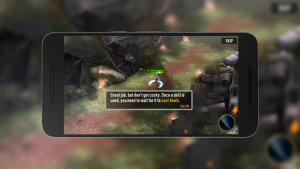 Great, kid! Don’t get cocky.
First of all, this is an online-only game. If you try to start it without an Internet connection, you’re gonna have a bad time. Star Wars: Force Arena merges some MOBA elements with character improvement. Also, you have additional units that you can deploy through a card-based system. It is a very interesting mixture of genres and works pretty well.
But what is it all about? The game is simple: you need to destroy your opponent’s base. You control a character, called a hero, and can deploy troops throughout the field, such as stormtroopers, rebel troops, and even X-Wings. Each site is protected by three turrets, and destroying them gives your team one point. Since matches are time-constrained, the match can be decided by who gets more points if you fail to destroy your opponent’s base before the time expires.
Controls are pretty simple. Just as in any MOBA, you just need to tap on whatever you want to destroy, and your troops will do the rest. For deploying troops, tap on the corresponding card and, as long as you have energy, they will deploy automatically.
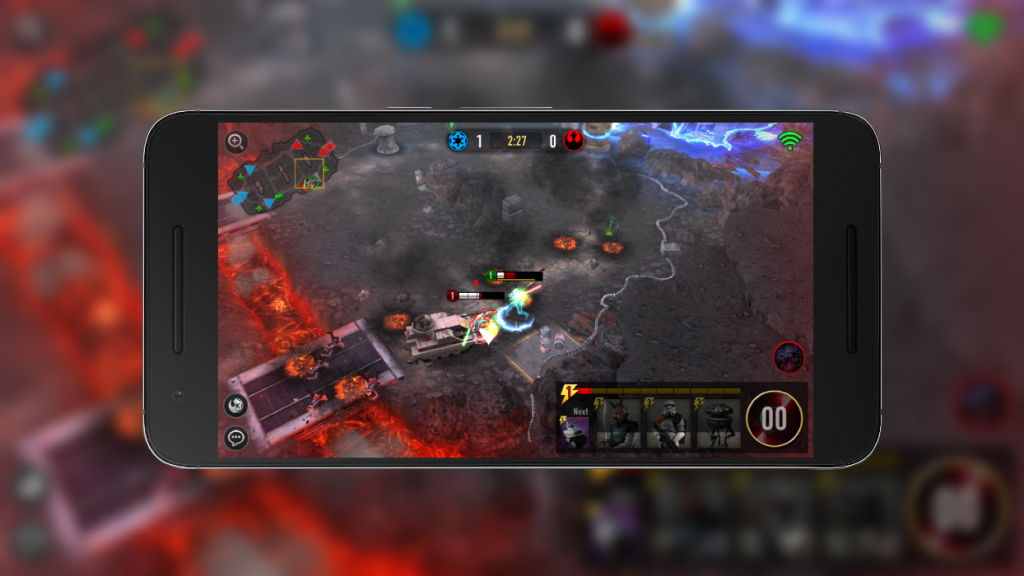 Gameplay is action-packed and fast-paced.
The game gets a whole new level of depth thanks to this card system since it provides such a large amount of strategies and customization. Do you prefer weaker troops that you can spawn quickly or prefer to have strong troops on your side at the cost of deploying them slower? What about a balance between both? You can do it whichever way you feel more comfortable with.
You get these cards through boosters, which you can get by winning matches, getting tickets, for free every four hours, or buying them directly with real money. Troops can also be leveled up by spending gold and collecting cards from the same type.
Let’s say you want to level up your Stormtroopers so that they actually hit something. You will need the appropriate amount of gold, and a certain number of Stormtrooper cards. Because the content of these boosters are random, leveling up troops can be a bit tricky. If you reach a point in which you want to upgrade a troop but you don’t have the required cards, you can also buy them separately with gold.
 2 vs 2 battles are superb.
All of the matches are online unless you choose the training mode instead. The matches can be either 1 vs 1 or 2 vs 2 and both of them are done in real-time against other humans. You will find different strategies, characters, and movements used since you’re playing against humans, and not a computer opponent.
The 2 vs 2 matches are especially entertaining. You have to collaborate with another person in order to win, and the amount of troops and heroes wandering around the stage makes the matches a very unique experience.
If you want to collaborate with people you know and not with random humans, you can also join a guild. Members of the same guild can go into missions together and chat through the built-in chat group. You can also battle with members of the guild in order to hone your skills.
General Impressions
Thanks to the robust card system, the amount of replay value increases dramatically, since there’s a lot of stuff you can upgrade and improve. The fact that you can choose between the light and dark side means that there are elements to improve on both sides of the Force as well.
Battles are frantic and exciting thanks to the different strategies you can use and the time limit the game puts on you. The fact that you play against a human and not an AI-controlled character, coupled with a pairing system that works as it should, means that opponents are normally pretty equal in skill and level.
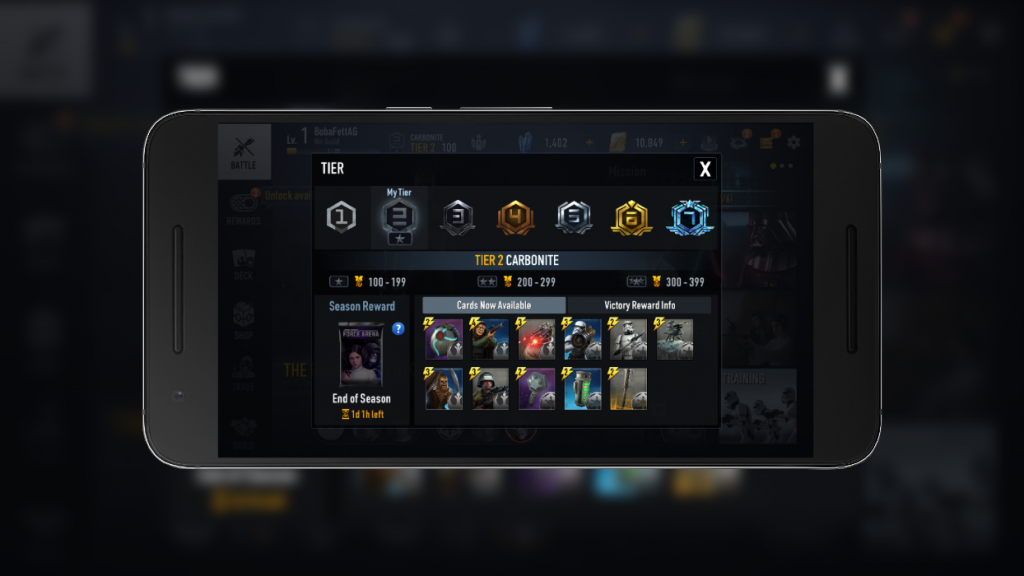 Through the deck system and leveling of your character, the game offers lots of replay value.
Unlike many other free-to-play games, you can totally play Star Wars: Force Arena without spending a dime. Sure, it requires patience and your progress will be slower, but it is completely doable. Also, in-app purchases are logically priced in the sense that you actually get a good value for your hard-earned money. It’s not like Pokémon Duel, for example, in which spending $5 yielded one token that could easily be useless to you.
Unfortunately, I believe that the game doesn’t explain fully everything that it should. The deck system is kind of complex and there’s not enough explanation of what some specific on-screen elements are, increasing the learning curve. With enough patience, you will figure it out by yourself, but it can feel a bit daunting at first.
Graphics
 Always in our hearts, Princess Leia.
With many games embracing the pixel/voxel art style, Star Wars: Force Arena focused instead on creating gorgeous-looking graphics that resemble as close as possible the masterpieces we see in the movies. The stages are all the same in structure but the scenery is different. Stages like Hoth and Tattooine will be immediately recognized and appreciated by any Star Wars fan.
Keep in mind, though, that in order to display these beautiful graphics, the game requires internal components that are able to handle it. For the first time since I’ve owned a Nomu S10, I saw bad performance in several sessions.
This is not a statement against the game, since what I’m doing is equivalent to trying to play Battlefield 4 on a Core Duo laptop, but rather a heads-up so that you know what to expect if you have a low-end phone. The graphics are first-class, the graphics processor needs to be too.
Sound
Music and sound effects are as top-notch as you would expect from a Star Wars game. The soundtrack sounds exactly like if it was extracted from a movie score, and the sound effects stay true to their origins. Blasters, lightsabers, and starships all have the characteristic sound we all love, immersing you in the experience.
Conclusion
Star Wars: Force Arena offers interesting gameplay through the mix of several elements and game mechanics. If you’ve played League of Legends or DOTA before, then you’ll feel right at home. Coupled with recognizable characters from the Star Wars world, superb graphics, and the sound we’ve grown accustomed to listen in the Star Wars universe, this game is a great example of how to use a well-known franchise and make a worthy game out of it.
Download and install Star Wars: Force Arena from the Google Play Store.
Official Windows 10 Creators Update disk image now available for Insiders
Why it matters to you
Insider program members now have another way to install the Windows 10 Creators Update early.
After months of hype, the Windows 10 Creators Update is drawing near, and over the last few weeks Microsoft has been busy making the final preparations for its release. Now, the company has officially released the disk image files necessary to install the update to members of the Windows Insider program.
Earlier this month, it emerged that build 15063 of Windows 10 would be the version of the operating system that’s rolled out to all users as the Creators Update. Members of the Insider program have had access to this build for over a week, but until now it’s only been distributed via the Windows Update utility.
However, now it’s possible to adopt the pre-release version of the Creators Update by downloading a disk image and starting the process manually. If you’re enrolled in the Insider program, the necessary ISO files are available via Microsoft’s Software Download website.
More: Here’s how you can start using the Windows 10 Creators Update today
Disk images or the standard, Enterprise, Education, Home Single Language, and Home China versions of Windows 10 are being offered up, according to a report from MS Power User. 32-bit and 64-bit versions of each ISO have been made available.
Given that these disk images are still considered to be pre-release versions of the Creators Update, there may be some minor bugs and other issues present. As a result, it’s not recommended to use the ISO files to install the build on your primary system — as is the case with all pre-release builds offered through the Insider program.
Soon, Microsoft will release official ISO files to the public, allowing all PC users to perform a clean install of the Creators Update if they want to. It’s expected that distribution of the update will be staggered, so not all users will be prompted to make the upgrade on day one, but the rollout process is scheduled to start on April 11.
Can you find the Bentley in this 57.7 billion pixel photograph of Dubai?
Why it matters to you
Whether or not a Bentley is in your price range, the tech behind this 57.7 billion pixel photograph is pretty cool.
How do you take a photograph worthy of a luxury Bentley that starts at almost a quarter of a million dollars? With lots (and lots) of megapixels and camera tech inspired by NASA. Earlier this month, Bentley broke its own record with a 57.7 billion pixel photograph of Dubai and the new Flying Spur W12 S. The photograph encourages web browsers to explore Dubai and try to find the luxury car — like a high-tech version of Where’s Waldo for grownups.
Last year, the company ran a similar campaign when it shot a 53,000 megapixel image of the Golden Gate Bridge with enough detail to see the car’s iconic logo stitched into the headrest of a rose gold Mulsanne. The company’s latest image is based on similar technology, but ups those megapixels to 57,700, making it one of the most detailed landscape images yet.
More: Google’s gigapixel captures of famous masterpieces let you see every stroke
Bentley says it put the same attention to detail that goes into the 130 man-hours required to craft the Flying Spur into creating the image of Dubai. The camera was suspended from the Cayan Tower, one of the city’s tallest buildings about 866 feet (264 meters) above street level. The camera took 1,825 images over the course of two days. Each image was then stitched together and corrected for the light levels — since the process took so long that the images were shot at different times of day. Fifteen-mile-per-hour wind also threatened the project.
With all those images stitched, the photo becomes one of the largest landscape shots yet — it took 18 hours to download the file.
Along with exploring the city and finding the car which is (spoiler alert!) in the marina toward the center of the image, the image is detailed enough to zoom all the way to the iconic winged logo on the car’s hood. Bentley also created a 360-degree video showing off the car’s interior, narrated by the company’s head of exterior design, John Paul Gregory.
Explore the full resolution image at Bentley’s website.
 AIVAnet