


Science brought us a breakthrough: A wine bottle that doesn’t drip
Why it matters to you
Hate red wine stains on your white tablecloth or wooden dinner tables? This drip-free wine bottle is here to help.
Sometimes scientists focus their gray matter on solving massive problems like creating sources of sustainable energy able to help feed, clothe, and connect humanity for the next 1,000 years or so. Other times, they harness their superior knowledge of chemistry, materials science, and physics to invent a new type of wine bottle that doesn’t drip.
Sure, the first one is the most important but… well, who wouldn’t benefit just a little bit from the second?
Fortunately, that is where Brandeis University biophysicist Daniel Perlman. A research scientist at the university for the past 30 years, Perlman has used some of his extracurricular time to pursue something of a passion project.
“This research project grew out of my love of wine, and my experience of watching red wine bottles stain tablecloths and wooden surfaces,” he told Digital Trends. “I started wondering whether there was a remedy that could be found in the design of the bottle.”
More: Vivino Market gives personalized wine recommendations
It turned out to be a more complex problem than you might think, which is presumably why no one had previously cracked it without needing an additional add-on to the wine bottle itself.
“It involved thinking about some of the chemical interactions between wine and glass, and analyzing slow-motion video showing the pouring that takes place from a standard wine bottle,” Perlman said. “What wine has a tendency to do is to cling to the glass surface as it leaves the bottle. Particularly if you’re pouring from a full or nearly full bottle, the flow of wine actually hooks backwards, so that when you tilt the bottle upright this backwards flow is what causes the drips that run down the neck. By introducing a channel or groove, which acts a bit like the moat around a castle, we were able to create a barrier that interrupts the tendency of the liquid to flow down underneath the lip.”
Got that? Perlman’s colleagues at Brandeis certainly have, since they’ve rushed to file a patent application and are now in conversations with several wine bottle manufacturers.
“We’ve tested both red and white wines, and both behave in a very similar way — although red wine is the more problematic one in terms of having the ability to stain tablecloths and the like,” Perlman continued. “However, the design is applicable to both, as well as different styles of wine bottle. We originally developed this for bottles with cork closures, but this design could be introduced into a screwtop-style wine bottle neck as well.”
Alcatel’s new A30 costs just $60 after discount, can be pre-ordered from Amazon
Why it matters to you
Looking for a super low-cost device? The Alcatel A30 has just been unveiled, and can be purchased with a subsidy from Amazon Prime for $60 after discount.
Smartphone manufacturer Alcatel is having quite a year. The company launched a number of phones at Mobile World Congress 2017, and now its back with another device — the Alcatel A30.
The device is decidedly budget, and comes in at less than $100. Not only that, but it also has gesture controls like flip to mute, and runs Android 7.0 Nougat. It’s set to be released in April, and it’s currently available for pre-order on Amazon Prime — where you can get it at a $40 discount, which brings the price to $60.
More: Alcatel’s new Plus 12 Windows 2-in-1 tablet can be your “office on the go”
So what kind of specs can you expect on the device? Well, as mentioned, it is a low-cost phone, so don’t expect anything mind-blowing. For the price, however, it’s certainly not bad.


Under the hood, you’ll find a 1.1GHz Qualcomm Snapdragon 210 processor, along with 2GB of RAM and 16GB of storage. The device also has a microSD card slot, so you can expand that storage by up to 32GB. On the back of the phone, you’ll find an 8MP rear-facing camera, while on the front, there’s a 5MP front-facing camera. The display sits at 5 inches and has a 720p display.
When it comes to the design, the phone looks pretty basic — but that’s not necessarily a bad thing. It just looks like a normal smartphone.
As mentioned, the phone is currently available for pre-order as an Amazon Prime exclusive, as is the Moto G5 Plus, and as part of that deal, you’ll get a subsidy. Of course, there is a tradeoff — in exchange for the subsidy, you’ll have to deal with a few extra ads and promotional offers every now and then. You can, thankfully, also get it without the ads and promotional offers, but you won’t get the $40 Amazon Prime discount, which comes in the form of an Amazon Prime gift card.
The Alcatel A30 is set to be released April 19.
Pre-order now from:
Amazon
Weekly Rewind: Chuck Berry’s legacy, Apple’s (RED) iPhone, Lexus’ new yacht

A lot can happen in a week when it comes to tech. The constant onslaught of news makes it nigh impossible for mere mortals with real lives to keep track of everything. That’s why we’ve compiled a quick and dirty list of this week’s top 10 tech stories, from Apple’s highly anticipated red iPhone to Lexus’ new luxury yacht — it’s all here.
Apple has finally taken the wraps off the new ruby red ‘iPhone (RED)’

On Tuesday, in partnership with nonprofit Product (RED), Apple added a brand new, ruby red iPhone model to its roster: the iPhone (RED). Like the company’s (RED) iPod Nano, Beats headphones, and Smart Battery cases, the launch promotes Product (RED)’s ongoing effort to combat HIV and AIDS, which remain among the globe’s worst health problems. More than 35 million people have died of the virus, and 37 million are infected each year, according to Product (RED).
Read the full story here.
Diets are not equal for all people; ancestral homelands can make a difference

Proponents of specific food class-centric diets such as paleo, vegan, gluten-free, ketogenic, or the Mediterranean diet often tend to prescribe their plans for everyone. Not so fast, says a group from the University of California, Berkeley. Biologists at UC Berkeley and other institutions around the world have published research that shows genetic differences from natural selection based on dietary changes in Europe, Ars Technica reports.
Read the full story here.
Lexus floats a new brand idea: The high-performance Lexus Sports Yacht

What is it with big-name carmakers and luxury sports yachts? Mercedes-Benz, Aston Martin, and Bugatti have all launched or shown concepts of yachts that are slick, fast, and extremely pricey. Now we can add Lexus to the gang with the Lexus Sports Yacht, which was recently introduced at the Miami International Boat Show.
Read the full story here.
What’s in a Name? Meet Bixby — the smart sidekick who’ll help you use your digital gear

There’s a new name in artificial assistants, but Samsung argues this one won’t tell you dumb jokes or a weather forecast, nor will it look up facts for you online. This bright assistant is meant to improve your interactions with your digital life — not just with your smartphone, but with your washing machine, thermostat, vacuum cleaner, and more. It’s nothing less than a rethink of how we use our stuff.
“Philosophically, what we’re looking at is revolutionizing the interface,” Injong Rhee, head of research and development at Samsung Mobile Communications Business Group, told Digital Trends.
Read the full story here.
Novel braille smartwatch enables the blind to read notifications

The Dot is a smartwatch with a unique interface that is able to translate basic notifications for blind users by dynamically reproducing braille on its specialized surface. It has been in development for the past couple of years, but mass production has finally begun, with the first orders set to ship out in April. Although braille has been a useful tool for those with limited vision for close to 200 years, in an age of touchscreens and smart devices, many of the world’s millions of visually impaired can be left out of the loop.
Read the full story here.
Studying brain waves while watching trailers can help predict a film’s success

As an industry built around making money by guessing what the general population wants to watch, Hollywood has been trying to get into our minds for years. An experiment at Northwestern University’s Kellogg School of Management may have cracked the best way to do this: by literally reading moviegoers’ brain waves.
Read the full story here.
Five legendary bands whose music wouldn’t sound the same without the late Chuck Berry

We lost one of popular music’s most important and influential musical architects on Saturday, as Chuck Berry died at the age of 90. Berry’s profound lyrics, melodies, and guitar stylings are the very bedrock of all rock-influenced music made in the past six decades. Without the iconic St. Louis-born musician, the sounds coming out of your radio, streaming service, or record player would be profoundly different.
Read the full story here.
Osprey’s affordable new anti-gravity packs save your back without injuring your wallet

Osprey set the standard in backpacking comfort when it introduced its cutting-edge Anti-Gravity suspension and back panel in 2015. The Atmos and Aura Backpacks were the first models to be equipped with Osprey’s AG technology, and were lauded for their ability to distribute the weight of the pack and make you feel like you were carrying less weight.
Now this revolutionary suspension system is making its way to other backpacks in Osprey’s lineup — new for the spring 2017 hiking season are AG versions of the popular Aether and Ariel line of long distance backpacks.
Read the full story here.
How Celebrity Cruises is using smartphones to put power in passengers’ hands

Whether by plane, train, or automobile, our standard modes of travel are getting more connected. As each becomes another “device” within the Internet of Things, they are able to provide real-time information and personalization that wasn’t possible before. We can now add cruises into the mix.
Carnival revealed its connected Medallion technology, which helps passengers tailor experiences to their needs. And now Celebrity Cruises is following suit, and it’s using the smartphone as the starting point. We recently visited Celebrity’s Innovation Lab, in Miami, to look at some of the things the company has in store.
Read the full story here.
Hackers demand Apple pay up or millions of iCloud accounts will be wiped

A group of hackers is allegedly trying to extort Apple by holding its customers’ data for ransom and threatening to remotely wipe iCloud accounts connected to both iPhones and iPads if the demands are not met. The group self-identifies as the “Turkish Crime Family,” and is demanding either $75,000 in Ethereum or Bitcoin or $100,000 in iTunes gift cards, according to a report from Motherboard. Not only that, but the hackers gave Apple an April 7 deadline to meet the demands — or else they will start wiping both phones and iCloud accounts.
Read the full story here.
Weekly Rewind: Chuck Berry’s legacy, Apple’s (RED) iPhone, Lexus’ new yacht

A lot can happen in a week when it comes to tech. The constant onslaught of news makes it nigh impossible for mere mortals with real lives to keep track of everything. That’s why we’ve compiled a quick and dirty list of this week’s top 10 tech stories, from Apple’s highly anticipated red iPhone to Lexus’ new luxury yacht — it’s all here.
Apple has finally taken the wraps off the new ruby red ‘iPhone (RED)’

On Tuesday, in partnership with nonprofit Product (RED), Apple added a brand new, ruby red iPhone model to its roster: the iPhone (RED). Like the company’s (RED) iPod Nano, Beats headphones, and Smart Battery cases, the launch promotes Product (RED)’s ongoing effort to combat HIV and AIDS, which remain among the globe’s worst health problems. More than 35 million people have died of the virus, and 37 million are infected each year, according to Product (RED).
Read the full story here.
Diets are not equal for all people; ancestral homelands can make a difference

Proponents of specific food class-centric diets such as paleo, vegan, gluten-free, ketogenic, or the Mediterranean diet often tend to prescribe their plans for everyone. Not so fast, says a group from the University of California, Berkeley. Biologists at UC Berkeley and other institutions around the world have published research that shows genetic differences from natural selection based on dietary changes in Europe, Ars Technica reports.
Read the full story here.
Lexus floats a new brand idea: The high-performance Lexus Sports Yacht

What is it with big-name carmakers and luxury sports yachts? Mercedes-Benz, Aston Martin, and Bugatti have all launched or shown concepts of yachts that are slick, fast, and extremely pricey. Now we can add Lexus to the gang with the Lexus Sports Yacht, which was recently introduced at the Miami International Boat Show.
Read the full story here.
What’s in a Name? Meet Bixby — the smart sidekick who’ll help you use your digital gear

There’s a new name in artificial assistants, but Samsung argues this one won’t tell you dumb jokes or a weather forecast, nor will it look up facts for you online. This bright assistant is meant to improve your interactions with your digital life — not just with your smartphone, but with your washing machine, thermostat, vacuum cleaner, and more. It’s nothing less than a rethink of how we use our stuff.
“Philosophically, what we’re looking at is revolutionizing the interface,” Injong Rhee, head of research and development at Samsung Mobile Communications Business Group, told Digital Trends.
Read the full story here.
Novel braille smartwatch enables the blind to read notifications
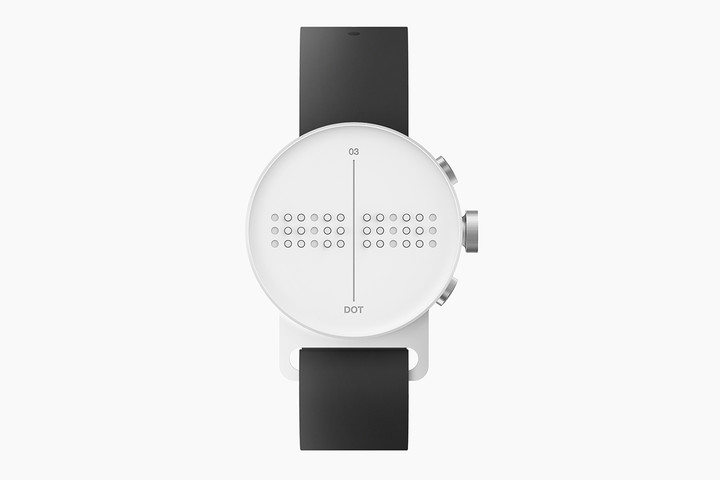
The Dot is a smartwatch with a unique interface that is able to translate basic notifications for blind users by dynamically reproducing braille on its specialized surface. It has been in development for the past couple of years, but mass production has finally begun, with the first orders set to ship out in April. Although braille has been a useful tool for those with limited vision for close to 200 years, in an age of touchscreens and smart devices, many of the world’s millions of visually impaired can be left out of the loop.
Read the full story here.
Studying brain waves while watching trailers can help predict a film’s success

As an industry built around making money by guessing what the general population wants to watch, Hollywood has been trying to get into our minds for years. An experiment at Northwestern University’s Kellogg School of Management may have cracked the best way to do this: by literally reading moviegoers’ brain waves.
Read the full story here.
Five legendary bands whose music wouldn’t sound the same without the late Chuck Berry

We lost one of popular music’s most important and influential musical architects on Saturday, as Chuck Berry died at the age of 90. Berry’s profound lyrics, melodies, and guitar stylings are the very bedrock of all rock-influenced music made in the past six decades. Without the iconic St. Louis-born musician, the sounds coming out of your radio, streaming service, or record player would be profoundly different.
Read the full story here.
Osprey’s affordable new anti-gravity packs save your back without injuring your wallet

Osprey set the standard in backpacking comfort when it introduced its cutting-edge Anti-Gravity suspension and back panel in 2015. The Atmos and Aura Backpacks were the first models to be equipped with Osprey’s AG technology, and were lauded for their ability to distribute the weight of the pack and make you feel like you were carrying less weight.
Now this revolutionary suspension system is making its way to other backpacks in Osprey’s lineup — new for the spring 2017 hiking season are AG versions of the popular Aether and Ariel line of long distance backpacks.
Read the full story here.
How Celebrity Cruises is using smartphones to put power in passengers’ hands

Whether by plane, train, or automobile, our standard modes of travel are getting more connected. As each becomes another “device” within the Internet of Things, they are able to provide real-time information and personalization that wasn’t possible before. We can now add cruises into the mix.
Carnival revealed its connected Medallion technology, which helps passengers tailor experiences to their needs. And now Celebrity Cruises is following suit, and it’s using the smartphone as the starting point. We recently visited Celebrity’s Innovation Lab, in Miami, to look at some of the things the company has in store.
Read the full story here.
Hackers demand Apple pay up or millions of iCloud accounts will be wiped

A group of hackers is allegedly trying to extort Apple by holding its customers’ data for ransom and threatening to remotely wipe iCloud accounts connected to both iPhones and iPads if the demands are not met. The group self-identifies as the “Turkish Crime Family,” and is demanding either $75,000 in Ethereum or Bitcoin or $100,000 in iTunes gift cards, according to a report from Motherboard. Not only that, but the hackers gave Apple an April 7 deadline to meet the demands — or else they will start wiping both phones and iCloud accounts.
Read the full story here.
Google retires SMS support in Hangouts, axes experimental Gmail features
Why it matters to you
If you use Hangouts to send and receive SMS messages, it’s time to switch: Google is doing away with support soon.
At the Google’s HQ in San Francisco, it’s that time of year again: Spring cleaning. On Friday, Google detailed features that will be going away in the coming weeks as part of the company’s perennial efforts toward “streamlining” its products.
First to get the ax is text message support in Google’s Hangouts messaging app. In the next few weeks, holdouts will get a Hangouts notification to switch to another app. And starting on May 22, Hangouts will cease to send and receive carrier SMS messages.
More: Attack on Slack: Google beefs up its Hangouts services, meet and chat
Google is suggesting that users migrate to its text-focused Android Messages app. “We want to provide a consistent and easy-to-use SMS experience for Android users right out of the box,” a spokesperson said. “We’re focusing on making Android Messages the primary place to access SMS and are working with carriers and device manufacturers to include Android Messages natively in Android devices.”
Google notes that the shutdown won’t impact Google Voice users and Google Fi subscribers who use Hangouts for messaging. It has published a helpful resource with more information.
Meanwhile, Google Talk — the precursor to Hangouts — is shutting down entirely. Google said it will prompt Gmail users who haven’t switched to Hangouts to do so, and that the legacy Google Talk Android app, which Google replaced with Hangouts in 2013, will stop functioning by late April.
More: Hangouts may lose SMS support as Google overhauls it to take on Slack
Google is also retiring a few features in Labs, mail service’s experimental collection of apps and settings. Authentication Icons, which identified verified (i.e., legitimate) senders with a “key” icon, are going the way of the dodo. So will the Google Voice Player, which provided an audio preview of incoming voice mails. The next to go are previews of Picasa photos and chat pictures; Quick Links, which provided fast access to emails and folders; the ability to quote selected text; Smart Labels, which automatically categorized newsletters, promotions, receipts, and notifications; and Yelp review snippets.
Finally, Google is retiring Google+ functionality in Gmail. Beginning sometime in April, you’ll no longer be able to email Google+ profiles or use Google+ Circles.
More: Google launches business-friendly video-calling version of Hangouts called Meet
Canning old products and features — even popular ones — is nothing new for Google. In 2013, the Mountain View giant caused a minor uproar when it shut down Google Reader, an web service that consolidated articles from around the web. And it shut down Google Flu Vaccine Finder, a mapping app that showed nearby vaccination places across the United States, in 2012.
Still, the shutdowns will no doubt catch some users by surprise, but Google is pledging to minimize the disruption wherever possible. “We realize these updates may be an inconvenience,” a spokesperson said. “These updates will help us to focus and prioritize features that will improve the entire G Suite user experience for everyone.”
Adata’s XPG SD700X is an external SSD for gamers that’s both rugged and fast
Why it matters to you
Your Xbox One or PS4 probably needs some additional fast storage, and Adata has made a gaming-themed SSD that can also work for anyone who needs a rugged external drive.
Solid-state disks (SSDs) are slowly taking over the world, beating out spinning-disk hard disk drives (HDDs) for any application where speed and durability matter. SSDs are significantly faster than HDDs, and because they have no moving parts that can be susceptible to shocks and movement, they’re also more reliable.
Of course, SSDs are also significantly more expensive than HDDs, and so they’re not the most economical solution for high-volume storage and for backup. That usually rules out SSDs as external drives, but ADATA wants to change all of that with its new XPG SD700X 1TB — which is also aimed directly at gamers looking to add storage to their consoles.
More: Micron stacks memory with 3D NAND technology for mobile, increasing capacity
Adata is using 3D NAND in the XPG SD700X, which offers some advantages over older 2D NAND. First, because it stacks storage cells vertically and not just horizontally, 3D NAND promises to keep SSD capacities on the rise. Second, it brings advantages in cost and power efficiency while also offering high performance. Thus, Adata’s newest external drive offers up enhanced performance and reduce power consumption in a relatively small package.
The XPG SD700X also offers enhanced reliability via its U.S. Army MIL-STD-810G certification for being shot and drop resistant. In addition, the SSD meets IEC IP68 specs for being both waterproof up to an hour of immersion in 1.5m deep water and totally dust-tight. This makes the XPG SD700X a particularly good option as an external drive for anyone who needs to carry their storage into harsh conditions.
In terms of performance, the XPG SD700X utilizes a USB 3.1 Gen 1 connection, so it’s legacy-compatible while offering up to to 5GB/s transfer rates. The drive itself offers 440MB/s read and 430MB/s write speeds, making it not only many times faster than an HDD but also compatible with fast internal SSDs. The drive comes in a bright red case that gives an obvious nod to gamers.
Adata describes the device as follows:
“The XPG SD700X is the first gaming-styled IP68 external SSD designed to expand console storage. It’s completely dust-tight and highly waterproof, delivering up to 1TB in plug n play for Xbox One and PS4. With quality 3D NAND plus DRAM cache and SLC mode, the SD700X reaches 440MB/s read and write – over 4X faster than internal Xbox One/PS4 HDDs. That means games load faster and run smoother, giving gamers the double benefit of space and speed. Plus, it’s PC and Android compatible as a bonus.”
If you’re looking for a ton of storage in a robust, reliable, and high-performance external drive, then you’ll still have to wait a while for the XPG SD700 to show up in various retail outlets. When it does arrive, it will be available in 256GB, 512GB and 1TB versions complete with USB Type-A cable and a 3-year limited warranty.
Genome 10K wants to sequence the genes of endangered species
Why it matters to you
Sequencing the genome of 10,000 different animal species can help reveal vital information about which ones are endangered and maybe even teach us a bit about our own history, too.
You’ve quite possibly heard of the Human Genome Project, the massive international science research project dedicated to sequencing the human DNA. A less well-known project called Genome 10K has a not-unrelated mission — but instead of mapping just the human genome, it’s dedicated to sequencing the genome of thousands of animal species, including those most at risk of extinction.
“The purpose of the Genome 10K project is to assemble a genomic zoo of DNA sequences representing the full diversity of vertebrate animals, including at least 10,000 different vertebrate species,” David Haussler, the Genome 10K trustee and scientific director at the University of California Santa Cruz Genomics Institute, told Digital Trends. “Establishing the genetic diversity of vertebrate species would create a priceless resource for the life sciences and worldwide conservation efforts. We have only just begun to understand our natural environment. Because virtually all the biology of an animal is encoded in its genome, the Genome 10K project will provide a great leap forward.”
More: Hybrid woolly mammoths could soon walk the Earth, thanks to Harvard scientists
A genome, Haussler said, can help us calculate how endangered a particular species is by the effects of population size reductions that lead to inbreeding. This information is vital for prioritizing conservation efforts and helping plan efforts to conserve, and, via outbreeding, increase diversity within a species.

Members of the Genome 10K Community of Scientists gathered at its first meeting in April 2009 at the Seymour Center in Santa Cruz, California.
“The genomes of different vertebrates also tell us a great deal about ourselves: How we became human and what makes us uniquely human genetically,” Haussler continued. “By sequencing thousands of vertebrate genomes we will have an unprecedented evolutionary microscope for peering into our natural history, allowing us to understand our story over the last several hundred million years, and helping us better predict which genetic variations that are in our genomes today cause disease.”
Scientists involved with Genome 10K have developed new methodologies for genome sequencing and analysis. These have been proved on hundreds of cases, including many endangered species.
“Anyone can help assemble this genomic zoo by making a donation on our website,” Haussler said. “By donating now, you can help create a shared resource that will inform and guide our understanding of animal life for generations to come.”
Android Wear 2.0 watches from Hugo Boss, Tommy Hilfiger and Movado are coming and they look fantastic

The 2017 Android Wear watch line-up is looking good!
If you want your smartwatch to look good while it’s doing all the cool things on your wrist, you’re going to love what we’re seeing from the Baselworld 2017 watch show.
Courtesy of the @AndroidWear Twitter account we get a first look at watches from Hugo Boss, Tommy Hilfiger, and Movado that look nothing like any Android Wear 2 watch we’ve seen before.
Movado has a teaser for the Movado Connect at their website, and we see that the men’s version is coming this fall with five bracelet styles. No word on a ladies model or any pricing, but they do tell us to expect over 100 different dial styles.
This fall, Movado will introduce a touchscreen smartwatch that brings midcentury modern design into the new millennium with cutting-edge technology. One of the first watches designed specifically for Android Wear 2.0, this smartwatch features over 100 fascinating dial variations. Each dial explores Movado’s iconic single dot design with brilliant new color, dimension, complication, details and day to night transformation.
The Hugo Boss Touch and oddly named Tommy Hilfiger TH24/7You are detailed by Wareable, and they have a bit of information on each:
-
The Hugo Boss Touch comes this August and will check in at $395. Expect to see NFC and Android Pay, but there is no heart rate sensor so Android Fit may be a no-show.
-
The Tommy Hilfiger TH24/7You comes “later this year” and is priced at $299. Band styles include a brown leather and stainless link bracelet, and they say NFC is absent on the TH24/7You.
While Android Wear 2.0 lends itself well to fashion-sport timepieces like the LG Watch Sport this trio of high-end watches show that they can look great, too. We’re looking forward to hearing more about these and other new Android Wear devices and expect the lineup to be looking good come summertime.
Android Wear
- Everything you need to know about Android Wear 2.0
- LG Watch Sport review
- LG Watch Style review
- These watches will get Android Wear 2.0
- Discuss Android Wear in the forums!
Pokemon Go is giving players a chance to catch rare shiny Magikarp
Pokemon Go fans have a new quest: Shiny Magikarp.
The popular game has an event going on right now that honours water-type Pokemon, and as part of an effort to get people playing Pokemon Go, the app is offering up highly coveted shiny Pokemon. These have never been spotted in the app before and are obviously hard to find. They can transform and have different colours than standard Pokemon. So, if you happen to catch any shiny Magikarp, you’re doing well.
Trainers across the world are reporting sightings of rare golden Magikarp in the wild! https://t.co/ZjUoac0wKG pic.twitter.com/ymx3jzwSY2
— Pokémon GO (@PokemonGoApp) March 24, 2017
They are collector’s items that evolve into powerful red Gyarados, which are featured prominently in Pokemon Gold and Silver. Although spotting a golden Magikarp won’t be easy, you should keep in mind that the Water Festival makes water-type Pokemon of all kinds more common everywhere. Nevertheless, it only has a discovery rate of 220 standard Magikarp to one shiny, according to Kotaku.
- Help! Pokemon Go isn’t working: How to fix common Pokemon Go problems
- Pokemon Go top tips: Master the Pokemon mayhem
- Pokemon Go Gym tips: How to battle, train and win
You’ll need to do some leg work to catch shiny Magikarp, but once you do, you might as well pick up this hat that Niantic, the game’s developer, has begun offering in the in-game shop. Niantic said its special event ends on 29 March at 4 pm ET.
- Pokemon Go: How to play and other tips and tricks
- What is Pokemon Go and why is everyone talking about it?
- Pokemon Go: Best, worst and craziest places people have found Pokemon
- London through the eyes of Pokemon Go
- Pokemon Go: 11 amazing, mind-boggling facts about the AR game
How to adult at security
You’re a grown-ass adult — so stop using the same password for everything. Seriously, your cat’s name followed by your birthday isn’t fooling anybody. Don’t be that guy (of any gender) who gets totally owned by ransomware. Pull up your big-person pants, walk with us through the baddies of threats and help yourself to our tips on how to totally adult your way through the nightmare that is modern computer security. Don’t worry, you got this.
Ransomware
Ransomware can happen to anyone. It has exploded into an epidemic over the past few years, infecting people, police departments, hospitals, schools and more.
Ransomware is a malware infection that goes into your network and encrypts (locks) every file it can find while its presence remains hidden. Then a screen appears explaining that the files are locked until a bitcoin payment is sent (with instructions for sending the money). Payment is usually 1/2 bitcoin, which right now is around $500. Mess with the files or decline to pay and forget about ever opening those files and seeing your MP3 collection or bat mitzvah photos ever again. But if payment is sent, you get a key to decrypt everything within a few hours.
Ransomware usually infects people through tainted email attachments, links disguised as legitimate websites or infected ads (on the site or in pop-up windows).

Right now, there is no definitive way to prevent ransomware, but there are things you can do to help protect yourself.
Never download attachments you don’t expect. Double-check the spelling of any links to make sure they’re legitimate spellings before you click, and avoid shortened links from untrusted sources. Turn off your email program’s ability to automatically display images.
Next, get your backup act together. Backups are definitely something that makes you an adult: You should have auto-backups set with everything possible. Apple’s Time Machine is an encrypted blessing. CrashPlan is an example of a backup service that copies and stores your files on a regular schedule, and it also comes as standalone software.
But when it comes to fighting ransomware, you want to have a separate set of backups that are out of reach of your network, because ransomware will also lock up any external drives you have attached or mapped. Make one big backup every 60 to 90 days (or more often if you’d like) that all goes on one external hard drive. Then unplug that hard drive from your network and put it on a shelf for safekeeping — just in case.
Surveillance
Between broken security and an aggressive surveillance state, it often feels like the deck is stacked against us. Some people react by going overboard with surveillance paranoia, others sink into apathy and give up.
When you start to learn about all the ways in which we’re tracked, collected and surveilled by corporations, online creeps and governments, it’s easy to feel overwhelmed. If you want to be an adult (i.e., neither of these extremes) about your privacy and fight back the creeping tendrils of surveillance that have soaked into our lives, you’ll look for a sweet spot in the middle that’s right for you.
First, identify what kind of surveillance you’re trying to fight. Is it government, corporate or another person? Research how each entity can spy on you and focus your attention accordingly.

If you’re looking to subvert government spying, look at privacy manuals for activists. The OPSEC for Activists series (1, 2, 3) by information security professional Ellie Armageddon is among the best you’ll find. Also be sure to use encrypted apps for chat like Signal or Threema, stick to online connections that use https and use a VPN whenever you’re using the internet outside of your home.
Ideally, we’d all use encrypted email connections whenever possible, or when we feel it’s necessary. However, setting up an encrypted email environment is a difficult task for nontechnical people. So it’s no surprise that most internet users are still communicating via email services that don’t have end-to-end encryption, like Gmail, Yahoo and others. One option is ProtonMail, which offers free and paid accounts. One Apple-only solution is GPG Tools, which you download and then configure to Apple Mail.
Corporate surveillance is threaded throughout the fabric of our lives. It’s insidious, tracking our every move online and off, through our phones and devices, with and without our consent. Facebook is still among the worst, and if you don’t believe me, check out this new tool that shows how Facebook collects its data on you.
You can limit the spying that corporations do in a range of ways, from de-installing their apps on your phone to drilling down into privacy settings and opting out of everything you can. Stop them from tracking your physical location and your browsing habits, and whenever possible, prevent apps from scraping your address books. Also, try your best to avoid using companies that have bad reputations for privacy and security abuses, and don’t install disreputable apps. Use a robust browser that respects privacy and security, like Chrome, Firefox or Brave.
To stop individuals from spying on you, like hackers, start with the things I’ve suggested to fight government spying: Use a VPN and encrypt your communications.
But you should also take extra precautions. Never log in to any of your accounts on someone else’s device, and don’t let someone use your phone, laptop or tablet outside of your sight. Turn on two-factor authentication (2FA) on all of your accounts that have it as an option (Amazon and Google, for instance). Cover your webcam when you’re not using it. Make sure all photos you take aren’t leaking your location data; most apps have a setting that lets you toggle location on and off.
Finally, the adult basics: Get your password life in line. Use a service like LastPass or (my favorite) 1Password, to remember your passwords for you. Those apps will keep all of them securely encrypted in a backup. Use that manager to make sure you’re not reusing passwords — that’s one of the main ways hackers get you. They find old passwords of yours in old breach dumps (like Target or Home Depot) and go through your accounts everywhere to see if you’ve reused it. Use the password manager to create new, complex passwords that can’t be easily cracked.
Botnets
We all love the convenience of connected devices, app-controlled lightbulbs and high-tech cars. But they come with many disadvantages, one of the biggies being that they can be hijacked by botnets.
Botnets often harness the weak security of internet-connected devices, like DVRs, printers, routers, vending machines and cameras, to overload targeted businesses and websites with traffic. This is a network of bots that responds to the commands of their controller, and for those in the know, they’re as easy to build as they are to rent or buy.
While the flood of traffic from a botnet is usually used to take sites down, sometimes they’re part of a scam to elevate search rank.

It’s difficult for us consumers to fight botnets because half the problem lies with the manufacturers of our connected appliances. The makers aren’t practicing good security. But we can at least make sure our connected devices aren’t using a simple or default password.
Often things like routers ship with a basic password for our convenience in setup. That means all the routers have the same password, and most people don’t change it — making them quite easy to hack. So be an adult and go make sure the passwords on your internet-connected devices aren’t the ones in the instruction manuals.
Identity management
One new buzzword that emerged from the recent RSA security conference in San Francisco was something called identity management. That simply refers to the user accounts we have on our devices and high-tech cars.
The problem here is that previous owners’ profiles aren’t getting removed when the items are being resold. For instance, one man who presented at RSA found that after he sold his convertible, he could still use the car’s app to control the vehicle, even though it was now owned by someone else. In that instance, his access to the car remained for four years.
Of course, knowing is only half the battle. The other half is doing something about it. Security pros are finding that wiping devices or doing a reset isn’t enough and that often previous user data remains connected in the cloud.
Make sure you’re removed from a device’s account when you sell it (or throw it away; people dig this stuff out of the trash to reuse too). Contact the manufacturer and talk to tech support if you’re not sure. Check all used devices you get to make sure no one’s settings are still on them and that there’s nothing in their connection history other than yourself. If there is, contact the manufacturer to have them removed.
Adulting, accomplished

That’s it! Security might be one of those things that always manages to intimidate us into feeling like little kids in a world of grown-up threats. But hopefully this little guide helps you adult your way through it enough to keep your privacy, your identity and all of your files safe.
Check out all of Engadget’s “Adult Week” coverage right here.
Images: Getty Images/iStockphoto (email); ER_Creative via Getty Images (CCTV); Getty Images/iStockphoto (IoT network); AndreyPopov via Getty Images (jumping people)
 AIVAnet