


Apple introduces new 9.7in iPad, drops the Air moniker
Apple has quietly introduced a new iPad model to its online store, alongside a new (Product)RED iPhone 7 and iPhone 7 Plus. The new iPad, simply called iPad, replaces the Air 2 and retains the 9.7-inch screen.
- Apple iPad Air 2 review: Lighter, faster, thinner, better
But rather than just change the name, Apple has made some updates under the hood, namely replacing the A8X processor of the Air 2 with a new 64-bit A9 chip. The new chip means the new iPad is capable of delivering faster processing speeds and increased graphics performance over its Air 2 predecessor.
The Retina display is claimed to have had a bump in brightness, too, and it will come preinstalled with iOS 10. Elsewhere it’s business as usual, Touch ID, 8-megapixel rear camera, 1.2-megapixel front-facing camera, slim aluminium body in Space Grey, Gold and Silver finishes and up to 10 hour battery life.
It’s essentially the same tablet as before, with a few minor upgrades, but that’s no bad thing when the iPad Air 2 was one of the best tablets on the market, even when it was approaching three years old.
But the good news is, even with those updates, Apple has brought the price of the iPad down by £40 to a rather reasonable £339 for the 32GB Wi-Fi only model and £469 for the Wi-Fi and 4G LTE model. The only other storage option is 128GB and that can be yours for £429 or £559 depending on your connectivity choice.
- Apple iPad Pro 9.7 review: The tablet to beat all tablets
- Apple iPad Pro 10.5 tipped for early 2017, could have A10X processor
There’s no sign of a new 10.5-inch iPad Pro model just yet, but rumours are still suggesting we’ll see this new model sometime in the next few months. The same analysts have correctly predicted an affordable 9.7-inch iPad, so our fingers are crossed the iPad Pro rumour is true as well.
You’ll be able to order the new iPad from 3pm on the 24 March.
iPhone SE updated with 32GB and 128GB models, same prices
Apple has updated its popular, entry-level 4-inch iPhone with larger capacities for the same prices.
The new iPhone SE models will be available from Friday 24 March priced from £379 when bought SIM-free.
They look the same as the existing models – like the original iPhone 5, but in gold, rose gold, silver and space grey colours. The extra capacity will come in handy for photos, apps and other storage-hungry features, however.
The current 16GB and 64GB models are being completely phased out.
Apple’s announcement came as something of a surprise, alongside a new iPad model and bright red versions of its iPhone 7 and 7 Plus smartphones to help raise money for the (Product)RED charity.
- Apple iPhone SE review: Great things can come in small packages
The iPhone SE comes with a 4-inch Retina display (1136 x 640 pixels) and A9 processing chip. There is an M9 coprocessor too, for intensive graphics duties.
A 12-megapixel camera can be found on the rear and the phone is capable of recording video at up to 4K in 30fps. The front FaceTime HD camera has 1.2-megapixels and can record 720p video.
Like the iPhone 7, the SE has a fingerprint sensor in the home button and is compatible with Apple Pay so can be used to pay for purchases in many shops around the UK and abroad.
ICYMI: CT scanning mummies and drones that land like birds

Today on In Case You Missed It: Researchers from The Field Museum are using CT scanners to look inside mummies from Peru and Egypt to see what lies behind the casket and ancient gauze. The images have uncovered information about the gender and approximate age the of deceased when they took their last breath. It also gives museum-goers the opportunity to peel away the layers of a mummy and check out 3D models of what the dead might have looked like before they met their untimely end.
We also checked out research for fixed-wing drones that land like birds. Typically these type of tiny aircraft need a runway just like a full-size plane. But the folks at BMT Defence Services are developing a drone that flies and lands like our feather friends thanks to AI, deformable wing and moveable tail. The goal is to get the flying machines to swoop up at the last minute and fall a few inches to the ground just like the your neighborhood sparrows.
As always, please share any interesting tech or science videos you find by using the #ICYMI hashtag on Twitter for @mskerryd.
Apple doubles the storage of the iPhone SE and iPad Mini 4
The new, limited-edition red iPhone 7/7 Plus and upgraded 9.7-inch iPad aren’t the only things Apple has to share today. The company is also increasing the storage across all iPhone SE and iPad Mini 4 configurations. The lowest-capacity 4-inch iPhone SE is now 32GB, up from 16GB, and the 64GB model has been scrapped in favor of a 128GB version. Basically, Apple has doubled the storage and finally killed off the last 16GB iPhone, but good news: The prices haven’t changed. The new 32GB iPhone SE costs $399/£379 (the same price as the old 16GB device), while the 128GB model comes in at $499/£479. Both will go on sale this Friday, March 24th.
For the iPad Mini 4, Apple has simply done away with the 32GB and 64GB models, introducing a new, lone 128GB config. You’re getting an even better deal here, since you’re only expected to pay as much as the 32GB was worth for quadruple the storage — though it makes sense customers should get more bang for their buck since the internals of the Mini 4 are lagging behind Apple’s other iPads. The 128GB tablet goes on sale today for $399/£419 for the WiFi-only model, and $529/£549 if you add LTE connectivity.
Source: Apple (1), (2)
There’s now a GameBoy emulator for the Apple Watch
The last place you’d probably want to play a video game is on an Apple Watch. The wearable has a tiny screen, almost no buttons and can only be operated with one hand. It’s a completely impractical gaming device, but developer Gabriel O’Flaherty-Chan made a Game Boy emulator for it anyway.
Named after Pokémon’s Giovanni, the wrist-worn Game Boy emulator crams Nintendo’s original gaming portable into an Apple Watch Series 2. It doesn’t quite play games at full speed, but it is fully functional. On-screen buttons underneath the game display let users tap in start, select and B button inputs, and swiping up, down, left or right emulates the d-pad inputs. Want to press the A button? Just tap on the right side of the watch’s face.

The project is a fork of Gambatte, an existing Game Boy emulator — but O’Flaherty-Chan says it wasn’t an easy port. Apple’s WatchOS didn’t use any of the graphics standards the original emulator relied on, and was never really meant to play complex games. Still, the project is a neat proof of concept, albeit one that will never see full support on the App Store. Still, if you want to check it out for yourself, hit up the GitHub link at source link below. Giovanni is open-source, after all.
Via: Ars Technica
Source: GitHub
The life-changing magic of tidying up (your computer)
Someone once told me that consumerism is the process whereby our happiness is ripped from us so that it can be sold back to us at a profit. It’s the sort of thing you don’t think about when you’re a kid, but gradually hits you as an adult. After all, three decades of constant consumption, retail therapy and 24-hour supermarkets takes its toll. I’ve reached a place where I’m being slowly suffocated by my possessions, both real and imaginary, and it’s time to make a change.
Read the lifestyle pages or watch any of the Hoarders-style TV shows and minimalism documentaries and you’ll see what’s happening. It seems as if the Western world has decided, as one, to collectively fetishize asceticism as a refreshing alternative to consumerism. Marie Kondo’s category-defining book The Life-Changing Magic of Tidying Up has sold more than 5 million copies. Everyone is shedding their unwanted possessions in the hope of recapturing some lost joy and freeing up space in the home.
What interests me is how all of this translates to the digital space, where physical constraints aren’t something you have to worry about. After all, if you start to run out of storage capacity on a computer, it’s easy to run to the store and pick up a far bigger hard drive for not much cash. Right now, for instance, you can grab a 3TB HDD for just $90 on Amazon — enough for thousands of high-def movies. In this manner, you could theoretically store almost everything you ever wanted without fear of ever having to think about clearing out. In the real world, you’ve gotta hire a storage locker, and that costs a hell of a lot more than $30 a terabyte.

Cheaper than a storage locker and far more capacious.
Hoarding isn’t simply about the act of not throwing something away; it’s about forming a deep psychological bond to your stuff. To the point where you would rather suffer gross inconvenience than deal with the anxiety of disposal. Which is the sort of itchy, restless feeling I get whenever I start to think about tidying the old files on my computer.
The consequence is that I have several hard drives full of disorganized electronic junk that I have no interest in exploring, but am incapable of wiping. I’ve formed that unreasonable attachment to such digital ephemera that I simply need to get over if I’m ever going to live a simpler, happier, better life. So, armed with a copy of The Life-Changing Magic of Tidying Up, I rolled up my sleeves and got to work.
Many books on decluttering talk about organizing elements of your life in isolation, but Marie Kondo differs from the norm. She believes that you should declutter your life in one intensive, prolonged act that can take up to six months (if done properly). For instance, you should gather together every item of clothing that you possess and dump them all on your living room floor. It’s only then, when you can appreciate everything that you own, that you can make judgments about what you should keep.
The second plank of her system is to assume that everything should be thrown away, so you have to justify keeping everything. The rule of thumb is that you should retain only things that bring you some form of joy. Now, if you struggle to find joy in your socks, then Kondo says that you should reappraise your relationship with the footwear. That may sound like nonsense, because it is, but you have to admit, you probably find joy in having something between your foot skin and the inside of your shoes.
All of this is easier in the real world than in a computer, since there’s no virtual living-room floor across which I can scatter my files. The best that I can hope for is that sorting files by type in my computer’s master list of files will be sufficient. Unfortunately, that’s not entirely useful for making decisions, because it takes so much time to go into each one to examine its contents.
“That may sound like nonsense, because it is.”
The Kondo system works as an inverted pyramid, starting with all the things it should be easy to get rid of. The book explains that you do clothes first, then books, papers, general miscellany and finish with your sentimental items. Adapting this slightly, I thought I’d start with desktop apps and bookmarks, before moving on to documents, videos and finishing up with my photos.

Marie Kondo (left), leading the charge for us to be minimal.
Apps, as it turns out, was a ridiculously easy place to begin, and I was able to cull plenty of inessential files in around 10 minutes. Bookmarks, on the other hand, took the better part of an extraordinarily painful day. The list of stories that I agonized over included an AV Club article about the real KFC recipe, two different reports on the original series plan for Babylon 5 and 55 links about kitchen design.
The conundrum was that while none of these things particularly sparked joy, I owed something, surely, to Past Dan. After all, he had felt it worthwhile to bookmark those pieces with the intention of revisiting them later. It felt like a betrayal simply to wipe something that he’d felt was important — almost like I’d thrown out someone else’s stuff without his permission.
In my panic, I consulted Josh Becker, founder and editor of Becoming Minimalist and author of The More of Less. He sympathized with my plight and was able to explain why, talking about a story that he’d heard from another minimalist, David Bruno. “Bruno wrote a book called The 100 Thing Challenge where he got down to owning just 100 physical things,” Becker said. “The hardest thing for him to get rid of was the woodworking tools in his garage,” not because he’d used them, but because he hadn’t.
Becker went on to say that the hardest things for people to get rid of are those “that signify the death of a dream.” It’s not that Bruno was sad about losing his woodworking tools; it was the realization that he would now probably never even attempt to become a woodworker. My reluctance to delete that KFC recipe wasn’t because I was worried about Past Dan; it was because it represented the death of an ambition. Not that KFC is that nice anyway, but you know what I mean.
It’s not about what these files, bookmarks, apps and photos are so much as what they represent to you. The meaning that you give to them is an order of magnitude more important than what they do on their own. “Decluttering forces questions of value and purpose onto you,” Becker said later. “What do I want to accomplish? How can I best serve others, and how can I move society forward?” It left me thinking what, exactly, was it that I wanted to do, not only with my stuff but also with my life.
So, now, I’m going to start again, looking at each file and folder and bookmark not within the context of joy, but purpose. Specifically, if having this bulleted list of dinner ideas from 2013 will somehow help me become a better person in 2017. Or if I’ll ever have another reason to use a picture of Spike Lee taking a picture with an iPad in portrait mode. Not to mention a 2GB pitch video for a product I wound up not covering because it was too silly. My hunch is that I can probably get rid of them all without a moment’s thought.
Check out all of Engadget’s “Adult Week” coverage right here.
Answers edited for clarity.
Image Credits: Getty (Hard Drives), Joanne Rath / Boston Globe via Getty (Marie Kondo)
Devon police will establish the UK’s first 24/7 drone squad
The Devon and Cornwall Police force is to become the first in the UK with a permanent, 24-hour drone assistance unit. The flying fuzz will be on hand to search for missing persons, seek out suspects and generally provide an eye in the sky whenever needed, gathering intel at crime scenes and responding to road accidents. The dedicated unit, which will also help out police in neighbouring Dorset, is set to launch this summer after a new “drone manager” is hired to oversee the nine sites the coppercopters will operate out of.
Drones are being trialled by police forces across the UK, and London rozzers have previously said they could make high-speed pursuits safer, particularly where motorbikes are involved. Devon and Cornwall Police is the first constabulary to commit to a permanent unit after testing DJI Inspire 1 drones in the field for the past two years.
Via: Gizmodo, The Mirror
Source: Devon and Cornwall Police
Foursquare is getting better at selling your location data
Foursquare may have fallen off your radar, but it’s far from dead — rather, it has morphed into a business analytics juggernaut, selling its location data and API to businesses like Capital One, Twitter and Microsoft. Now, it’s pulling those services into one place with Foursquare Analytics, a Google Analytics-style dashboard that measures foot traffic instead of browsing data. It has launched the service with beta partners Taco Bell, TGI Fridays, H&M, Lowe’s and Equinox Fitness.
“Foursquare Analytics allows brick-and-mortar retailers and restaurant chains to understand how their own company and an entire category are performing based on actual, measurable, real-world visits — and much more quickly than any option out there,” writes CEO Jeff Glueck in a Medium post.
The company relies on users to opt in to its granular location data services, so the app must have enough interesting features to motivate folks to install and use it. At the same time, it has to have rock-solid security and anonymization features, as it essentially knows your precise location at any given moment. Finally, it has to compile that data into something useful for brands, retailers and other businesses.
To do that, it draws on data not just from Foursquare and its ancillary apps like Swarm, but also hundreds of other apps that use its “Places” database, including those from Snapchat, Twitter and Apple. The company can then “accurately measure” visits to 93 million business locations worldwide, and normalize foot traffic data to reflect the US population.
Citing retailer T.J. Maxx as an example, Foursquare said it can tell businesses how often consumers visit their stores, how old they are, in which cities stores are most popular, and even which other brand’s stores consumers visited before their store. This kind of granular data is extremely valuable to businesses, and the speed at which Foursquare can deliver it is unmatched.
However, it does raise questions (again) about Foursquare’s privacy. Though the company promises that it fastidiously safeguards it’s users’ privacy, it doesn’t take many data points to guess who someone is. As one analyst told the New Yorker, “just show me where your phone is between midnight and eight o’clock, and I’ve pretty much figured out who you are.”
Source: Foursquare
Apple Watch Gets New Striped Woven Nylon, Classic Buckle, and Standalone Nike Sport Bands
As has been expected, Apple today debuted a new Spring 2017 lineup of Apple Watch bands that introduces all-new options like Striped Woven Nylon, sold-separately Nike Sport bands, and new colors for Hermès. Every band is available to order today on Apple.com.
Striped Woven Nylon bands now come in Berry, Tahoe Blue, Orange, Red, and Pollen. There’s also an all-new Midnight Blue Woven Nylon band, but it lacks the new stripe pattern.
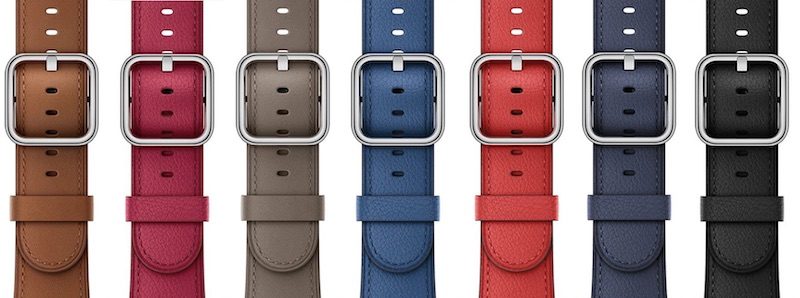
New Sport band colors include Pebble, Azure and Camellia, and the Classic Buckle has gotten a small buckle redesign and now comes in Sapphire, Berry, and Taupe.
Users can also finally buy the Nike Sport Band separately in Anthracite/Black, Pure Platinum/White, and Volt/Black. The company is introducing new collections of Nike Bands as well, including a 38mm and 42mm Space Grey Aluminum Case with Anthracite/Black Sport Band and 38mm and 42mm Silver Aluminum Case with Pure Platinum/White Sport Band.
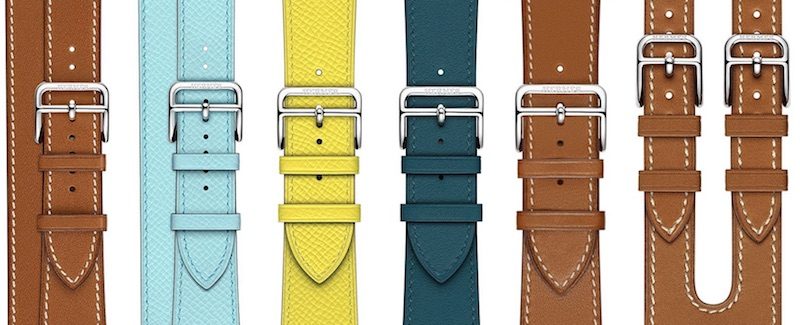
Apple Watch Hermès is gaining new colors: 38mm Double Tour in Bleu Zéphyr Epsom leather, 38mm Double Buckle Cuff in Fauve Barenia leather, 42mm Single Tour in Lime Epsom leather, and 42mm Single Tour in Colvert Swift leather. One new addition to the Hermès collections has been made and it includes the Apple Watch Series 2 with the 38mm Double Buckle Cuff in Fauve Barenia calfskin leather.
For first time Apple Watch owners, Apple has simplified collections down to bundles that only include Sport Bands, Nike Sport Bands, and the Milanese Loop. This means that bundles including Woven Nylon, Link Bracelet, and Classic Buckle options will no longer be offered, and anyone who wants these bands will have to purchase them separately after they have their Apple Watch.
Pricing for all the bands has not changed with today’s announcement: Sport Bands and Woven Nylon cost $49, Classic Buckles cost $149, and the Hermès Bands run for $339 (Single Tour), $489 (Double Tour), and $689 (Double Buckle Cuff). All can be ordered on the Apple Store today.
Related Roundups: Apple Watch Series 2, watchOS 3
Tag: Apple Watch bands
Buyer’s Guide: Apple Watch (Neutral)
Discuss this article in our forums
Apple Launches New Silicone and Leather iPhone 7 Case Colors
Apple this morning made its iPhone 7 silicone and leather cases available in a handful of new colors.
The colors of the new silicone cases (above, left to right) are described as Azure, Camellia, and Pebble, priced at $35 for iPhone 7 models and $39 for iPhone 7 Plus.

Elsewhere, the leather case options have expanded to include shades of Sapphire, Taupe, and Berry, costing $45 for iPhone 7 and $49 for iPhone 7 Plus.
In addition to the iPhone 7 cases, a new iPhone SE leather case in Saddle Brown is available for $39. All of the cases can be ordered on Apple’s online store as of this morning.
Related Roundup: iPhone 7
Discuss this article in our forums
 AIVAnet