


March Madness is back in VR, but it will cost you
Last year, the NCAA streamed the Final Four and championship game in virtual reality for free as March Madness came to a close. For the 2017 tournament that’s already in progress, the college sports governing body is teaming up with Turner Sports and CBS Sports to offer VR streaming of not only those final three games, but of the Sweet 16 and Elite 8 as well. Those two rounds begin this Thursday, March 23rd and run through the weekend.
The live games will be available from the March Madness VR app inside the Oculus store that’s available for download today. Once inside, you’ll need to buy a “premium ticket” to watch the immersive action on the hardwood for $2 or $3 per game. For the cost of admission, you’ll get a virtual courtside seat where you can expect multiple camera angles, sound from inside the arena and dedicated commentary on the pricier Gold level. If you want to pay up all six games for this tier, you can hand over $8 to do just that. At $2 per game, you’ll get access to a single 180-degree camera angle and the regular CBS broadcast commentary from Jim Nantz and crew at the Silver level.
The tech that drives the whole thing is Intel’s True VR, formerly known as the live events-focused virtual reality setup from Voke, a small company that the chipmaker purchased late last year. Intel says that with Voke’s technology it can use VR to offer both live and on-demand games and highlights that will “bring the in-stadium experience to life from any location.” If you’ll recall, Voke powered the March Madness virtual reality streams in 2016. True VR will employ so-called pods that contain a dozen cameras each for the Sweet 16 and Elite 8. The plan for those two rounds is to use up to 48 cameras for the games. For the Final Four and championship game, Intel is bumping that total up to 84.
This is only the beginning of VR events with the NCAA, Intel, Turner and CBS. Part of today’s news is that this year’s March Madness coverage is the start of a multi-year deal between all four with Intel being named the exclusive VR live games partner of the NCAA. Even if you’re not a huge fan of VR, you can still expect to see Intel’s 360 replay tech during broadcasts of the Final Four and championship game on CBS.
Twitter triples suspensions of pro-terrorist accounts in one year
If it wasn’t already clear that Twitter is serious about stamping out pro-terrorist accounts, it is now. The social network has posted its transparency report for the second half of 2016, which reveals that it suspended over 376,000 accounts for backing terrorism. That’s triple the 125,000 it took down one year earlier, and a still-hefty 60 percent more than the 235,000 accounts it pulled in the first half of 2016. While some officials still don’t think Twitter is up to snuff (it’s not proactively reporting extremist material to police, the UK says), there’s no doubt that it’s considerably more aggressive.
This latest report is also Twitter’s first to directly tackle concerns about censoring journalists and media outlets… and there’s one main perpetrator. Out of 88 requests to pull content from verified media sources, 77 of them came from Turkey — a country whose current administration is notorious for trying to crush online dissent. Twitter says it did pull 14 accounts and 15 tweets in response to Turkish requests, but it also filed objections “whenever possible.” As it stands, the country didn’t have any success demanding info. Turkey made 493 requests for account details, but was denied every time.
There aren’t many other big revelations, but Twitter is promising more news on American data requests. The internet giant now has a space in its US report for touching on those national security letters that are no longer covered by gag orders. You aren’t exactly going to see a deluge (just a handful have been disclosed), but this should provide more insight into what law enforcement really wants.
Via: Recode
Source: Twitter
I don’t know how to drive and I may never have to learn
Whenever I’m hanging out with friends from out of state and I pull out my New York state ID, there’s always a bit of confusion: “What is that? Is it like a driver’s license? Is that valid? Can you fly with that? Why don’t you just get a real license?” And I have to give the same list of explanations: It’s just a good as a driver’s license for ID, since I have to provide the same level of documentation to the DMV to get one. I can use it to fly and get into bars. And, well, I don’t have a driver’s license because … I don’t know how to drive. I’ve never needed to. And, as I approach my fourth decade on this earth, I might never need to, because the world is increasingly made for people like me.
Usually the next line I hear is: “I guess it doesn’t really matter because you live in New York.” It is true that the city has some of the best transportation in the world, with a 24-hour subway system that reaches four boroughs, and buses to fill all the gaps in between. And for those times when New York’s MTA can’t quite cut it, there’s a plethora of for-hire cars roaming the streets, which have only gotten easier to hail thanks to apps like Uber, Lyft and Curb. We also have bike sharing now. And Car2Go. And when we can, we walk.

It’s easy to dismiss New York as an exception. Ditto for San Francisco. Except that they’re not. Public-transportation use is up across the United States in cities as disparate as Albany, Minneapolis, Tampa and even Wenatchee, Washington. In 2014, the American Public Transportation Association reported 10.8 billion trips taken — the highest number in 58 years. That number is only set to grow even further as cities gain new residents — eight of the 10 largest gains were cities in Texas like San Antonio and Houston.
However, car culture isn’t going away anytime soon in the US. Though people seem to be buying fewer passenger vehicles and sales might be leveling off, sales of trucks and other more commercial autos are still going strong — probably because these aren’t as easily eschewed or replaced. We’re still big on cars, and government policy isn’t looking likley to change any time soon: The federal budget proposed last week cuts transportation funding 20 percent, putting projects like Seattle’s light-rail extension and San Francisco’s new Transbay crossing at risk.
We may never fully get around to building the infrastructure needed to create a carless or even car-light society. We heavily invested in building out the highway system back in the ’30s at the expense of public transit — you might remember the conspiracy to dismantle L.A.’s streetcar system as a plot point in Who Framed Roger Rabbit? — but it’s something that actually happened to some extent.

The attachment to cars in this country makes sense when you consider that one of the most common jobs in more than 20 states is truck driver; it’s not a career that can be exported to another country like so many manufacturing positions. We’ve come to romanticize the idea of just hopping in our own personal vehicle and going where the highway leads. Final Fantasy XV even based its story around a group of boys on a road trip.
There’s also a certain level of invisibility for car-free people: For starters, they tend to be from a lower income bracket — a study from 2007 shows them averaging $39,000 per year vs. $44,000 for the general population. That difference partially explains why so many struggling millennials have forgone the idea.
Age and income combine to make transit users politically weaker than their car-using counterparts, meaning that politicians tend to be averse to improving our infrastructure: It’s a lot of money spent on something that is unlikely to benefit most of their base. At least until that base gets too old to drive: Senior citizens make up about 2.2 percent of transit users, and with baby boomers reaching retirement age, that number will only grow.

With so many people besides me leaning away from car use, then, how is that car culture adapting? Well, it depends on where you live. For many cities, it’s as simple as adding more service to an existing transit system. Some have taken the step of expanding their train lines, like the Silver Line in D.C., or the Second Avenue Subway in New York. A few towns, like Brunswick in Maine, are experimenting with public transit for the first time. But they aren’t expanding as quickly as demand, mostly because it’s tough to get the budget and contracts in place quickly.
For years public services have been supplemented with things like New York’s dollar vans, where private drivers hustle for fares as part of an informal shadow system. But now the tech sector is stepping in, aiming to disrupt transportation and make a little cash in the process.

In addition to the ride-hailing apps mentioned above, there’s even a service, Skedaddle, that lets you book entire buses. Companies have taken shots at running their own transit lines as well, like Leap and Chariot. These haven’t entirely taken off — partially because they’re being done in cities that already have robust, functional systems the services are competing with (they barely even touch New York because it would fail super-hard). But when they fill a real gap, they can be successful; as much as we love to hate them, the tech buses of Silicon Valley are an example of private industry stepping up where public systems falter.
The transportation revolution is coming as devices too. Last month I previewed a robot intended for carrying cargo, which could help people shop and companies make deliveries, taking vehicles off the road. But perhaps the biggest disruptor is the advent of driverless vehicles. They’re being tested now, with a relatively low rate of accidents (and presumably less as these vehicles increase and can communicate with each other). It’s a scary future if you depend on truck driving for your livelihood. But if you or your loved ones have ever been in a crash, it’s a godsend. And for people like me who don’t know how to drive, it’s a portent that I may never have to.
Check out all of Engadget’s “Adult Week” coverage right here.
Images: Getty (Crosswalk); Getty (Truck); Richard Levine/Getty Images (Subway); Josh Edelson/AFP/Getty Images (Bus)
Apple’s finally taken the wraps off the new ruby red ‘iPhone (RED)’
Why it matters to you
Apple has long contributed to the fight against HIV/AIDS, and the new iPhone (Red) is a continuation of that trend.
Move over, jet black. Red is the iPhone’s hot new color.
On Tuesday, in partnership with nonprofit Product (RED), Apple added a brand-new bright ruby red iPhone model to its roster: The iPhone (RED). Like the company’s (RED) iPod Nano, (RED) Beats headphones, and (RED) Smart Battery cases, the launch is intended to promote Product (RED)’s ongoing effort to combat HIV and AIDS, which remains one of the globe’s worst health problems. More than 35 million people have died of the virus, and 37 million are infected each year, according to Product (RED).
More: Apple iPhone 6 review
As with Apple’s other Product (RED)-branded devices, a portion of every iPhone (RED) sale will be donated to The Global Fund, a charitable organization that finances HIV/AIDS grants to roughly half a dozen countries in sub-Saharan Africa. “This is the biggest day in our 10-year partnership, (RED) CEO Deb Dugan told Mashable. “[We’ve] seen from the time we’ve begun with Apple that more than 18 million people have effective treatment. Having Apple make this very big statement, it takes our breath away.”
It’s another notch in Apple’s belt in its fight against the disease. The iPhone maker has made a tradition of marking World AIDS Day with a campaign to donate to Product (RED), and in 2012, it teamed up with Starbucks to offer a special iTunes eBasket that saw 5 percent of proceeds donated to The Global Fund.
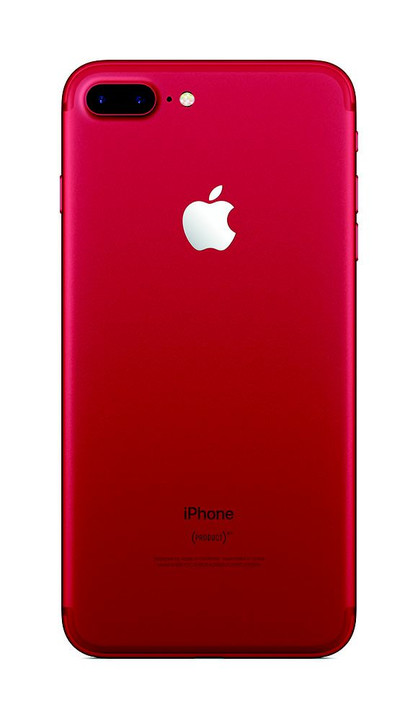
The iPhone 7 and 7 Plus Special Edition (RED) will ship starting Friday. Every model is constructed from brushed aluminum and features a bright red back, white front, and silver Apple logo. The design is the only difference between the Product (RED) phones and the current iPhone 7 and 7 Plus devices — functionally speaking, they’re the same.
More: Apple iPhone 5S review
Here’s how the pricing breaks down:
- iPhone 7 128 GB: $749
- iPhone 7 256 GB: $849
- iPhone 7 Plus 128 GB: $869
- iPhone 7 256 GB: $969
Apple said the percentage of each sale that goes to Product (RED) varies by channel, but historically, the iPhone maker’ has been one of the charity’s biggest contributors. It has donated $130 million to the cause thus far — an amount that’s more than many countries have contributed, according to Dugan.
The new iPhones will become available starting March 24 in Apple’s online and brick-and-mortar stores. Apple will try to inform potential buyers about Product (RED)’s mission through posters, pamphlets, and other promotional materials, Apple VP of Marketing Greg Joswiak told Mashable.
“It’s a nice recognition of our partnership with the (RED) team in fighting HIV and AIDS, Joswiak said.
All hail ‘The iPad,’ Apple’s most affordable full-size tablet yet
Why it matters to you
Apple is introducing a new iPad: The 9.7-inch iPad. At $330, it’s one of Apple’s most affordable tablets yet.
A red iPhone wasn’t the only thing Apple had up its sleeve this week. On Tuesday, the Cupertino, California company announced a new 9.7-inch iPad that’s intended to replace the iPad Air 2, which has been discontinued. It starts at $330.
The new entry-level new iPad, which Apple is simply calling “the iPad,” features the firm’s speedy A9 processor, a Retina (2,048 x 1,536 pixels) display, a battery that lasts about 10 hours on a charge, and virtually the same specifications as the outgoing iPad Air 2. It boasts an 8 MP rear iSight camera, a 1.2 MP front-facing FaceTime camera, two speakers, a Touch ID fingerprint sensor, support for Apple Pay, and accouterments you’d expect — namely, a 3.5mm headphone jack, Wi-Fi 802.11ac, and Bluetooth 4.2.
More: Apple iPad 2017: News and Rumors
“iPad is the world’s most popular tablet. Customers love the large, 9.7-inch display for everything from watching TV and movies to surfing the web, making FaceTime calls, and enjoying photos, and now it is even more affordable,” Philip Schiller, Apple’s senior vice president of Worldwide Marketing, said in a press release. “New customers and anyone looking to upgrade will love this new iPad for use at home, in school, and for work, with its gorgeous Retina display, our powerful A9 chip, and access to the more than 1.3 million apps designed specifically for it.”
The new 9.7-inch iPad will launch on Friday, March 24 in Apple’s online and brick-and-mortar stores. The first batch of launch countries include Australia, Canada, China, France, Germany, Hong Kong, Italy, Japan, Netherlands, Spain, Sweden, Switzerland, and the United Kingdom. The second wave, which includes Denmark, India, Mexico, Norway, Russia, Turkey, and other countries, will follow in April. Finally, Brazil, Taiwan, and others will get it in May.
Compared to the 9.7-inch iPad Pro, the new iPad is a step down in terms of raw processing power. The Pro features a 12 MP camera and a faster chip. But this time around, affordability seems to be the focus, and at $330, the new iPad is significantly less expensive than the $600 9.7-inch iPad Pro.
More: The new iPad models will reportedly debut in March 2017
That could help spur lagging iPad sales. Last fiscal quarter, Apple sold 13.1 million iPads, compared to 16.1 million from the same time last year. The company still dominates the tablet industry with an estimated 21-percent market share, according to Strategy Analytics, but the market overall is on a downswing. A recent report from market research firm IDC showed that table vendors shipped 52.9 million tablets in the fourth quarter of 2016, down 20.1 percent from a year ago.
With any luck, the new iPad will turn things around.
You can say ‘Alexa, order from Prime Now’ for ice cream and other necessities
Why it matters to you
Whether you’re sick, busy, or just not inclined to go out, asking Alexa to order via Prime Now is a great convenience.
Just used the last disposable diaper or cracked the last six-pack of beer? (Well, hopefully not at the same time.) In either case, though, you’ll be pleased to know that on March 21, Amazon added a Prime Now skill so you can get free two-hour delivery of select “daily essential” items with Alexa voice shopping. And in three cities, that includes alcohol.
Ordering via Alexa is now available in the 30-plus Prime Now cities. According to Amazon, tens of thousands of products are available through Prime Now shopping. Alcohol delivery, which also starts on this first day of spring, is limited to Seattle where you can order any type of booze, and Columbus and Cincinnati in Ohio where you’re restricted to ordering beer and wine.
More: Tell Alexa you’re hungry and she can help you order from Grubhub
Alexa Prime Now shopping works with Amazon Echo devices including Tap, Dot, Fire TV, and Tablet. In order to shop with Alexa’s Prime Now skill, you have to be an Amazon Prime subscriber with a default payment method and shipping address. The $99 Prime membership comes with a boatload of other benefits including free two-day shipping on millions of items, free access to Prime videos, music, and more.
When you order with Alexa’s Prime Now shopping skill the syntax is “Alexa, order from Prime Now.” Alexa will recommend a product from those available and if you confirm, will add it to your order. You can include as many items as you wish. When you’re done adding items to your order Alexa sets the 2-hour delivery time.
“Bringing Prime Now to Alexa voice shopping combines two of the most innovative shopping technologies available for an experience that our customers are going to wonder how they ever lived without,” said Assaf Ronen, Amazon’s vice president of voice shopping. “We’re excited to offer the full Prime Now catalog with Alexa, including tens of thousands of items, which allows you to refill everyday essentials you’ve just run out of like diapers or dish soap, or cater to unexpected guests with Merlot and ice cream, all without ever leaving your house or even getting up from the couch.”
Previously you could shop on Amazon with Alexa and use the Alexa Deals skill for daily specials. Prime Now orders with the Alexa voice assistant adds to the service’s menu of shopping aids.
Close to the Metal Ep 35: We’re not over the moon about Mass Effect: Andromeda


There have been a lot of exciting open-world RPGs lately, but unfortunately, neither of the big names have made their way to the PC world. That’s left enthusiasts with a lot of idle hardware on their hands, and we hoped Mass Effect: Andromeda might be just the game to solve that issue.
Those flames have been fanned by extensive teasing and hype-building surrounding the release, as well as some hot new GPUs entering the market around the same time. So we were actually a bit disappointed to find out the game doesn’t actually look all that nice. That’s despite the older, well-optimized Frostbite engine EA has been using for years.
So what’s causing the issues? Part of it has to do with the way the game handles resolution. Users can set their resolution wherever they like, but on medium and low, the game automatically applies render scaling, dropping the actual rendered resolution. The result is a blurry, blocky mess — one that offers a considerable performance boost.
More: ‘Mass Effect: Andromeda’ performance guide
Beyond that, the usual culprits result in the largest performance gains. Dropping ambient occlusion and light quality on their own can raise your framerate, without causing a lot of weird visual artifacts — except the weirdness inherent to this game — although realism suffers as lighting quality drops.
With the game rolling out the very same day we record our weekly computing podcast, Close to the Metal, it’s the perfect time to discuss our results and find out what went wrong.
Close to the Metal is a podcast from Digital Trends that takes a single topic from the computing world and takes a deep dive into it, exploring GPU performance, new software, or a lively discussion about hardware until we’ve covered every corner. Please subscribe, share, and send your questions to podcast@digitaltrends.com. We broadcast the show live on YouTube every Tuesday at 1pm EST/10am PST.
Modders are recreating ‘Red Dead Redemption’ inside ‘Grand Theft Auto V’
Why it matters to you
If you can’t wait for Red Dead Redemption 2, this modding project might be able to occupy some of your time over the summer.
Gamers are hungry for more Red Dead Redemption, as evidenced by the enormous response to last year’s announcement that a sequel was in development. As fans anticipate the follow-up’s debut this fall, a group of dedicated players has set about recreating its predecessor’s map within Grand Theft Auto V.
This ambitious set of modders, helmed by an individual known as Mr. Leisurewear, announced the project over the weekend, according to a report from Gamespot. The Xbox 360 version of Red Dead Redemption is being picked apart and reconstructed for use with third-party multiplayer clients designed for Grand Theft Auto V.
Rockstar makes a lot of money selling in-game currency to GTA Online players, so the project won’t be compatible with the game’s official online offering. The studio takes a stern stance on modifications that could counteract the advantages of buying in-game currency, so the modders are steering clear.
More: Red Dead Redemption 2: Everything we know
It’s not just the Red Dead Redemption map that’s being recreated and inserted into Grand Theft Auto V. The group intends to reconstruct environmental elements like the game’s day-to-night cycle, and there are even plans to reproduce certain gameplay mechanics.
The team is currently looking for programmers who could help with the process of recreating this content within the framework of Grand Theft Auto V. The game’s Dead Eye slow-motion targeting is listed as a top priority, but there’s also a mention of the various mini-games that were peppered throughout Red Dead Redemption, like five-finger filet, arm wrestling, and poker.
It’s anticipated that a beta version of the map will be released some time this summer, although there’s no word whether that will include any of the gameplay mechanics and other content that’s being worked on. In any case, that timing should work out well for players who are eager to get their hands on Red Dead Redemption 2, which is scheduled to release in late 2017.
Google makes searching on Android better with new Shortcuts feature
Google has introduced yet another way to search on Android.
There is no shortage of ways to find things on an Android device. If you’ve bought a phone in the last couple of years, it’s more than likely you have a Google search bar on your main homescreen — Google requires it as part of its certification process — and some phones, including its Nexus and Pixel line, have the Artist Formerly Known As Google Now, now known merely as the Feed, to the left of the main homescreen.

Well, Google still thinks searching for specific topics is too difficult, because it’s introducing a new Shortcuts menu within the Feed that’s meant to simplify the process of getting in-depth information.
Getting up-to-the-minute info is as easy as a single tap. With shortcuts right on the home screen, you now have access to in-depth experiences across sports, eat & drink, entertainment and weather. Need to know whether to bring a raincoat tomorrow? Want the score to last night’s basketball game? Looking for what’s on TV tonight or who’s nominated for best supporting actress? Shortcuts on Google will get you there.
Android users will find dozens of other useful shortcuts too—translate, nearby attractions, flights, hotels, internet speed test, currency converter, and more. Plus, if you’re looking for fun, there are shortcuts like tic-tac-toe, roll a die, animal sounds, solitaire, and always a Google favorite: I’m feeling curious.
What’s interesting about this is that Shortcuts presumably makes it easier to get sports scores, movie times and other pieces of information people often search for. But it’s also putting web apps like Google Translate and Google Trips — experiences that are available as native apps on Android — front and center in the experience.
The feature is rolling out first to Android, iOS and mobile web users U.S., with more countries expected to come in the next few months.
What do you think of Shortcuts? Is it useful, or just another set of icons cluttering up the Feed?
Android Nougat
- Android 7.0 Nougat: Everything you need to know
- Will my phone get Android Nougat?
- Google Pixel + Pixel XL review
- All Android Nougat news
- How to manually update your Nexus or Pixel
- Join the Discussion
You can now buy the HTC Ultra in Canada for a cool grand
The HTC U Ultra has come to Canada at a steep price.
There were a number of beautiful photos of the HTC U Ultra I could have chosen for this post, because the phone is very nicely made. Its reflective glass shimmers in the light in a way that no other does. It’s also $749 USD.

Now, Canadians can get in on the fun, with the U Ultra available unlocked through HTC’s website for a cool grand. That’s $999 CAD.
Available in three choice colors — blue, white, and black — the phone has all the makings of a great flagship, but as Andrew Martonik points out in his review, there just aren’t many reasons to buy one over the many cheaper and better alternatives:
HTC continues to get the basics right with flagships. The U Ultra has a great screen, amazing build quality and stunning design. You get just about every spec inside you’d expect, and the day-to-day performance as a result is fantastic with a super-smooth software experience. Unfortunately, HTC’s camera performance once again lags behind the pack, its secondary display is all but useless and there’s no headphone jack or waterproofing — all in a phone that’s charging a premium price of $999 CAD.

If you can get over those things, the HTC U Ultra is still a great device with some awesome HTC-built software.
See at HTC
 AIVAnet